
स्वामीनारायण मंदिर
झाडेश्वर-भरूच, ता./जि. भरुच
Swaminarayan Temple
Zadeshwar-Bharuch, Tal./Dist. Bharuch
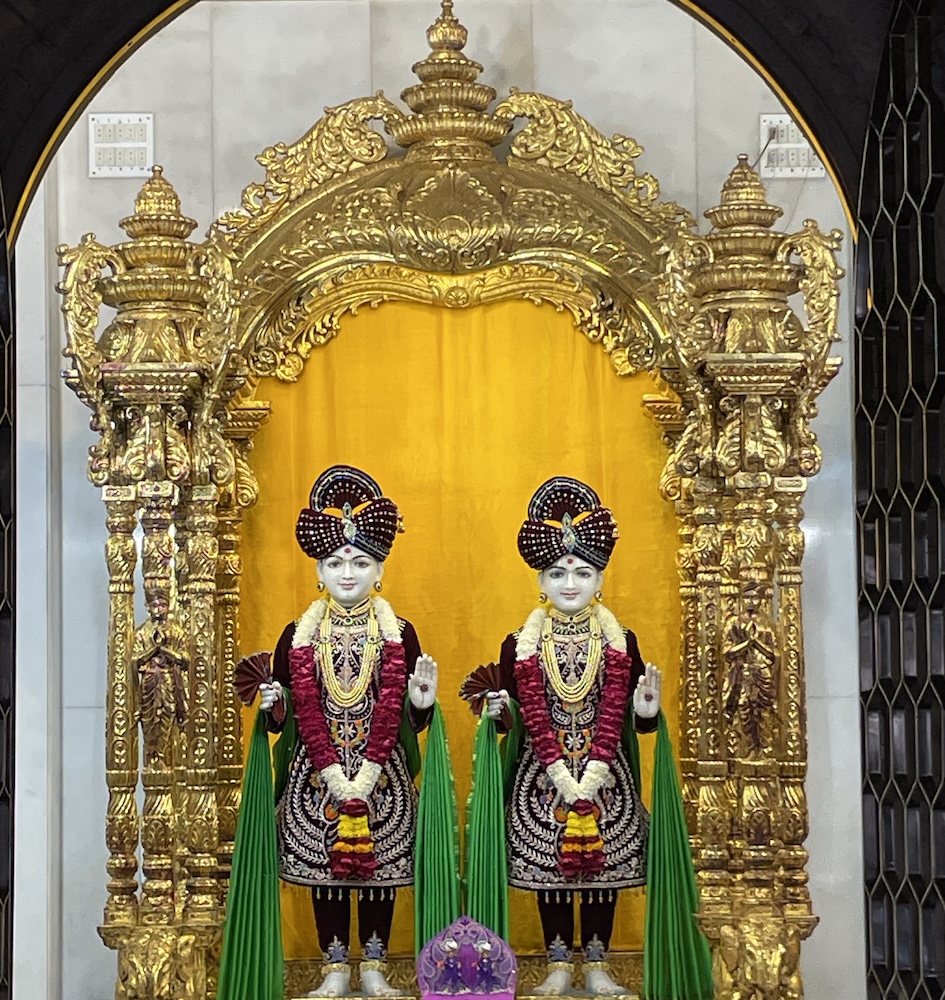 The Swaminarayan temples, established across the globe by the ‘Bochasanwasi Akshar Purushottam Swaminarayan Sanstha’ (BAPS), are considered a sublime confluence of architectural brilliance, aesthetic beauty and spiritual depth. The founder of this sect was Neelkanth Varni, also known as Swami Sahajanand, who is revered as Swaminarayan – an incarnation of Lord Krishna. These temples, identified by his name, serve as sanctuaries of faith for millions of devotees. The temple at Zadeshwar, sprawling across an eighteen-acre expanse, is one such eminent shrine.
The history of this sect reveals that the founder, Swami Sahajanand, was originally named Ghanshyam Pande. He was born in 1781 in the village of Chhapaiya near Ayodhya in Uttar Pradesh. At the tender age of twelve, he renounced his hearth and home. There followed seven years of travel across the length and breadth of India and rigorous penance in the Himalayas, during which period he was known as Neelkanth Varni. In 1800, after receiving initiation from Swami Muktanand at Mangrol in Saurashtra and subsequently from Guru Ramanand at Piplana, 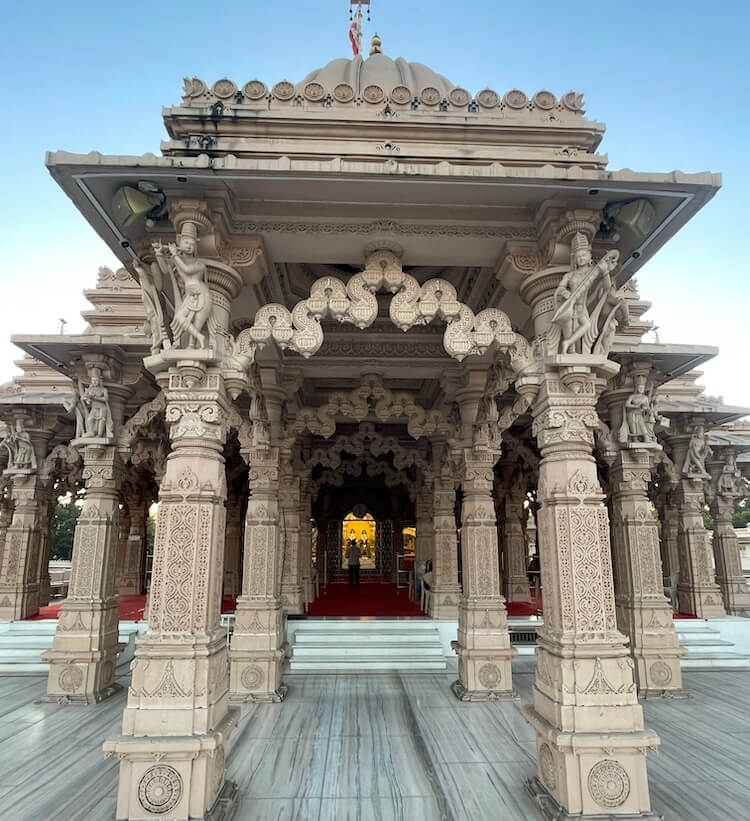 he chose Gujarat as the primary sphere for his religious and social reform activities. Drawing upon the philosophies of Ramanujacharya’s ‘Vishishtadvaita’ (qualified non-dualism) and Vallabhacharya’s ‘Shuddhadvaita’ (pure non-dualism), he propagated a harmonious and inclusive faith.
It was Ramanand who bestowed the name Sahajanand upon Neelkanth Varni. In 1801, Sahajanand became the head of the Ramanandi sect. His primary teaching was that Swami Narayan is none other than Lord Shri Krishna and that humanity should seek refuge in Him. Devotees firmly believe that Sahajanand alias Neelkanth Varni, is indeed Swami Narayan – the Supreme Divine incarnation. It is recounted that in November 1820, Sahajanand himself explained to Gopalanand Swami the six reasons for his incarnation. Following the demise of Sahajanand or Swami Narayan, in 1830, the stewardship of the sect was assumed by Gunatitanand Swami. Later, in 1905, Shastri Yagnapurushdas, known as Shastri Maharaj, established the ‘Bochasanwasi Akshar Purushottam Swaminarayan Sanstha’ (BAPS) within the broader Swaminarayan tradition.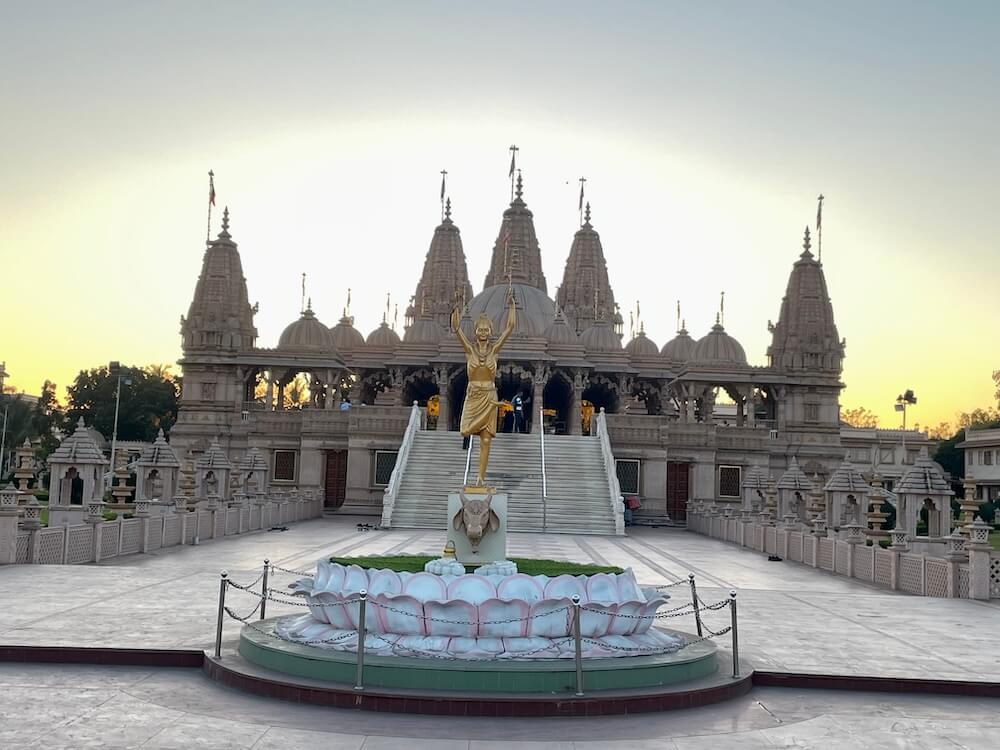
Under the leadership of Pramukh Swami, who held the presidency of the organisation, BAPS witnessed a massive global expansion after 1971. Today, there are two magnificent Swaminarayan Akshardham temples worldwide, with the Akshardham in New Delhi regarded as one of the largest temple complexes in the world. Nestled across 100 acres on the banks of the Yamuna, this temple has been recorded in the Guinness Book of World Records. Furthermore, BAPS maintains 150 Shikharbaddha (pinnacled) temples and over 1,700 shrines globally. The majority of these temples were constructed under the direct guidance of Pramukh Swami.
The history of the Zadeshwar shrine is particularly noteworthy. Bhagwan Swaminarayan, the founder of the sect, stayed in Bharuch for two days in 1789. 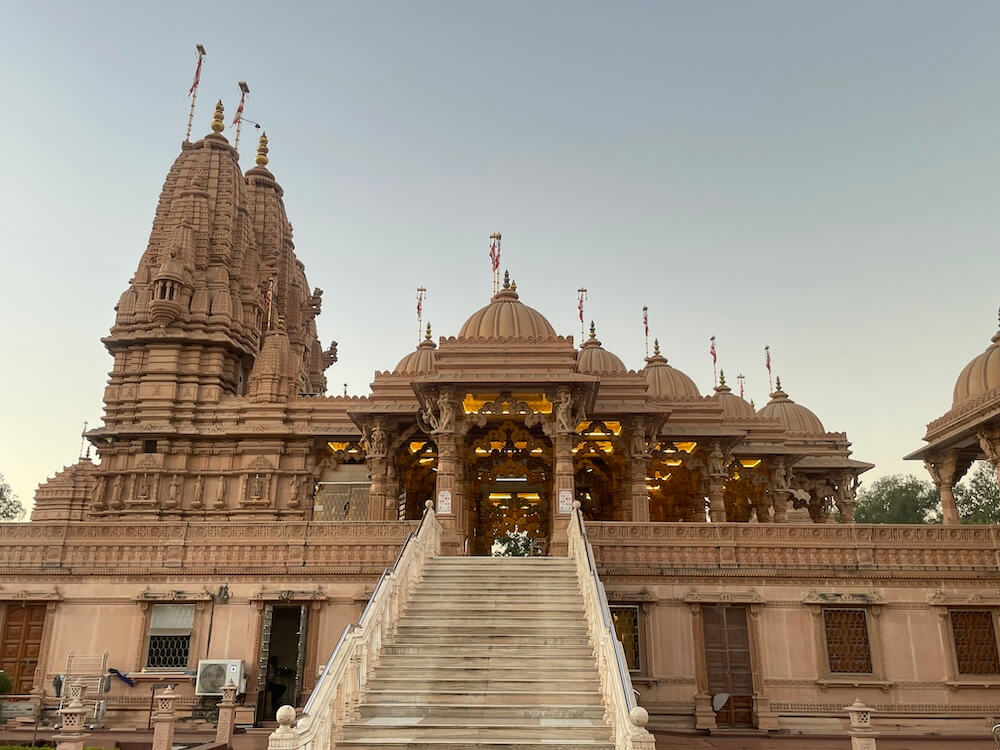 Brahmaswarup Shastriji Maharaj too visited Zadeshwar near Bharuch on several occasions to deliver discourses. After him, Yogiji Maharaj accelerated the Satsang (spiritual assembly) activities in this region. Between 12 and 16 February 1968, a scriptural reading programme was held in the presence of Yogiji Maharaj, during which he resolved to establish a temple in the Bharuch area. In 1975, on the day of Margashirsha Shuddha Dashami, Pramukh Swami performed the Pran-Pratishtha (consecration ceremony) of idols in a Hari Mandir in Bharuch. As the number of followers attending the Satsang grew over time, the need for a larger pinnacled temple became evident. A devotee of the sect, Motibhai M. Patel, donated eighteen acres of his land at Zadeshwar near Bharuch, situated on National Highway 48, to BAPS for this purpose.
  Subsequently, on 13 January 1998, the foundation stone was laid in the presence of Pramukh Swami. The construction of this temple, fashioned from pink sandstone, was completed in approximately four years. On 8 December 2001, the idols were ritualistically consecrated within the temple.
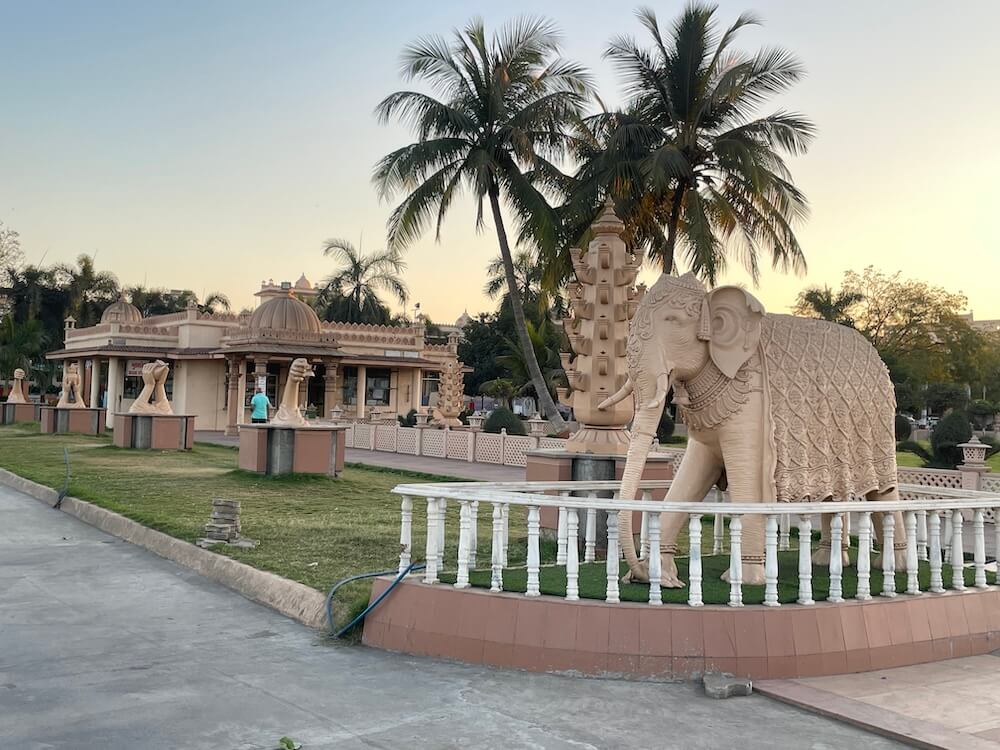
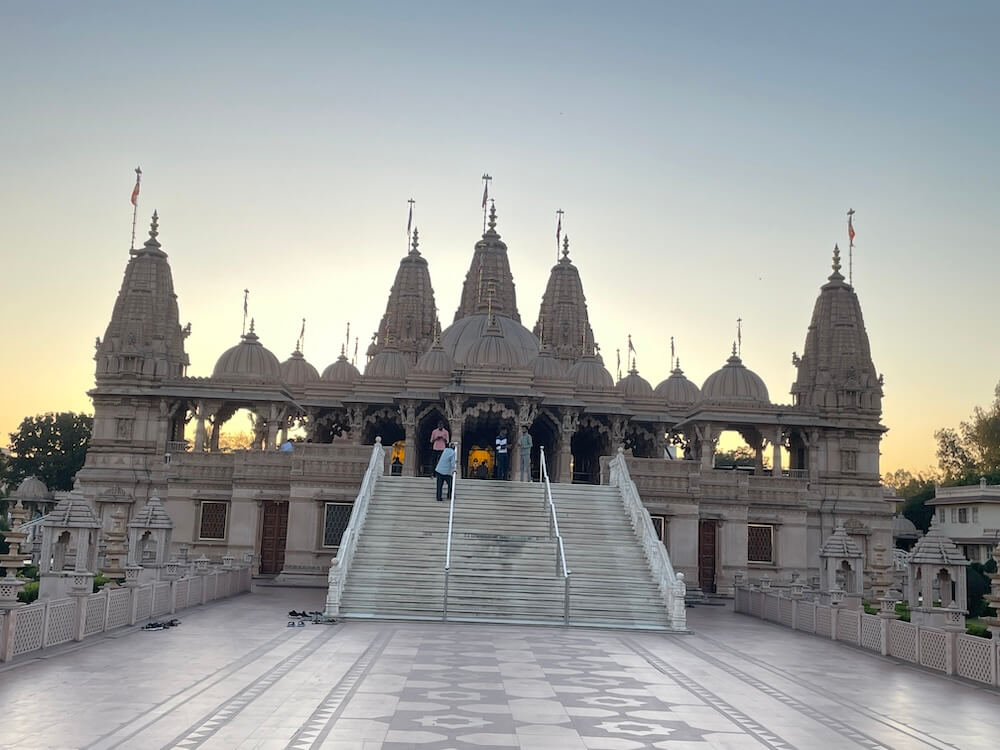
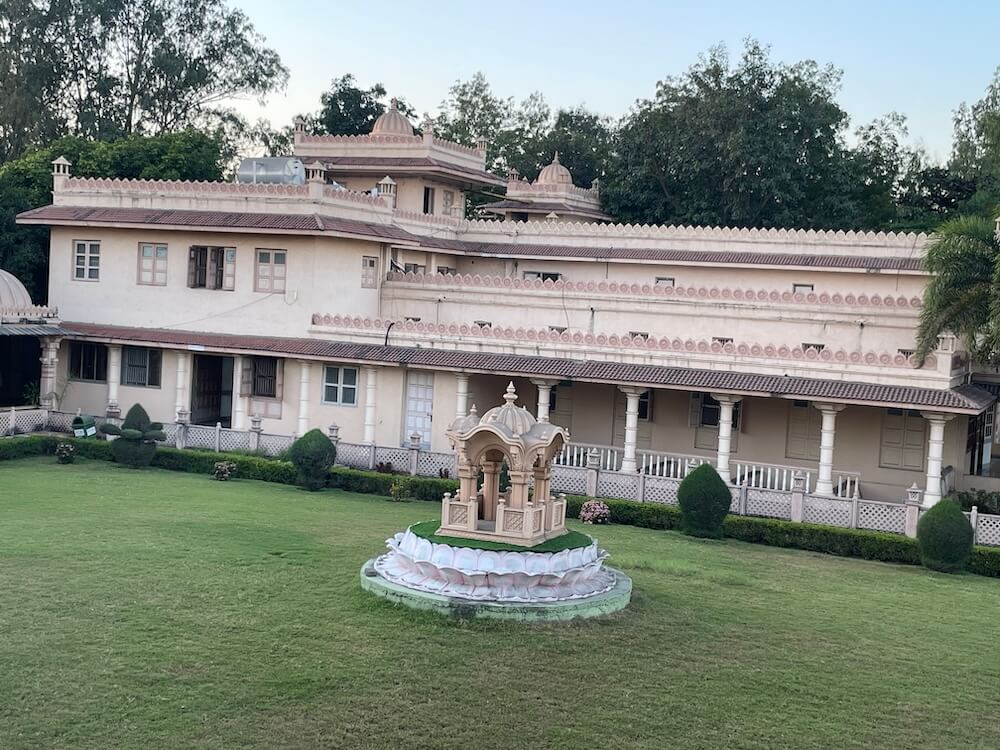
This temple, set within vast grounds, is protected by a large compound wall and features three entrances. Upon entering the grand premises, one is greeted by a golden idol of Neelkanth Varni, positioned on a pedestal atop a large lotus-shaped structure. This pedestal features a Nandimukha (the face of the bull Nandi), near which lie the Danda (staff) and Kamandalu (water pot) of Neelkanth Varni. At a short distance, sculptures of elephants grace the area. 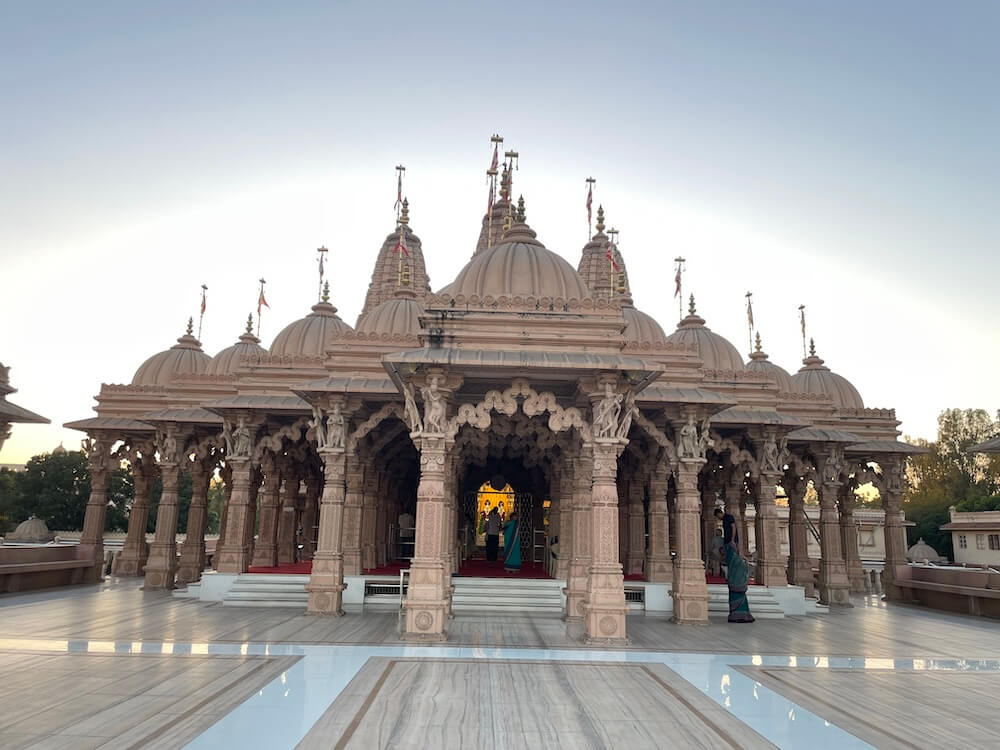 The gardens are adorned with sculptures of various Hastamudras (hand gestures) holding auspicious symbols such as the bell, conch and Kalash (sacred vessel). The path leading to the temple steps is flanked by lush lawns on both sides, punctuated by several Meghadambaris (ornate canopies), Samais (traditional lamps) and Deepstambhs (pillars of light).
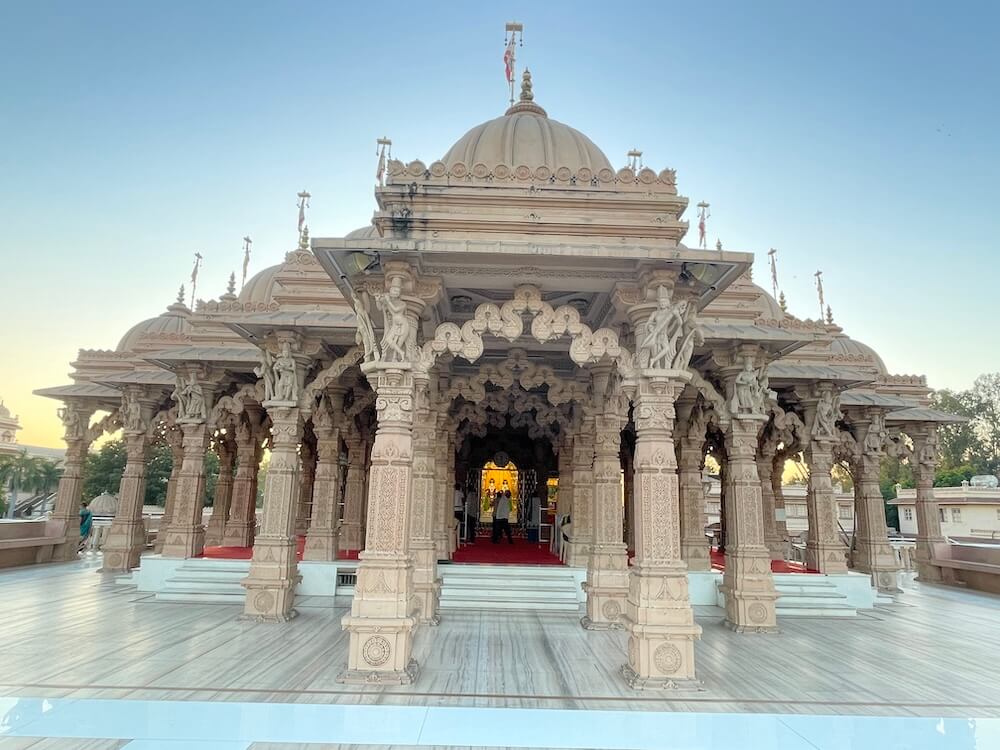
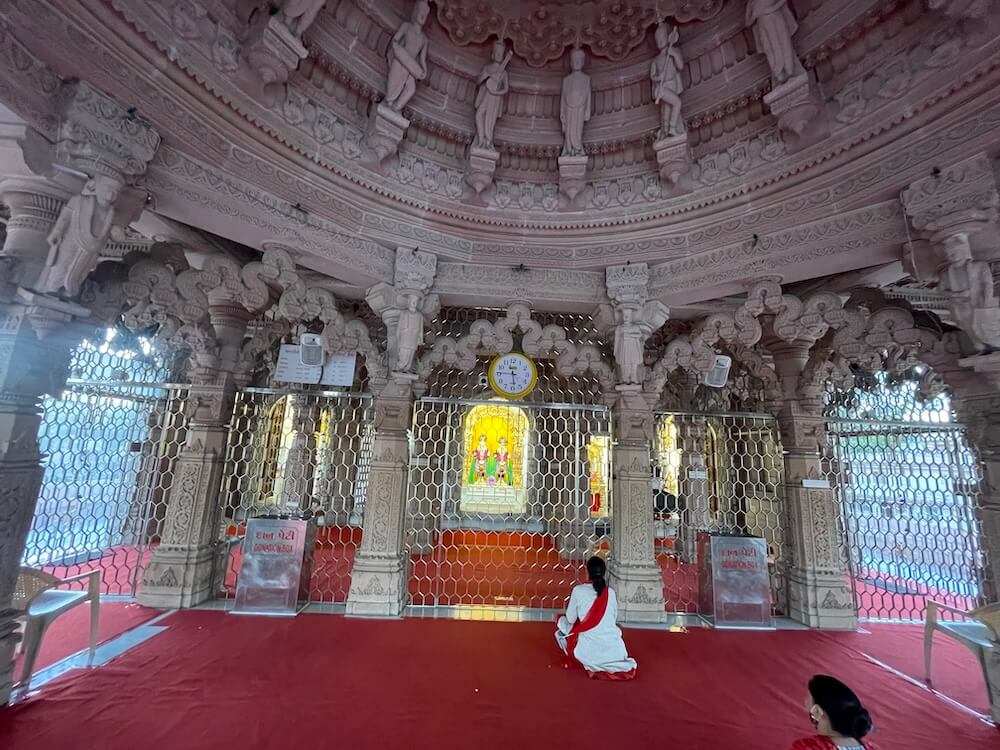
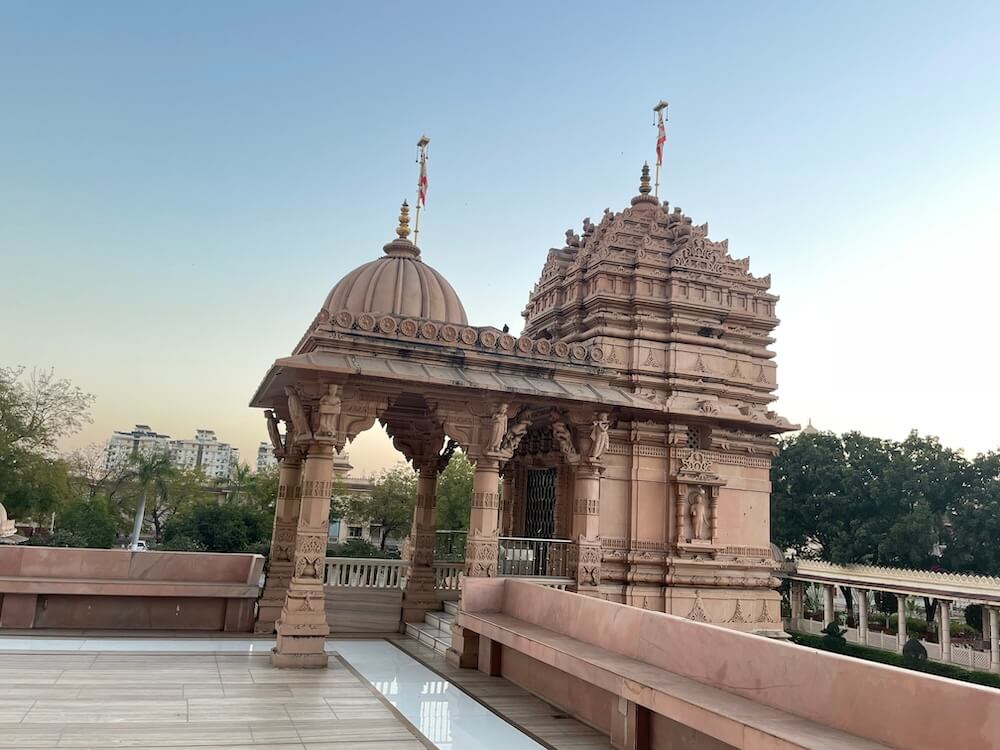
All Swaminarayan temples, whether in India or abroad, share a specific and consistent architectural style and this temple is no exception. This two-storeyed structure reaches a height of 75 feet and spans a width of 193 feet. It features five tall spires – three main and two subsidiary – whilst the Mukhamandap (entrance porch) and Sabhamandap (assembly hall) are topped by approximately twelve large and small domed spires. The temple is further embellished with intricately carved pillars, arches, ‘Makartoranas’ and sculptures of Sursundaris (celestial beauties).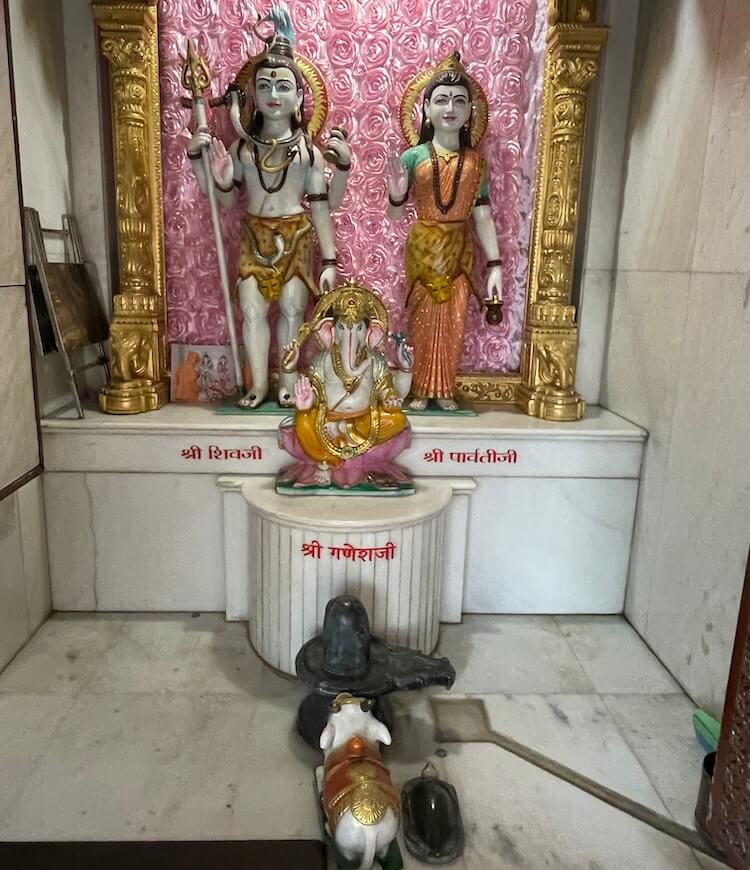
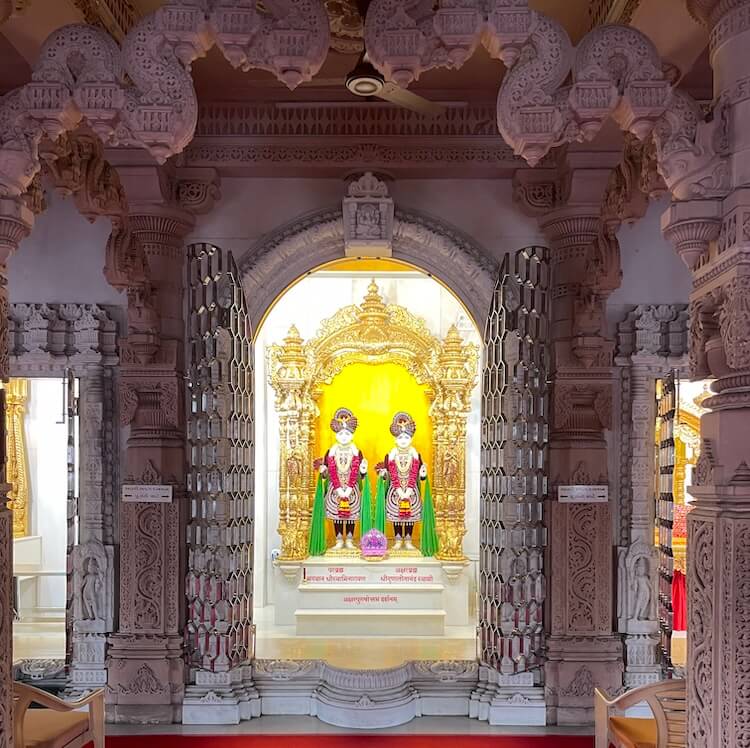
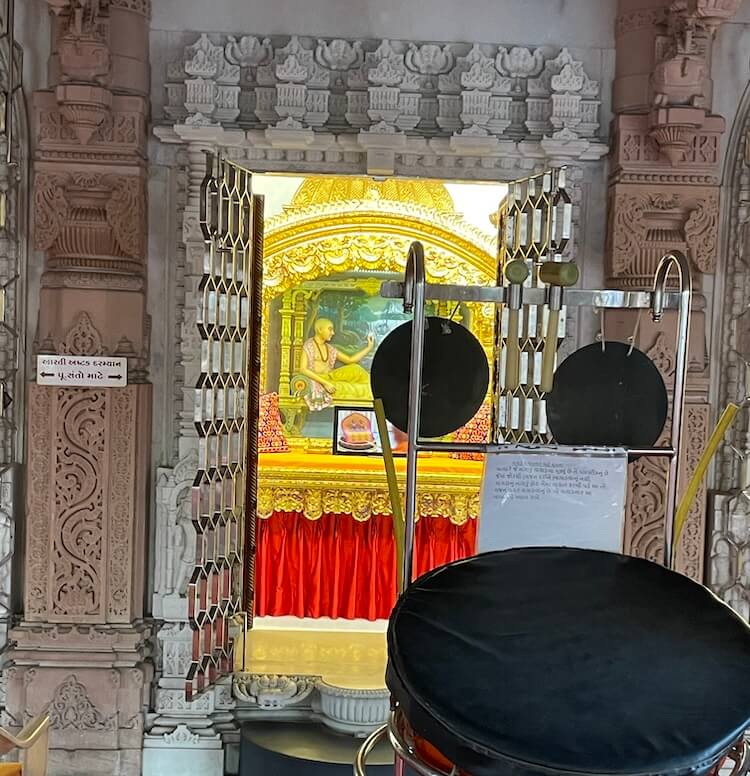
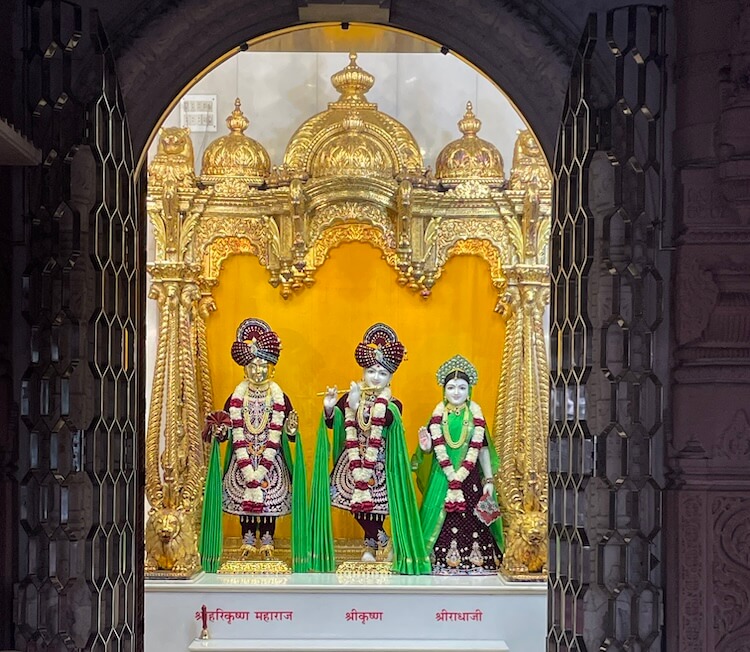
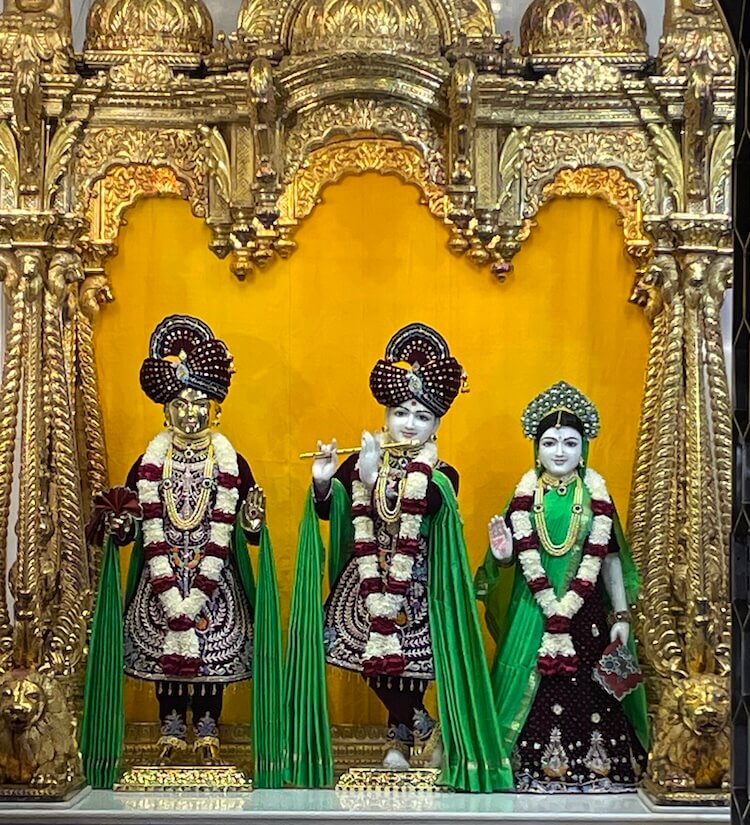
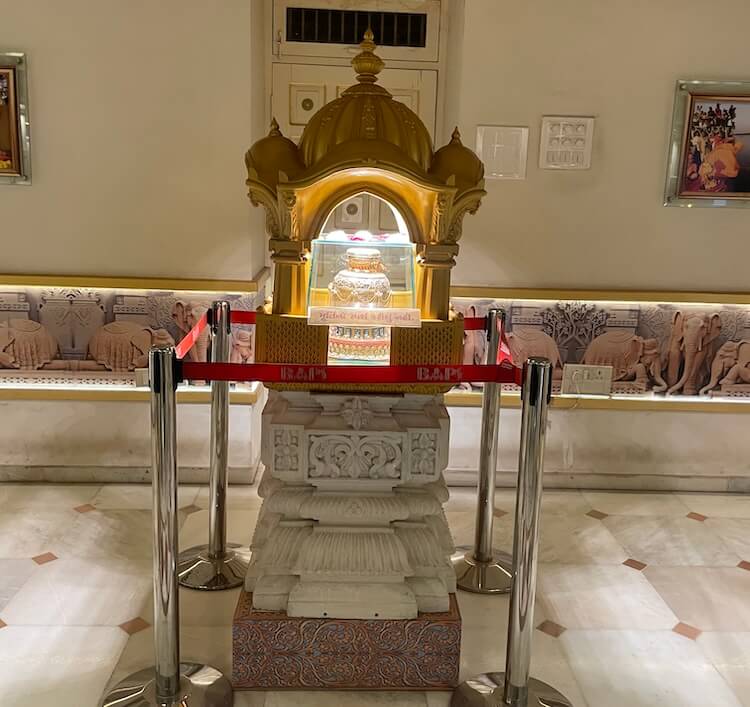
Entrance to the main temple courtyard is gained by ascending twenty-five steps. To the left, a small shrine contains a standing idol of Shiva-Parvati within an ornate canopy. Facing it, on a pedestal, is an idol of Ganesha, preceded by a Shivpindi, Nandi and a tortoise figure. To the right in the courtyard, another small shrine houses marble idols of Shri Ram-Sita and Hanuman within a golden canopy atop a marble pedestal. From the Mukhamandap, one ascends four steps to enter the Sabhamandap. The capitals of the pillars in the assembly hall feature idols of the heads of the Swaminarayan sect, while the circular ceiling is adorned with figures of various divine servants. The entrances to the Garbhagrihas (sanctum sanctorums) and the canopies upon the internal marble pedestals are decorated with exquisite carvings. The main sanctum enshrines the idols of Swaminarayan and Gunatitanand Swami within a golden canopy on a marble pedestal. The sanctum to the left houses Harikrishna Maharaj along with Krishna and Radha, while the one to the right contains an idol of Ghanshyam Maharaj. Additionally, portraits of Swaminarayan and his disciples are placed within these sanctums.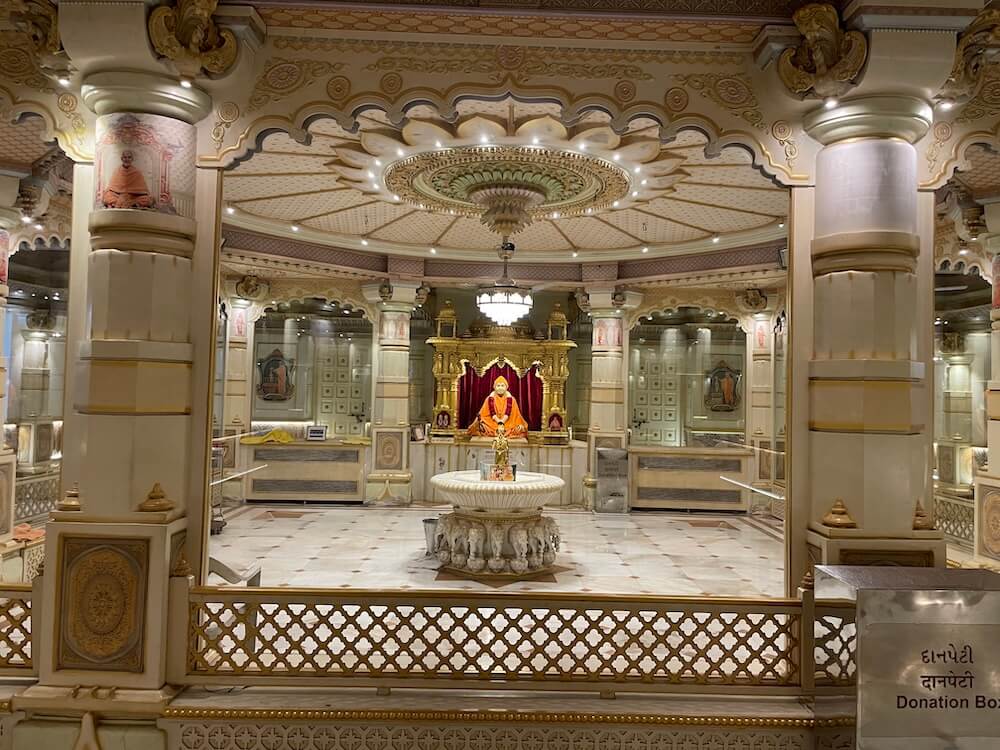
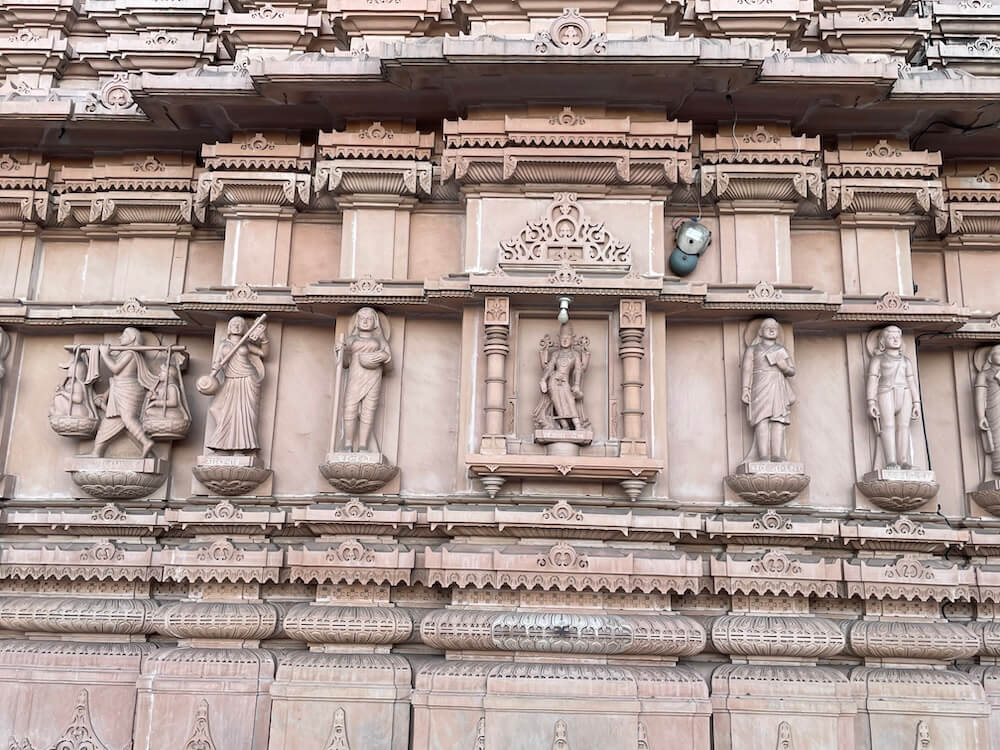
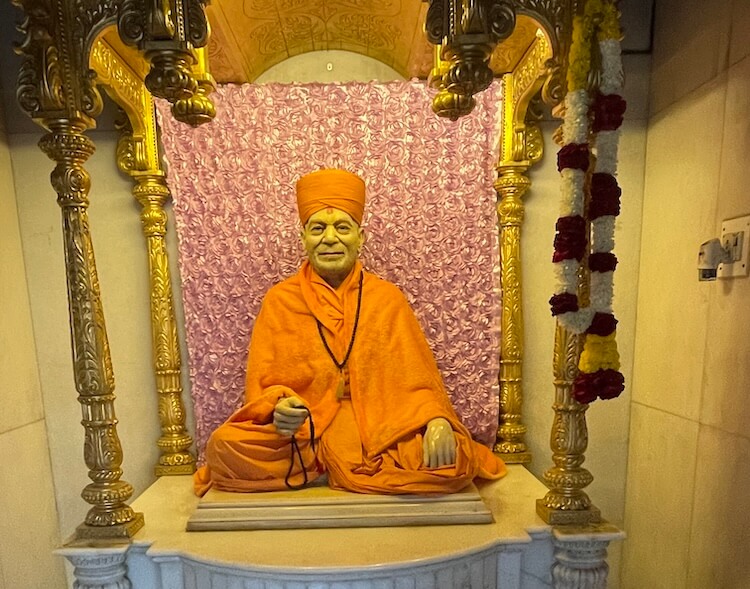
The exterior walls of the Garbhagrihas are adorned with beautiful sculptures depicting various deities, the Dashavatara (ten incarnations of Vishnu) and renowned saints. At the rear corners of the main structure are two smaller shrines, each comprising a Mukhamandap and a sanctum, housing idols of Shastriji Maharaj and Yogiji Maharaj. On the ground floor of the temple lies the ‘Neelkanth Varni Abhishek Mandap’, where a golden idol of Neelkanth Varni stands upon a marble pedestal. Devotees perform Jalabhishek (ritual bathing with water) on this idol using small vessels provided nearby. Idols of Pramukh Swami and other luminaries of the Swaminarayan tradition are also situated here.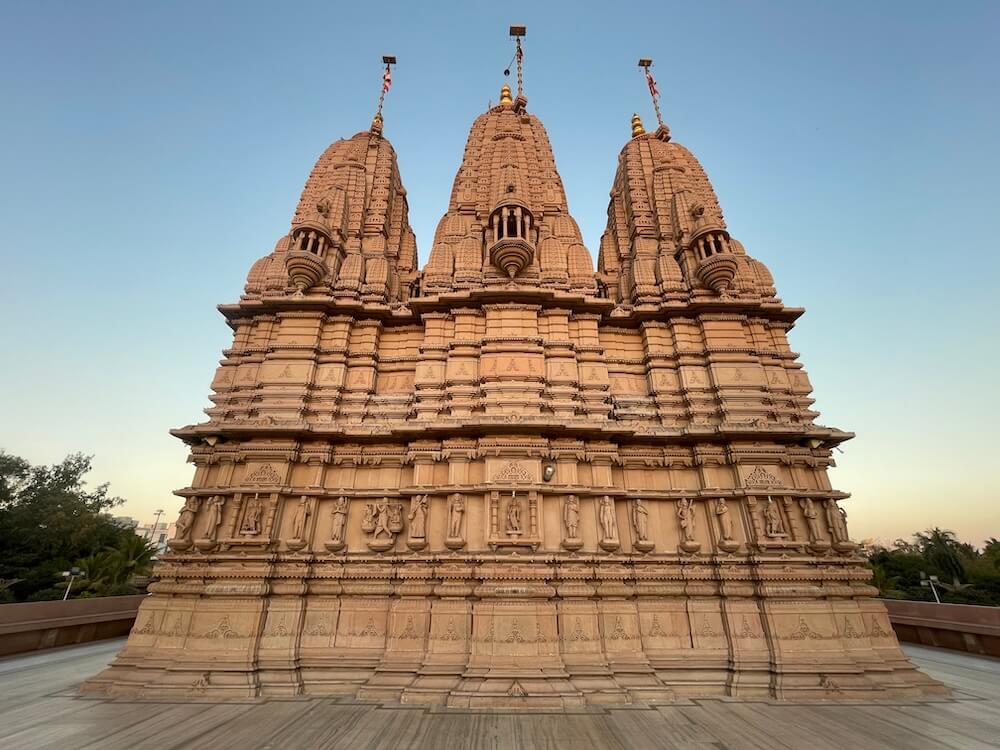
Devotees may visit the temple for Darshan between 7:30 am and 8:30 pm. The temple remains closed for brief intervals during Aarti (the ceremony of light) and Bhog (food offerings). The daily schedule includes Mangala Aarti at 6:00 am, Shringar Aarti at 7:30 am, Rajbhog at 11:15 am, Sandhya Aarti at 7:00 pm and Shayan Aarti at 8:15 pm. Every Sunday from 5:00 pm to 7:00 pm, various assemblies such as the Bal Sabha, Balika Sabha, Kishore Sabha and Satsang Sabha are conducted.
Within the temple premises, the Neelkanth Bhavan provides accommodation for devotees, offering both air-conditioned and non-air-conditioned rooms. The ‘Premvati’ cafeteria serves pure vegetarian meals and snacks. A bookshop on the grounds offers literature related to the Swaminarayan sect, ritual items and Ayurvedic medicines.
Main Features :
- 6 km away from Bharuch
- ST (State Transport) bus facility available from Bharuch
- Private vehicles can reach up to the temple parking
- Accommodation and breakfast facilities are available in the vicinity
- Contact : Temple Office, Mo. : +91 9998991200
स्वामीनारायण मंदिर
ज़ादेश्वर-भरूच, ताल./जिला. भरूच
मंदिरे
Temples
मंदिर
-
कोटेश्वर महादेव मंदिर कदोद, ता. भरुच, जि. भरुच
अधिक माहितीKoteshwar Mahadev Temple Kadod, Tal. Bharuch, Dist. Bharuch
View Detailsकोटेश्वर महादेव मंदिर कडोद, ताल. भरूच, जिला. भरूच
विवरण देखें -
धर्मेश्वर महादेव मंदिर धर्मशाळा-झानोर, ता. भरुच, जि. भरुच
अधिक माहितीDharmeshwar Mahadev Temple Dharmashala-Jhanor, Tal. Bharuch, Dist. Bharuch
View Detailsधर्मेश्वर महादेव मंदिर धर्मशाला-झानोर, ताल. भरूच, जिला. भरूच
विवरण देखें -
साईबाबा मंदिर रामवाटिका सोसायटी, झाडेश्वर, ता./जि. भरुच
अधिक माहितीSai Baba Temple Ramvatika Society, Zadeshwar, Tal./Dist. Bharuch
View Detailsसाईं बाबा मंदिर रामवाटिका सोसायटी, जादेश्वर, ताल./जिला. भरूच
विवरण देखें