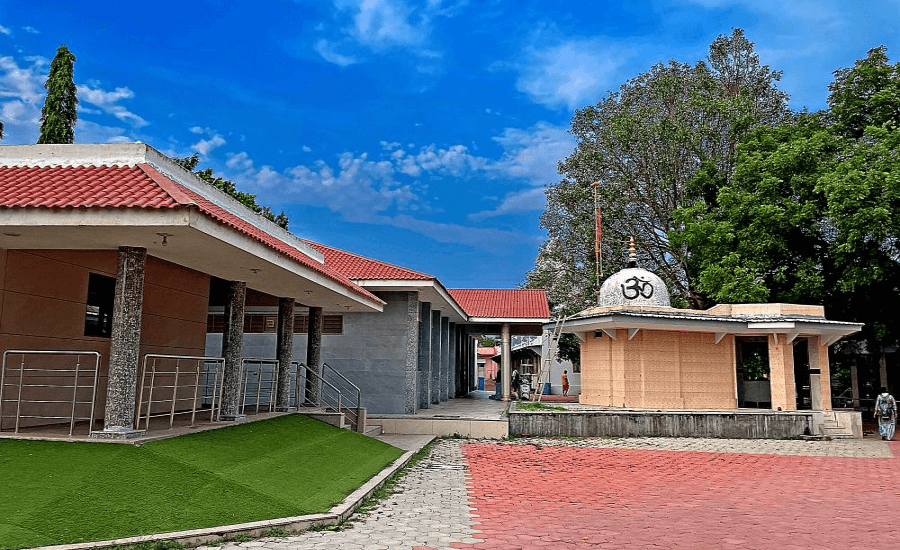
 The Rang Avadhoot Maharaj Temple, located in the sacred land of Nareshwar along the banks of the Narmada River, is an important pilgrimage site for followers of the Dattatreya tradition. Known for teachings like ‘‘Parasparo Devo Bhava’’ (see divinity in one another) and ‘‘Mata Mataiv Kevalam’’ (there is none like a mother). Rang Avadhoot Maharaj was a revered saint in the Dattatreya sect. His samadhi (final resting place) is in Nareshwar, also known as ‘Matrutirth’ (the Mother’s pilgrimage site). Pilgrims from around the world visit this temple for blessings and spiritual peace.
Rang Avadhoot Maharaj was a poet-saint who authored many spiritual works. Before embracing the life of a renunciant, he was active in India’s independence movement led by Mahatma Gandhi. He also worked with Gandhi’s ‘Navajivan Trust’ and played a significant role in spreading the Dattatreya tradition across Gujarat, where he was worshipped as an incarnation of Dattatreya by his devotees.
Born as Pandurang Vitthalpant Valame on 21 November 1898 in Godhra, Gujarat, his parents originally hailed from the Devale village in the Sangameshwar taluka of Ratnagiri, Maharashtra. His family served as priests at the Vitthal Temple in Godhra. At the age of eight, while visiting Narasimhawadi with his family, he encountered the saint Vasudevanand Saraswati (Tembe Swami) and received spiritual initiation (diksha) from him.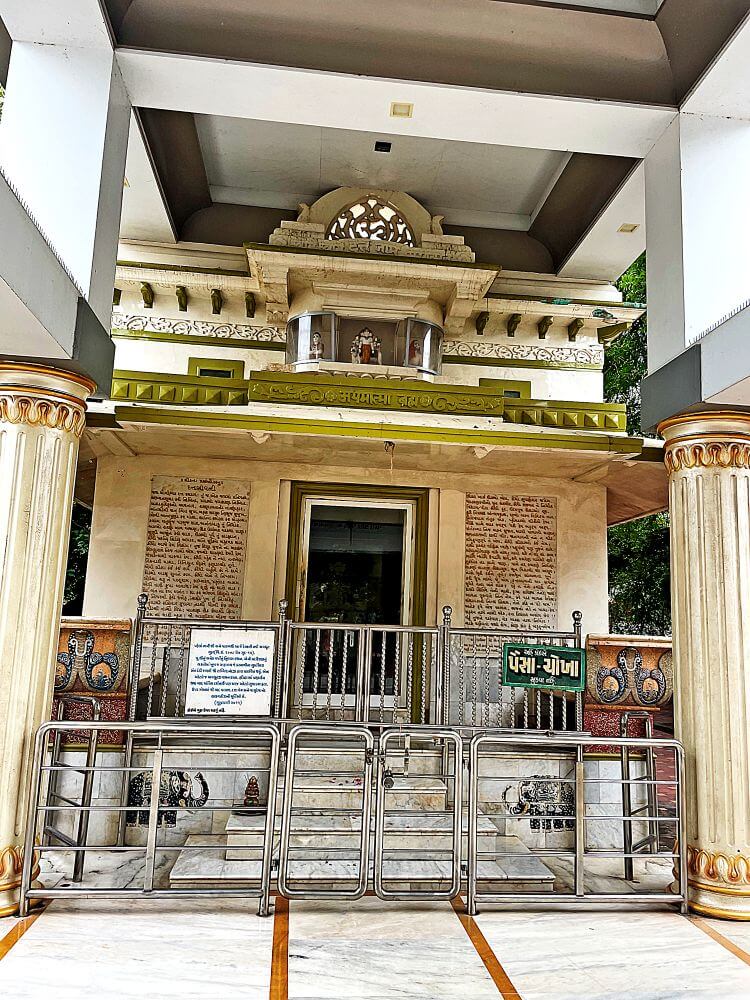
Rang Avadhoot Maharaj passed the matriculation exam and enrolled in a college in Baroda (now Vadodara). However, inspired by the nationalist fervor of Mahatma Gandhi’s ‘Non-Cooperation Movement’, he left his studies and joined the freedom struggle. He later completed his education at Gujarat Vidyapith, a university established by Gandhi, and worked for a while at the ‘Navajivan Trust’. After some time, he also taught Sanskrit at the Vinaymandir School in Ahmedabad. However, his inclination toward spirituality remained strong, and in 1923, after receiving his mother’s blessing, he embraced a life of renunciation.
In 1925, Rang Avadhoot Maharaj arrived at Nareshwar and chose it as his spiritual abode. Legend has it that upon his arrival, he witnessed a peacock and a snake playing together, symbolizing the harmony of this sacred land. Convinced of the spiritual significance of the place, he built a hut there and began his meditative life. The memory of this event is preserved today at the entrance of the Rang Mandir. The gateway is designed in the shape of a peacock’s fanned tail, with snake carvings on the two pillars flanking it. It was at this very location that Rang Avadhoot Maharaj established the Narmada Mata Temple. Today, the expansive Rang Avadhoot Temple and Ashram stand on this very site, attracting thousands of devotees.
 The temple complex has a grand entrance marked by four large pillars supporting a semicircular arch. On the front side of the arch is a statue of Lord Dattatreya, and on the inner side is a statue of Rang Avadhoot Maharaj. Carvings of ‘damaru’ (a small drum), trident, conch shell, and ‘Om’ adorn the arch.
Here stands the grand Samadhi temple of Rang Avadhoot Maharaj, constructed entirely in marble. The temple features a rectangular open assembly hall (Sabhamandap), with a flat roof supported by numerous circular pillars. Inside the sanctum (Garbha Griha), a seated statue of Rang Avadhoot Maharaj is enshrined on a tall, square pedestal. Right in front of the sanctum, at one end of the Sabhamandap, there is a memorial dedicated to his mother, Rukmamba. Her marble statue is installed beneath a golden canopy on a high platform. Interestingly, this statue was established while Rukmamba was still alive. Rang Avadhoot Maharaj was extremely devoted to his mother, referring to her as his ‘‘Supreme Court.’’ After the death of his brother, his mother came to live at this sacred site permanently.
Rang Avadhoot Maharaj passed away on 19th November 1968 while in Haridwar. His mortal remains were flown to Ahmedabad by a special flight and then brought to Nareshwar. His final rites were performed on 21st November, and his Samadhi (memorial) was built at the same spot where the cremation took place. Maharaj had expressed a desire for his Samadhi to be placed near his mother’s memorial.
Next to the Samadhi temple stands a 200-300-year-old neem tree, which is now dry but was once large and flourishing. Rang Avadhoot Maharaj used to sit under this tree, giving discourses and conversing with his devotees. There is also a small memorial at this spot, and a legend associated with it claims that due to Maharaj’s sweet words, the bitterness of the neem tree’s leaves gradually faded.
Close to the Samadhi is “Matrutirtha,” the memorial for Maharaj’s mother, Rukmamba. Beneath a large tree, there is a replica of a rocky mountain (rock monument) called “Matrushail,” where a marble shrine with a statue of Rukmamba is enshrined on a pillar. Rukmamba passed away in 1967, and her last rites were performed here.  Following her passing, one lakh recitations of the “Shri Suktam” hymn were completed before the memorial was established.
Within the temple complex, there is a marble shrine of Nareshwar Mahadev (Shiva). Inside the sanctum, a large Shivalinga (representation of Lord Shiva) is placed on a tall, circular base. The base is adorned with trident-shaped carvings, and the cylindrical Shivalinga has the sacred “Omkar” symbol engraved on it. A metal snake figurine is also placed on the Linga. Right in front of this temple once stood Rang Avadhoot Maharaj’s hut, where he lived. Today, a small temple has been built at this location, with a statue of Rang Avadhoot. The temple complex also houses shrines dedicated to Dattavatari Swami Samarth and Dattaguru. Additionally, the Samadhi of Maharaj’s beloved dog, Buchiya, is located here. Various personal items used by Maharaj are preserved within the ashram premises.
Rang Avadhoot Maharaj’s birth anniversary is celebrated with great enthusiasm on 21st November, known as “Rang Jayanti.” The tradition of celebrating this event started during his lifetime, with his mother’s permission. Other festivals celebrated at the temple include Datta Jayanti, Hanuman Jayanti, Buddha Purnima, Guru Purnima, Tripur Utsav during Kartik Purnima, and Holi. Many devotees believe in the continued presence of Maharaj’s miracles, which draws large crowds to the temple for his darshan (viewing). The temple trust also conducts various religious activities such as homas (fire rituals), yagnas (sacrificial rituals), and offers food donations. A special Yagnashala (sacrificial fire hall) has been built for these ceremonies. Devotees can visit the temple for darshan from early morning until night, except between 12:00 PM and 2:30 PM.
During his time at Nareshwar Dham, Rang Avadhoot Maharaj authored several books and devotional songs. Some of his most popular works include Datt Bavani, Rang Hridayam, Sangeet Geeta, Atmachintan, Shri Datt Panchpadi, and Nareshwar Mahatmya.