 When one thinks of a temple, the image of idols naturally comes to mind. Yet, in Indore, there stands a Radha-Krishna temple where no idol of Radha and Krishna is enshrined. Much like the reverence of Guru Granth Sahib in a gurdwara, this temple worships the sacred scriptures of its sect. This is the Radha-Krishna Pranami Dham of the Pranami tradition, a Hindu sect grounded on the principles of monotheism, equality and religious tolerance. The temple holds nearly a century of history and remains the chief spiritual center for Pranami followers in and around Indore.
The Pranami Sampradaya is also known as the Nijananda sect. It was founded by Swami Devchandra, who was born in Umerkot in the Sindh province on October 11, 1581. Followers of this sect would greet each other with respectful salutations, or ‘pranam’ and thus they came to be known as Pranamis. The sect expanded greatly under the guidance of Mahamati Prannath, originally named Mehraj Thakur, who was born on October 7, 1618, in Jamnagar, Gujarat. His father, Keshav Thakur, served as a chief minister in the Jamnagar state. At the age of 12 years, 2 months and 10 days, Mehraj Thakur met Swami Devchandra, who initiated him with the sacred Nijanam Taratam mantra.
 Accepting the resolve of ‘Sukh Sheetal Karun Sansar’ (to bring peace and coolness to the world) Prannath established the ‘Sundarsath Sangh’. Followers of the sect became known as ‘Sundarsath’. After the passing of Devchandra, his son Bihari succeeded as the sect’s leader. Bihari, however, was known for his stern and arbitrary ways, which led to differences with Prannath. Ultimately, devotees urged Prannath to establish a separate seat. Accordingly, in 1672, on the banks of the Tapti River at Surat, at Panchmahamangalpuri Dham, Prannath raised the banner of faith and established an independent spiritual seat. He resided there for seventeen months, receiving the title of ‘Mahamati’ and the name Prannath. Alongside this sacred place, Jamnagar’s Navtanpuri Dham and Panna’s
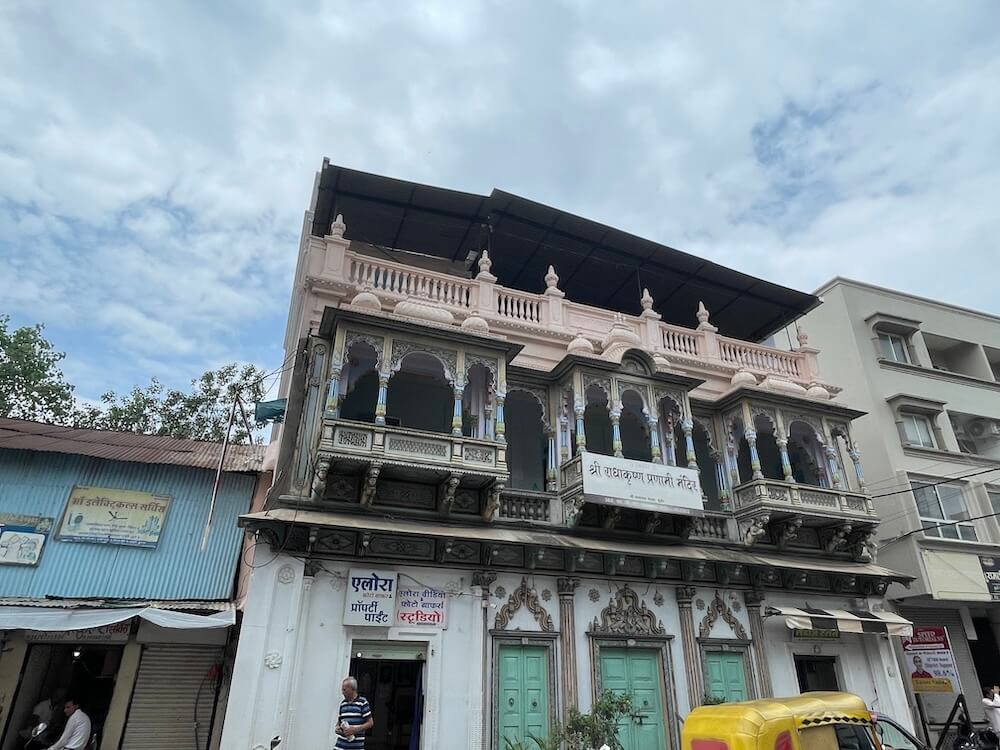
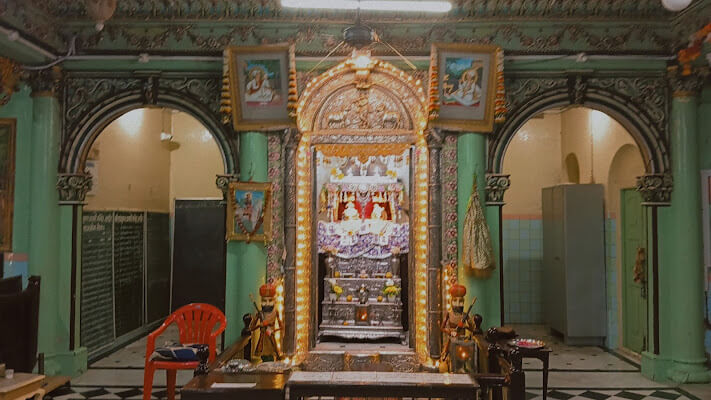
  Padmavatipuri Dham are also considered principal pilgrimage centers of the sect. Scattered across the country, many other Pranami temples exist, one of the oldest of which stands in Indore, said to have been established in 1920.The temple is located on a bustling thoroughfare at Gorakund Square. Its two-storied structure resembles an old princely mansion. On the upper floor are three large wooden galleries, with beautifully carved wooden pillars and arches. The roof carries an ornate wooden railing. On the ground floor, the temple has three entryways leading into a spacious sabhamandap. Within this hall, adorned with numerous circular pillars, are displayed portraits of revered saints of the Pranami sect. One wall holds a painting in the style of Raja Ravi Varma, depicting Krishna with the Gopis. The ceiling of the hall is decorated with fine ornamental work. Towards the front, lies the sanctum of the temple.
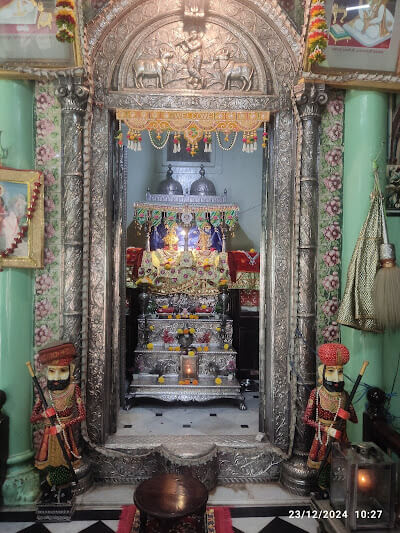
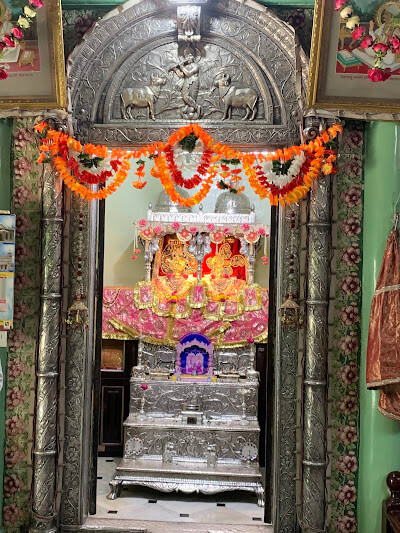
The sanctum stands between two pillars with a tall entrance, clad in golden sheets with intricate carvings. On either side of its doorframes are guardian figures. Above the lintel is carved the image of Lord Krishna playing his flute. Inside, placed atop a silver-plated pedestal, rest the sacred scriptures of the sect, i.e. the ‘Taratamvani’ and the ‘Shrimad Bhagavad Gita’, revered as the embodiment of Radha and Krishna. These texts are adorned with fine cloth and flower garlands, representing the divine couple. An eternal flame is kept burning here.
The ‘Taratamvani’, also called ‘Kuljam Swaroop’, is a compilation of seventeen scriptures. Its three main divisions are based on the philosophies of the Vedas, the spiritual wisdom of the ‘Quran’ and the ‘Bible’ and the glorification of ‘Brahman’ in its pure, manifest form. This scripture is also known as ‘Jagni’. A revolutionary doctrine within it declares that the God spoken of in the Vedas and the God of the Quran are one and the same.
At this temple, rituals are performed five times daily. The sect worships Krishna only in his child form and thus the festival of Krishna Janmashtami is celebrated here with the utmost enthusiasm. The temple is managed by the ‘Seth Bakhtaram Bachharam Bhandari Prannath Sanstha’.