
ओंकारेश्वर महादेव मंदिर
आनंद शहर, ता. आणि जि. आनंद
Omkareshwar Mahadev Temple
Anand City, Tal. and Dist. Anand
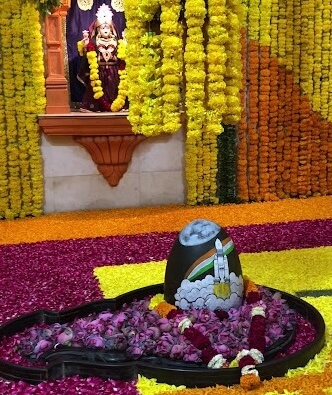 The roots of Shaivism, one of the most ancient traditions within Hinduism, can be traced in India to a period even prior to the arrival of the Aryans. For this reason, the worship of Lord Shiva has existed in the subcontinent since antiquity. As a result of this long-standing tradition, Shiva temples are found in greater numbers across the country than temples dedicated to any other deity. Omkareshwar Mahadev is believed to be the creator of the primordial cosmic sound ‘Om’, the sacred vibration regarded as the first manifestation in the process of creation. Among the many names by which Mahadev is known, this particular name holds special reverence. It is therefore not surprising that among the many Shiva temples within the district, the Omkareshwar Mahadev Temple in the city of Anand has become a place of deep devotion for countless devotees. The Shivling enshrined here is widely believed to fulfil vows and prayers and hundreds of devotees visit the temple each day to seek darshan.
Although the temple is not extremely ancient, over the past several decades it has emerged as a central focus of the religious and spiritual life of this region. 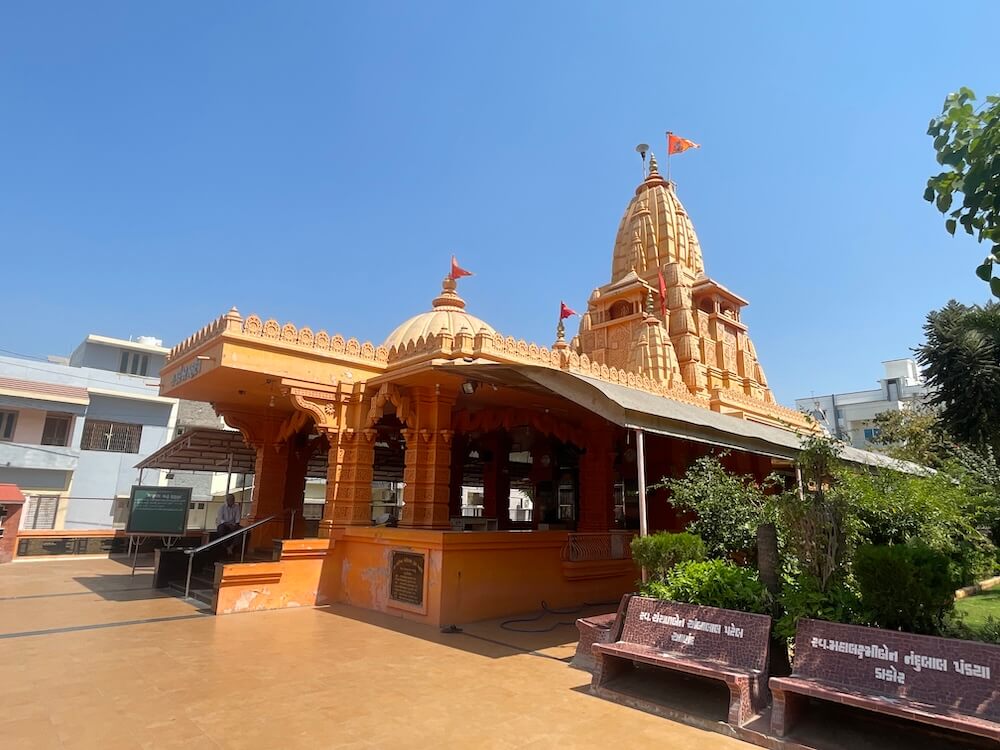 According to local tradition, many years ago the place where the temple now stands was occupied by a solitary ascetic who had built a small hut there. Immersed in intense austerity, he spent day and night engaged in the recitation of the sacred sound ‘Om’. Pleased by his unwavering devotion, Bhagwan Mahadev is believed to have appeared before him and granted him the opportunity to ask for a boon. The ascetic humbly requested that his chosen deity should reside permanently at that very spot. Accepting the request of his devotee, Mahadev chose to manifest there in the form of a Shivpind.
The ascetic devoted the remainder of his life to the service of this sacred emblem. After his passing, local devotees of Shiva came together and resolved to construct a temple at the site. Through collective community effort and donations offered by devotees,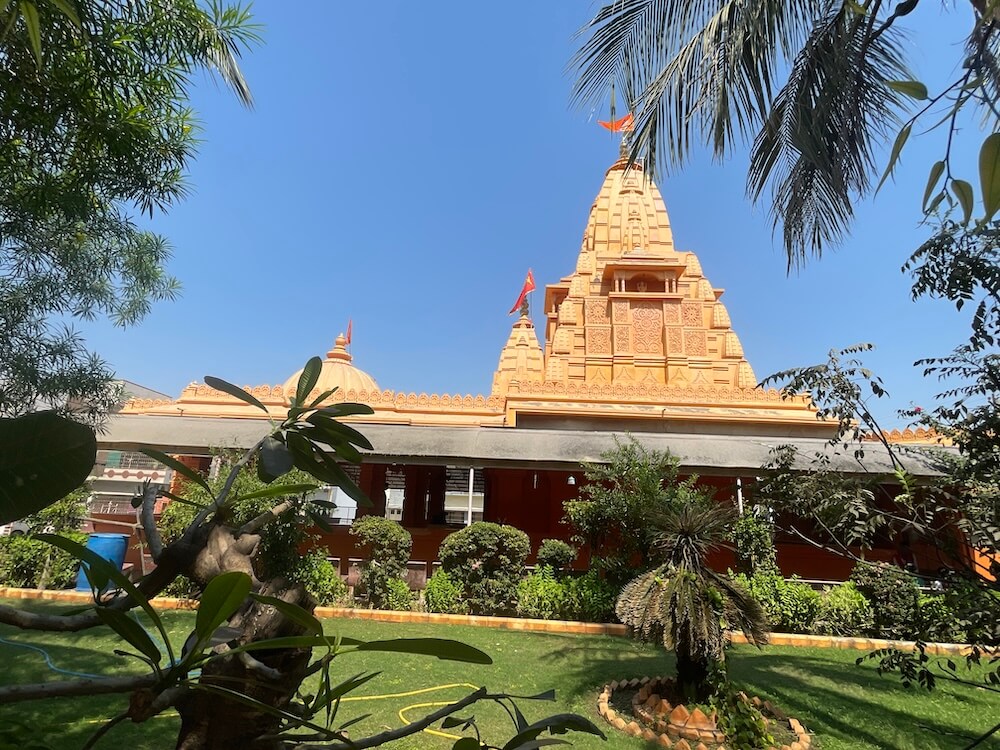 the temple structure gradually took shape. As the deity was believed to have manifested from the sacred sound ‘Om’, he came to be known as ‘Omkareshwar’. Following recent renovation work, the temple has acquired its present form. An official reference to the temple also appears in the 1981 Gazetteer of Kheda district (now Anand district).
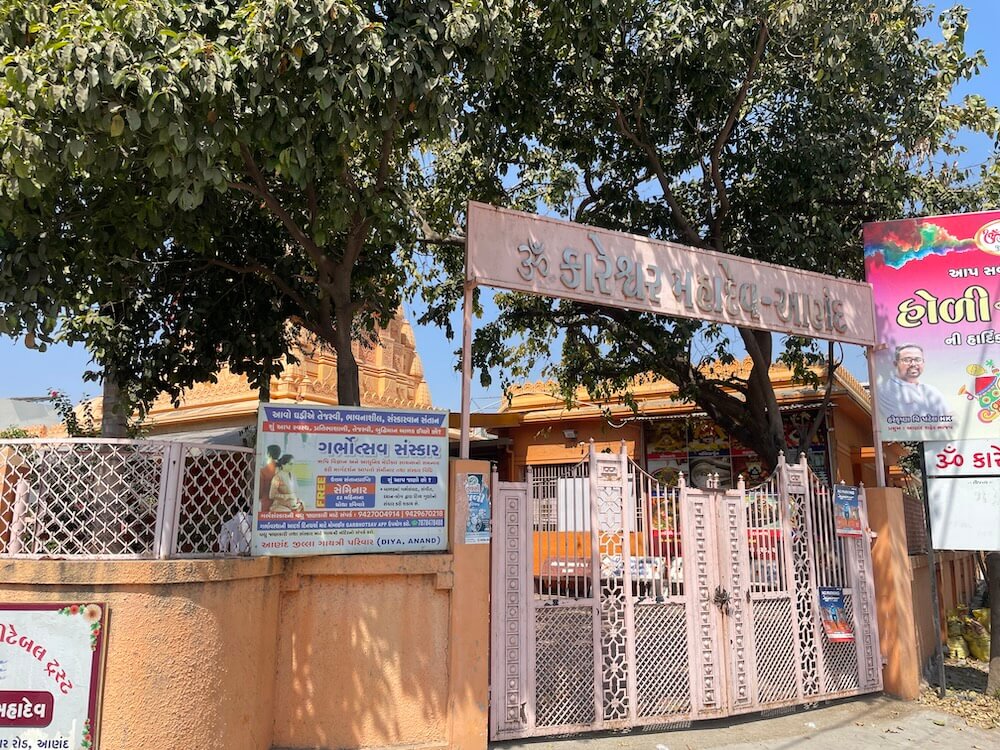
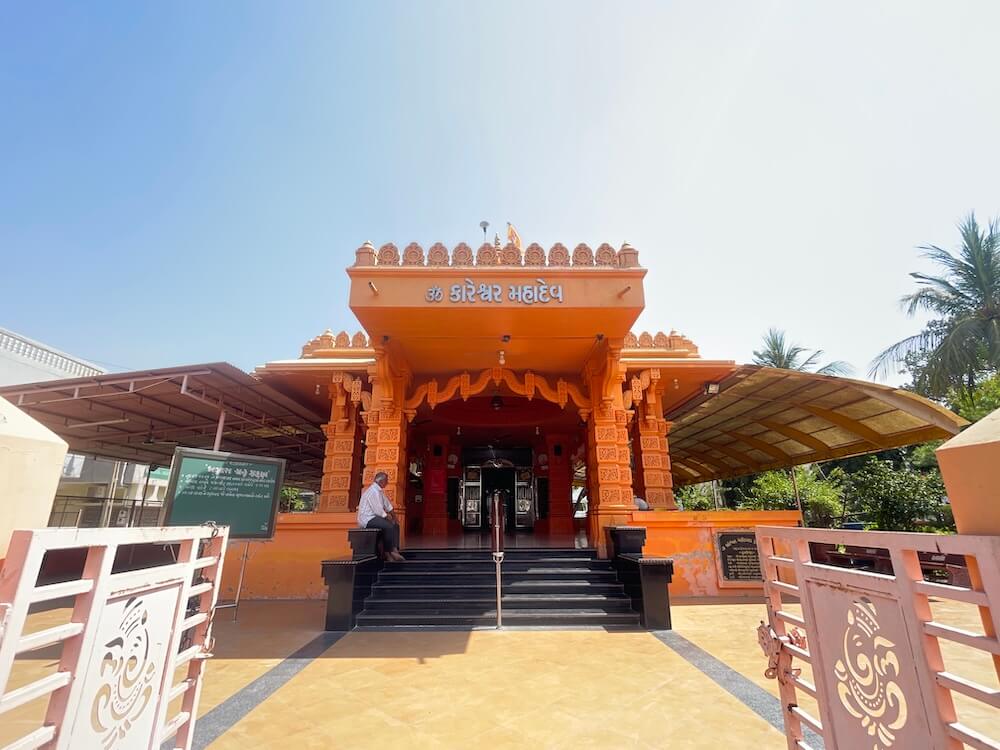
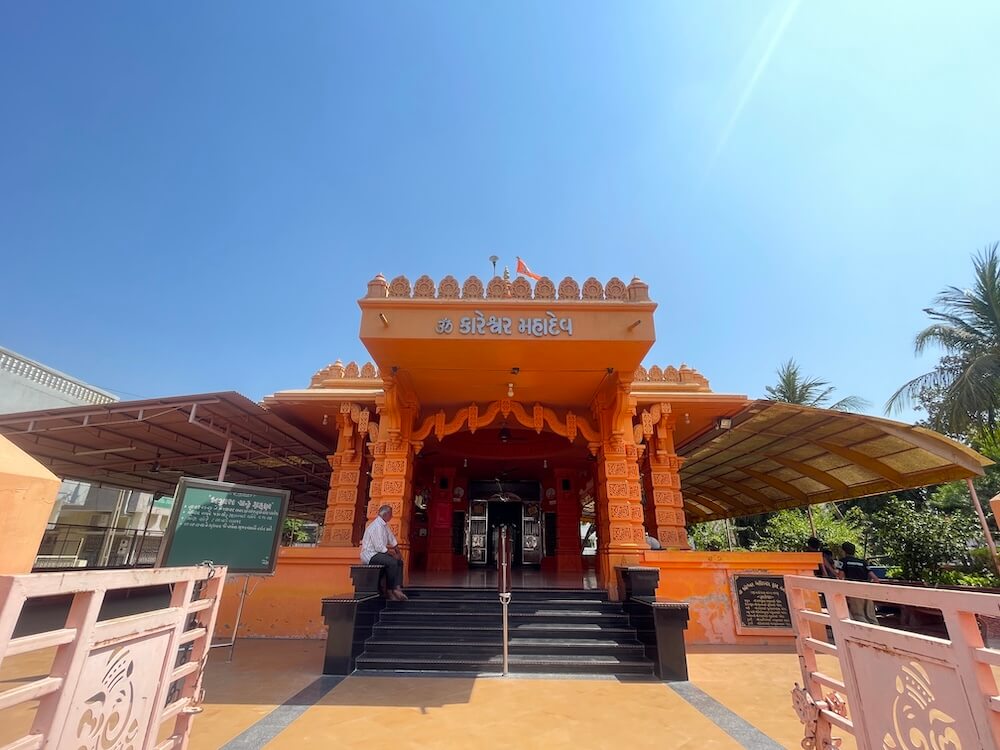
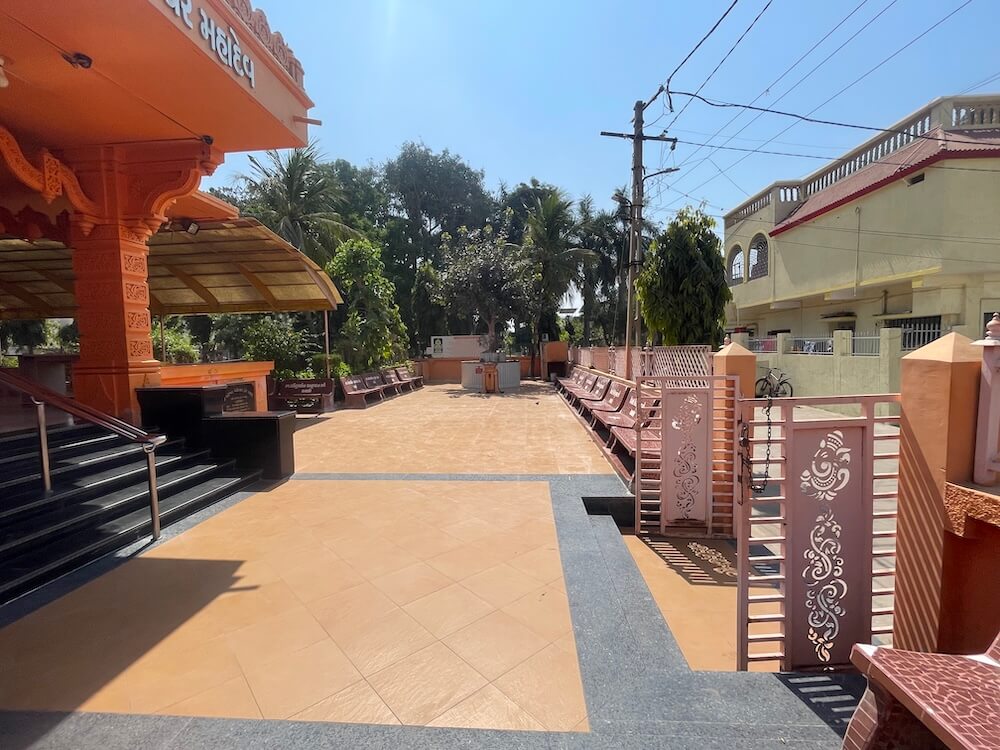
The temple is located at a prominent site along the Anand–Vidyannagar road, within the area of Vivekanand Wadi and Shrinathji Park Society. The temple complex is enclosed by a surrounding boundary wall with a main entrance gateway. Passing through the entrance leads into a spacious courtyard paved with paver blocks. Within the courtyard, several seating arrangements have been provided for devotees. 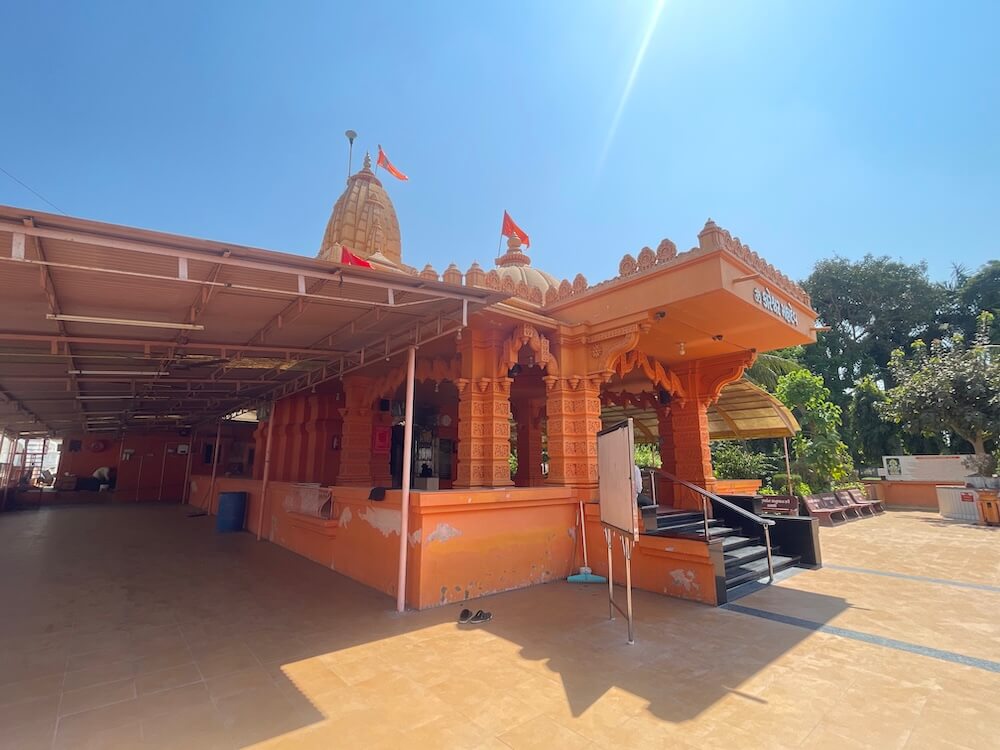
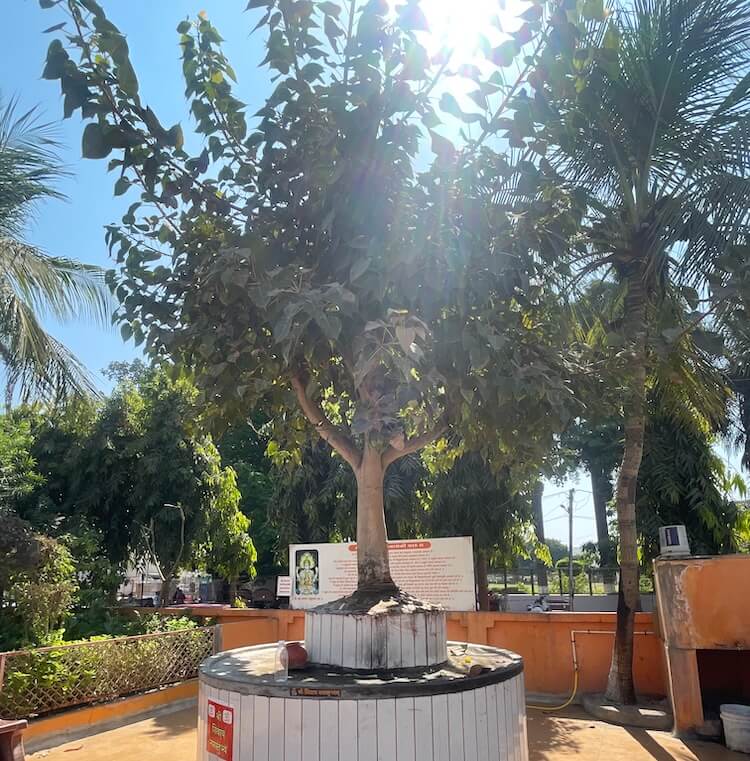
A sacred Rudraksha tree stands here, surrounded by a sturdy protective platform. Behind the temple, a beautifully landscaped garden filled with various types of trees has been developed. Locally, the entire temple complex is also referred to as ‘Mahadev Kshetra’.
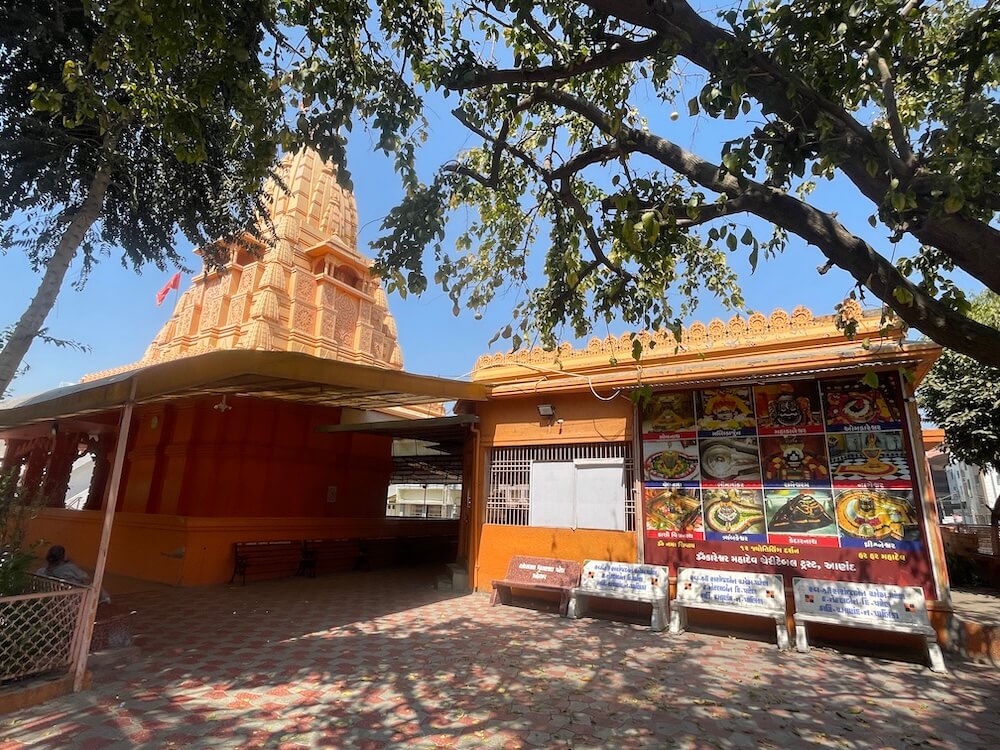
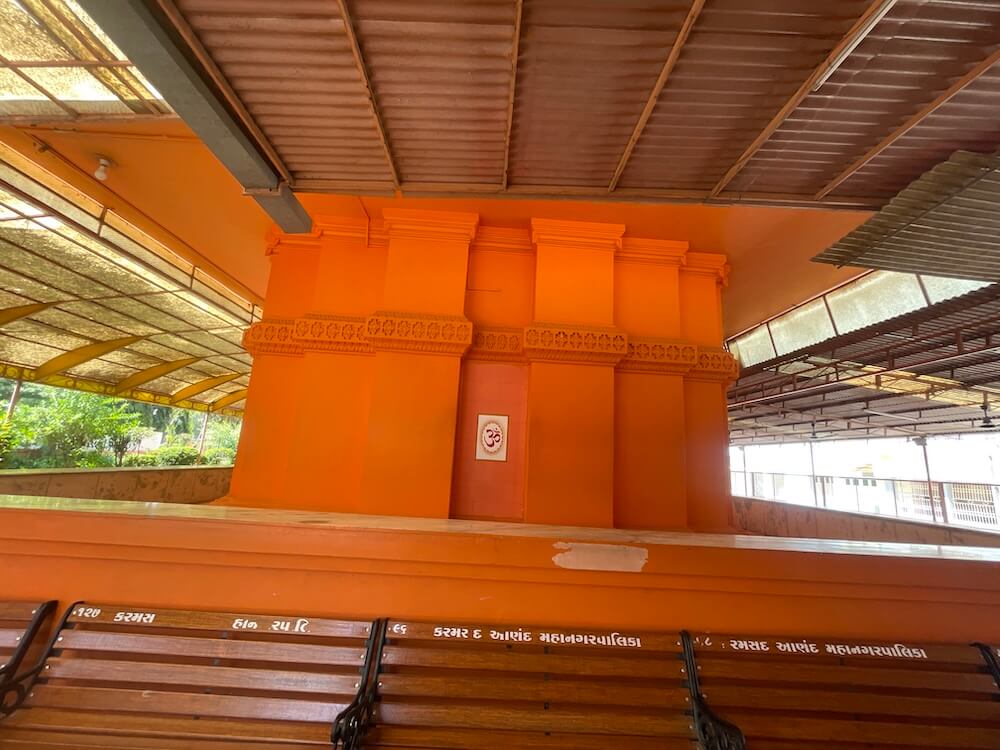
Constructed in the Nagara architectural style, the temple stands upon a Jagati (raised platform) approximately three feet above the courtyard. Its layout comprises a Mukhamandap (entrance pavilion), Sabhamandap (assembly hall) and Garbhagriha (sanctum). On three sides of the temple stands a large pavilion supported by iron pillars and covered with a metal roof. During festival occasions, this pavilion serves as the venue for the Annachhatra (community food service). From the courtyard, four steps lead upward through the Mukhamandap into the Sabhamandap.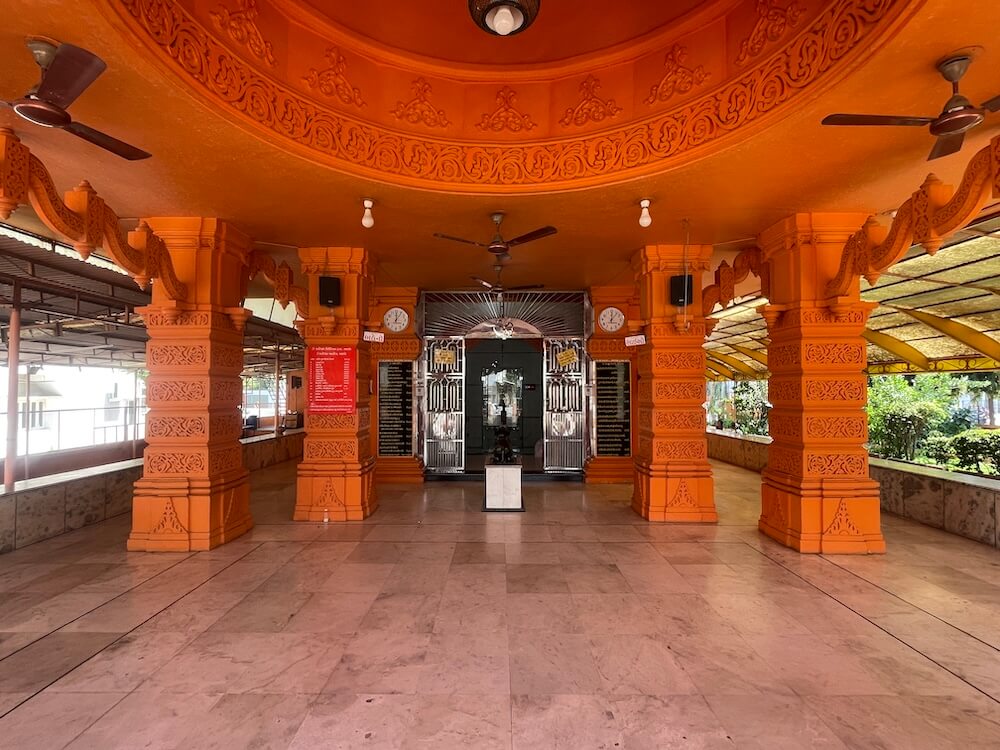
Within the semi-open assembly hall, the pillars are connected by graceful arched brackets. The beams resting upon these pillars support a domed ceiling decorated internally with circular ornamental patterns. At the centre of the Sabhamandap, directly before the sanctum, stands the idol of Nandi upon a Vajrapitha (stone pedestal). Inside the Garbhagriha is a black stone Shivling placed at the centre. Above the Shivling is a brass representation of a serpent, while from the ceiling hangs a silver vessel used for the ritual abhishek (libation). In a niche within the rear wall of the sanctum stands the idol of Mata Parvati.
The roof of the temple is bordered by a protective parapet on all sides. 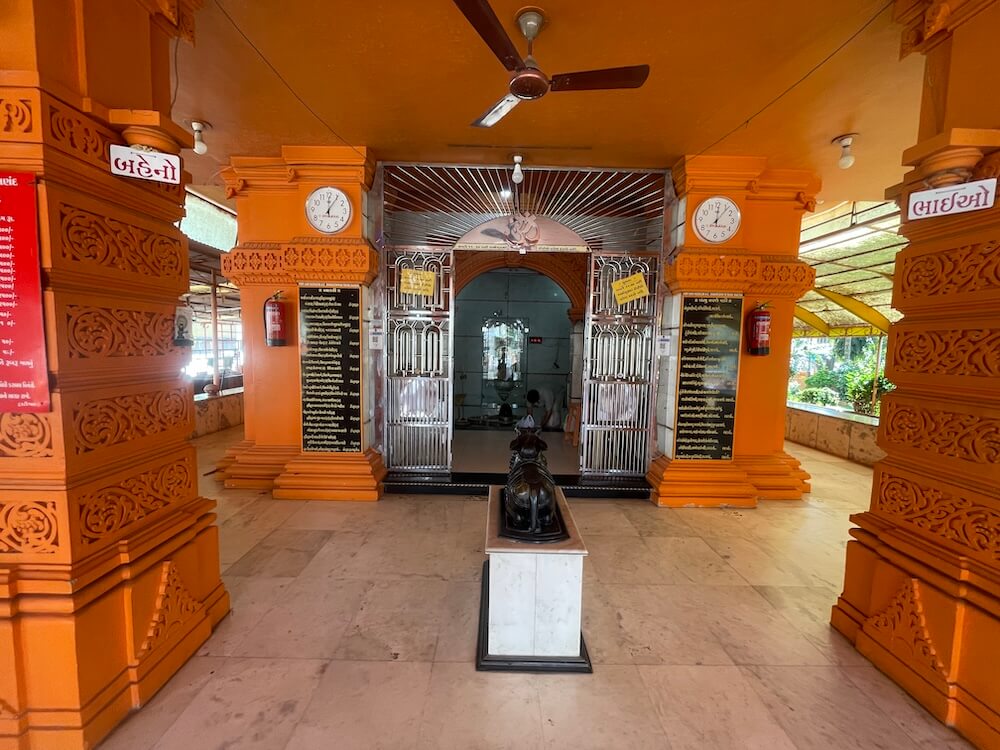 Above the sanctum rises a tall, tapering shikhara in the Nagara style, crowned with a Kalasha finial.
Throughout the year, numerous festivals and religious observances are celebrated in the Omkareshwar Mahadev Temple. The most important of these is Mahashivaratri, when thousands of devotees gather here for darshan. On that day, a temporary Shivling nearly thirty-five feet in height is erected within the temple premises. In addition, programmes such as ‘Sahasra Jyotirling Darshan’ and spiritual exhibitions are organised. During the month of Shravan, special ‘Maharudra’ pujas are performed every Monday, accompanied by a ceremonial palanquin procession of Mahadev.
Festivals such as Nag Panchami, Shri Krishna Janmotsav, Dussehra, Diwali and Kartik Purnima are also celebrated here with great enthusiasm. On Kartik Purnima, the temple hosts a grand ‘Deepotsav’, when the entire complex is illuminated by thousands of earthen lamps. During festival periods, Mahaprasad is distributed to devotees who arrive for darshan. Large numbers of devotees also visit the temple on Mondays, on the auspicious day of Pradosh and on Amavasya. The temple remains open for devotees from 5 am to 12 pm and from 4 pm to 9 pm.
Useful Information
- Located at 1.5 km from Anand Bus Station.
- State Transport bus services to Anand are available from many cities across the state.
- Private vehicles can reach the temple parking area.
- Several accommodation and breakfast facilities are available in the surrounding area.
ओंकारेश्वर महादेव मंदिर
आनंद शहर, तहसील और जिला: आनंद
मंदिरे
Temples
मंदिर
-
भीमनाथ महादेव मंदिर लिंबळी, ता. सोजित्रा, जि. आनंद
अधिक माहितीBhimnath Mahadev Temple Limbali, Tal. Sojitra, Dist. Anand
View Detailsभीमनाथ महादेव मंदिर लिम्बाली, ताल. सोजित्रा, जिला. आनंद
विवरण देखें -
मेलडी माता मंदिर मालताज, ता. सोजित्रा, जि. आनंद
अधिक माहितीMeldi Mata Temple Malataj, Tal. Sojitra, Dist. Anand
View Detailsमेलडी माता मंदिर मालताज, ताल. सोजित्रा, जिला. आनंद
विवरण देखें -
चंद्रमौलेश्वर महादेव मंदिर उमरेठ, ता. उमरेठ, जि. आनंद
अधिक माहितीChandramouleshwar Mahadev Temple Umreth, Tal. Umreth, Dist. Anand
View Detailsचंद्रमौलेश्वर महादेव मंदिर उमरेठ, तहसील उमरेठ, जिला आनंद
विवरण देखें