 The folk deity of the South, Khandoba – known also as Malhari Martand – is a Shaivite god. In Maharashtra he is called Khandoba, in Karnataka Mailara; in either name he is the people’s God. As with countless families from many communities across Maharashtra, he is also the family deity of the royal houses of Baroda’s Gaekwads and Indore’s Holkars. About two centuries ago, the consecration of Malhari Martand was performed within the royal palace at Indore. In that regal residence- now known as the Old Rajwada – the temple of Malhari Martand stands. Once the private shrine of the royal family, it is today open to all for darshan.
 Like Vitthal of Maharashtra, Khandoba’s roots lie in Karnataka. The folk God known as Mailara was later exalted as Malhari Martand. The Sanskrit text ‘Mallari Mahatmya’, composed sometime between 1260 and 1540 CE, tells his incarnation story. It is narrated thus : in the Krita Yuga, the seven sages – sons of Dharma – were engaged in austerities upon a mountain named Manichul. A demon called Malla invaded and devastated their forest hermitage. The sages fled to Indra, who told them, “Malla and his brother Mani have received from Brahma the boon of invincibility; I am powerless to destroy them.” In the end, all the sages came before Shankar.
When Shiva heard of the excesses of the demon Malla, he was enraged. To annihilate Mani and Malla, Shiva assumed the form of Martand Bhairava. In the battle that followed, Martand Bhairava vanquished the pair and from this he came to be known as Mallari Martand. 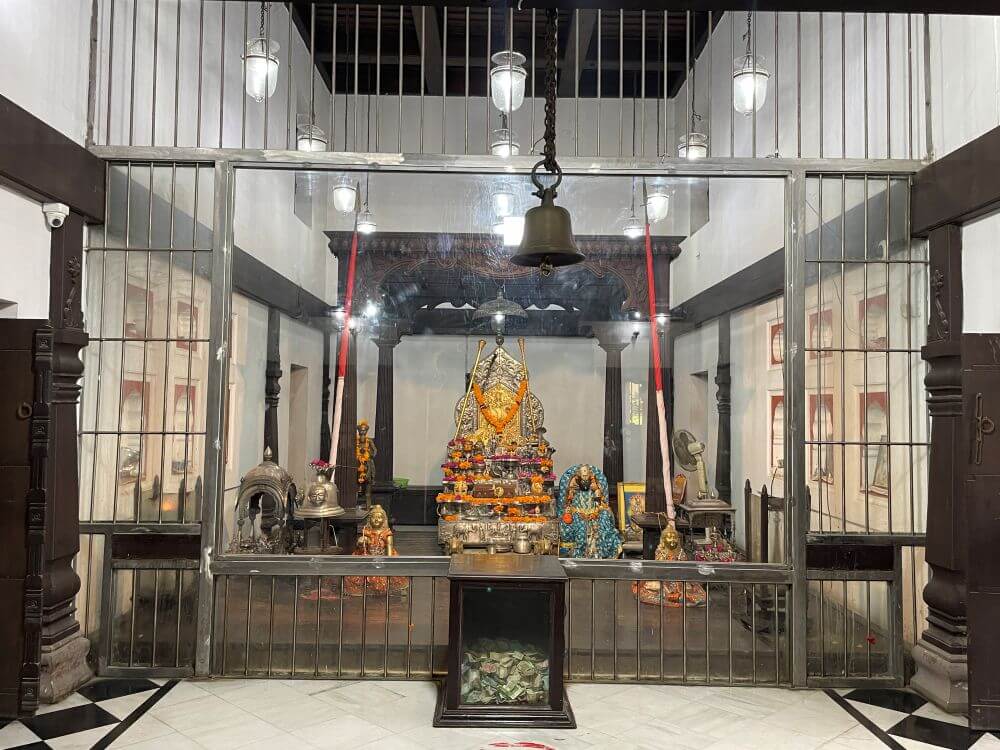 The principal weapon of Martand Bhairava is the sword called khanda; from this he came to be known as Khandoba. In folk tradition, Khandoba is said to have two wives, Mhalsa and Banai. His retinue includes the minister Hegad Pradhan and he is accompanied by a horse and a dog. The principal seat of Khandoba in Maharashtra is Jejuri.
Near Jejuri, on the banks of the Nira river, lies Hol, the ancestral village of the Holkars. Jejuri’s Khandoba is their family deity. The father of Malhar Rao Holkar, founder of the Holkar state, was named Khanduji after Khandoba himself and he gave his son the name Malhar in honour of their deity. The city of Indore in the Malwa region was established by Malhar Rao Holkar. Once a small village, he expanded it and named it Malharnagari. 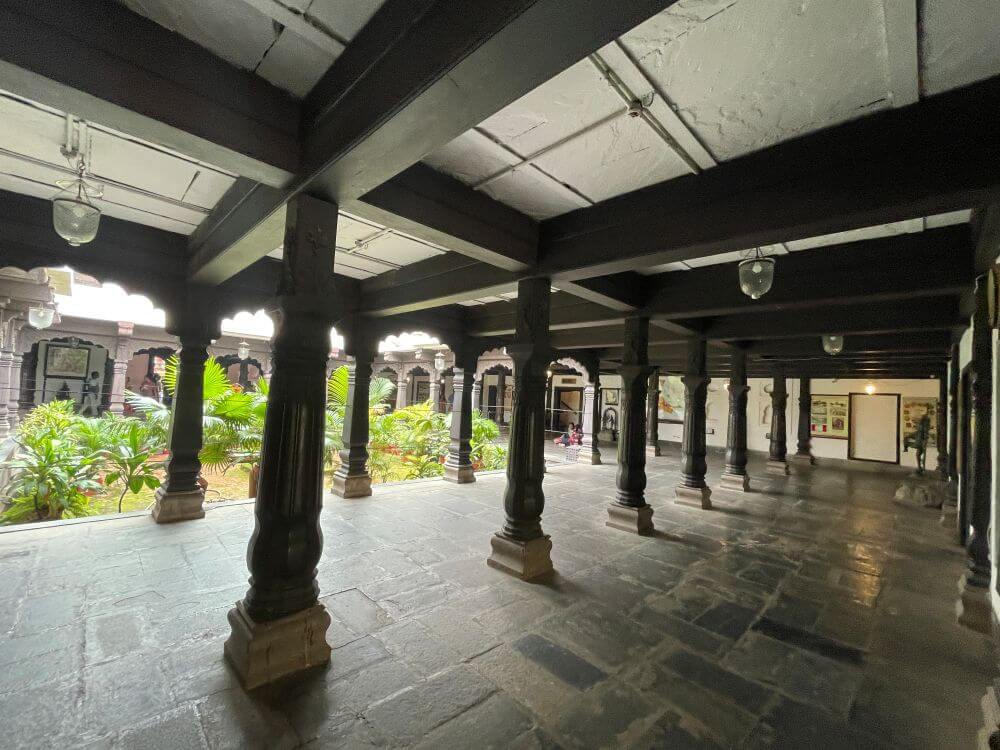 The royal seal of Malhar Rao bore the legend, ‘Shri Mhalsakant charani tatpara Khandojisuta Holkar’ (the son of Khandoji Holkar ever devoted at the feet of Shri Mhalsakant). In 1811 Malhar Rao Holkar (the Third) ascended the throne of Indore. During his reign (1811–1833) he spent roughly four lakh rupees to construct a magnificent palace and there established the idol of Malhari Martand within the palace temple. As the seat of the Holkar throne, it hosted all official state and religious ceremonies. In 2007, the ancient temple here was restored at a cost of about two crore rupees by the Devi Ahilyabai Holkar Private Trust. Thereafter, on 11 March 2007, this private temple of the royal family was ceremonially opened by Her Highness Maharani Usha Devi Holkar and her husband, Shrimant Satishchandra Malhotra.
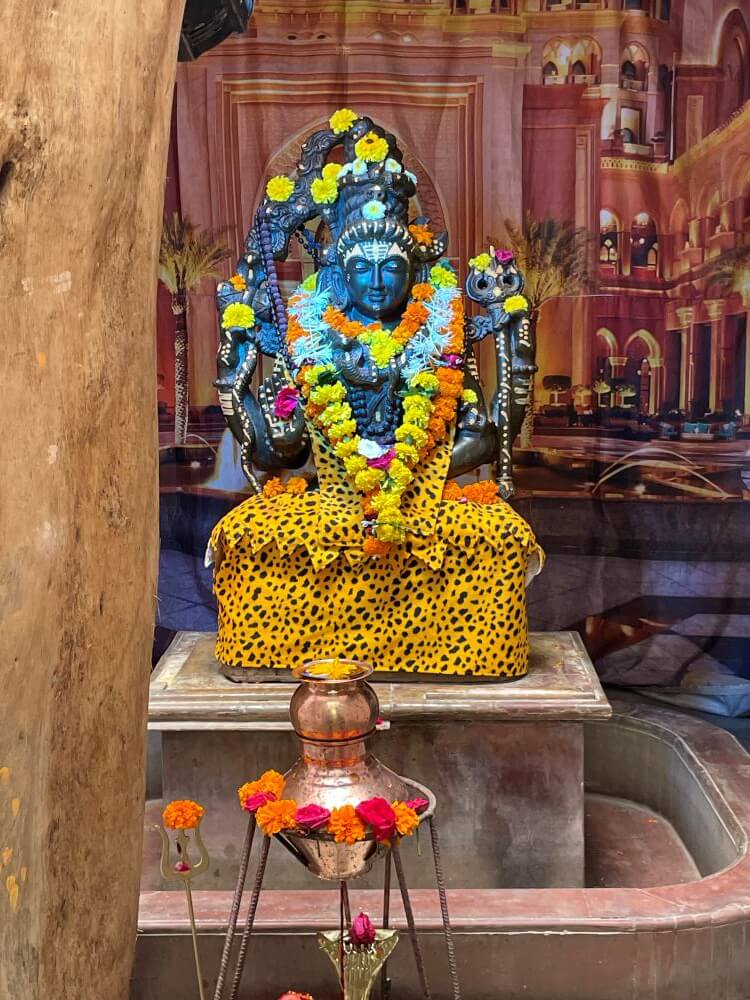
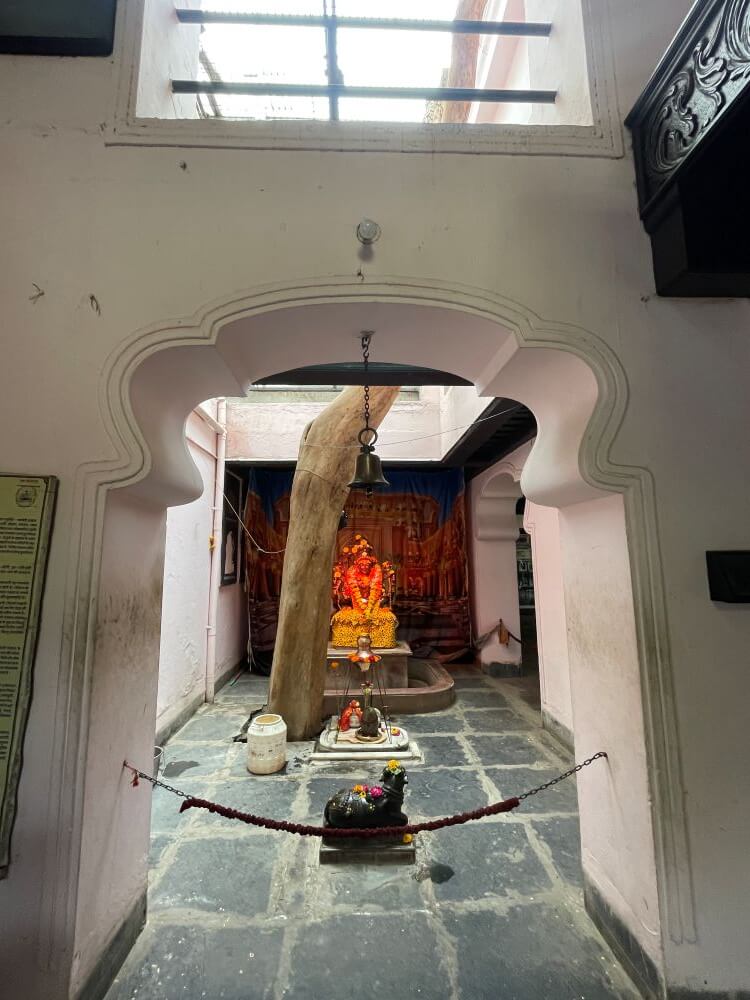
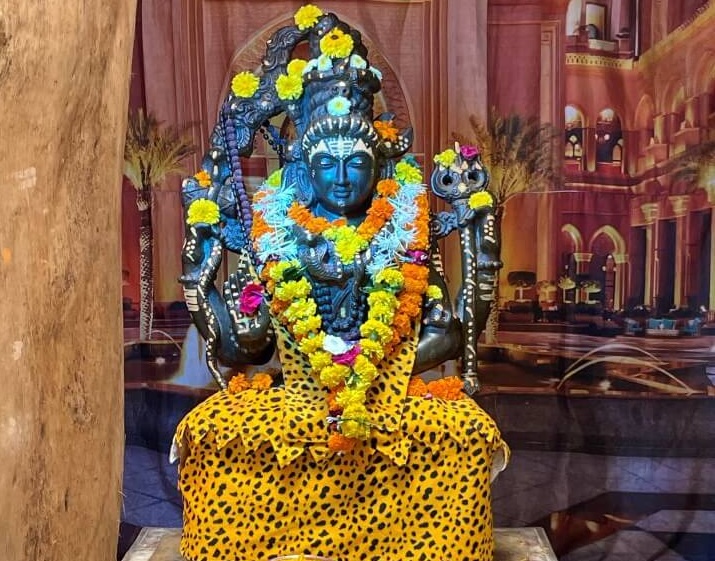
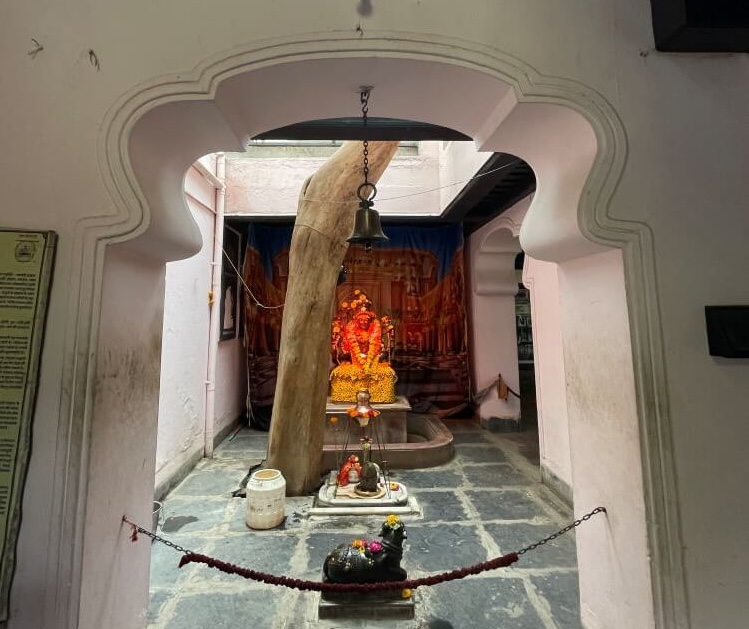 The Rajwada has a grand stone gateway. The portal holds a stout wooden door and above it rises a cusped stone arch. Upon it is carved the royal seal of the Holkar house, emblazoned with horse, Nandi, spear and sword. Passing through the great gate, one finds a temple of Mahadev on the left. Near the foot of a tree a Shiva-linga has been installed. Bbefore it sits a stone Nandi and upon a nearby plinth is enthroned an image of Shankar Mahadev.
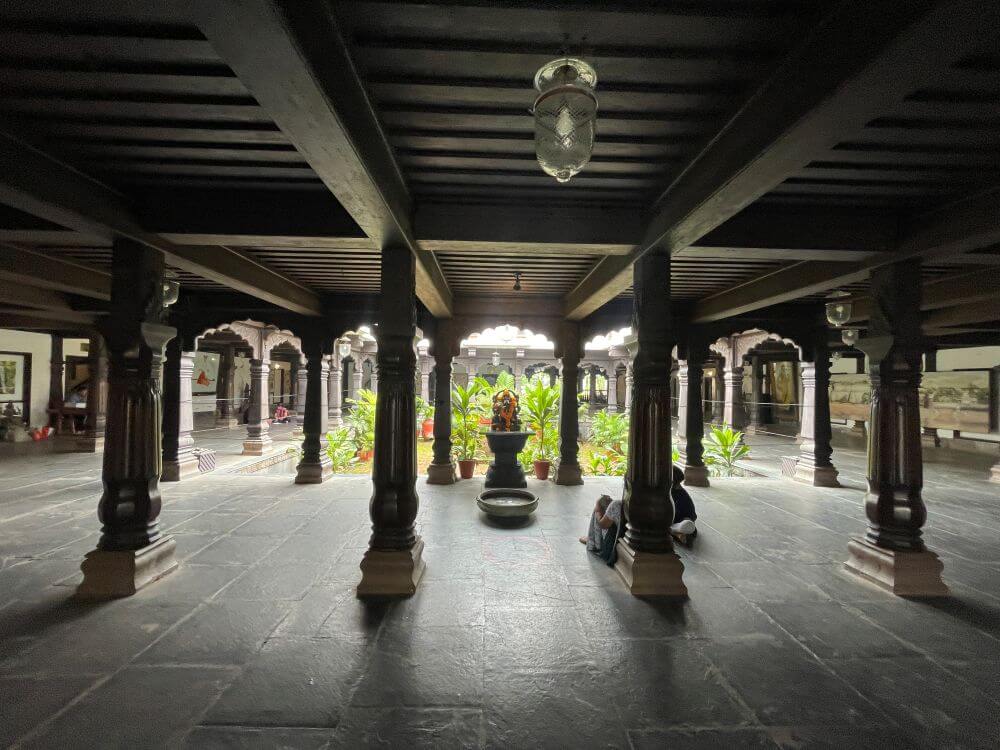
There is a spacious pillared gallery, the ‘ovari’, supported on sturdy wooden columns on all four sides. Directly opposite, upon a beautiful stone platform, is a metal image of Lord Gajanan. In the open court between the ranges of pillars a lovely garden has been laid out. Throughout the ovari one may see ancient images, such as Shiva in his form as the teacher of music, Veenadhara; Shiva as Vrishavahana, with Nandi and Parvati; and venerable metal images of Nataraja, Parvati and Ardhanari. 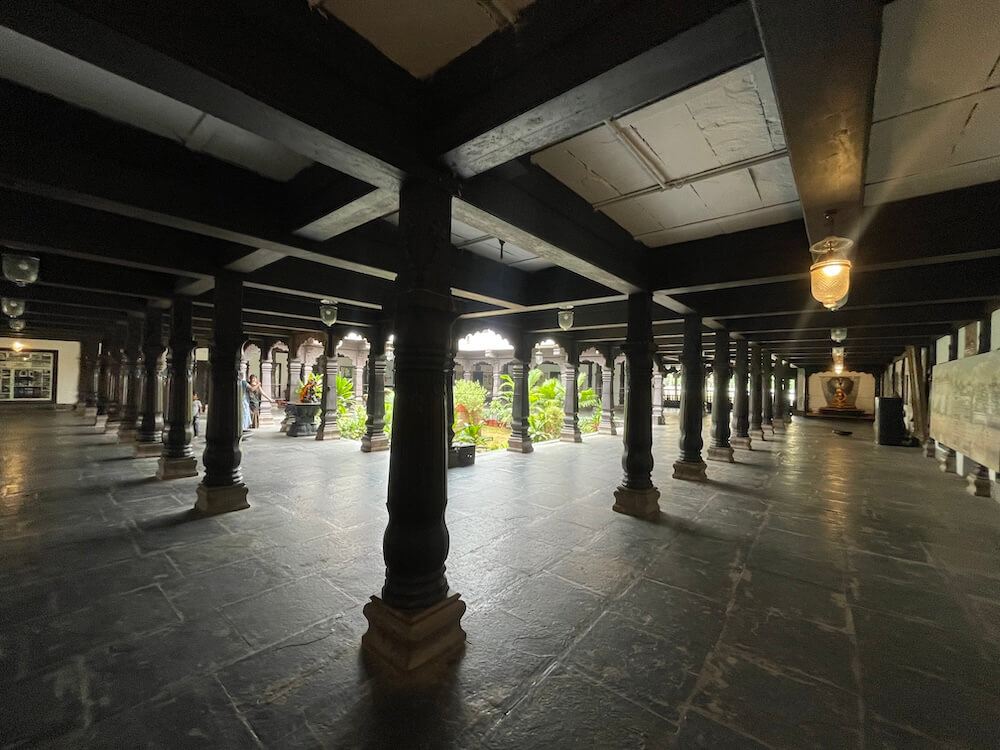 In the ovari there are also panels describing the works of Ahilyabai and the history of the Holkar royal house. On the second floor, there is a small museum presenting information related to the Holkar dynasty.
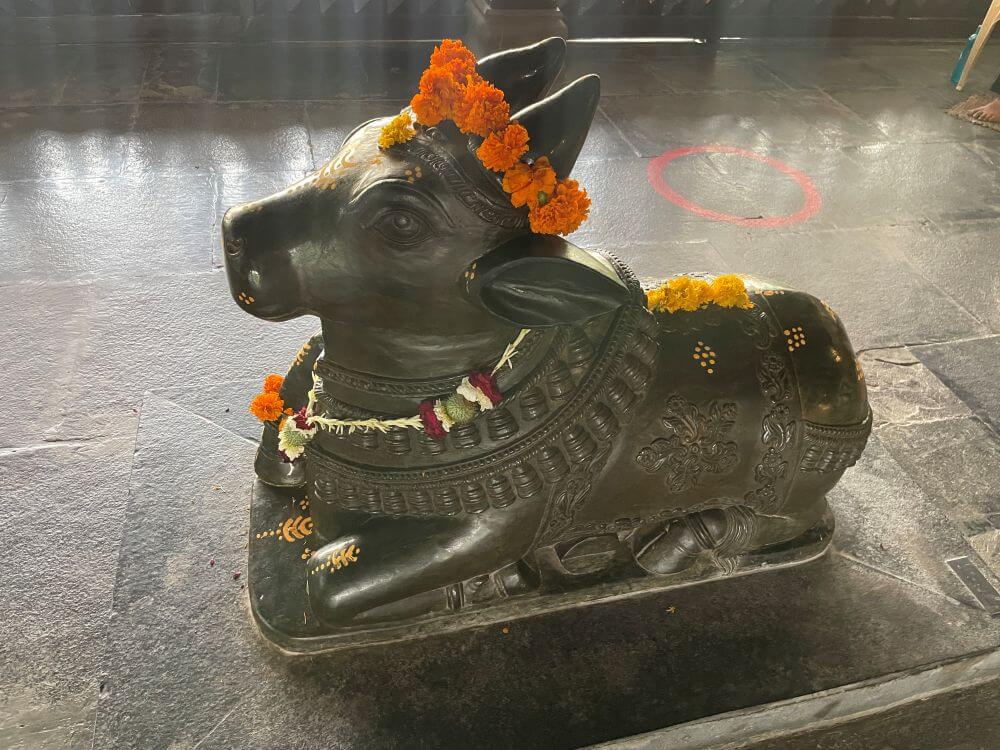
Toward the rear of the Rajwada, within the ovari, lies the temple’s principal sanctum. Before it are a fire-altar (homakunda) and, carved from a single mass of stone, a finely executed statue of Nandi. The sanctum is spacious. Within stands a pedestal of marble and upon it a great wooden shrine with fluted pillars. Close to the two pillars at the front are placed two tall spears.
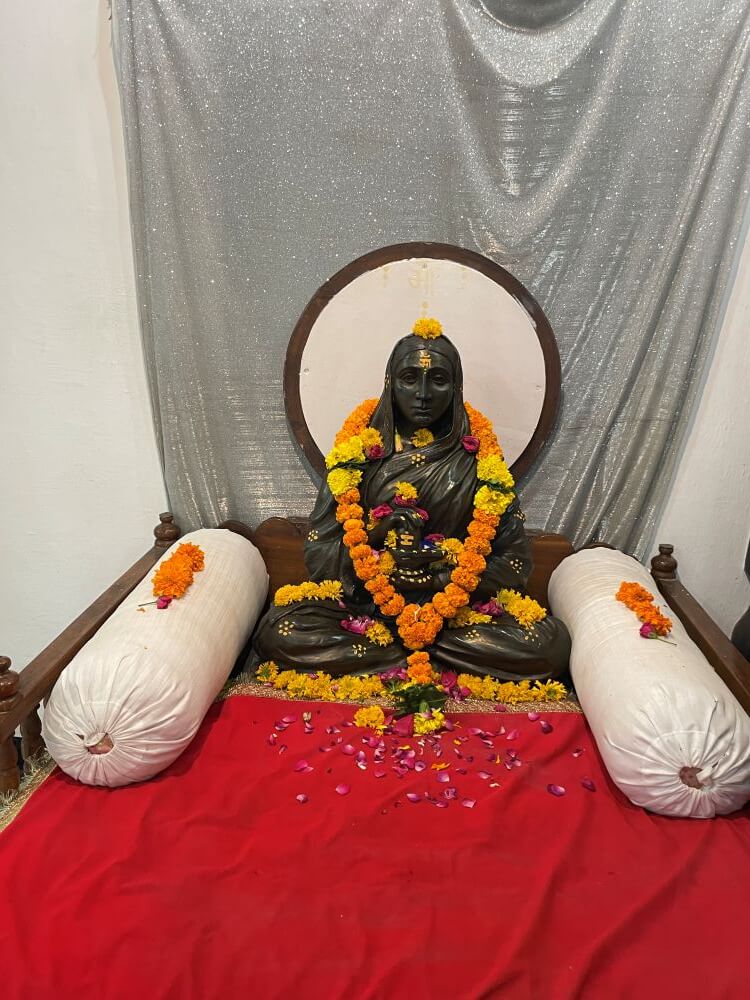
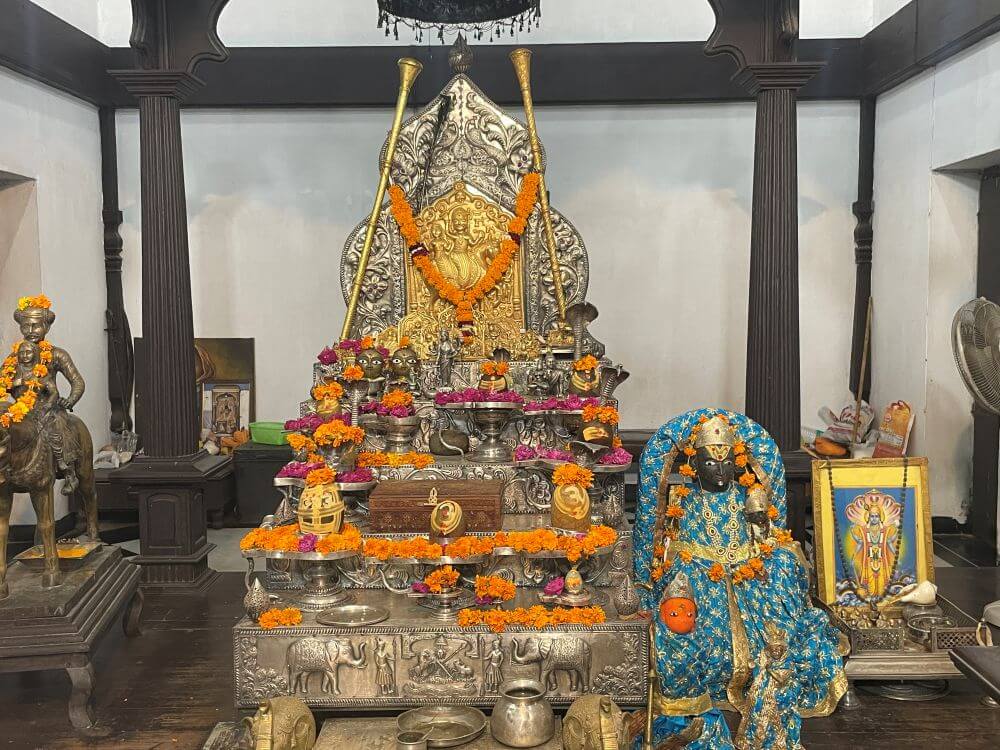
Inside the shrine is a lofty seat with steps sheathed in silver. The seat is adorned with delicate foliage patterns carved in relief. 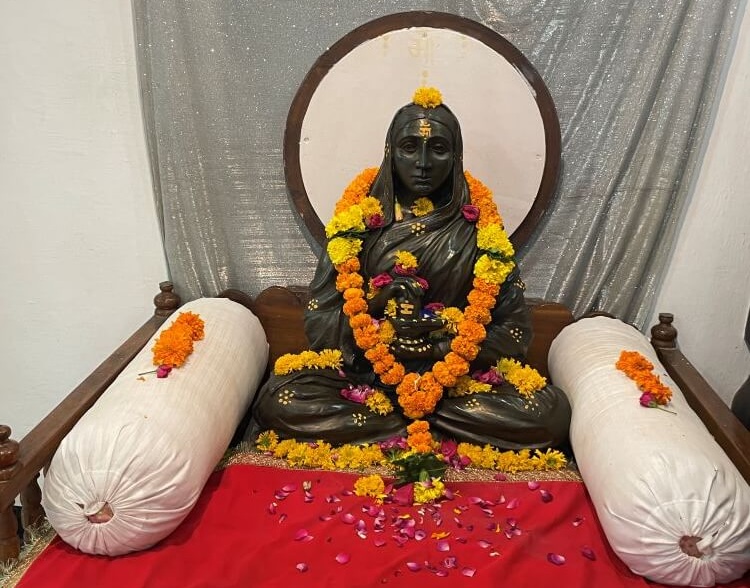 At its base, in the center of the lower panel, is the royal emblem of the Holkar house. On either side stand figures of guards and of elephants. At the highest place upon the seat is enthroned a large repousse panel (taak) of Malhari Martand. It is a carved image of Khandoba mounted on a horse, a sword in his hand and behind him Mhalsa. Here are also the masks or images of Mhalsai, Banai, Yamai, Rambhai, Aasra Devi, as well as the deities Mhaloba, Viroba, Bhairoba, Vyankoba and the Panchadev. There are images of serpents, a Shiva-linga and memorial plaques (smriti-tak) of the Holkar kings and queens. On the left side of the deity’s seat stands a large metal image of Khandoba on horseback with Mhalsai. Facing them are two images of the Bal-Krishna. Within the sanctum, upon a cushion, there is a statue of Punyashlok Ahilyabai Holkar seated with a Shiva-linga cradled in her hand.
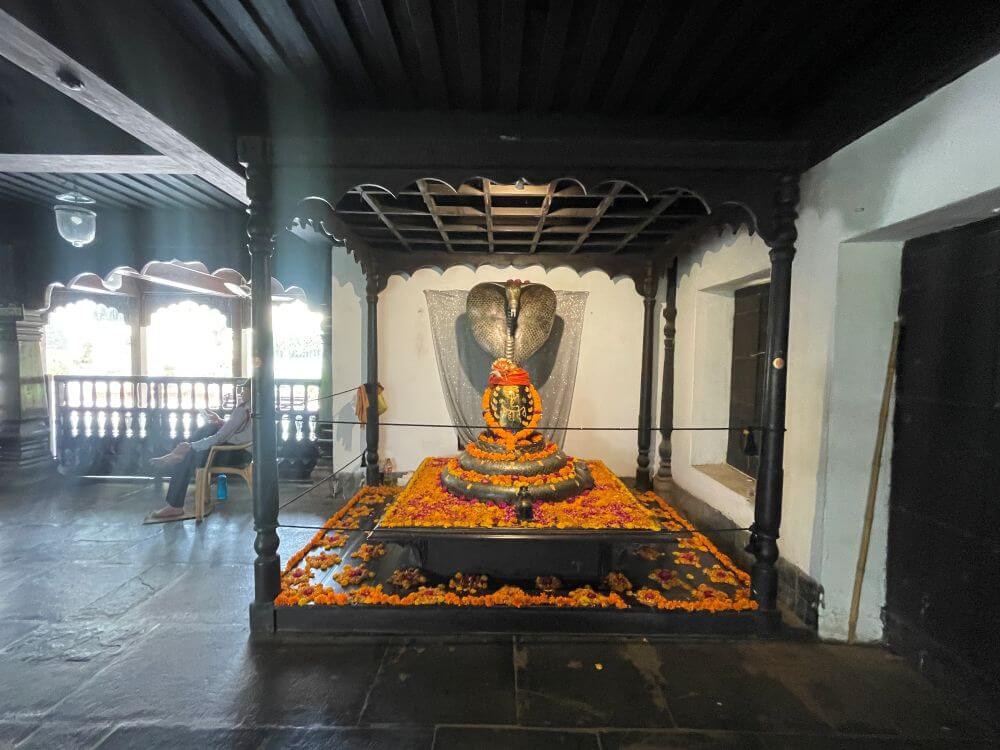
 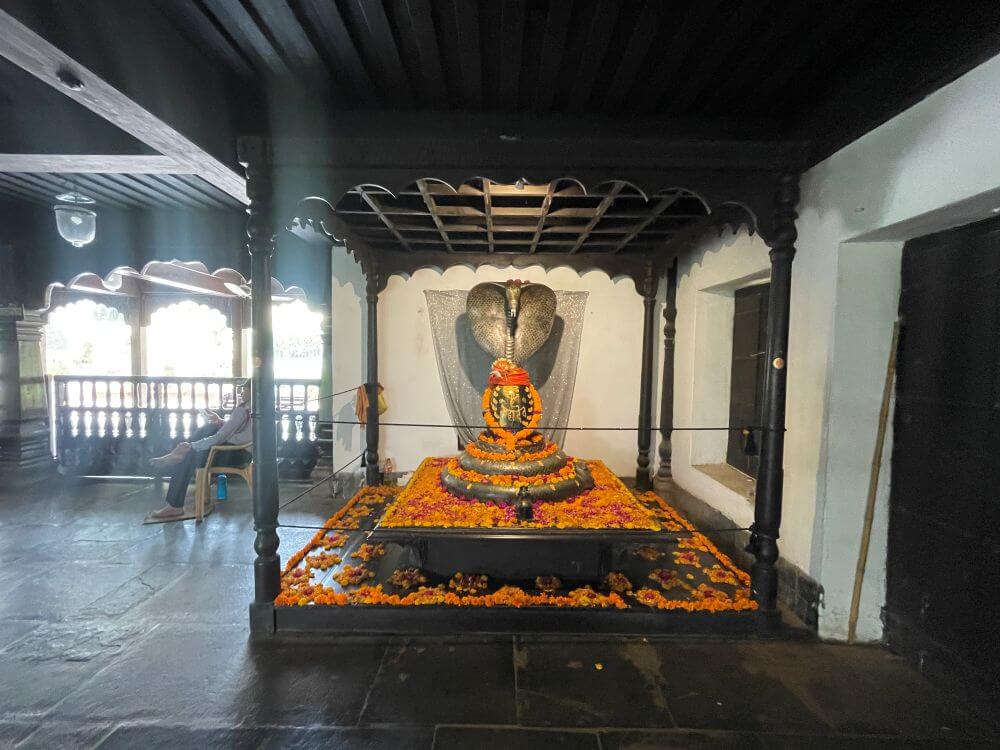 In the portion opposite the sanctum, a grand Shiva-linga is enthroned upon a wooden seat inside a large wooden shrine. It is encircled by a brass serpent, its majestic hood arched above.
Because Khandoba is the family deity of many households in Indore and the Malwa region, there is a constant stream of devotees and visitors here. All daily rites of worship are duly performed in the temple. Champa Shashthi is the great festival of this shrine. It is observed from the first day of the bright fortnight of Margashirsha (Pratipada) through the sixth day (Shashthi) and is also called the Pancharatra of Malhari Martand. During this festival, ghatasthapana is performed in the temple. On Shashthi day, the deity’s aarti is sung and the ritual of ‘Tali’ is carried out. In a copper vessel the embossed panel (tak) of Khandoba is placed; to it offerings of bel and bhandara (the turmeric sacred to Jejuri) are made; five or more people lift the vessel three times. In that moment resound the cries of victory – “Sadanandacha Yelkot!” and “Bhairavnathache Changbhale!”. This ritual is called as ‘Tali Bharne’. After this the aarti of the Lord is performed. Members of the royal family, numerous dignitaries of Indore and thousands upon thousands of devotees attend this ceremony.