
कबीरवाद
मंगळेश्वर, तालुका व जिल्हा भरूच
Kabirvad
Mangleshwar, Taluka and District Bharuch
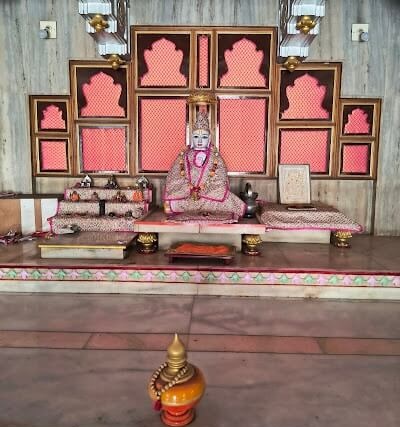 In the Bharuch district of Gujarat, near the village of Mangleshwar, lies an island in the midst of the Narmada River’s expanse. It is a home to a colossal banyan tree celebrated as Kabirvad. Spreading across approximately 4.33 acres, this majestic tree has stood like a silent ‘tapasvi’ (ascetic) since at least the 15th century. The thousands of prop roots that have descended deep into the earth are revered as symbols of the message of spiritual unity bestowed upon society by the saint-poet Kabir. Beneath the sprawling canopy of this arboreal wonder stands a temple dedicated to Saint Kabir. This site has flourished not only as a sacred ‘tirthakshetra’ (place of pilgrimage) but also as an enchanting destination for travellers.
Kabir, who lived in North India during the fourteenth and fifteenth centuries, was a renowned saint-poet. As a poet, Kabir holds an exalted place in Hindi literature. Without attaching himself to any single sect or religion, Sant Kabir valued experiential wisdom above all else and for the worship of God, he chiefly upheld the ‘Yogmarg’ and the ‘Bhaktimarg’.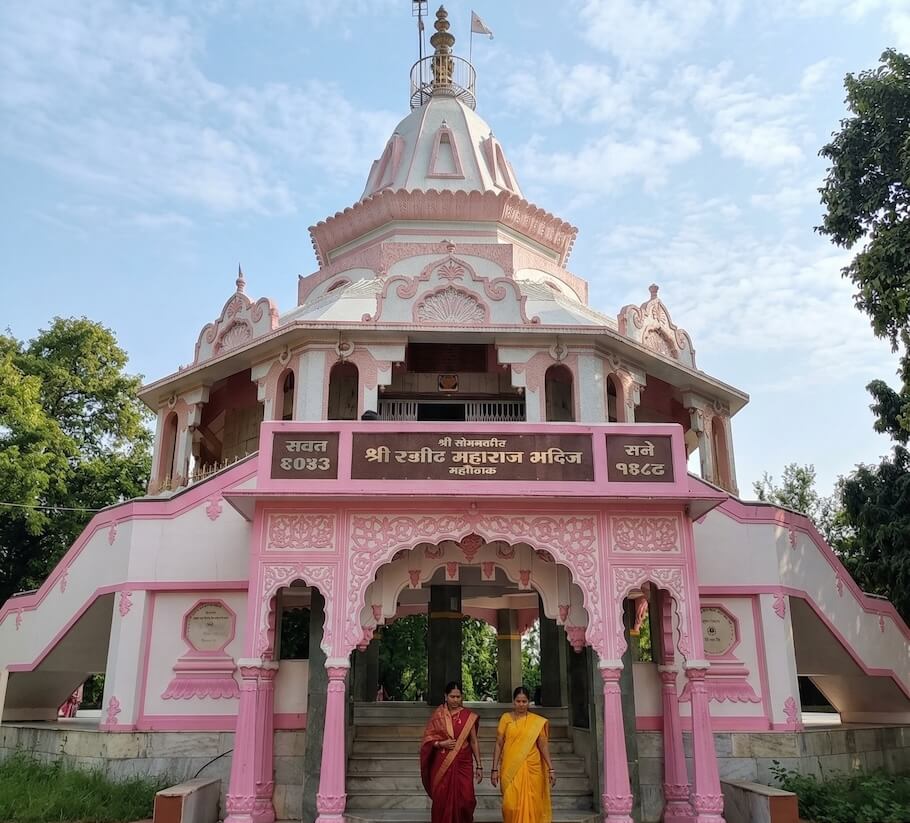 He held no faith in caste distinctions, ancestral pride, religious divisions, rigid traditions, ritual fasts or elaborate ceremonies. Through his verses, he launched scathing attacks upon the flaws, inconsistencies and moral failings of both Hindu and Islamic orthodoxies. His compositions were primarily oral and were later committed to writing by his devoted followers. The ‘Kabir Granthavali’ and ‘Kabir-Bijak’ are considered the authoritative anthologies of his work.
No official record of Kabir’s life is available. His period is generally accepted to be from AD 1398 to AD 1518. Yet scholars differ on this, as well as on who his parents were, what his birthplace was and who his guru may have been. Many legends circulate about him. Numerous legends surround him, several of which are inextricably linked to this gargantuan banyan on the Narmada island. In a 1908 issue of ‘The Journal of the Bombay Branch of the Royal Asiatic Society’, Jivanji Jamshedji Modi published an article titled ‘A Few Notes on Broach from an Antiquarian Point of View’. 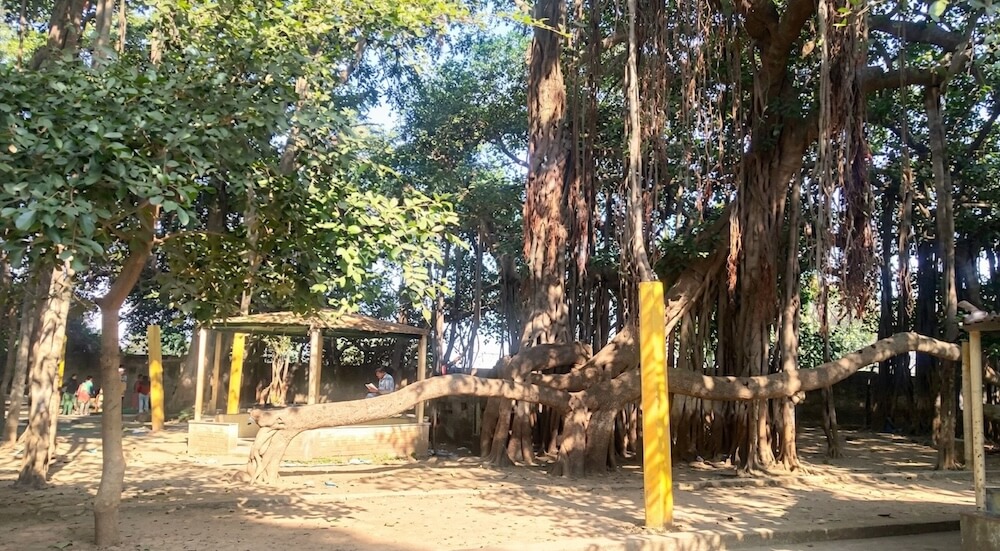 In it, he recounts a legend stating that Saint Kabir once visited the Mangleshwar region near Bharuch during his travels across India. Upon arriving at this island, he discarded a small wooden twig he had used to clean his teeth (a ‘datun’); from this humble twig, it is said, the mighty banyan tree eventually sprouted. Modi’s account also makes mention of the Kabir temple situated here.
According to another legend, two brothers named Jiva and Tatva lived in the village of Shuklatirth in the Mangleshwar region of Bharuch district. In their search for a true saint they planted upon this island a dried branch of a banyan tree. 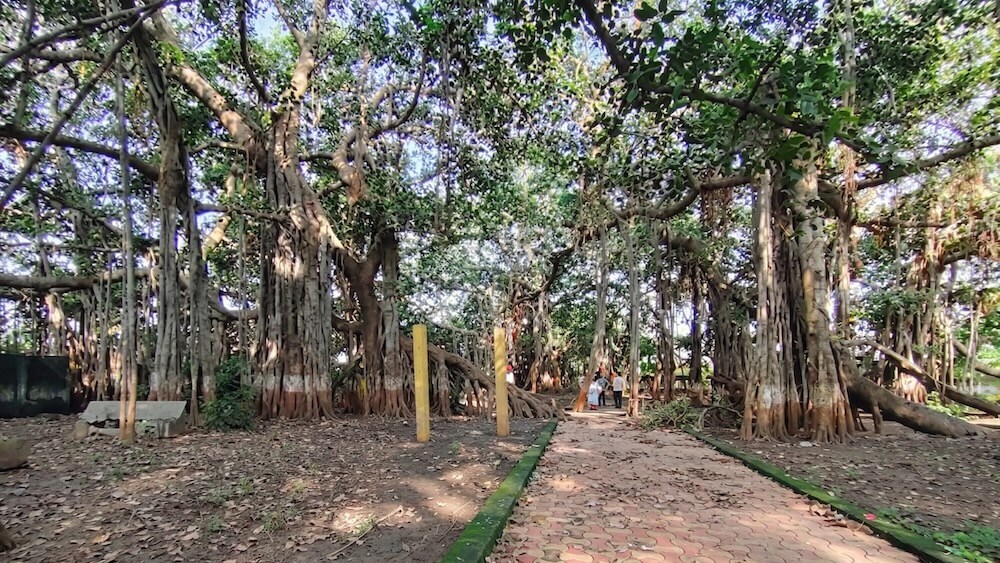 They resolved that the saint who could make this branch turn green again would be the true sant. They would invite saints here, wash their feet and pour that water (charanamrut) near the branch. Yet the branch did not turn green with the charanamrut of any saint. One day when Sant Kabir arrived here, the brothers worshipped him and offered his charanamrut to the branch. At once, the dried branch turned green. From that branch, it is believed, this vast banyan tree came into existence.
The celebrated Gujarati poet Narmad described this banyan tree in the words: ‘dhundhle rangon se lada hua, door kisi parvat ke saman, nadi ke beech mein khada, nirbhayata se.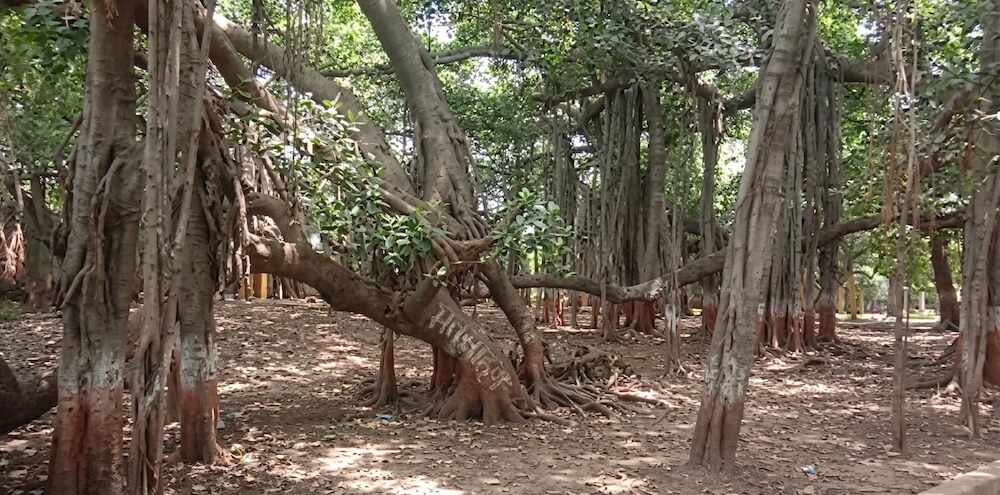 ’ (Standing ‘fearlessly in the middle of the river, laden with dusky hues, resembling a distant mountain’.) According to entries in the ‘Encyclopaedia Britannica (Vol 10)’, the earliest mention of this tree may have been made by Nearchus, the admiral of Alexander the Great. Nearchus, regarded as a pioneer of the sea route to India, described his travels in ‘The Voyage of Nearchus From the Indus to the Euphrates’ (as chronicled by William Vincent). His era, approximately 360 to 300 BC, leads some scholars to believe the tree’s lineage could be nearly two and a half millennia old.
 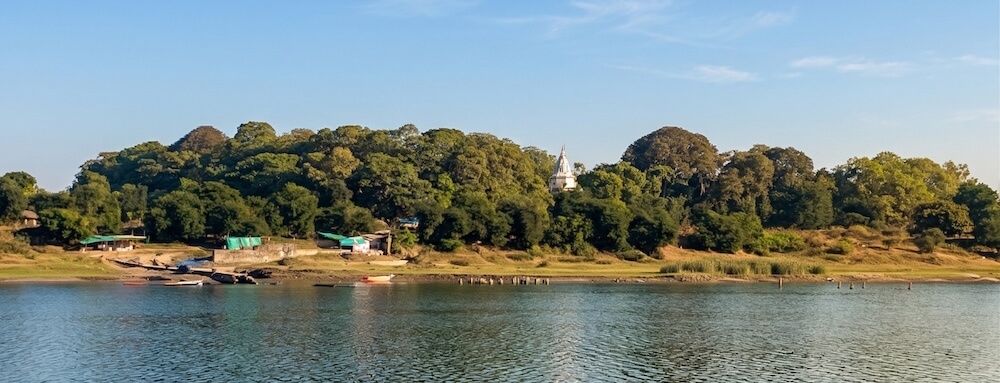 The British writer and artist James Forbes (1749–1819) also mentions this banyan in his ‘Oriental Memoirs—A Seventeen Years Residence in India’. Forbes notes that many believed this was indeed the very tree mentioned by Nearchus. He described it as having a circumference of roughly 610 metres (2,000 feet) and possessing over three thousand branches, noting that seven thousand people could find shelter beneath its shade.
  Today, Kabirvad covers an area of 17,520 square metres (4.33 acres) with a circumference of approximately 641 metres (2,103 feet). Its canopy is so dense that sunlight struggles to reach the forest floor.
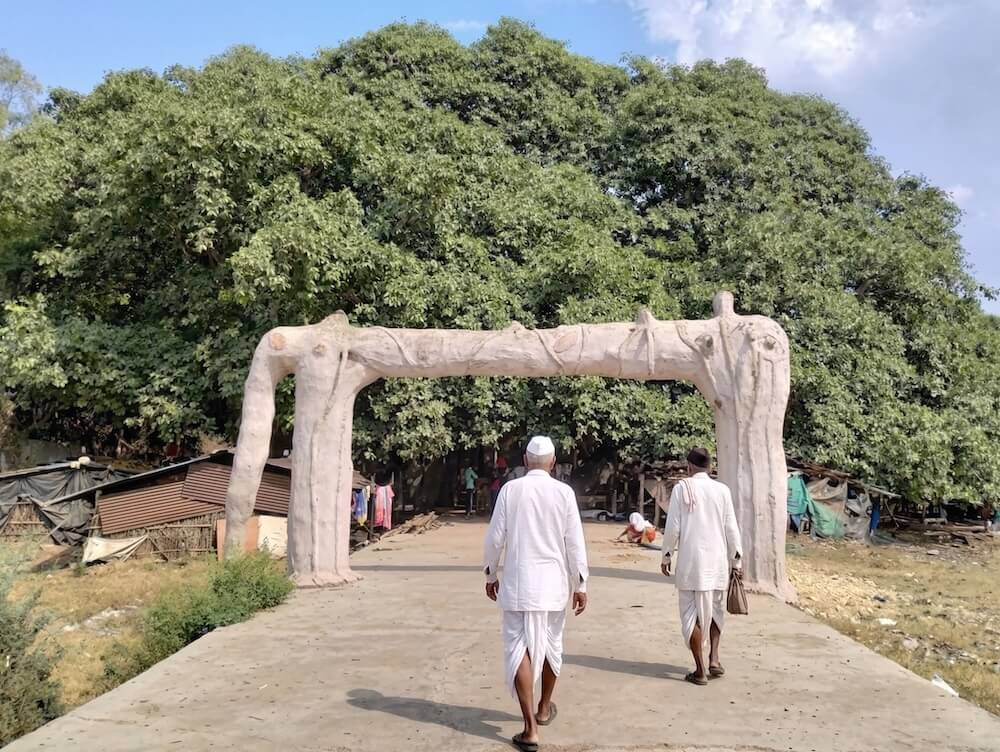
To reach this sanctuary, one travels from Bharuch via Shuklatirth toward Zhanor to a spot known as Kabir Madhi on the banks of the Narmada. From there, boats ferry pilgrims to the island. After arriving at this shore, at a short distance one sees an entrance gate shaped like a wooden arch. From this gateway begins the realm of Kabirvad. Walking further from here, on the left one comes upon the darshan of a Shivalinga. Near this Shivalinga there is also an idol of Ganesh. In the vicinity there are a few stalls selling food items as well. Everywhere one beholds the thick aerial roots, sunk deep into the earth, of this immense banyan which is a refuge for thousands of birds and also for creatures such as monkeys and squirrels. To this day, no one has been able to discover the original root of this ancient tree. At some distance stands the Kabir temple. In the three-storeyed building in front of this temple, accommodation is available.
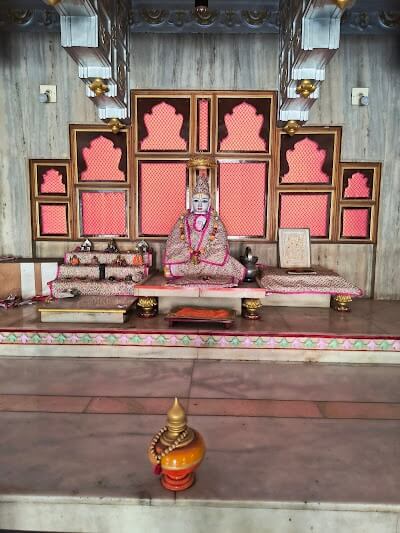
In 1987, the structure of the Kabir temple was built here. This circular temple, with its attractive colour scheme, has an ornate entrance gateway. A fine example of modern sculpture, the temple is crowned by a lofty shikhar bearing a two-tiered amalak and kalash. The interior is finished entirely in marble and the ‘sabhamandap’ (assembly hall) is accessed via staircases on two sides. On the upper portion of the entrance to the sabhamandap, in the centre, there is a sculpture of Ganesh. In the grand sabhamandap, many devotees can sit at the same time. In niches near the garbhagriha are the places of Hanuman and Ganesh. Between the sabhamandap and the garbhagriha there is stainless steel railing. Upon a marble pedestal in the garbhagriha stands the idol of Sant Kabir.
Hundreds of pilgrims visit Kabirvad seeking both the joy of nature and spiritual serenity. On the day of ‘Kartik Purnima’ (the full moon of the month of Kartik), the Ram-Kabir sect organises a magnificent ‘yatra’ (fair). Devotees from Gujarat, Madhya Pradesh and Maharashtra flock to the island during this time. A unique tradition of this fair involves the distribution of ‘Kaliroti’ as ‘prasad’ (consecrated food) to the gathered faithful.
Main Features :
- 16 km away from Bharuch
- ST (State Transport) bus facility available from Bharuch
- Private vehicles can reach up to the parking
- Accommodation and breakfast facilities are available in the vicinity
कबीरवाद
मंगलेश्वर, तालुका और जिला भरूच
मंदिरे
Temples
मंदिर
-
कोटेश्वर महादेव मंदिर कदोद, ता. भरुच, जि. भरुच
अधिक माहितीKoteshwar Mahadev Temple Kadod, Tal. Bharuch, Dist. Bharuch
View Detailsकोटेश्वर महादेव मंदिर कडोद, ताल. भरूच, जिला. भरूच
विवरण देखें -
धर्मेश्वर महादेव मंदिर धर्मशाळा-झानोर, ता. भरुच, जि. भरुच
अधिक माहितीDharmeshwar Mahadev Temple Dharmashala-Jhanor, Tal. Bharuch, Dist. Bharuch
View Detailsधर्मेश्वर महादेव मंदिर धर्मशाला-झानोर, ताल. भरूच, जिला. भरूच
विवरण देखें -
साईबाबा मंदिर रामवाटिका सोसायटी, झाडेश्वर, ता./जि. भरुच
अधिक माहितीSai Baba Temple Ramvatika Society, Zadeshwar, Tal./Dist. Bharuch
View Detailsसाईं बाबा मंदिर रामवाटिका सोसायटी, जादेश्वर, ताल./जिला. भरूच
विवरण देखें