
गलतेश्वर महादेव मंदिर
सरनाल, तालुका ठासरा, जिल्हा खेडा
Galteshwar Mahadev Temple
Sarnal, Taluka Thasra, District Kheda
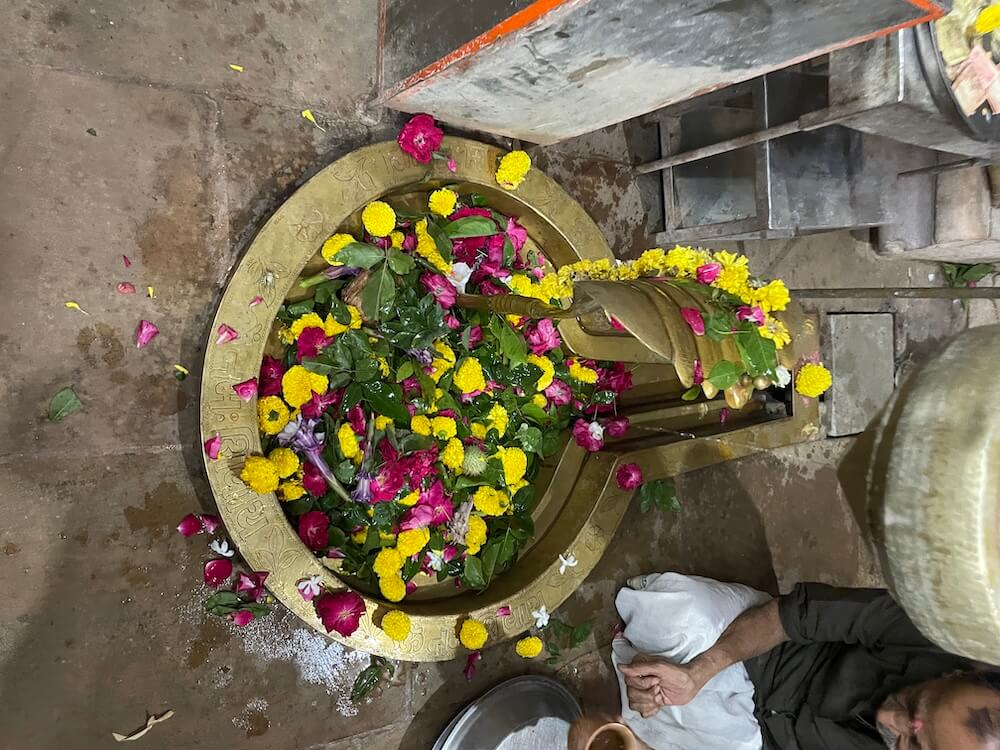 A testament to the ancient temple grandeur of Gujarat, a Shiva temple adorned with countless sculptures and intricate craftsmanship is situated at Sarnal in the Kheda district. This exquisite shrine rests at the confluence of the Mahisagar and Galti rivers, located approximately 16 km from Dakor, the renowned Vaishnava pilgrimage site famous for the temple of Lord Ranchhodraji. It is celebrated as Galteshwar Mahadev. According to the Archaeological Survey of India, this temple was established in the latter half of the twelfth century. Recognised as a potent centre of spiritual energy, the temple is frequented by large numbers of devotees and scholars of ancient architectural sculpture.
The history of this temple is intimately entwined with the annals of the Solanki (Chalukya) dynasty. 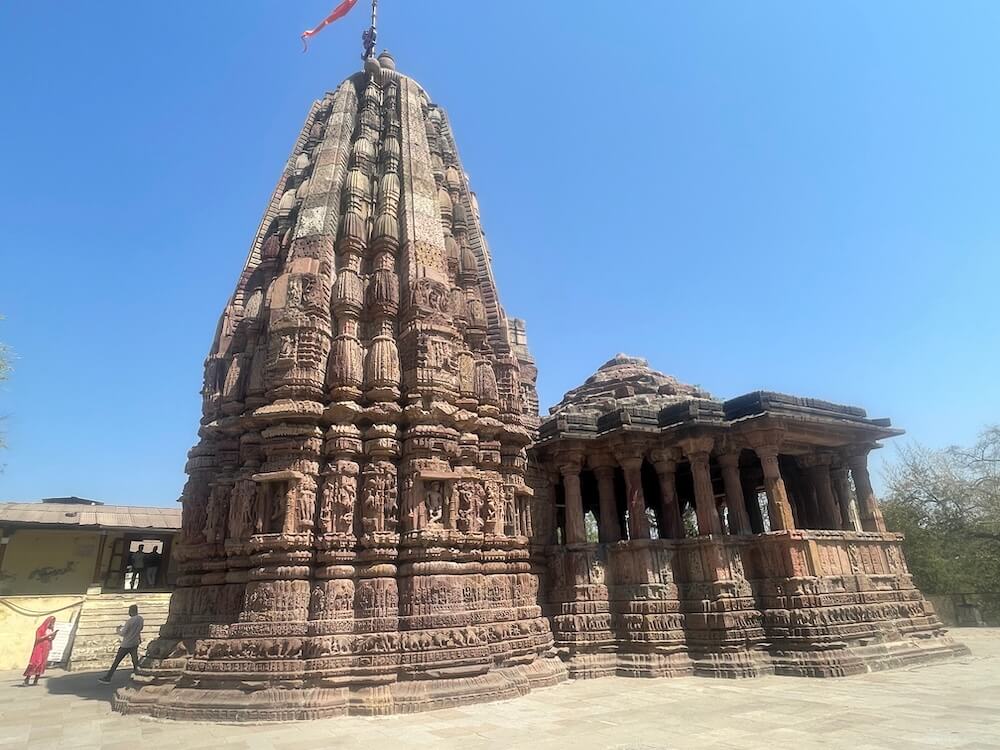 Mularaja was the founder of the Solanki lineage. He was the nephew and army commander of King Samantsinh of the Chavda dynasty, who had nurtured him since childhood. According to the ‘Kumarapala-charita’ authored by the famous Jain Acharya Hemachandracharya and the ‘History of the Gujarat Country’ by Lokhitwadi Gopal Hari Deshmukh, Mularaja assassinated his maternal uncle, Samantsinh and established the Solanki dynasty at Anhilwad Patan in 942 AD. This lineage was devout worshippers of Lord Shiva. Mularaja had constructed a magnificent Shiva temple named ‘Rudra Mahalaya’ at Siddhpur. Furthermore, acting upon a divine vision granted by Lord Shiva, he attacked King Graharipu of Vamansthali in the Gir region, who used to plunder devotees travelling to Somnath. A great monarch of the Solanki dynasty, Siddharaj Jaisinh (reign 1094–1143),
  was also a follower of the Shaiva sect. Numerous Shiva temples were erected during his era. His successor, Kumarapala (reign 1143–1172), was also initially a devotee of Shiva. Although he later embraced Jainism, he continued to commission several Hindu temples. Scholars estimate that this remarkably beautiful temple was likely established during the reign of King Kumarapala.
Two legends are recounted regarding this temple. According to one tale, it derived the name Galteshwar Mahadev from the Galti river flowing nearby. The second legend suggests that Sage Galava performed rigorous penance here for many years. Ancient texts mention three individuals named Galava : one was a grammarian whose views are quoted in the ‘Nirukta’ and ‘Aitareya Aranyaka’. 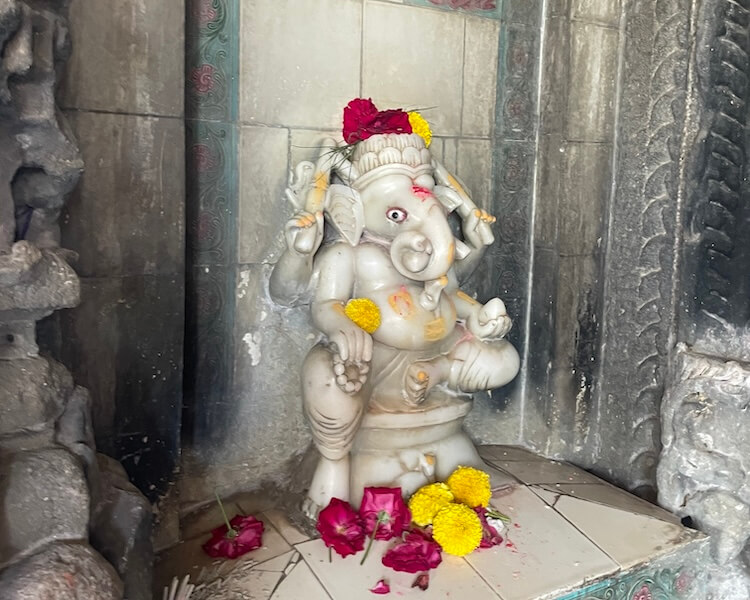 The second was a master of Ayurveda who composed the ‘Shalakyatantra’ and was recorded by Sage Charaka as attending a gathering of sages in the Himalayas. The third, Sage Galava, was a disciple of Vishwamitra and the foster father of Madhavi, the daughter of King Yayati and one of the ‘Panch Pativratas’. While it remains unknown which Sage Galava is associated with this site, it is said that due to his penance, a self-manifested (‘Swayambhu’) Shiva Lingam appeared here. Subsequently, the then King Chandrahas built a temple at the site, which was later reconstructed by the Solanki kings.
A few years after the temple’s construction, Gujarat faced foreign invasions, during which this shrine at Sarnal suffered significant damage. The invaders demolished the temple spire (‘Shikhara’) and defaced the sculptures. 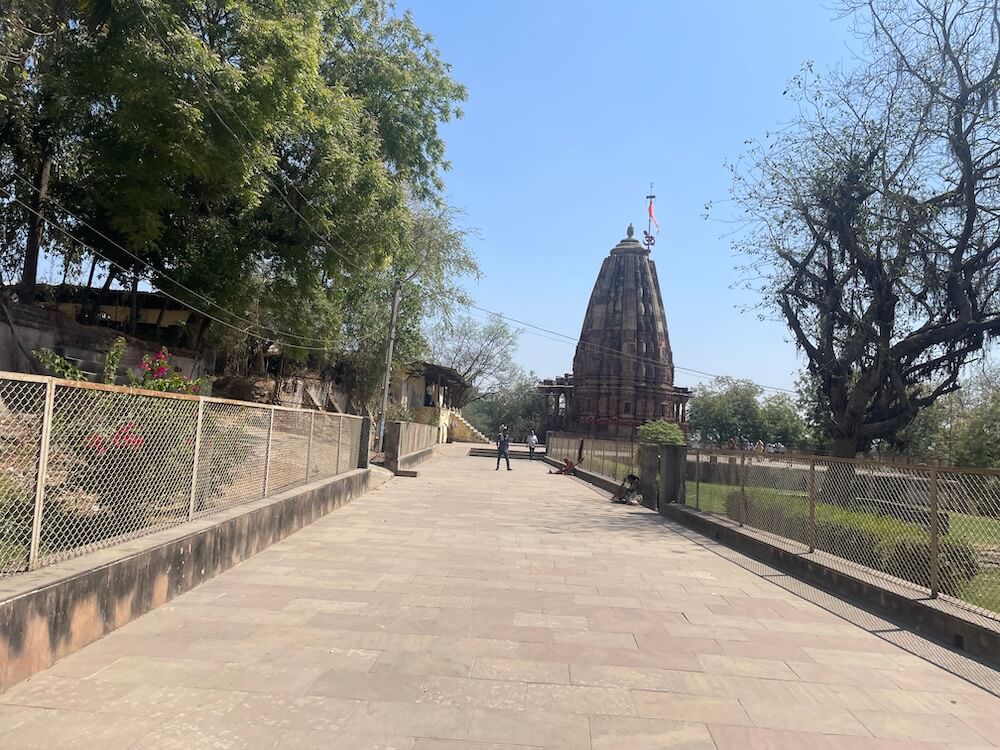 According to the Kheda District website of the Government of Gujarat, several attempts were made over the years to restore the spire to its original state. Finally, under the supervision of the Archaeological Survey of India (ASI), the ‘Gujarat Pavitra Yatradham Vikas Board’ completed the reconstruction of the spire in 2021.
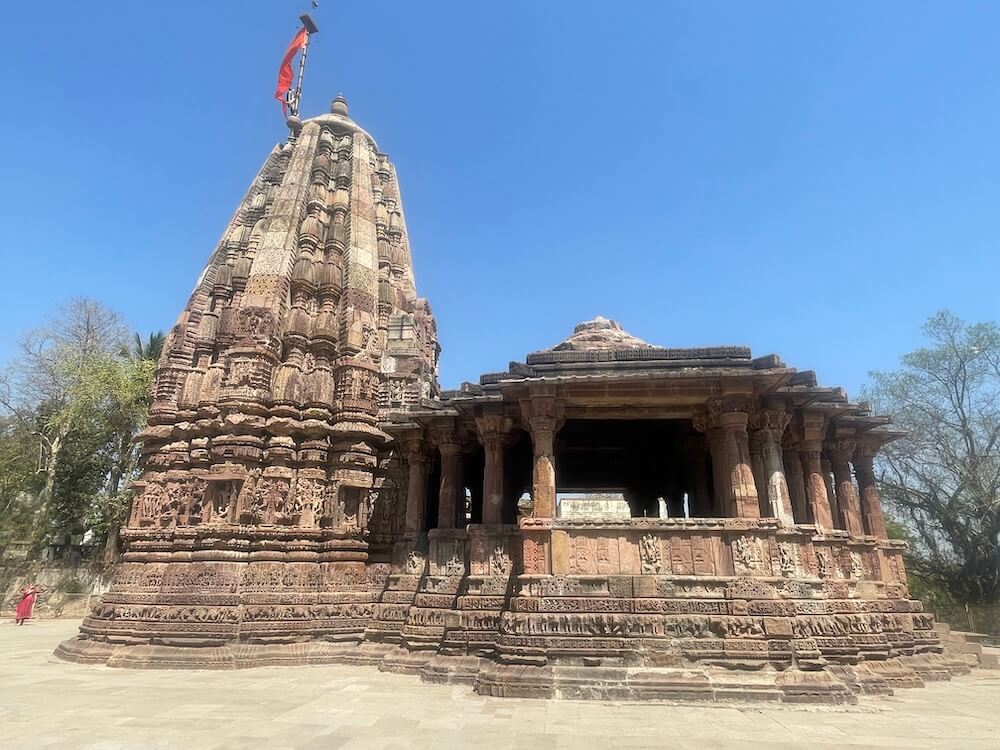
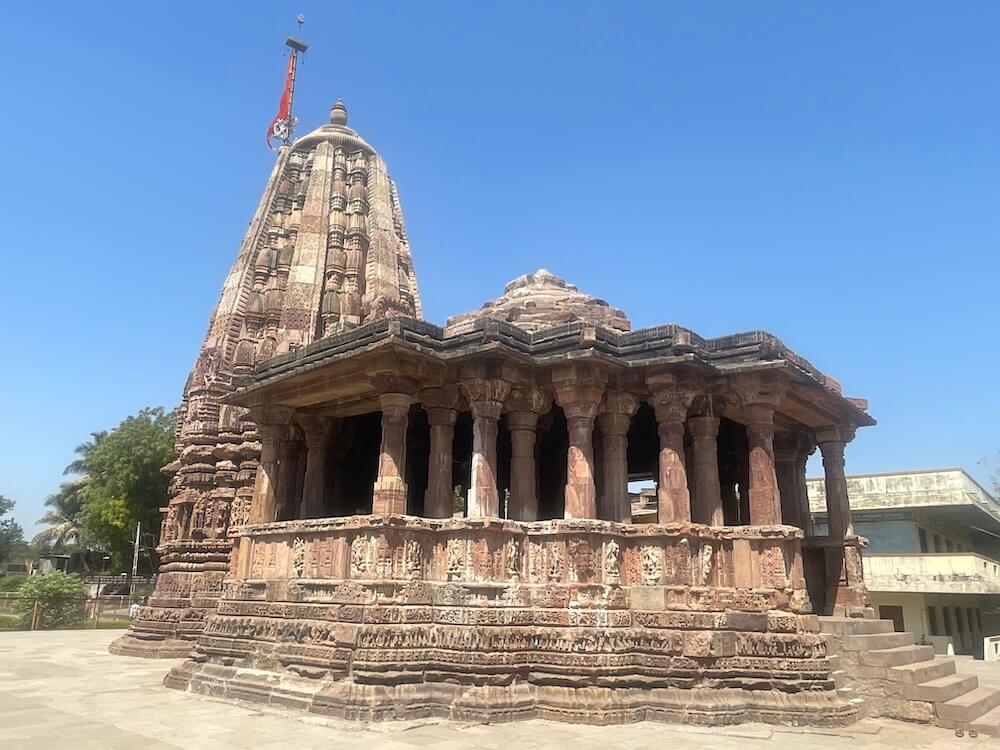
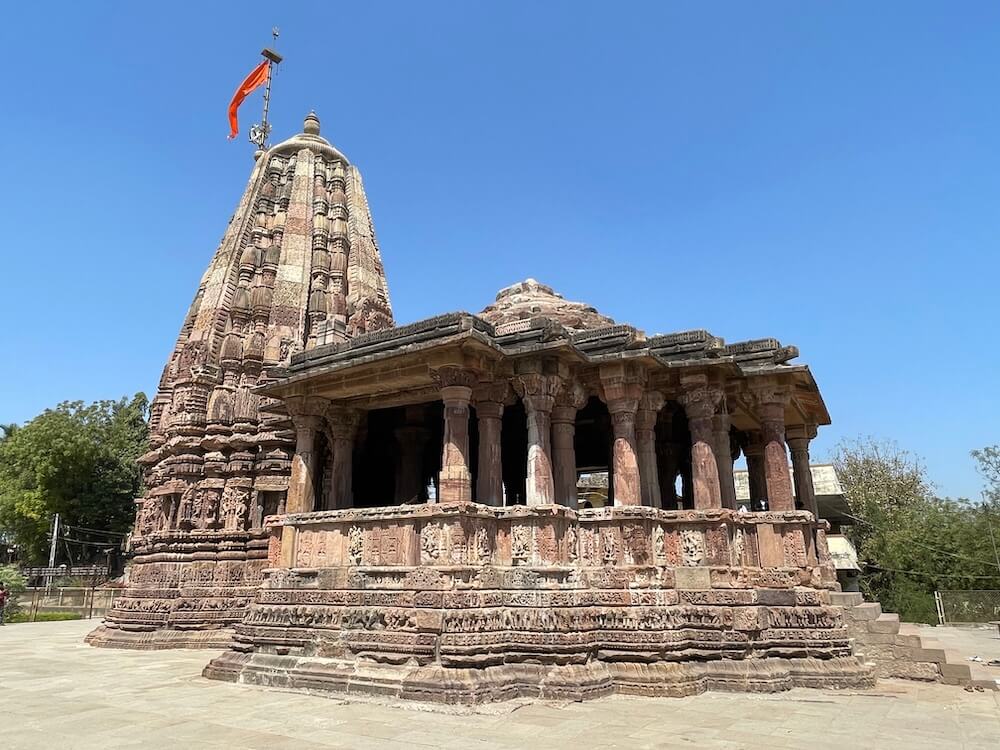
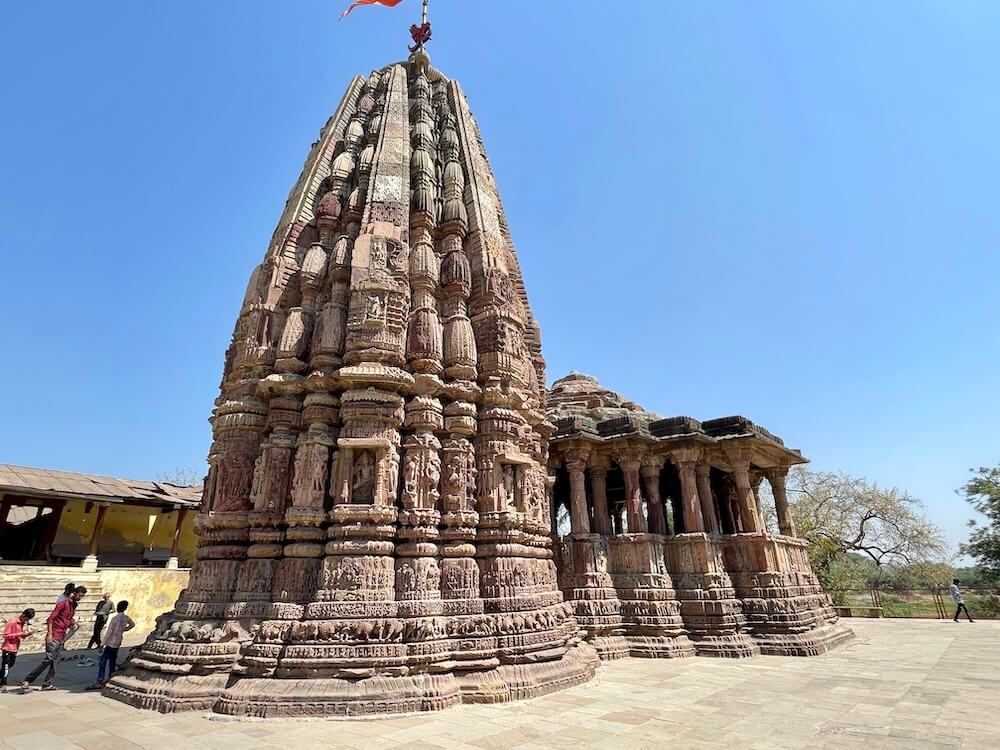
The temple precincts in Sarnal village house several shops selling ritual items and small eateries. A modest gateway leads into a spacious stone-paved courtyard. A short walk from this entrance brings one face-to-face with the ancient temple, built in the ‘Saptaratha Bhumija’ style. The ‘Bhumija’ style is primarily a sub-style of ‘Nagara’ architecture, possessing distinct regional characteristics. Detailed information regarding the specific design of ‘Bhumija’ temples is provided in the ‘Samarangana Sutradhara’,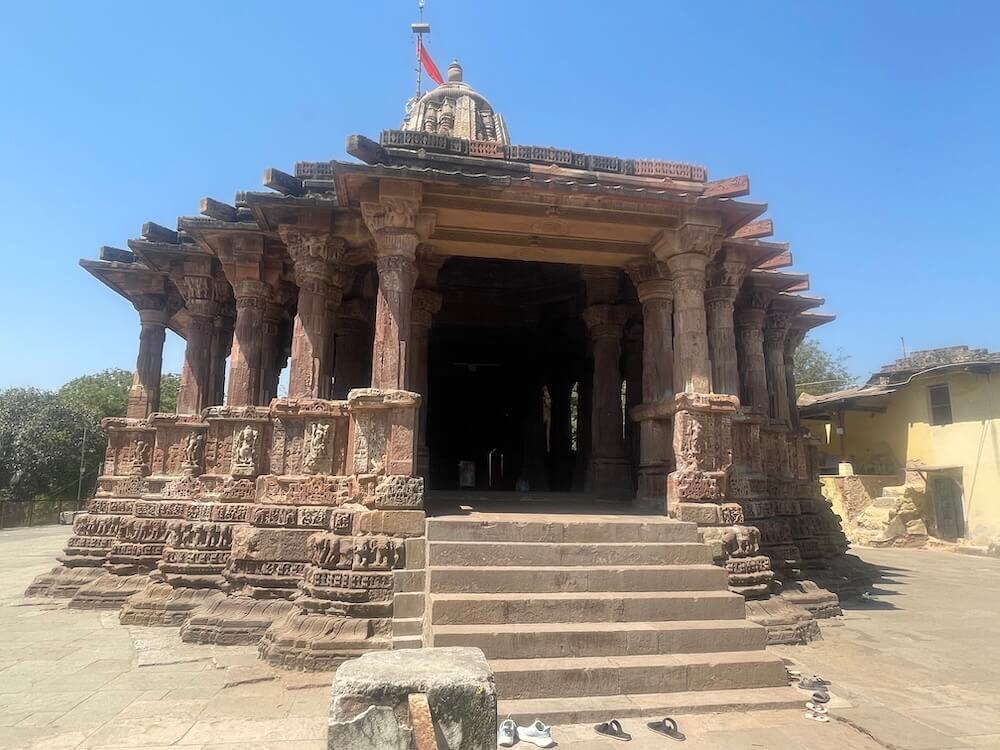 a treatise written by King Bhoja of Malwa. While such temples appear in Maharashtra from approximately the eleventh century, they are relatively rare in Gujarat.
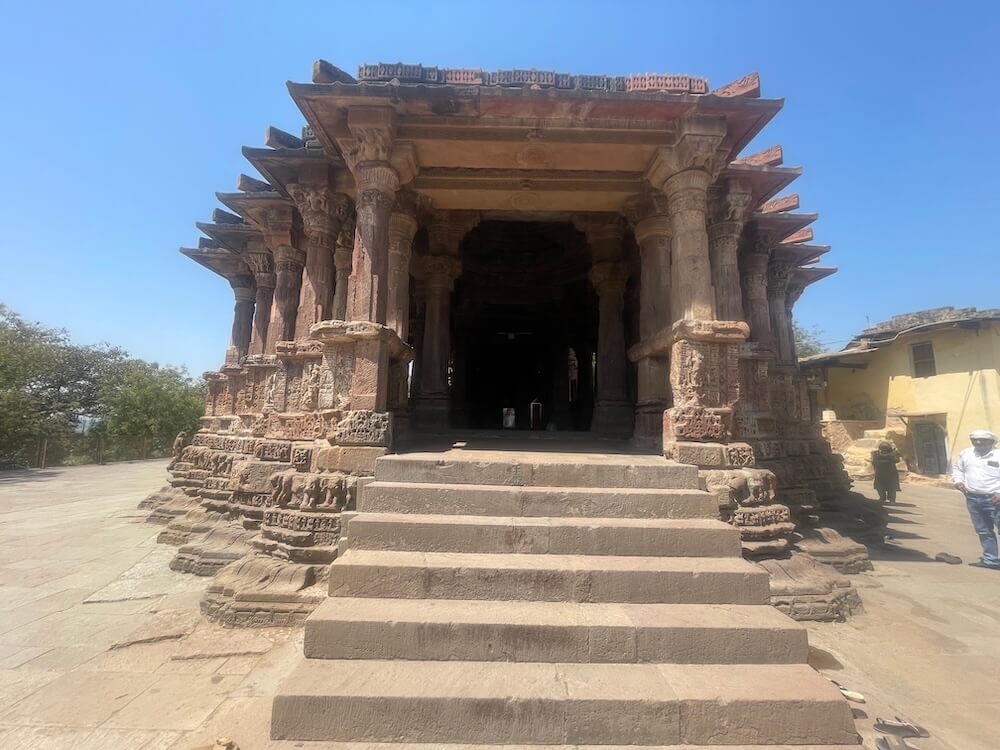
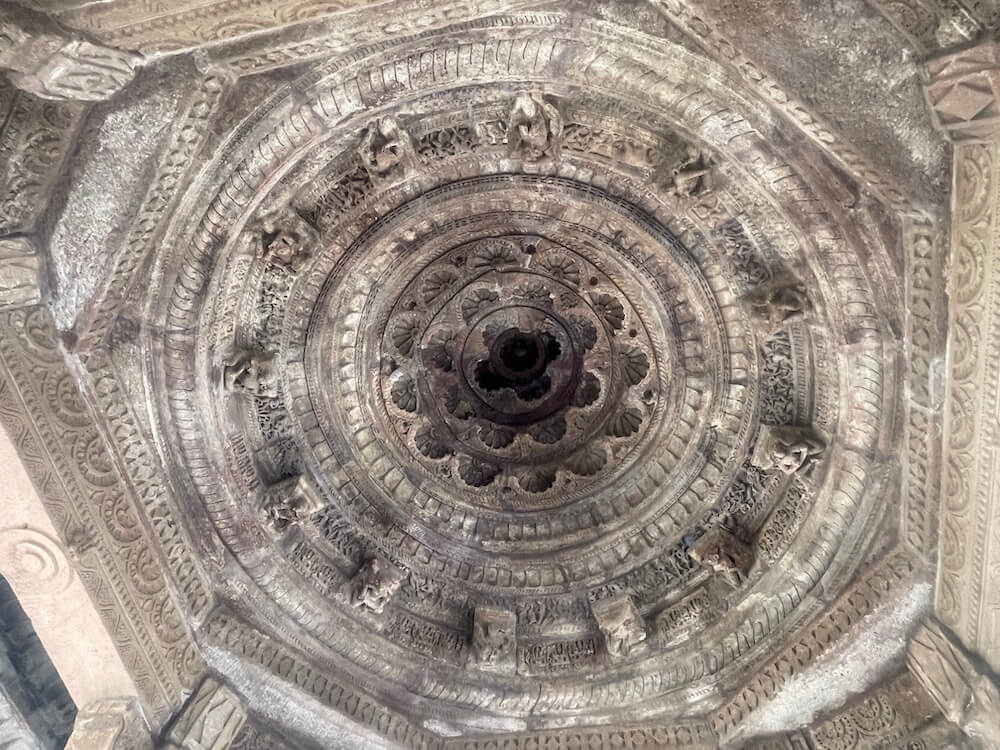
The temple structure comprises a ‘Sabhamandapa’ (assembly hall), an ‘Antarala’ (vestibule) and a ‘Garbhagriha’ (sanctum sanctorum). The ‘Sabhamandapa’ is star-shaped and follows a semi-open design, accessible via seven steps. The hall is supported by eight internal and sixteen external pillars, which bear the weight of the ceiling. Atop the ‘Sabhamandapa’ sits a dome-shaped roof. The bases (‘Stambha Pada’) of the pillars are square, while the shafts (‘Stambha Danda’) are circular, all of which are adorned with intricate carvings. The capitals of the pillars feature sculptures of weight-bearing ‘Kirtimukhas’ and ‘Yakshas’.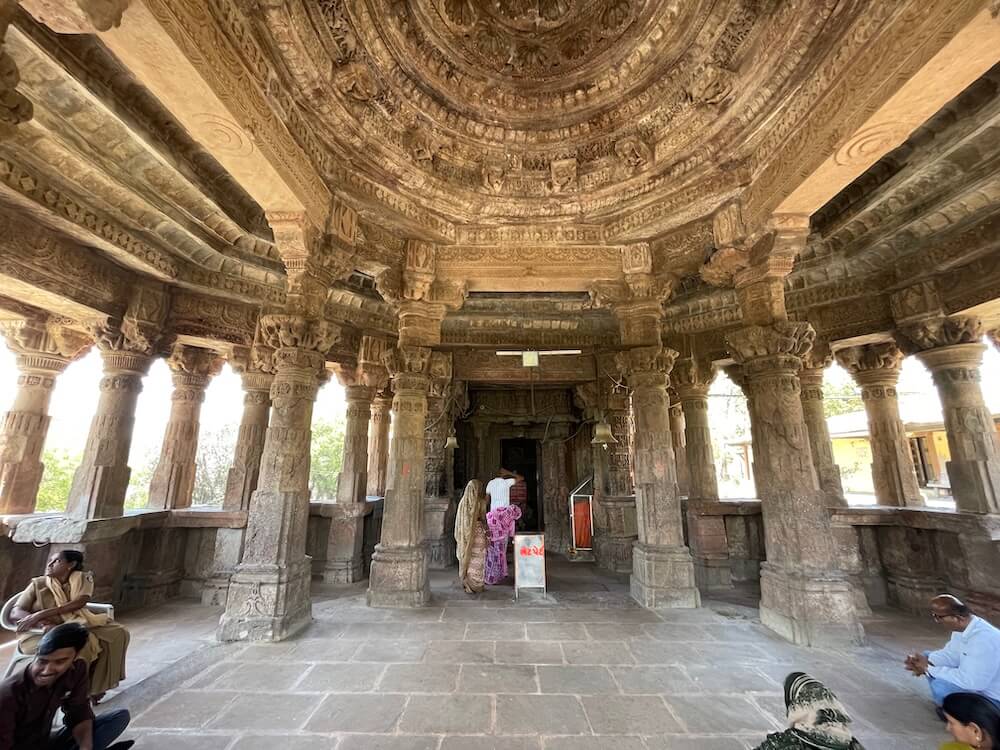 Within the hall lies a stone-paved ‘Rangashila’ (ceremonial floor). Above it, the ceiling is concave, resembling an inverted coconut shell, whereas the ceilings in the aisles of the hall are flat. These ceilings are carved with circular lotus motifs. At the front of the hall, a marble Nandi and a tortoise idol rest upon a stone pedestal.
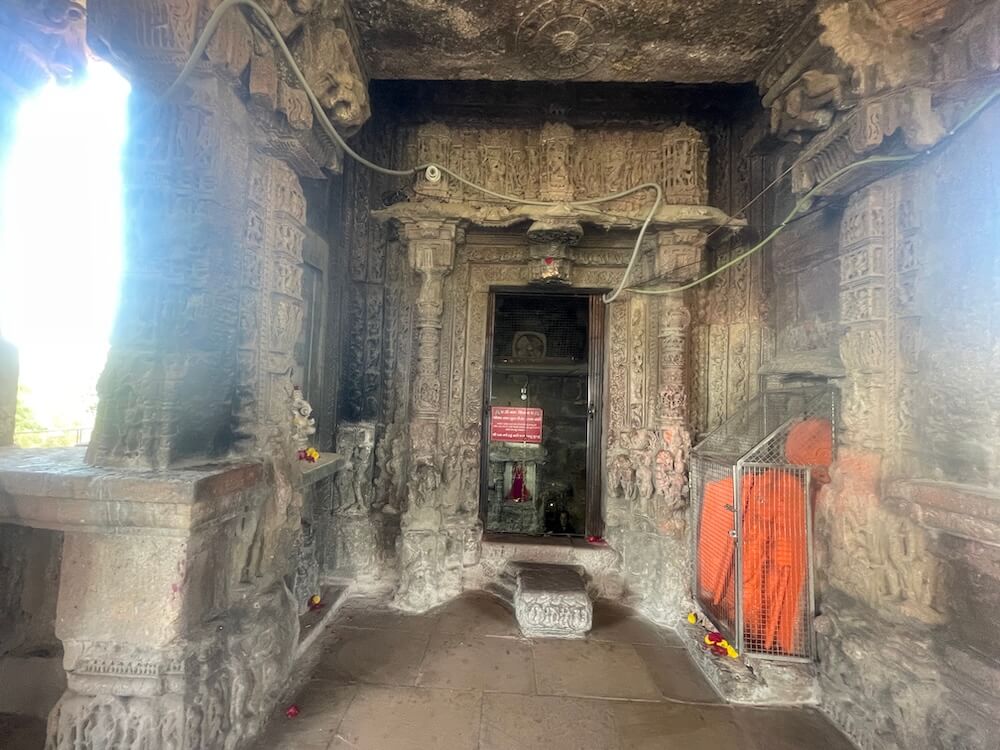
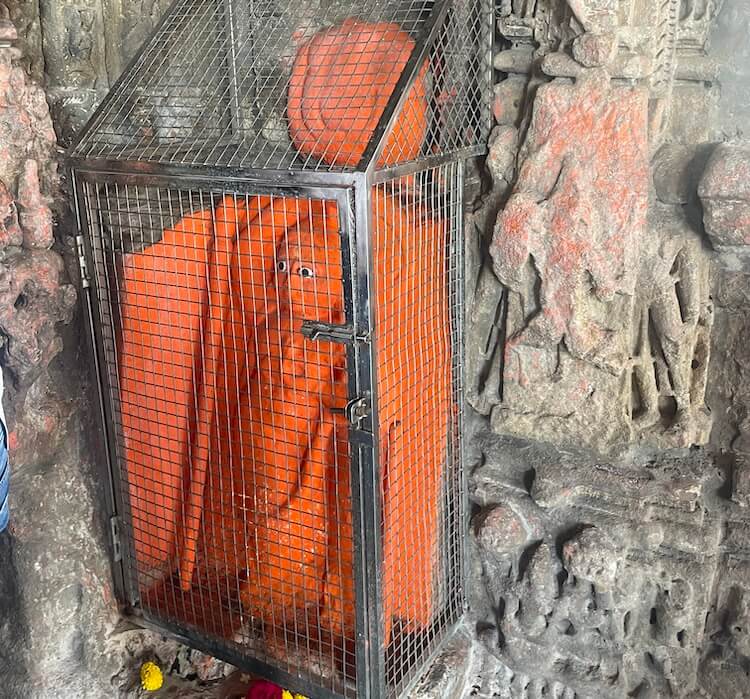
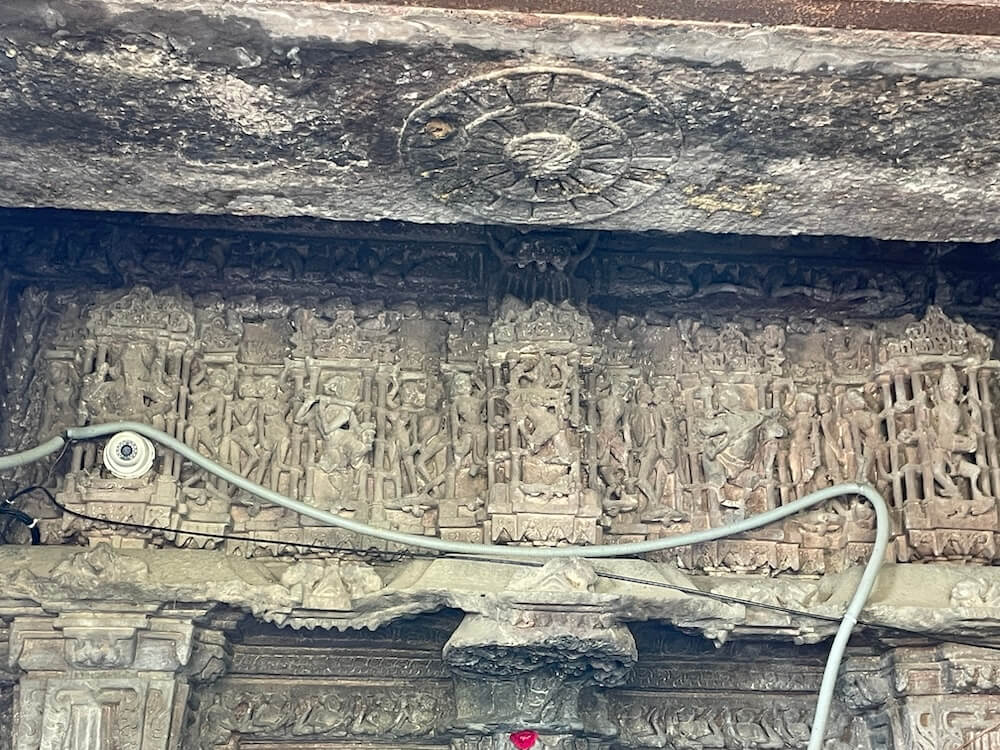
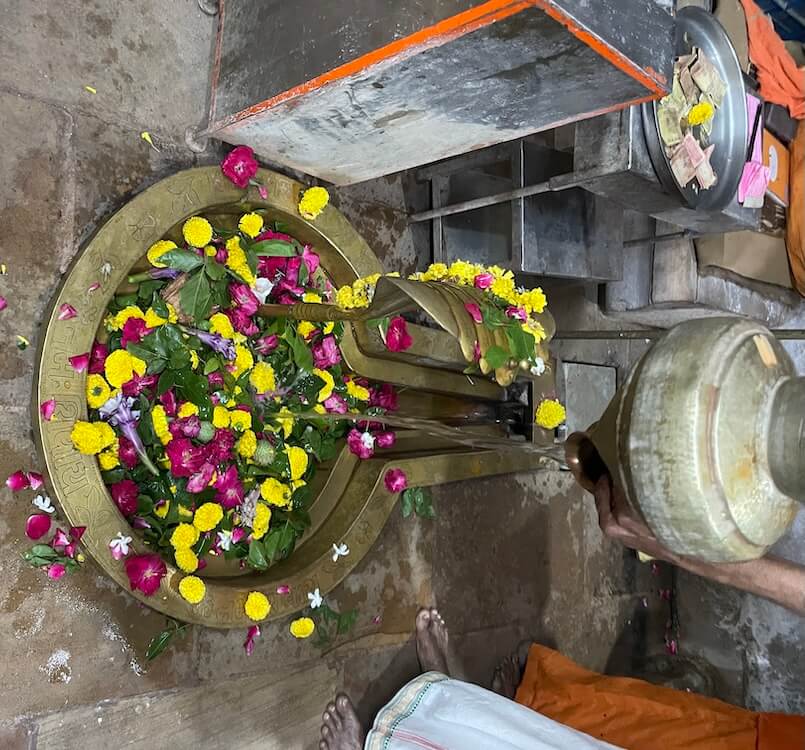
In the ‘Antarala’, a marble niche to the right houses an idol of Ganesha, while the left houses Hanuman. Hanuman’s stone-carved idols is coated with vermilion. The walls of the vestibule are also engraved with numerous small sculptures. The ‘Garbhagriha’ is of the ‘Nirandhara’ type, meaning it lacks an enclosed circumambulation path around the inner sanctum. 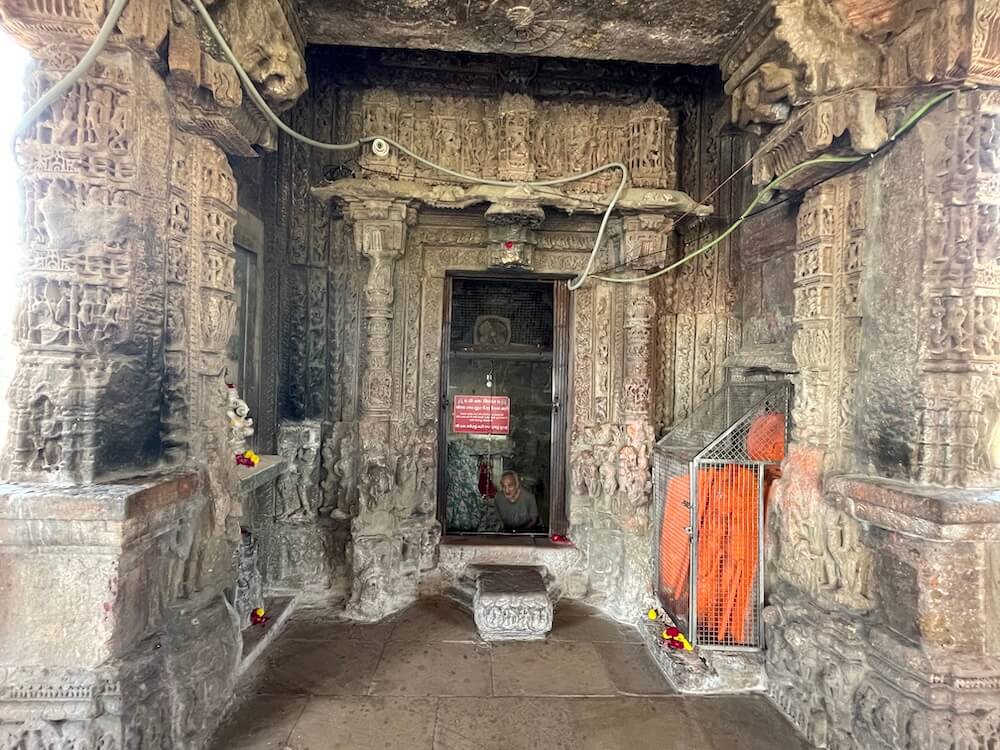 The entrance to the sanctum is a ‘Saptashakha’ (seven-layered) doorway, with each layer of the frame carved with floral and leaf patterns. One of the pillars is semi-circular in shape. Carved at the base of these pillars are the figures of Ganga and Yamuna, along with doorkeepers, Gandharvas and Apsaras. The ‘Lalatabimba’ (central pediment) of the doorway features a carving of Ganesha. The threshold (‘Mandaraka’) is elevated, preceded by a ‘Chandrashila’ (moon-stone step). Above the lintel, the upper frieze depicts Lord Shiva alongside various sculptures of ‘Surasundaris’ (celestial beauties) and attendants. Inside the sanctum, a stone Shivalinga is situated within a ‘Jaladhari’ (‘Shalunka’ or base) positioned below ground level. A large brass serpent idol coils around the Shivlingaa, topped by a brass ‘Galantika’ (water-dripping vessel). A marble four-armed idol of Mata Parvati resides in a nearby niche.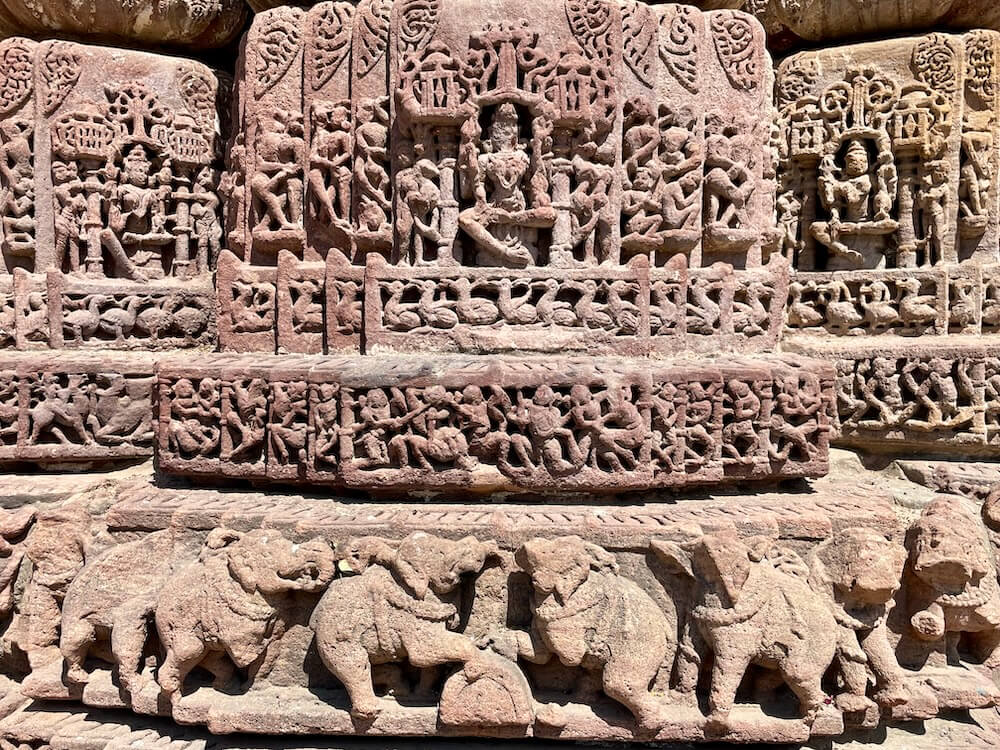
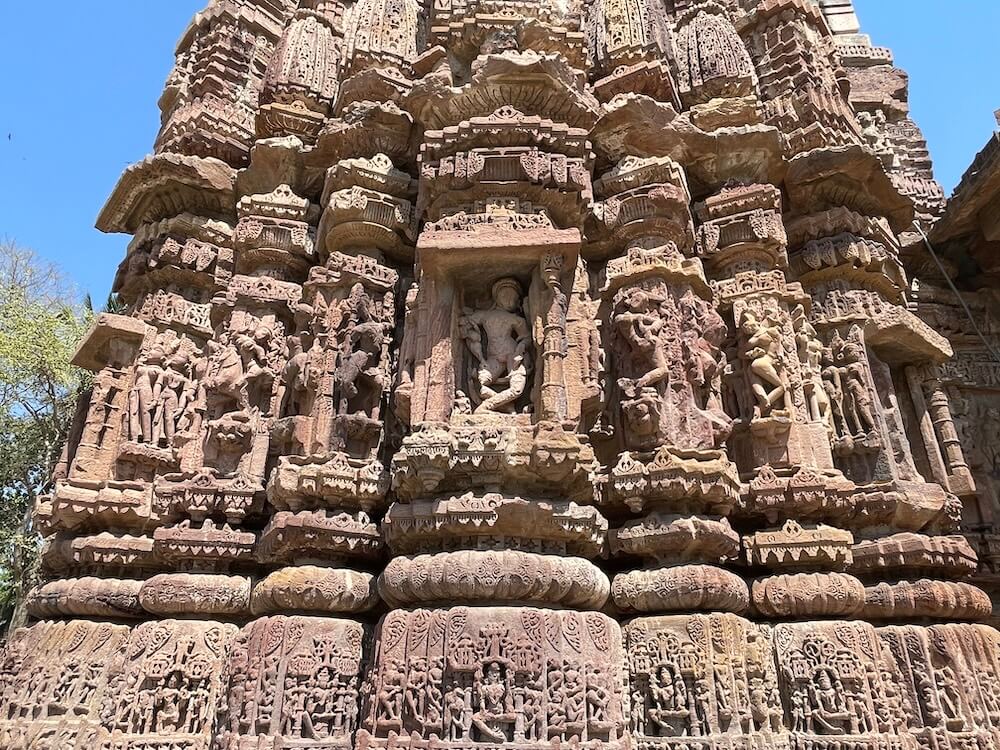
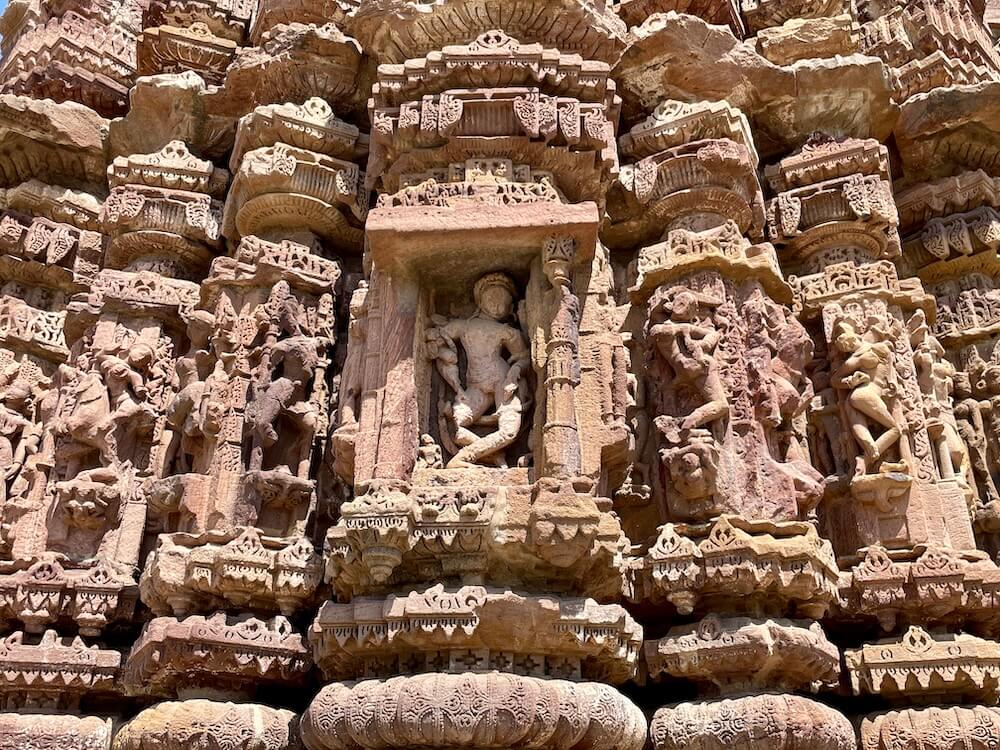
The exterior walls of the sanctum and the assembly hall are known as the ‘Mandovara’. The lower portion of this wall (‘Jangha’) is covered in countless carvings. The ‘Gajathar’ (row of elephants) and ‘Narathar’ (scenes from human life) on these walls are particularly noteworthy. The sculptures depict men and women engaged in various activities, including some erotic art (‘Kamashilpa’). Niches on the ‘Mandovara’ of the sanctum house idols of various deities. The spire above the sanctum tapers upwards. Unique features of ‘Bhumija’ architecture, such as the ornamental bands (‘Mulmanjari’) and niches (‘Shurasenaka’), are visible on this spire. It is crowned by an ‘Amalaka’ shaped like a chariot wheel, supporting a ‘Kalasha’ (finial), with the ‘Dharmadhwaja’ (religious flag) fluttering above.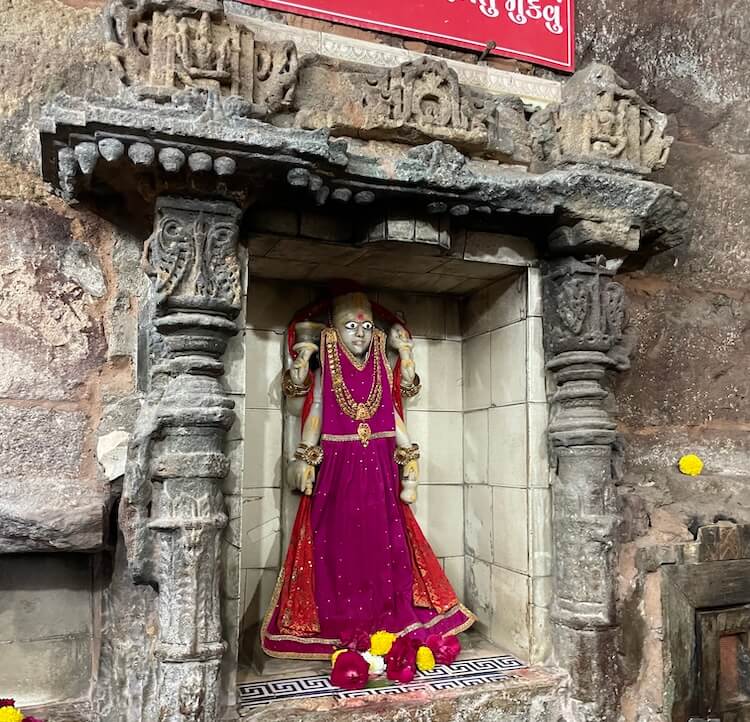
Devotees believe the Shiva Lingam here to be ‘Swayambhu’ and that its sight grants the fulfilment of wishes; consequently, the temple is always crowded. Similarly, scholars of architecture and tourists visit in great numbers to admire the craftsmanship. The grandest festival celebrated here is Mahashivratra, observed with immense fervour and attracting thousands of pilgrims. On this day, devotees bathe in the Mahisagar river at dawn before performing ‘Jalabhishek’ on Lord Shiva. Special prayers are conducted through the four watches (‘Prahars’) of the night, during which the Shivlingaa is anointed with milk, curd, honey and ghee. Elaborate arrangements of ‘Bel’ leaves are made. Furthermore, crowds gather on Shravani Mondays and Shravani Amavasya. Religious festivals, including Krishna Janmashtami, are celebrated with joy. Fairs are held on the temple grounds during Janmashtami and Sharad Purnima. The exuberance of Lord Krishna’s birth celebrations at the nearby Dakor temple finds a beautiful reflection at Galteshwar. 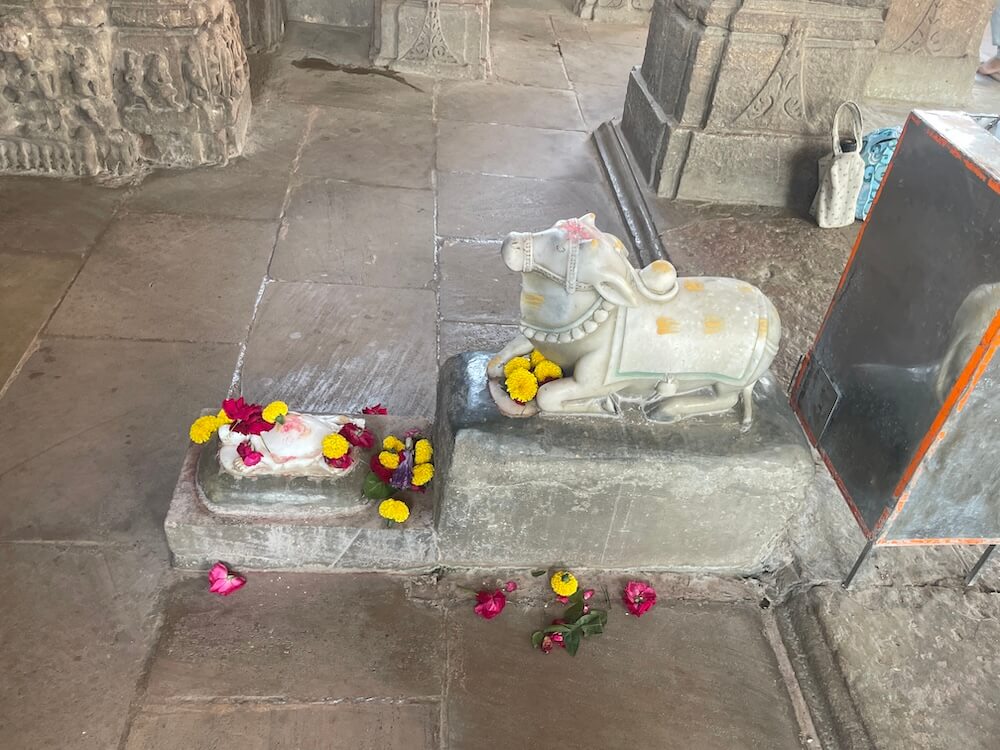 On Sharad Purnima, religious programmes are organised by the riverbank under the moonlight. This temple has been declared a protected monument by the Archaeological Survey of India. Devotees may visit for ‘Darshan’ daily from 6:00 am to 8:00 pm.
In 2022, the Government of Gujarat organised the 73rd ‘Van Mahotsav’ (Forest Festival) on the premises of the Galteshwar Mahadev Temple. Chief Minister Bhupendra Patel inaugurated the ‘Galteshwar Cultural Forest’ spanning five hectares. Over 300 plant species have been planted here, with the ‘Bel’ leaf forest and the Shivalinga-shaped garden serving as primary attractions for tourists. A children’s play area and a butterfly garden have been developed, while facilities such as a bamboo mist tunnel and a nature education centre make it an excellent location for students and researchers.
Useful Information
- Located at 24 km from Thasra and 80 km from Kheda
- GSRTC bus services are available from Thasra and Kathlal
- Private vehicles can reach the temple parking lot.
- Accommodation and breakfast facilities are available in the vicinity.
गलतेश्वर महादेव मंदिर
सरनाल, तालुका थसरा, जिला खेड़ा
मंदिरे
Temples
मंदिर
-
भूमपुरा हनुमान मंदिर भूमापुरा, मोडज, ता. महेमदावाद, जि. खेडा
अधिक माहितीBhumapura Hanuman Temple Bhumapura, Modaj, Tal. Mahemdavad, Dist. Kheda
View Detailsभूमापुरा हनुमान मंदिर भूमापुरा, मोडाज, ताल. महेमदावाद, जिला. खेड़ा
विवरण देखें -
भाथीजी महाराज मंदिर फागवेल, ता. कापडवंज, जि. खेडा
अधिक माहितीBhathiji Maharaj Temple Phagvel, Tal. Kapadvanj, Dist. Kheda
View Detailsभथीजी महाराज मंदिर फागवेल, ताल. कपडवंज, जिला. खेड़ा
विवरण देखें -
केदारेश्वर महादेव मंदिर महादेवपुरा, ता. कठालाल, जि. खेडा
अधिक माहितीKedareswar Mahadev Temple Mahadevpura, Tal. Kathlal, Dist. Kheda
View Detailsकेदारेश्वर महादेव मंदिर महादेवपुरा, ताल. कठलाल, जिला. खेड़ा
विवरण देखें