
ISKCON Temple
Nugar Circle, Mehsana Bypass Highway, Tal / Dist. Mehsana
 Chaitanya Mahaprabhu was a transcendent Vaishnava saint of Bengal, who established the profound significance of the Holy Name, proclaiming that devotion to the Supreme Lord is superior to mere intellectual knowledge of the Brahma and that God-realisation is attainable through the accessible path of ‘Bhakti’. The ‘International Society for Krishna Consciousness’ (ISKCON) is an organisation based on the Gaudiya Vaishnava philosophy he advocated. ISKCON has built grand Krishna temples worldwide to promote devotion to Krishna. These temples help to make the philosophy of the Shrimad Bhagavad Gita and Vedic Dharma accessible to people. The temple in Mehsana, Gujarat, is one of ISKCON’s important shrines.
The founder of ISKCON is A. C. Bhaktivedanta Swami Prabhupada, widely known as Shrila Prabhupada. He was born as Abhay Charan De on 1st September 1896 in Kolkata. 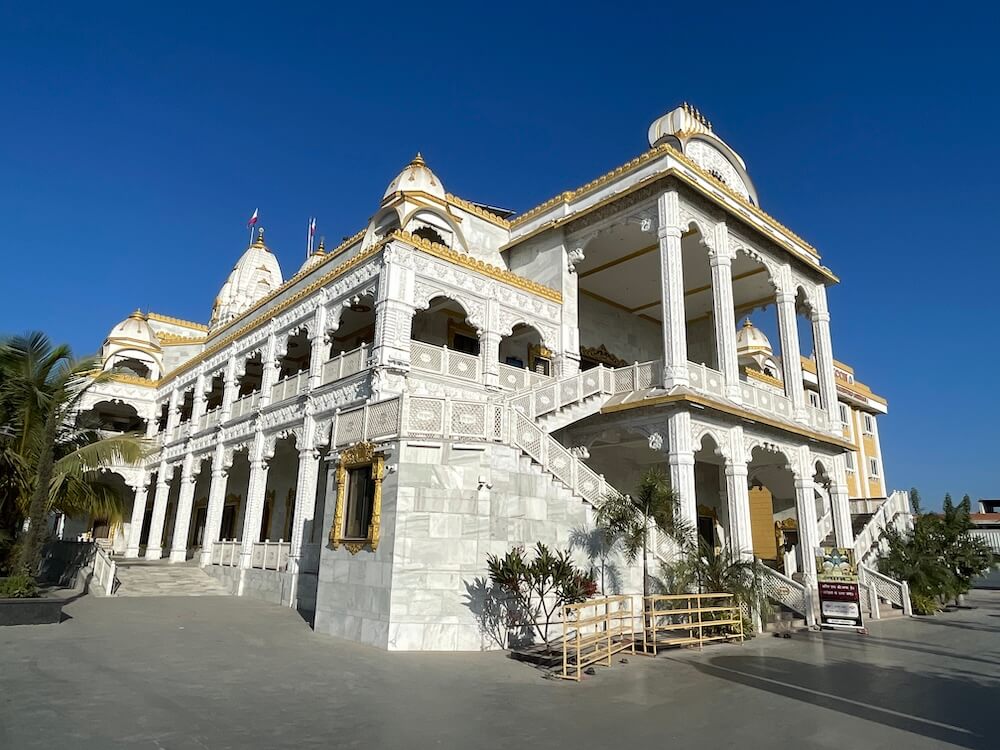 His pious parents, Gour Mohan De and Rajani, raised him with Krishna devotion from childhood. He attended Scottish Church College in Kolkata and mastered English, Sanskrit and other subjects. In 1922, Prabhupada met Bhaktisiddhanta Sarasvati Thakur, a saint from the Shri Gaudiya Vaishnava lineage. He received formal initiation in 1933 and became a preacher of the Vaishnava tradition. Prabhupada managed a pharmaceutical business to support his family for some time. After 1950, he retired from worldly life to devote himself entirely to Krishna devotion and spiritual work. In 1959, he took up the ‘Sannyasa’ order and became A. C. Bhaktivedanta Swami.
Bhaktisiddhanta Sarasvati, his guru, desired that Swami Prabhupada bring Lord Krishna’s teachings to the Western world in English.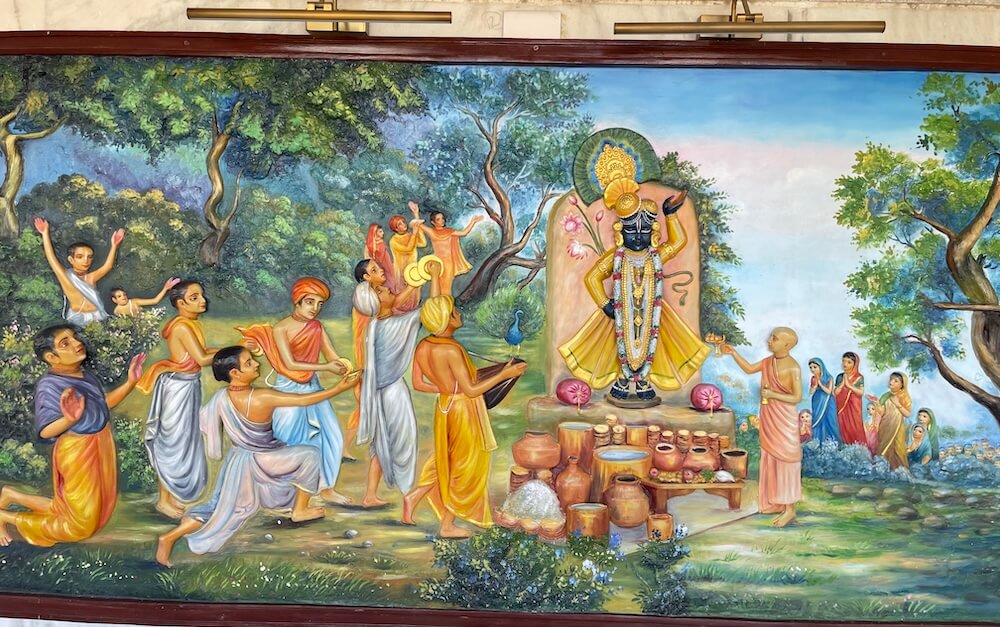 Swami Prabhupada wrote ‘Bhagavad-gita As It Is’. He also translated the Shrimad Bhagavatam and other Vaishnava scriptures. In 1965, at sixty-nine, he faced many challenges, including two heart attacks on the journey and travelled to America. ISKCON was founded in New York in 1966 with his vision. The main aim was to share the Bhagavad Gita and Vaishnava philosophy globally. He taught the masses the ‘Hare Krishna Mahamantra’ and started a movement based on it. Swami Prabhupada wrote over seventy books, including commentaries on the Bhagavad Gita, Shrimad Bhagavatam and Chaitanya Charitamrita. He passed away on 14th November 1977 at the Krishna Balaram Temple in Vrindavan.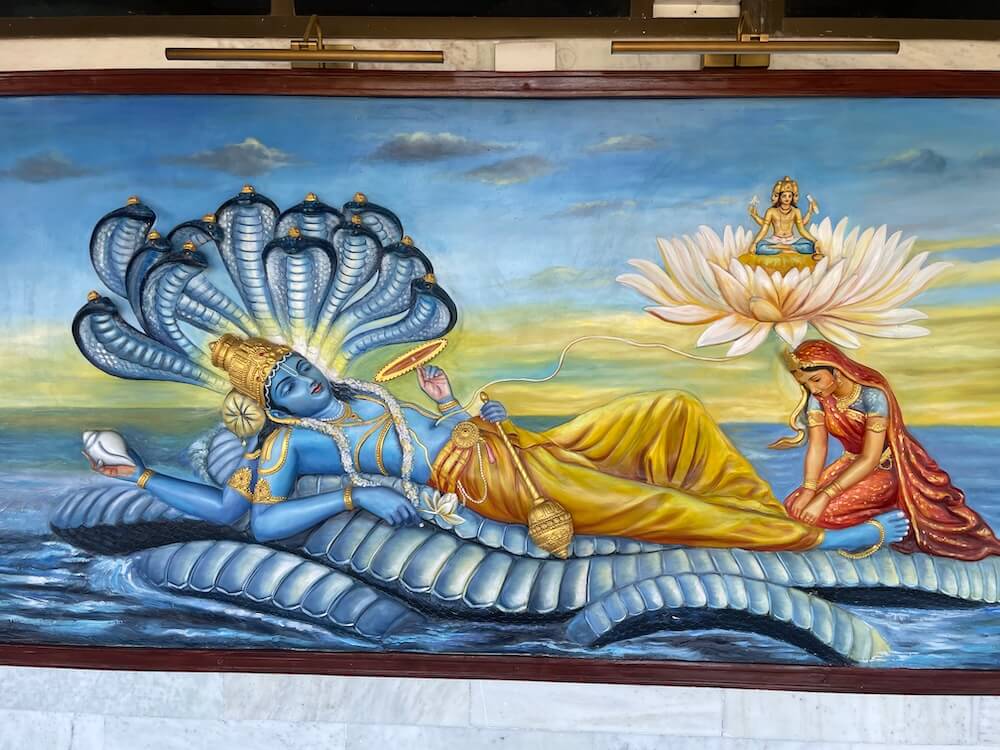
Today, hundreds of ISKCON temples are located in over 100 countries, where Lord Krishna is exclusively worshipped. This practice originates in the ninth chapter of the ‘Shrimad Bhagavad Gita,’ ‘Raja-Vidya-Raja-Guhya-Yoga,’ where Krishna declares that worshipping other demigods is born of ignorance. The verse states : ‘O son of Kunti, even those who faithfully worship other demigods are actually worshipping Me alone, but do so in an unauthorised way, characterised by ignorance.’ Accordingly, only Lord Krishna is worshipped in this temple at Mehsana.
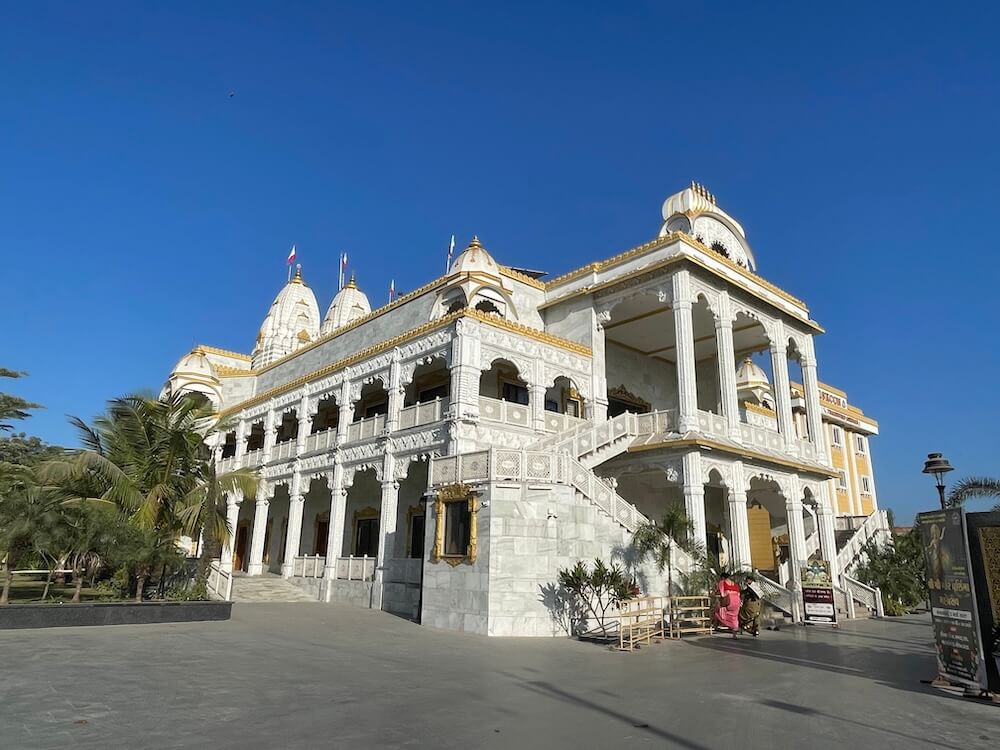
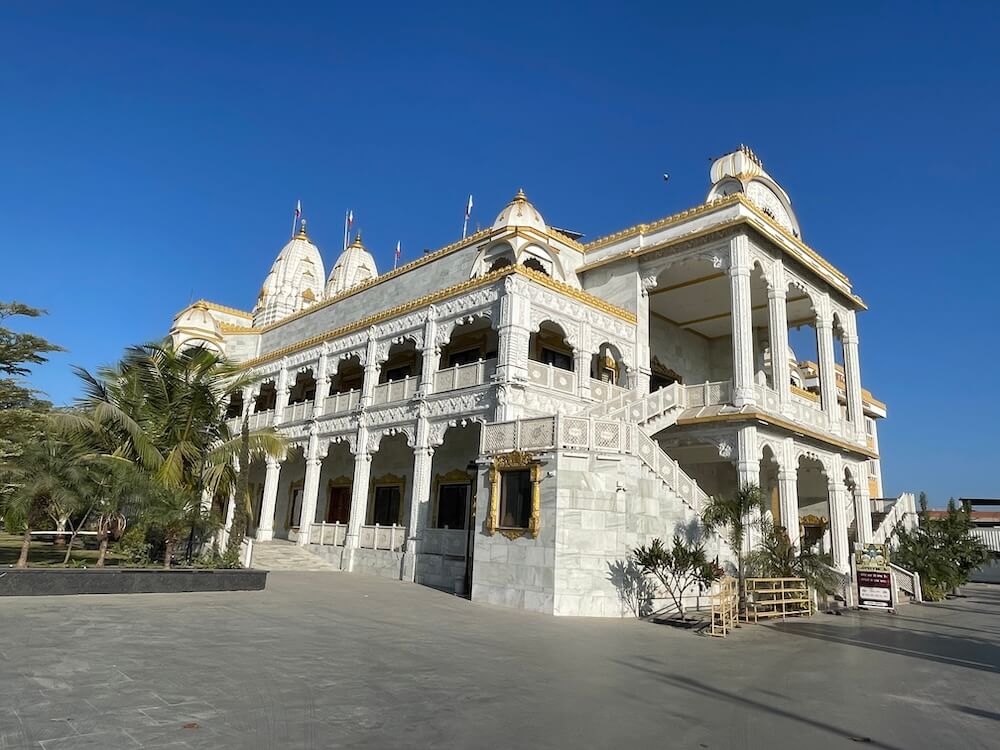
This grand temple is near Nugar Circle on the Mehsana Bypass Highway. Navayogendra Swami Maharaj guided its development. The foundation stone was laid in 2014. 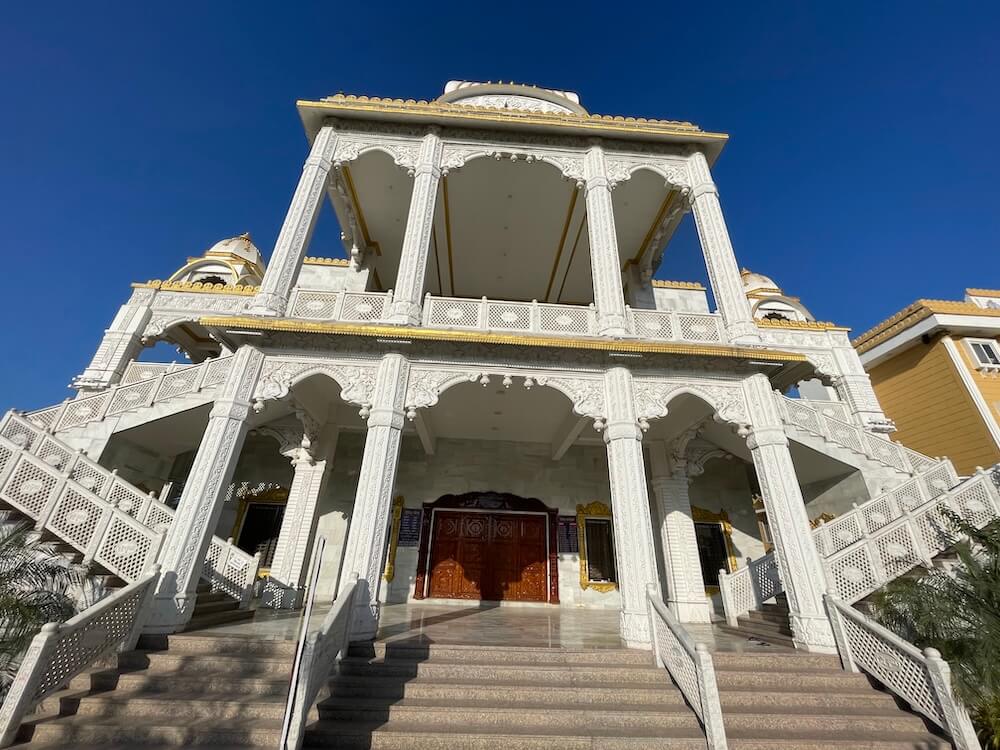 The main assembly hall was finished and opened to devotees in 2016. The temple grounds are picturesque and very tranquil. Near the entrance, there is a beautiful garden with slides, swings and see-saws for children. There is also a black marble wall in the garden. The ‘Hare Krishna’ Mahamantra is inscribed here in golden English letters and it attracts visitors’ attention. Special seats have been arranged in this area for devotees to sit and chant ‘Japa’.
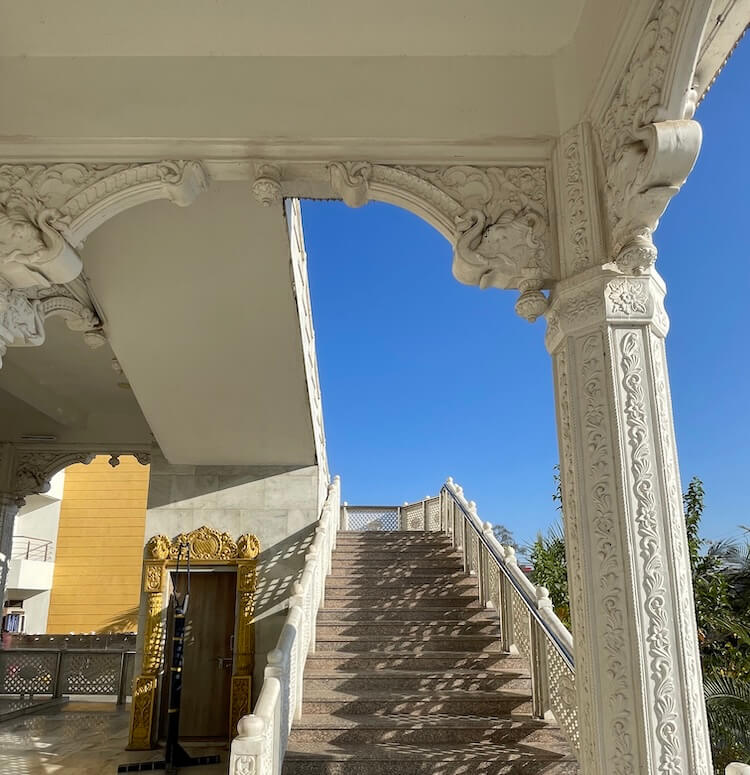
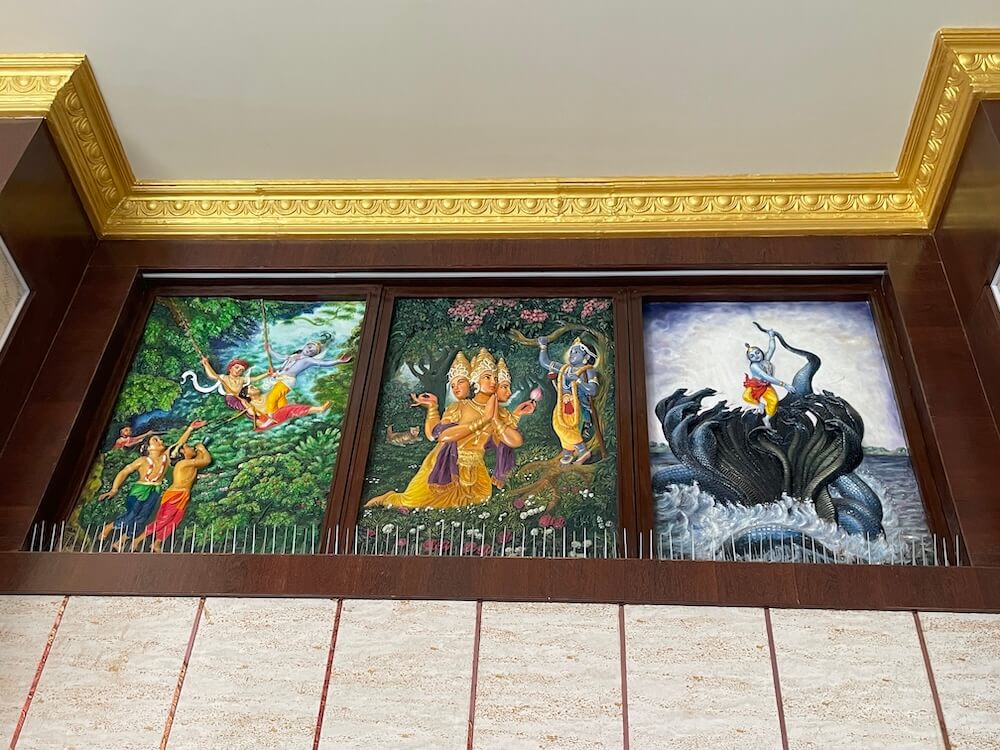
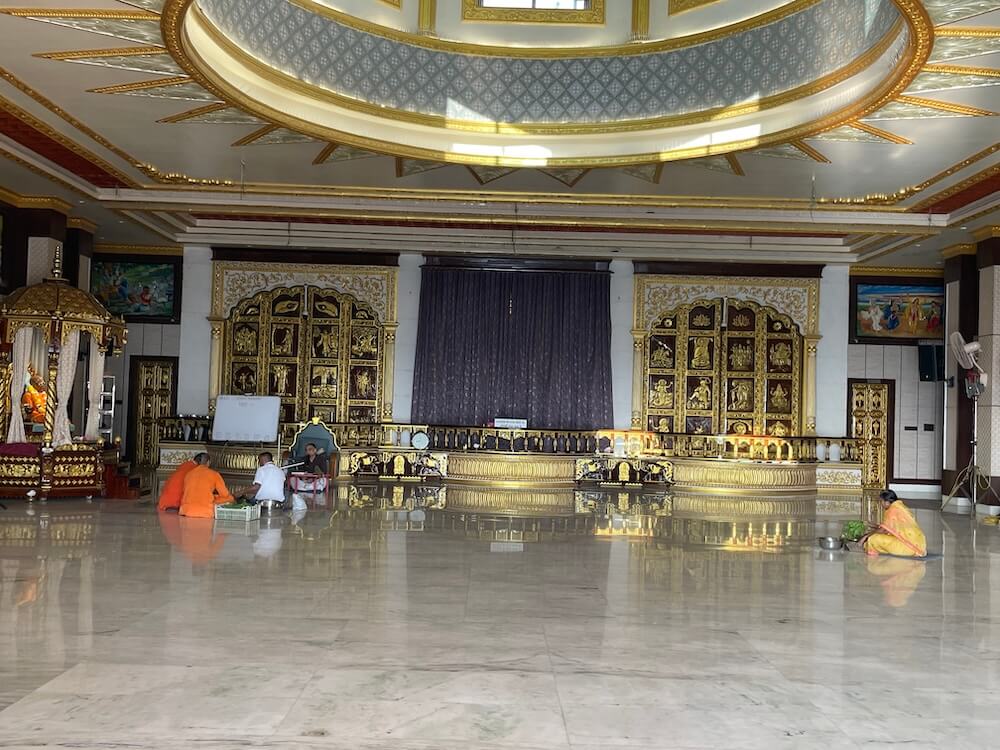
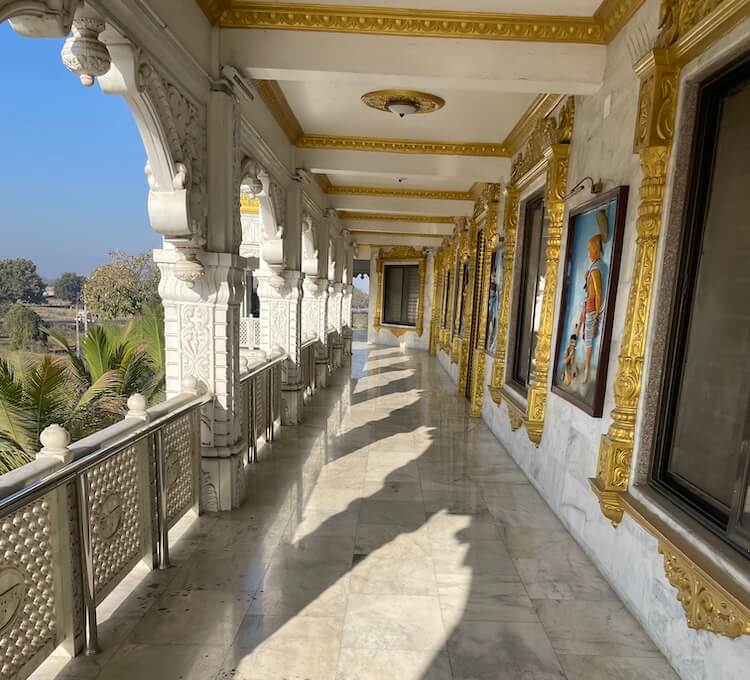
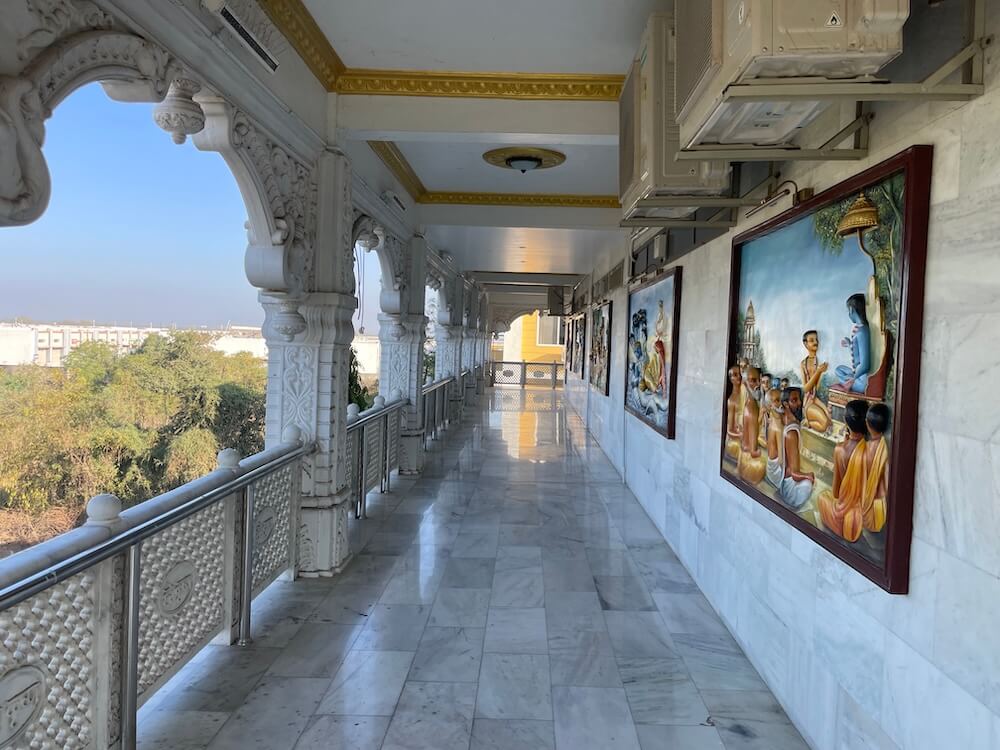
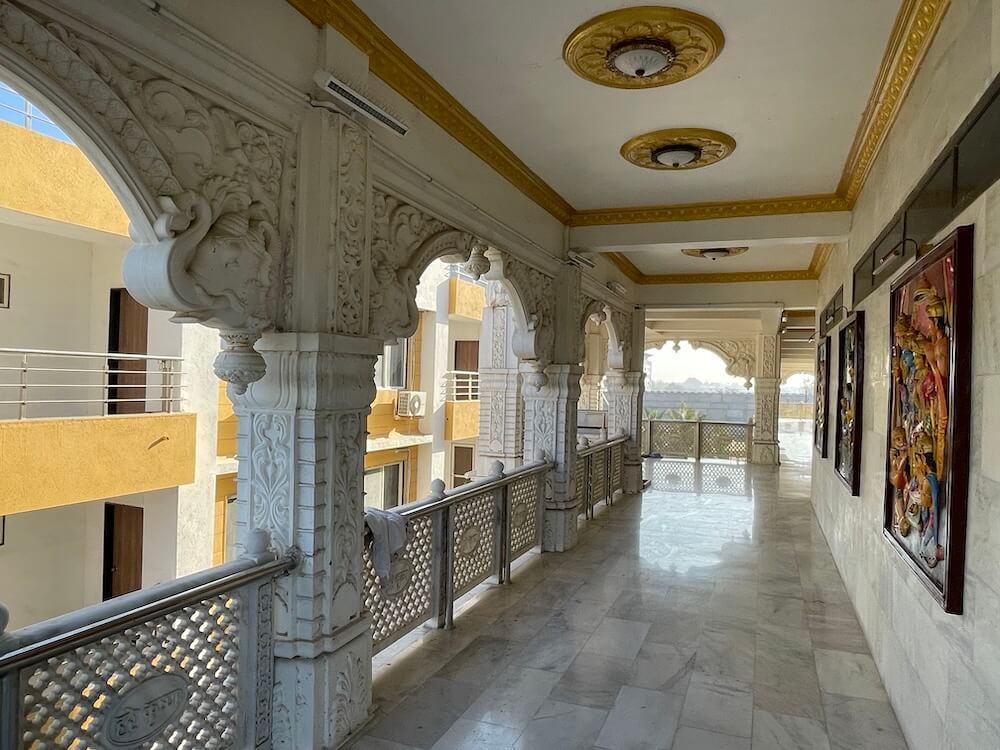
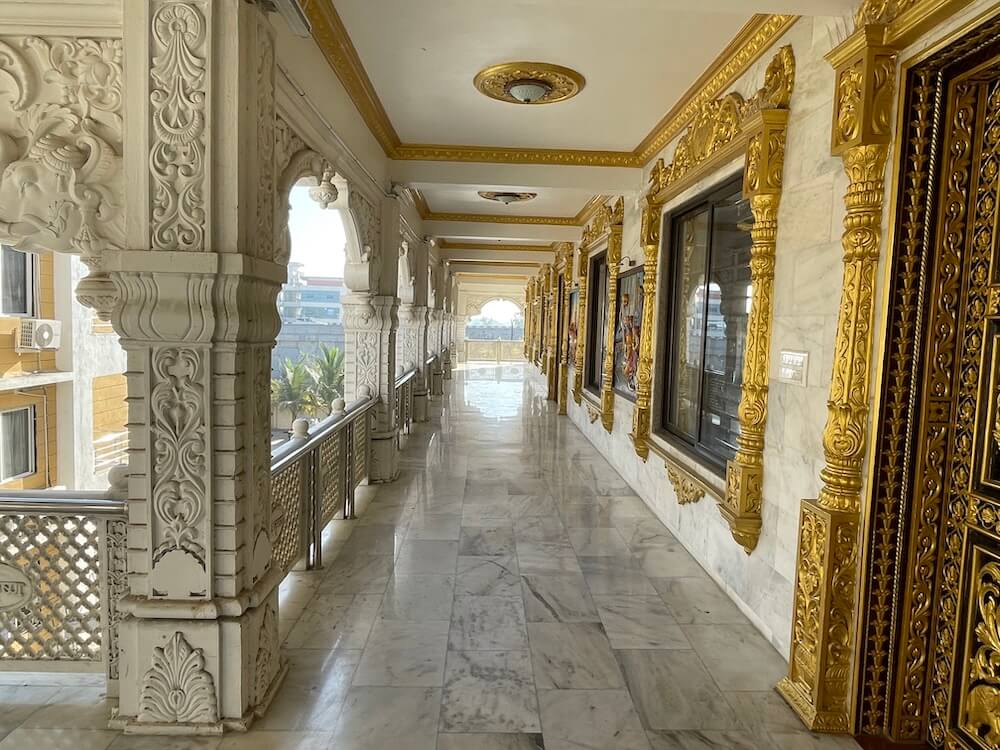
This two-storeyed temple is constructed of pristine white marble. The ground floor houses a hall for religious ceremonies, while the main temple is situated on the upper floor. Built upon a high plinth, one enters the ground-floor porch by ascending six steps from the courtyard. From here, two separate stairways lead to the upper floor, one on the right and one on the left. Ascending a further forty steps brings one to the entrance porch of the upper-level temple. 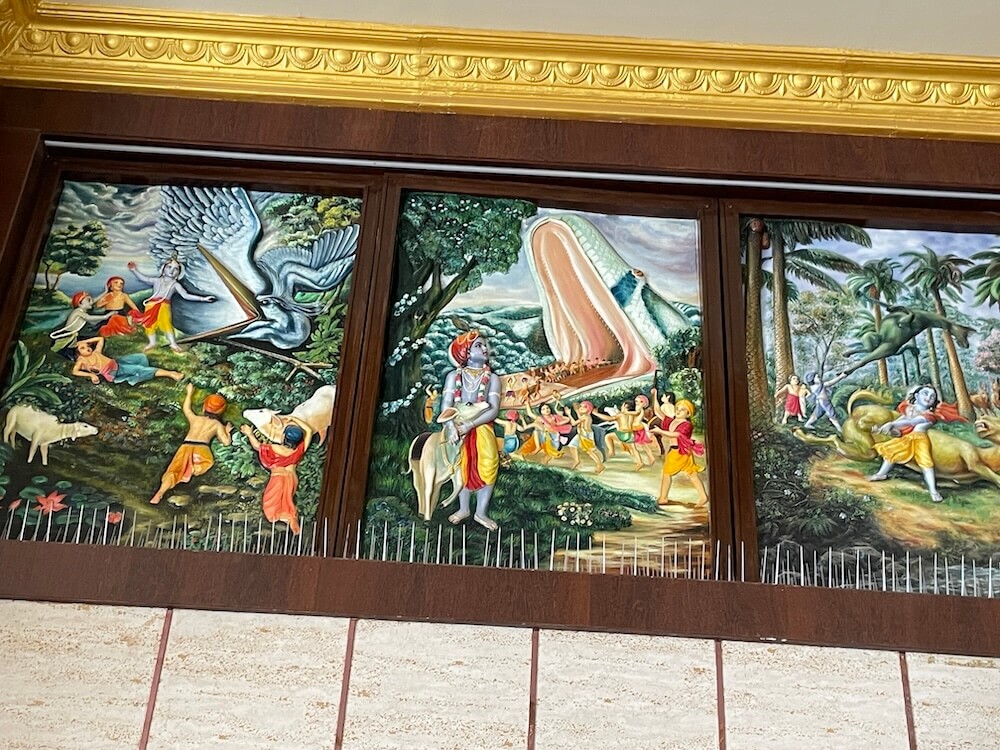 A circumambulatory path surrounds the temple structure on this floor. The architectural layout comprises a grand, spacious assembly hall and a sanctum sanctorum. On the walls of the assembly hall, various ‘Krishna Leelas’ (divine plays) of Lord Krishna are exquisitely carved. These primarily include his childhood valour in slaying demons such as Bakasura, Aghasura and Vatsasura; the slaying of the whirlwind demon Trinavarta; the prayers offered by Lord Brahma (Brahma-vimohana Leela) and the subduing of the serpent Kaliya in the Yamuna (Kaliya Mardan). Alongside these, the ‘Vanbhojan’ with companions and the ‘Go-charan Leela’ (herding of cows) are depicted. Furthermore, images portray the royal stroll of Shri Radha-Krishna amidst nature, the ‘Jhulan Leela’ on a swing tied to a tree and the ‘Venu-nada Leela’,
 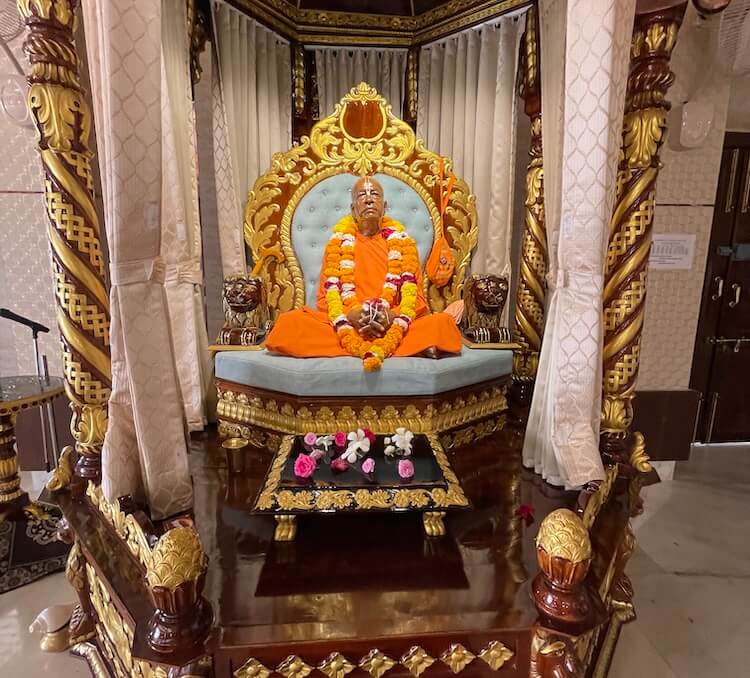 where the sweet melody of the flute enchants all the Gopis. Additionally, the domed ceiling of the assembly hall features a depiction of the ‘Maharaas’ Leela.
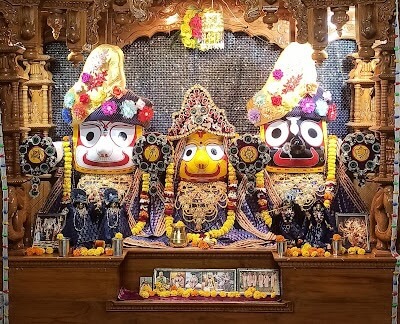
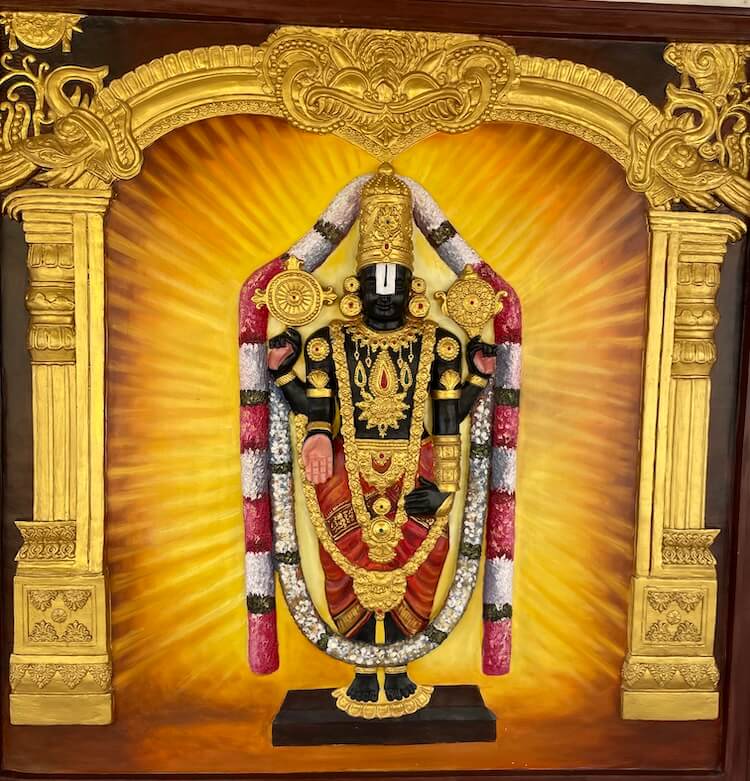
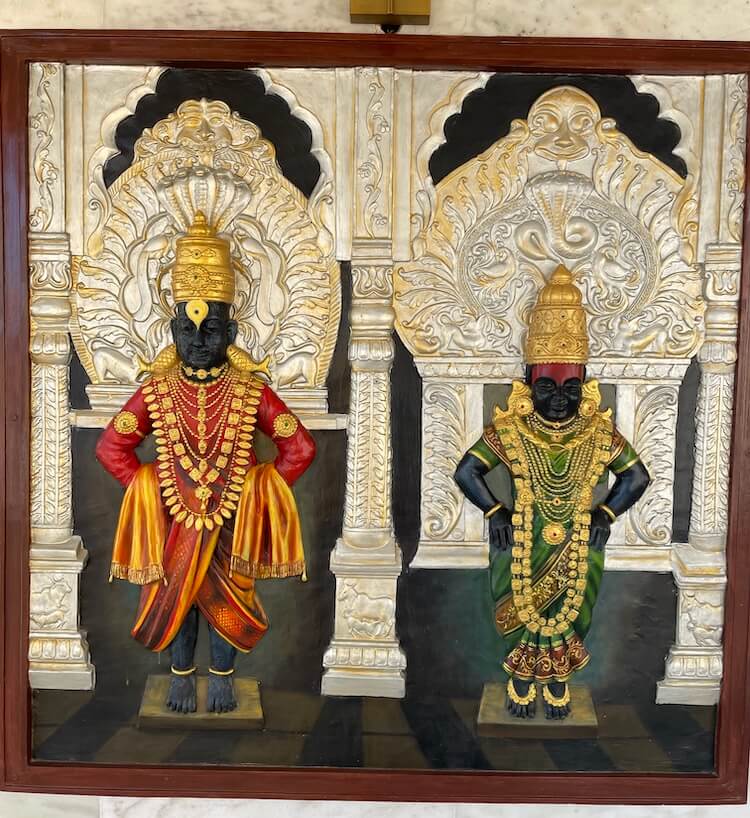
At the assembly hall’s front, a beautiful idol of A. C. Bhaktivedanta Swami Prabhupada sits in a decorated pavilion. Such idols are present in all ISKCON temples to honour him. Near the sanctum entrance, you will find a golden carved archway and dark curtains. A semi-circular wooden railing with lotus petal designs separates the hall from the sanctum. Shri Radha-Krishna deities are consecrated here, following strict rites. Alongside them are wooden idols of Jagannath, Baladev and Subhadra, made like those in the Jagannath Puri temple in Odisha. Jagannath is in black on the right, Baladev in white on the left and Subhadra in yellow in the centre. All three have beautiful silk clothes, gold jewels and grand crowns. In front of the main deities stand smaller metallic festival idols. At the base are photographs of Swami Prabhupada and other gurus. 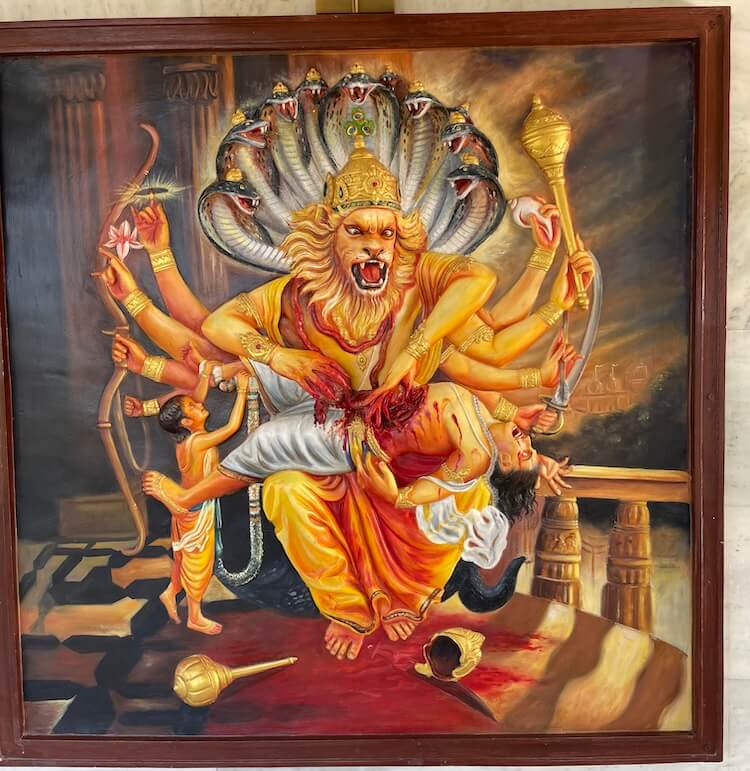 During festivals, the sanctum is elegantly decorated with flowers and leaves.
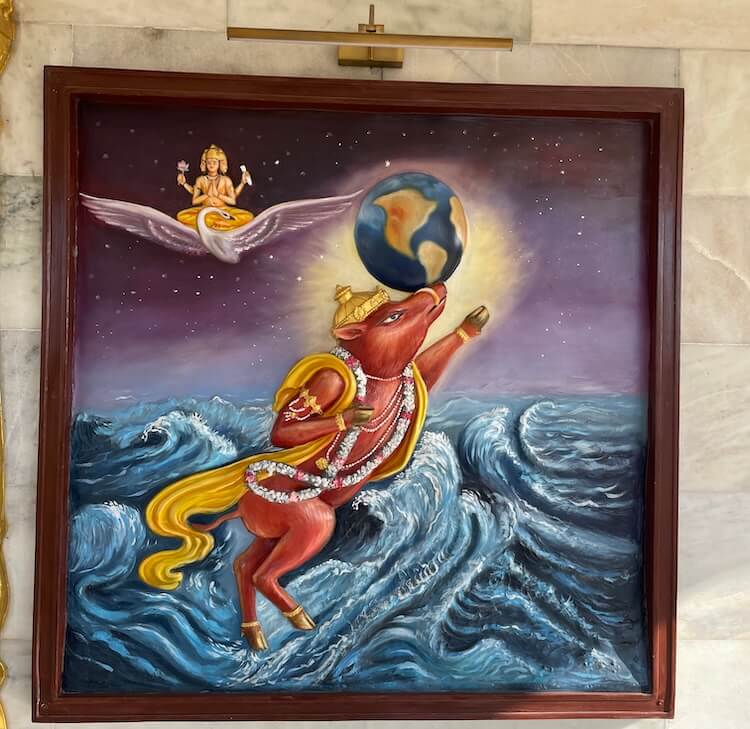
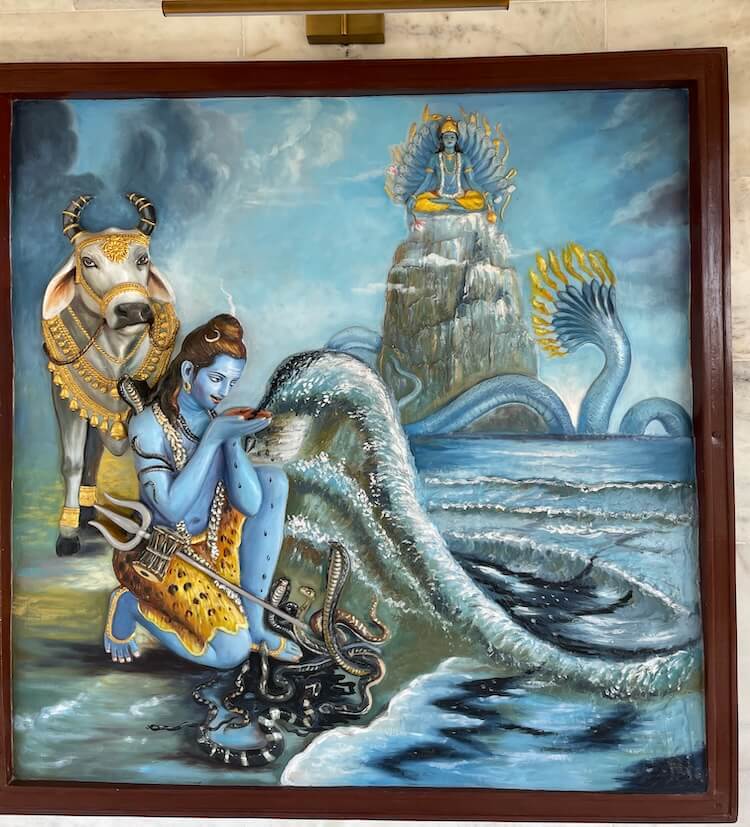
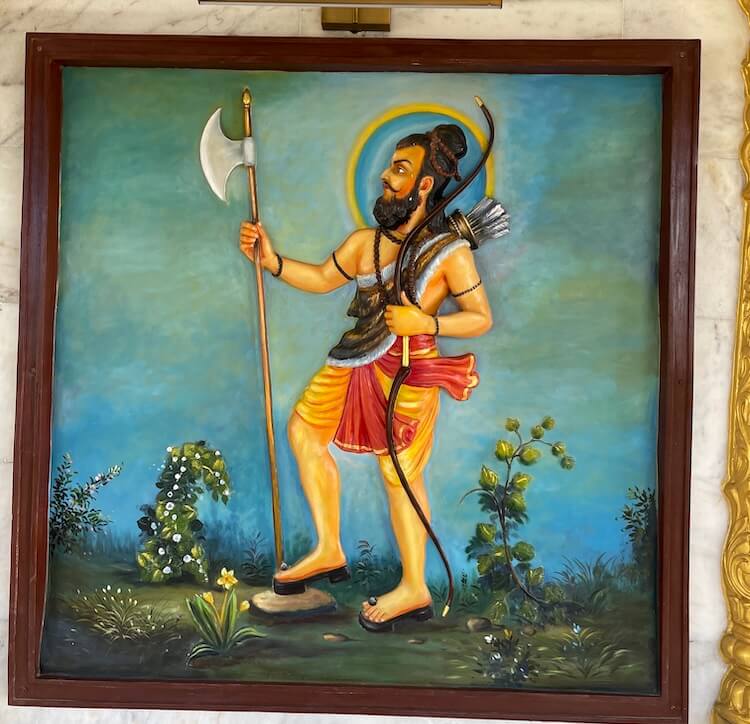
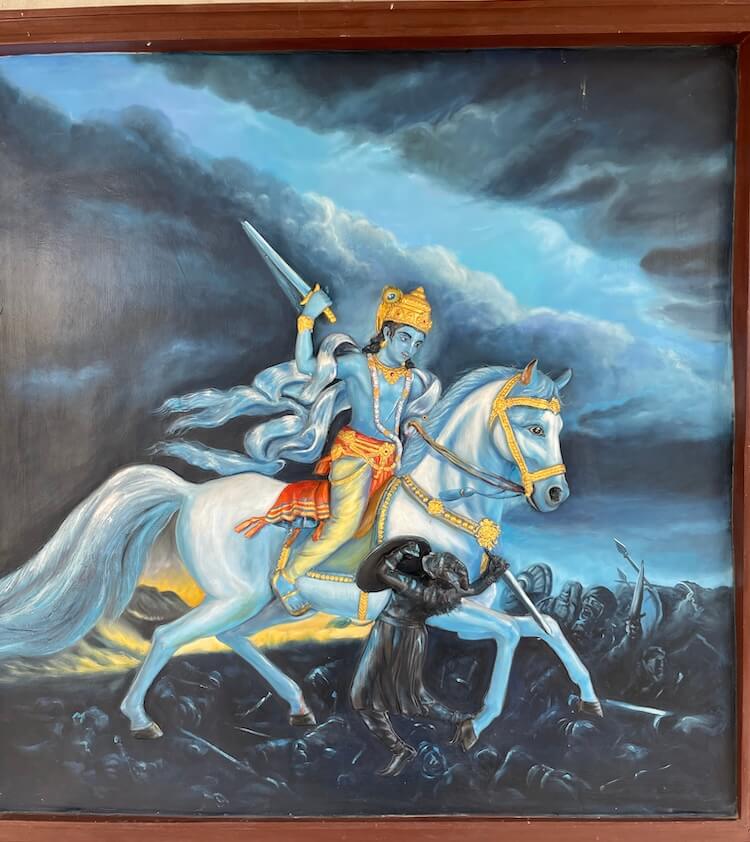
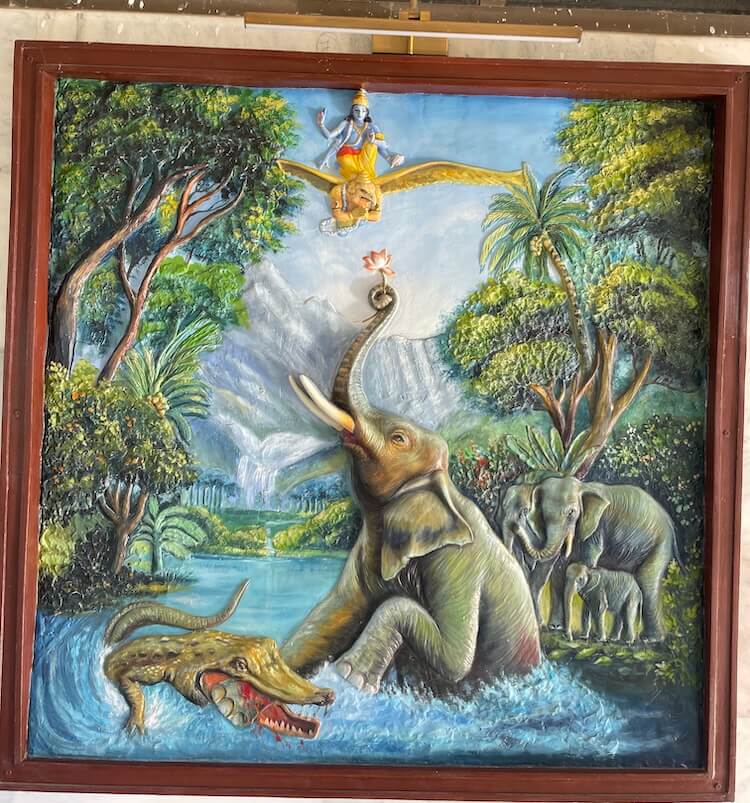
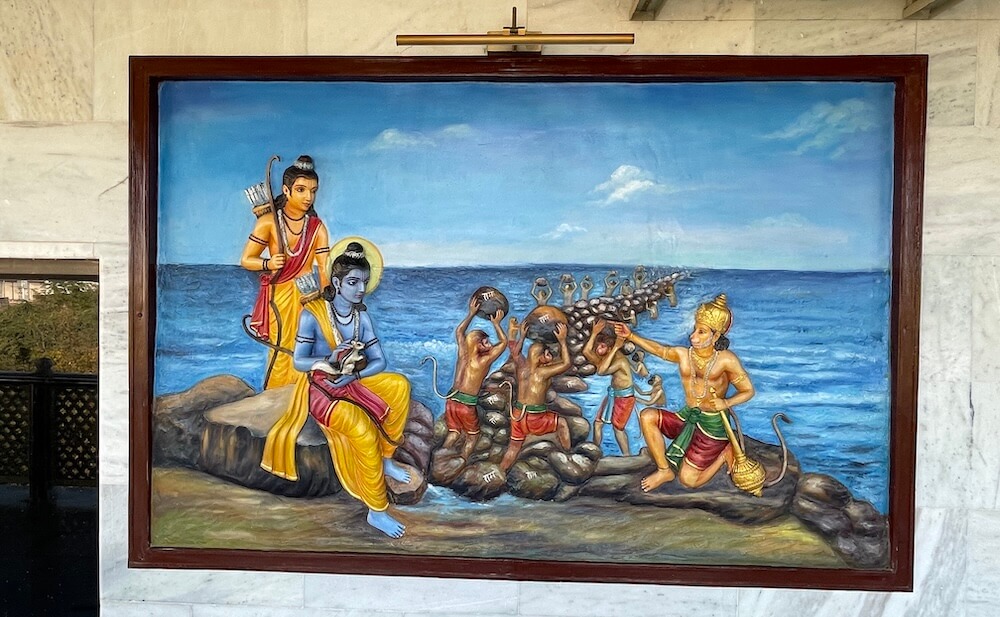
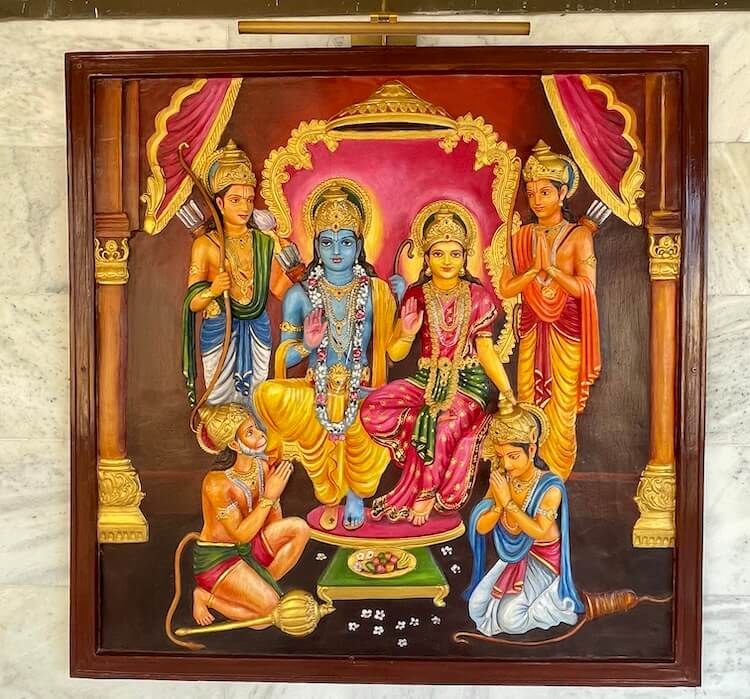
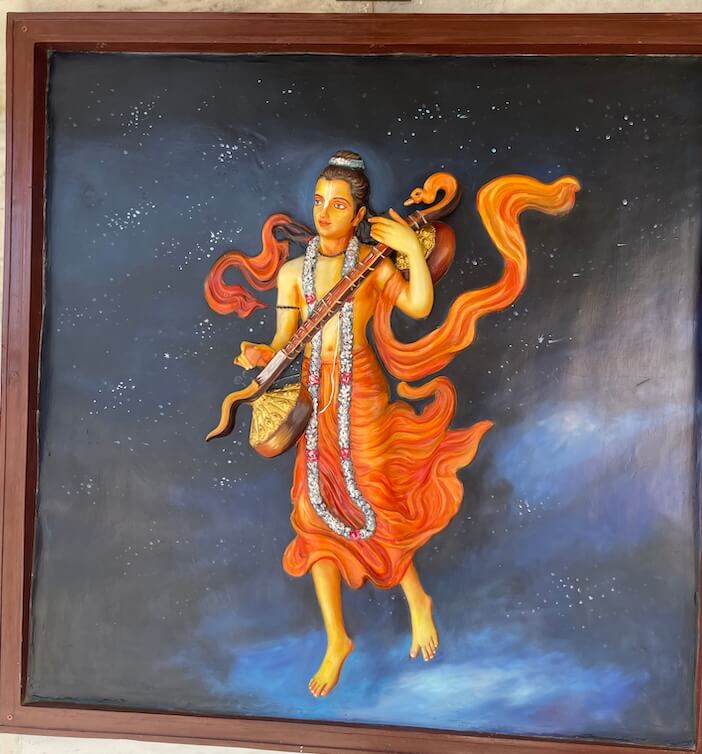
The walls along the circumambulatory path feature relief sculptures depicting Lord Vishnu’s incarnations and mythological episodes. These include a powerful Varaha scene, with the earth balanced on His tusks; the Vaman incarnation, placing His foot on King Bali’s head; Lord Nilkantha (Shiva), who protects the world by consuming ‘Halahal’ poison; and Parashurama, wielding an axe. Also shown are Vishnu rescuing Gajendra from a crocodile (Gajendra Moksha); Lord Narasimha emerging from a pillar to slay Hiranyakashipu; Kalki on a white horse, destroying unrighteousness at the end of Kali-yuga; and King Parikshit hearing the ‘Shrimad Bhagavatam’ among sages.
The temple’s day starts with ‘Mangal Aarti’ at 4:30 am. ‘Bhagavat Katha’ begins at 8:15 am. At 7:15 am, ‘Shringar Darshan’ takes place. ‘Rajbhog Aarti’ is held at 12 noon and the temple closes at 12:30 pm. It reopens at 4:30 pm for ‘Utthapan Aarti’. ‘Sandhya Aarti’ and ‘Shayan Aarti’ times change with the seasons.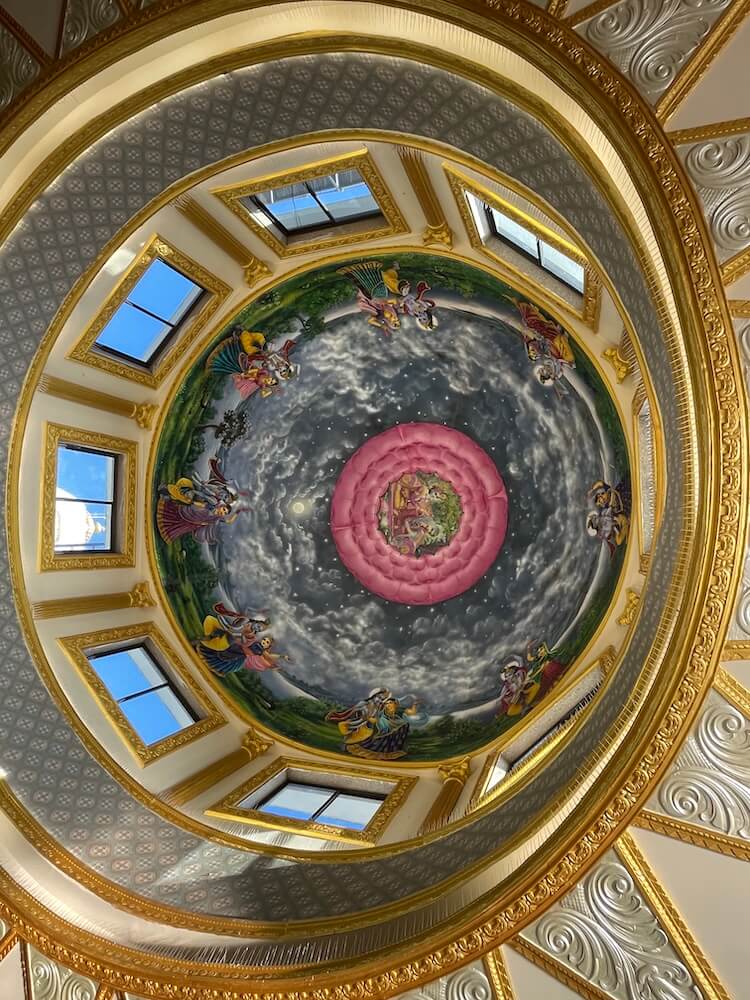 In winter, Sandhya Aarti is at 6:30 pm and Shayan Aarti at 8:15 pm. In summer, Sandhya Aarti is at 7:00 pm and Shayan Aarti at 8:30 pm. Devotees can offer ‘Dainik Seva’ (daily service) such as garlands, Balbhog, Rajbhog, fruit service and Aarti service.
These are available for special occasions such as birthdays or wedding anniversaries.
Among the weekly observances, the ‘Sunday Love Feast’ holds paramount importance, featuring congregational chanting, ‘bhajans’, spiritual discourses and a free ‘Mahaprasad’ for devotees.
‘Shri Krishna Janmashtami’ is the grandest annual celebration here, during which the Lord is bathed in ‘Panchamrita’ at midnight, followed by a ‘Maha-Aarti’.
The ‘Shri Shri Gaura Purnima Mahotsav’, celebrating the appearance day of Chaitanya Mahaprabhu, is also a major festival, featuring Harinam Kirtan, Bhagavad Katha, Maha-Abhishek and ‘bhojan prasad’.
Additionally, the ‘Jagannath Rath Yatra’ in the month of Ashadh, the ‘Jhulan Yatra’ in Shravan, the ‘Govardhan Puja’ (Annakut Mahotsav) on Diwali Padwa, ‘Radhashtami’ and ‘Gita Jayanti’ are celebrated with great enthusiasm.
A grand wooden chariot for the Rath Yatra stands as a centre of attraction within the temple premises.
Useful Information
- Located at 7 km from Mehesana Bus Station.
- GSRTC bus services are available from numerous cities across the state to Mehesana.
- Private vehicles can travel up to the temple car park.
- Several accommodation and breakfast options are available in the vicinity.
- Contact – Temple Office, Mob- 9915502597, 9157183525.
इस्कॉन मंदिर
नुगर सर्कल, मेहसाणा बाईपास हाईवे, ताल/जिला। मेहसाणा
मंदिरे
Temples
मंदिर
-
वैजनाथ महादेव मंदिर महादेवपुरा (गावडा), ता. विजापूर, जि. मेहसाणा
अधिक माहितीVaijnath Mahadev Temple Mahadevpura (Gavada), Tal. Vijapur, Dist. Mehsana
View Detailsवैजनाथ महादेव मंदिर महादेवपुरा (गावड़ा), ताल. विजापुर, जिला. मेहसाणा
विवरण देखें -
वैजनाथ महादेव मंदिर सोखडा, तालुका विजापूर, जिल्हा मेहसाणा
अधिक माहितीVaijanath Mahadev Temple Sokhada, Taluka Vijapur, District Mehsana
View Detailsवैजनाथ महादेव मंदिर सोखाडा, तालुका विजापुर, जिला मेहसाणा
विवरण देखें -
काशी विश्वनाथ महादेव मंदिर मेहसाणा, जि. मेहसाणा
अधिक माहितीKashi Vishwanath Mahadev Temple Mehsana, Dist. Mehsana
View Detailsकाशी विश्वनाथ महादेव मंदिर मेहसाणा, जिला. मेहसाणा
विवरण देखें