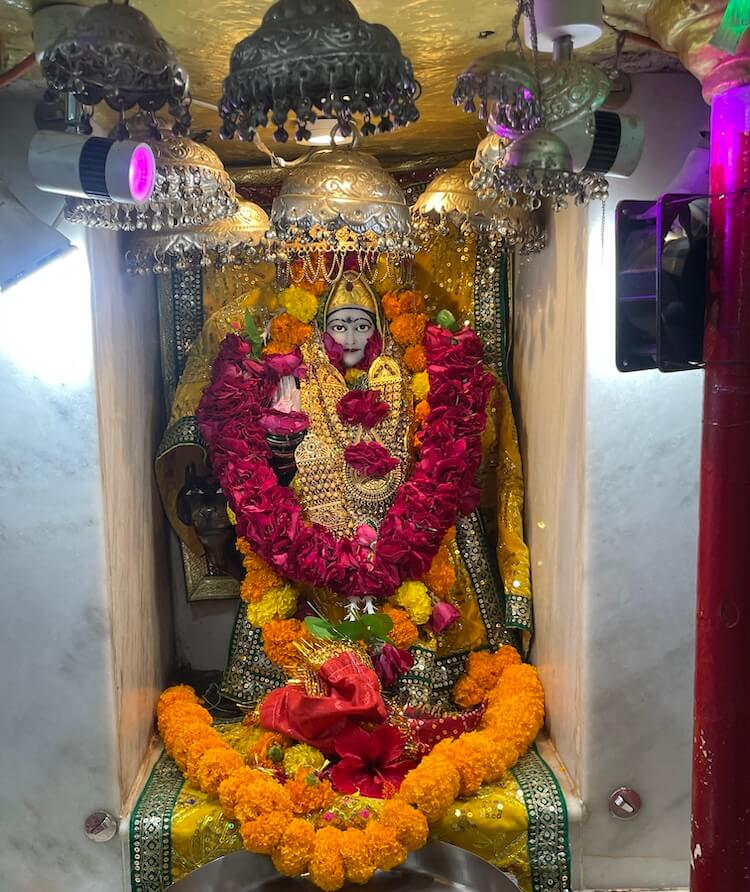
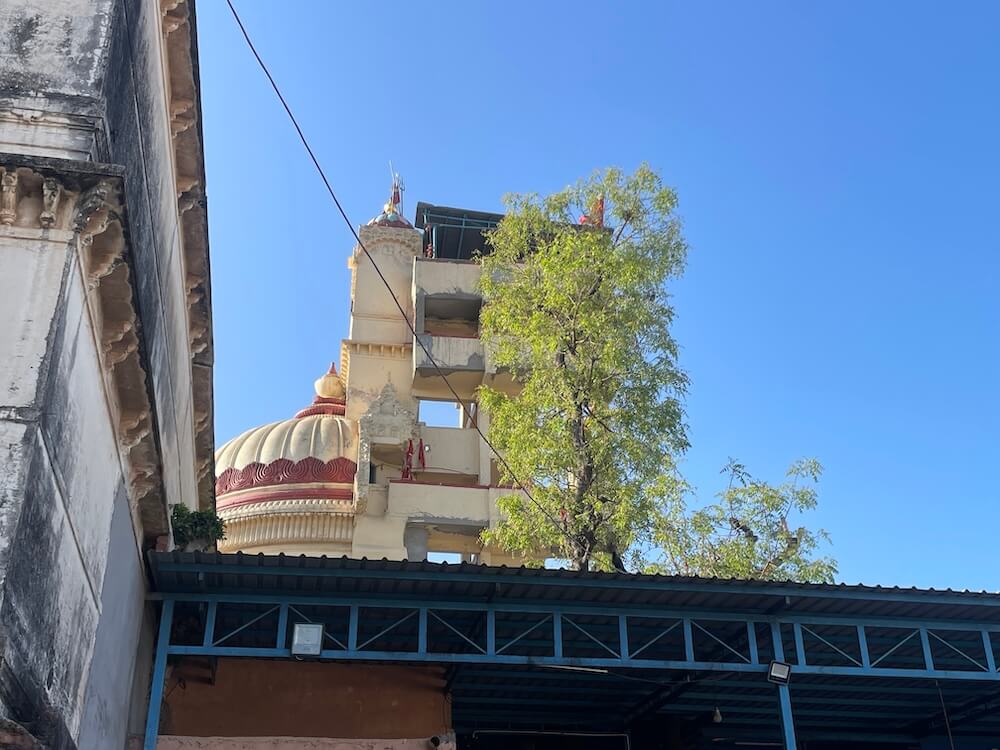
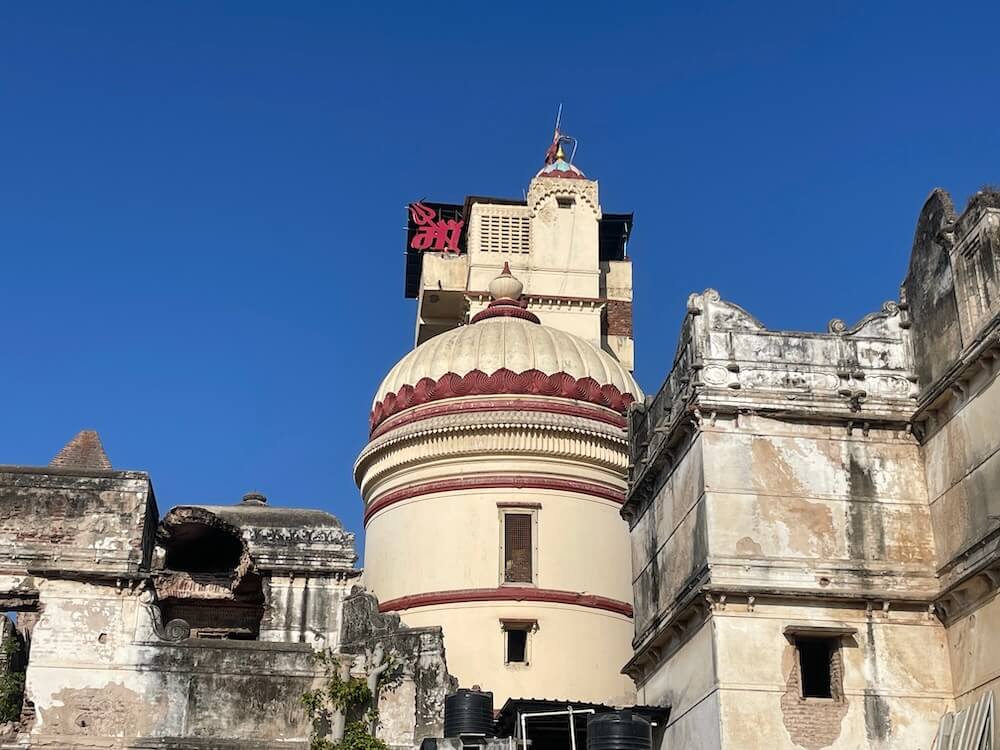
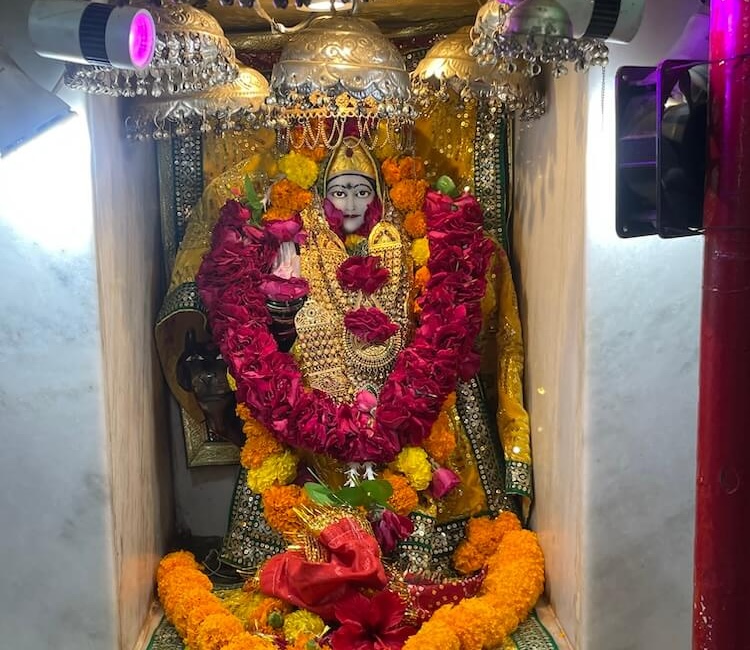
At the very heart of the town of Kadi in North Gujarat, enshrined upon the seventh floor of an edifice that was once a historical palace, lies the sacred abode of Meldi Mata. To the faithful, this Devasthan (sanctuary) is of paramount spiritual significance. The deity is known locally as ‘Malharrao ni Meldi’ and ‘Kangaravali Mata’. Her original seat is located seven kilometres away within a ‘Vav’ (stepwell) in the village of Jasalpur. It is said that seven centuries ago, the Goddess manifested within this stepwell at the precise moment of sunrise, earning her the epithet ‘Ugtai Mata’. She is celebrated as the destroyer of the ‘Shad Ripu’—the six internal enemies of man: lust, anger, pride, greed, attachment and envy. To numerous rural families across Gujarat, Rajasthan and Western India, she is revered as the Kuldevi (ancestral family deity).
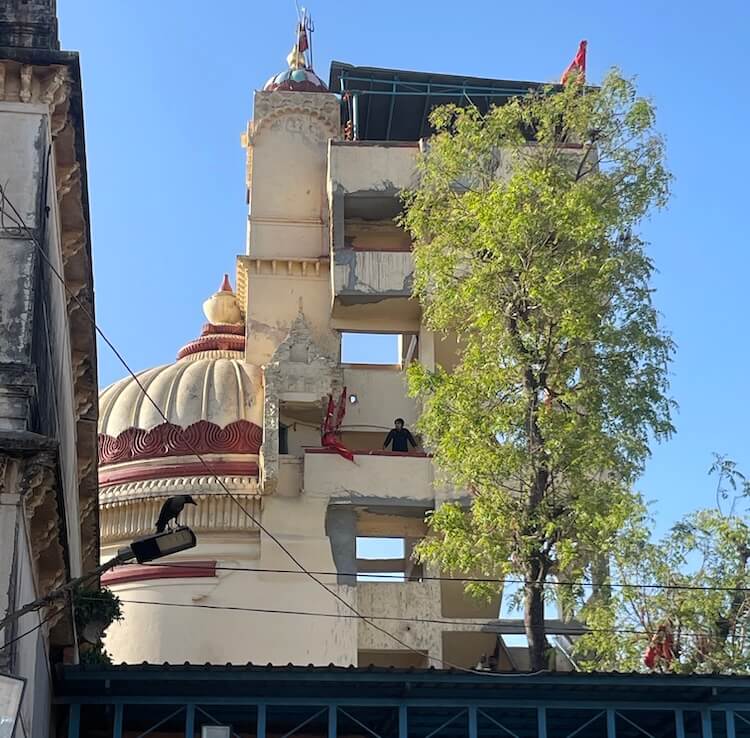
The town of Kadi possesses a heritage spanning many centuries. In antiquity, it was known as ‘Katipur’, before the name Kadi—signifying a ‘strong fortress’—became established. Some historians suggest the name is derived from the Sanskrit word ‘Krudi’. During the colonial era, Kadi was a significant princely state under the Gaekwad dynasty of Baroda. Malharrao Gaekwad, the younger brother of Khanderao Gaekwad of Baroda, ruled Kadi. Malharrao was reputed to have a volatile temperament and to harbour atheistic inclinations. Legend has it that while hunting in the forests near Jasalpur, he discovered a stepwell crafted from exquisite marble. He resolved to dismantle the Vav and use its carved stones to build his own palace. An elderly woman named Hiru Doshi, a devotee of the Goddess, implored the King to spare the structure, but her pleas were dismissed. The King ordered the stones to be cut and loaded onto bullock carts to be transported to Kadi. However, despite immense effort, the carts remained immobilized. So the King ordered them to be moved with the help of elephants. As the procession moved from Jasalpur via Visalpur, the Goddess took the form of a buffalo upon a hillock known as ‘Hathi Temba’. In this form, she attacked the elephants and buried them in the earth—a site that bears the name ‘Hathi Temba’ to this day. Undeterred, Malharrao persisted in his obstinacy and eventually completed a seven-storey palace in Kadi. Yet, on the very night of its completion, the structure collapsed. This occurred seven times in succession. The King, in his frustration, imprisoned the astrologers who had calculated the auspicious timings. Eventually, Malharrao surrendered to the divine will and summoned 151 Bhuvas (priestly devotees). One Jivan Bhuva, from the village of Beruva, demonstrated the Goddess’s power by sitting in boiling oil and extracting a pumpkin from a pot without breaking it. A celestial voice then commanded the King that the palace would only stand if the Goddess were enshrined on the seventh floor. Malharrao sought forgiveness and the principal seat of the Goddess was thus established at the palace’s summit.
The lore regarding the origin of Meldi Mata is equally compelling. It is recounted that in ancient times, a demon named Amruva caused great havoc in the Saurashtra region. When the Goddess Uma (Parvati) attempted to slay him, he hid within the carcass of a dead cow. Refusing to touch the impure hide, Uma rubbed her hands together in fury. From the Mal (impurities/dirt) of her hands, a young girl was created. Because of her birth from Mal, she was named ‘Meldi’. She slew the demon Amruva and was subsequently sent to Chamunda Mata. To test her, Chamunda Mata sent her to the Kamrup region, where Meldi Mata transformed all negative energies into a black goat, which she adopted as her Vahana (mount). Pleased, Chamunda Mata entrusted her with the protection of devotees in the Kaliyuga. Blessed by the Navdurgas, the eight-armed Mother holds a trident, sword, lotus, discus, dagger and mace. In one hand, she holds a bottle in which tantric powers are imprisoned, while the other hand is held in the Abhaya Mudra (gesture of fearlessness). Clad in red or saffron, she is revered as the protector of the countryside.
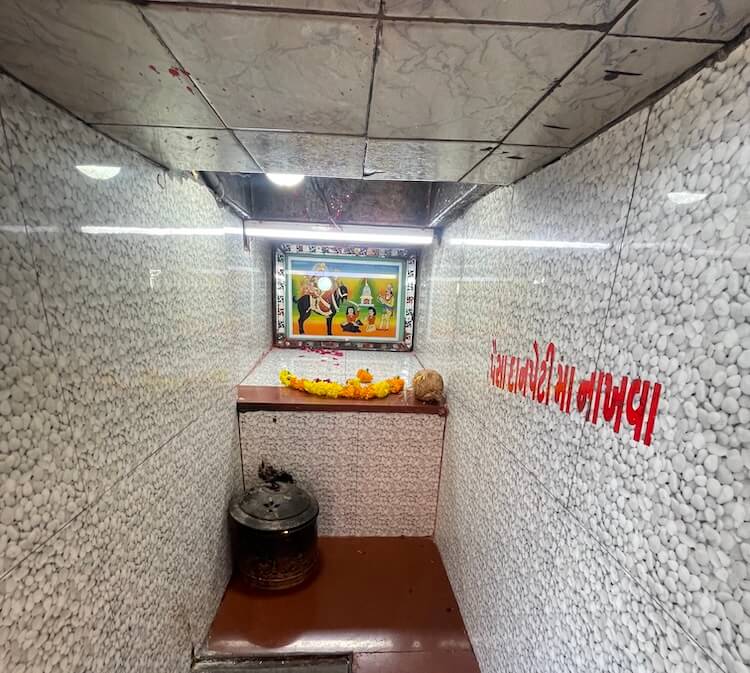
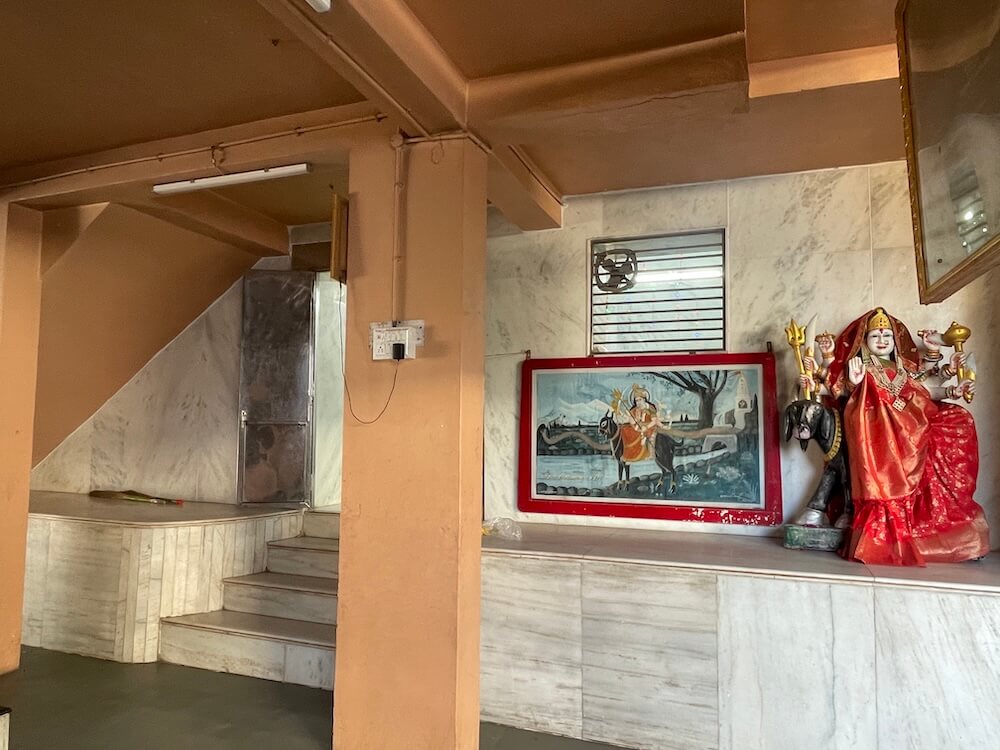
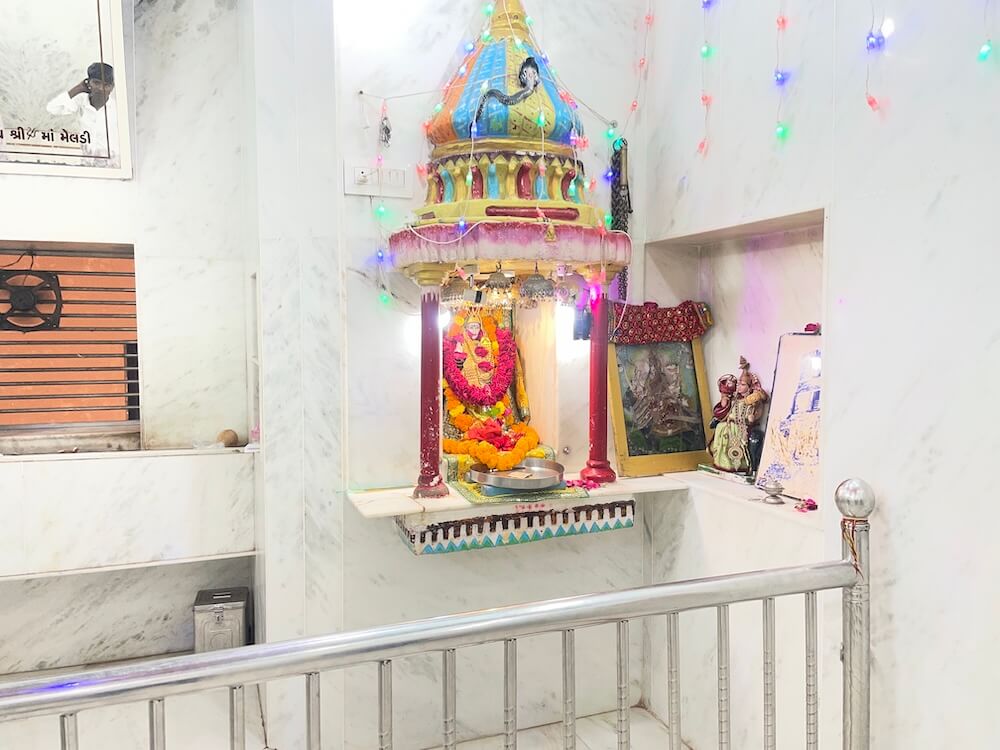
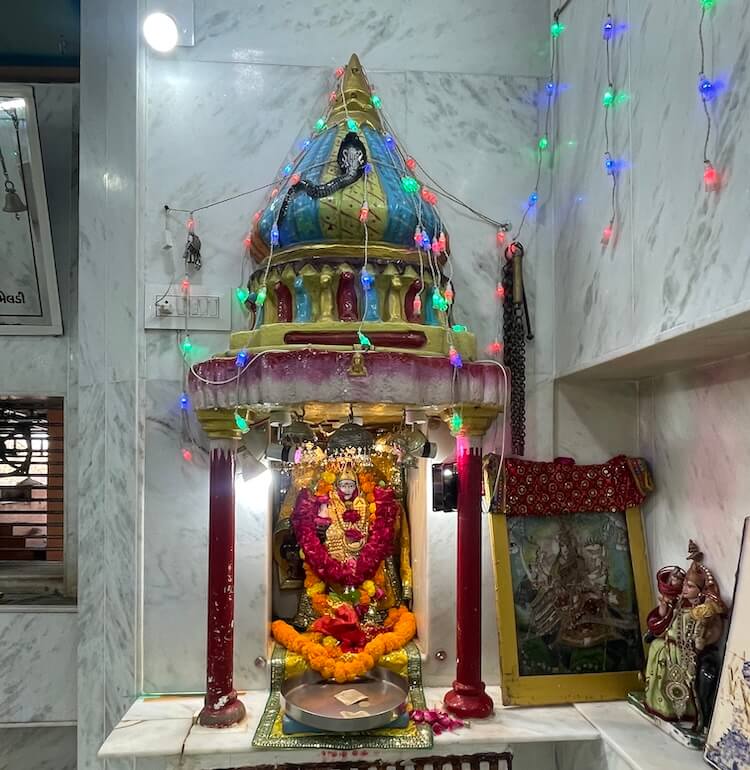
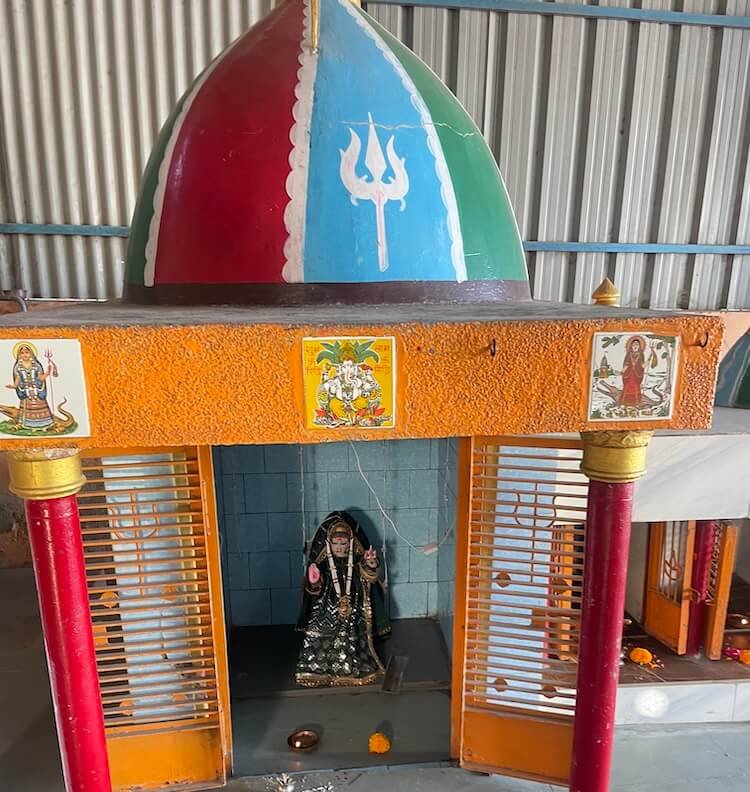
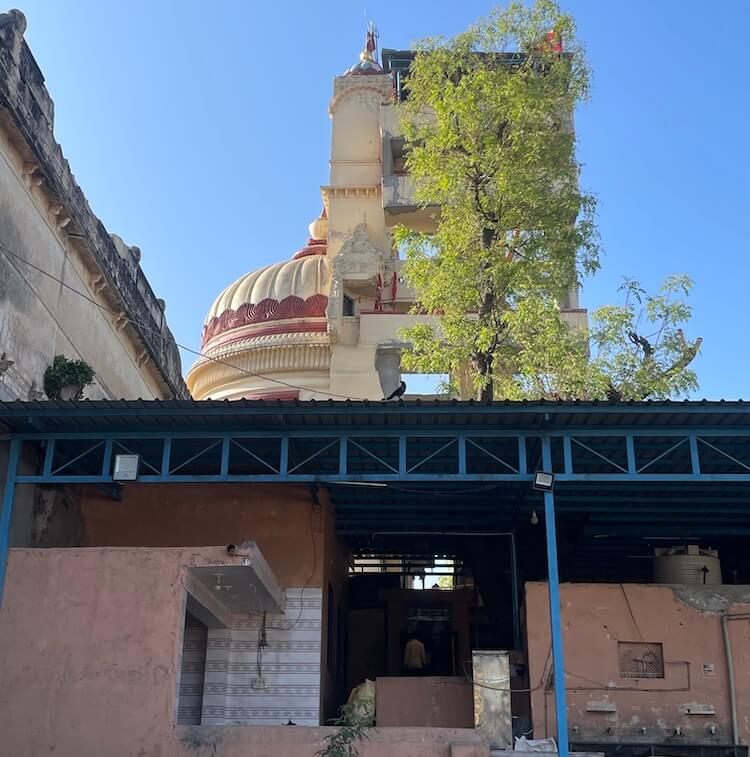
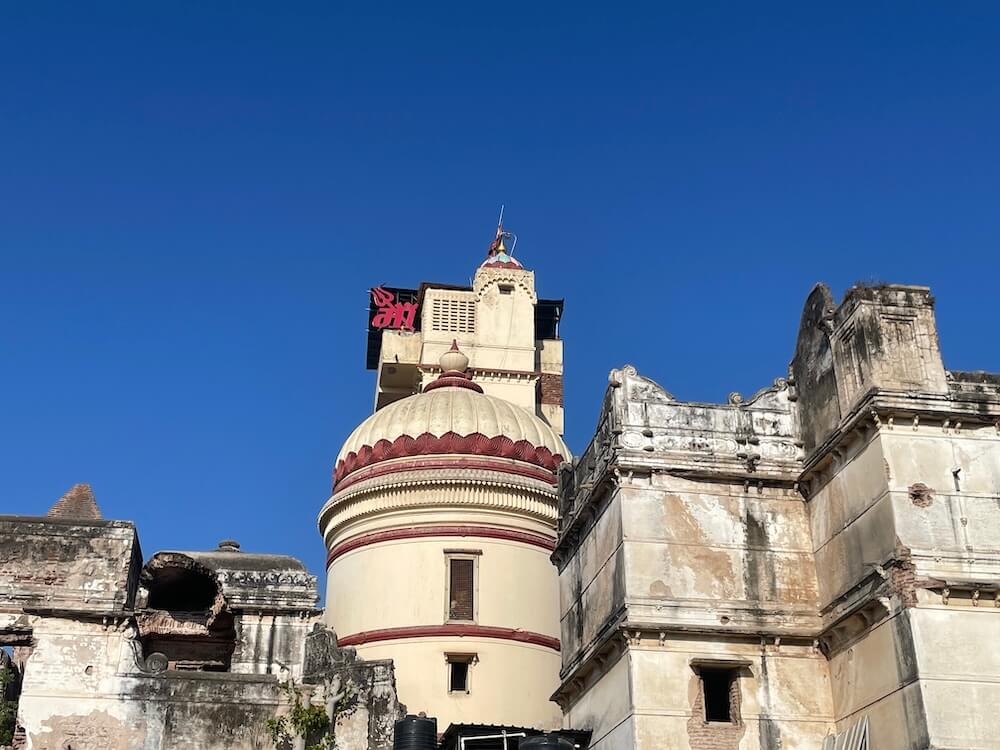
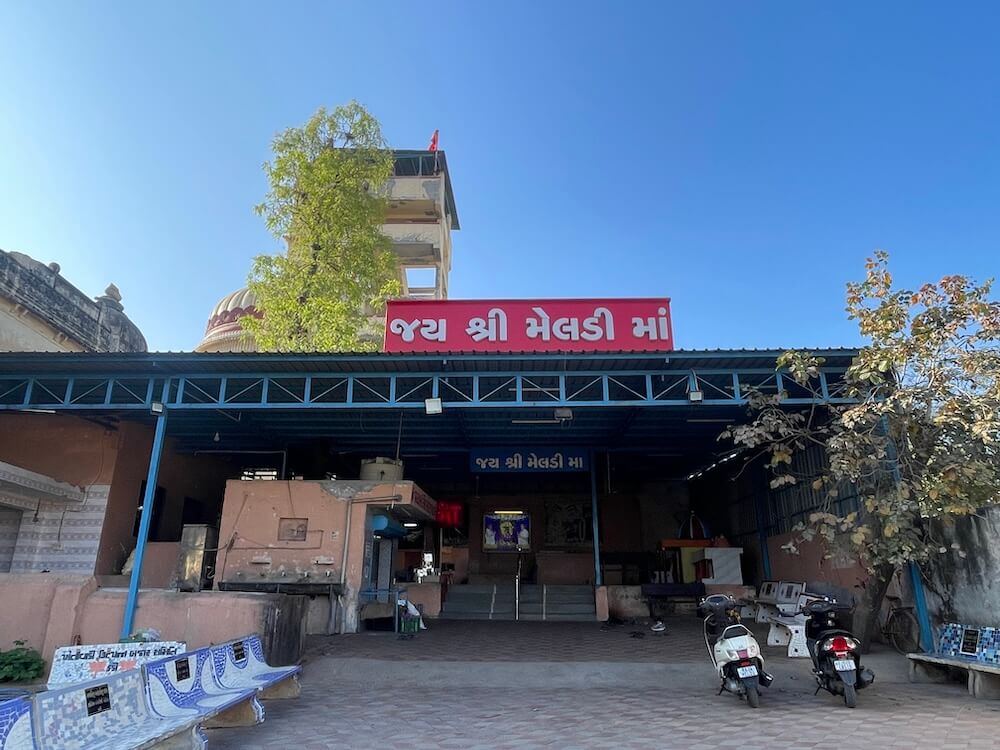
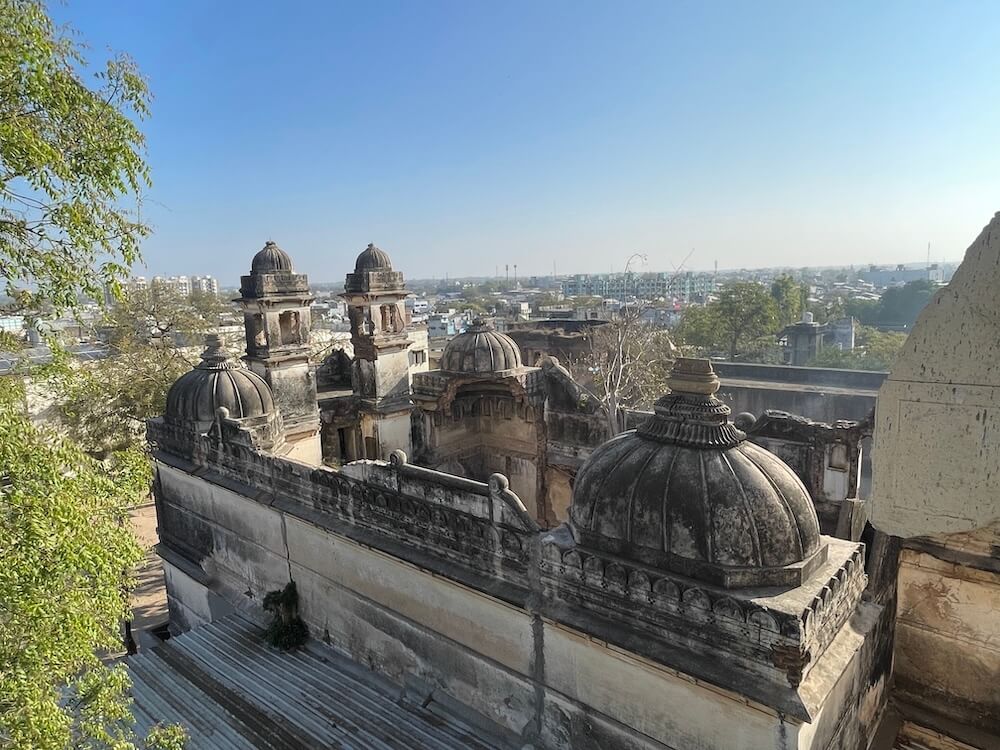
Upon entering the gateway opposite the Mamlatdar office in Kadi, one sees the remnants of the historical palace fortifications. Access to the Devasthan is through a grand stone portal. A short walk reveals the weathered edifice of the palace, adjacent to which a new staircase has been constructed. To the left is the ‘Prasad Bhandar’, where ritual offerings are sold. The sanctum is situated seven storeys above ground. As the original palace was converted into a temple, the architecture is a unique fusion of royal and religious styles. Near the entrance, a stepwell has been built to commemorate the Goddess’s manifestation at Jasalpur. Passing through the Mukhamandap (entrance porch), one enters the lower assembly hall where carved idols of the Navdurga surround the main deity. A small idol resides in a niche to the right and a small wooden chariot of the Goddess is kept upon a pedestal nearby. The central part of the structure is circular, mirroring the form of a Vav, allowing devotees on the first floor to look down directly upon the idol in the main sanctum. The original walls, balconies and windows of the historical palace remain remarkably well-preserved.
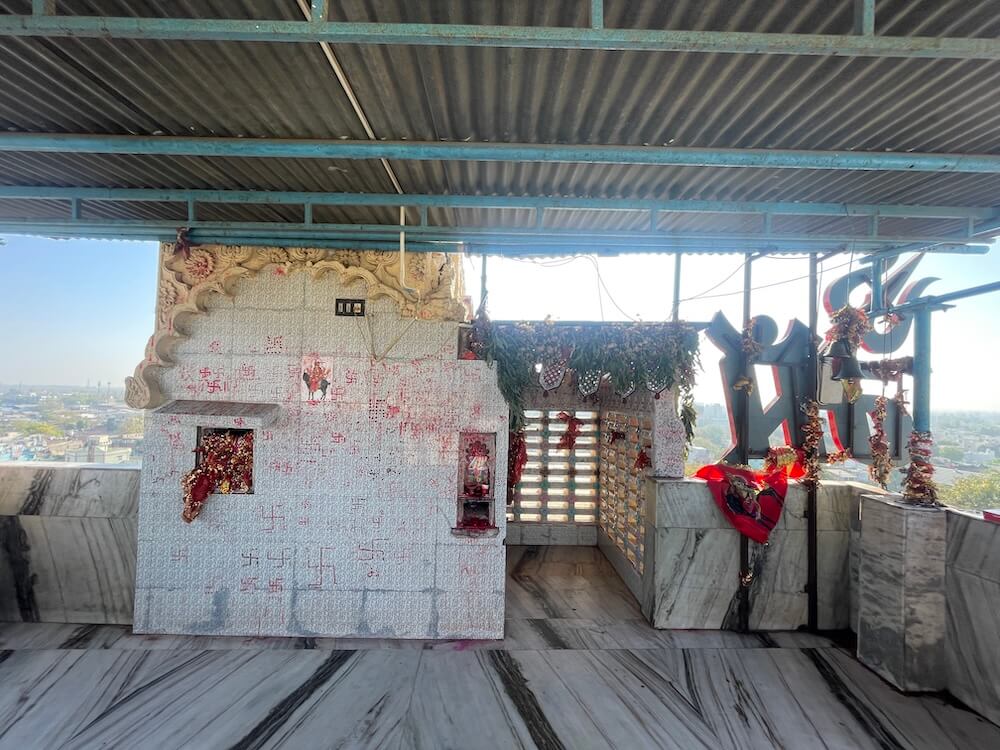
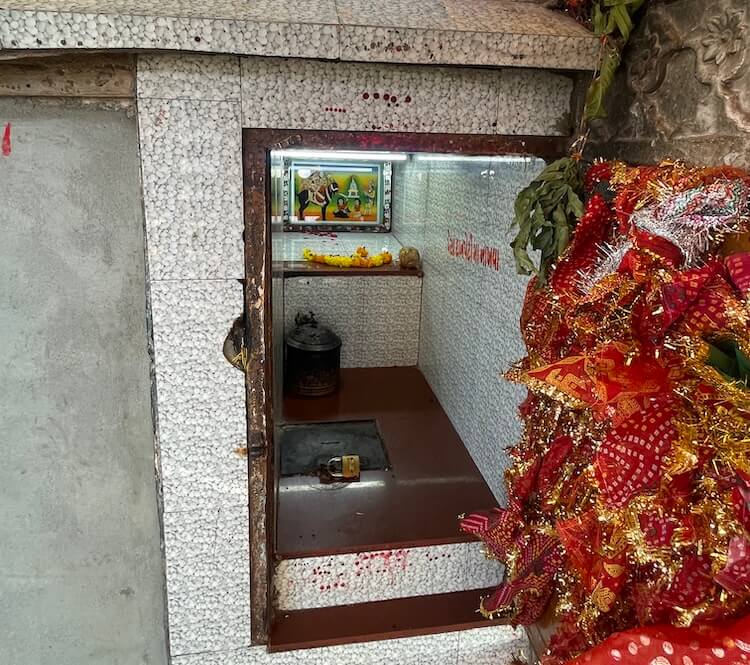
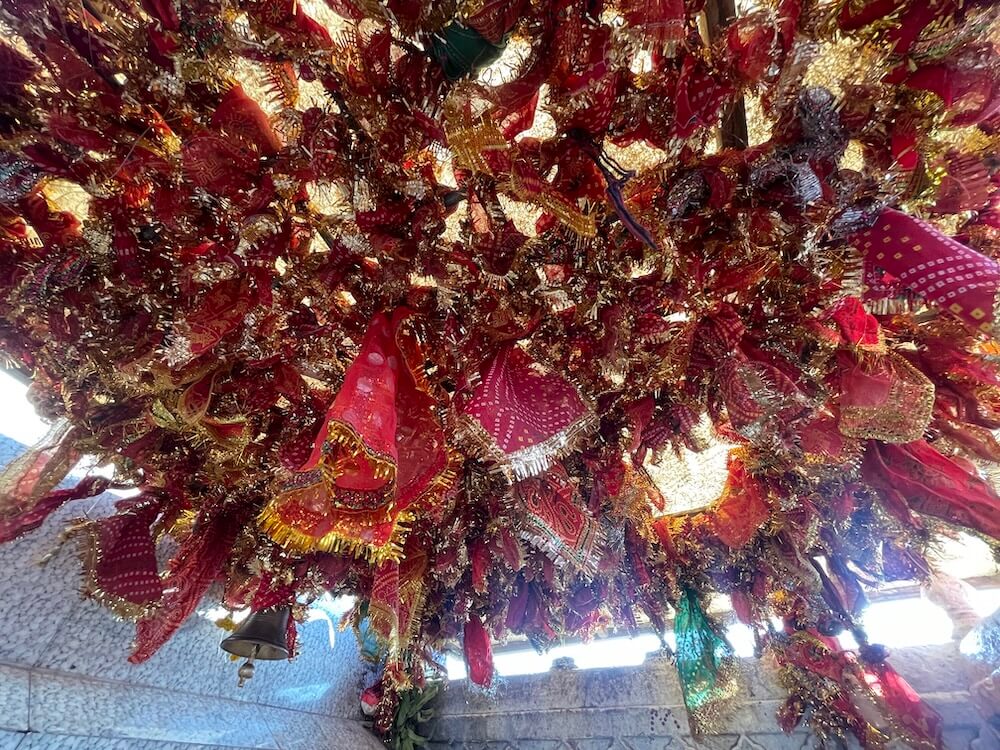
In former times, the main sanctum was accessed through a door on the first floor via narrow stairs that permitted only one person at a time. Due to structural decay, the path to the seventh floor was temporarily closed. In 1987, a new seven-storey staircase was constructed adjacent to the palace. As an act of devotion or upon the fulfilment of a vow, many women fix ‘Tiklis’ (small ornamental bindis) upon each step as they ascend. From the seventh floor you can see the historical ruins. The original seat of the Goddess is located in a corner sanctum upon a raised pedestal, with her image set against the rear wall. The walls are adorned with traditional ‘Mata ni Pachedi’ (ritual textile painting artwork), depicting the Goddess mounted upon her black goat. A 52-yard flag flutters atop the seven-storey spire. Coconuts and Chunris (sacred scarves) offered by the faithful hang near the entrance of the sanctum.
The Devasthan hosts various festivals throughout the year, with Navratra being the most significant. During the months of Chaitra and Ashvin, special Pujas (rituals) are performed for nine consecutive days, drawing thousands of pilgrims from across the state. Garba dances are held every night during this period. The annual Patotsav (anniversary of consecration) is celebrated on a grand scale, beginning with a Maha-aarti on the night of Ashadh Pratipada, followed by a Nagaryatra (city procession) the next morning. A fair is held every full moon (Purnima), where devotees offer ‘Sukhdi’ (a traditional sweet made of wheat, ghee and jaggery) as Naivedya, which is then distributed as Prasad. It is believed that visiting for five consecutive Sundays ensures the fulfillment of one’s prayers. Childless couples often seek the Goddess’s blessings for progeny and many return to place photographs of their children outside the sanctum in gratitude. The temple is open for devotees every day from 6 AM to 8.30 PM.
Useful Information
Located at 1 km from Kadi Bus Station and 40 km from Mehsana city.
GSRTC bus services operate from several cities to Kadi.
Private vehicles can reach the temple parking area directly.
Accommodation and breakfast facilities are available in the vicinity.
Contact – Temple Office, Mob.- 9586312710
Meldi Mata Temple
Kadi, Tal. Kadi, Dist. Mehsana
At the very heart of the town of Kadi in North Gujarat, enshrined upon the seventh floor of an edifice that was once a historical palace, lies the sacred abode of Meldi Mata. To the faithful, this Devasthan (sanctuary) is of paramount spiritual significance. The deity is known locally as ‘Malharrao ni Meldi’ and ‘Kangaravali Mata’. Her original seat is located seven kilometres away within a ‘Vav’ (stepwell) in the village of Jasalpur. It is said that seven centuries ago, the Goddess manifested within this stepwell at the precise moment of sunrise, earning her the epithet ‘Ugtai Mata’. She is celebrated as the destroyer of the ‘Shad Ripu’—the six internal enemies of man: lust, anger, pride, greed, attachment and envy. To numerous rural families across Gujarat, Rajasthan and Western India, she is revered as the Kuldevi (ancestral family deity).
The town of Kadi possesses a heritage spanning many centuries. In antiquity, it was known as ‘Katipur’, before the name Kadi—signifying a ‘strong fortress’—became established. Some historians suggest the name is derived from the Sanskrit word ‘Krudi’. During the colonial era, Kadi was a significant princely state under the Gaekwad dynasty of Baroda. Malharrao Gaekwad, the younger brother of Khanderao Gaekwad of Baroda, ruled Kadi. Malharrao was reputed to have a volatile temperament and to harbour atheistic inclinations. Legend has it that while hunting in the forests near Jasalpur, he discovered a stepwell crafted from exquisite marble. He resolved to dismantle the Vav and use its carved stones to build his own palace. An elderly woman named Hiru Doshi, a devotee of the Goddess, implored the King to spare the structure, but her pleas were dismissed. The King ordered the stones to be cut and loaded onto bullock carts to be transported to Kadi. However, despite immense effort, the carts remained immobilized. So the King ordered them to be moved with the help of elephants. As the procession moved from Jasalpur via Visalpur, the Goddess took the form of a buffalo upon a hillock known as ‘Hathi Temba’. In this form, she attacked the elephants and buried them in the earth—a site that bears the name ‘Hathi Temba’ to this day. Undeterred, Malharrao persisted in his obstinacy and eventually completed a seven-storey palace in Kadi. Yet, on the very night of its completion, the structure collapsed. This occurred seven times in succession. The King, in his frustration, imprisoned the astrologers who had calculated the auspicious timings. Eventually, Malharrao surrendered to the divine will and summoned 151 Bhuvas (priestly devotees). One Jivan Bhuva, from the village of Beruva, demonstrated the Goddess’s power by sitting in boiling oil and extracting a pumpkin from a pot without breaking it. A celestial voice then commanded the King that the palace would only stand if the Goddess were enshrined on the seventh floor. Malharrao sought forgiveness and the principal seat of the Goddess was thus established at the palace’s summit.
The lore regarding the origin of Meldi Mata is equally compelling. It is recounted that in ancient times, a demon named Amruva caused great havoc in the Saurashtra region. When the Goddess Uma (Parvati) attempted to slay him, he hid within the carcass of a dead cow. Refusing to touch the impure hide, Uma rubbed her hands together in fury. From the Mal (impurities/dirt) of her hands, a young girl was created. Because of her birth from Mal, she was named ‘Meldi’. She slew the demon Amruva and was subsequently sent to Chamunda Mata. To test her, Chamunda Mata sent her to the Kamrup region, where Meldi Mata transformed all negative energies into a black goat, which she adopted as her Vahana (mount). Pleased, Chamunda Mata entrusted her with the protection of devotees in the Kaliyuga. Blessed by the Navdurgas, the eight-armed Mother holds a trident, sword, lotus, discus, dagger and mace. In one hand, she holds a bottle in which tantric powers are imprisoned, while the other hand is held in the Abhaya Mudra (gesture of fearlessness). Clad in red or saffron, she is revered as the protector of the countryside.
Upon entering the gateway opposite the Mamlatdar office in Kadi, one sees the remnants of the historical palace fortifications. Access to the Devasthan is through a grand stone portal. A short walk reveals the weathered edifice of the palace, adjacent to which a new staircase has been constructed. To the left is the ‘Prasad Bhandar’, where ritual offerings are sold. The sanctum is situated seven storeys above ground. As the original palace was converted into a temple, the architecture is a unique fusion of royal and religious styles. Near the entrance, a stepwell has been built to commemorate the Goddess’s manifestation at Jasalpur. Passing through the Mukhamandap (entrance porch), one enters the lower assembly hall where carved idols of the Navdurga surround the main deity. A small idol resides in a niche to the right and a small wooden chariot of the Goddess is kept upon a pedestal nearby. The central part of the structure is circular, mirroring the form of a Vav, allowing devotees on the first floor to look down directly upon the idol in the main sanctum. The original walls, balconies and windows of the historical palace remain remarkably well-preserved.
In former times, the main sanctum was accessed through a door on the first floor via narrow stairs that permitted only one person at a time. Due to structural decay, the path to the seventh floor was temporarily closed. In 1987, a new seven-storey staircase was constructed adjacent to the palace. As an act of devotion or upon the fulfilment of a vow, many women fix ‘Tiklis’ (small ornamental bindis) upon each step as they ascend. From the seventh floor, one can look down upon the historical ruins. The original seat of the Goddess is located in a corner sanctum upon a raised pedestal, with her image set against the rear wall. The walls are adorned with traditional ‘Mata ni Pachedi’ (ritual textile painting artwork), depicting the Goddess mounted upon her black goat. A 52-yard flag flutters atop the seven-storey spire. Coconuts and Chunris (sacred scarves) offered by the faithful hang near the entrance of the sanctum.
The Devasthan hosts various festivals throughout the year, with Navratra being the most significant. During the months of Chaitra and Ashvin, special Pujas (rituals) are performed for nine consecutive days, drawing thousands of pilgrims from across the state. Garba dances are held every night during this period. The annual Patotsav (anniversary of consecration) is celebrated on a grand scale, beginning with a Maha-aarti on the night of Ashadh Pratipada, followed by a Nagaryatra (city procession) the next morning. A fair is held every full moon (Purnima), where devotees offer ‘Sukhdi’ (a traditional sweet made of wheat, ghee and jaggery) as Naivedya, which is then distributed as Prasad. It is believed that visiting for five consecutive Sundays ensures the fulfillment of one’s prayers. Childless couples often seek the Goddess’s blessings for progeny and many return to place photographs of their children outside the sanctum in gratitude. The temple is open for devotees every day from 6 AM to 8.30 PM.
Useful Information
Located at 1 km from Kadi Bus Station and 40 km from Mehsana city.
GSRTC bus services operate from several cities to Kadi.
Private vehicles can reach the temple parking area directly.
Accommodation and breakfast facilities are available in the vicinity.

 However, despite immense effort, the carts remained immobilized. So the King ordered them to be moved with the help of elephants. As the procession moved from Jasalpur via Visalpur, the Goddess took the form of a buffalo upon a hillock known as ‘Hathi Temba’. In this form, she attacked the elephants and buried them in the earth—a site that bears the name ‘Hathi Temba’ to this day. Undeterred, Malharrao persisted in his obstinacy and eventually completed a seven-storey palace in Kadi. Yet, on the very night of its completion, the structure collapsed. This occurred seven times in succession. The King, in his frustration, imprisoned the astrologers who had calculated the auspicious timings. Eventually, Malharrao surrendered to the divine will and summoned 151 Bhuvas (priestly devotees).
 One Jivan Bhuva, from the village of Beruva, demonstrated the Goddess’s power by sitting in boiling oil and extracting a pumpkin from a pot without breaking it. A celestial voice then commanded the King that the palace would only stand if the Goddess were enshrined on the seventh floor. Malharrao sought forgiveness and the principal seat of the Goddess was thus established at the palace’s summit.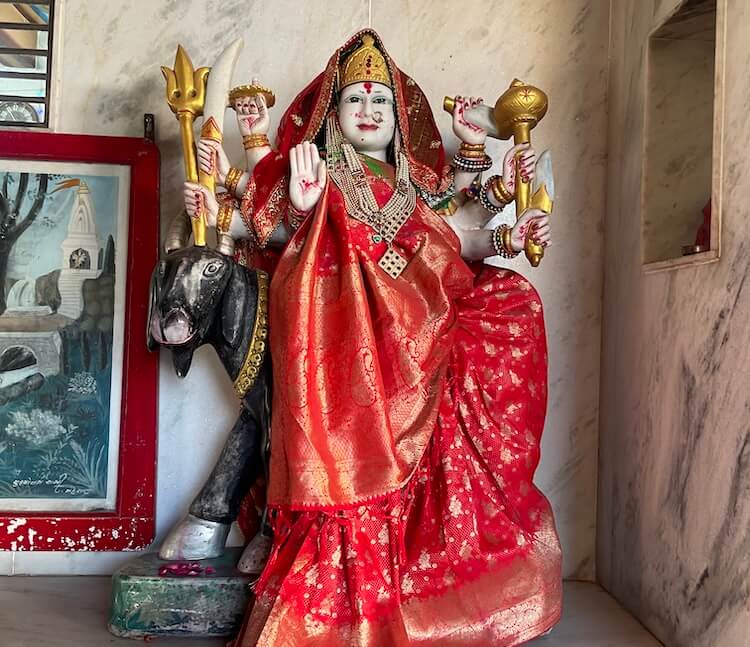
 Eventually, Malharrao surrendered to the divine will and summoned 151 Bhuvas (priestly devotees). One Jivan Bhuva, from the village of Beruva, demonstrated the Goddess’s power by sitting in boiling oil and extracting a pumpkin from a pot without breaking it. A celestial voice then commanded the King that the palace would only stand if the Goddess were enshrined on the seventh floor. Malharrao sought forgiveness and the principal seat of the Goddess was thus established at the palace’s summit.