त्रिमंदिर
बाबरिया कॉलेज के पास, वडोदरा, ता. / जिला. वडोदरा
 Inspired by the vision of the enlightened Jain spiritual leader and founder of ‘Akram Vigyan’ (the science of direct self-realization) Dada Bhagwan, Trimandirs have been built across India to spread the message of harmony among all religions. One such magnificent Trimandir stands in Vadodara, constructed with the intention of guiding those entangled in religious divisions toward a deeper understanding of equality, peace and spiritual unity instead of the pursuit of moksha through sectarian practices. This vast temple complex, spread over 6,880 square feet, houses deities from Jainism, Shaivism and Vaishnavism, alongside revered figures from other faiths, underlining its secular essence. People from various castes, sects and backgrounds come here in large numbers, making it a true spiritual confluence.
In a world where people often get trapped in the limitations of their own religious emotions, invisible walls of division have grown strong. Dada Bhagwan envisioned a movement that would break these barriers, helping humanity rediscover peace, unity and eternal joy. He proposed the idea of establishing Trimandirs across the country to uplift people’s spiritual understanding. Born on November 8, 1908, in Tarsali village of Gujarat, Dada Bhagwan’s real name was Ambalal Muljibhai Patel.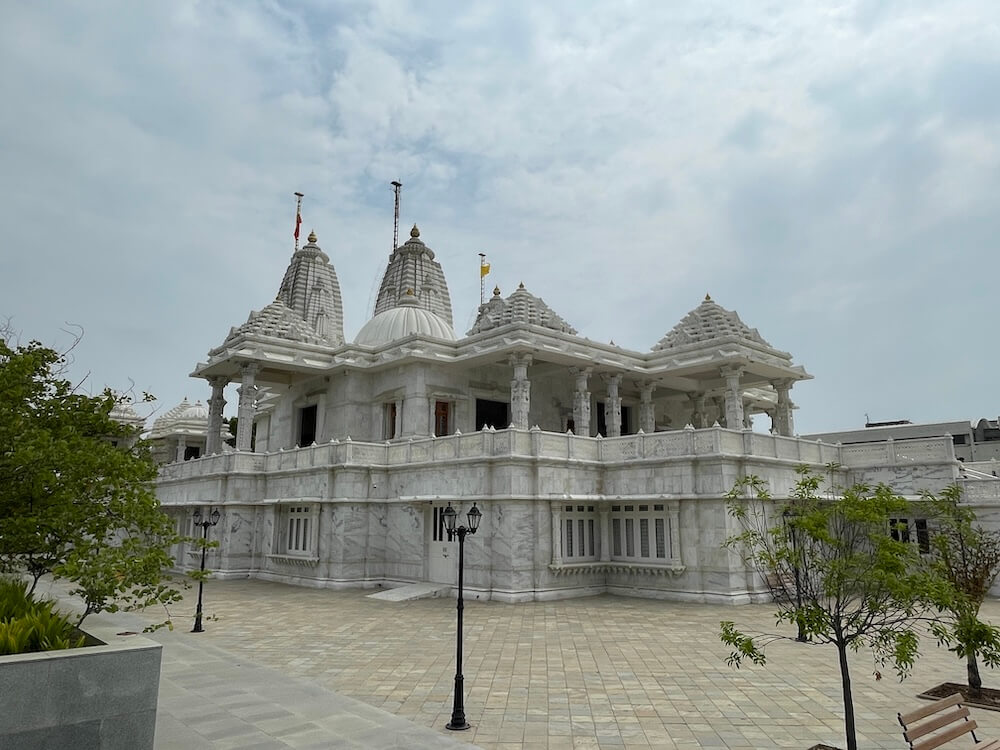
 Known affectionately as Dadashri, he chose not to pursue higher education beyond the tenth standard because he wanted to live a self-reliant life, free from employment under anyone. His fascination with spirituality began early and as a young man, he moved to Mumbai for business.
While working as a contractor at the dry docks managed by Patel & Company at Mumbai port, a transformative moment occurred. He claimed that in June 1958, while sitting on platform number 3 at Surat railway station, he experienced Atma Gnan (self-realization). This moment marked the beginning of the Akram Vigyan movement in the 1960s. According to the official website of the Dada Bhagwan Foundation, Akram Vigyan offers a ‘shortcut’ to self-realization, bypassing the traditional need for renunciation or rigorous self-discipline. In this philosophy, when ignorance of the soul is completely destroyed through the grace of an enlightened one, a profound inner transformation begins. This process of realization is known as Gnyan Vidhi, which is claimed to grant soul-awareness within two hours. The core of this science is Gnyan Bhakti – complete devotion through knowledge, especially toward Simandhar Swami and Dada Bhagwan, who is seen as his medium. Trimandirs place great emphasis on the worship of Simandhar Swami with deep devotion. Most Trimandirs are managed by the Shri Simandhar Swami Aradhana Trust and affiliated charitable foundations.
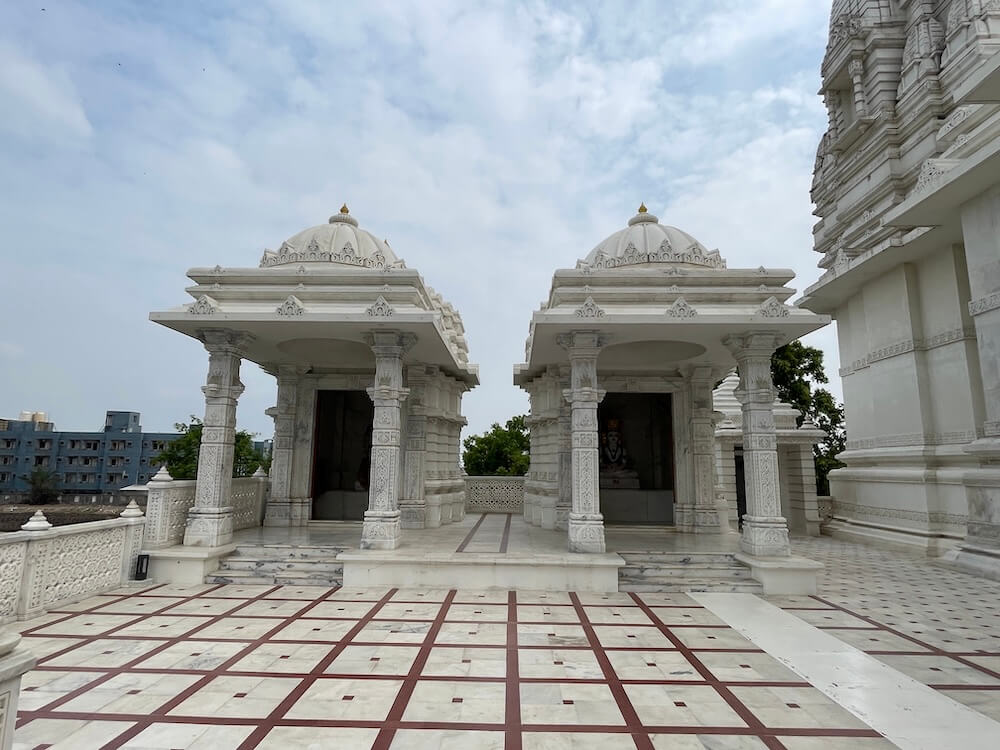
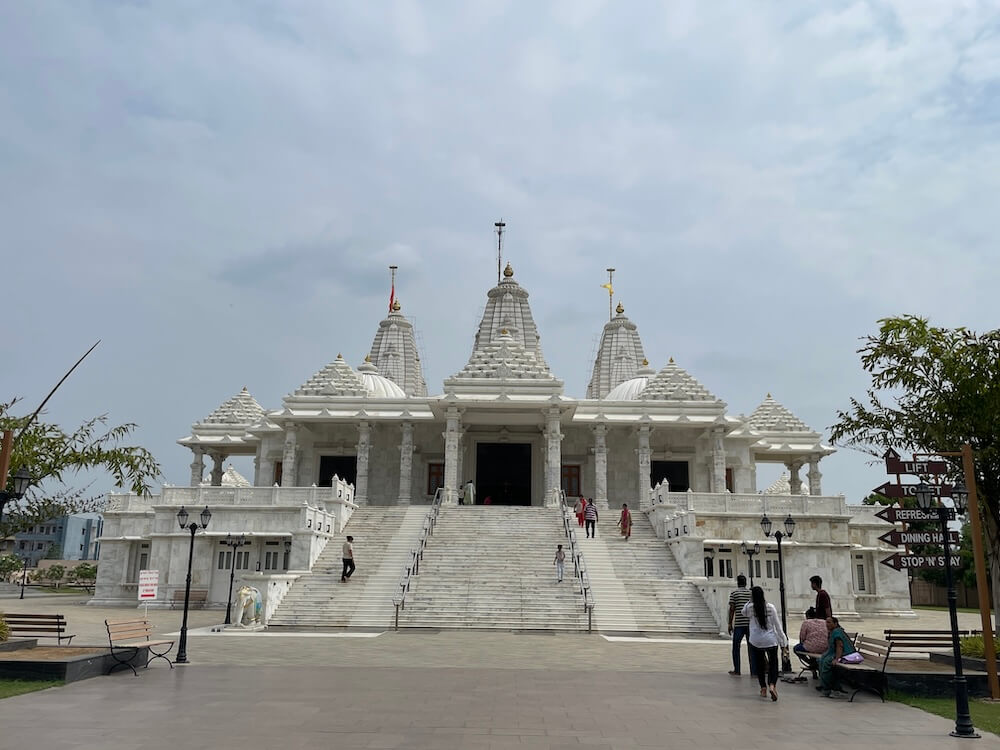
The Trimandir in Vadodara was built in 2017. Visitors enter the temple through a tall iron gate decorated with carved pillars. 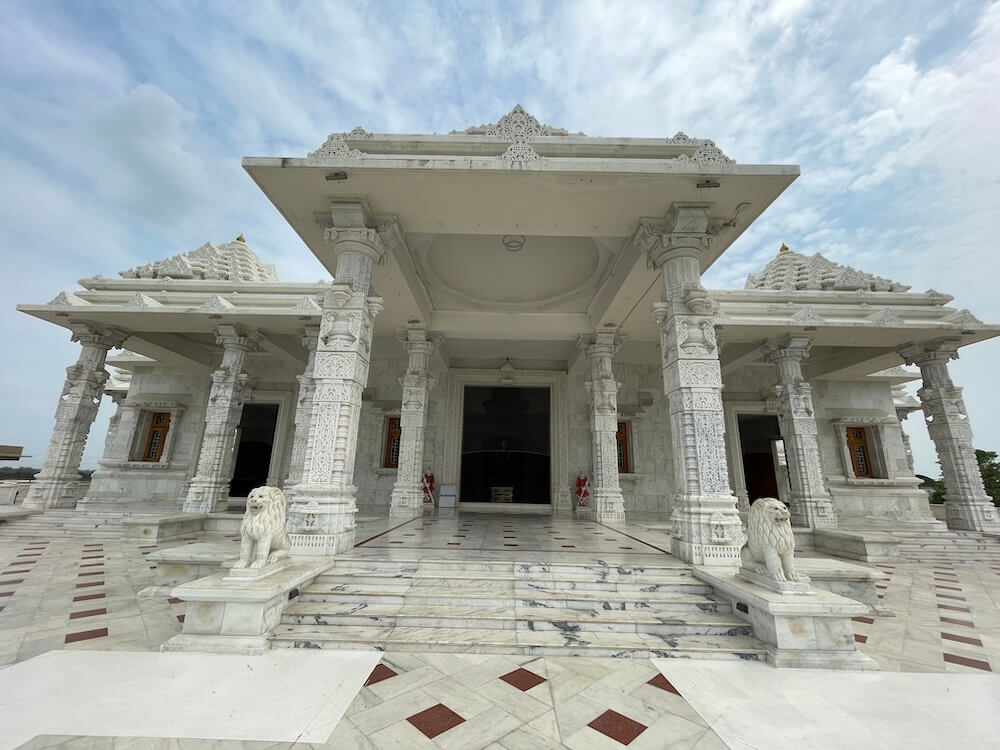 After ascending five steps, one reaches the marble-paved courtyard, where a grand white marble temple structure stands prominently. The base area of the temple alone spans 9,010.68 square feet. The main shrine lies on the upper floor of this two-storey building. Like other Trimandirs, it features an antarala (inner porch), ovaris (side galleries), an assembly hall and garbhagrihas (sanctums). Pyramid-shaped domes crown the porches and side galleries, while three large domes sit atop the main assembly hall. The sanctums rise with tall Urushringa-style spires, each topped with golden kalashas.
Marble elephant statues guard the spacious staircases on both sides of the temple and 35 steps lead up to the entrance of the main mandap. At the entryway are sculptures of lions on either side. Every column in the porch and side galleries is richly carved, as are the railings. 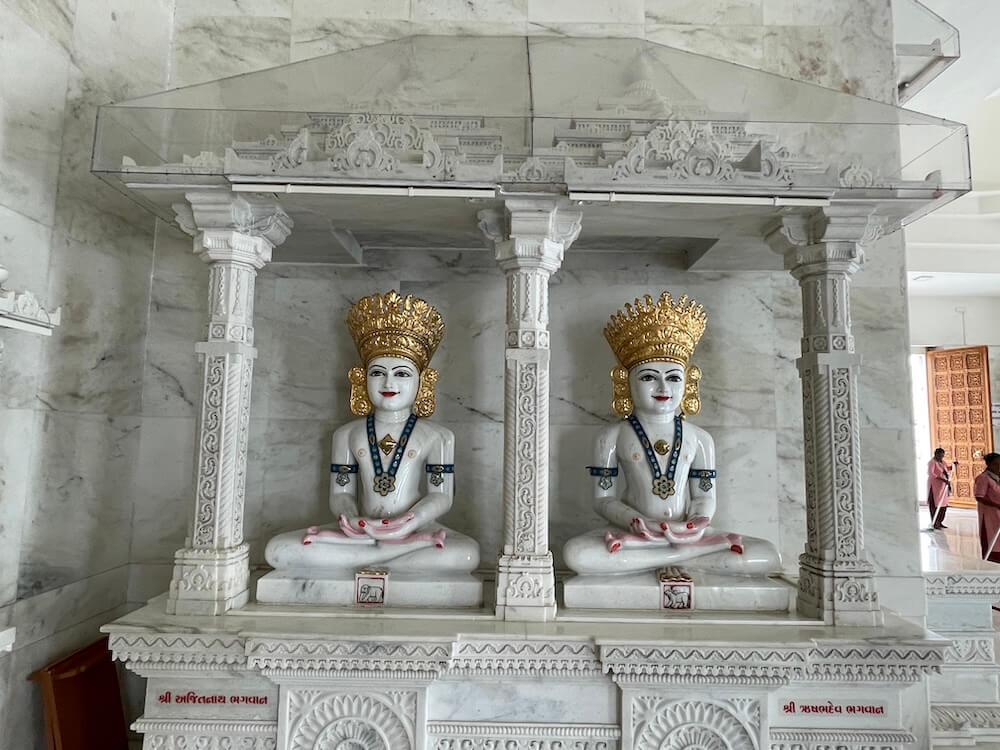 The assembly hall is accessible through three grand doorways, each framed in ornate carvings. Statues of divine sentinels (Dwarapalas) flank the central door. Inside, giant chandeliers hang from the ceiling, casting a gentle glow over the space.
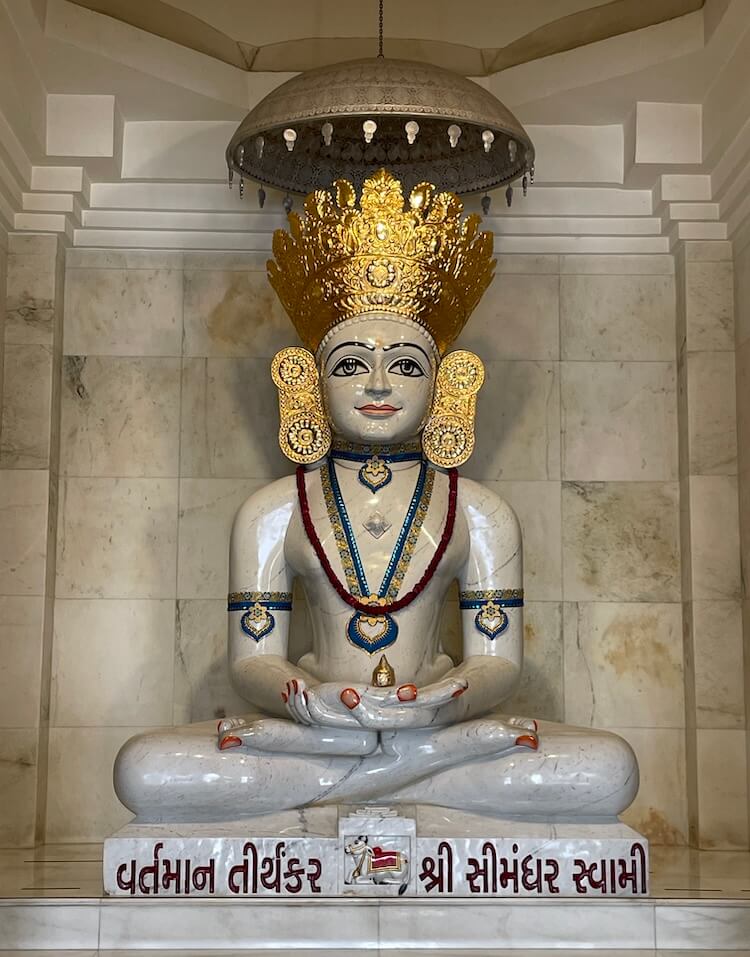
Directly ahead is the sanctum housing a 13 feet-tall marble idol of Jain Tirthankar Simandhar Swami, crowned in gold and shaded by a ceremonial canopy. According to Jain belief, Simandhar Swami is a living Tirthankar, currently residing in a parallel world known as Mahavideh Kshetra. Jain traditions hold that he was born during the era of the 17th and 18th Tirthankaras, Kunthunath and Arahanath. His physical form is said to be 1,500 feet tall, his age is believed to be 150,000 years and he is destined to live for another 125,000 years. 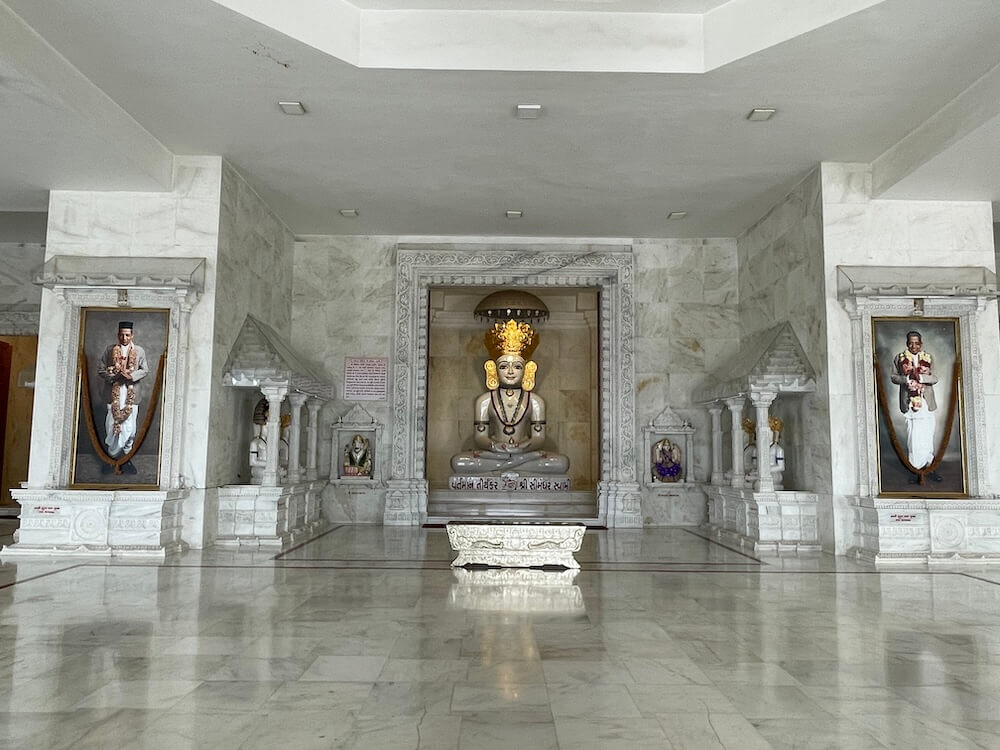 It is said that King Dasharath received initiation from Simandhar Swami.
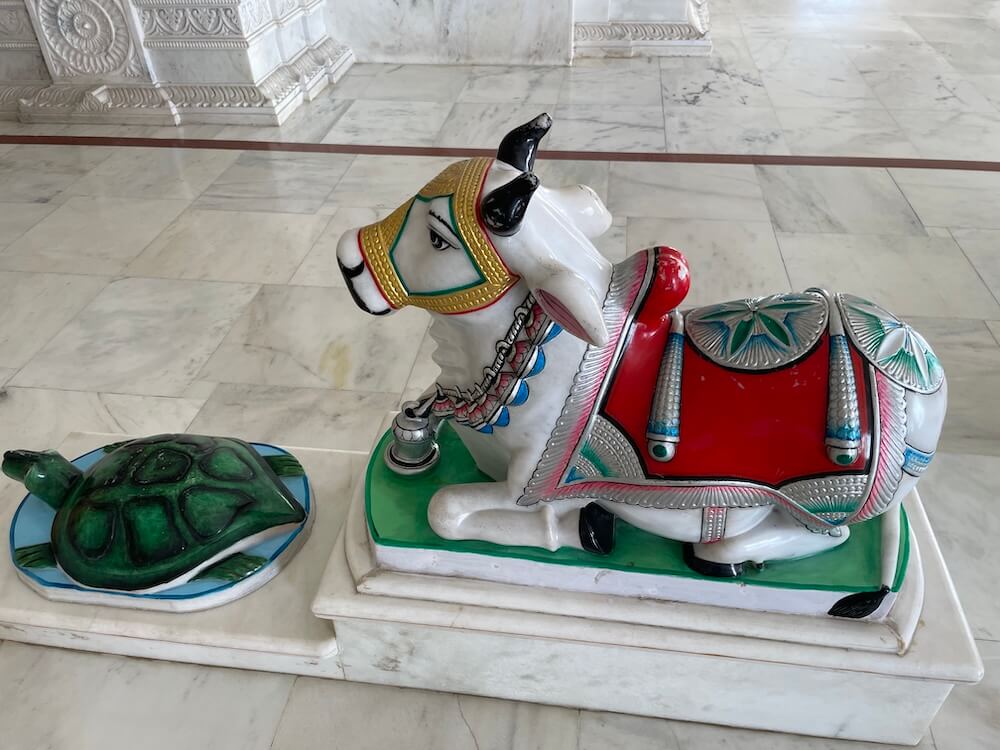
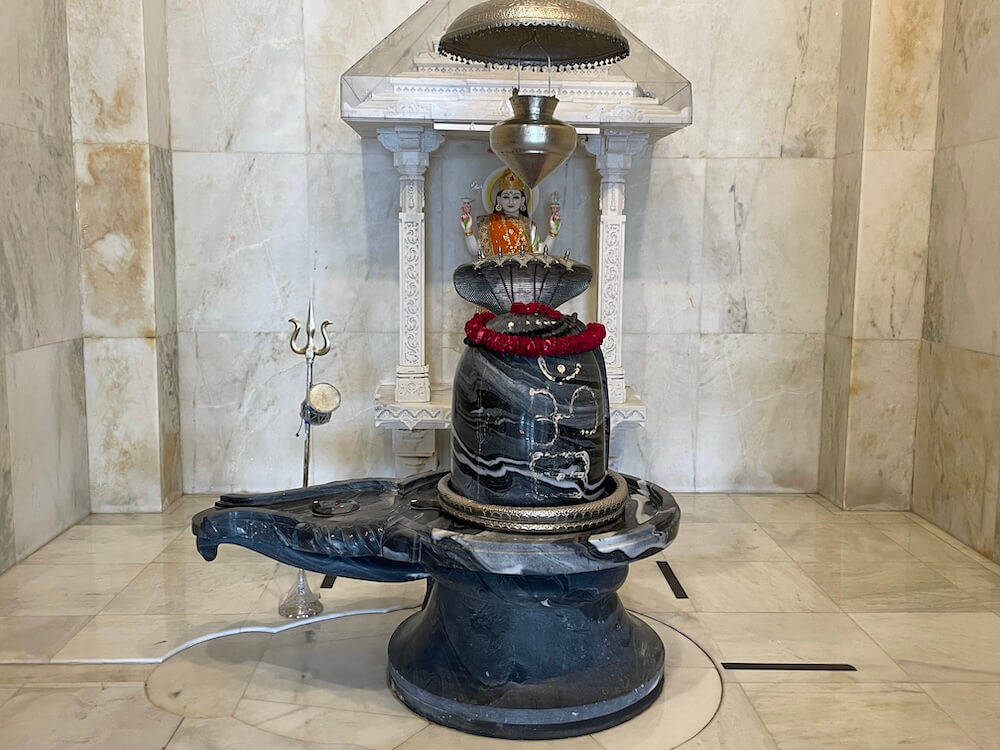
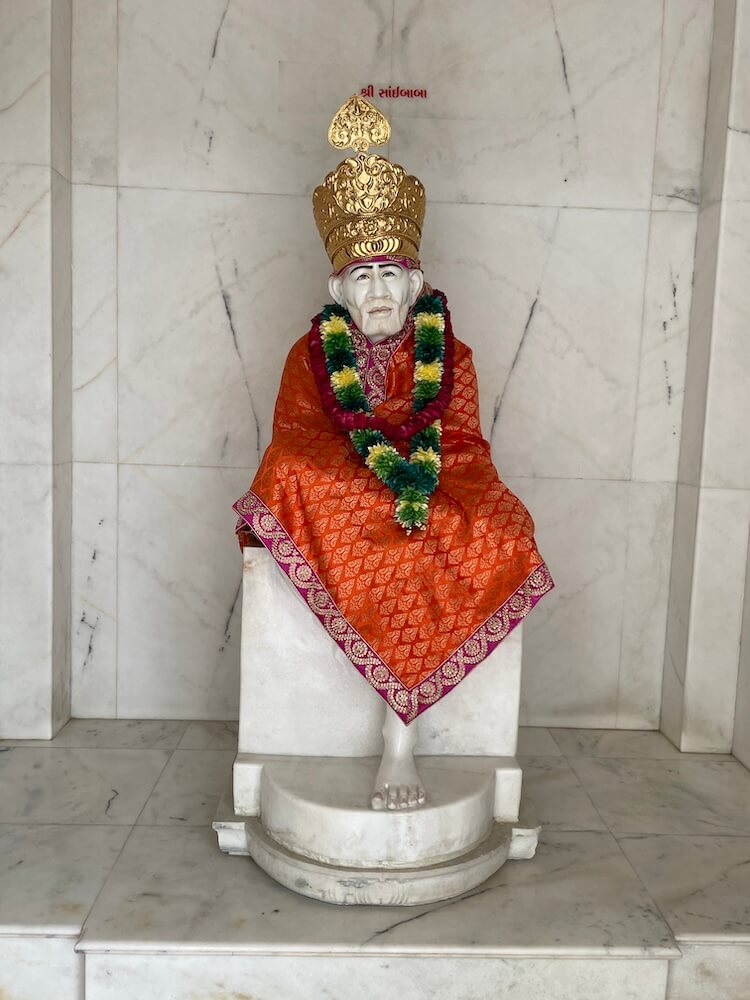
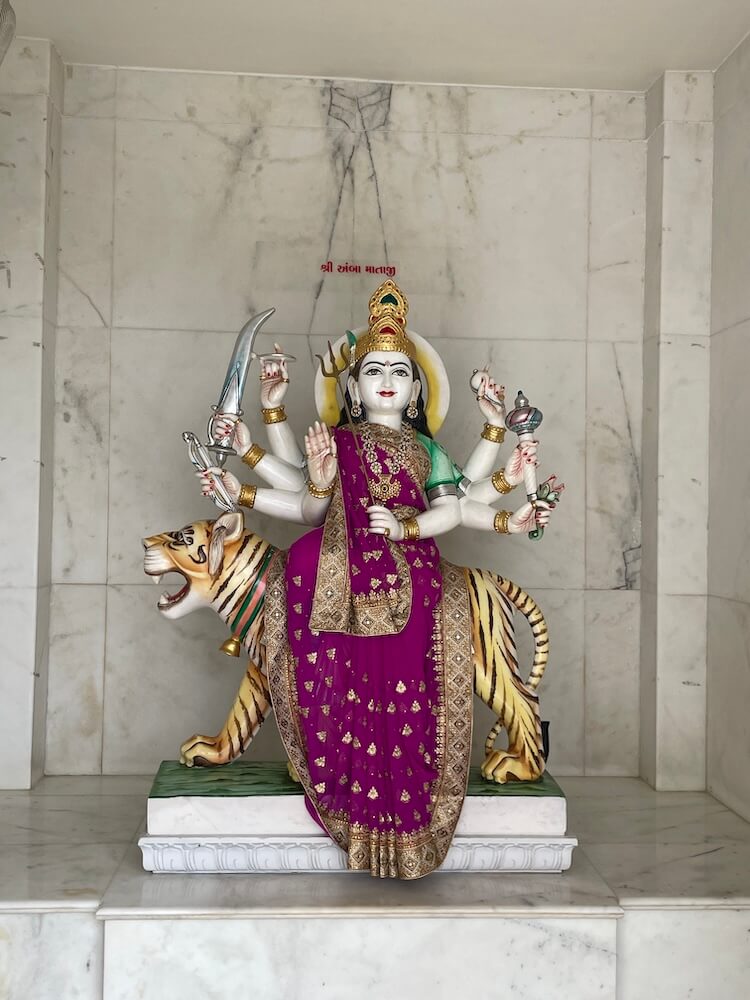
Outside this sanctum are shrines to Chandrayan Yaksha Dev and Panchanguli Yakshini Devi. Along the adjacent walls are idols of Bhagwan Mahavir, Bhagwan Parshvanath, Bhagwan Ajitnath and Bhagwan Rishabhdev. Near this sanctum is an image of Dada Bhagwan. To the left is Shivlok, the Shaiva section, with Nandi and the sacred turtle placed in front of the sanctum. Here, shrines of Ganesha and Hanuman are also present. The central feature is a Shivling, over which a serpent holds a protective hood. Behind the Shivling is a sculpture of Parvati Mata. On the right side of Simandhar Swami’s sanctum is Vishnulok. Outside this sanctum are shrines to Bhadrakali, Chakreshwari and Mahakali. Inside the sanctum, placed on a raised platform, are idols of Shrinathji, Shri Krishna and Tirupati Balaji arranged from left to right. 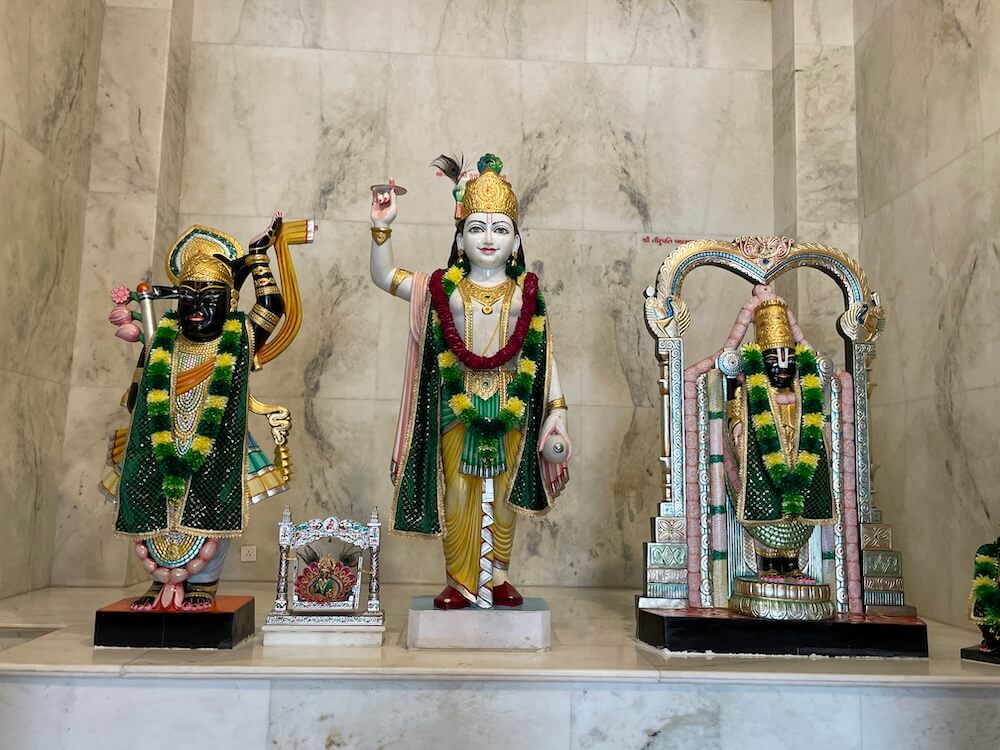 The complex also features separate sanctums dedicated to Padmanabh Dev, Padmavati Devi, Sai Baba and Amba Mata.
The temple houses three spiritual discourse halls. The largest of these spans 15,437 square feet, while the other two are 1,480 square feet each. Every day, hundreds of devotees visit this temple. At night, the temple is illuminated with spectacular lighting. Festivals like Mahashivratri, Guru Purnima, Janmashtami, Navratri and Mahavir Jayanti are celebrated with great enthusiasm. Devotional gatherings are held on the last Sunday of every month and spiritual satsangs occur every three months. Summer camps for children are organized annually.
For children, the temple grounds offer a variety of play facilities. An electric shuttle service is available for the convenience of visitors. A museum and mini-theatre enrich the visitor experience. The on-site Vignyan Bhandar bookstore offers spiritual books, audio CDs, DVDs, audiobooks and photographs based on Dada Bhagwan’s Akram Vigyan. These materials are available not only in Hindi, Gujarati and other Indian languages but also in English, German, Portuguese, Spanish and more.
त्रिमंदिर
बाबरिया कॉलेज के पास, वडोदरा, ता. / जिला. वडोदरा