
श्री आदि शंकरा जन्मभूमी क्षेत्रम्
कलाडी, जि. एर्नाकुलम.
Sri Adi Shankara Janmabhoomi Kshetram
Kalady, Dist. Ernakulam.
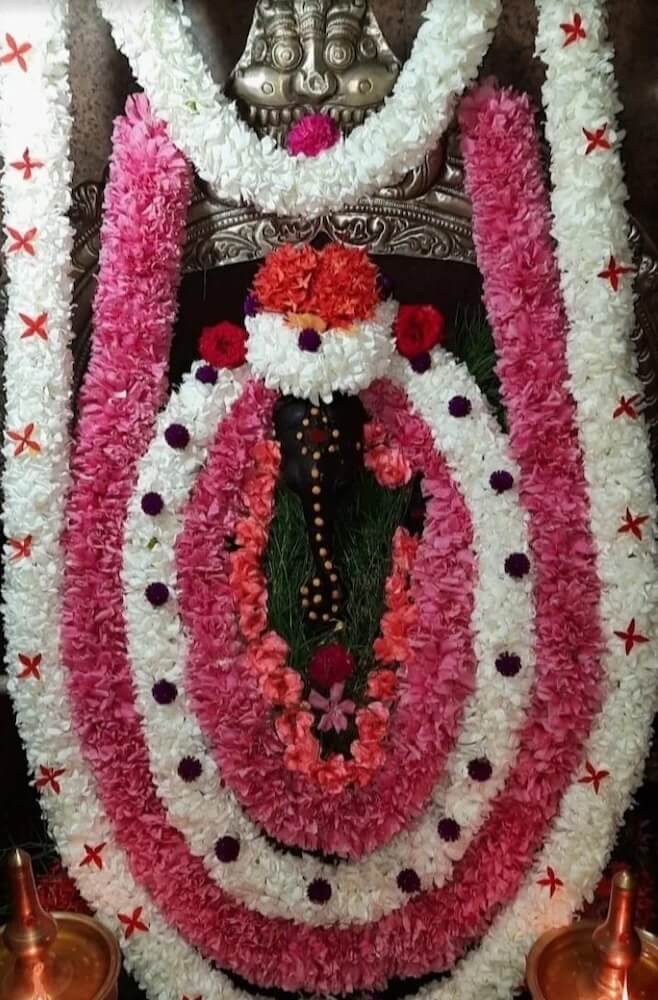 Adi Shankara Janmabhoomi Temple, situated on the banks of the Periyar (Poorna) River at Kalady in Ernakulam district, is an important pilgrimage centre believed to be the birthplace of Adi Shankaracharya. Dedicated to preserving the memory of Adi Shankaracharya, the great philosopher of Advaita Vedanta and one of the most revered spiritual teachers of Sanatana Dharma, the temple is managed by the Sringeri Sharada Peetham. It is believed that the temple complex stands on the site of Adi Shankaracharya’s birthplace. Throughout the year, many devotees and pilgrims from different parts of India and abroad visit the temple to offer prayers.
According to traditional belief, this site, where the Kaippilly Mana, the ancestral home of Adi Shankaracharya, once stood in the 8th century, remained neglected and largely forgotten for many centuries after he renounced worldly life. In 1905, Jagadguru Sri Sacchidananda Shivabhinava Narasimha Bharati Swamiji, the 33rd Jagadguru of the Sringeri Sharada Peetham, identified the site as the birthplace of Adi Shankaracharya after studying old records and carrying out detailed investigations. The then ruler of Travancore, Sree Moolam Thirunal Rama Varma Maharaja, later declared the area a sacred site and granted the land to the Sringeri Math for the construction of a temple. As part of this initiative, temples dedicated to Adi Shankaracharya and Goddess Sharadamba were built and their consecration was performed under the guidance of the Jagadguru on 21 February 1910. 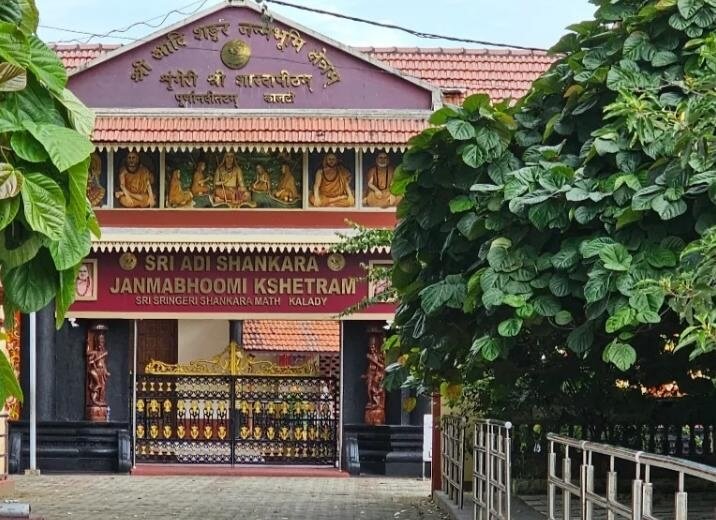 Following this restoration, Kalady regained recognition as the birthplace of Adi Shankaracharya and gradually developed into one of India’s important centres of pilgrimage and learning.
According to traditional belief, Adi Shankaracharya was born in AD 788 at Kaippilly Mana in Kalady to Shivaguru and Aryamba. Legend says that he was born as the result of the prayers offered by his parents at the Vadakkunnathan Temple in Thrissur for the blessing of a child. From a very young age, he displayed exceptional intelligence and studied the Vedas and Upanishads here. Aryamba had to walk a long distance every day to bathe in the Periyar (Poorna) River. 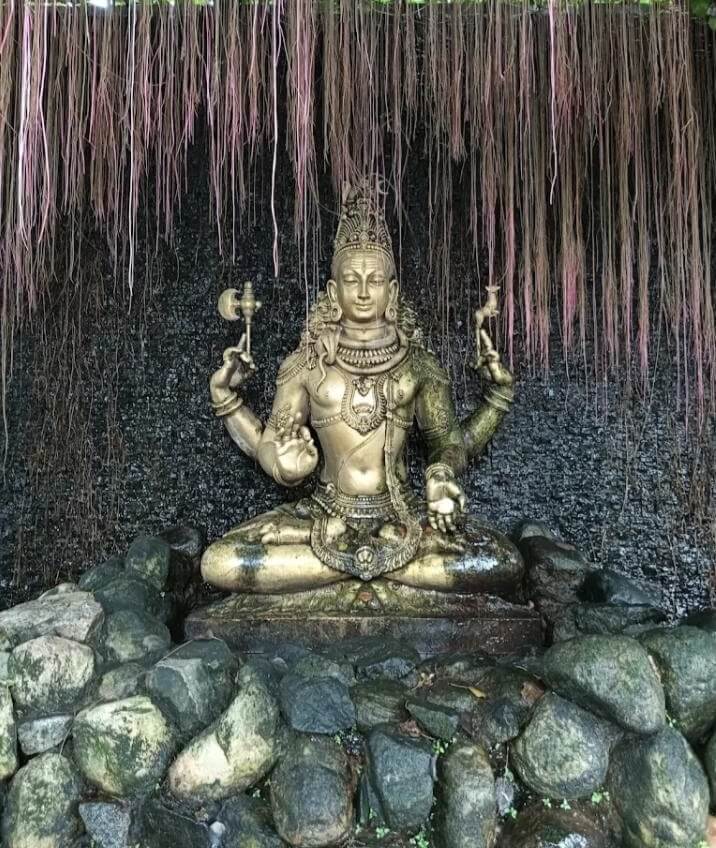 According to legend, when the young Shankara saw his aged mother collapse from exhaustion on her way to the river, he prayed to Lord Krishna, the family deity. Pleased with his devotion, the Lord commanded the Periyar River to follow Shankara’s footsteps and flow close to their home. It is believed that the river changed its course accordingly and the place came to be known as “Kalady”, meaning “footsteps”. Later, when Shankara wished to become a monk, his mother refused to give her permission as he was her only son. Legend says that while bathing in the Periyar River, a crocodile caught his leg. Believing that death was near, Shankara asked his mother to allow him to take sannyasa (monastic vows). As soon as she agreed, the crocodile released him without causing any injury. The place where this event is believed to have taken place is today known as Muthalakkadavu (Crocodile Ghat).
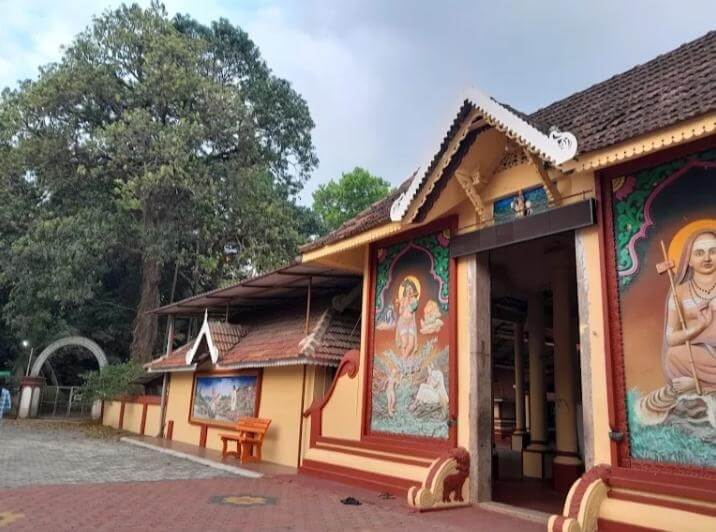
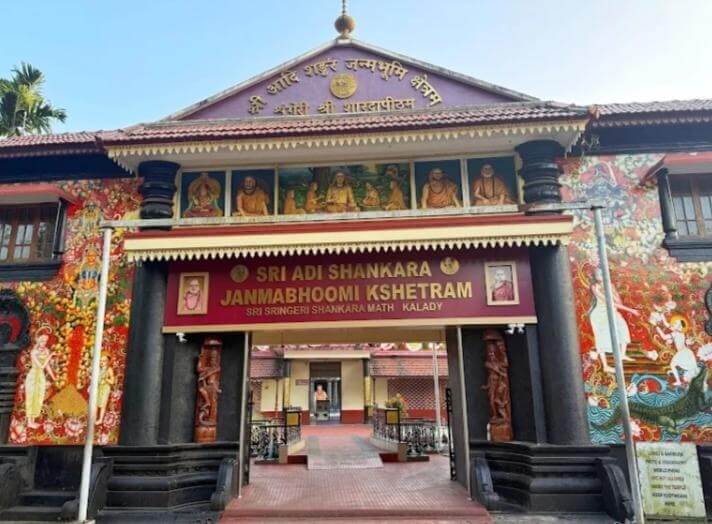
The temple’s architecture is a blend of traditional Kerala and South Indian (Dravidian) styles. Its simple, monastery-like atmosphere is one of its main attractions. The main entrance features a traditional Kerala-style gateway with a tiled roof supported by wooden pillars. 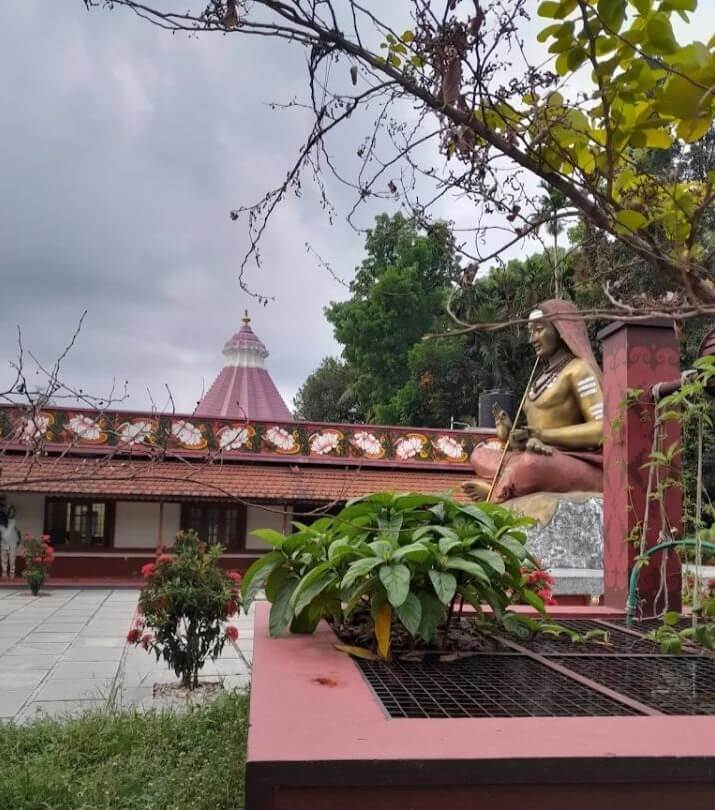 Images and sculptures of Adi Shankaracharya and his principal disciples can be seen above the entrance. Unlike many large temples, the complex has no towering gopurams or elaborate structures. Instead, visitors are welcomed by a spacious courtyard shaded by trees, with the calm waters of the Periyar (Poorna) River flowing beside the temple. Inside the complex is a large prayer hall built in the style of South Indian monasteries, along with the two main sanctums dedicated to Adi Shankaracharya and Goddess Sharadamba.
One of the main sanctums is dedicated to Adi Shankaracharya, who is enshrined in the form of Dakshinamurti, seated in the lotus posture (Padmasana) with the Chinmudra, symbolising the teaching of supreme knowledge. In front of the idol are the sacred silver Shankara Padukas (holy footprints), where devotees traditionally offer their prayers. The sanctum is built in the Shodashakona (16-sided) style, symbolising the sixteen divine arts, which represent completeness in Indian philosophy. Nearby is the sanctum of Goddess Sharadamba, the Goddess of wisdom and learning, enshrined seated on the Sri Chakra.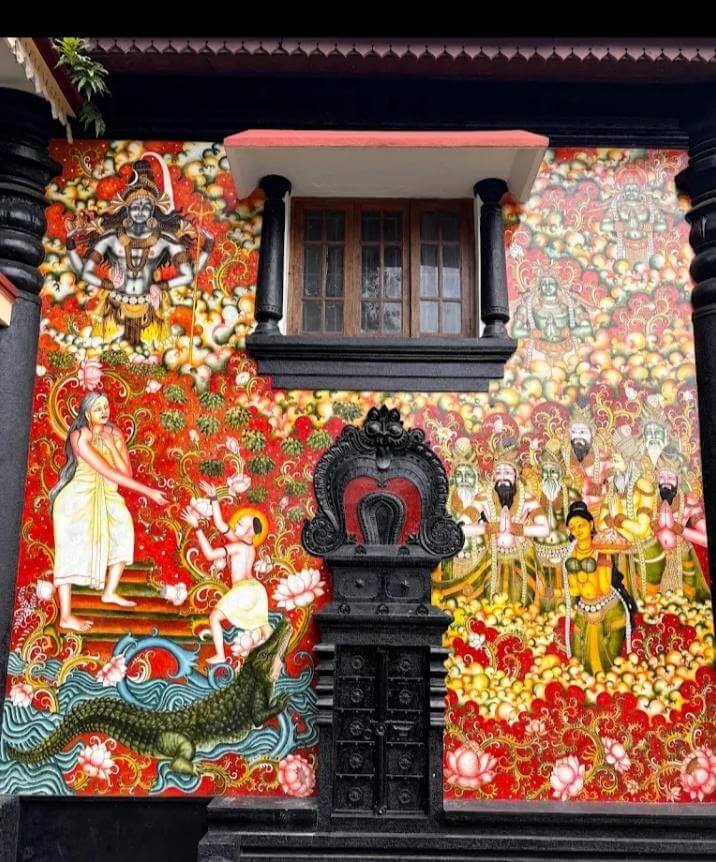 Built on the model of the main Sharadamba shrine at Sringeri, this sanctum follows the Ashtapadma (eight-petalled lotus) design, representing the human heart lotus. The walls are also decorated with carvings of the Saptamatrikas (Seven Mother Goddesses).
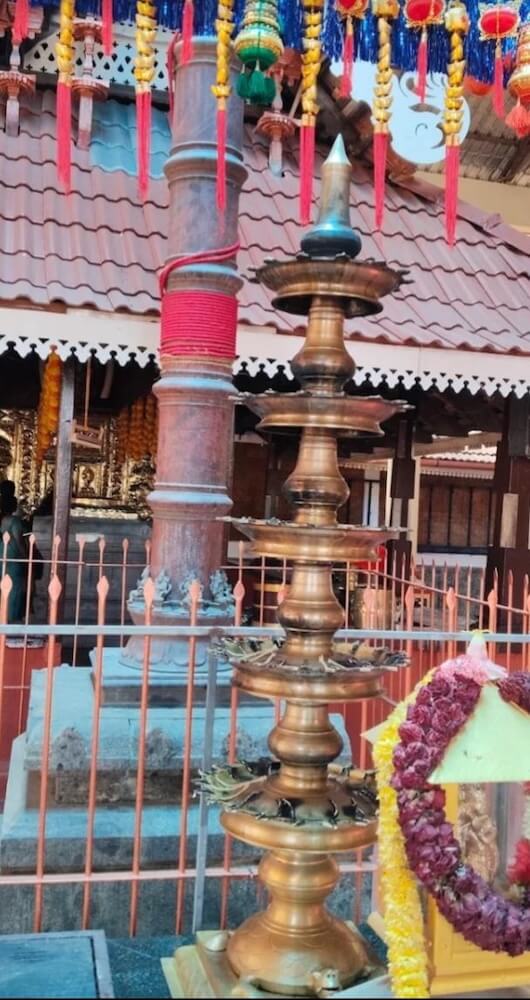
The architecture of both sanctums features fine South Indian carvings. Unlike the traditional Kerala temple style, their walls are built with polished black granite in the architectural style of Karnataka and Tamil Nadu. Within the temple complex is a small memorial shrine marking the cremation site of Aryamba, the mother of Adi Shankaracharya. A Tulasi platform and a lamp that is kept continuously lit can also be seen there. The complex also includes the Gauri Shankara Temple, dedicated to Lord Shiva and Goddess Parvati. From the inner courtyard, stone steps lead down to the historic Muthalakkadavu on the banks of the Periyar River, where the famous crocodile legend of Adi Shankaracharya is believed to have taken place.
Apart from the main sanctums, the temple complex also has shrines dedicated to Lord Mahaganapati, the remover of obstacles, Gauri Shankara (Lord Shiva and Goddess Parvati) and Shakti Ganapati, who is worshipped in a special form. 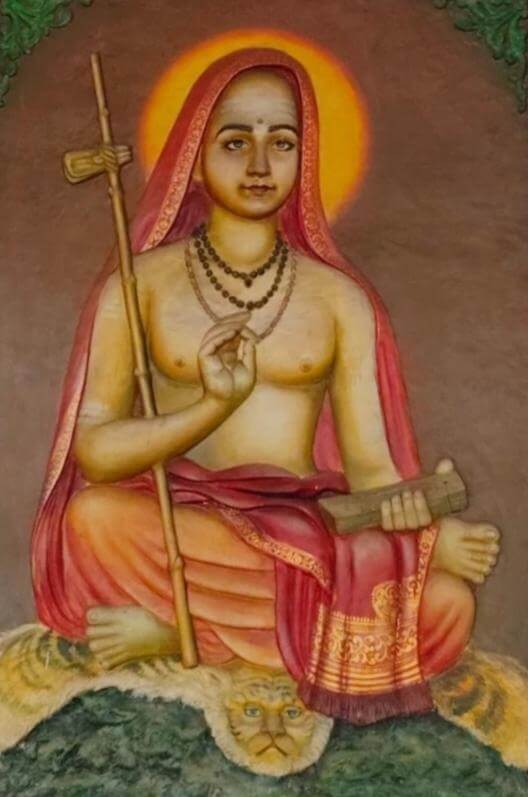 There is also a small shrine dedicated to the memory of Jagadguru Sri Sacchidananda Shivabhinava Narasimha Bharati Swamiji, the 33rd Jagadguru of the Sringeri Sharada Peetham, who led the rediscovery and restoration of this sacred birthplace.
The most important festival celebrated at the temple is Sri Shankara Jayanti Mahotsavam, observed on Vaishakha Shukla Panchami during the Malayalam months of Medam–Edavam (April–May). This five-day festival includes Vidwat Sabha (scholarly discussions), Vedic chanting, the Ratholsavam (chariot procession) and the Kanakadhara Yajna, during which the Kanakadhara Stotram composed by Adi Shankaracharya is recited by a group of Vedic scholars. The Sharada Sharannavarathri Mahotsavam, celebrated over nine days in the Malayalam month of Kanni (September–October), is another major festival. During this period, Goddess Sharadamba is adorned in different forms each day and special rituals such as the Maha Chandika Homa, Sangeetharchana and Vidyarambham are conducted. The Prathishta Dina Mahotsavam, marking the temple’s consecration, is observed on Magha Shukla Dwadashi in the Malayalam month of Kumbham (February–March) with special Kumbhabhishekam and other rituals. Special poojas, homas and abhishekams are also performed at the Gauri Shankara and Mahaganapati shrines during Maha Shivaratri and Vinayaka Chaturthi.
Among the temple’s main offerings, the most important is the Kanakadhara Archana, dedicated to Goddess Sharadamba. Performed with the recitation of the Kanakadhara Stotram composed by Adi Shankaracharya, this offering is made by devotees seeking prosperity, financial well-being and relief from poverty. The Paduka Pooja, performed before the sacred Shankara Padukas in the Adi Shankaracharya sanctum, is offered in remembrance of the Guru and for success in education and guidance in life. The Medha Sukta Archana, dedicated to Goddess Sharadamba, is performed for wisdom, memory and academic success, while offering a silk cloth (Pattu Charthal) to the Goddess is believed to bring marital blessings and family prosperity. Devotees also perform Advaita Archana and Ashtothara Archana for Adi Shankaracharya and Goddess Sharadamba. Another important offering is lighting a lamp and offering Pushpanjali at the memorial shrine of Aryamba, the mother of Adi Shankaracharya, seeking a mother’s blessings, good health and the well-being of the family.
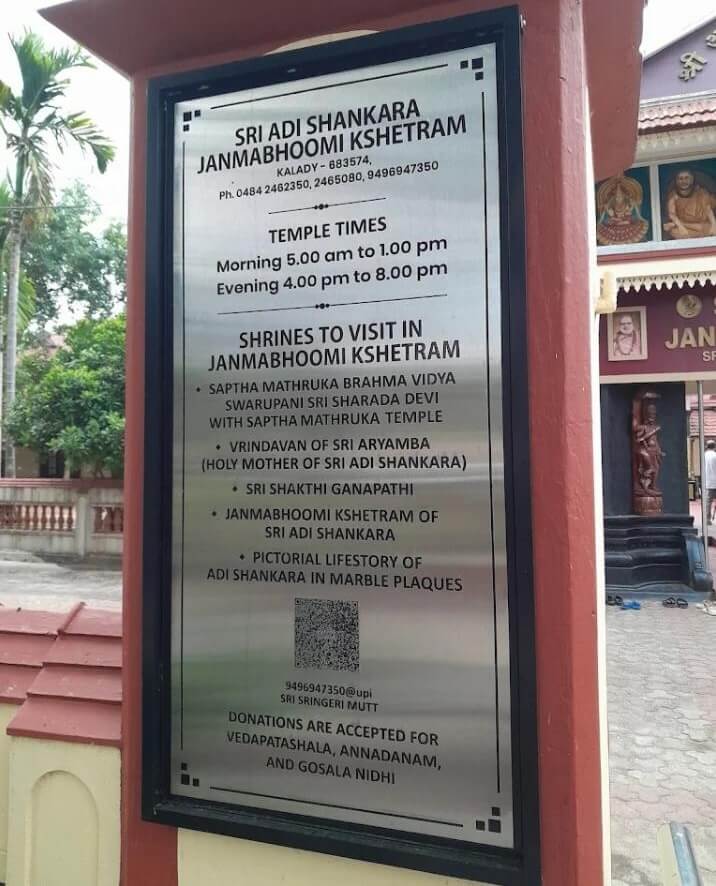
The temple opens daily at 05:00 AM. Nirmalya Darshanam and Abhishekam are performed at 05:30 AM, followed by Usha Pooja at 07:00 AM, Dhara and special archanas at 08:30 AM and Ucha Pooja with Maha Nivedyam at 11:30 AM. The temple closes at 1:00 PM. It reopens at 04:00 PM, followed by Deeparadhana (Seeveli) at 06:30 PM and Athazha Pooja at 07:30 PM, before closing for the day at 08:00 PM. A free prasada meal is served to devotees at the monastery dining hall from 12:00 PM to 01:30 PM after the Ucha Pooja. Bookings for special archanas and Paduka Pooja should be made at the counter before 10:30 AM. On special occasions such as Shankara Jayanti and Navaratri, pooja timings may vary and the temple may remain open until later in the evening.
Key highlight :-
- Located 8 km from Angamaly, 16 km from Aluva, and 10 km from Perumbavoor.
- The nearest railway station is Angamaly Railway Station, about 8 km away.
- The nearest airport is Cochin International Airport, about 7 km away.
- KSRTC and local bus services are available to the temple from Aluva and Angamaly.
- Private vehicles can be parked in the temple’s designated parking area.
- Accommodation and food facilities are available in the nearby towns.
- Contact number +91 4842462350, +91 4842465922
श्री आदि शंकराचार्य जन्मभूमि क्षेत्र
कलाडी, जिला. एर्नाकुलम.
मंदिरे
Temples
मंदिर
મંદિરો
கோவில்கள்
దేవాలయాలు
ക്ഷേത്രങ്ങൾ
ದೇವಾಲಯಗಳು
মন্দিরসমূহ
ਮੰਦਿਰ
-
श्री लक्ष्मी नारायण मंदिर कुंबलम, जि. एर्नाकुलम.
अधिक माहितीSree Lakshmi Narayana Temple Kumbalam, Dist. Ernakulam.
View Detailsश्री लक्ष्मी नारायण मंदिर कुम्बलम, जिला. एर्नाकुलम.
विवरण देखेंSree Lakshmi Narayana Temple Kumbalam, Dist. Ernakulam.
વિગત જુઓSree Lakshmi Narayana Temple Kumbalam, Dist. Ernakulam.
விவரங்களைக் காண்கSree Lakshmi Narayana Temple Kumbalam, Dist. Ernakulam.
వివరాలను చూడండిSree Lakshmi Narayana Temple Kumbalam, Dist. Ernakulam.
വിശദാംശങ്ങൾ കാണുകSree Lakshmi Narayana Temple Kumbalam, Dist. Ernakulam.
ವಿವರಗಳನ್ನು ವೀಕ್ಷಿಸಿSree Lakshmi Narayana Temple Kumbalam, Dist. Ernakulam.
বিস্তারিত দেখুনSree Lakshmi Narayana Temple Kumbalam, Dist. Ernakulam.
ਵੇਰਵੇ ਦੇਖੋ -
कोचीन थिरुमाला देवस्वोम मंदिर चेरलाई, मत्तनचेरी, जि. एर्नाकुलम.
अधिक माहितीCochin Thirumala Devaswom Temple Cherlai, Mattancherry, Dist. Ernakulam.
View Detailsकोचीन थिरुमाला देवास्वोम मंदिर चेरलाई, मट्टनचेरी, जिला। एर्नाकुलम.
विवरण देखेंCochin Thirumala Devaswom Temple Cherlai, Mattancherry, Dist. Ernakulam.
વિગત જુઓCochin Thirumala Devaswom Temple Cherlai, Mattancherry, Dist. Ernakulam.
விவரங்களைக் காண்கCochin Thirumala Devaswom Temple Cherlai, Mattancherry, Dist. Ernakulam.
వివరాలను చూడండిCochin Thirumala Devaswom Temple Cherlai, Mattancherry, Dist. Ernakulam.
വിശദാംശങ്ങൾ കാണുകCochin Thirumala Devaswom Temple Cherlai, Mattancherry, Dist. Ernakulam.
ವಿವರಗಳನ್ನು ವೀಕ್ಷಿಸಿCochin Thirumala Devaswom Temple Cherlai, Mattancherry, Dist. Ernakulam.
বিস্তারিত দেখুনCochin Thirumala Devaswom Temple Cherlai, Mattancherry, Dist. Ernakulam.
ਵੇਰਵੇ ਦੇਖੋ -
पझूर पेरुमथ्रिककोविल महादेवाचे मंदिर पझूर, पिरावोम, जि. एर्नाकुलम.
अधिक माहितीPazhoor Perumthrikkovil Mahadeva Temple Pazhoor, Piravom, Diist. Ernakulam.
View Detailsपज़हूर पेरुमथ्रिककोविल महादेव मंदिर पज़हूर, पिरावोम, जिला। एर्नाकुलम.
विवरण देखेंPazhoor Perumthrikkovil Mahadeva Temple Pazhoor, Piravom, Diist. Ernakulam.
વિગત જુઓPazhoor Perumthrikkovil Mahadeva Temple Pazhoor, Piravom, Diist. Ernakulam.
விவரங்களைக் காண்கPazhoor Perumthrikkovil Mahadeva Temple Pazhoor, Piravom, Diist. Ernakulam.
వివరాలను చూడండిPazhoor Perumthrikkovil Mahadeva Temple Pazhoor, Piravom, Diist. Ernakulam.
വിശദാംശങ്ങൾ കാണുകPazhoor Perumthrikkovil Mahadeva Temple Pazhoor, Piravom, Diist. Ernakulam.
ವಿವರಗಳನ್ನು ವೀಕ್ಷಿಸಿPazhoor Perumthrikkovil Mahadeva Temple Pazhoor, Piravom, Diist. Ernakulam.
বিস্তারিত দেখুনPazhoor Perumthrikkovil Mahadeva Temple Pazhoor, Piravom, Diist. Ernakulam.
ਵੇਰਵੇ ਦੇਖੋ