
श्री जलाराम बाप्पा मंदिर
इम्रान नगर, वापी, ता. वापी, जि. वलसाड
Shri Jalaram Bappa Mandir
Imran Nagar, Vapi, Tal. Vapi, Dist. Valsad
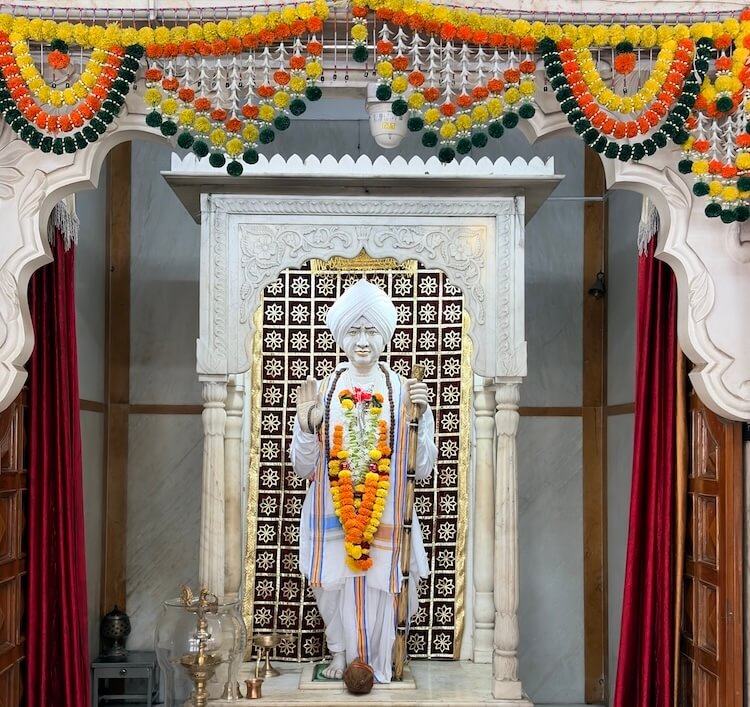 The Jalaram Bappa Mandir, nestled within the Imran Nagar locality of Vapi city in Valsad district, stands as a premier sanctuary of faith for devotees, carrying forward the legacy of altruistic service pioneered by Saint Jalaram Bappa. Amongst the saints who safeguarded humanism by transcending the boundaries of the caste system and social stratification, the name of Saint Jalaram Bappa is uttered with profound reverence. During an era marked by social inequality, he devoted his entire life to serving the underprivileged and the afflicted. Rooted in the fundamental belief that ‘service to humanity is service to God’, this sacred site has become a crucial centre of devotion and social welfare.
Saint Jalaram Bappa was born in 1799 on the seventh day of the bright fortnight of the Hindu month of Kartik (Kartik Shuddha Saptami) in Virpur (Rajkot district, Gujarat), to the devout couple Pradhan Thakkar and Rajbai.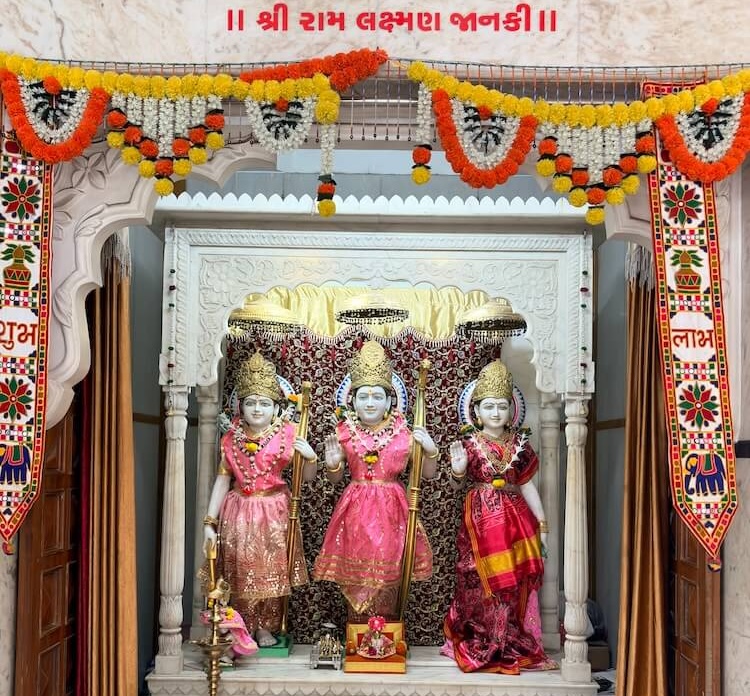 Owing to the moral upbringing imparted by his mother from early childhood, an innate spirit of service was deeply ingrained in his disposition. Recognising Jalaram’s spiritual inclination, Saint Raghuvir Dasji accepted him as his disciple. Despite his marriage to Veerbai at the tender age of sixteen, his mind remained detached from worldly domestic affairs. He began dedicating his time entirely to the succour of the needy. At the age of eighteen, Bappa accepted the discipleship of Saint Bhojalram of Fatehpur. Steadfastly adhering to the sacred verses imparted by his guru, he continued his lifelong vow of social service uninterrupted. By the age of twenty, his renown had spread far and wide. He eventually departed from his earthly abode on 23 February 1881.
Being an ardent devotee of Lord Shri Ram, Bappa regarded the feeding of the hungry as the supreme, eternal vow of his life—a tradition that continues to flourish across numerous temples dedicated to him to this day. Legend holds that Lord Shri Ram once tested Bappa by appearing in the guise of an elderly ascetic. He requested his wife’s services. Without a moment’s hesitation, Bappa sent his wife along with the ascetic. Another popular account narrates that when certain youths attempted to defile Bappa’s community kitchen by placing the flesh of dead birds into the food, the birds were miraculously restored to life at Bappa’s touch and flew away. He also laboured extensively to foster harmonious relations between the Hindu and Muslim communities.
The city of Vapi boasts a rich historical trajectory, evolving from an ancient agrarian settlement into a contemporary industrial metropolis. Situated on the banks of the Damanganga River, Vapi was formerly known as ‘Vapika’, meaning ‘stepwell’. At present, the city is globally recognised as a premier industrial hub of Asia.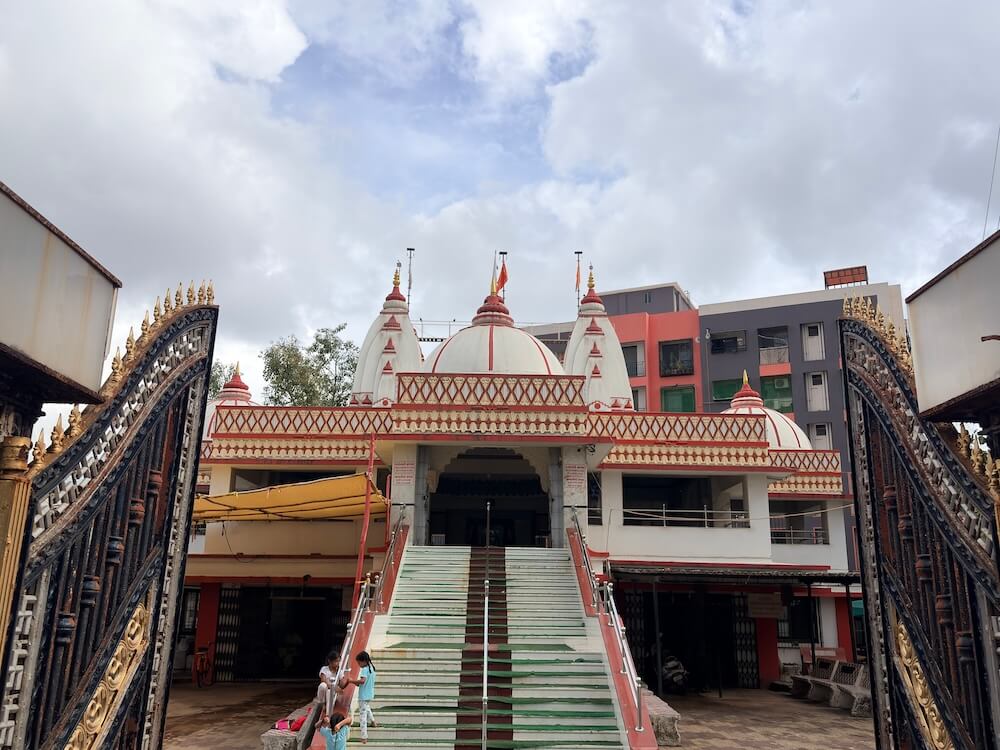 Formerly part of the Pardi territory, this region remained a rustic village dedicated to cultivating paddy and fodder grass until the 1960s. It was during this very decade that the Gujarat Industrial Development Corporation was established. The subsequent creation of an industrial estate catalysed the rapid development of the area, transforming it into a bustling city. A few years ago, the Jalaram Bappa Bhakt Mandal established the Jalaram Bappa Temple within this city. Embodying the charitable legacy of Bappa, this temple actively operates a community kitchen alongside several other social welfare initiatives.
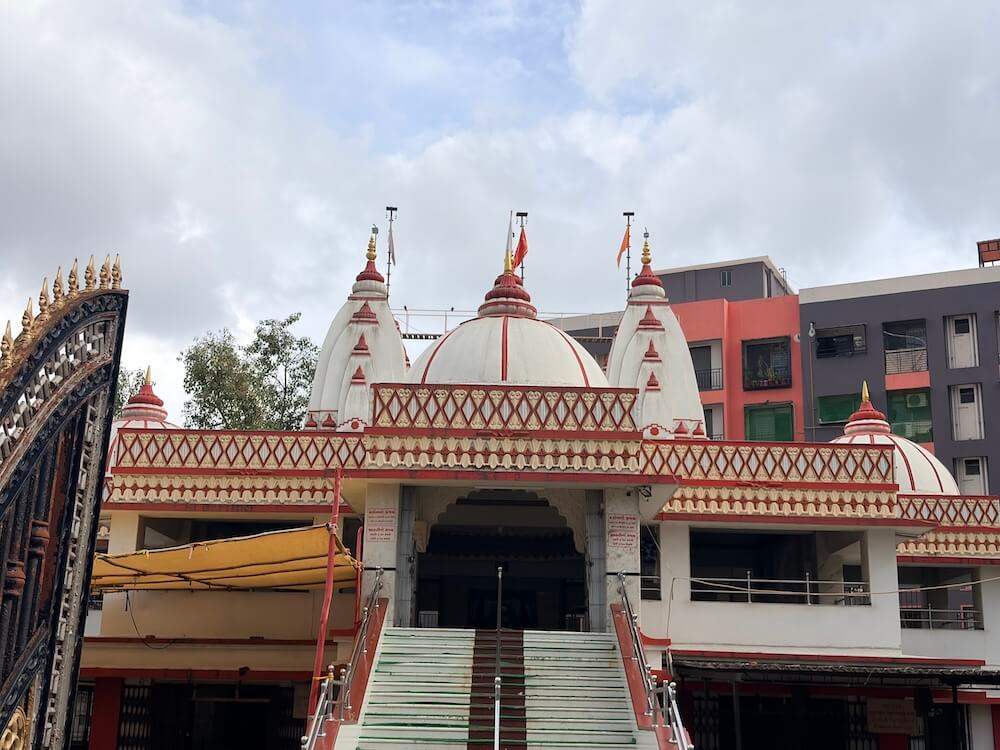
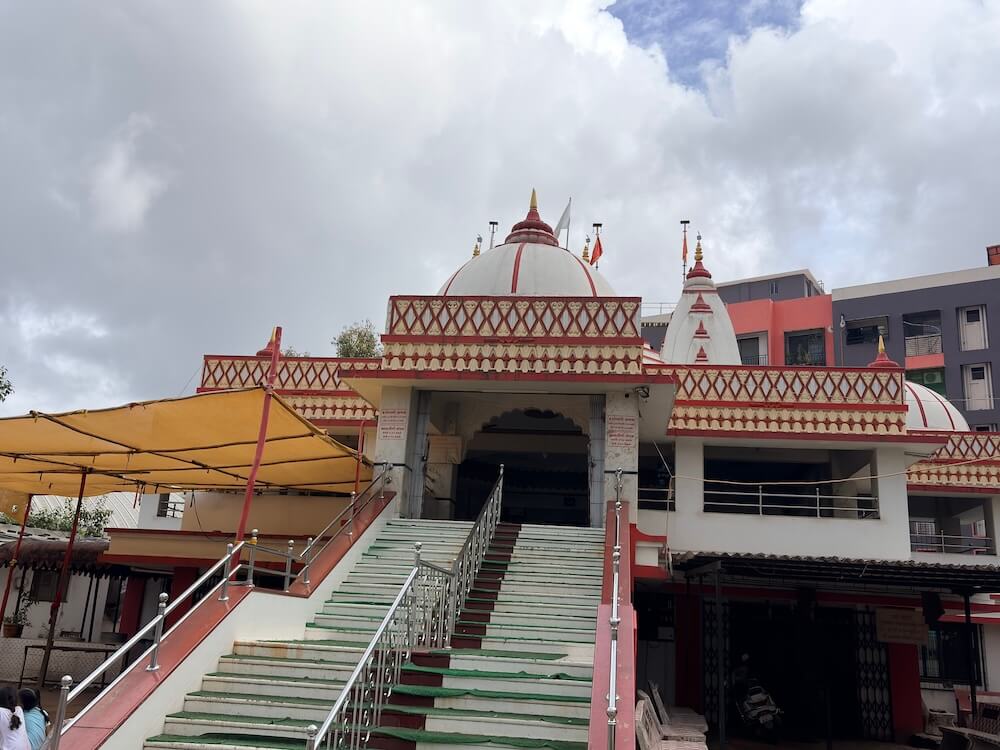
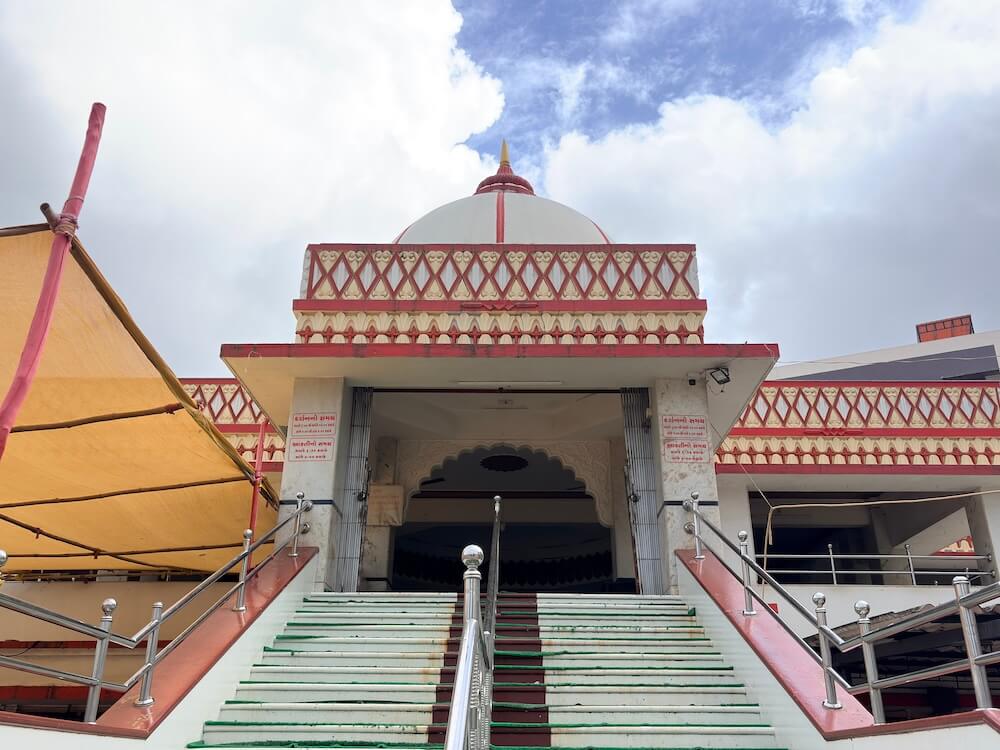
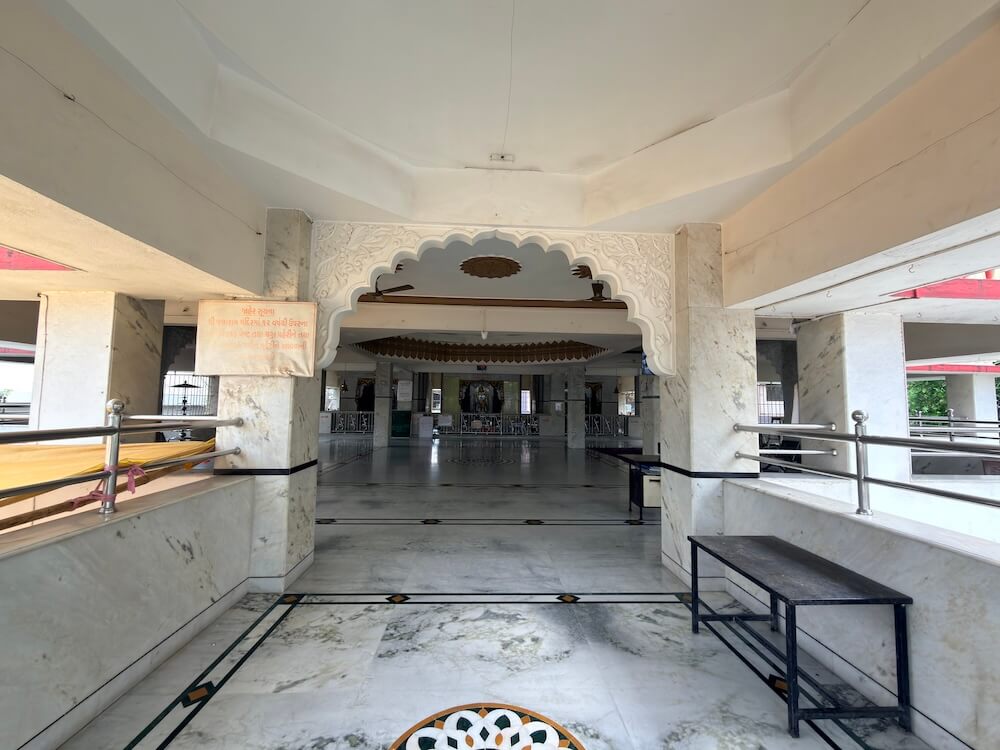
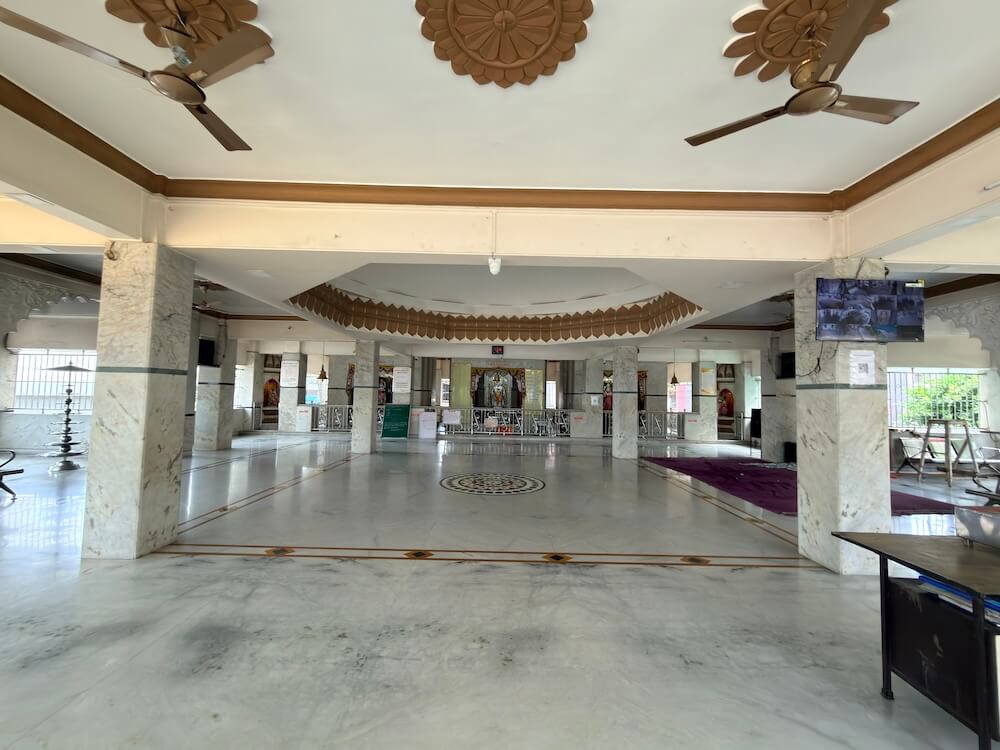
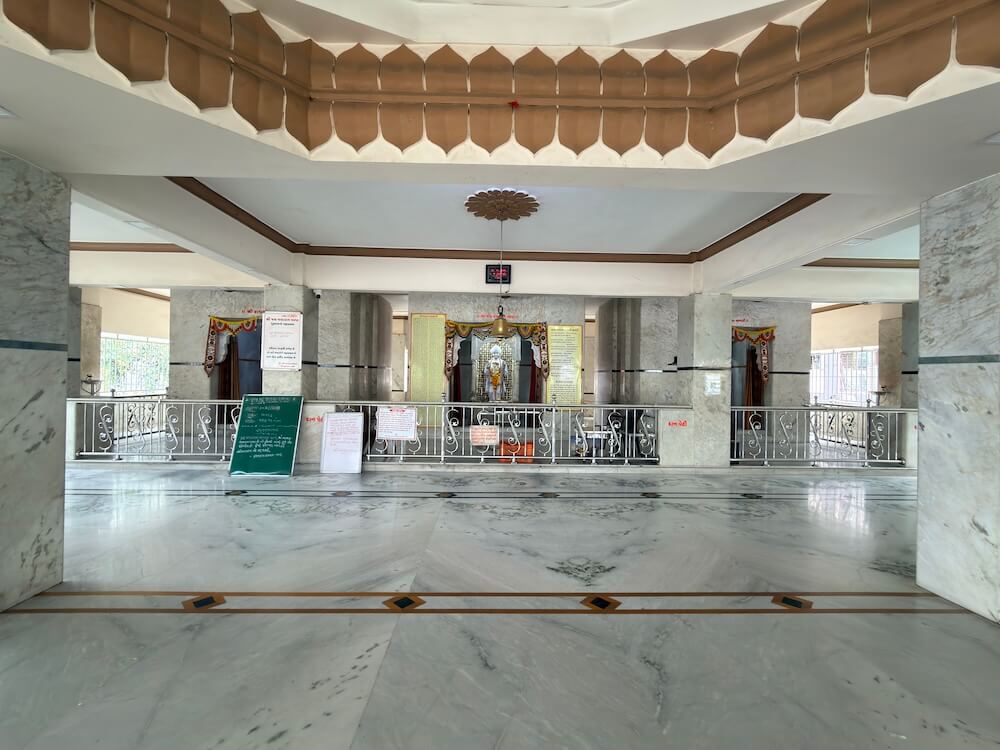
The temple stands majestically adjacent to the national highway in the Imran Nagar locality of Vapi city. The principal gateway is set within the fortified ramparts enclosing the precinct, providing access to a beautifully paved courtyard. Benches are thoughtfully placed at various intervals across the courtyard for the comfort of devotees. The precinct also houses a pilgrims’ rest house (Bhaktanivas) building, flanked by an adjacent chamber dedicated to the spiritual seat of the lineage (Gurugadi-Kaksha).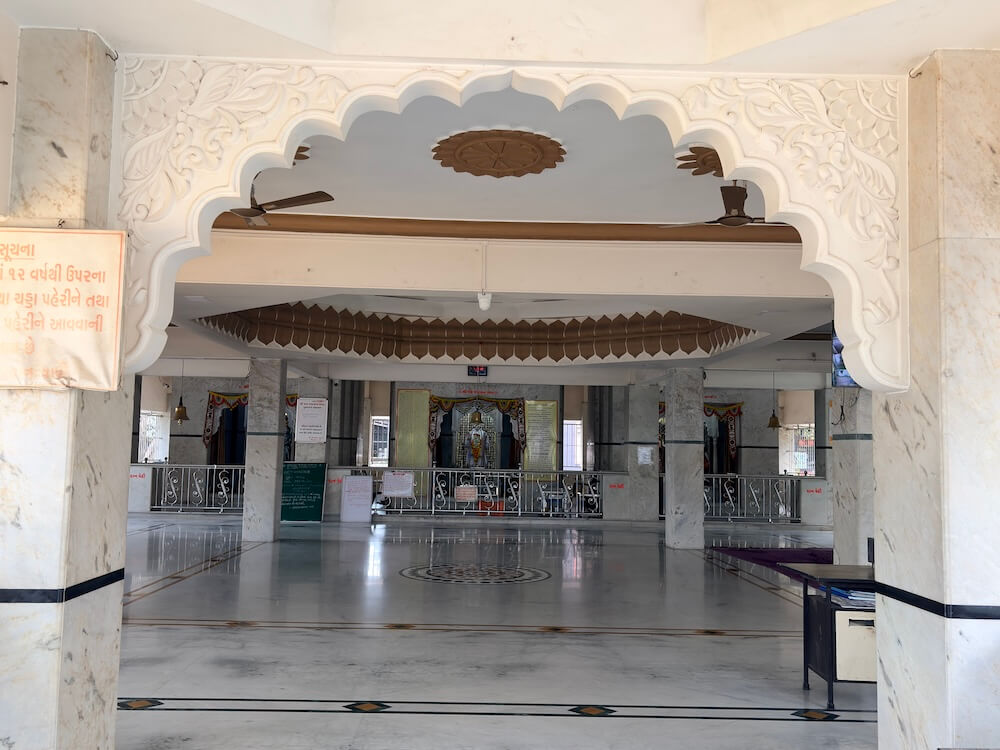 Constructed out of pristine white marble, this double-storeyed edifice features a tranquil meditation centre on the ground floor. The principal shrine is situated on the first floor, accessed from the courtyard by ascending a flight of approximately twenty steps. The architectural design of the temple comprises a front porch (Mukhamandapa), a congregational hall (Sabhamandapa) and the sanctum sanctorum (Garbhagriha). Both the front porch and the congregational hall are designed in a semi-open fashion. The twin pillars flanking the entrance of the congregational hall are elegantly interconnected by a cusped archway (mahirapi toran). The ceiling (vitana) of the congregational hall features detailed circular carvings. An automated drum (nagara) is installed in the hall and resonates daily during the sacred arati. Proceeding beyond the congregational hall into the vestibule (antarala),
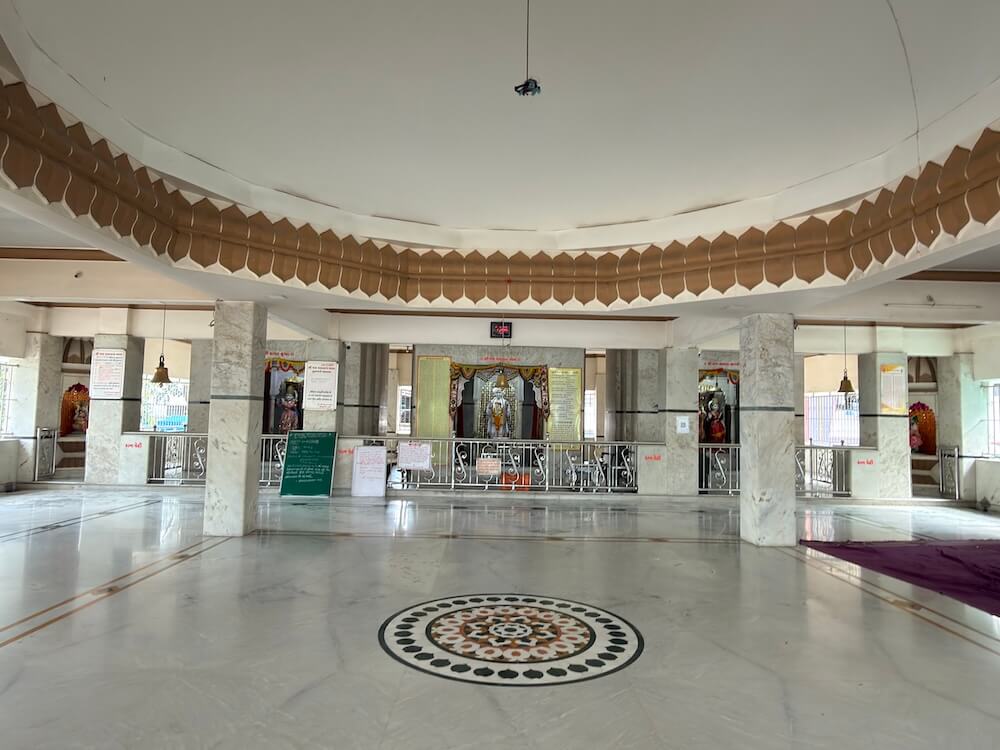 one finds the idols of Lord Ganesha and Lord Hanuman enshrined in beautifully crafted pavilions along the left and right walls, respectively.
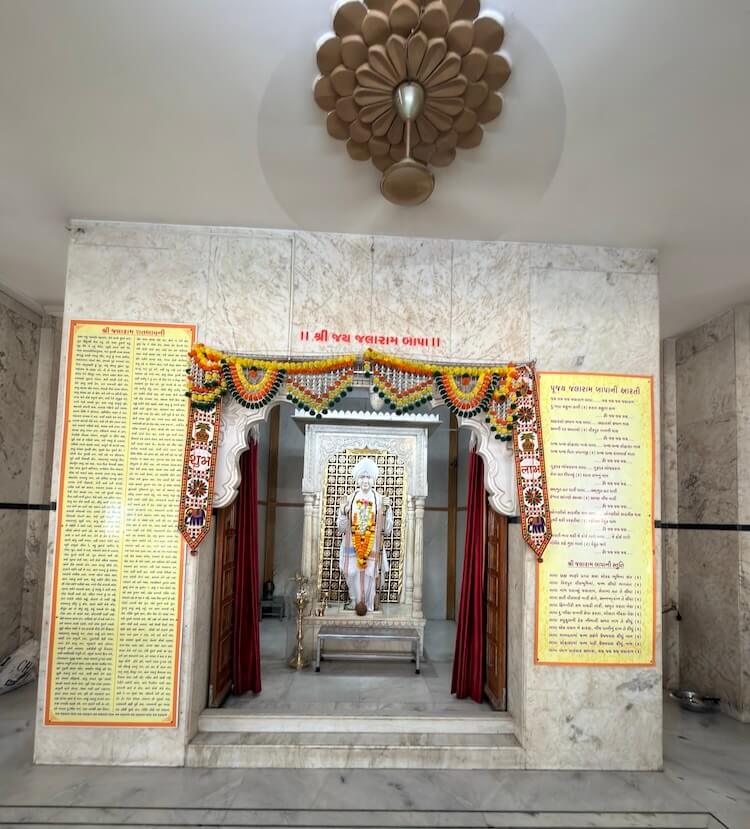
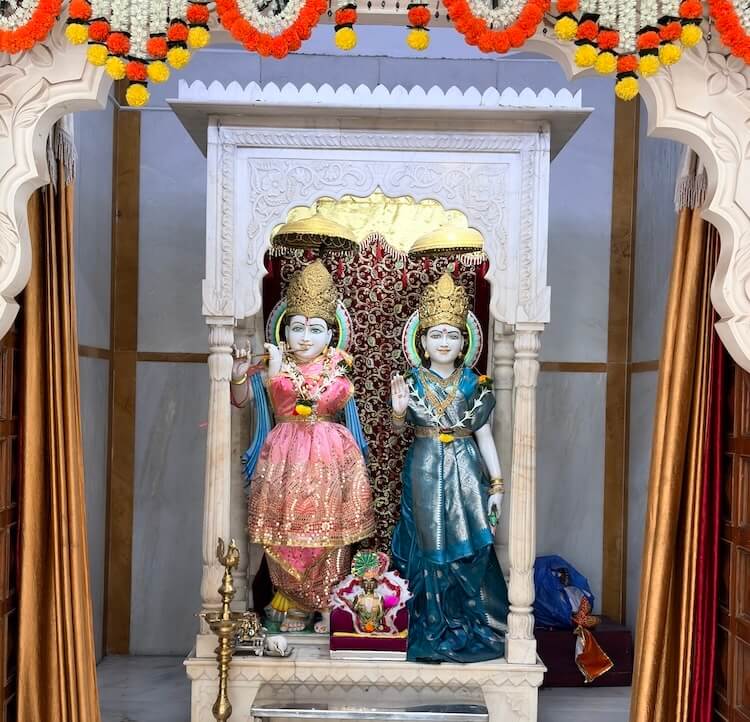
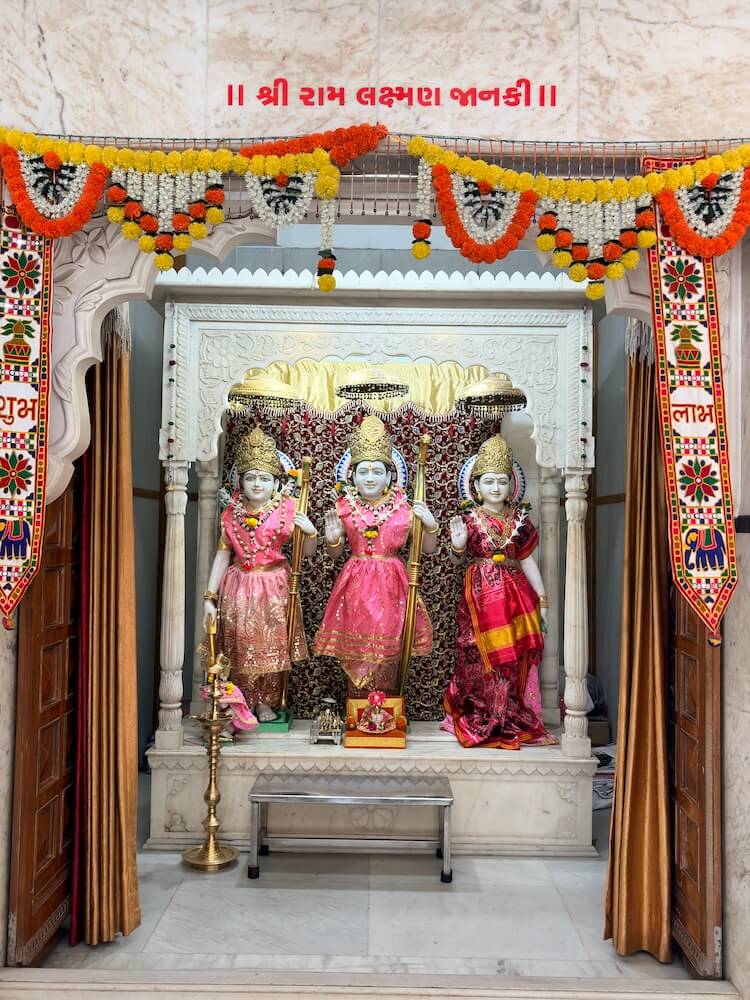
Beyond the vestibule lie three distinct sanctum sanctorums. Each of them features intricately carved door frames at their entrances, with exquisite sculptures adorning their lintels (lalatabimba). At the threshold of the central main sanctum sanctorum, the sacred lotus footprints (padma paduka) of Jalaram Bappa are reverently placed upon a table. Inside the sanctum, a white marble idol of Jalaram Bappa resides within an ornate pavilion on a pedestal. The idol depicts Bappa holding a traditional staff and wearing a classic turban.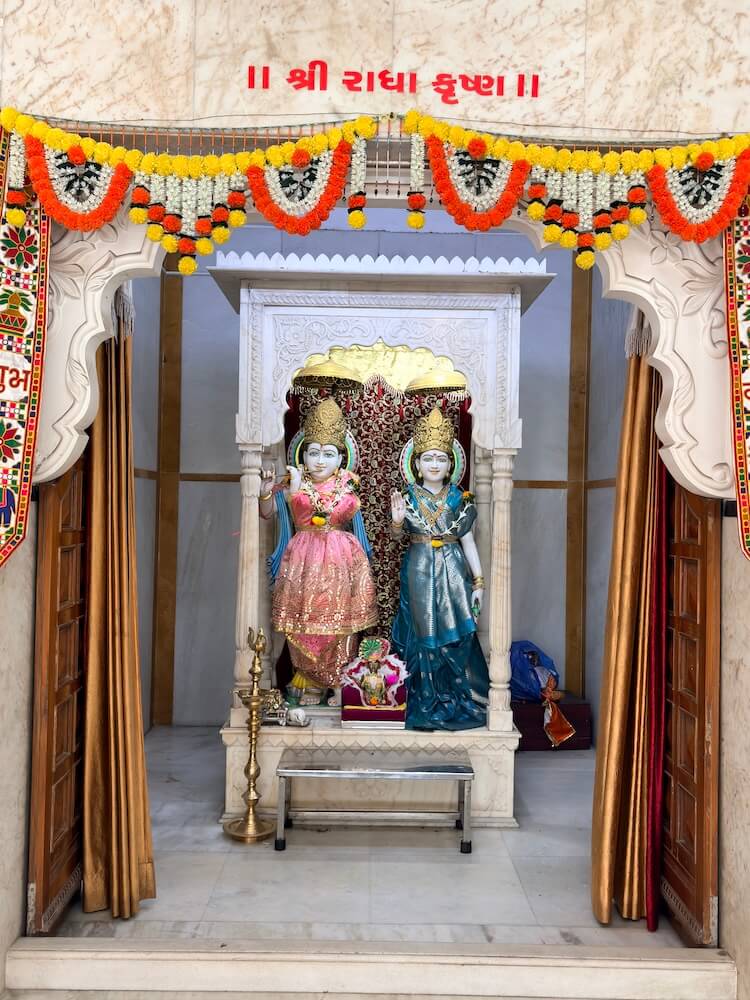 The sanctum sanctorum situated to the left of the main shrine houses the idols of Radha-Krishna, whilst the one to the right enshrines the idols of Shri Ram, Lakshmana
and Mother Janaki. A circumambulatory path extends around the exterior of all three sanctum sanctorums. The roof above the front porch is adorned with dome-shaped spires featuring vertical fluted patterns. The congregational hall is surmounted by a hexagonal spire composed of descending tiers, whilst the roofs of the three sanctum sanctorums feature tall, square spires that taper elegantly towards the apex. These principal spires are further embellished on all four sides with smaller subsidiary spires (angashikharas).
The seventh day of the bright fortnight of Kartik (Kartik Shuddha Saptami), celebrated as Jalaram Bappa Jayanti, is the temple’s primary annual festival. On this auspicious occasion, the entire temple is resplendently illuminated. Throughout the day, a diverse array of spiritual programmes, including devotional singing (bhajan), spiritual discourses (kirtan) and theological lectures (pravachan), are organised. Sanctified food (Mahaprasad) is systematically served to all the visiting devotees. In addition, numerous other festivals, such as the birth anniversary of Lord Krishna, Hanuman Jayanti, Ram Navami, Dussehra and Diwali, are celebrated here with great fervour. Every Saturday, a mass recitation of the ‘Sundarkand’ is organised in the temple between 9:30 am and 11:00 am. On Thursdays, congregational singing of bhajans and devotional songs takes place from 6:00 pm to 7:30 pm. Following the Thursday evening bhajans, sanctified food is distributed to the gathered devotees. The temple remains open from 6:00 am to 12:00 pm and from 4:00 pm to 8:00 pm. The regular arati is performed daily at 6:30 am and 7:00 pm.
Useful Information :
- Situated at a distance of 2 km from the Vapi ST Bus Station and 5 km from the Vapi Railway Station
- Situated at a distance of 29 km from Valsad city
- State Transport (ST) bus services are available from several major cities across Gujarat to Vapi.
- Private vehicles can access the temple premises directly.
- Accommodation and breakfast facilities are available in the surrounding vicinity.
- Contact: Temple Office, Mo. 9558844603
श्री जलाराम बप्पा मंदिर
इमरान नगर, वापी, ताल. वापी, जिला. वलसाड
मंदिरे
Temples
मंदिर
-
साईबाबा मंदिर तिथळ, ता./जि. वलसाड
अधिक माहितीSai Baba Temple Tithal, Tal./Dist. Valsad
View Detailsसाईं बाबा मंदिर तीथल, ताल./जिला. वलसाड
विवरण देखें -
भाव-भावेश्वर महादेव मंदिर बारुमाळ, ता. धरमपूर, जि. वलसाड
अधिक माहितीBhav-Bhaveshwar Mahadev Temple Barumal, Tal. Dharampur, Dist. Valsad
View Detailsभाव-भावेश्वर महादेव मंदिर बारुमल, ताल. धरमपुर, जिला. वलसाड
विवरण देखें -
दत्त मंदिर पाथरी, ता./जि. वलसाड
अधिक माहितीDatt Temple Pathri, Tal./Dist. Valsad
View Detailsदत्त मंदिर पाथरी, ताल./जिला. वलसाड
विवरण देखें