
पेरुमपदवोम भगवती मंदिर
पेरुंबदावोम, एलांजी, जि. एर्नाकुलम.
Perumpadavom Bhagavathi Temple
Perumbadavom, Elanji, Dist. Ernakulam.
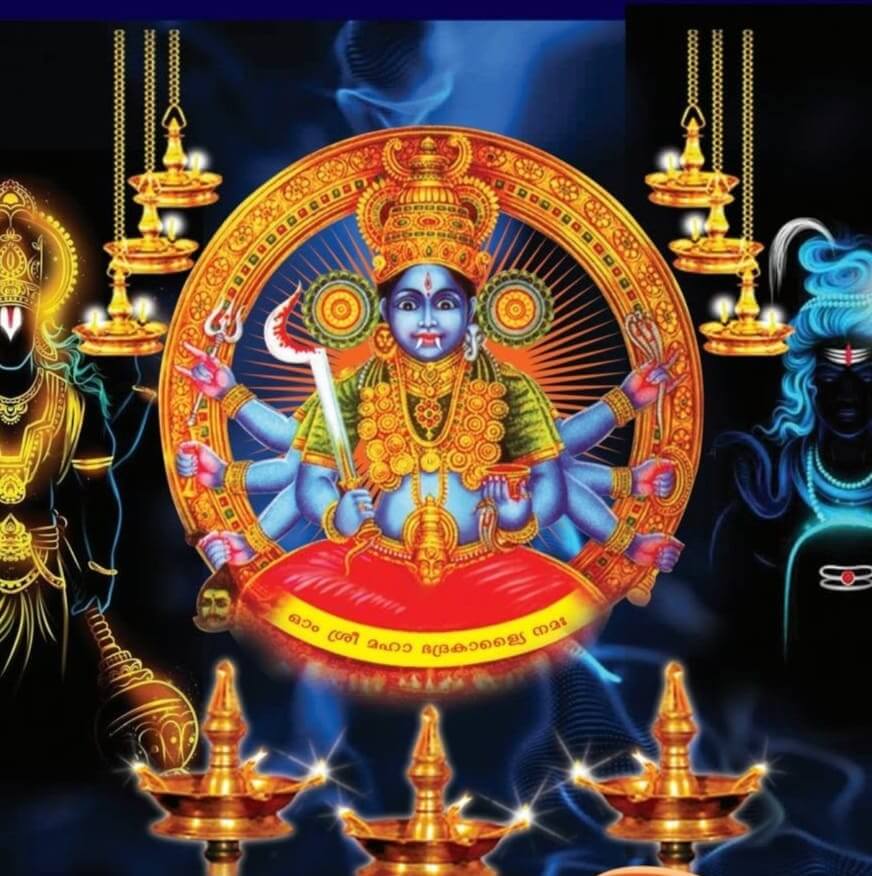 Perumpadavom Bhagavathi Temple is an important place of worship located at Perumbadavam in Elanji Grama Panchayat of Ernakulam district, Kerala, on the Thalayolaparambu–Koothattukulam Road. Closely connected with the spiritual life and cultural heritage of the region, the temple is one of the main centres of worship for devotees. It is also known as the principal guardian deity temple of Perumbadavam, the native place of the renowned Malayalam writer Perumbadavam Sreedharan. Visited by numerous devotees throughout the year, the temple continues to be an important symbol of the area’s religious faith and cultural tradition.
Historians estimate that this temple is at least 300 to 500 years old. In its early days, the Goddess was worshipped on a stone platform. Over time, the sanctum and the larger temple complex were constructed. During Tipu Sultan’s Malabar–Travancore campaign of AD 1789–1790, the temple suffered severe damage and the sacrificial stone (Balikkal) in front of the temple was broken. Following the attack, the temple remained in a ruined condition for many years. 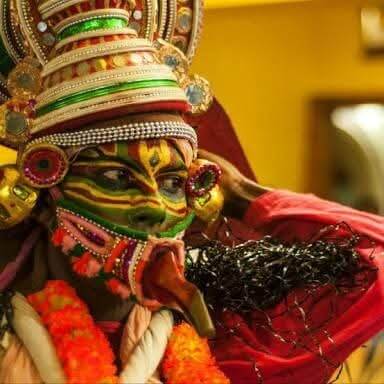 During the rule of the Kingdom of Travancore, as part of Colonel Munro’s administrative reforms, temples began to be brought under government control in 1811 and the initial restoration work at this temple was carried out in the following decades. Later, under the leadership of the Travancore Devaswom Board, the temple was completely renovated and the idol of the Goddess was reconsecrated. Although the present temple complex is only about 70 to 100 years old, the original shrine has a history that goes back several centuries. Preserving this ancient tradition, the Goddess is still ceremonially taken in procession from the sanctum to the original stone platform during the annual Pooram festival, where special rituals and ceremonies are performed.
As in most Bhadrakali temples in Kerala, the Goddess here is believed to be another manifestation of the Kodungallur Bhagavathi. According to local tradition, the Goddess accompanied a devotee in his palm-leaf umbrella after he had offered prayers at Kodungallur and later chose to reside at this place.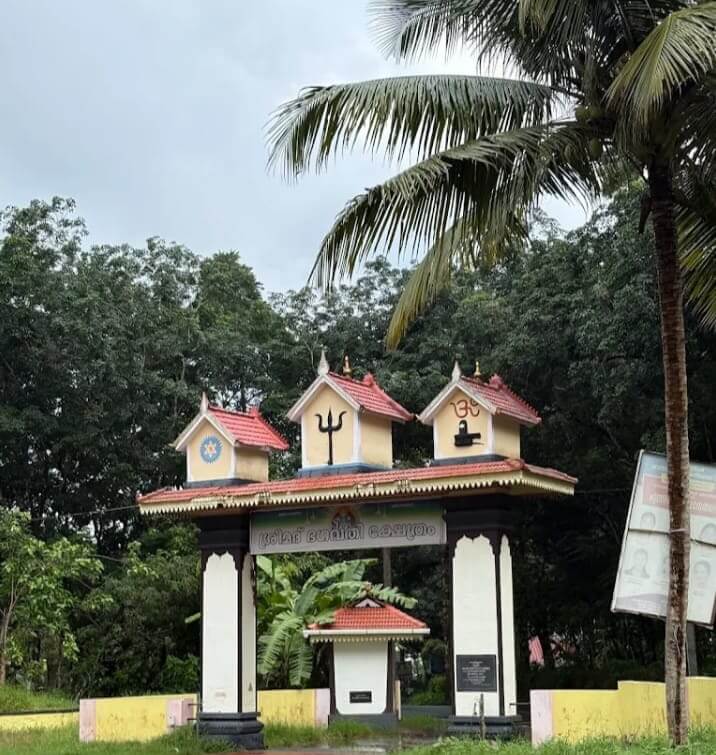 Another traditional belief is connected with the temple’s history. It is believed that when Tipu Sultan’s soldiers broke the sacrificial stone (Balikkal), thousands of bees and wasps suddenly appeared and attacked the army, forcing the soldiers to retreat without causing further damage to the temple. There is also a belief associated with the temple pond. Devotees believe that the pond never dries up completely, even during the hottest summer, as a natural spring continues to flow there through the divine presence of the Goddess.
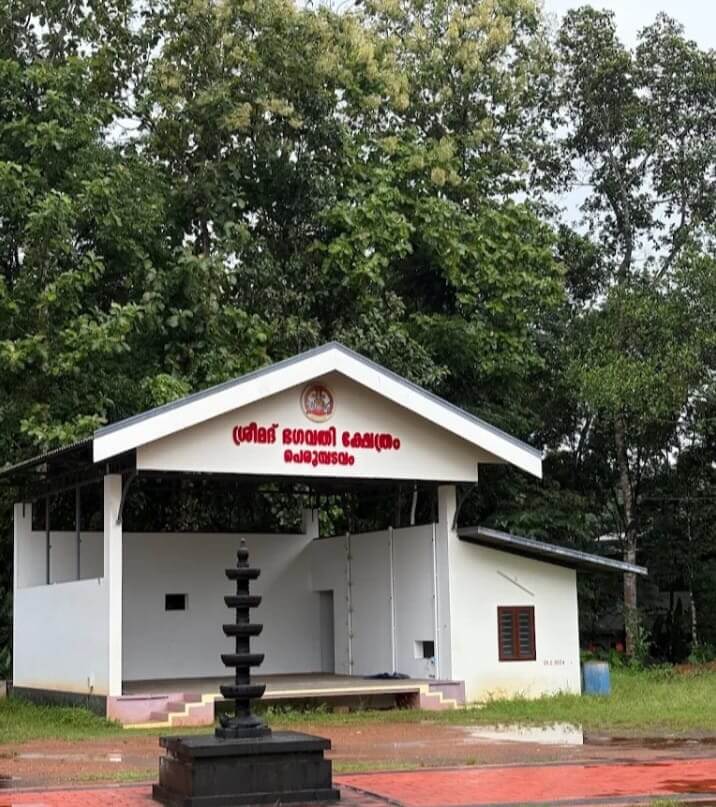
The temple is set amidst a lush green rural landscape and blends beautifully with its natural surroundings. As you enter the temple, the first structure you see is a spacious concrete elephant shelter, which is used to accommodate elephants and conduct major ceremonies during festivals. Entry to the temple is through a traditional Kerala-style gateway with a tiled roof. Near the entrance is a large temple pond where devotees can wash their hands and feet before worship. The main temple complex is enclosed by a large tiled outer cloister. 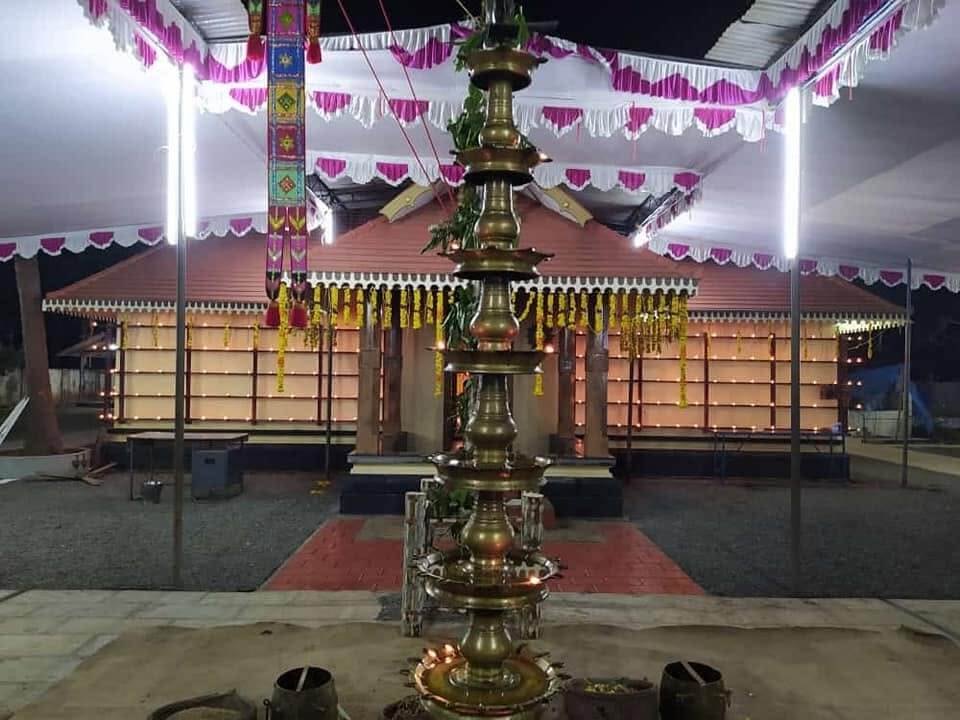 Inside, directly in front of the sanctum, stands a large sacrificial stone (Balikkal), followed by a square Namaskara Mandapam. The beautifully carved wooden pillars and ceiling of the Namaskara Mandapam highlight the elegance of traditional Kerala temple architecture.
As you enter the main temple complex, the first feature that catches your attention is the rows of traditional oil lamps fixed along the outer walls of the cloister. When these lamps are lit in the evening, they fill the temple premises with a beautiful glow. Inside stands the square sanctum, built in the traditional Kerala architectural style. Its roof is completely covered with copper sheets and crowned with a shining finial (Thazhikakkudam). The black stone base and walls add to the grandeur of the sanctum. Beautiful Dwarapalaka sculptures can be seen on either side of the entrance,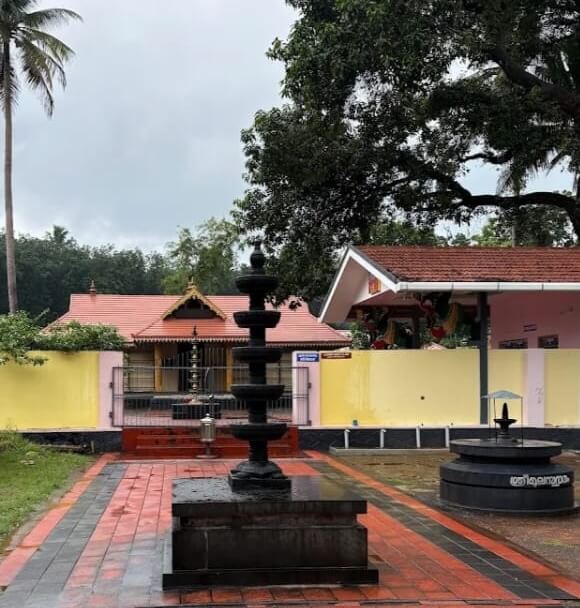 while the black stone steps (Sopanam) leading to the sanctum are decorated with fine carvings. Priests distribute prasadam to devotees from this Sopanam. The main deity, Bhadrakali, is consecrated facing north in a calm and compassionate form. At the south-west corner (Kannimoola) of the main sanctum is a separate shrine for Lord Ganesha, facing east. Outside the Nalambalam, on the south-west side, is a shrine dedicated to Lord Dharmashasta. In the south-east corner of the temple complex, beside a sacred grove, are the shrines of Nagaraja and Nagayakshi. A separate platform dedicated to Yakshiyamma is also located within the temple premises.
The most important festival of the temple is the eight-day Meena Pooram, celebrated on the Pooram star in the Malayalam month of Meenam (March–April). The festival begins with the ceremonial flag hoisting led by the Thantri. During the festival, Thalappoli, Chenda Melam, Panchavadyam, ceremonial fireworks, elephant processions, Theyyam and other traditional art performances are held. 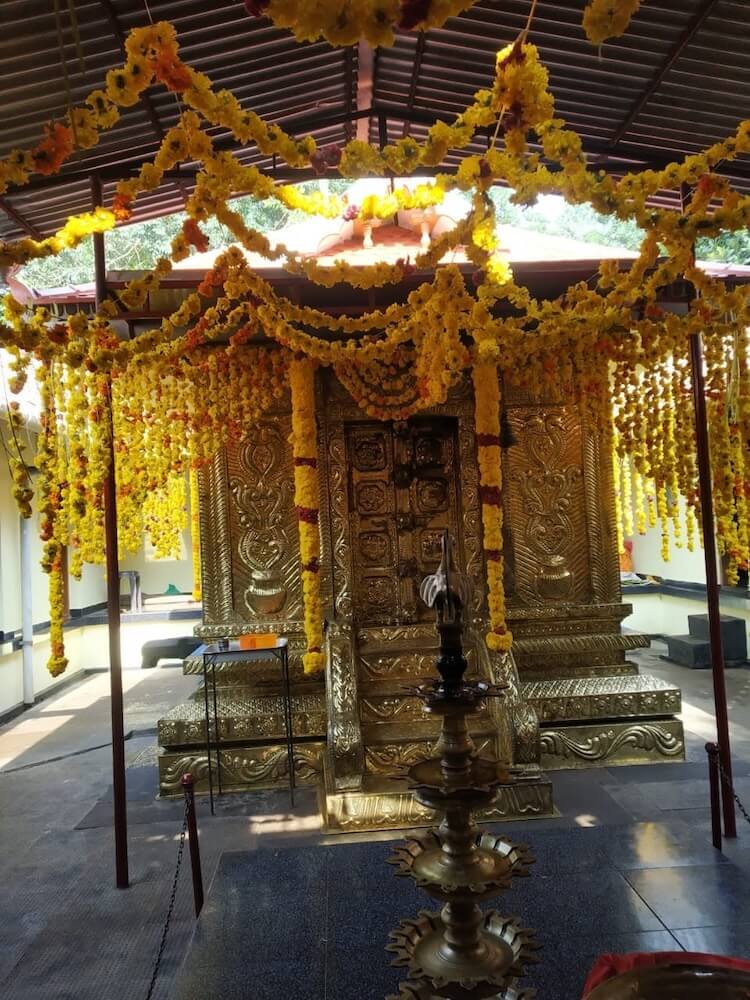 On the night before Aarattu, the ceremonial Pallivetta is conducted and the festival concludes with the Goddess’s Aarattu on the Pooram day. Navaratri, celebrated during the Malayalam month of Kanni (September–October), is another important festival. Special poojas are performed for the Goddess throughout the nine days and the Vidyarambham ceremony for children is held on Vijayadashami. During the Mandala–Makaravilakku season, from Vrischikam 1 to Dhanu 11, special poojas and lamp offerings are conducted for Lord Dharmashasta. On the Ayilyam star days in the Malayalam months of Kanni, Thulam and Vrischikam, special rituals such as Sarpabali and Nagaroot are performed for the Naga deities. Thrikarthika is celebrated in the month of Vrischikam by lighting numerous traditional oil lamps throughout the temple premises. In addition, Tuesdays and Fridays are considered especially auspicious days at the temple, when special poojas and offerings are performed for the Goddess.
Devotees offer a variety of ritual offerings at the temple for different prayers and intentions. The main offerings to the presiding deity, Bhagavathi, include Kadumpayasam, Chathussatham, Lalitha Sahasranamarchana, Muttarukkal and Pattu Charthal. Kadumpayasam is offered to seek the Goddess’s blessings and protection from enemies and negative influences. Chathussatham is offered for the successful fulfilment of important wishes, while Lalitha Sahasranamarchana is performed for prosperity and the well-being of the family.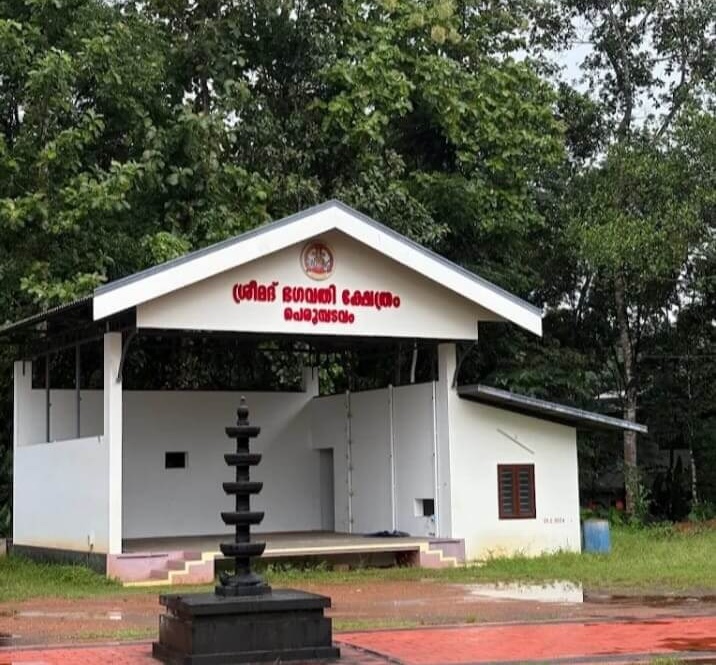 Muttarukkal is offered with prayers for the removal of obstacles in life and Pattu Charthal, the offering of silk cloth to the Goddess, is performed to seek her blessings for a happy marriage. Among the other deities, Ganapathi Homam is offered to Lord Ganesha at the Kannimoola for the removal of obstacles and the success of new ventures. Neerajanam is offered to Lord Dharmashasta, while Palamrutham and Nagaroot are offered to the Naga deities for relief from Naga Dosha and for the blessing of children.
The temple opens daily at 5:00 am. Nirmalya Darshan is at 5:30 am, followed by Usha Pooja at 6:00 am. After the Ucha Pooja at 8:30 am, the temple closes for the morning at 10:00 am. It reopens at 5:00 pm, followed by Deeparadhana at 6:30 pm and Athazha Pooja at 7:30 pm. The temple closes for the day at 8:00 pm after the completion of the day’s rituals. Pooja and darshan timings may vary on festival days and during special occasions such as Navaratri and the Mandala season.
Key highlight :-
- Located 9 km from Piravom, 11 km from Thalayolaparambu and 10 km from Koothattukulam.
- The nearest railway station is Piravom Road Railway Station, about 14 km away.
- Local bus services are available to the temple from Piravom, Koothattukulam and Thalayolaparambu.
- Private vehicles can be parked in the temple’s designated parking area.
- Accommodation and food facilities are available in the nearby towns.
- Contact number 9400025530
पेरुम्पदावोम भगवती मंदिर
पेरुंबदावोम, एलानजी, जिला। एर्नाकुलम.
मंदिरे
Temples
मंदिर
-
आजीकाल श्री वराह देवस्वोम अळेकल, चेराई, जि. एर्नाकुलम.
अधिक माहितीAzheekal Shree Varaha Devaswom Azheekal, Cherai, Dist. Ernakulam.
View Detailsअज़ीकाल श्री वराह देवस्वोम अज़ीकल, चेराई, जिला। एर्नाकुलम.
विवरण देखें -
व्यत्तिला शिव सुब्रह्मण्य स्वयंभू क्षेत्रम् विट्टीला, जि. एर्नाकुलम.
अधिक माहितीVyttila Shiva Subrahmanya Swayambhu Kshethram Vyttila, Dist. Ernakulam.
View Detailsव्यत्तिला शिव सुब्रह्मण्यं स्वयंभू क्षेत्रम् विट्टिला, जिला. एर्नाकुलम.
विवरण देखें -
श्री मरातिल कोट्टाराम भगवती मंदिर मराडू, जि. एर्नाकुलम.
अधिक माहितीSree Marattil Kottaram Bhagavathy Temple Maradu, Dist. Ernakulam.
View Detailsश्री मरात्तिल कोट्टारम भगवती मंदिर मरदु, जिला. एर्नाकुलम.
विवरण देखें