
मेलडी माता मंदिर
उमठी, ता. कवंत, जि. छोटा उदेपूर
Meldi Mata Temple
Umthi, Tal. Kavant, Dist. Chhota Udepur
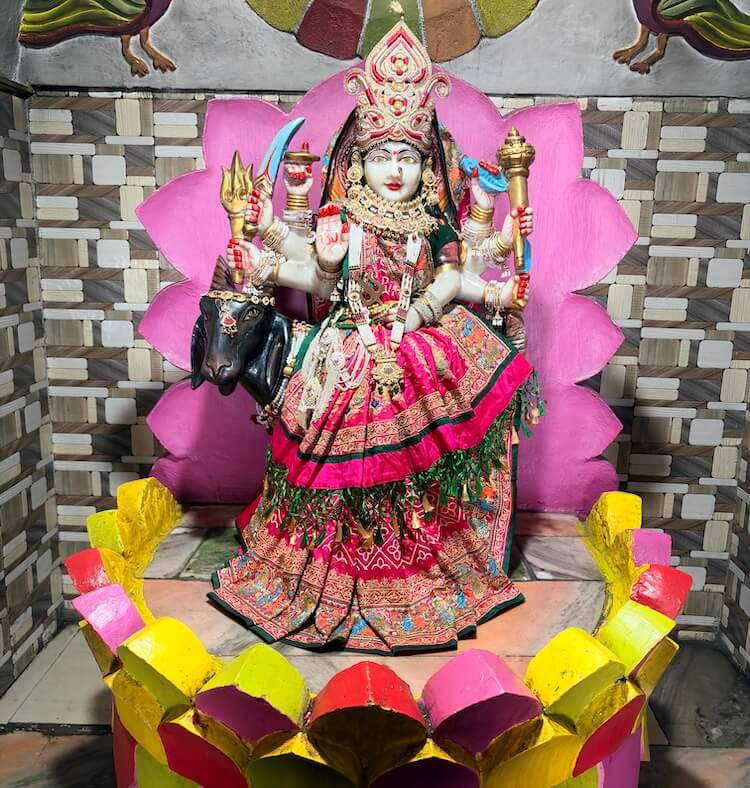 The Meldi Mata Temple is situated in the village of Umthi within the Kavant taluka of Chhota Udepur. This deity stands as an exceptionally significant folk goddess across the rural expanses of both Rajasthan and Gujarat. The agrarian and Koli communities primarily venerate this Goddess to shield themselves from malevolent forces. Bestowing stability upon life alongside divine protection, this deity is also universally renowned by the title of Rajrajeshwari. According to mythological legends, the genesis of this Goddess is traced back to the residue (‘mal’) produced from the body of Mother Parvati, thereby earning Her the name of Meldi Mata. The congregation holds an unshakeable faith in this Goddess, who is widely recognized as a mother who swiftly rushes to the aid of her devotees in times of distress. This sacred shrine of Meldi Mata in Umthi village remains a pre-eminent bastion of faith for the entire region.
References concerning the genesis of Goddess Meldi are preserved within the classical scriptural treatise, the ‘Devi Bhagavata’. 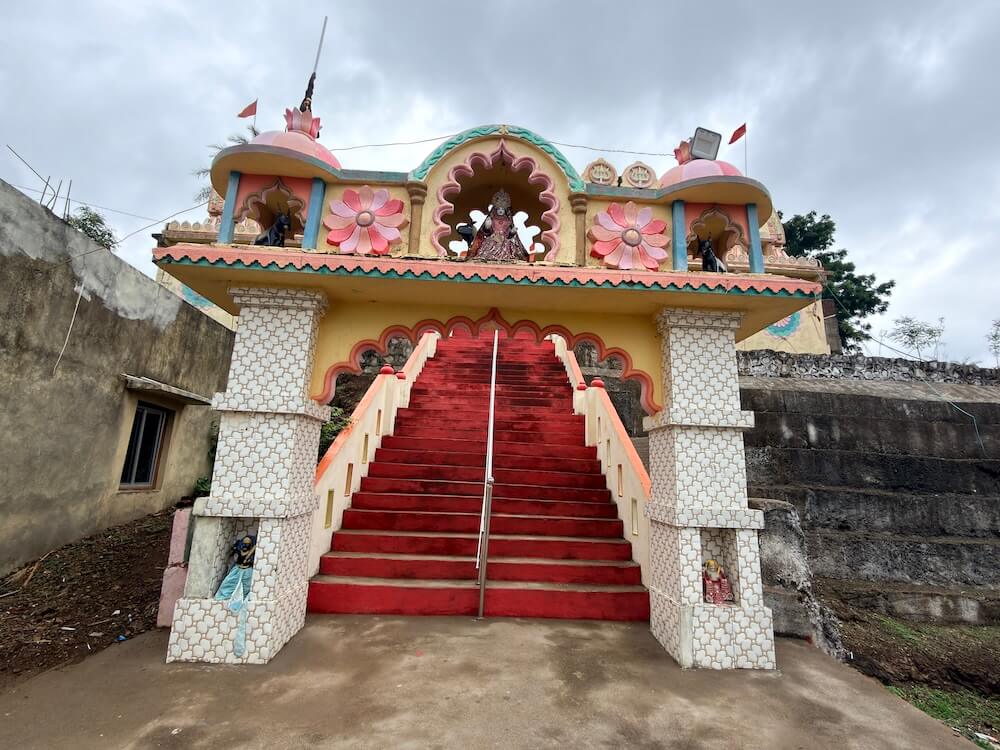 According to these accounts, in ancient epochs, a demon named Amaruwa unleashed a reign of terror and tyranny upon the inhabitants of the earth. In response, Goddess Uma declared war to eradicate the demonic entity. Realizing that his defeat was absolute and imminent during the conflict, the demon Amaruwa sought refuge by hiding beneath the carcass of a dead cow. Standing a short distance away from that defiled spot, the Goddess began to rub Her hands in absolute fury. The residue (‘mal’) that emerged from Her hands instantly manifested into a five-year-old maiden. Because She was born from this divine residue, the deity acquired the timeless name of ‘Meldi’. This fierce goddess successfully slew the demon Amaruwa, liberating the Saurashtra region from his reign of terror.
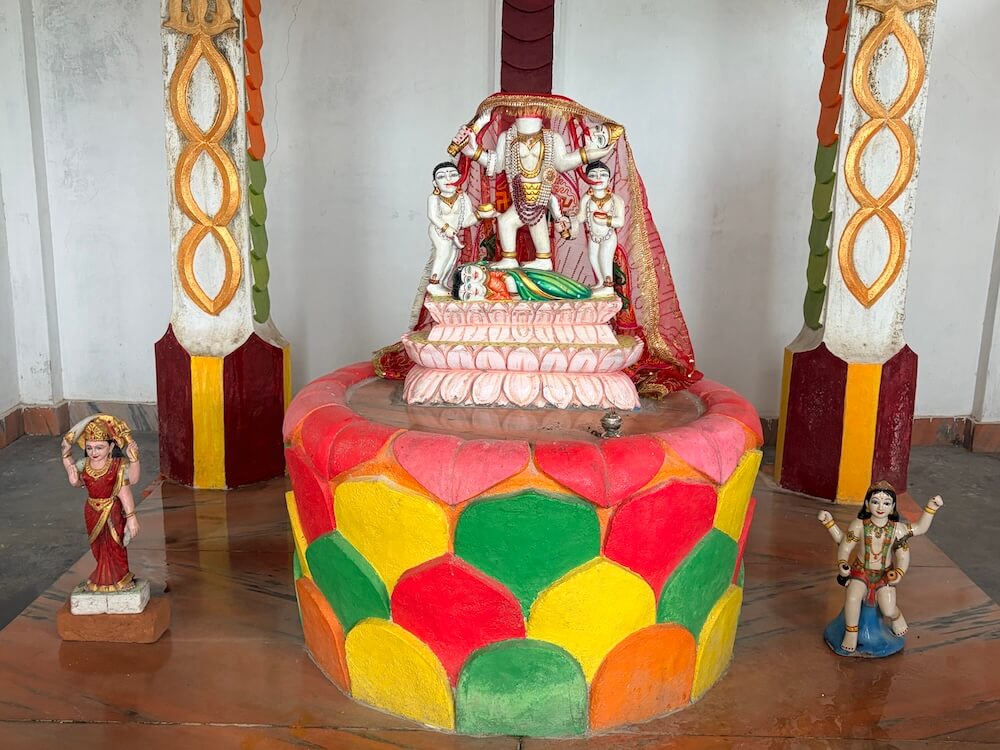 Following this historic triumph, Goddess Uma directed Mother Meldi to Goddess Chamunda, who subsequently sent Her to the Kamarup region to test Her spiritual prowess. There, utilizing Her supreme divine energies, Meldi Mata transformed the hostile occult forces into the physical form of a black goat and imprisoned their dark spells inside a ritual bottle. Adopting this black goat—the absolute symbol of the conquered malevolent forces—as Her permanent celestial mount, She established Her sovereign authority. In recognition of this momentous feat, Mother Jagadamba bestowed a holy boon upon Her, proclaiming that in the epoch of Kali Yuga, She would be universally adored by humanity as the supreme deity who destroys the internal vices of lust, anger, pride, greed, attachment and jealousy within the human mind.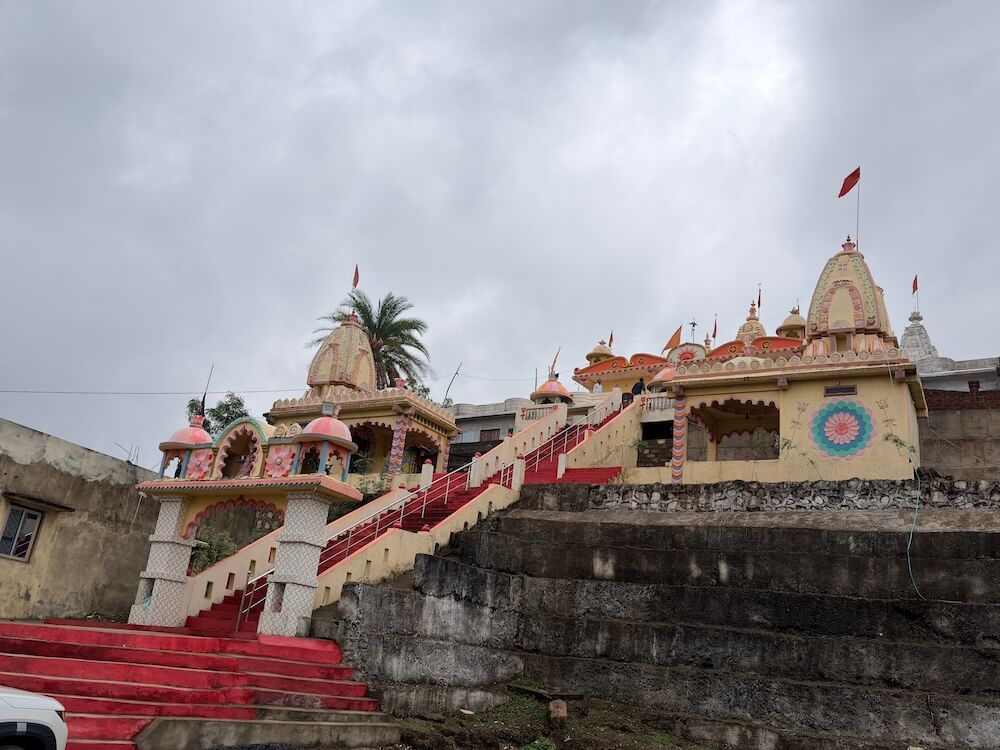
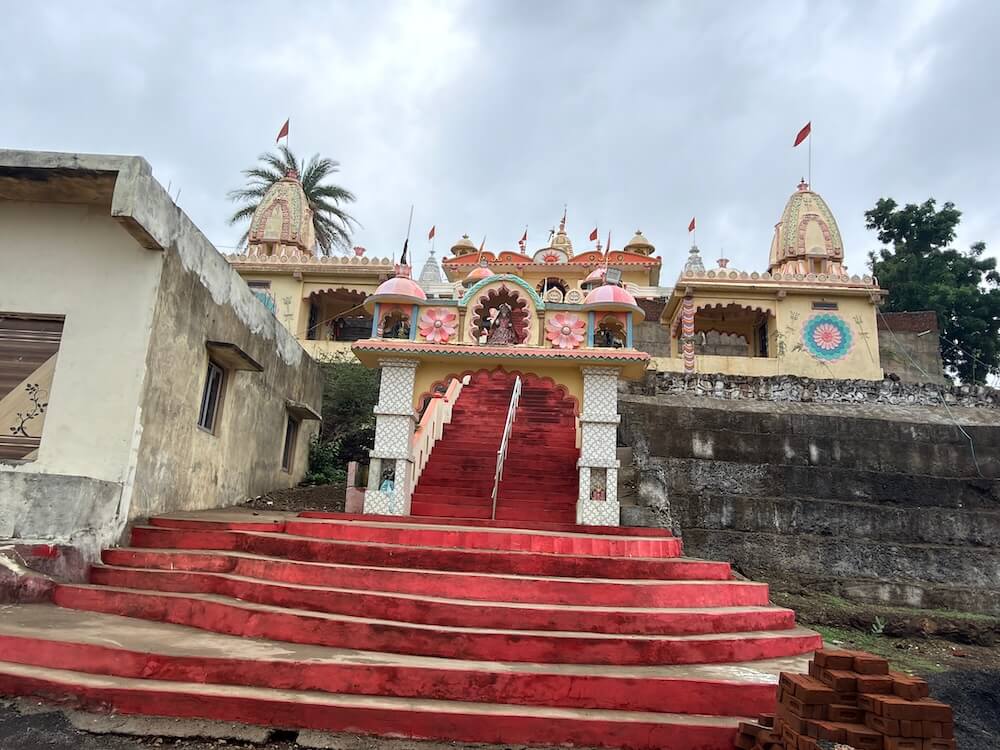
The temple is beautifully perched upon a towering hill situated a short distance from the village. Ample parking spaces are available at the base of the hill for visiting vehicles. From the foothills, a well-constructed flight of steps ascends directly to the temple premises, fitted with safety balustrades on either side for the convenience of the pilgrims. A grand welcome archway (‘Swagat Kaman’) marks the commencement of this pathway. Embedded within the rectangular structural columns of this archway are architectural niches enshrining finely sculpted figures of Bhairava as gatekeepers. Surmounting these columns is an elevated terrace topped with three ornate domed pavilions (‘meghdambaris’), which enshrine the beautifully consecrated idols of Mother Meldi, Mother Chamunda and Mother Amba. 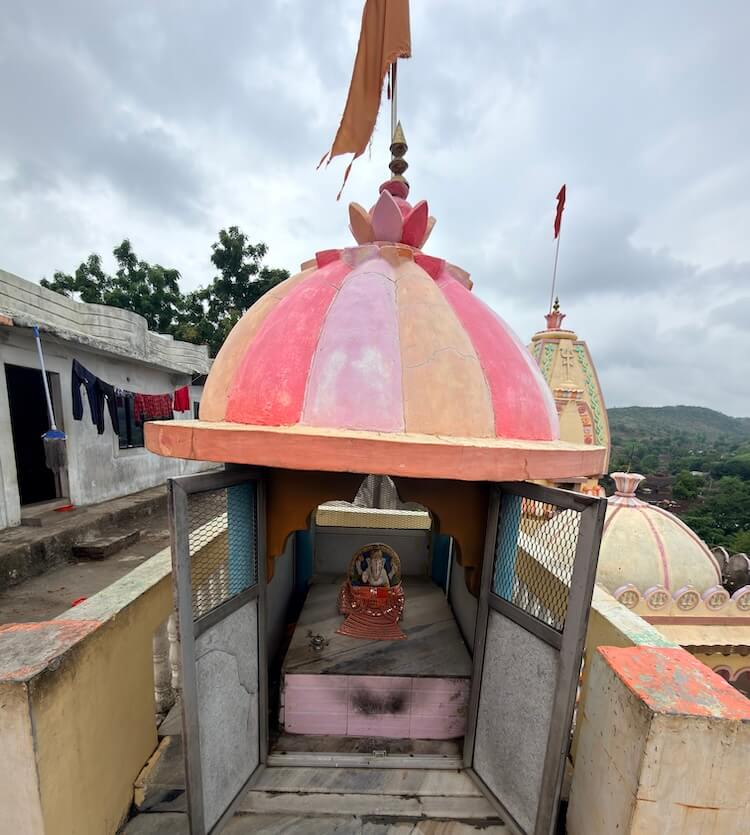 Positioned to match each other along the midsection of the stairwell are independent sub-shrines dedicated to Lord Ganesha and Lord Hanuman. Proceeding further up the steps, dedicated guard rooms are constructed on both sides of the pathway.
Upon ascending the final steps, visitors emerge onto a spacious, open veranda fronting the temple. It is bordered by a protective lateral balustrade. Architecturally, the sanctuary features a central assembly hall leading to three distinct sanctum sanctorums. The main entrance to the assembly hall is adorned with an intricately carved doorframe. Within the hall, a beautifully executed cusped arch (‘mahirap kaman’) supported by two elegant columns directly faces the primary central sanctum. The door jambs of all three sanctums are embellished with delicate lotus-petal relief carvings. Consecrated upon the stone pedestal (‘vajrapitha’) inside the principal central sanctum is an eight-armed (‘ashtabhuja’) idol of Mother Meldi majestically seated upon Her goat mount (‘ajarudh’). Adorned in fine vestments and precious ornaments, a polished crown studded with diamonds rests upon Her head. 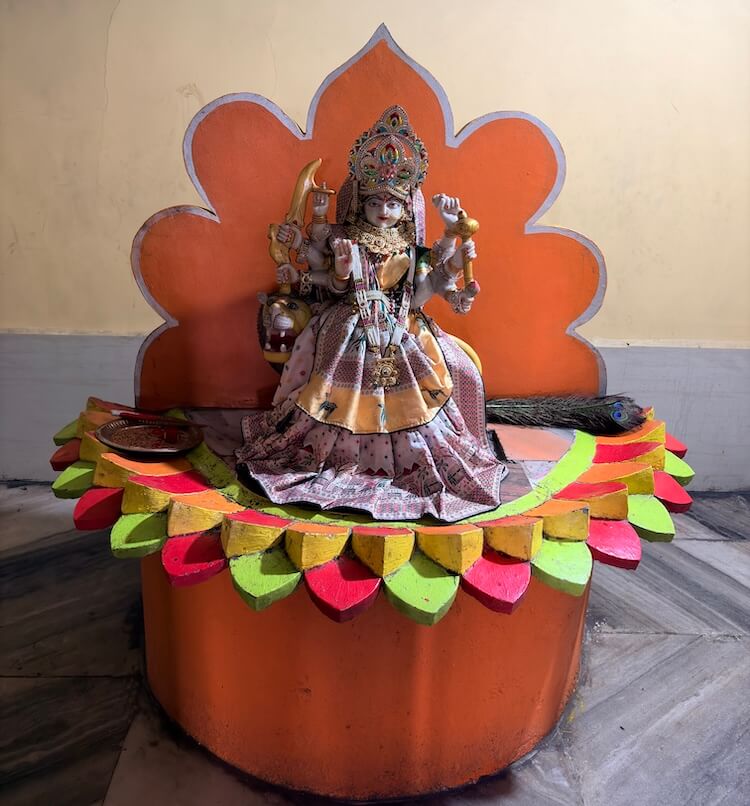 The Goddess wields a sword, a trident, a mace, a discus, a conch shell, a ritual bottle and a sacred lotus flower in Her hands, while one hand is held open in the traditional blessing posture (‘abhaya mudra’). The rear wall behind this central idol features exquisite bas-relief carvings of peacock motifs. Flanking the primary shrine, the subsidiary sanctum on the left houses an idol of Goddess Chamunda upon a stone pedestal, while the sanctum on the right enshrines an idol of Goddess Amba.
The roofline covering the main assembly hall is capped with a magnificent dome-shaped spire. In contrast, the superstructures surmounting the three primary sanctums rise into square-based spires. The spire positioned over the sanctum of Mother Meldi is relatively more towering. All square spires are beautifully decorated with rows of matching miniature auxiliary spires (‘angashikharas’).
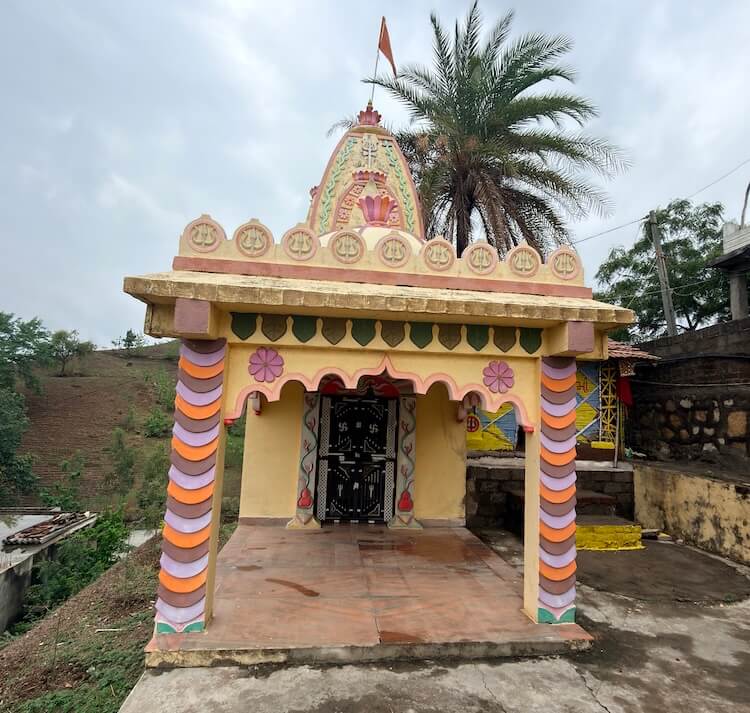
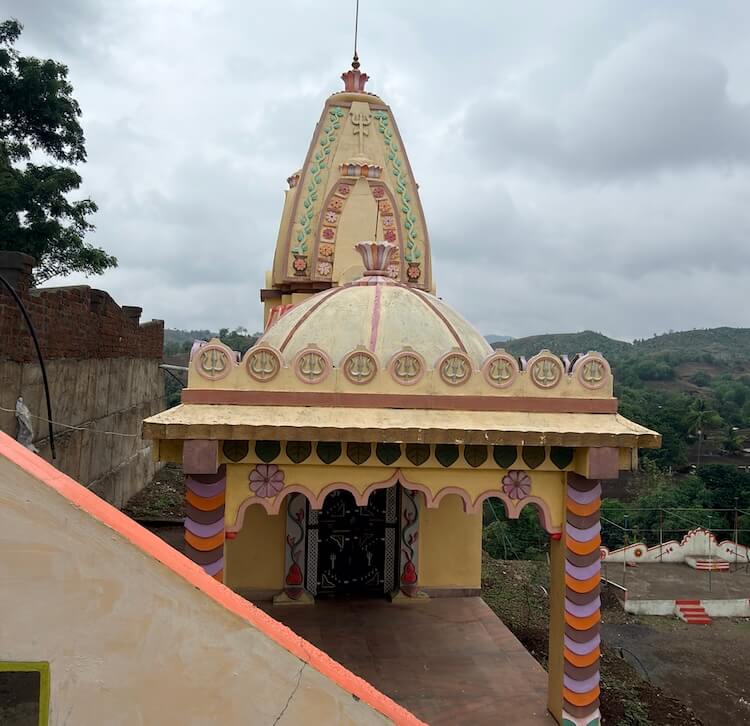
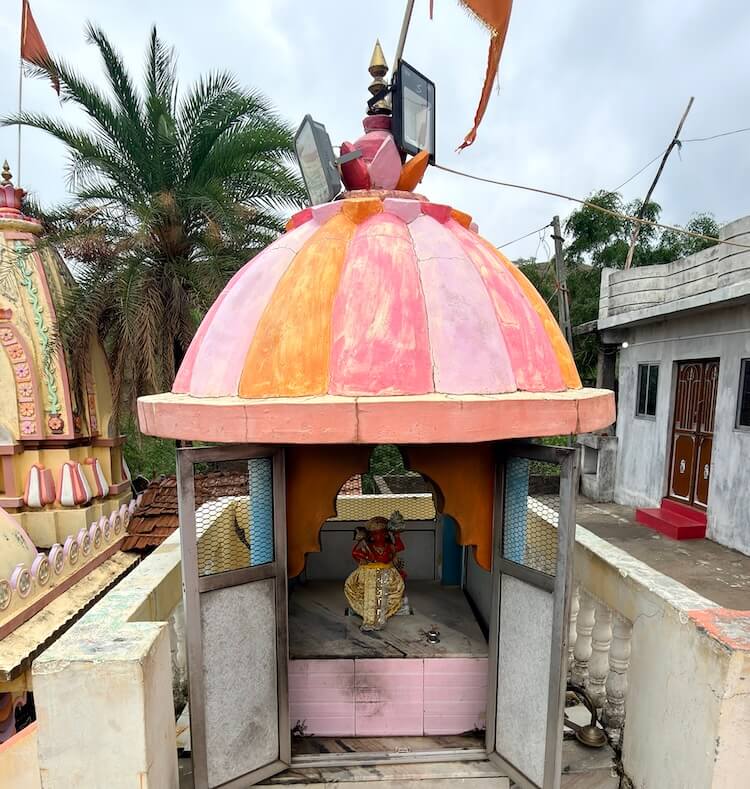
Situated adjacent to the main complex is a smaller subsidiary temple configured with its own assembly hall and sanctum, which enshrines an idol of Yogini Devi seated in the traditional meditative lotus posture (‘padmasana’).
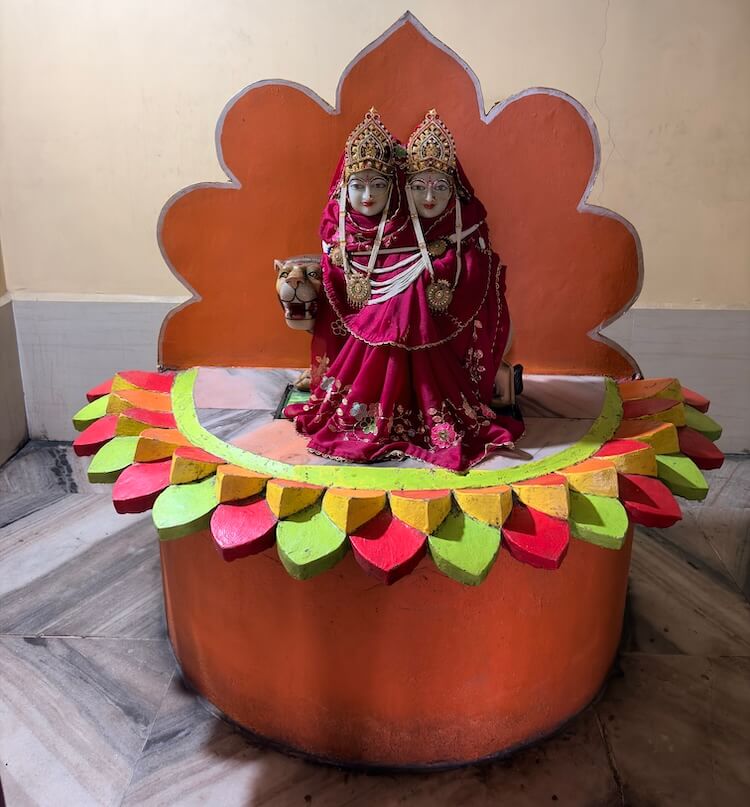 The festivals of Chaitra Navratri and Sharadiya Navratri stand as the pre-eminent annual celebrations observed at the temple premises.
Throughout the ten consecutive days of the Navratri festivals, the precincts become intensely animated with a vast influx of pilgrims arriving to offer fine vestments, precious jewelry, traditional confectionery and various votive offerings to fulfil their vows.
During this sacred ten-day period, the temple trust organises specialized grand fire offerings (‘hom-havan’), congregational singing (‘bhajans’ and ‘kirtans’), devotional music and traditional Garba dances. Additionally, the religious calendar enthusiastically celebrates the holy month of Shravan, Krishna Janmotsav, Nag Panchami and Ashadha Amavasya.
The temple witnesses a steady surge of devotees throughout the week, particularly on Sundays, Tuesdays, Fridays and during the auspicious lunar phases of Ashtami, Purnima (full moon) and Amavasya (new moon). The temple doors remain open to welcome devotees for the ‘darshan’ of Mother Meldi daily from 6:00 am until 7:00 pm.
Useful Information :
- Situated at a distance of 10 km from Kavant
- Located 38 km away from Chhota Udepur city
- Reliable state transport bus services to the location are available from Kavant.
- Private vehicles can drive directly up to the designated foothills of the temple mountain.
- Lodging and breakfast facilities are not available in the immediate vicinity.
मेलडी माता मंदिर
उमठी, ताल. कावंत, जिला. छोटा उदेपुर
मंदिरे
Temples
मंदिर
મંદિરો
கோவில்கள்
దేవాలయాలు
ക്ഷേത്രങ്ങൾ
ದೇವಾಲಯಗಳು
মন্দিরসমূহ
ਮੰਦਿਰ
-
पंचेश्वर महादेव मंदिर हांडोड, ता. संखेडा, जि. छोटा उदेपूर
अधिक माहितीPancheshwar Mahadev Temple Handod, Tal. Sankheda, Dist. Chhota Udepur
View Detailsपंचेश्वर महादेव मंदिर हैंडोड, ताल. संखेडा, जिला. छोटा उदेपुर
विवरण देखेंPancheshwar Mahadev Temple Handod, Tal. Sankheda, Dist. Chhota Udepur
વિગત જુઓPancheshwar Mahadev Temple Handod, Tal. Sankheda, Dist. Chhota Udepur
விவரங்களைக் காண்கPancheshwar Mahadev Temple Handod, Tal. Sankheda, Dist. Chhota Udepur
వివరాలను చూడండిPancheshwar Mahadev Temple Handod, Tal. Sankheda, Dist. Chhota Udepur
വിശദാംശങ്ങൾ കാണുകPancheshwar Mahadev Temple Handod, Tal. Sankheda, Dist. Chhota Udepur
ವಿವರಗಳನ್ನು ವೀಕ್ಷಿಸಿPancheshwar Mahadev Temple Handod, Tal. Sankheda, Dist. Chhota Udepur
বিস্তারিত দেখুনPancheshwar Mahadev Temple Handod, Tal. Sankheda, Dist. Chhota Udepur
ਵੇਰਵੇ ਦੇਖੋ -
पशुपतीनाथ महादेव मंदिर नसवडी, ता. नसवडी, जि. छोटा उदेपूर
अधिक माहितीPashupatinath Mahadev Temple Naswadi, Tal. Naswadi, Dist. Chhota Udepur
View Detailsपशुपतिनाथ महादेव मंदिर नसवाडी, ताल. नसवाडी, जिला. छोटा उदेपुर
विवरण देखेंPashupatinath Mahadev Temple Naswadi, Tal. Naswadi, Dist. Chhota Udepur
વિગત જુઓPashupatinath Mahadev Temple Naswadi, Tal. Naswadi, Dist. Chhota Udepur
விவரங்களைக் காண்கPashupatinath Mahadev Temple Naswadi, Tal. Naswadi, Dist. Chhota Udepur
వివరాలను చూడండిPashupatinath Mahadev Temple Naswadi, Tal. Naswadi, Dist. Chhota Udepur
വിശദാംശങ്ങൾ കാണുകPashupatinath Mahadev Temple Naswadi, Tal. Naswadi, Dist. Chhota Udepur
ವಿವರಗಳನ್ನು ವೀಕ್ಷಿಸಿPashupatinath Mahadev Temple Naswadi, Tal. Naswadi, Dist. Chhota Udepur
বিস্তারিত দেখুনPashupatinath Mahadev Temple Naswadi, Tal. Naswadi, Dist. Chhota Udepur
ਵੇਰਵੇ ਦੇਖੋ -
नानी अंबाजी मंदिर जीवनपुरा, ता. नसवडी, जि. छोटा उदेपूर
अधिक माहितीNani Ambaji Temple Jeevanpura, Tal. Naswadi, Dist. Chhota Udepur
View Detailsनानी अम्बाजी मंदिर जीवनपुरा, ताल. नसवाडी, जिला. छोटा उदेपुर
विवरण देखेंNani Ambaji Temple Jeevanpura, Tal. Naswadi, Dist. Chhota Udepur
વિગત જુઓNani Ambaji Temple Jeevanpura, Tal. Naswadi, Dist. Chhota Udepur
விவரங்களைக் காண்கNani Ambaji Temple Jeevanpura, Tal. Naswadi, Dist. Chhota Udepur
వివరాలను చూడండిNani Ambaji Temple Jeevanpura, Tal. Naswadi, Dist. Chhota Udepur
വിശദാംശങ്ങൾ കാണുകNani Ambaji Temple Jeevanpura, Tal. Naswadi, Dist. Chhota Udepur
ವಿವರಗಳನ್ನು ವೀಕ್ಷಿಸಿNani Ambaji Temple Jeevanpura, Tal. Naswadi, Dist. Chhota Udepur
বিস্তারিত দেখুনNani Ambaji Temple Jeevanpura, Tal. Naswadi, Dist. Chhota Udepur
ਵੇਰਵੇ ਦੇਖੋ