
पशुपतीनाथ महादेव मंदिर
नसवडी, ता. नसवडी, जि. छोटा उदेपूर
Pashupatinath Mahadev Temple
Naswadi, Tal. Naswadi, Dist. Chhota Udepur
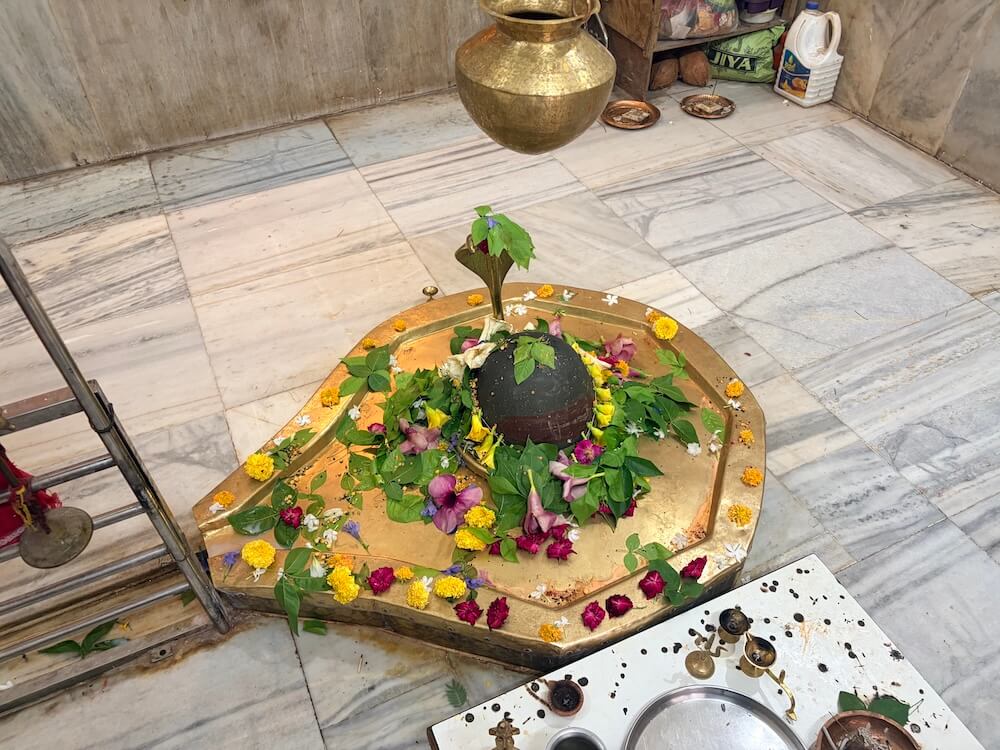 The Pashupatinath Mahadev Temple is beautifully situated in the town of Naswadi, nestled within the picturesque valley of the Ashwin River in the Chhota Udepur district. Formerly under the sovereign jurisdiction of the princely state of Chhota Udepur, this territory witnessed a significant administrative realignment on 15 August 2013, when the new district was carved out from the pre-existing Vadodara district. Comprising approximately 220 villages, this taluka constitutes a predominantly indigenous tribal region within the fertile Narmada basin. The landscape is inhabited by the Rathwa, Tadvi, Bhil, Baria and Nayak communities. Among these, the Rathwa tribe has brought global renown to the region through their distinctive ‘Pithora’ folk art—vibrant ritualistic paintings rendered masterfully upon residential walls.
 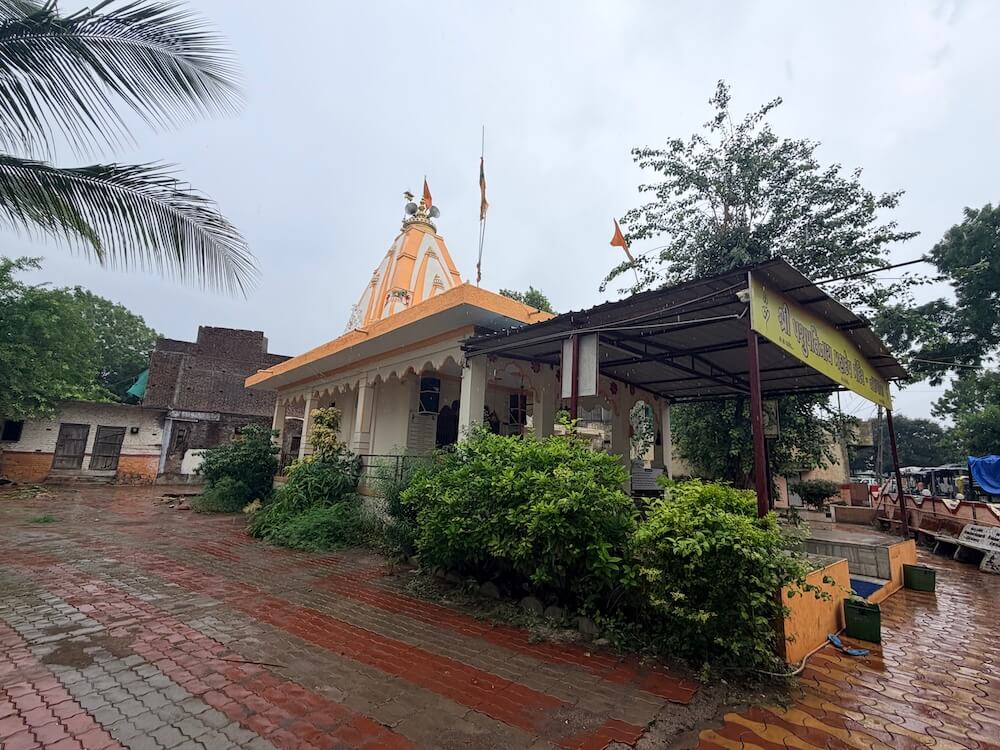 Amidst the numerous sacred shrines gracing this cultural landscape, the Pashupatinath Mahadev Temple stands distinguished as a pre-eminent bastion of faith for countless pilgrims.
In classical Sanskrit, the title ‘Pashupati’ translates literally as the Sovereign Lord of all living beings and creatures. The mythological origin concerning the manifestation of Pashupati Mahadev is intimately intertwined with the legendary events of the Mahabharata. Exhaustive theological accounts of this divine occurrence, complete with detailed scriptural context, are preserved within the Kedar Khanda of the Skanda Purana, the Koti Rudra Samhita of the Shiva Purana and the Linga Purana. Following the conclusion of the catastrophic Kurukshetra war, the Pandava brothers, acting upon the solemn counsel of Lord Shri Krishna and the venerable sage Maharishi Vyas, 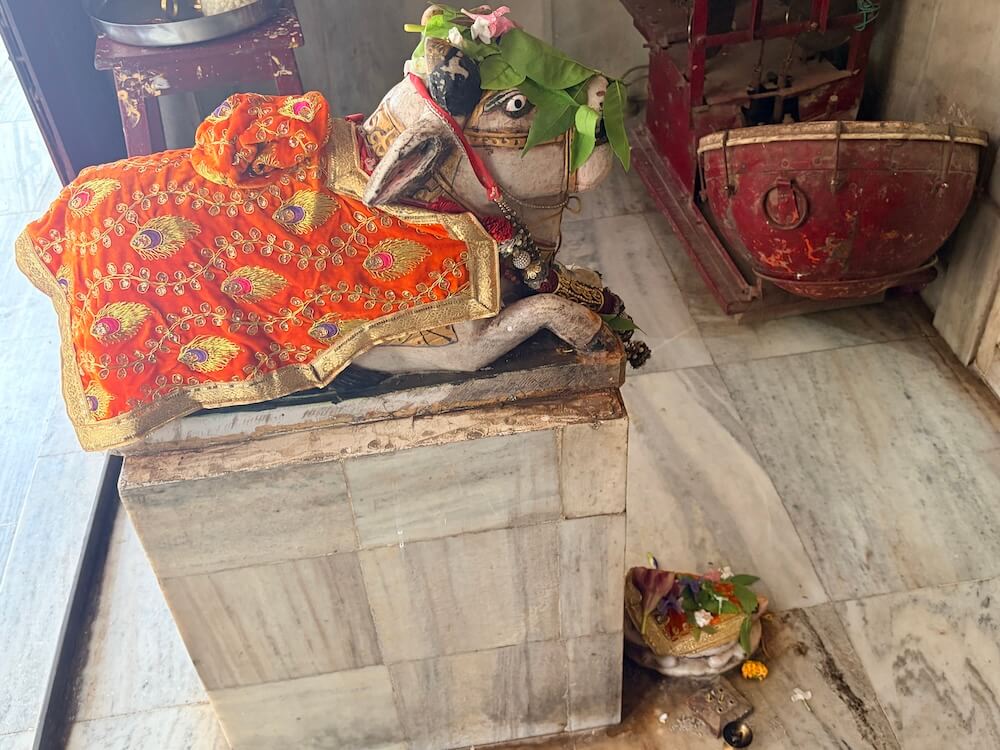 set forth on a historic pilgrimage to seek the audience of Lord Shiva. Their objective was to achieve absolute absolution from the collective sins of gotravadha (clan-slaying), brahmahatya (the killing of kin holding priestly status) and the wider slaughter of their close relatives. However, deeply aggrieved by the wholesale destruction witnessed during the war, Lord Shiva was disinclined to grant the Pandavas an immediate audience. When the seeking brothers arrived at the holy city of Kashi in pursuit of the deity, Lord Shiva retreated from Kashi to seek absolute seclusion at Kedarnath in the upper Himalayas.
Undeterred, the Pandavas pursued the divine presence from Kashi to the alpine heights of Kedarnath. In an attempt to conceal Himself from their gaze, Lord Shiva assumed the physical form of a bull. 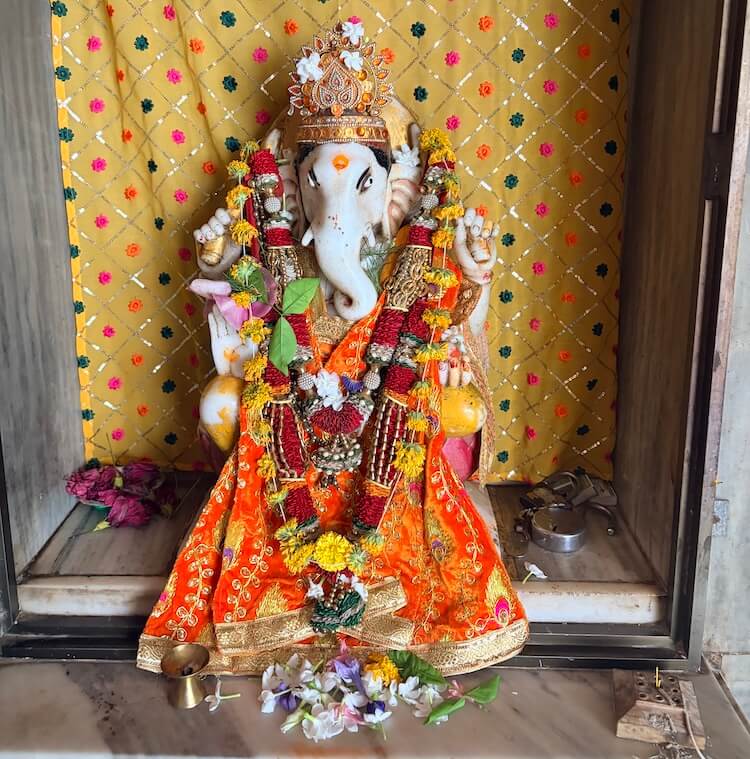 He seamlessly integrated Himself into a herd of livestock grazing nearby and began to sink mystically into the earth. Suspecting this divine stratagem, the mighty Bhima assumed a colossal stature and planted his massive feet across two towering mountain peaks to intercept the herd. Whilst all the other cattle passed safely beneath Bhima’s straddled legs, the bull representing the disguised Mahadev steadfastly refused to do so. Bhima instantly recognized the deity. As the divine bull was submerging into the subterranean depths, Bhima forcefully gripped the hump (vashinda) that remained above the ground. Profoundly moved by the unyielding devotion, absolute fidelity and iron resolve of the Pandavas, Lord Shiva manifested in His full glory, instantly absolving them of the sin of gotravadha. On this momentous occasion, the hind portion of the divine bull remained permanently anchored at Kedarnath, where the holy Kedarnath Jyotirlinga stands enshrined to this day. Simultaneously, the divine countenance of the deity miraculously manifested along the banks of the Bagmati River in Kathmandu, Nepal.
  Owing to His adoption of an animal form and His status as the ultimate saviour of all living creation, the deity became universally adored by the name ‘Pashupatinath’.
According to the sacred epigraphy of the Skanda Purana and the Shiva Purana, the deity is worshipped at the principal Pashupatinath Temple in Kathmandu in the form of a five-faced phallic emblem (Panchamukhi Shivpindi). These five distinct countenances structurally represent the directions of the cosmos—East, West, North, South and the Zenith. Consequent to the rich legacy of this divine event and the widespread historical expansion of the Shaiva tradition, numerous temples dedicated to Pashupatinath were erected across the length and breadth of India. 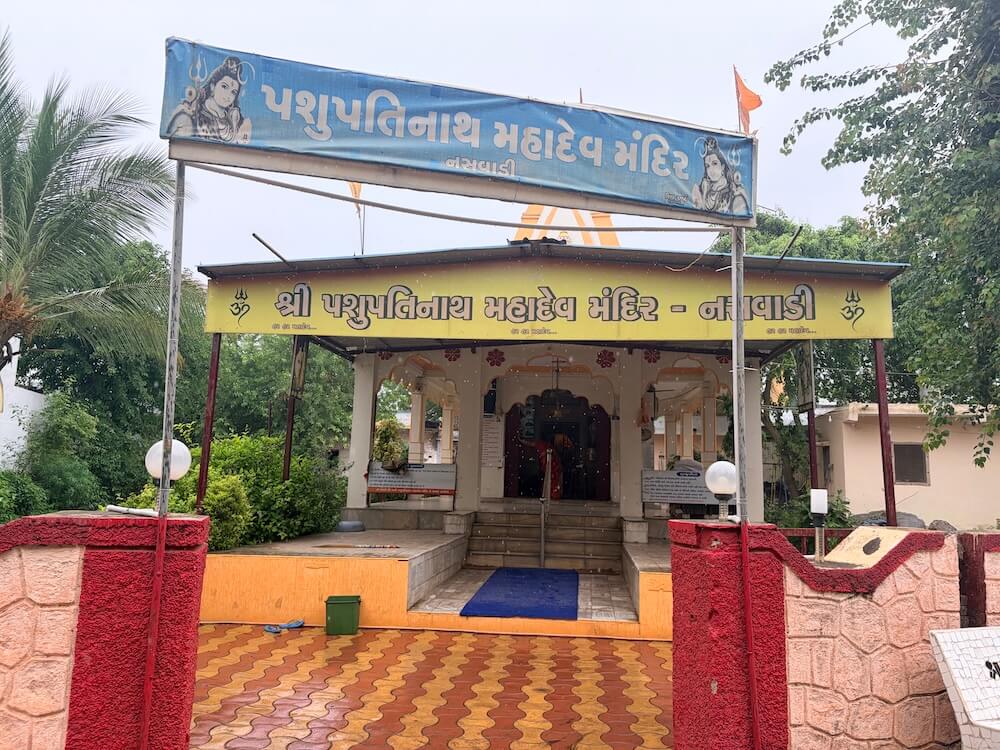 The sacred sanctuary situated at Naswadi in the Chhota Udepur district is widely revered as a continuation of this ancient architectural and spiritual lineage.
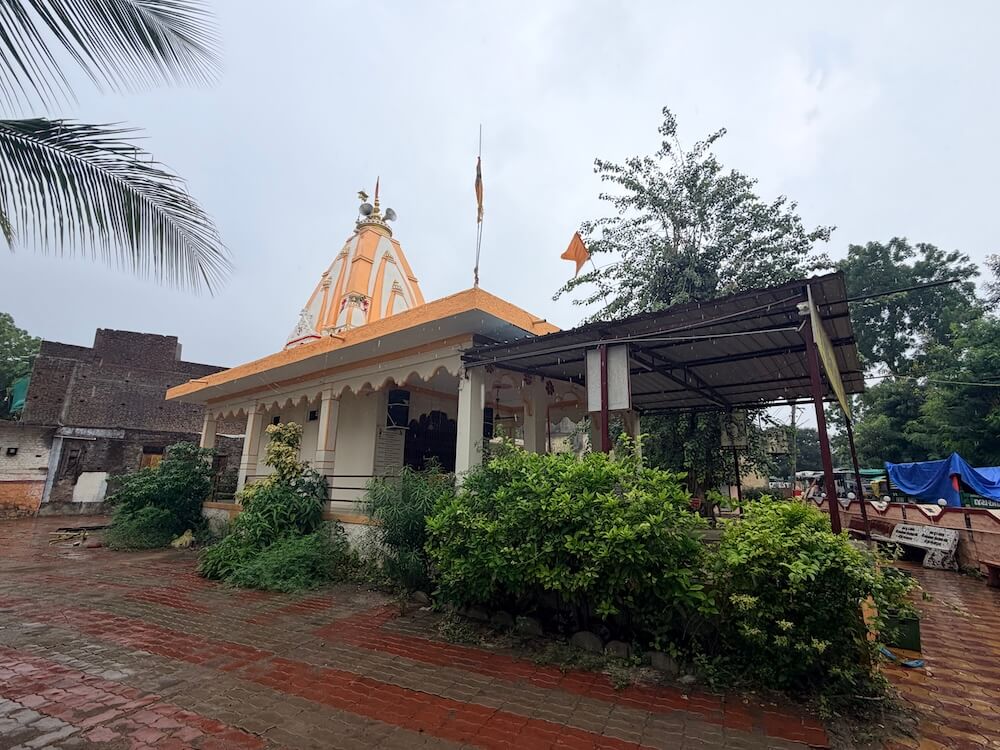
Local sacred lore affirms that the Pashupatinath Temple at Naswadi possesses a historical antiquity spanning approximately three to four centuries. In ancient epochs, this entire geographical terrain was enveloped by a dense, primeval forest. According to local traditions, the heroic Pandavas originally consecrated the shivling at this precise spot to serve as the supreme guardian and lord of all creatures inhabiting the wilderness. Access to the inner temple courtyard is gained through a grand gateway set into a robust defensive perimeter wall that encompasses the sanctuary. The paved courtyard features comfortable seating benches arranged for the relaxation of visiting pilgrims, alongside a well-equipped community kitchen and a permanent charitable food pavilion (annachhatra). 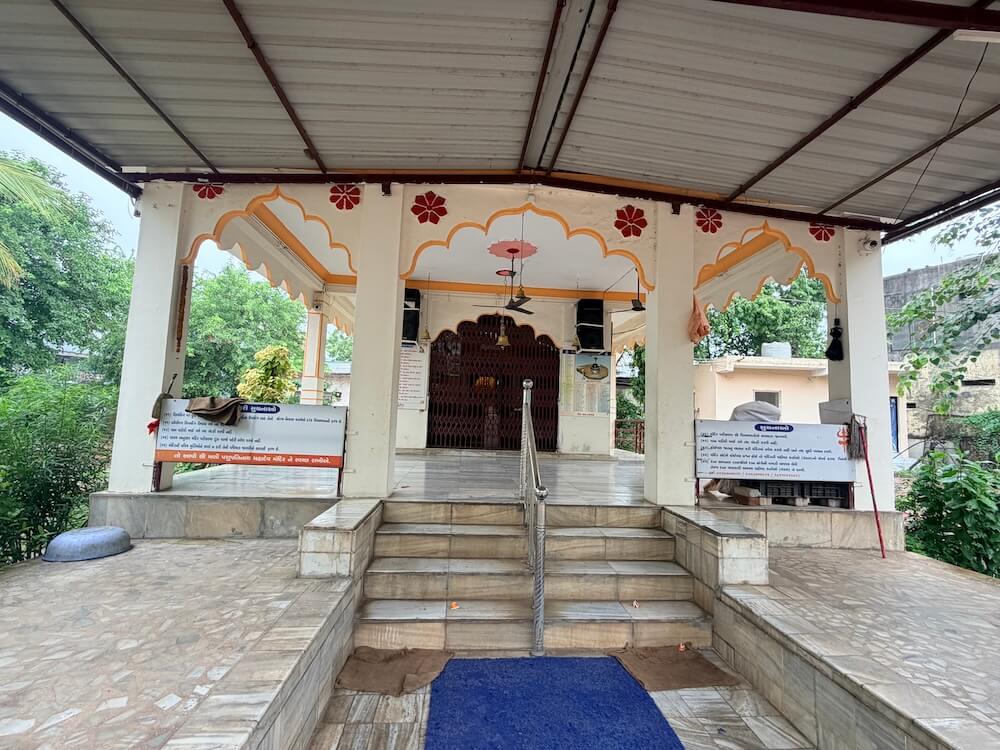 Furthermore, dedicated structural niches within this courtyard enshrine ancient stone idols representing various tutelary deities.
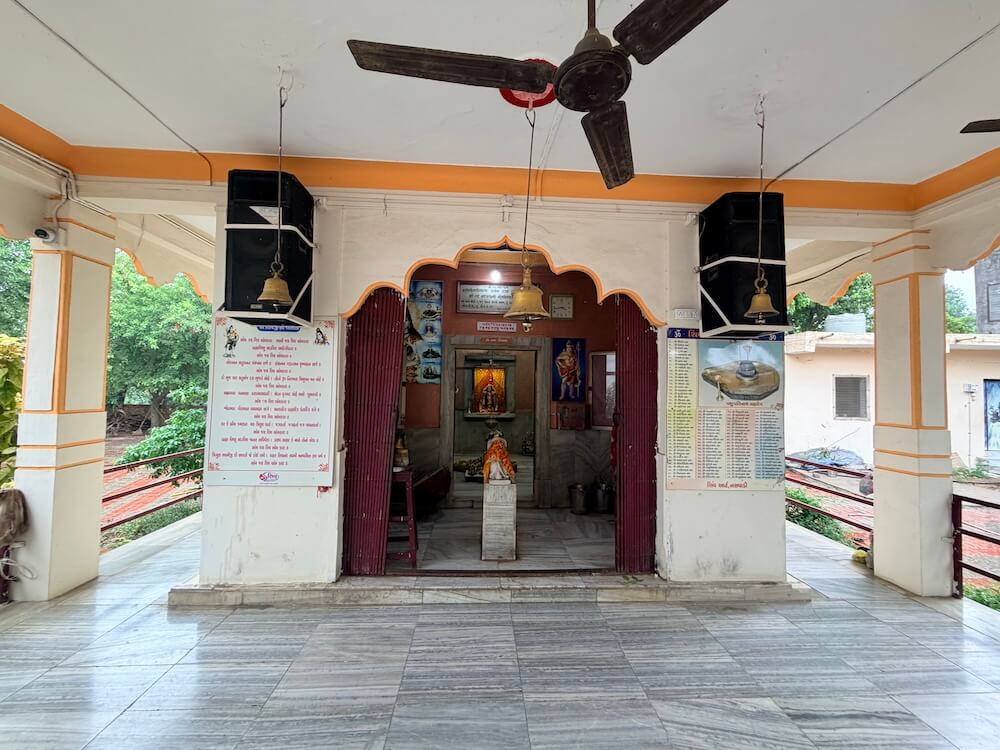
Structurally, the temple exhibits a classical layout comprising a main assembly hall, an antechamber and the primary sanctum sanctorum, all resting upon an elevated plinth rising approximately two feet high. Fronting the assembly hall is an extended portico supported by robust iron columns and sheltered by a corrugated iron roof to facilitate comfortable public viewing. The main assembly hall (sabhamandap) is configured in a traditional semi-open architectural style, with its supporting columns seamlessly integrated via elegant decorative arches (mahirapi toranas). 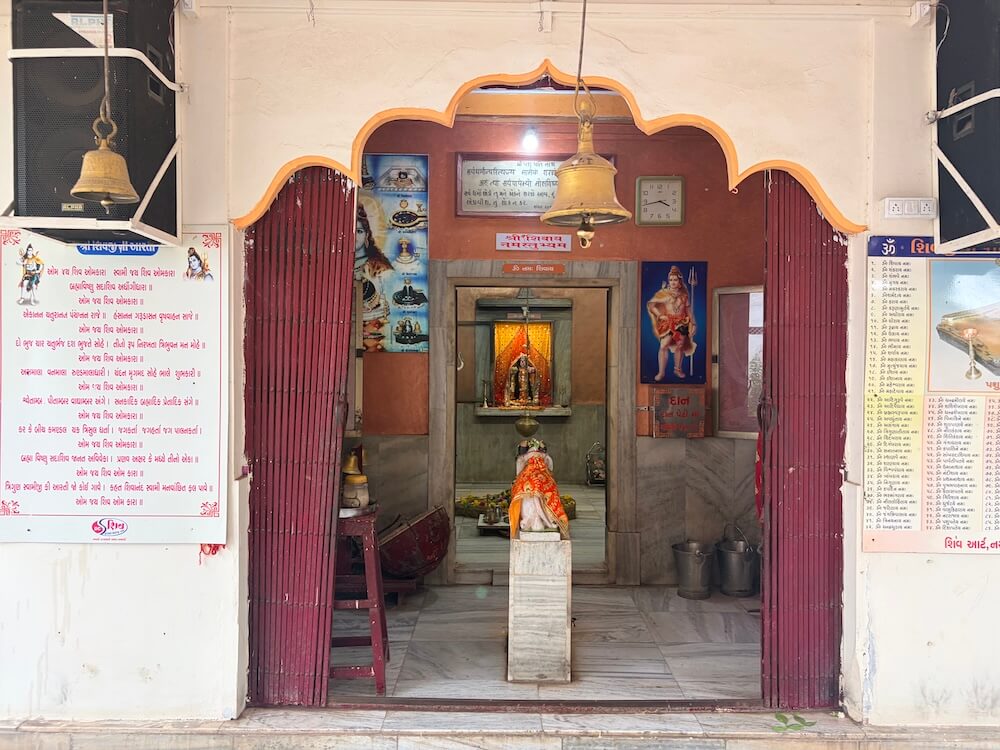 The geometric center of the hall leads directly into the integrated antechamber and the inner sanctum. A fine sculpture of Lord Ganesha graces the central lintel (lalatabimba) surmounting the entrance to the antechamber. Consecrated upon a central pedestal directly before the doorway of the inner sanctum are masterfully sculpted representations of Nandi facing a sacred stone tortoise. Embedded within architectural niches on the right and left walls of the antechamber are elegant idols of Lord Ganesha and Lord Maruti.
Beyond the antechamber lies the sunken chamber of the sanctum sanctorum, whose elaborate door jambs are decorated with crisp, vertically aligned linear carvings. Consecrated at the exact center of the sanctum floor is the primordial shivpindi.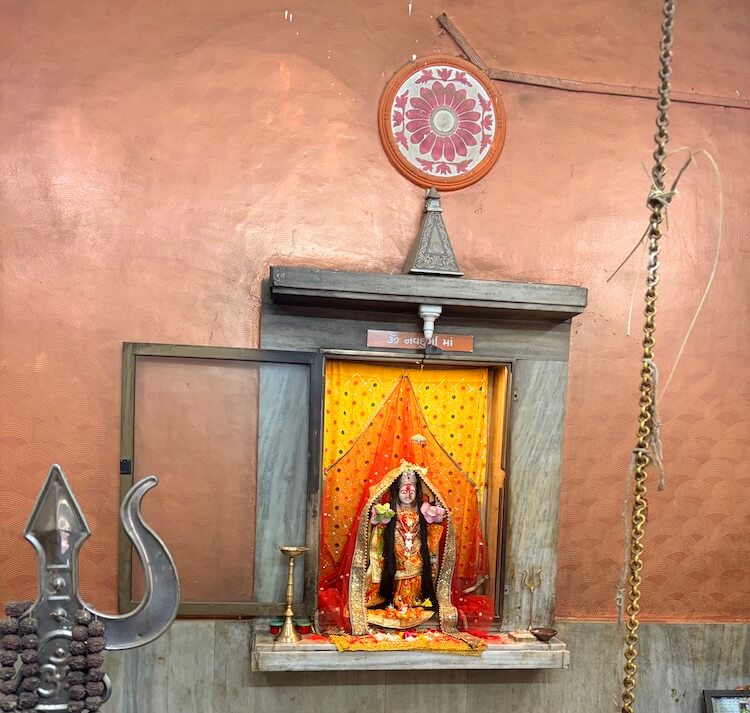 The sacred base (shalunka) of this emblem is encased in a magnificent, polished brass covering. Surmounting the shivpindi is a finely crafted metallic serpent deity (Nagraj) forming a protective canopy. At the same time, a ritual vessel (abhishekpatra) remains suspended from the ceiling to ensure a continuous holy drip upon the deity. Positioned adjacent to the central altar are a traditional iron trident (trishool) and a hand-drum (damru). Enshrined within a beautifully sculpted niche on the rear wall behind the main deity is a white marble idol of Mother Parvati. A paved circumambulatory path (pradakshinamarga) runs continuously along the external perimeter of the antechamber and the sanctum. The superstructure surmounting the sanctum rises into a square-based primary spire (shikhara), whose exterior walls are embellished with rows of matching miniature auxiliary spires (angashikharas).
A rich calendar of religious festivals and traditional celebrations is observed at the Naswadi Pashupatinath Temple throughout the year.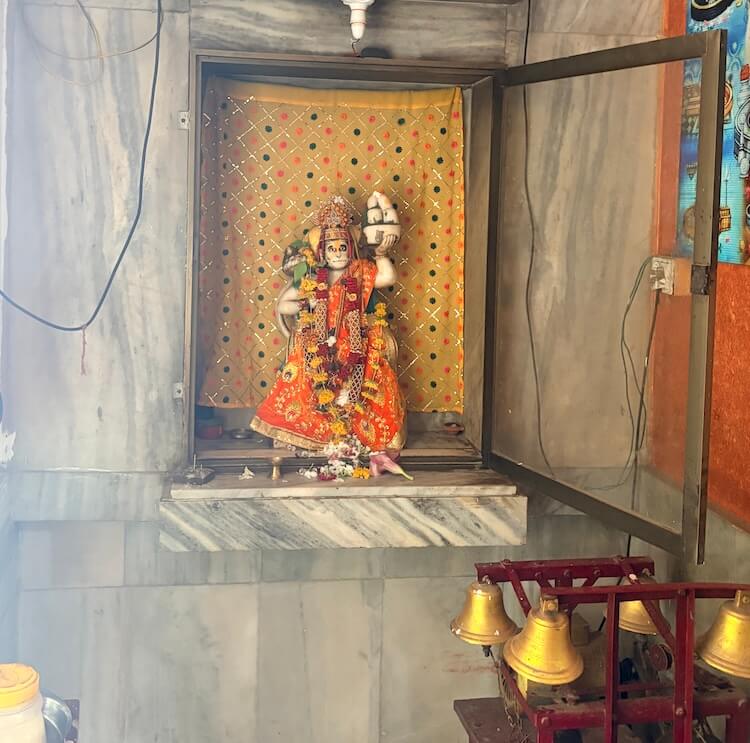 The festival of Mahashivratri stands as the pre-eminent annual celebration, drawing thousands of devotees from across the Naswadi taluka and its adjoining rural hinterlands. Throughout the holy month of Shravan, the temple remains densely animated with pilgrims arriving to offer prayers on Shravan Mondays. Additionally, prominent festivals such as Nag Panchami, Shri Krishna Janmotsav, Shravan Purnima, Shravani Amavasya, Dussehra and Diwali are celebrated here with immense public enthusiasm. During these major festive periods, a sumptuous mahaprasad prepared in the community kitchen is distributed to all visiting pilgrims. The temple trust organises specialised grand fire rituals (Mahayajna), elaborate traditional ablutions (Rudrabhisheka), congregational singing sessions (bhajans and kirtans) and intensive scriptural discourses. Beyond these annual celebrations, the temple witnesses a steady influx of devotees on Mondays and during the auspicious lunar phases of Pradosha Vrat, Purnima (full moon) and Amavasya (new moon). The temple doors remain open to welcome devotees for the darshan of Pashupatinath Mahadev daily from 6:00 am until 12:00 noon and from 4:00 pm until 8:00 pm.
Useful Information :
- Situated at a distance of 1 km from Naswadi bus station
- Located approximately 60 km away from Chhota Udepur city
- Reliable state transport bus facilities to Naswadi operate frequently from numerous urban centers across the district.
- Private vehicles can drive directly up to the temple premises.
- Comfortable lodging and breakfast facilities are available in the immediate vicinity.
पशुपतिनाथ महादेव मंदिर
नसवाडी, ताल. नसवाडी, जिला. छोटा उदेपुर
मंदिरे
Temples
मंदिर
મંદિરો
கோவில்கள்
దేవాలయాలు
ക്ഷേത്രങ്ങൾ
ದೇವಾಲಯಗಳು
মন্দিরসমূহ
ਮੰਦਿਰ
-
पंचेश्वर महादेव मंदिर हांडोड, ता. संखेडा, जि. छोटा उदेपूर
अधिक माहितीPancheshwar Mahadev Temple Handod, Tal. Sankheda, Dist. Chhota Udepur
View Detailsपंचेश्वर महादेव मंदिर हैंडोड, ताल. संखेडा, जिला. छोटा उदेपुर
विवरण देखेंPancheshwar Mahadev Temple Handod, Tal. Sankheda, Dist. Chhota Udepur
વિગત જુઓPancheshwar Mahadev Temple Handod, Tal. Sankheda, Dist. Chhota Udepur
விவரங்களைக் காண்கPancheshwar Mahadev Temple Handod, Tal. Sankheda, Dist. Chhota Udepur
వివరాలను చూడండిPancheshwar Mahadev Temple Handod, Tal. Sankheda, Dist. Chhota Udepur
വിശദാംശങ്ങൾ കാണുകPancheshwar Mahadev Temple Handod, Tal. Sankheda, Dist. Chhota Udepur
ವಿವರಗಳನ್ನು ವೀಕ್ಷಿಸಿPancheshwar Mahadev Temple Handod, Tal. Sankheda, Dist. Chhota Udepur
বিস্তারিত দেখুনPancheshwar Mahadev Temple Handod, Tal. Sankheda, Dist. Chhota Udepur
ਵੇਰਵੇ ਦੇਖੋ -
नानी अंबाजी मंदिर जीवनपुरा, ता. नसवडी, जि. छोटा उदेपूर
अधिक माहितीNani Ambaji Temple Jeevanpura, Tal. Naswadi, Dist. Chhota Udepur
View Detailsनानी अम्बाजी मंदिर जीवनपुरा, ताल. नसवाडी, जिला. छोटा उदेपुर
विवरण देखेंNani Ambaji Temple Jeevanpura, Tal. Naswadi, Dist. Chhota Udepur
વિગત જુઓNani Ambaji Temple Jeevanpura, Tal. Naswadi, Dist. Chhota Udepur
விவரங்களைக் காண்கNani Ambaji Temple Jeevanpura, Tal. Naswadi, Dist. Chhota Udepur
వివరాలను చూడండిNani Ambaji Temple Jeevanpura, Tal. Naswadi, Dist. Chhota Udepur
വിശദാംശങ്ങൾ കാണുകNani Ambaji Temple Jeevanpura, Tal. Naswadi, Dist. Chhota Udepur
ವಿವರಗಳನ್ನು ವೀಕ್ಷಿಸಿNani Ambaji Temple Jeevanpura, Tal. Naswadi, Dist. Chhota Udepur
বিস্তারিত দেখুনNani Ambaji Temple Jeevanpura, Tal. Naswadi, Dist. Chhota Udepur
ਵੇਰਵੇ ਦੇਖੋ -
बाला हनुमान मंदिर मेरिया, ता. बोदेली, जि. छोटा उदेपूर
अधिक माहितीBala Hanuman Temple Meriya, Tal. Bodeli, Dist. Chhota Udepur
View Detailsबाला हनुमान मंदिर मेरिया, ताल. बोडेली, जिला. छोटा उदेपुर
विवरण देखेंBala Hanuman Temple Meriya, Tal. Bodeli, Dist. Chhota Udepur
વિગત જુઓBala Hanuman Temple Meriya, Tal. Bodeli, Dist. Chhota Udepur
விவரங்களைக் காண்கBala Hanuman Temple Meriya, Tal. Bodeli, Dist. Chhota Udepur
వివరాలను చూడండిBala Hanuman Temple Meriya, Tal. Bodeli, Dist. Chhota Udepur
വിശദാംശങ്ങൾ കാണുകBala Hanuman Temple Meriya, Tal. Bodeli, Dist. Chhota Udepur
ವಿವರಗಳನ್ನು ವೀಕ್ಷಿಸಿBala Hanuman Temple Meriya, Tal. Bodeli, Dist. Chhota Udepur
বিস্তারিত দেখুনBala Hanuman Temple Meriya, Tal. Bodeli, Dist. Chhota Udepur
ਵੇਰਵੇ ਦੇਖੋ