
कलिकुलंगरा श्री भद्रकाली मंदिर
कलिकुलंगारा, उत्तर परावूर, जि. एर्नाकुलम.
Kalikulangara Sree Bhadrakali Temple
Kalikulangara, North Paravur, Dist. Ernakulam.
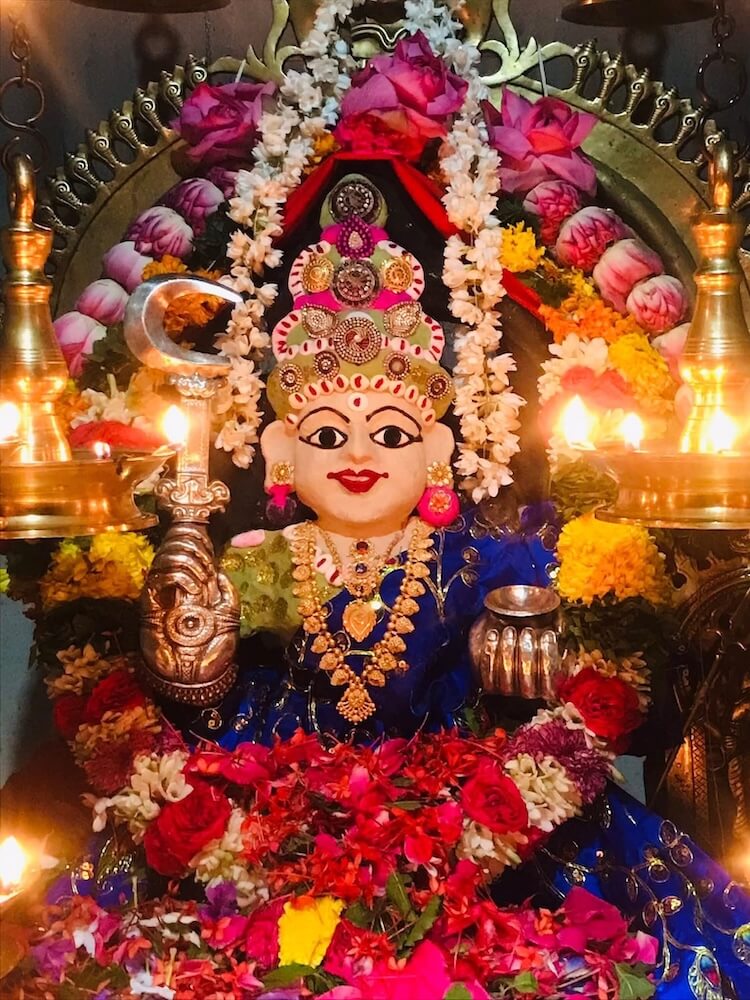 Kalikulangara Sree Bhadrakali Temple is a well-known Bhagavathi temple located at Kalikulangara in Nandiyattukunnam village, near North Paravur in Ernakulam district, Kerala. The place is believed to have derived the name “Kalikulangara” from the sacred pond beside the temple, where the presence of Goddess Bhadrakali is traditionally believed to reside. The main deity is Sree Bhadrakali, a Dravidian form of the Goddess, who is affectionately known among devotees as “Kalikulangara Muthi”. The deity faces east and is worshipped by devotees as the supreme manifestation of the Divine Mother.
There are no clear historical records regarding the establishment of the temple. It is believed to have originally existed as an ancient sacred grove (kavu) that served as a place of worship for the local community. In its early days, the land belonged to a Namboothiri family in Nandiyattukunnam village. After the family left the village, the responsibility for the temple was entrusted to two prominent local families. Initially, worship was conducted only by women according to traditional family customs. The temple was later renovated and South Indian Vedic rituals were introduced, with Paravur Sreedharan Thanthri becoming the temple’s traditional chief priest (Thanthri). A significant turning point in the temple’s history was the visit of Sree Narayana Guru. 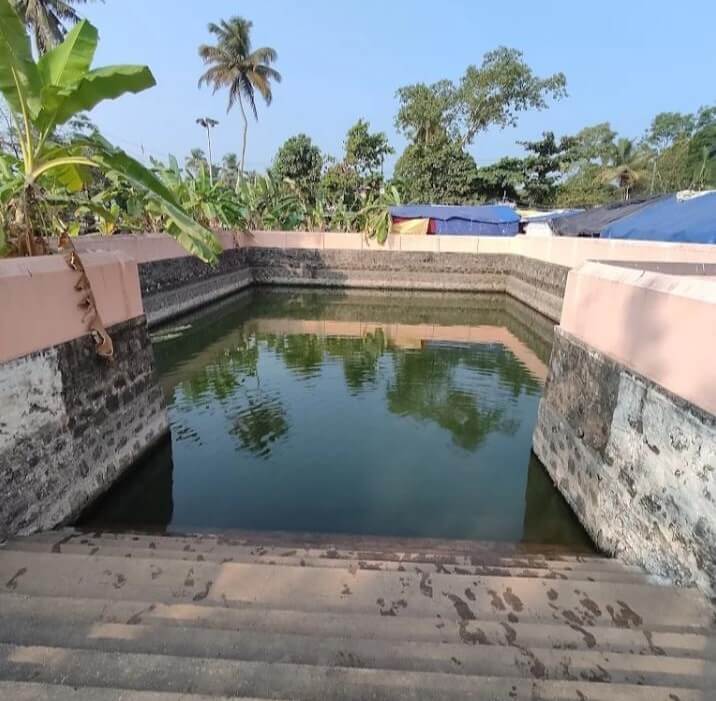 At the invitation of his householder disciple, Sree Achambava of the Kakkanad family, the Guru visited the temple and expressed his opposition to the animal sacrifice practised there, advising that it should be discontinued. The practice was subsequently abolished and the temple became a place of worship open to people of all castes and religions. Today, the temple is administered by the Sree Narayana Dharma Sangham Trust under the Varkala Sivagiri Mutt.
Several legends are associated with the temple. According to the most well-known tradition, the Goddess was originally worshipped by a devotee of Kali who lived in an area south of present-day Nandiyattukunnam. Forced to leave his home because of the cruelty of the local landlord, he travelled with a sacred worship stone believed to embody the presence of the Goddess. On reaching Nandiyattukunnam, he installed the stone near the local sacred grove and pond. It is believed that the pond where the Goddess came to reside is the present-day Kalikulam, from which the place derives its name. 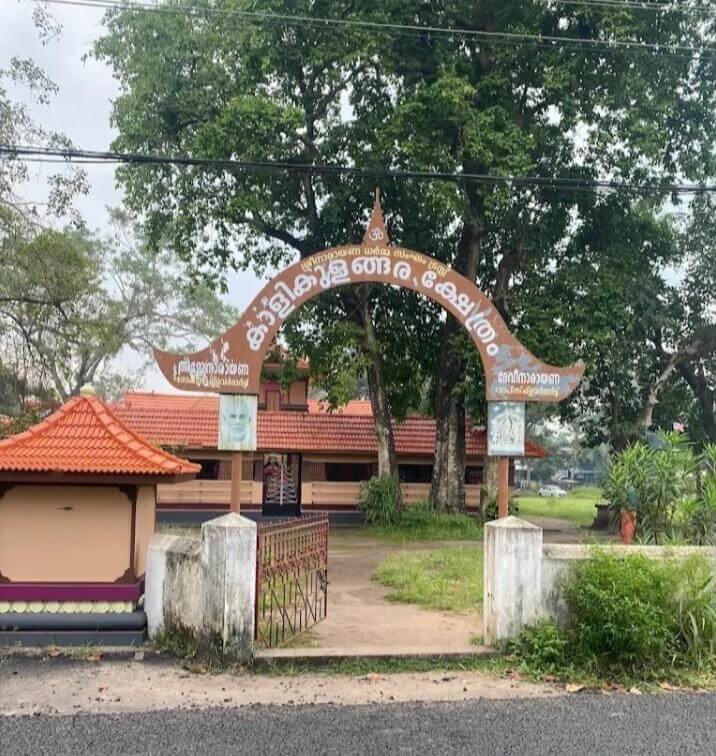 Another local legend says that the residence of the Paravur Thampuran, who opposed the first Valiya Vilakku festival, was destroyed by fire as an expression of the Goddess’s wrath. It is also said that when Sree Narayana Guru first visited the temple, some orthodox local people tried to drive him away by throwing stones. Later, they recognised his greatness and dedicated the temple to him. Local tradition further recalls that the Guru later remarked, “I spent a night here.”
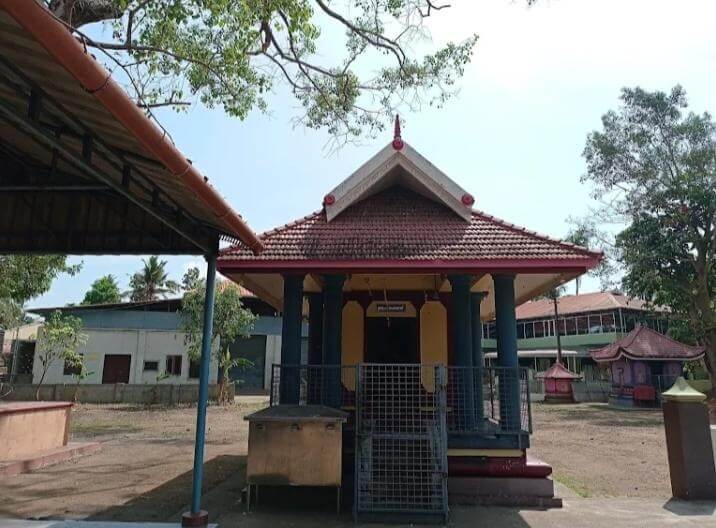
The temple pond, known as Kalikulam, is located in front of the temple and is one of its main features. Passing through the entrance gateway and the compound wall, which are built of dressed stone and cement, visitors enter the temple complex, which reflects the traditional Kerala style of temple architecture with tiled roofs. A large banyan tree with a raised platform around its base stands within the temple courtyard. Inside, the Nalambalam surrounds the Sreekovil and a Namaskara Mandapam is situated directly in front of the sanctum. On one side of the Nalambalam,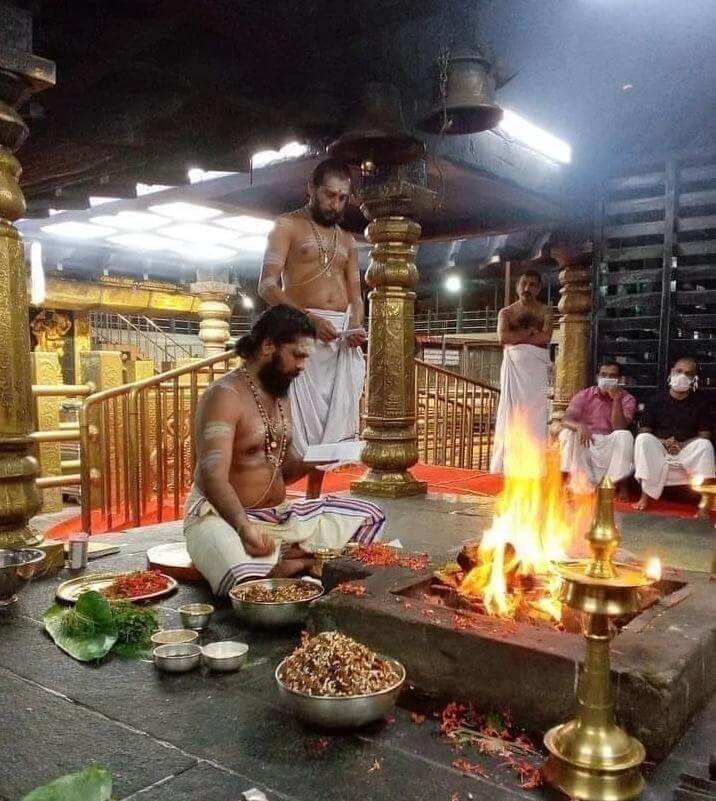 there is a dedicated area for preparing the temple’s special Thendu Nivedyam offering, along with counters for receiving offerings from devotees.
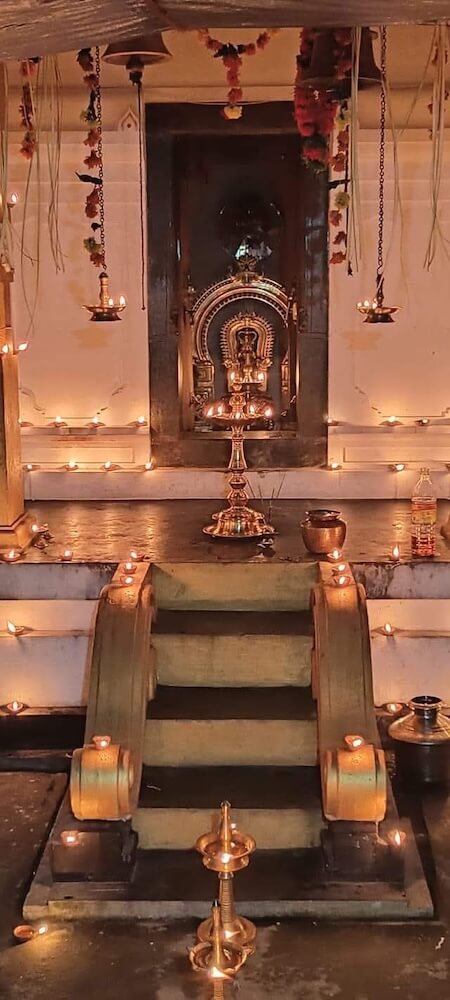
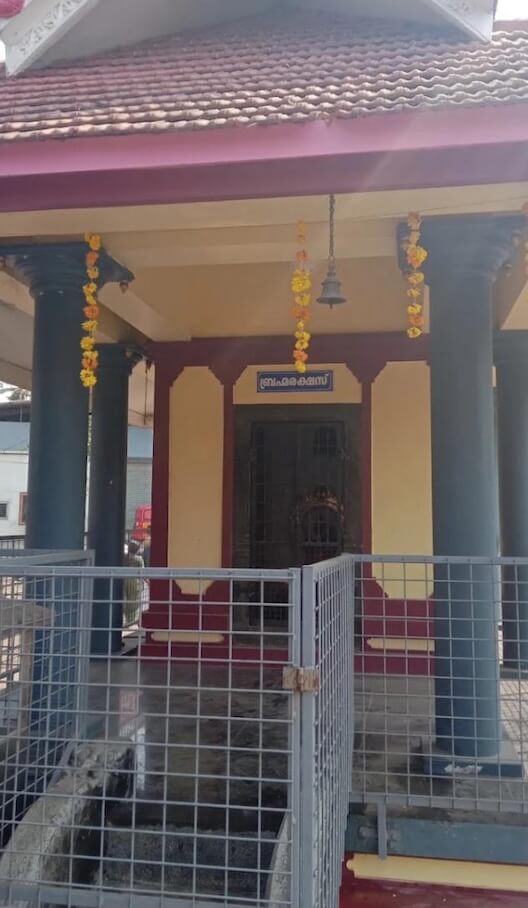
The main Sreekovil stands at the centre of a spacious square-shaped Nalambalam and faces east. In keeping with the temple’s traditional kavu heritage, there is no permanent flagstaff. Instead, a temporary flagpole made from an areca palm is erected during the annual festival. An Aniyara (sacred chamber) attached to the Sreekovil houses a wooden festival idol carved from jackwood, which is taken out only for ceremonial processions during the festival. The main deity is Sree Bhadrakali. According to local tradition, the principal object of worship inside the Sreekovil is the sacred stone installed by the devotee mentioned in the temple legend. Shrines dedicated to Veerabhadra, Ghantakarna and Sundari Yakshi are also situated on either side of the main Sreekovil.
The temple’s main annual festival is the 41-day Valiya Vilakku Mahotsavam, which begins on Makara Sankranti and concludes on the 12th day of the Malayalam month of Kumbham. 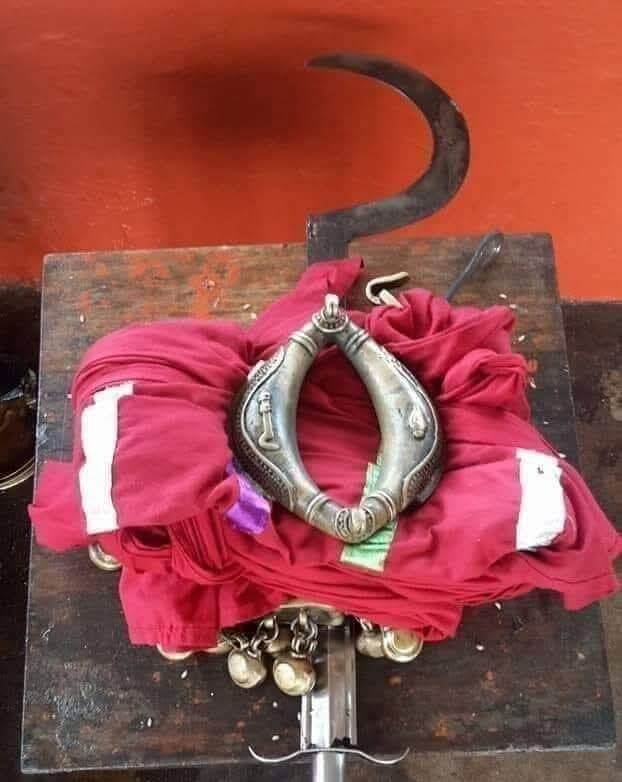 In keeping with traditional customs, elephants and fireworks are not included in the celebrations. During the final seven days of the festival, the wooden festival idol of the Goddess, carved from jackwood, is taken out in procession and made available for devotees to have darshan. The festival concludes with the Maha Kuruthi ritual after the lowering of the festival flag on Kumbham 12, following which the temple remains closed for seven days. Pongala is one of the major rituals performed during the festival. Throughout the 41-day festival, Thendu Nivedyam is offered by devotees as one of the temple’s principal offerings. Special poojas and ceremonies are also conducted on the first Friday of every Malayalam month, during the Mandala season and on the occasions of Navaratri, Durgashtami, Mahanavami and Vijayadashami.
The temple’s principal offering is Thendu Nivedyam. It is prepared by mixing rice flour, jaggery, grated coconut, dry ginger, cardamom and sesame seeds. The mixture is wrapped in an areca palm sheath and baked in a specially prepared earthen oven within the temple premises. Devotees mainly offer this vazhipadu for good health and the fulfilment of their prayers. It is offered in the largest numbers during the 41-day Valiya Vilakku Mahotsavam. Pongala, conducted during the annual festival, is another important offering. Other major offerings include Guruthi Pushpanjali, Maha Kuruthi, Raktha Pushpanjali, Kadumpayasam, Neypayasam and Vilakkumala.
The daily rituals at the temple begin with the Palliyunarthal ceremony at 04:30 AM. The temple opens at 05:00 AM, followed by Nirmalya Darshan at 05:05 AM, Abhishekam at 05:30 AM, Usha Pooja at 06:30 AM and Ucha Pooja at 10:30 AM. The temple closes for the morning at 11:00 AM. It reopens at 05:00 PM, followed by Deeparadhana at 06:30 PM and Athazha Pooja at 07:30 PM, before closing for the day at 08:00 PM. Pooja timings may vary during the annual festival, the Mandala season and on other special occasions.
Key highlight :-
- Located about 13 km from Kodungallur, 17 km from Aluva and 25 km from Ernakulam City.
- The nearest railway station is Aluva Railway Station, about 17 km away.
- KSRTC and local bus services are available to the temple from Aluva and Ernakulam.
- Private vehicles can be parked in the temple parking area.
- Accommodation and food facilities are available in the nearby towns.
कलिकुलंगरा श्री भद्रकाली मंदिर
कालीकुलंगारा, उत्तरी परवूर, जिला। एर्नाकुलम.
मंदिरे
Temples
मंदिर
મંદિરો
கோவில்கள்
దేవాలయాలు
ക്ഷേത്രങ്ങൾ
ದೇವಾಲಯಗಳು
মন্দিরসমূহ
ਮੰਦਿਰ
-
श्री लक्ष्मी नारायण मंदिर कुंबलम, जि. एर्नाकुलम.
अधिक माहितीSree Lakshmi Narayana Temple Kumbalam, Dist. Ernakulam.
View Detailsश्री लक्ष्मी नारायण मंदिर कुम्बलम, जिला. एर्नाकुलम.
विवरण देखेंSree Lakshmi Narayana Temple Kumbalam, Dist. Ernakulam.
વિગત જુઓSree Lakshmi Narayana Temple Kumbalam, Dist. Ernakulam.
விவரங்களைக் காண்கSree Lakshmi Narayana Temple Kumbalam, Dist. Ernakulam.
వివరాలను చూడండిSree Lakshmi Narayana Temple Kumbalam, Dist. Ernakulam.
വിശദാംശങ്ങൾ കാണുകSree Lakshmi Narayana Temple Kumbalam, Dist. Ernakulam.
ವಿವರಗಳನ್ನು ವೀಕ್ಷಿಸಿSree Lakshmi Narayana Temple Kumbalam, Dist. Ernakulam.
বিস্তারিত দেখুনSree Lakshmi Narayana Temple Kumbalam, Dist. Ernakulam.
ਵੇਰਵੇ ਦੇਖੋ -
कोचीन थिरुमाला देवस्वोम मंदिर चेरलाई, मत्तनचेरी, जि. एर्नाकुलम.
अधिक माहितीCochin Thirumala Devaswom Temple Cherlai, Mattancherry, Dist. Ernakulam.
View Detailsकोचीन थिरुमाला देवास्वोम मंदिर चेरलाई, मट्टनचेरी, जिला। एर्नाकुलम.
विवरण देखेंCochin Thirumala Devaswom Temple Cherlai, Mattancherry, Dist. Ernakulam.
વિગત જુઓCochin Thirumala Devaswom Temple Cherlai, Mattancherry, Dist. Ernakulam.
விவரங்களைக் காண்கCochin Thirumala Devaswom Temple Cherlai, Mattancherry, Dist. Ernakulam.
వివరాలను చూడండిCochin Thirumala Devaswom Temple Cherlai, Mattancherry, Dist. Ernakulam.
വിശദാംശങ്ങൾ കാണുകCochin Thirumala Devaswom Temple Cherlai, Mattancherry, Dist. Ernakulam.
ವಿವರಗಳನ್ನು ವೀಕ್ಷಿಸಿCochin Thirumala Devaswom Temple Cherlai, Mattancherry, Dist. Ernakulam.
বিস্তারিত দেখুনCochin Thirumala Devaswom Temple Cherlai, Mattancherry, Dist. Ernakulam.
ਵੇਰਵੇ ਦੇਖੋ -
पझूर पेरुमथ्रिककोविल महादेवाचे मंदिर पझूर, पिरावोम, जि. एर्नाकुलम.
अधिक माहितीPazhoor Perumthrikkovil Mahadeva Temple Pazhoor, Piravom, Diist. Ernakulam.
View Detailsपज़हूर पेरुमथ्रिककोविल महादेव मंदिर पज़हूर, पिरावोम, जिला। एर्नाकुलम.
विवरण देखेंPazhoor Perumthrikkovil Mahadeva Temple Pazhoor, Piravom, Diist. Ernakulam.
વિગત જુઓPazhoor Perumthrikkovil Mahadeva Temple Pazhoor, Piravom, Diist. Ernakulam.
விவரங்களைக் காண்கPazhoor Perumthrikkovil Mahadeva Temple Pazhoor, Piravom, Diist. Ernakulam.
వివరాలను చూడండిPazhoor Perumthrikkovil Mahadeva Temple Pazhoor, Piravom, Diist. Ernakulam.
വിശദാംശങ്ങൾ കാണുകPazhoor Perumthrikkovil Mahadeva Temple Pazhoor, Piravom, Diist. Ernakulam.
ವಿವರಗಳನ್ನು ವೀಕ್ಷಿಸಿPazhoor Perumthrikkovil Mahadeva Temple Pazhoor, Piravom, Diist. Ernakulam.
বিস্তারিত দেখুনPazhoor Perumthrikkovil Mahadeva Temple Pazhoor, Piravom, Diist. Ernakulam.
ਵੇਰਵੇ ਦੇਖੋ