
गंगा माता मंदिर बंदर रोड,
बिलीमोरा, ता. गाणदेवी, जि. नवसारी
Ganga Mata Temple
Bandar Road, Bilimora, Tal. Gandevi, Dist. Navsari
 In Indian culture, rivers have long been revered as mothers and considered holy. They hold immense importance in our society, both materially and in cultural and religious traditions. Rising at Gangotri and flowing down from the Himalayas, the Ganga is regarded as the holiest of India’s rivers. Known by names such as Vishnupriya, Vishnupadi, Brahmadrava, Jahnavi, Mandakini and Tripathaga, she is worshipped as a purifier of sins. Temples dedicated to Ganga Mata stand in many parts of the country. One such well-known shrine is in Bilimora in Navsari district.
According to historical records in the ‘Imperial Gazetteer of India’ (Vol. 1 and 7) and the ‘Gazetteer of the Bombay Presidency’ (Surat and Baroda Divisions), Bilimora has been a busy port and shipbuilding centre since medieval times. 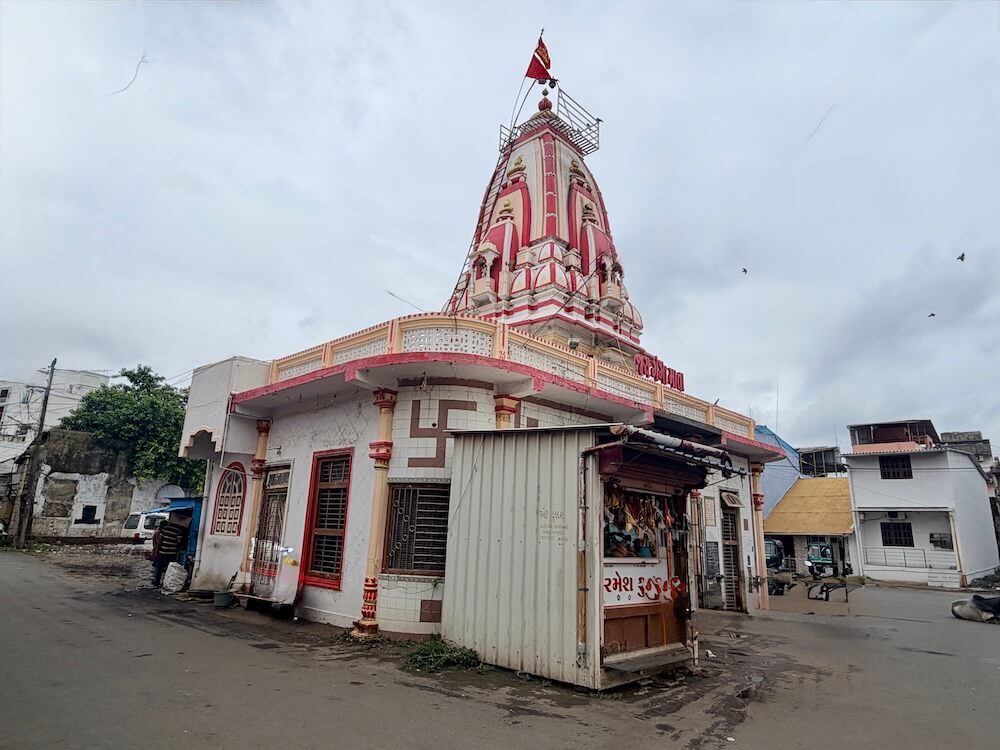 Works such as ‘The Origin of Bombay’ (1900) by historian J. Gerson da Cunha also refer to the ports along India’s western coast and the waterways of Gujarat and North Konkan. The region supported a wide range of maritime trading and seafaring activities. During the late 18th century, the Gaekwad rulers of Baroda State established a naval base here called the Bandar Bilimora Suba Armar, which gave the town considerable strategic importance.
Local tradition holds that this area once had extensive forests of bilva or bael trees. The word Bili is derived from these woods, while Mora referred to the settlement along the seashore, together giving rise to the name Bilimora. Gandevi, the taluka headquarters, 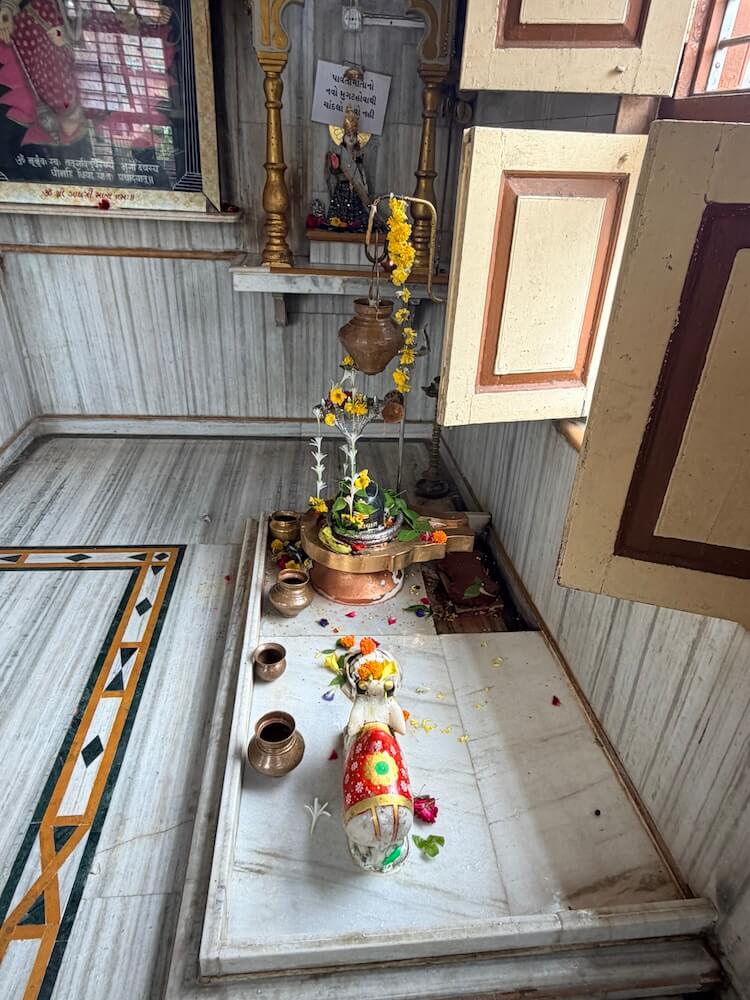 was known in ancient times as Gandhavati or Gandhadevi and 8th-century copper-plate inscriptions from the Chalukya and Rashtrakuta periods record the Navsari region as Navasarika or Nagasarika. For generations, the Ganga Mata Temple has remained an important place of worship for the local Tandel, Kharwa, Koli and trading communities who sail out to sea through the estuary of the Ambika River. Seafarers pray here for blessings before setting out on their voyages and upon returning safely to shore, holding the shrine and its goddess in deep devotion.
Hindu religious tradition and Puranic literature have long venerated water deities and holy rivers as divine mothers. The ‘Skanda Purana’, particularly the ‘Sahyadri Khanda’ and ‘Tapi-Narmada Mahatmya’, along with the ‘Shrimad Devi Bhagavata’ and the ‘Shiva Purana’, describes in detail the descent of the Ganga from heaven to earth and the sanctity of water. According to these texts, Bhagiratha’s intense penance moved the gods to send the celestial river rushing down. Lord Shiva received her mighty flow upon his head and contained the torrent within his matted hair. Answering Bhagiratha’s prayer, Shiva released a single lock, creating a path for the Ganga to descend to earth while preventing her divine force from disturbing the cosmic balance. As the life-giving river that nurtures all creation and washes away sins, Ganga Mata is known as Tripathagamini and Papaharini.
 Bilimora lies at the mouth of the Ambika River where its waters meet the sea and local tradition regards Ganga Mata as an ancient guardian deity who protects the waterway and those who travel upon it. The shrine was established here in her honour. According to the local sthalapurana (temple legend), seafarers from this region once experienced the protective grace of a water deity during a violent storm at sea, after which their vessels reached the shore safely. To preserve the memory of this divine experience and seek the welfare of devotees where the river meets the ocean, the idol of Ganga Mata was ritually installed here in keeping with religious tradition. Because devotees regard the water flowing from a river’s source to its mouth as an embodiment of the Ganga, this shrine on the banks of the Ambika came to be known as the Shri Ganga Mata Temple.
The history of the Ganga Mata Temple in Bilimora is closely linked with the Maratha Empire and the Gaekwad State of Baroda in the 18th century. In the early 1720s, the Peshwas entrusted Senapati Pilajirao Gaekwad with revenue collection and defence in Gujarat. Baroda State subsequently established a major naval centre at Bilimora to guard its maritime frontiers and trading ships against the Portuguese, Dutch and French fleets. Around 50 warships and merchant vessels of the state were stationed at this harbour. According to local tradition, the port’s subhedar, naval officers and prominent members of the Kharwa-Tandel community took the initiative to build the shrine in the latter part of the 18th century, between 1768 and 1800.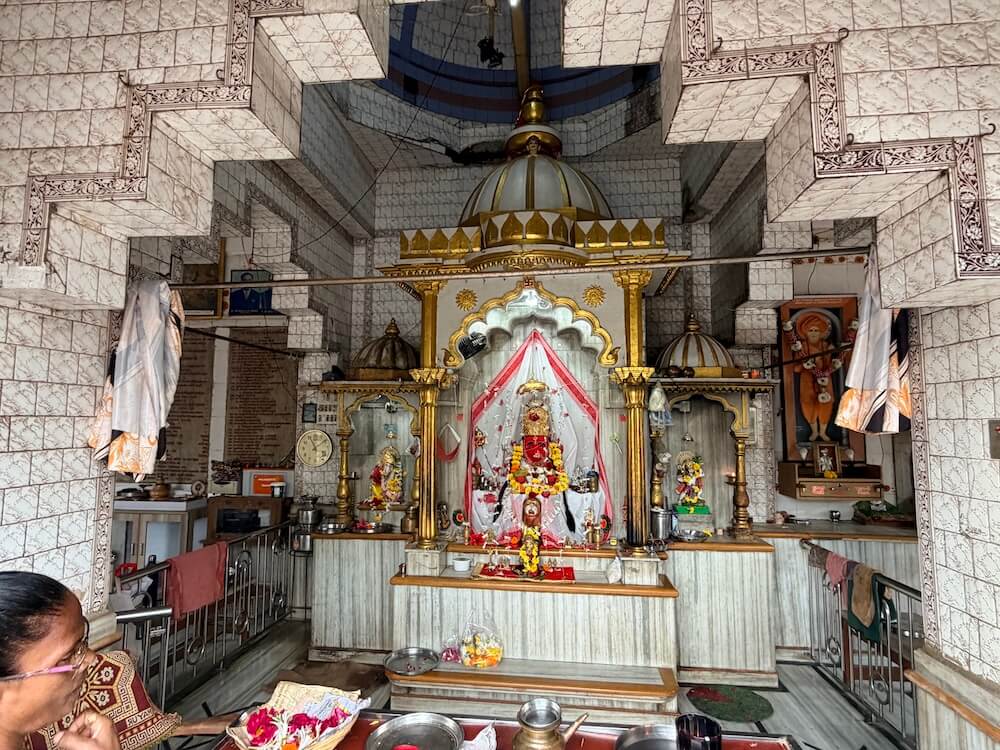 Bilimora and its port later developed considerably during the reign of Maharaj Sayajirao Gaekwad III in the 19th and 20th centuries, when local merchant guilds and devotees supported the restoration of the temple and its surroundings.
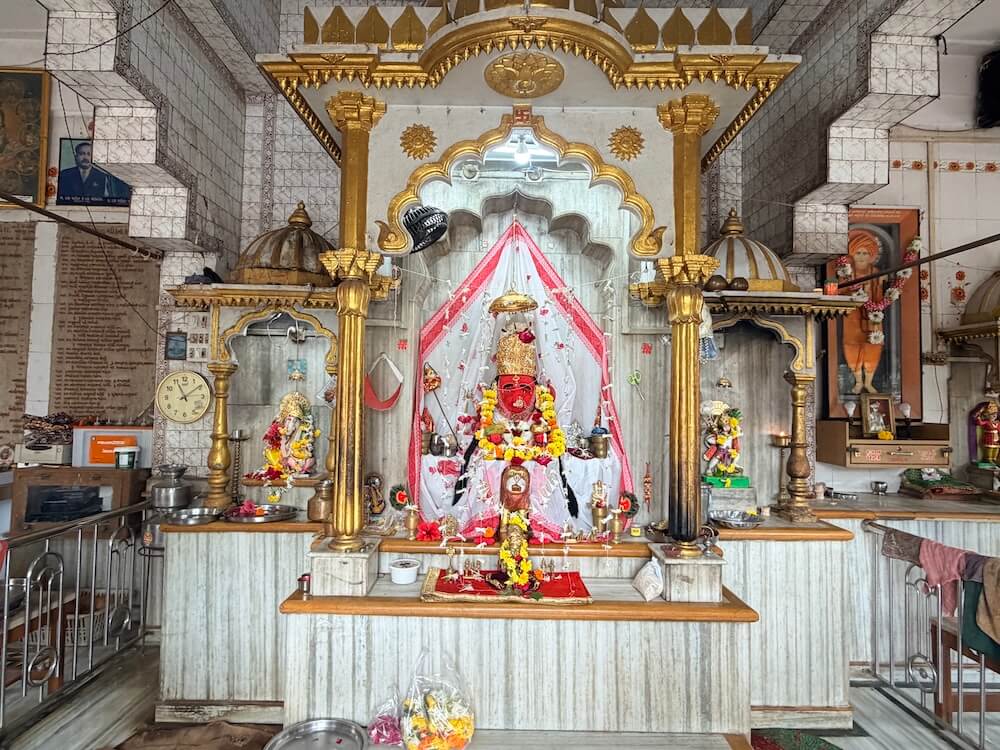
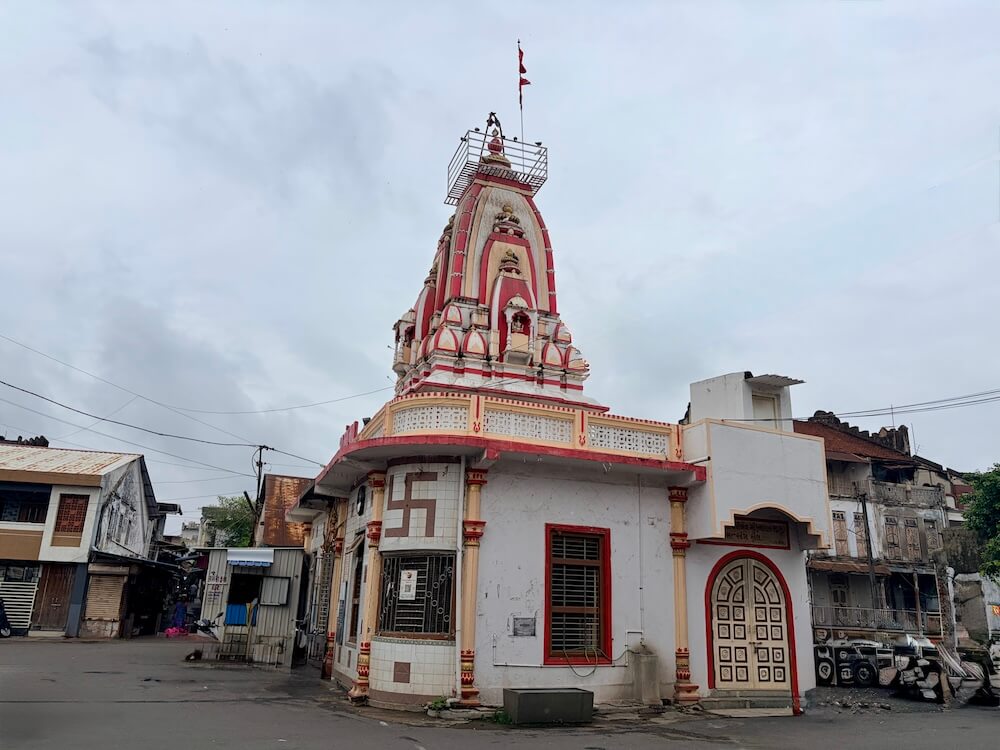
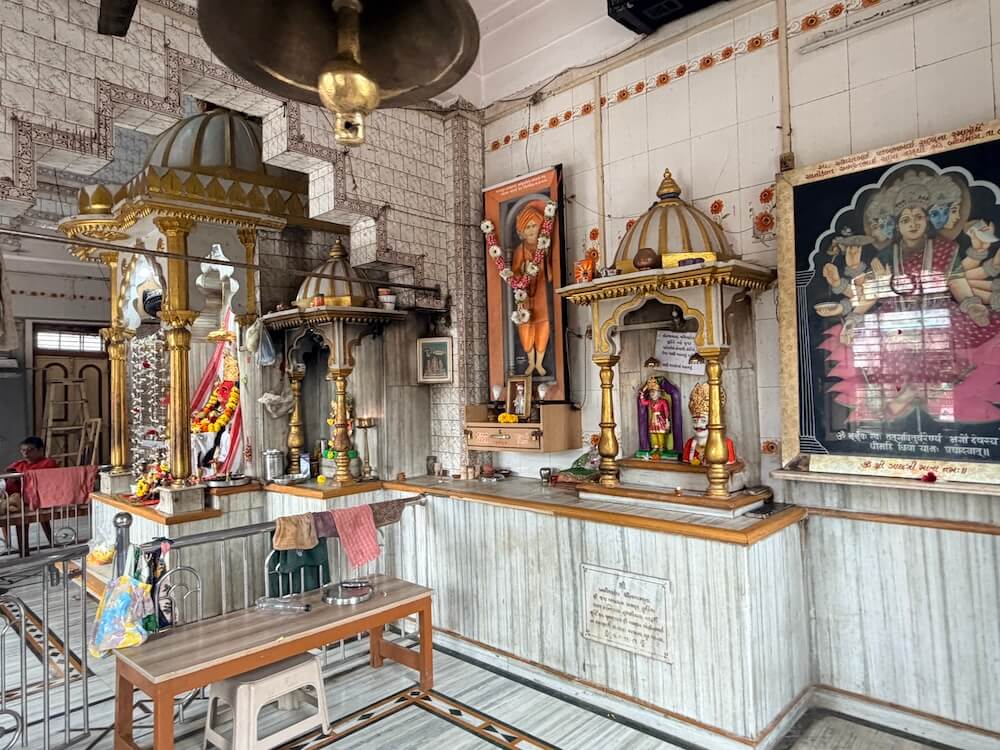
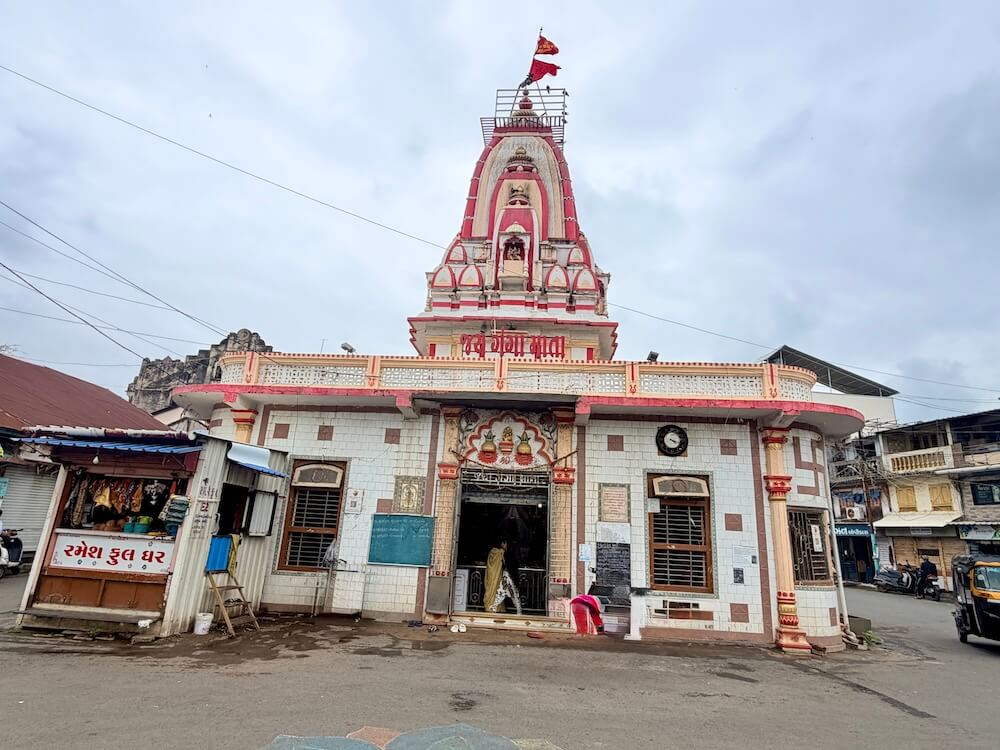
The Ganga Mata Temple stands near the estuary of the Ambika River along Bandar Road and consists of a sabhamandap and a garbhagriha. A carving of Lord Ganesha is set above the northern section of the entrance, flanked by auspicious mangal kalashs on either side. Inside the sabhamandap, a shrine dedicated to Mahadev stands beside the sanctum of Ganga Mata and houses sculptures of Nandi and a kurma (tortoise), along with a shivpind. Within the garbhagriha, a vermilion-covered stone idol of the goddess sits upon a vajrapith (raised stone pedestal) inside a finely decorated makhar (decorative frame). 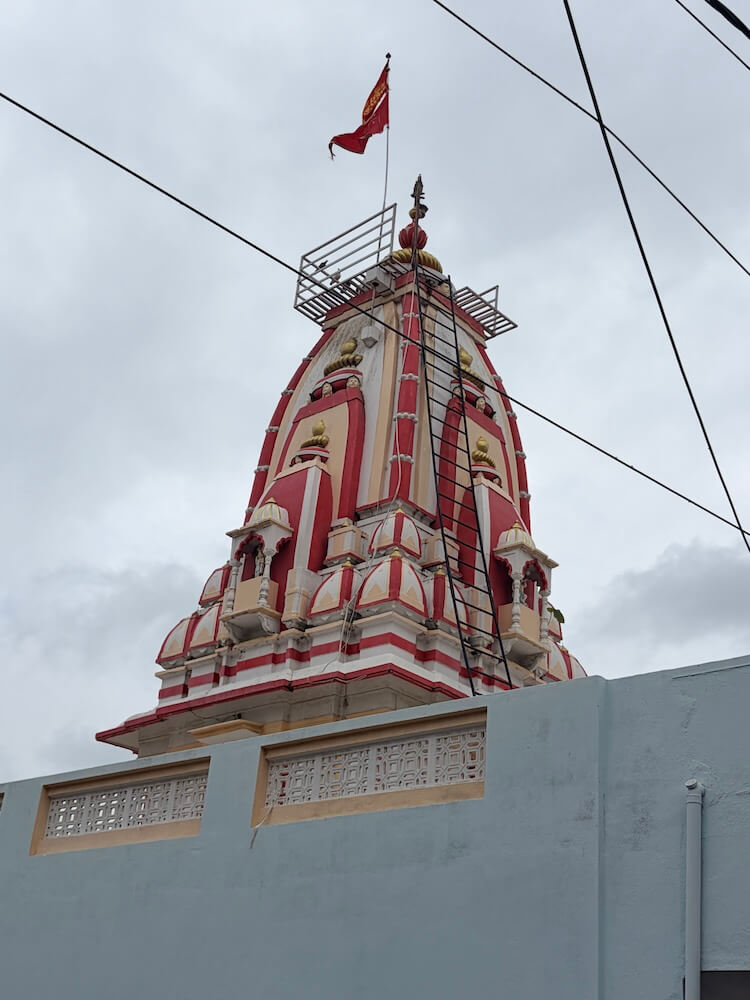 Smaller makhars on either side of the main deity contain murtis of Veer Maruti and Ganesha. Above the structure rises a square shikhar that tapers gradually towards the top, its surface decorated with miniature replicas of the spire.
In Bilimora, Ganga Mata is worshipped as a village deity and the shrine continues the traditional daily puja and naivedya offerings followed by devotees for generations. The temple remains open for darshan every day from 6 am to 12 pm and from 5 pm to 7.30 pm. Morning worship includes the Shringar Aarti at 7 am, while devotees gather at 7 pm for the evening maha aarti accompanied by dhoop-deep rituals and sankirtan. Mondays and Fridays draw particularly large crowds.
The temple celebrates Ganga Dussehra on a grand scale on the tenth day of the bright fortnight of Jyeshtha. The festivities commemorate the descent of the Ganga to earth and include special homa-havan rituals along with the distribution of mahaprasad. Sharadiya Navratri in the month of Ashwin is the shrine’s largest public festival, when hundreds of young men, women and devotees gather in the precincts over nine days for Gujarati garba and raas-garba (traditional folk dances) accompanied by the rhythms of Toor and Timli (traditional folk music). During the month of Shravan, pilgrims undertaking the kavad yatra collect water from the Ambika River and offer it to Mahadev and Ganga Mata. On Narali Purnima, local fishermen and Tandel seafarers perform ritual worship of the goddess before offering coconuts to the sea and praying for safe voyages upon the water.
Useful Information :
- Located 7 km from Gandevi
- Located 28 km from Navsari city
- State Transport buses and private vehicles operate regularly from Gandevi
- Private vehicles can reach the temple parking area
- Accommodation and breakfast facilities are available in the nearby area
- Contact : Natwarlal Mehta, President, Mobile : 9825235787, Pareshbhai Upadhyay, Priest, Mobile : 9428162099
गंगा माता मंदिर बंदर रोड,
बिलिमोरा, ताल। गणदेवी, जिला. नवसारी
मंदिरे
Temples
मंदिर
મંદિરો
கோவில்கள்
దేవాలయాలు
ക്ഷേത്രങ്ങൾ
ದೇವಾಲಯಗಳು
মন্দিরসমূহ
ਮੰਦਿਰ
-
रामजी मंदिर नवसारी, ता./जि. नवसारी
अधिक माहितीRamji Temple Navsari, Tal./Dist. Navsari
View Detailsरामजी मंदिर नवसारी, ताल./जिला. नवसारी
विवरण देखेंRamji Temple Navsari, Tal./Dist. Navsari
વિગત જુઓRamji Temple Navsari, Tal./Dist. Navsari
விவரங்களைக் காண்கRamji Temple Navsari, Tal./Dist. Navsari
వివరాలను చూడండిRamji Temple Navsari, Tal./Dist. Navsari
വിശദാംശങ്ങൾ കാണുകRamji Temple Navsari, Tal./Dist. Navsari
ವಿವರಗಳನ್ನು ವೀಕ್ಷಿಸಿRamji Temple Navsari, Tal./Dist. Navsari
বিস্তারিত দেখুনRamji Temple Navsari, Tal./Dist. Navsari
ਵੇਰਵੇ ਦੇਖੋ -
सोमनाथ महादेव मंदिर बिलीमोरा, ता. गाणदेवी, जि. नवसारी
अधिक माहितीSomnath Mahadev Temple Bilimora, Tal. Gandevi, Dist. Navsari
View Detailsसोमनाथ महादेव मंदिर बिलिमोरा, ताल. गणदेवी, जिला. नवसारी
विवरण देखेंSomnath Mahadev Temple Bilimora, Tal. Gandevi, Dist. Navsari
વિગત જુઓSomnath Mahadev Temple Bilimora, Tal. Gandevi, Dist. Navsari
விவரங்களைக் காண்கSomnath Mahadev Temple Bilimora, Tal. Gandevi, Dist. Navsari
వివరాలను చూడండిSomnath Mahadev Temple Bilimora, Tal. Gandevi, Dist. Navsari
വിശദാംശങ്ങൾ കാണുകSomnath Mahadev Temple Bilimora, Tal. Gandevi, Dist. Navsari
ವಿವರಗಳನ್ನು ವೀಕ್ಷಿಸಿSomnath Mahadev Temple Bilimora, Tal. Gandevi, Dist. Navsari
বিস্তারিত দেখুনSomnath Mahadev Temple Bilimora, Tal. Gandevi, Dist. Navsari
ਵੇਰਵੇ ਦੇਖੋ -
स्वामीनारायण गुरुकुल सांस्कृतिक गौधाम नवगम पाटिया, चंद्रवासन सुपा, जि. नवसारी
अधिक माहितीSwaminarayan Gurukul Cultural Gaudham Navagam Patiya, Chandravasan Supa, Dist. Navsari
View Detailsस्वामीनारायण गुरुकुल सांस्कृतिक गौधाम नवगाम पाटिया, चंद्रवासन सुपा, जिला। नवसारी
विवरण देखेंSwaminarayan Gurukul Cultural Gaudham Navagam Patiya, Chandravasan Supa, Dist. Navsari
વિગત જુઓSwaminarayan Gurukul Cultural Gaudham Navagam Patiya, Chandravasan Supa, Dist. Navsari
விவரங்களைக் காண்கSwaminarayan Gurukul Cultural Gaudham Navagam Patiya, Chandravasan Supa, Dist. Navsari
వివరాలను చూడండిSwaminarayan Gurukul Cultural Gaudham Navagam Patiya, Chandravasan Supa, Dist. Navsari
വിശദാംശങ്ങൾ കാണുകSwaminarayan Gurukul Cultural Gaudham Navagam Patiya, Chandravasan Supa, Dist. Navsari
ವಿವರಗಳನ್ನು ವೀಕ್ಷಿಸಿSwaminarayan Gurukul Cultural Gaudham Navagam Patiya, Chandravasan Supa, Dist. Navsari
বিস্তারিত দেখুনSwaminarayan Gurukul Cultural Gaudham Navagam Patiya, Chandravasan Supa, Dist. Navsari
ਵੇਰਵੇ ਦੇਖੋ