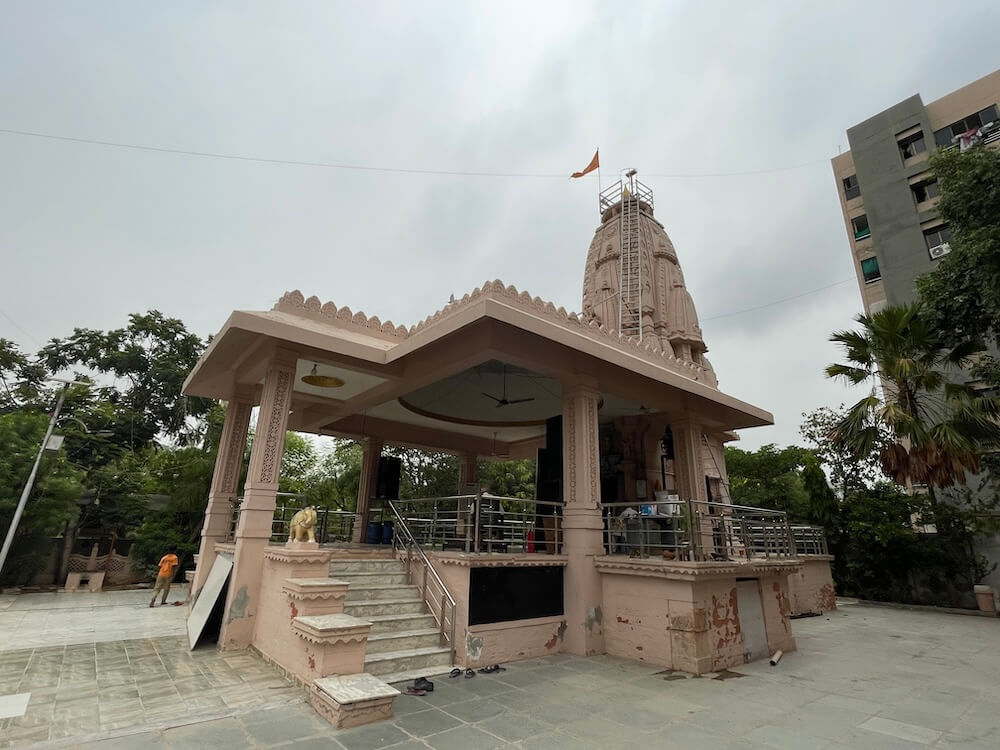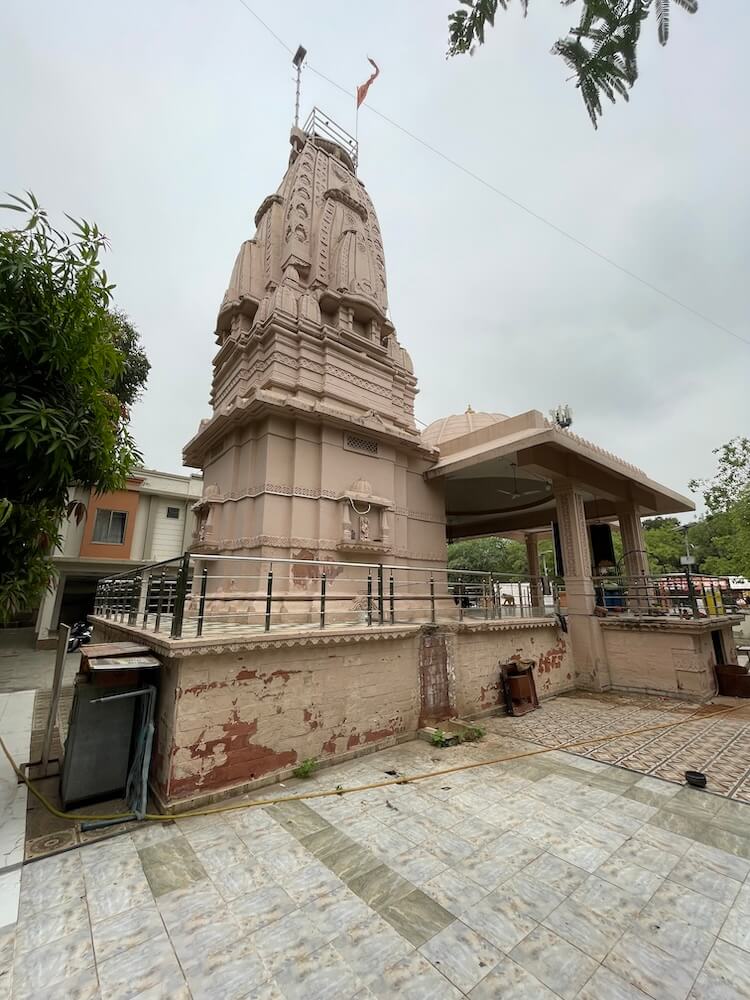
 In the sacred scriptures of Hinduism, three worlds – Swarga (heaven), Prithvi (earth) and Patal (underworld) – are mentioned and the lord who rules over all these three realms is known as Bhuvaneshwar. The temple dedicated to this form of Shiva, bearing the same name, stands serenely in Sector 6 of Gandhinagar and was constructed nearly five decades ago. The architectural beauty of this temple lies in its fusion of Indian and European styles. Devotees from the city flock here, especially on Mondays and during the auspicious occasion of Maha Shivaratri, to offer belpatra (bilva leaves) and perform abhishek on the sacred Shivling, chanting ‘Har Har Mahadev’ in collective devotion.
Gandhinagar, named in memory of Mahatma Gandhi, is considered India’s most well‑planned city after Chandigarh. This capital of Gujarat, situated on the banks of the Sabarmati River, is also known as the ‘Green City’. Among its many temples, the beautiful architecture of the Bhuvaneshwar Mahadev Temple was realized through the initiative of the Bhuvaneshwari Peeth, based in Gondal of Rajkot district. Gondal was once a princely state of the Kathiawad region. In 1634, Thakur Kumbhoji I Mermanji of the Jadeja dynasty established that state. During the reign of Gondal’s King Bhojrajsinh Bhagwatsinh, in 1946, Jagadguru Acharyashri Chandratirth Maharaj founded a temple and Peeth dedicated to Goddess Bhuvaneshwari there. 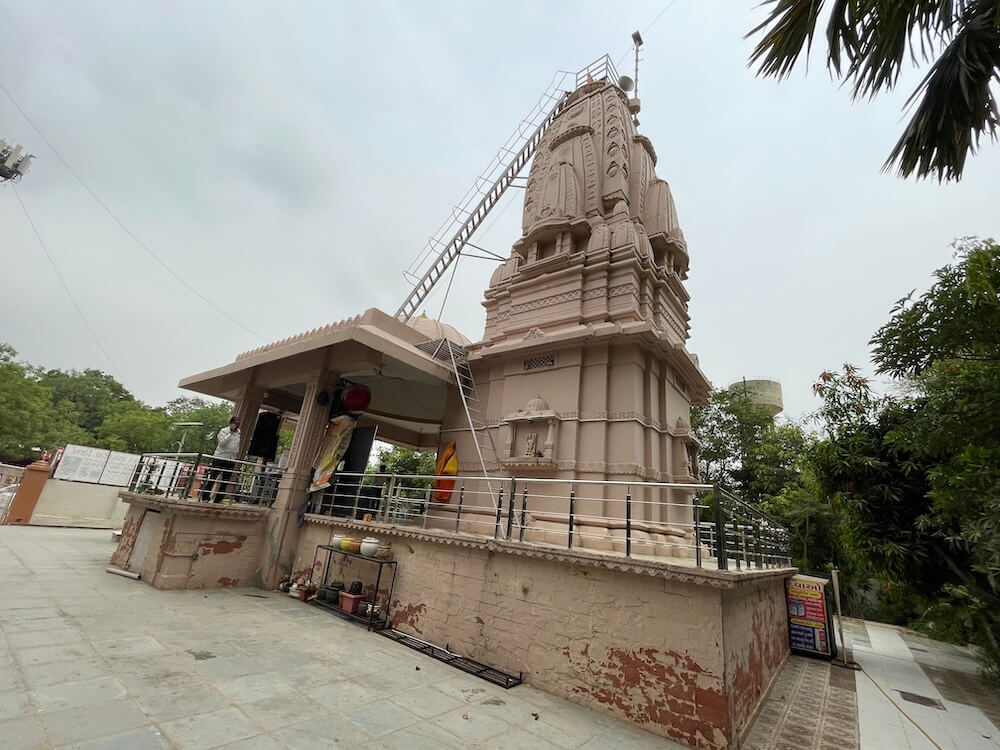 Inspired by Dr. Ravidarshan, who serves as the Peeth’s president, the Shiv temple in Gandhinagar was subsequently constructed in 2000.
Tucked beside the CPWD colony in a peaceful corner of Sector 6, this temple is surrounded by a boundary wall. Adjacent to it is a two-storied guesthouse also built by the Bhuvaneshwari Peeth. The temple’s office is located on the ground floor of this guesthouse, which also provides Ayurvedic medicines at affordable rates. In the temple’s paved courtyard, to the left, there is a smaller Shiva shrine. The main Bhuvaneshwar Mahadev temple is constructed using sandstone and is built in the Nagara architectural style, consisting of an open sabhamandap, an antaral (intermediate chamber) and the garbhagriha (sanctum sanctorum). 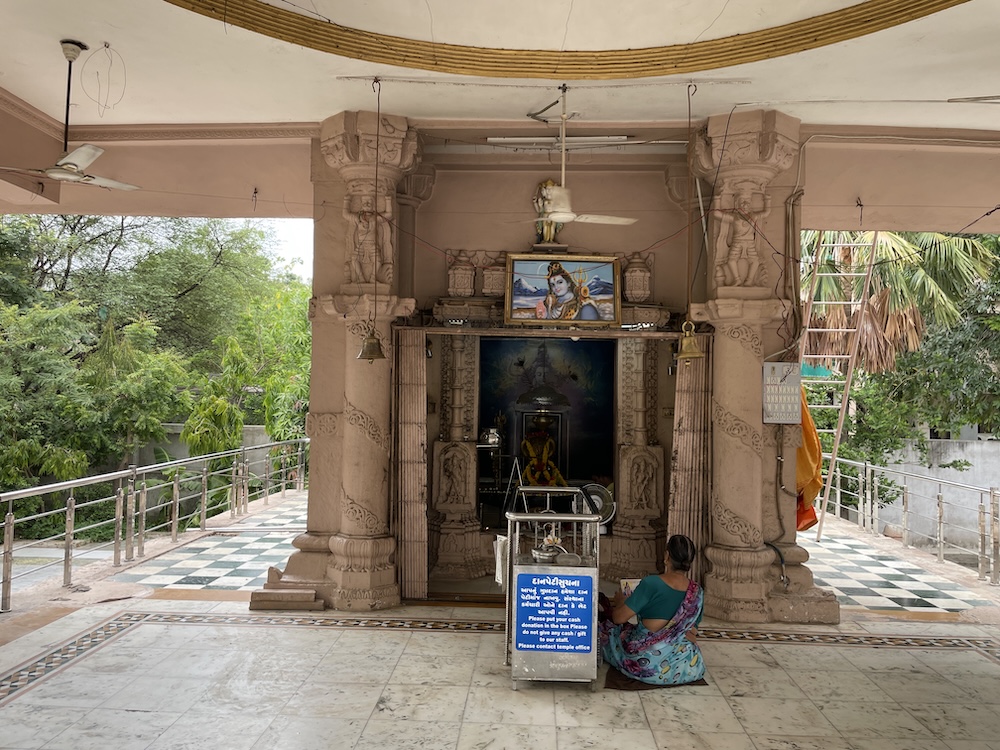 The sabhamandap has a domed spire while the garbhagriha features a towering urushringa-style shikhara. On the outer walls of the temple, niches house various deities sculpted in stone.
To reach this elevated shrine, devotees must climb a set of steps flanked on both sides by majestic elephants carved in stone. The temple’s design harmonizes traditional Indian craftsmanship with European stylistic touches. Around 25 detailed sculptures adorn the temple, including kichaka figures carved atop the columns at the entrance to the antaral. The doorframe of the garbhagriha and its supporting pillars are adorned with exquisite carvings. Below the pillars are stone sculptures of Shaiva gatekeepers, while above the doorway, a stunning image of Shiva is carved. 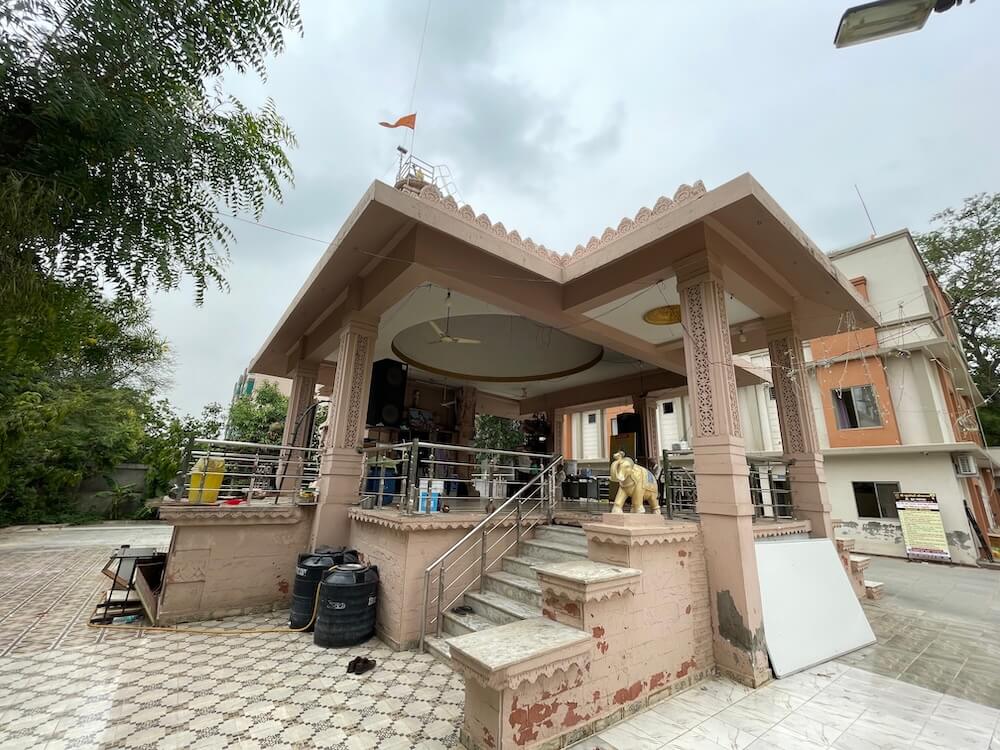 At the very top, a beautiful sculpture of Chaturbhuja Panchanan Shankar – the five-faced Lord Shiva – is displayed. Each of the five faces represents one of the Panchamahabhutas (five great elements) which are earth, water, fire, air and space and simultaneously, the five cardinal directions – east, west, north, south and center.
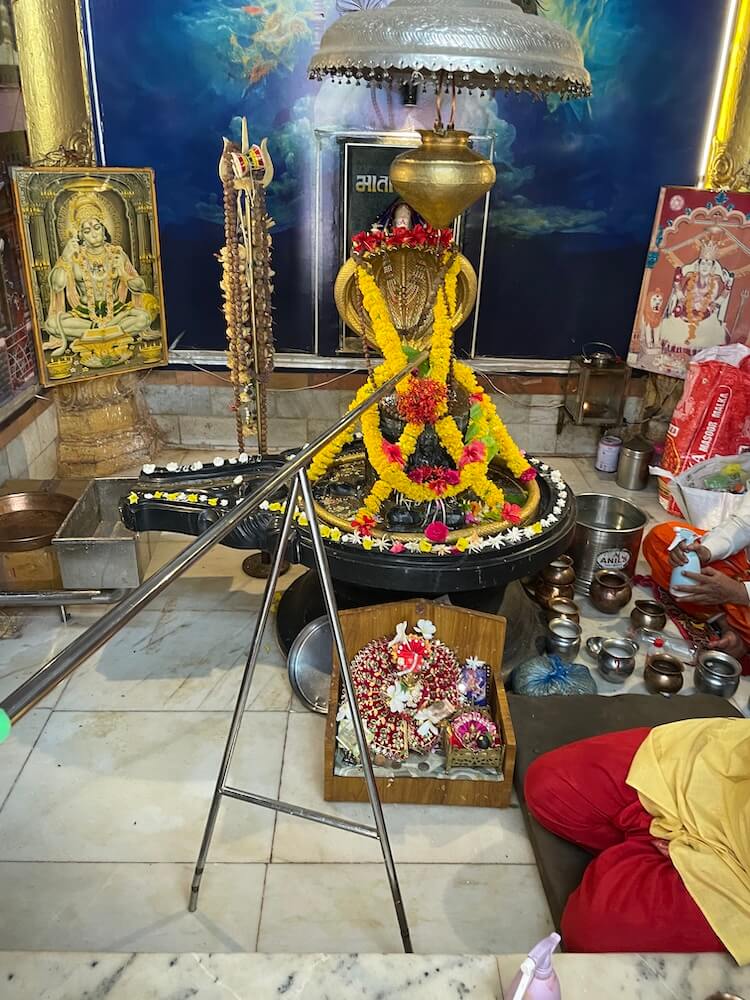
Inside the sanctum, at the heart of a grand, circular platform rests a majestic lingam carved from black marble. Above it, an intricately sculpted image of Jatadhari Shiva (Shiva with matted locks) wearing a serpent garland adorns the surface. A canopy formed by a coiled serpent shelters the lingam, while a bronze abhishek patra suspended from above ensures a continuous flow of water upon it. A silver umbrella crowns the top of the lingam, with a trident placed on its left side. In the niches on either side of the inner sanctum’s walls are the serene idols of Goddess Ganga on the left and Goddess Yamuna on the right. Behind the lingam, a niche houses the image of Goddess Parvati.
Daily worship and aarti are performed at the temple. On Mondays, a significant number of devotees from Gandhinagar visit to offer belpatra, water or milk to the sacred Shiva lingam. The holy month of Shravan sees a spike in devotional activities, with religious events organized every Monday. Maha Shivaratri is the most celebrated festival here, marked by rituals throughout the day including the performance of Laghu Rudra. The grand maha aarti held in the evening draws in large gatherings of devotees.
Bhuvaneshwar Mahadev Temple Sector 6, Gandhinagar, Tal./Dist. Gandhinagar