
Annapurna Dham
Adalaj, Tal. Gandhinagar, Dist. Gandhinagar
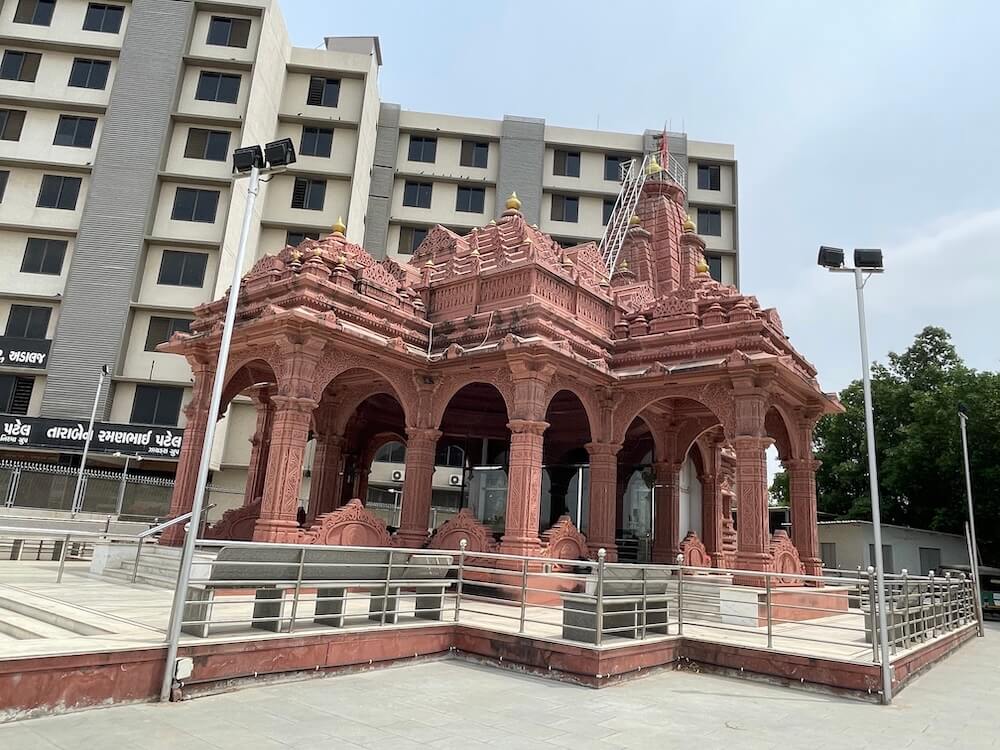
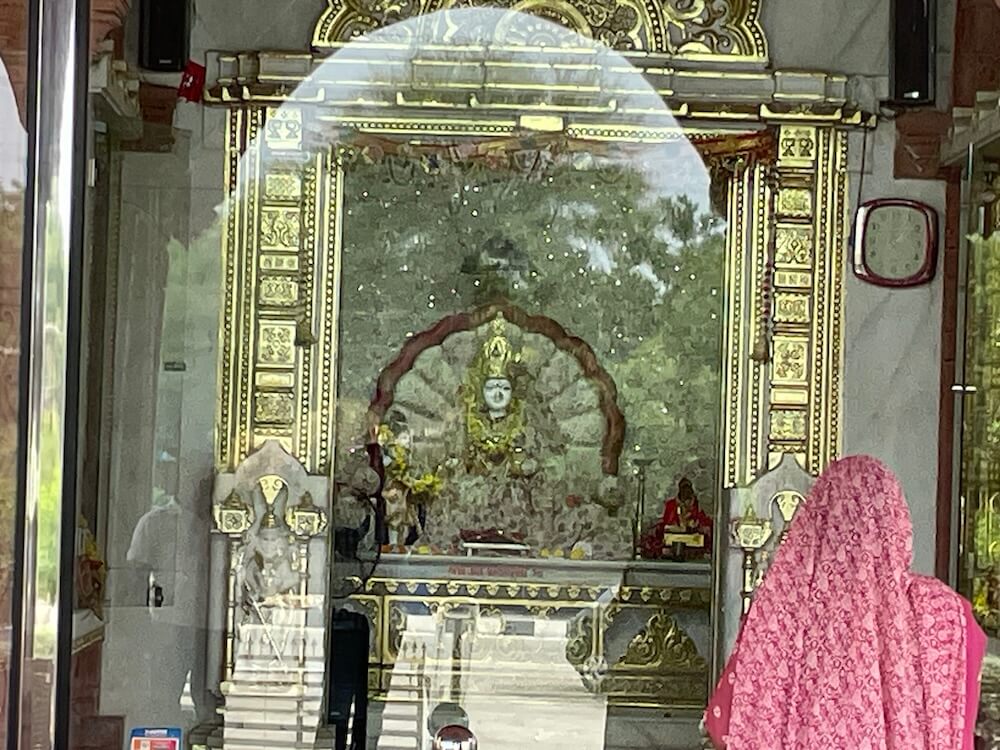 The goddess Annapurna, who nourishes the entire creation, is the revered deity of the influential Leuva Patidar community of Gujarat. The temple dedicated to her at Adalaj, built in the Nagar architectural style, is a spiritual center not only for the Leuva Patidars but also for hundreds of devotees from other communities. One notable aspect of this temple is that it’s not just a place for rituals and worship, it also serves as a center for daily nourishment. The temple’s trust operates the Annapurna Bhojanalay (community kitchen), where hundreds of people are served unlimited wholesome meals daily for a nominal cost.
Annapurna Devi is believed to be an incarnation of Gauri, the goddess of material prosperity. In the Markandeya Purana authored by Sage Ved Vyasa, Parvati is referred to as Annapurna.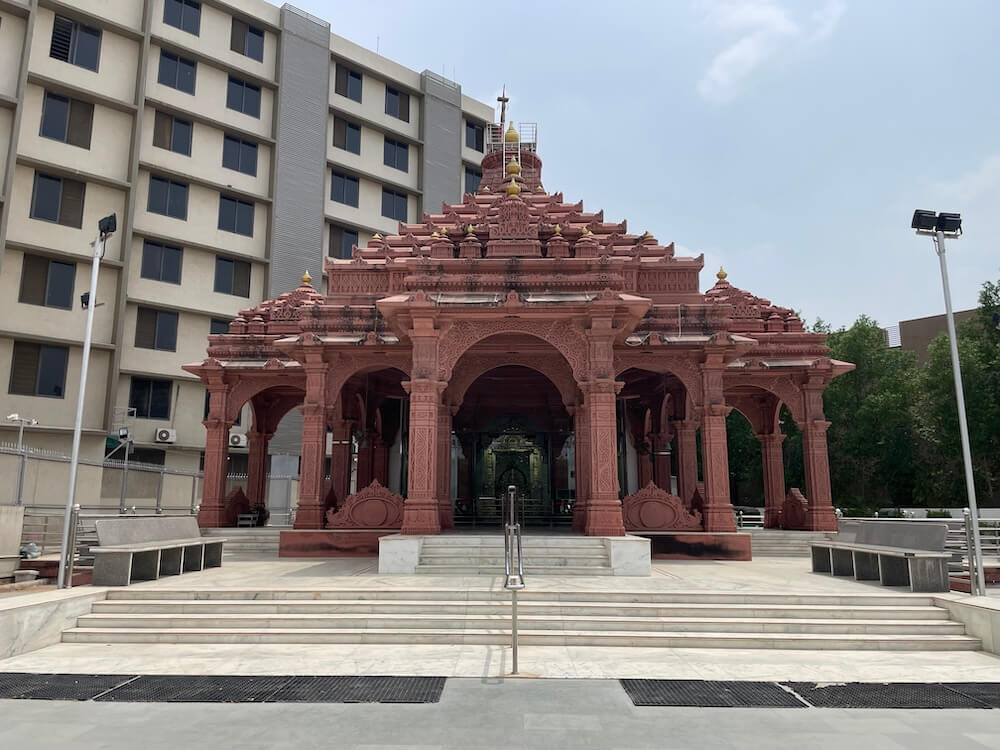 Devotees believe that this goddess blesses her followers with food, wealth and familial happiness. Annapurna is especially venerated among the Leuva Patidar community in Gujarat. The term Patidar is said to be derive from ‘Pat’, meaning agricultural land and refers to those who hold such lands. Some scholars trace the roots of the Patidar community to Lava and Kusha, the sons of Lord Rama. Lava’s capital was in present-day Lahore and the community descending from there came to be known as Leuva Patidar. Kusha’s capital was Kushawarta, now known as Patna and his descendants were known as Kadva Patidar.
About 2,400 years ago, the first group of Leuva Patidars migrated via the Panchanad route (Yamuna, Chambal, Sindh, Pahuj and Kunwari rivers) first to Saurashtra and then to Adalaj. Later, many more arrived from Ajmer, Marwar and Jaipur via Patan. 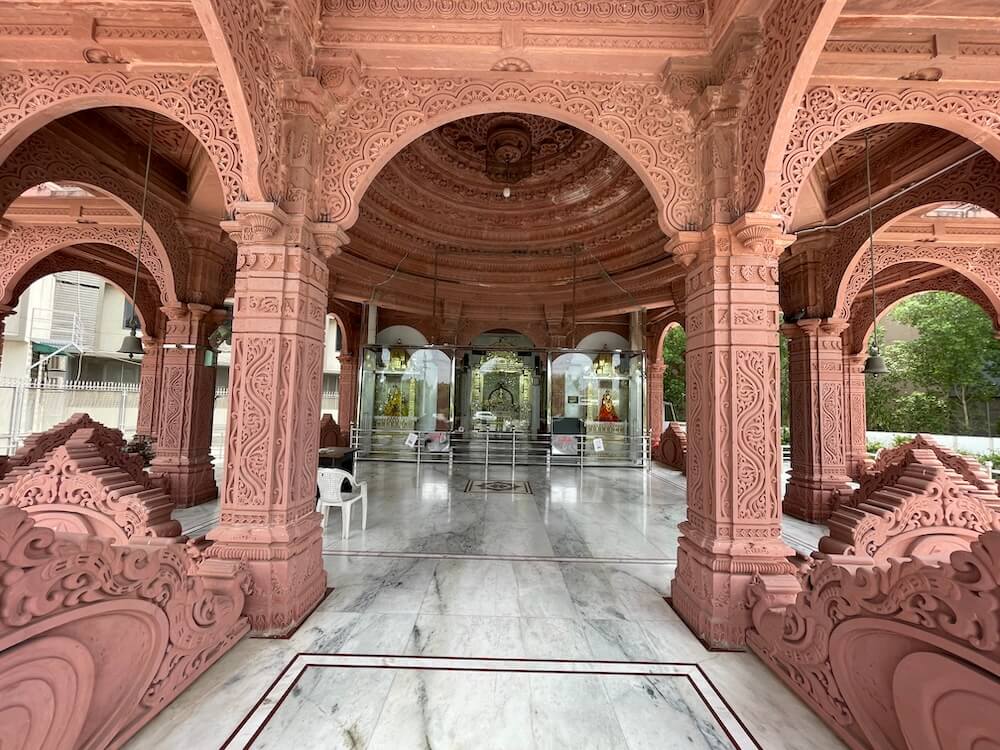 Historians believe that this group brought with them a golden idol of Annapurna Devi, which was placed in a niche of a stepwell at Adalaj. The idea of constructing a grand temple for their revered deity arose in the minds of some distinguished members of the community, leading to the construction of this temple at a cost of around ₹50 crore.
The Swaminarayan Trust of Adalaj donated land worth approximately ₹15 crore for just ₹1 as a symbolic token. The foundation ceremony for the temple structure was conducted on 28th May 2015 by Gujarat’s then-Chief Minister Anandiben Patel, with an eternal flame brought from Saurashtra. Upon the temple’s completion, Prime Minister Narendra Modi performed the consecration of the idols in 2019.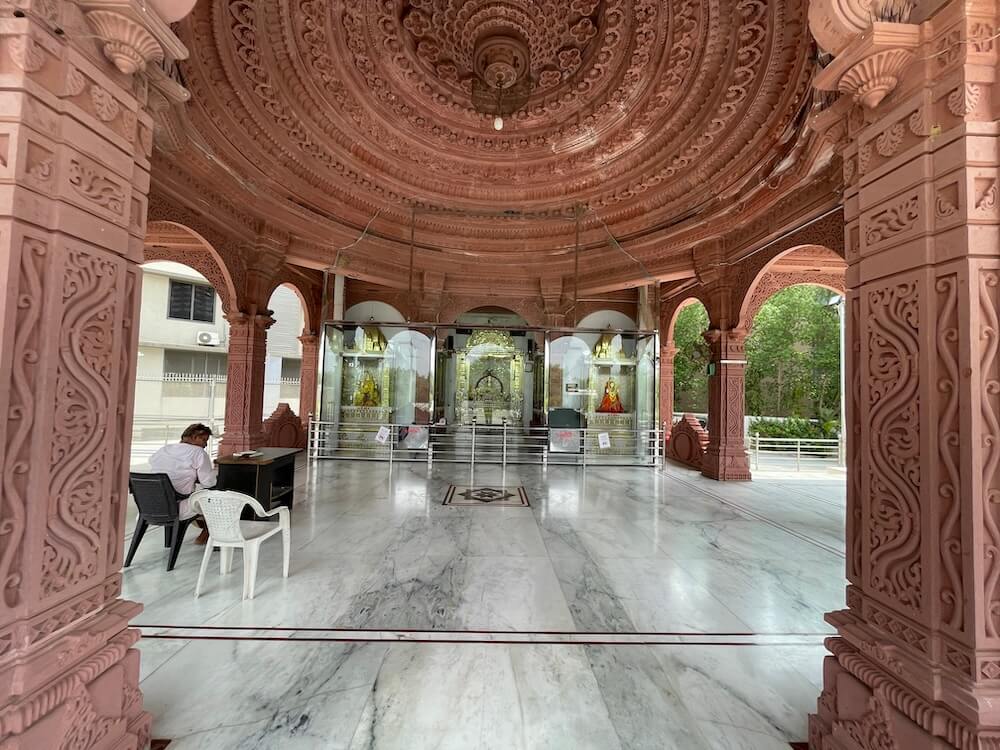
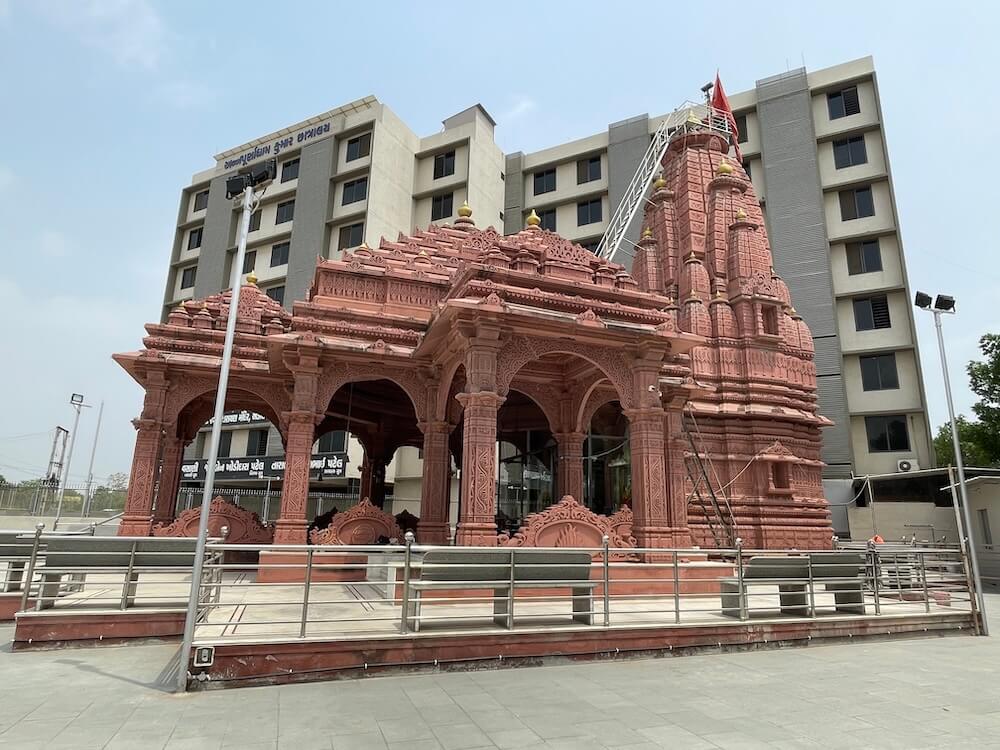
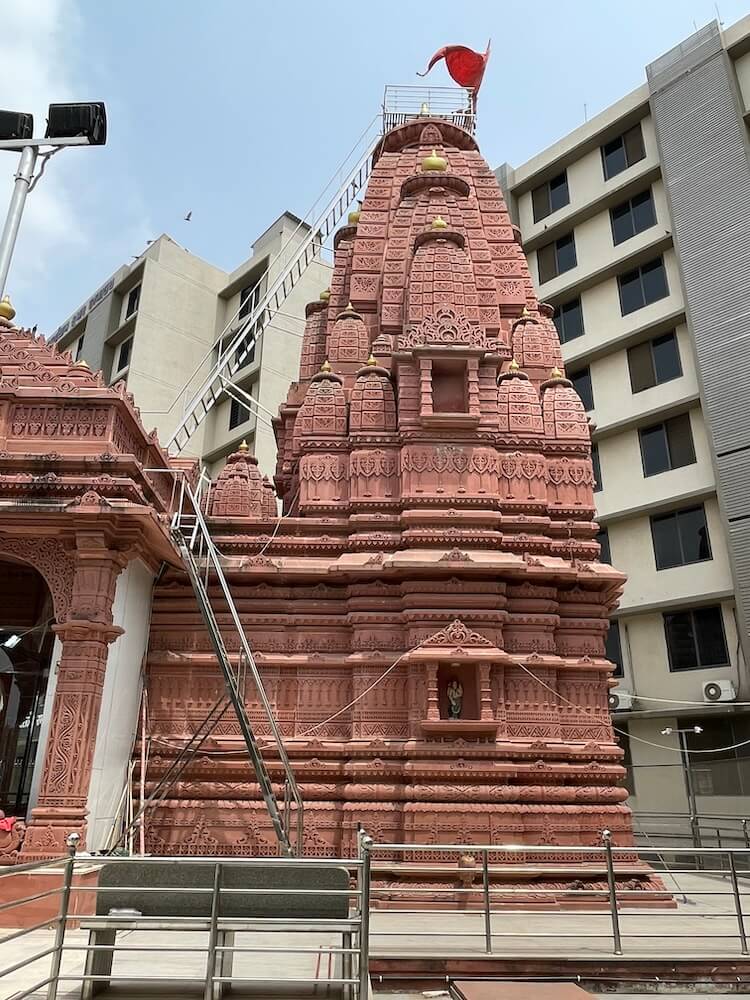
Located on the Adalaj-Koba Road, the temple stands in a spacious campus and is built using Rajasthani sandstone in the Nagar architectural style. The temple features a mukhmandap (entrance hall), sabhamandap (assembly hall), antaral (antechamber) and garbhagriha (sanctum sanctorum). The sabhamandap ceiling features decorative kalash pillars with a pyramid-shaped shikhara above. The garbhagriha is crowned with a tall Urushringa style shikhara typical of Nagar style, topped with a double-layered amalaka and a tall finial (kalash). The temple’s walls, pillars and ceilings display intricate carvings and its exterior features niches with idols of various deities.
Built on an elevated platform, the temple is accessed via eight steps. Inside the sabhamandap, Amba Mata’s idol is on the left and Khodiyar Mata’s on the right.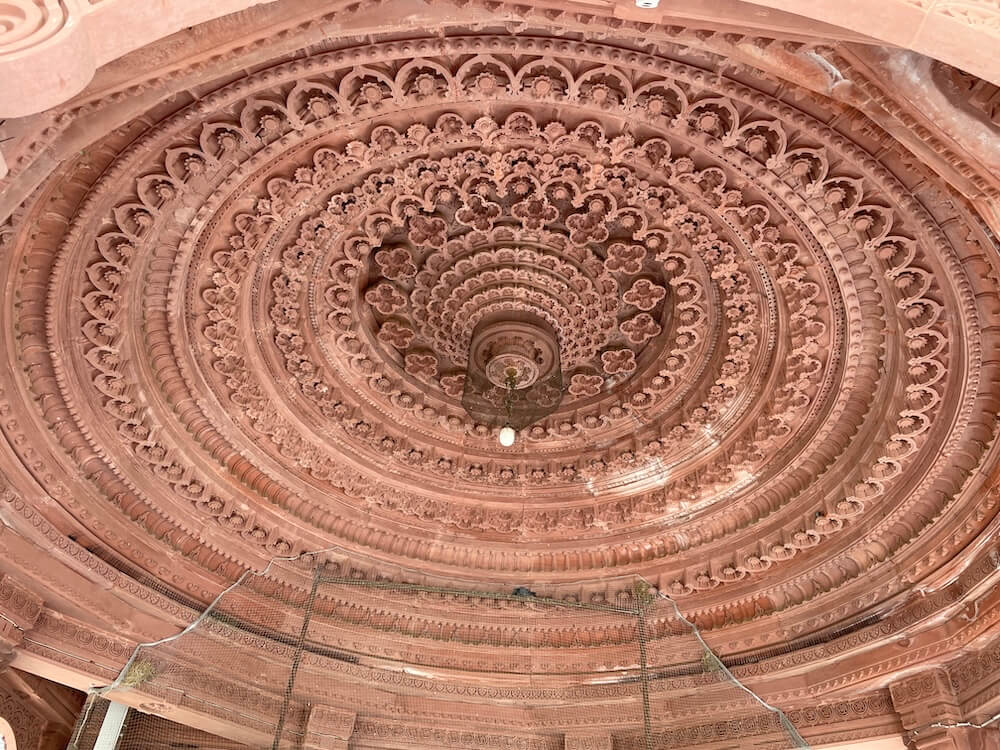 The antechamber houses idols of Hanuman and Ganesha. At the entrance to the ornately carved sanctum are two doorkeepers. The sanctum houses a serene marble idol of Annapurna Devi seated in the lotus posture. Adorned with a golden crown and ornaments, she holds a ladle in her right hand and a kamandalu in her left. The sanctum also features a standing Shiva idol to the right of Annapurna Devi.
Devotees from various parts of Gujarat, not just Adalaj, visit this temple. Sundays and Tuesdays witness large gatherings. The Annapurna Dham Trust organizes religious events throughout the year. The temple’s anniversary is celebrated on Maha Shivratri, with rituals like hom-havan, bhajans and kirtans, followed by mass mahaprasad. From Margashirsha Shukla Shashti to Margashirsha Krishna Ekadashi, 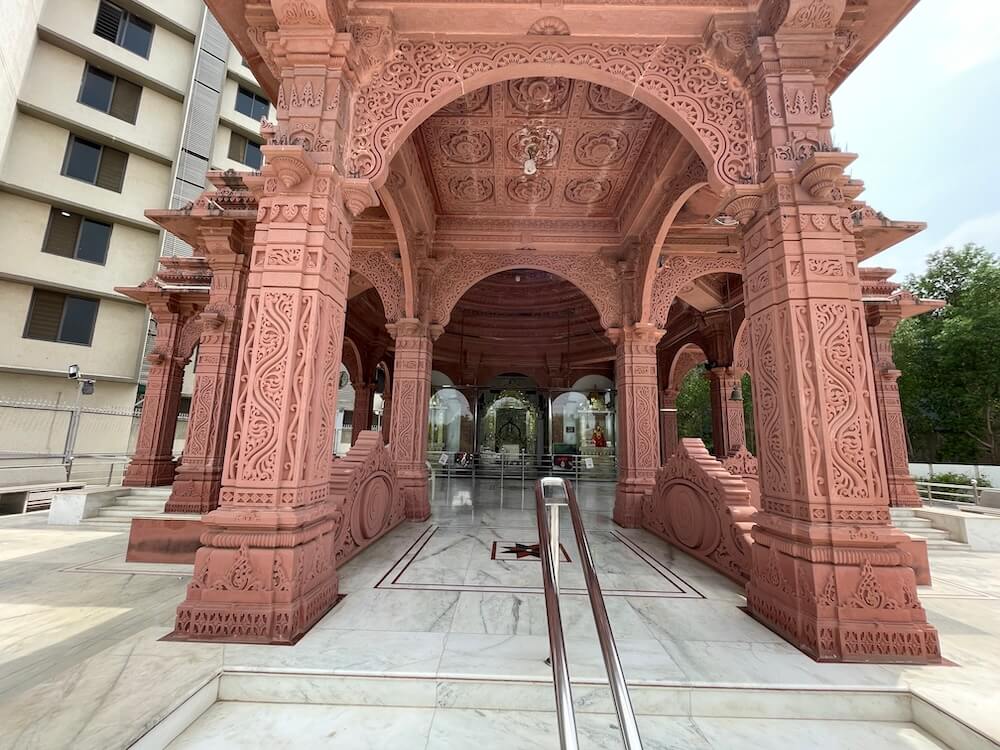 many women observe fasts here, receiving rice as prasadam on the final day. Behind the temple lies the Sharadamani Community Center and nearby, the trust has built a hostel for students, offering accommodation and food for 600 students across 150 rooms. The facility also includes a training center for competitive exams, an e-library, a conference room, a sports room, a TV room and basic health amenities.
The Annapurna Bhojanalay is operated by the temple trustees in collaboration with the Swaminarayan Trust. Here, a wholesome lunch including roti, sabzi, buttermilk, dal and rice is served for just ₹20 – and it’s unlimited. In the evenings after 5 PM, Royal Khichdi and Amul buttermilk are served for just ₹5 each. Approximately 600 people benefit from the meals in the morning and over 500 in the evening.
Key Features :
- Located Only 11 km from Gandhinagar
- Public transport available from Gandhinagar
- Private vehicles can reach up to the temple parking
- Accommodation and breakfast facilities available in the area
- Temple Location: https://maps.app.goo.gl/edjLM7wxWyJ257Sd7
मंदिरे
Temples
मंदिर
-
भुवनेश्वर महादेव मंदिर सेक्टर 6, गांधीनगर, ता./जि. गांधीनगर
अधिक माहितीBhuvaneshwar Mahadev Temple Sector 6, Gandhinagar, Tal./Dist. Gandhinagar
View DetailsBhuvaneshwar Mahadev Temple Sector 6, Gandhinagar, Tal./Dist. Gandhinagar
विवरण देखें -
लिंबज माता मंदिर रायसेन, ता. / जिल्हा गांधीनगर
अधिक माहितीLimbaj Mata Temple Raysan, Tal. / Dist. Gandhinagar
View Detailsलिम्बज माता मंदिर रायसेन, ता. / जिला गांधीनगर
विवरण देखें -
गायत्री शक्तीपीठ सेक्टर 1, गांधीनगर, ता./जि. गांधीनगर
अधिक माहितीGayatri Shaktipeeth Sector 1, Gandhinagar, Tal./Dist. Gandhinagar
View Detailsगायत्री शक्तिपीठ सेक्टर 1, गांधीनगर, ताल./जिला. गांधीनगर
विवरण देखें