
अंबा माता मंदिर
उमरगाव, ता. उमरगाम, जि. वलसाड
Amba Mata Temple
Umargam, Tal. Umargam, Dist. Valsad
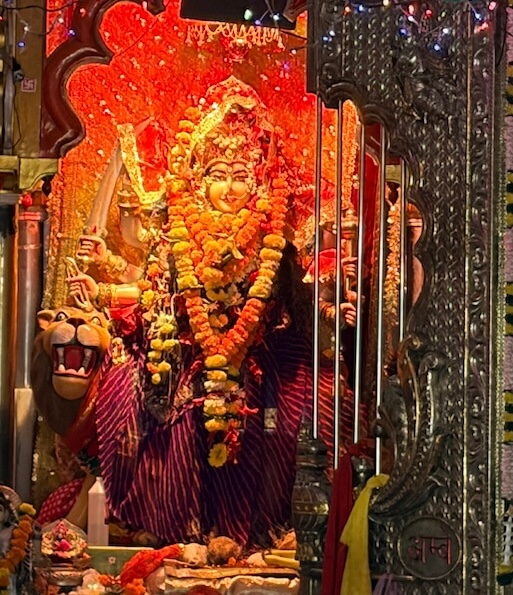 The state of Gujarat is traditionally regarded as a paramount centre of Shakta worship. Numerous shrines dedicated to Mother Amba adorn this province. Out of the fifty-one sacred Shakti Peethas distributed across the length and breadth of India, four are located within Gujarat. Among these, the Ambaji Temple situated in Banaskantha is revered as the most pre-eminent Shakti Peetha. It is a traditional belief that the heart of Goddess Sati descended upon this holy spot. In this unique idol-less temple, the sacred Shri Yantra is worshipped as the divine manifestation. Furthermore, Pavagadh near Champaner, Bahucharaji in Mehsana and Koteshwar in Kutch constitute the other principal Shakti Peethas of Gujarat. Serving as an integral part of this enduring Shakta heritage, the Amba Mata Temple at Umargam stands as a monumental centre of faith for the local populace.
According to sacred scriptures, Mother Amba is revered as the primordial cosmic energy of the universe. Ancient Hindu literature, most notably the ‘Markandeya Purana’ and specifically its renowned section titled the ‘Devi Mahatmya’, provides comprehensive chronicles of the Goddess. 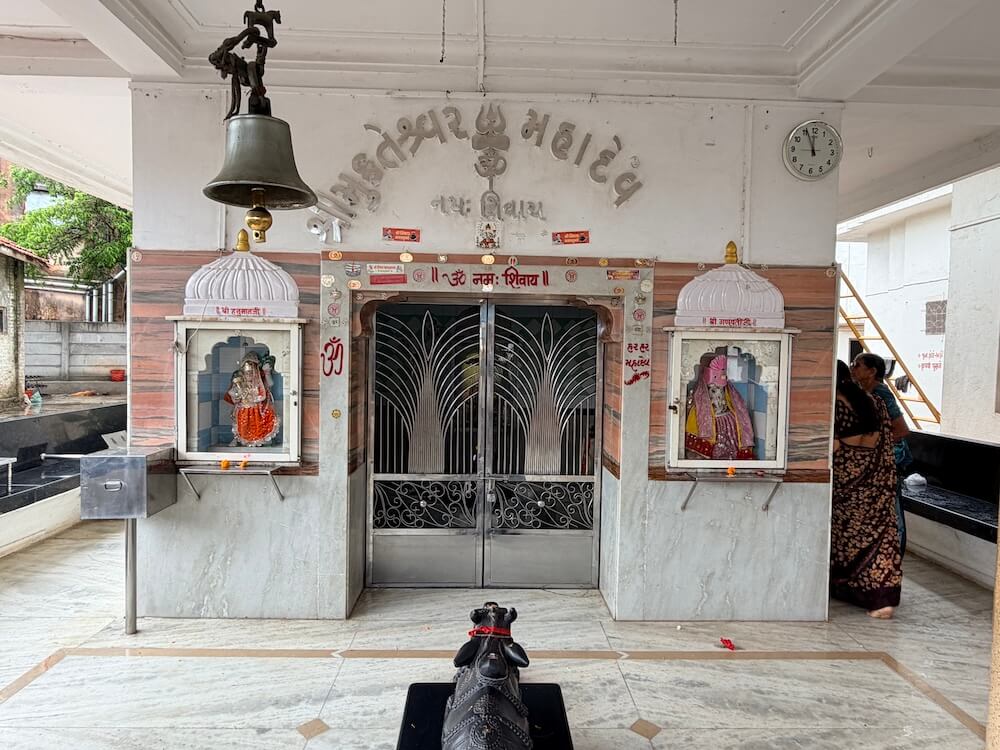 As recorded in these scriptures, a demon named Mahishasura had severely tormented all the celestial deities after securing the boon of immortality. Through rigorous penance directed towards Lord Brahma, he had obtained a stipulation that no man, god, or beast in the world could bring about his demise. Empowered by this boon, he deemed himself completely immortal, subsequently capturing the celestial realm and expelling the deities from heaven. Driven by his colossal might, it became virtually impossible for anyone to vanquish him.
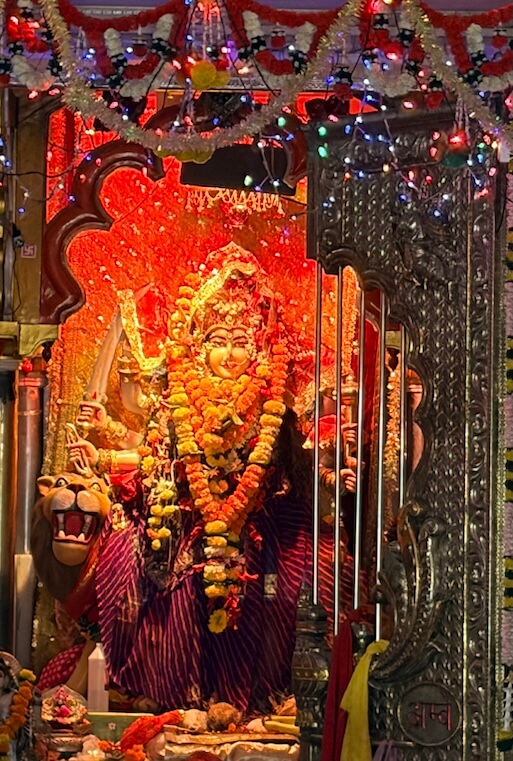
Per the precise conditions of the boon, Mahishasura could only meet his end at the hands of a woman. Consequently, the deities convened to deliberate, thereafter approaching Lord Shiva and Lord Vishnu for recourse.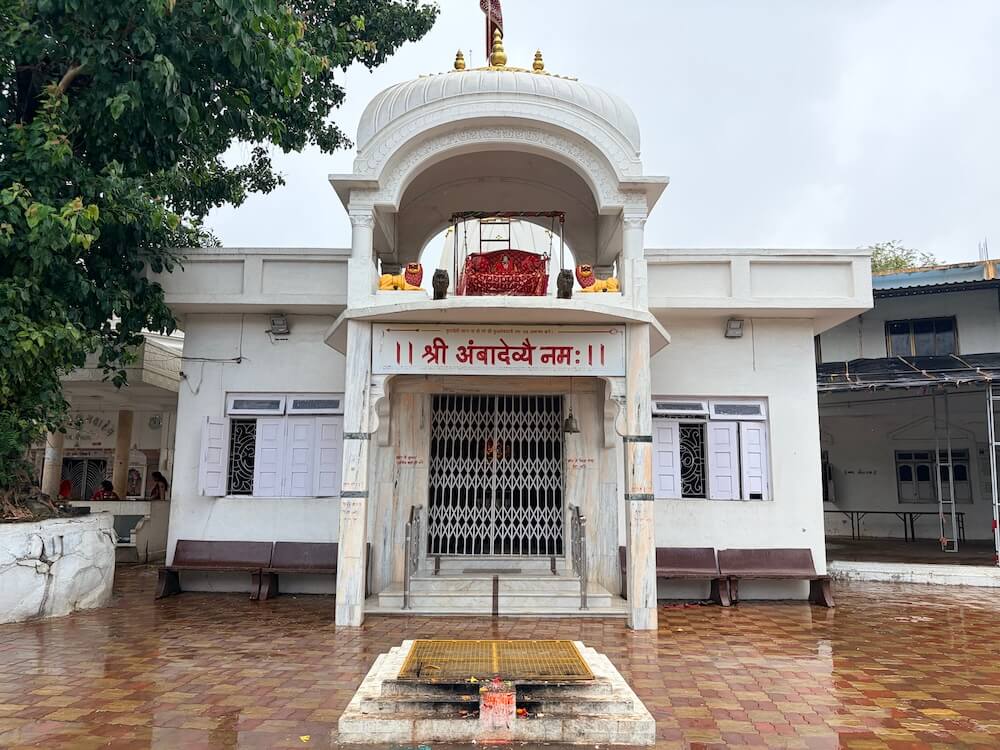 All the celestial beings then implored Mother Parvati to liberate them from the tyrannical oppression of the demon. To resolve this profound crisis, the divine energies of Brahma, Vishnu and Mahesh, along with the brilliant effulgence of all the other deities, coalesced into a singular form, each offering their distinct power to the Goddess. From this unified celestial radiance emerged Mother Amba. Her manifestation was exceptionally potent and resplendent. At that moment, the deities bestowed various mystical weapons upon her and the Himalayas presented a lion to serve as her celestial vehicle. Lord Shiva offered his trident, Lord Vishnu his discus, Lord Varuna his conch shell and the remaining deities surrendered their principal armaments. The Goddess wielded these formidable weapons—including the trident, sword, discus, noose and bow and arrow—within her eighteen hands.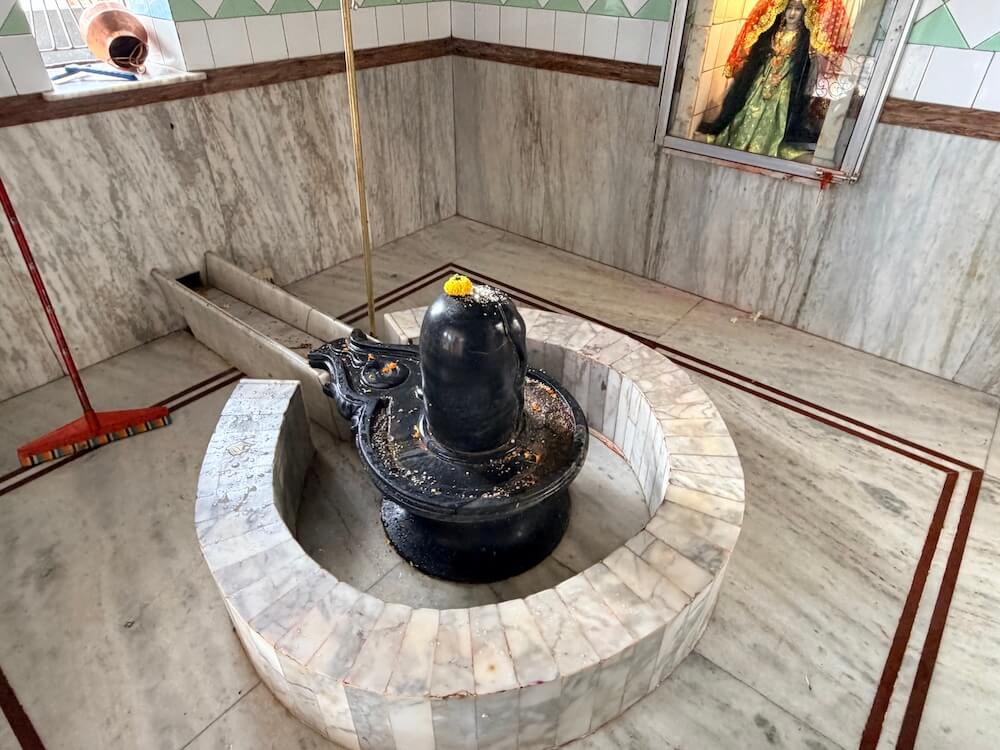
Equipped with this divine arsenal, she commenced the systematic destruction of Mahishasura’s forces. The Goddess engaged in a fierce and cataclysmic battle with Mahishasura for ten consecutive days. Ultimately, on the tenth day, the demon was slain. By virtue of this spectacular triumph, the Goddess earned the epithet ‘Mahishasuramardini’ (the slayer of Mahishasura). This day became universally symbolised as the victory of righteousness over evil and is traditionally celebrated as Vijayadashami or Dussehra. Owing to her maternal protection over the entire creation and her devotees during times of peril, she is affectionately addressed as Amba, meaning Mother.
This sanctuary, located at Umargam, is of recent construction. 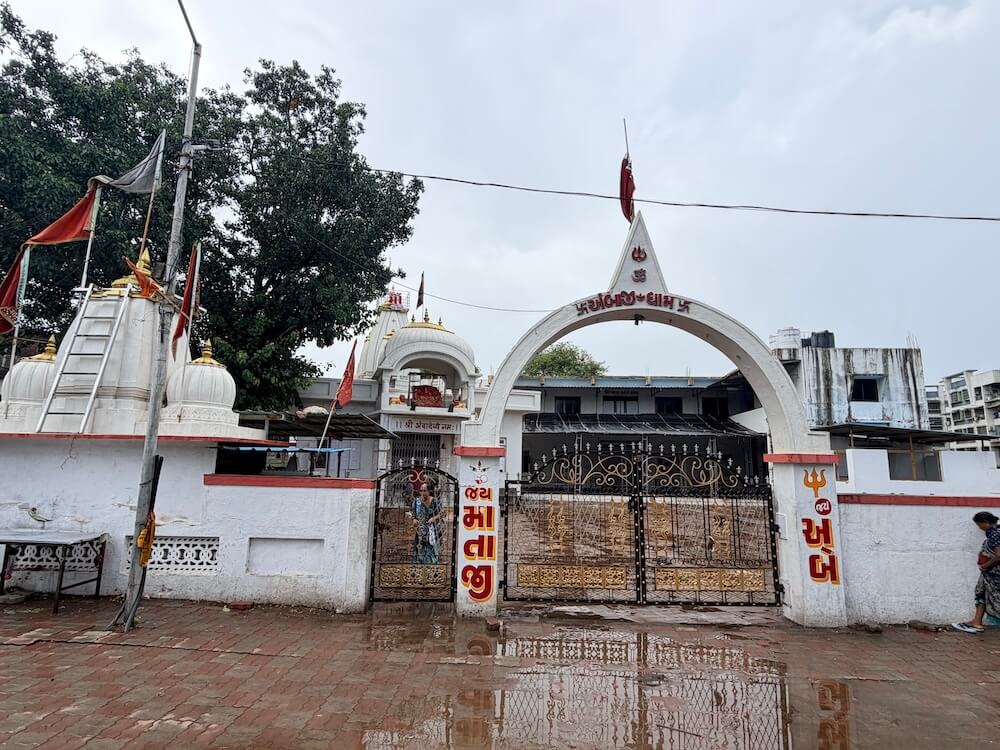 The shrine is positioned adjacent to the main road in the bustling locality of Mehta Colony within Umargam city. Dedicated parking facilities are arranged in front of the temple complex. The sanctuary is enclosed by a stone fortification wall, which features the primary entranceway. The welcome arch raised above this entrance is supported by two square columns on either side. Over the crescent-shaped torana (ornamental archway) of these pillars, a square, tapering spire has been built.
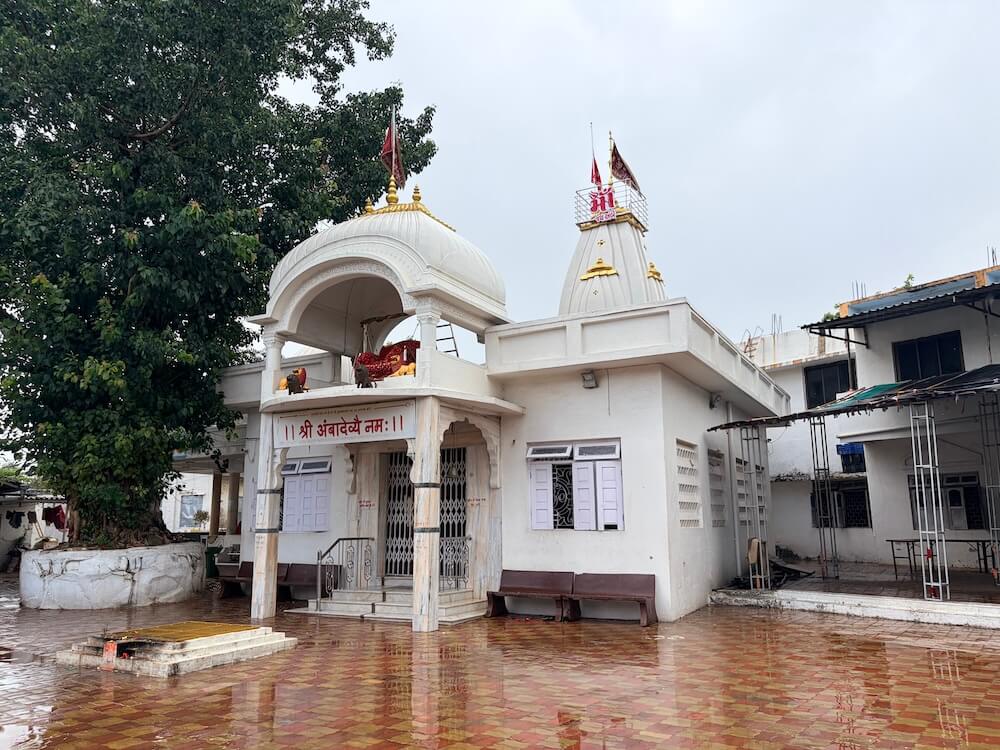
Within the temple courtyard, seating benches are arranged along the fortification wall for the convenience of visiting devotees. A Yagnakunda (sacrificial fire pit) is constructed directly into the ground in front of the shrine. 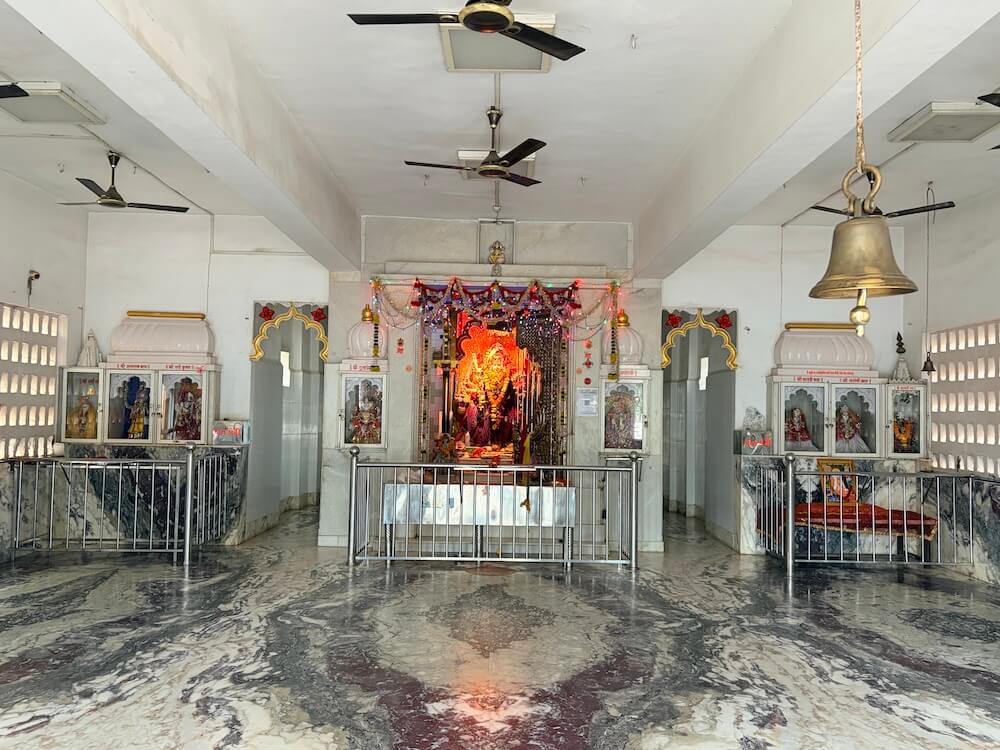 The courtyard also houses an ancient Peepal tree, which is encircled by a raised stone platform. Placed upon this sacred platform are historic stone hero-stones (‘Veergal’) and other antiquarian sculptures.
The architectural layout of the temple is distinctly divided into three principal segments : the Mukhamandapa (front porch), the Sabhamandapa (assembly hall) and the Garbhagriha (sanctum sanctorum). The front facade of the Mukhamandapa features two square columns. The entrance to the Sabhamandapa is set at a higher level than the front porch and its lintel (‘Lalatabimba’) is embellished with a beautifully carved sculpture of Lord Ganesha. Devotees ascend four steps from the front porch to enter the main assembly hall. 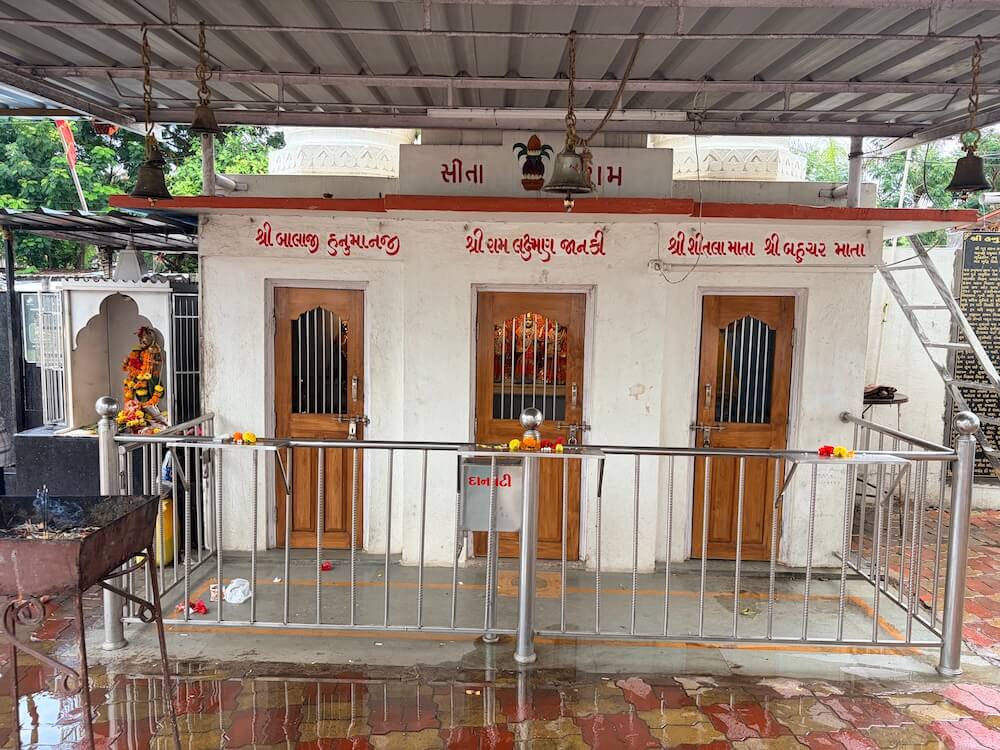 The Sabhamandapa here is fully enclosed, designed with large windows to facilitate natural light and ventilation. Nested within multiple divine niches (‘Devakoshtas’) along the walls of the assembly hall are the sacred idols of Mother Gayatri, Mother Santoshi, Mother Mahakali, Sai Baba, Jalaram Bapa and Radha-Krishna. The inner sanctum is situated at the far end of the assembly hall. The facade flanking the entranceway to the sanctum sanctorum features two divine niches housing the idols of Lord Ganesha and Shri Dattatreya. The lintel of the sanctum entrance is also adorned with a Ganesha sculpture. Inside the Garbhagriha, enshrined upon a canopy resting on the Vajrapitha (a raised stone pedestal), sits the majestic idol of Mother Amba, mounted upon the lion. The Goddess holds a trident, sword, discus, shield, bow and arrow and a sacred vessel of fire (Agnipatra) in her hands,
 while one hand is held in the Abhayamudra (blessing gesture). This ornately decorated idol is draped in fine vestments. A circumambulatory path (Pradakshinapatha) encompasses the outer perimeter of the sanctum. The exterior walls of this path are likewise fitted with niches containing images of various other deities.
The roof over the Mukhamandapa is crowned by a large, ornate dome-canopy (Meghadambari). At the absolute centre of this dome-canopy, an idol of Goddess Amba is installed upon a pedestal, flanked by intricately carved lion sculptures on both sides. The roof of this canopy features a horizontal spire topped by three golden pinnacles (Kalasas) arranged in a horizontal row. The main roof over the Garbhagriha features a high, square spire that tapers gracefully towards the summit. This primary spire is symmetrically surrounded by smaller secondary spires (Upashikharas).
Directly facing the main temple within the courtyard is an independent shrine dedicated to Mukteshwar Mahadev. A sculpted idol of Nandi sits gracefully in front of this Shiva temple. The divine niches positioned on either side of the sanctum entrance contain the idols of Lord Ganesha and Lord Hanuman. Centred upon the floor inside the sanctum sanctorum is the holy Shiva Lingam, while the niche on the rear wall houses an idol of Goddess Parvati. The roof of this secondary temple is topped with a conical spire. Furthermore, individual shrines dedicated to Lord Hanuman, Lord Ram-Lakshman-Janki, Mother Shitala and Mother Bahuchara are established within the temple precincts.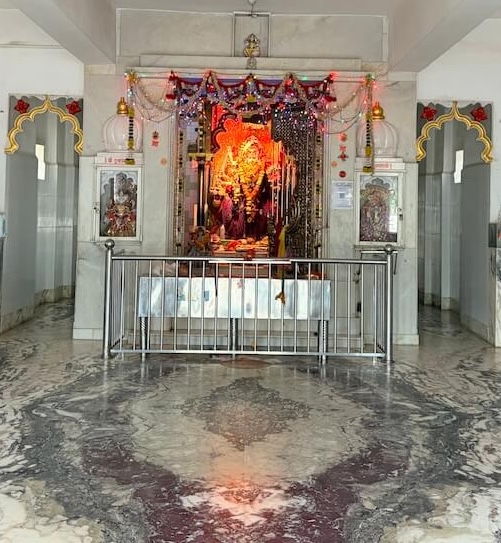 The courtyard also houses residential quarters for the head priests and temple servitors.
The Sharadiya Navratri festival is celebrated as the premier annual event at this holy shrine. Throughout this festive period, vibrant Garba dance celebrations are organised within the temple grounds for ten consecutive nights. Thousands of devotees from the surrounding areas gather during this festival to seek the blessings of the Goddess and actively participate in the Garba dances. On the auspicious day of Ashtami during Navratri, a grand Navchandi Yagna is performed at the temple. Concurrently, a complete scriptural recitation of the holy ‘Durga Saptashati’ text is conducted across the nine days. A variety of religious programs, including Kanya Pujan (ritual worship of young girls), devotional bhajans, kirtans, musical performances and the distribution of Mahaprasada, are meticulously organised. In addition, Chaitra Navratri, Hanuman Jayanti, Mahashivratri, the holy month of Shravan, Dussehra and Diwali are observed traditionally. Devotees routinely fulfil their religious vows during these festivals by offering sarees, chunris, traditional bridal ornaments, sweets and coconuts to the deity. Aside from the festive periods, a significant surge of pilgrims is observed every Tuesday, Friday, Ashtami and Purnima. The temple remains open for devotees to obtain darshan daily from 5:30 am until 9:00 pm.
Useful Information :
- Situated at a distance of 3 km from the Umargam bus station
- Situated at a distance of 60 km from Valsad city
- State Transport (ST) bus services connect Umargam with several major towns across the district.
- Private vehicles can drive directly up to the temple gates.
- Lodging and breakfast facilities are available in the surrounding vicinity.
अम्बा माता मंदिर
उमरगाम, ताल. उमरगाम, जिला. वलसाड
मंदिरे
Temples
मंदिर
મંદિરો
கோவில்கள்
దేవాలయాలు
ക്ഷേത്രങ്ങൾ
ದೇವಾಲಯಗಳು
মন্দিরসমূহ
ਮੰਦਿਰ
-
साईबाबा मंदिर तिथळ, ता./जि. वलसाड
अधिक माहितीSai Baba Temple Tithal, Tal./Dist. Valsad
View Detailsसाईं बाबा मंदिर तीथल, ताल./जिला. वलसाड
विवरण देखेंSai Baba Temple Tithal, Tal./Dist. Valsad
વિગત જુઓSai Baba Temple Tithal, Tal./Dist. Valsad
விவரங்களைக் காண்கSai Baba Temple Tithal, Tal./Dist. Valsad
వివరాలను చూడండిSai Baba Temple Tithal, Tal./Dist. Valsad
വിശദാംശങ്ങൾ കാണുകSai Baba Temple Tithal, Tal./Dist. Valsad
ವಿವರಗಳನ್ನು ವೀಕ್ಷಿಸಿSai Baba Temple Tithal, Tal./Dist. Valsad
বিস্তারিত দেখুনSai Baba Temple Tithal, Tal./Dist. Valsad
ਵੇਰਵੇ ਦੇਖੋ -
भाव-भावेश्वर महादेव मंदिर बारुमाळ, ता. धरमपूर, जि. वलसाड
अधिक माहितीBhav-Bhaveshwar Mahadev Temple Barumal, Tal. Dharampur, Dist. Valsad
View Detailsभाव-भावेश्वर महादेव मंदिर बारुमल, ताल. धरमपुर, जिला. वलसाड
विवरण देखेंBhav-Bhaveshwar Mahadev Temple Barumal, Tal. Dharampur, Dist. Valsad
વિગત જુઓBhav-Bhaveshwar Mahadev Temple Barumal, Tal. Dharampur, Dist. Valsad
விவரங்களைக் காண்கBhav-Bhaveshwar Mahadev Temple Barumal, Tal. Dharampur, Dist. Valsad
వివరాలను చూడండిBhav-Bhaveshwar Mahadev Temple Barumal, Tal. Dharampur, Dist. Valsad
വിശദാംശങ്ങൾ കാണുകBhav-Bhaveshwar Mahadev Temple Barumal, Tal. Dharampur, Dist. Valsad
ವಿವರಗಳನ್ನು ವೀಕ್ಷಿಸಿBhav-Bhaveshwar Mahadev Temple Barumal, Tal. Dharampur, Dist. Valsad
বিস্তারিত দেখুনBhav-Bhaveshwar Mahadev Temple Barumal, Tal. Dharampur, Dist. Valsad
ਵੇਰਵੇ ਦੇਖੋ -
दत्त मंदिर पाथरी, ता./जि. वलसाड
अधिक माहितीDatt Temple Pathri, Tal./Dist. Valsad
View Detailsदत्त मंदिर पाथरी, ताल./जिला. वलसाड
विवरण देखेंDatt Temple Pathri, Tal./Dist. Valsad
વિગત જુઓDatt Temple Pathri, Tal./Dist. Valsad
விவரங்களைக் காண்கDatt Temple Pathri, Tal./Dist. Valsad
వివరాలను చూడండిDatt Temple Pathri, Tal./Dist. Valsad
വിശദാംശങ്ങൾ കാണുകDatt Temple Pathri, Tal./Dist. Valsad
ವಿವರಗಳನ್ನು ವೀಕ್ಷಿಸಿDatt Temple Pathri, Tal./Dist. Valsad
বিস্তারিত দেখুনDatt Temple Pathri, Tal./Dist. Valsad
ਵੇਰਵੇ ਦੇਖੋ