
अमरकंठ महादेव मंदिर
संजन, ता. उमरगाम, जि. वलसाड
Amarkanth Mahadev Temple
Sanjan, Tal. Umargam, Dist. Valsad
 The Amarkanth Mahadev Temple is situated near the historical town of Sanjan in the Umargam Taluka of Valsad district. The town of Sanjan boasts a magnificent history. It was within this very town that Parsi refugees first found asylum upon their arrival in India in 698 AD. To commemorate this monumental event, the Sanjan Stambh (Sanjan Memorial Column) was erected here in 1917. The town also houses the sacred Agiary (Parsi Fire Temple). Nestled in close proximity to this historic town is the Amarkanth Mahadev Temple, which is traditionally revered as a prominent sub-seat (‘Upapeetha’) of the celebrated Amar Kantak Mahadev Temple situated at the source of the Narmada River in the Anuppur district of Madhya Pradesh.
A fascinating legend is narrated regarding the original Amar Kantak Temple in Madhya Pradesh. In ancient times, a king named Amar Kantak ruled over this region.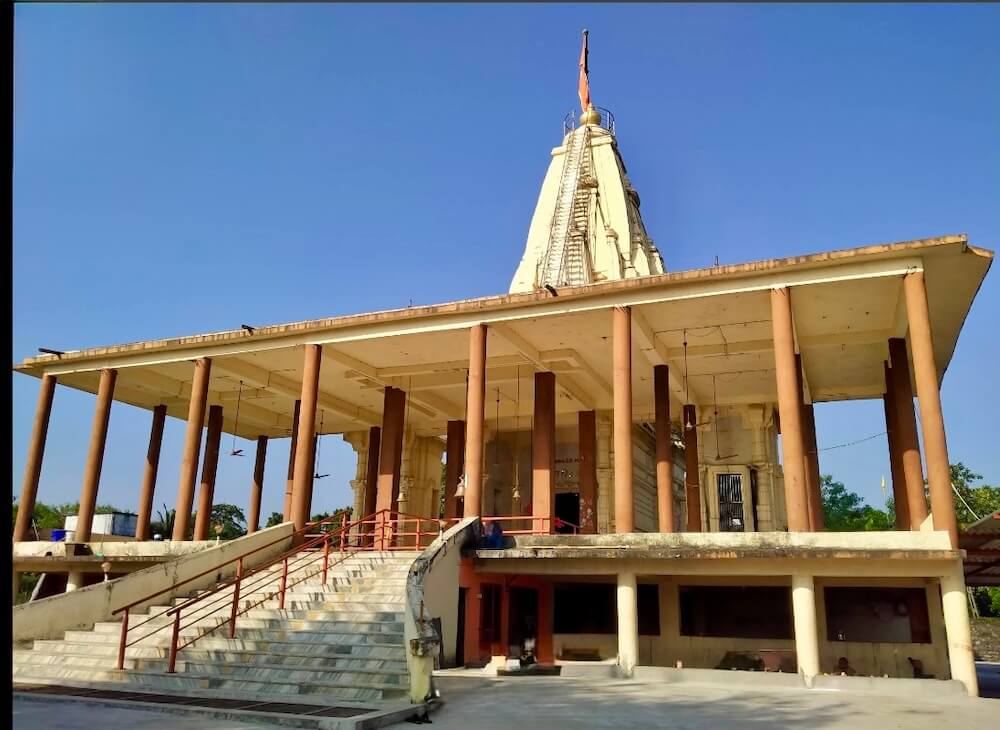 Princess Narmada was the daughter of King Amar Kantak. When Narmada attained a marriageable age, her wedlock was arranged with Emperor Shon, the ruler of a neighbouring kingdom. In the course of time, the king sensed his impending demise, prompting him to coronate Princess Narmada and hand over the complete administration of the realm into her hands. King Amar Kantak passed away before Narmada could be wedded. A few days after the sovereign’s death, Narmada presented Emperor Shon with a marriage proposal via her personal maidservant Jhola. This was done by formally presenting an engagement ring. The maidservant Jhola presented the ring before the monarch. As Emperor Shon had never personally beheld Princess Narmada, he mistook Jhola for the Princess and married her.
  Presented with an unexpected opportunity to become the queen, Jhola concealed the true facts from the Emperor and assumed the throne of that kingdom.
Meanwhile, as many days elapsed without any message arriving from Emperor Shon, Princess Narmada personally journeyed to the court of King Shon. Upon her arrival, she discovered the painful truth that her own maidservant, Jhola, had assumed her identity, married King Shon and become the queen. Distressed by the profound betrayal perpetrated by her own maidservant, Narmada retreated to the Maikal Mountains to perform rigorous penance dedicated to Lord Shiva. Pleased by her unwavering devotion, Lord Shiva manifested himself before her. Narmada then implored the Lord to dissolve her physical form into water and transform her into a river.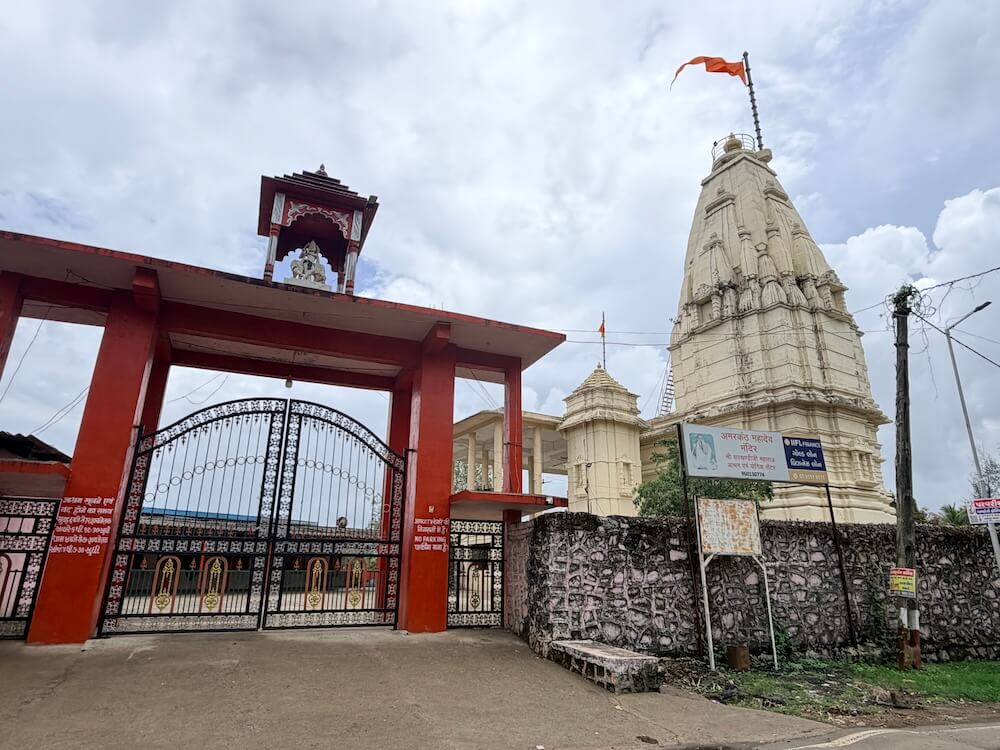 By the divine grace of Lord Shiva, Narmada was metamorphosed into a river, after which Amar Kantak flourished as a highly venerated place of pilgrimage. Devotees who find themselves unable to journey to the original Amar Kantak in Madhya Pradesh flock to this Amarkanth shrine near Sanjan to seek the blessings of Lord Shiva.
The Amarkanth Mahadev Temple is located somewhat away from the main residential settlements, perched gracefully on the banks of the Varoli River, which flows onwards to merge into the Arabian Sea. The temple complex is secured by a stone fortification wall. Positioned directly above the main entrance within an ornate dome-canopy (Meghadambari) is a pristine marble idol of Lord Krishna playing his flute. This gateway ushers visitors into the temple courtyard, which is adorned with sacred Peepal and Banyan trees. Within this very courtyard, near the riverbank, a semi-open ritual hall (Vidhimandap) has been constructed, primarily utilized for conducting Shraddha, Shanti and various other solemn religious rites. The courtyard also houses a sacred memorial shrine (Samadhi), which is said to belong to a late Mahant (chief priest) of the temple. Furthermore, the courtyard features a charitable dining hall (Annachhatra), residential quarters for the temple priests and servitors and other auxiliary structures.
The architecture of this two-storeyed temple follows the traditional layout comprising a Sabhamandapa (assembly hall), an Antarala (antechamber) and a Garbhagriha (sanctum sanctorum). 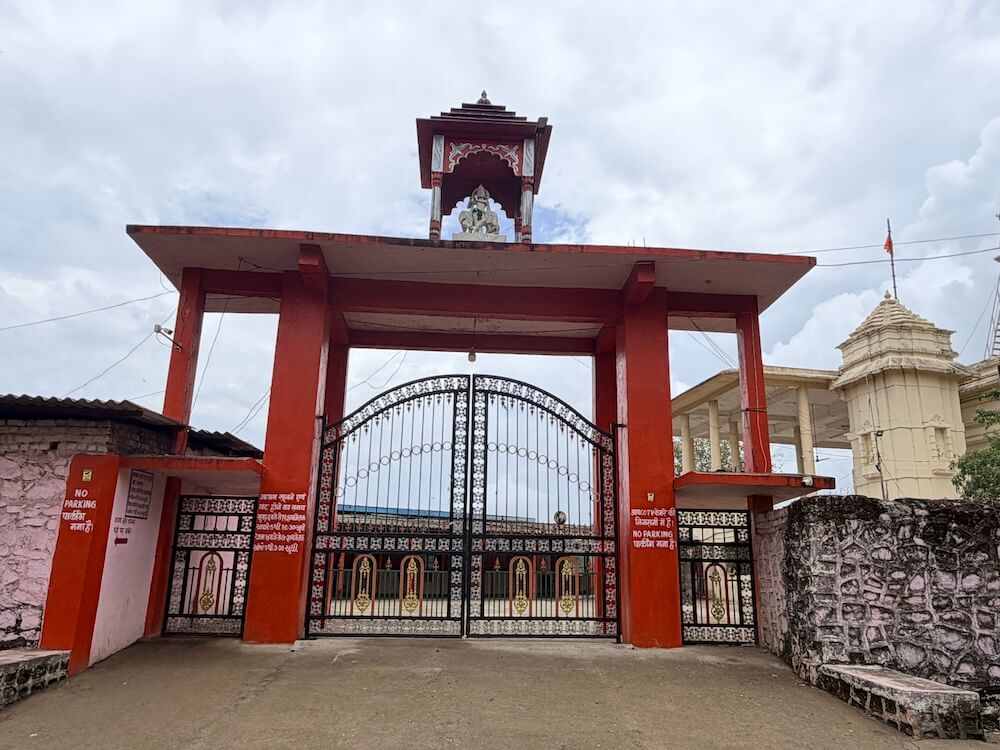 The primary shrine is located on the first floor, while the ground floor accommodates a meditation hall (Dhyanamandir) and a spacious hall designed for hosting diverse cultural programs. Devotees ascend approximately twenty steps from the courtyard to enter the assembly hall on the first floor. Inside the Sabhamandapa, security railings have been installed to streamline queues and improve the convenience of visiting worshippers. Positioned directly before the entranceway of the antechamber, resting upon a Vajrapitha (raised stone pedestal), is a marble sculpture of Nandi, ahead of which is an image of a tortoise. A separate canopy within the assembly hall houses an idol of Swami Kartikeya depicting his six-faced (Shadanan) form.
The entranceway to the antechamber is flanked by beautifully carved decorative pillars (Stambhashakhas).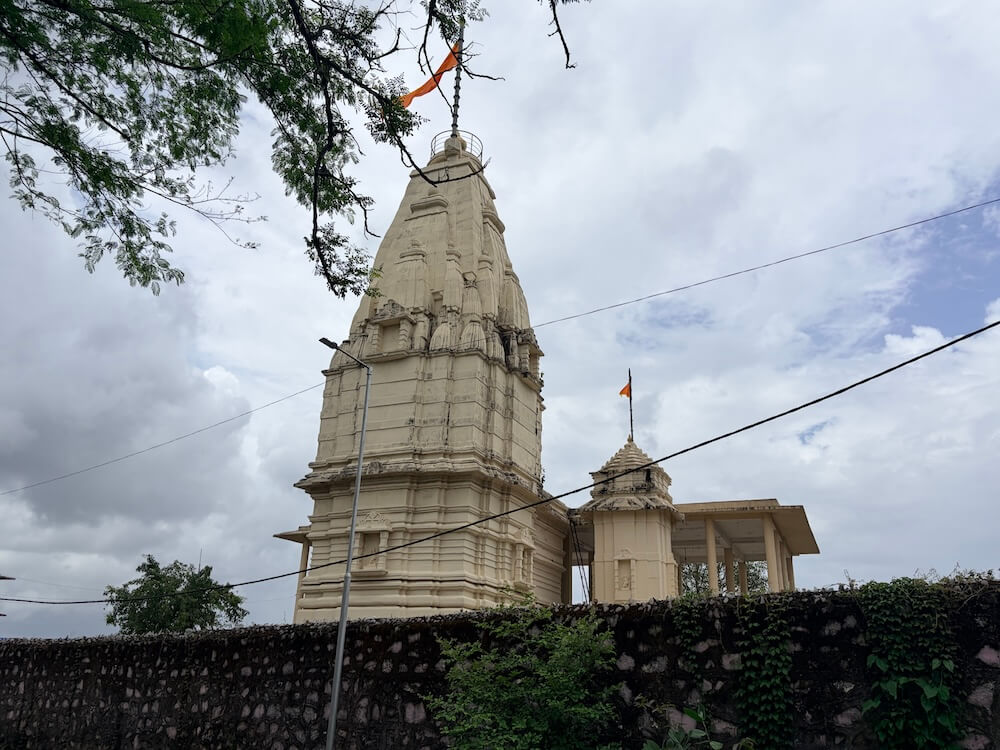 The left and right walls of the Antarala feature divine niches (Devakoshtas) housing the idols of Lord Ganesha and Lord Hanuman. Beyond the antechamber lies the doorway to the sanctum sanctorum, which features sculpted figures of celestial gatekeepers (Dwarpala) on either side. The doorway displays intricate carvings of foliage (Parnashakha), flowers (Pushpashakha) and ornamental pillars (Stambhashakha). The lintel panel (Lalatapatti) is adorned with delicate floral patterns, while the central lintel (Lalatabimba) features a fine sculpture of Lord Ganesha. The upper architrave (Uttaranga) of the entrance is carved with traditional bridal crest motifs and the lower threshold features a crescent stone (Chandrashila).
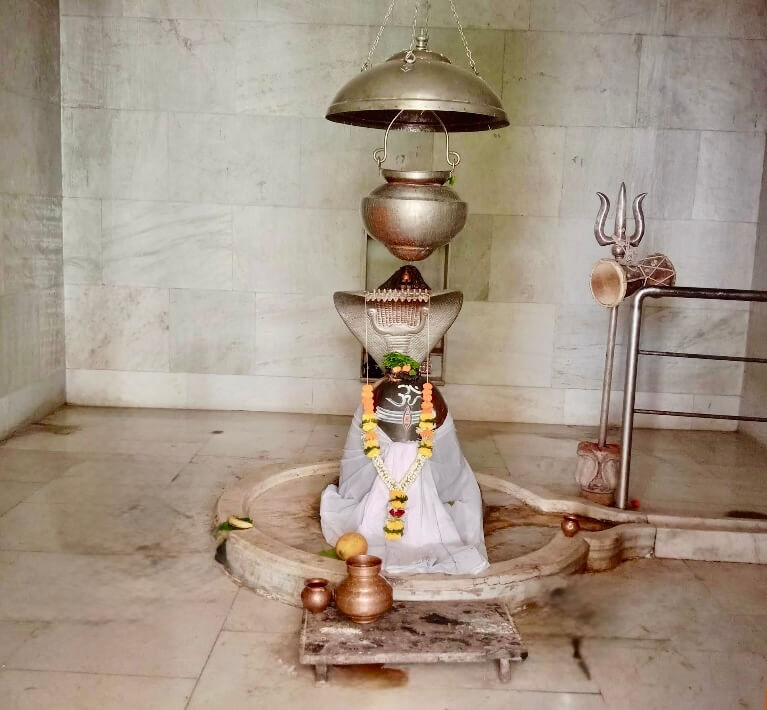
Enshrined upon the floor inside the sanctum sanctorum is the holy Shiva Lingam, sheltered beneath the brass canopy of a multi-hooded serpent. A perforated consecration vessel (Abhishekpatra) hangs suspended from the ceiling of the sanctum to facilitate a continuous stream of water over the Shiva Lingam. A divine niche in the rear wall of the sanctum houses an idol of Mother Parvati. Flanking the main sanctum on the left and right are two small, independent subsidiary sanctums, each housing consecrated idols of the Panchayatan deities.
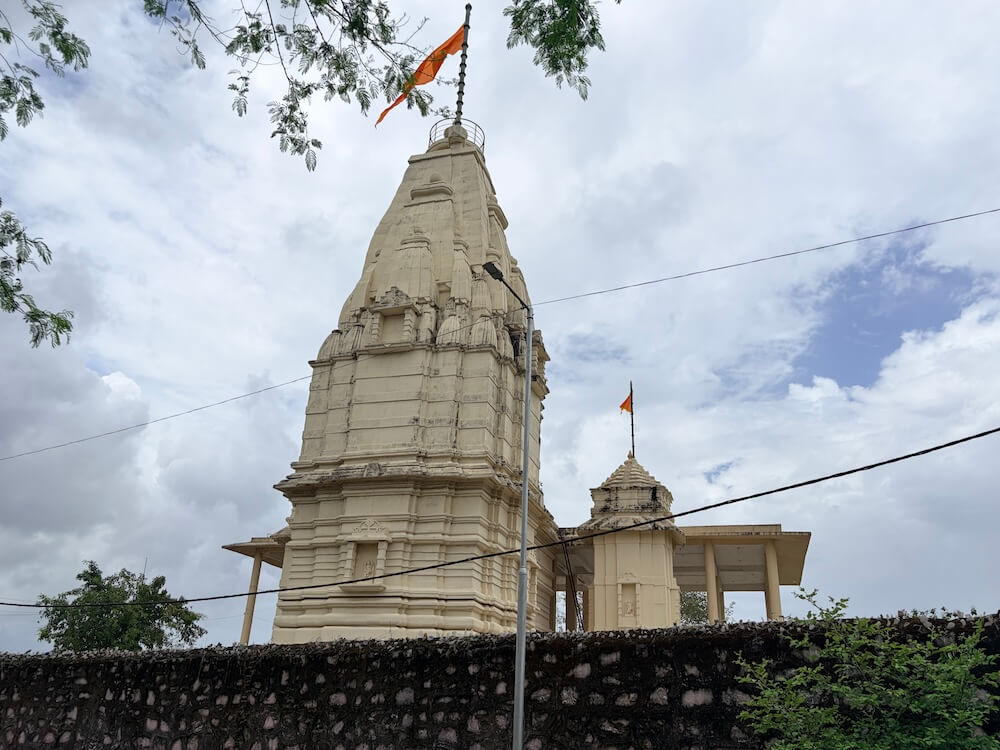
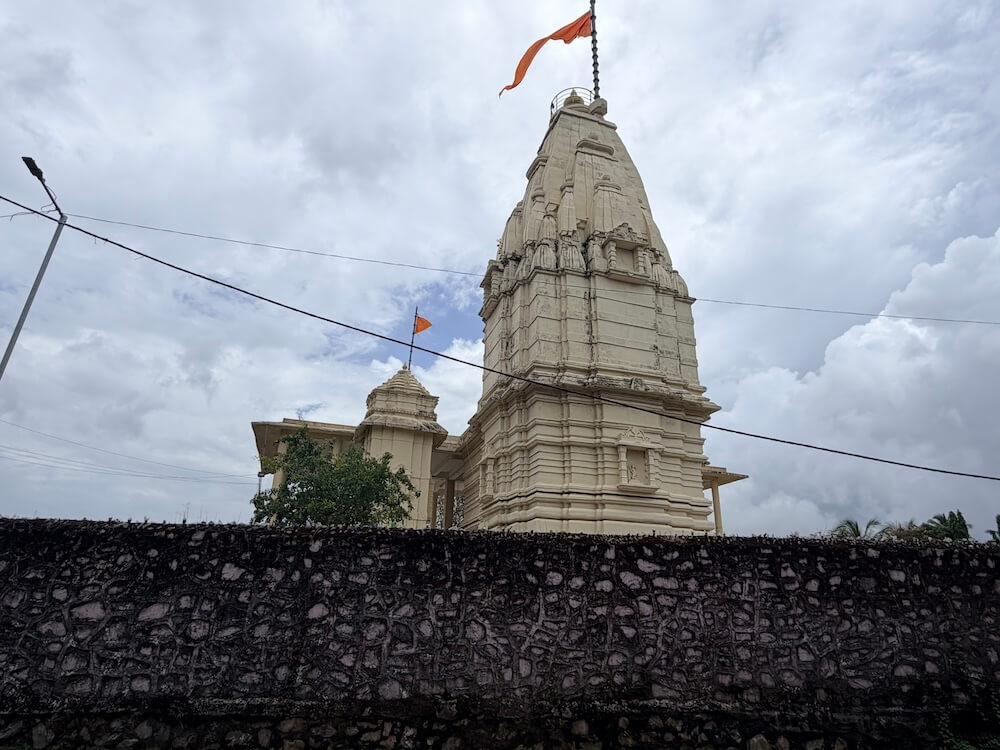
The exterior walls of the temple antechamber and the main wall architecture (Mandovara) feature intricate niches sculpted with various Shaivite and Vaishnavite iconographies. The roofs of all three sanctums are crowned by square spires (Shikharas) that taper gracefully towards the top. Among these three, the central spire over the main sanctum is significantly larger in scale and height. These spires are symmetrically adorned with smaller secondary spires (Angashikharas) across all four sides.
The temple courtyard also houses a dedicated cowshed (Goshalas), which provides shelter and care for approximately 100 cows. Situated a short distance from the temple is a beautiful grove and children’s park developed by the Social Forestry Department, featuring an array of diverse trees.
Mahashivratri stands as the premier annual festival celebrated at this temple. On this auspicious day, thousands of devotees from Sanjan and its surrounding territories gather in immense numbers. Long queues of worshippers form from the early hours of dawn to catch a glimpse of the deity. At daybreak on Mahashivratri, a grand Rudrabhisheka ceremony is performed over the Shiva Lingam amidst the rhythmic chanting of sacred Vedic mantras. This is followed by a series of religious programs, including the Shivyagna, recitation of the Mahamrityunjaya mantra, devotional bhajans and kirtans. Alongside these rituals, a continuous offering of milk (Dugdhabhisheka) is made to the main Shiva Lingam. The temple management organizes a grand Mahaprasada for all the visiting pilgrims on this day. Much like Mahashivratri, every Monday during the holy month of Shravan witnesses a massive influx of devotees who gather to offer holy libations to Lord Shiva. The temple remains open for darshan daily from 6:00 am to 12:30 pm and from 4:00 pm to 7:30 pm.
Useful Information :
- Situated at a distance of 8 km from Umargam
- Situated at a distance of 55 km from Valsad city
- State Transport (ST) buses and private vehicle facilities are available from Umargam.
- Private vehicles can drive directly up to the temple premises.
- Accommodation and breakfast facilities are available in the surrounding vicinity.
- Contact: Temple Office, Mobile: 960130774
अमरकंठ महादेव मंदिर
संजन, ताल. उमरगाम, जिला. वलसाड
मंदिरे
Temples
मंदिर
મંદિરો
கோவில்கள்
దేవాలయాలు
ക്ഷേത്രങ്ങൾ
ದೇವಾಲಯಗಳು
মন্দিরসমূহ
ਮੰਦਿਰ
-
साईबाबा मंदिर तिथळ, ता./जि. वलसाड
अधिक माहितीSai Baba Temple Tithal, Tal./Dist. Valsad
View Detailsसाईं बाबा मंदिर तीथल, ताल./जिला. वलसाड
विवरण देखेंSai Baba Temple Tithal, Tal./Dist. Valsad
વિગત જુઓSai Baba Temple Tithal, Tal./Dist. Valsad
விவரங்களைக் காண்கSai Baba Temple Tithal, Tal./Dist. Valsad
వివరాలను చూడండిSai Baba Temple Tithal, Tal./Dist. Valsad
വിശദാംശങ്ങൾ കാണുകSai Baba Temple Tithal, Tal./Dist. Valsad
ವಿವರಗಳನ್ನು ವೀಕ್ಷಿಸಿSai Baba Temple Tithal, Tal./Dist. Valsad
বিস্তারিত দেখুনSai Baba Temple Tithal, Tal./Dist. Valsad
ਵੇਰਵੇ ਦੇਖੋ -
भाव-भावेश्वर महादेव मंदिर बारुमाळ, ता. धरमपूर, जि. वलसाड
अधिक माहितीBhav-Bhaveshwar Mahadev Temple Barumal, Tal. Dharampur, Dist. Valsad
View Detailsभाव-भावेश्वर महादेव मंदिर बारुमल, ताल. धरमपुर, जिला. वलसाड
विवरण देखेंBhav-Bhaveshwar Mahadev Temple Barumal, Tal. Dharampur, Dist. Valsad
વિગત જુઓBhav-Bhaveshwar Mahadev Temple Barumal, Tal. Dharampur, Dist. Valsad
விவரங்களைக் காண்கBhav-Bhaveshwar Mahadev Temple Barumal, Tal. Dharampur, Dist. Valsad
వివరాలను చూడండిBhav-Bhaveshwar Mahadev Temple Barumal, Tal. Dharampur, Dist. Valsad
വിശദാംശങ്ങൾ കാണുകBhav-Bhaveshwar Mahadev Temple Barumal, Tal. Dharampur, Dist. Valsad
ವಿವರಗಳನ್ನು ವೀಕ್ಷಿಸಿBhav-Bhaveshwar Mahadev Temple Barumal, Tal. Dharampur, Dist. Valsad
বিস্তারিত দেখুনBhav-Bhaveshwar Mahadev Temple Barumal, Tal. Dharampur, Dist. Valsad
ਵੇਰਵੇ ਦੇਖੋ -
दत्त मंदिर पाथरी, ता./जि. वलसाड
अधिक माहितीDatt Temple Pathri, Tal./Dist. Valsad
View Detailsदत्त मंदिर पाथरी, ताल./जिला. वलसाड
विवरण देखेंDatt Temple Pathri, Tal./Dist. Valsad
વિગત જુઓDatt Temple Pathri, Tal./Dist. Valsad
விவரங்களைக் காண்கDatt Temple Pathri, Tal./Dist. Valsad
వివరాలను చూడండిDatt Temple Pathri, Tal./Dist. Valsad
വിശദാംശങ്ങൾ കാണുകDatt Temple Pathri, Tal./Dist. Valsad
ವಿವರಗಳನ್ನು ವೀಕ್ಷಿಸಿDatt Temple Pathri, Tal./Dist. Valsad
বিস্তারিত দেখুনDatt Temple Pathri, Tal./Dist. Valsad
ਵੇਰਵੇ ਦੇਖੋ