
श्री परमारा देवी मंदिर
एर्नाकुलम उत्तर, कचेरीपाडी, जि. एर्नाकुलम.
Sree Paramara Devi Temple
Ernakulam North, Kacheripady, Dist. Ernakulam.
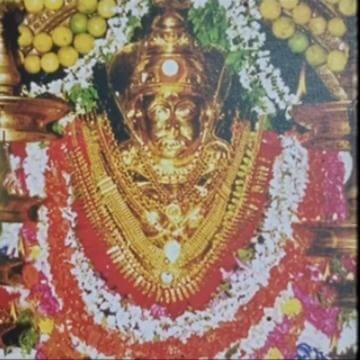 Sree Paramara Devi Temple is an ancient Hindu temple located in the heart of Ernakulam city, opposite the Town Hall at Kacheripady. It is one of the rare Bhadrakali temples in Kerala where the deity faces north. Sree Bhadrakali is the main deity here. Among the local people, the goddess is also known as Parambanar Kulangara Bhagavathi and Paramara Muthi.
Like many ancient temples in Kerala, there are no clear archaeological records or exact historical dates to confirm the year or the ruler during whose reign Sree Paramara Devi Temple was established. It is believed to have existed centuries before Ernakulam developed into a city and Kochi became a modern urban centre, when this area was still covered by forests. Before the development of the Ernakulam North, Kaloor and Kacheripady areas, which were part of the old Kingdom of Kochi, the temple is believed to have been an important centre of worship and local cultural life. The name ‘Paramara’ is said to have developed from the earlier name ‘Parambanar Kulangara Bhagavathi’. 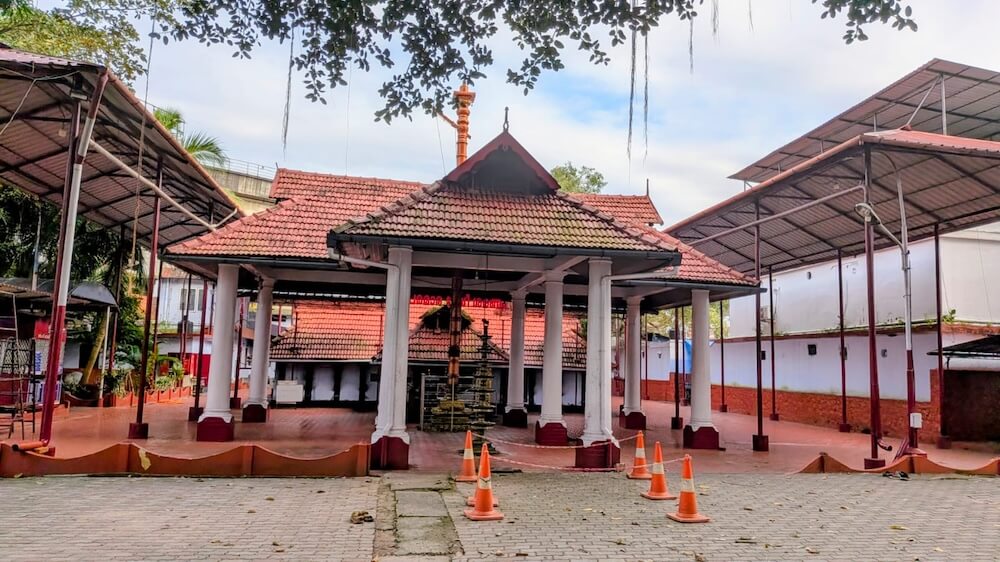 As the area grew during the rule of the Kochi kings, the temple became an important place of worship for local people and traders. It is also said to have existed here long before the development of Ernakulam North Railway Station, Town Hall and Kacheripady. At present, the temple’s daily activities, rituals and festivals are managed by the Paramara Devaswom Committee with the participation of devotees.
According to legend, long ago, a Brahmin ascetic from a distant place arrived in this area carrying a small idol of the goddess, which he worshipped wherever he travelled. 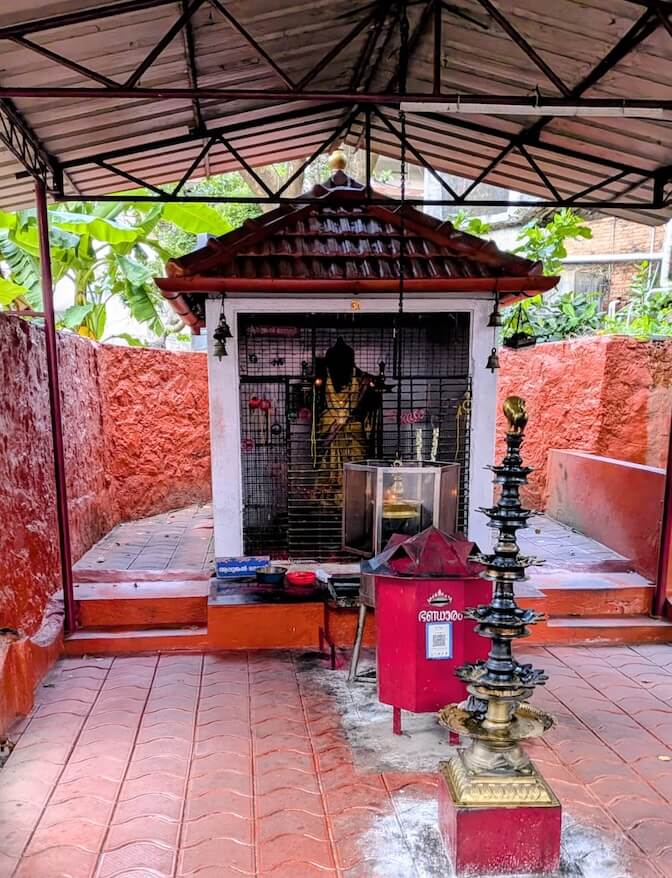 When he reached the forested area of Parambanar Kulangara, where the temple now stands, he placed the idol on the ground for his evening prayers. After completing his prayers, he tried to pick up the idol to continue his journey, but it could not be moved from the ground. He is believed to have realised that the place had a strong divine presence. When the local people came to know about this, they decided to build a temple for the goddess at the spot where the idol had remained fixed. Devotees consider the goddess here to be another form of Kodungallur Bhagavathi. As the deity faces north, she is also worshipped as ‘Paramara Muthi’ or ‘Paramara Ammumma’.
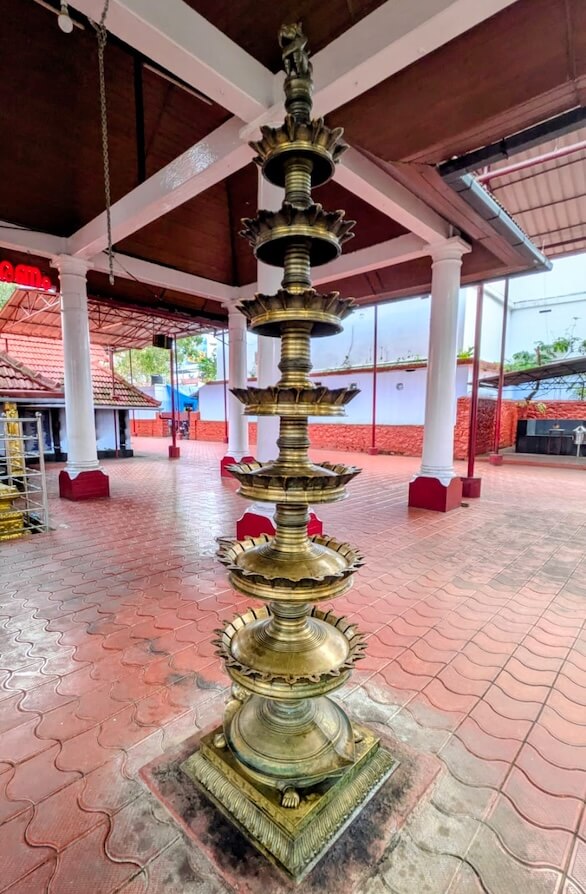
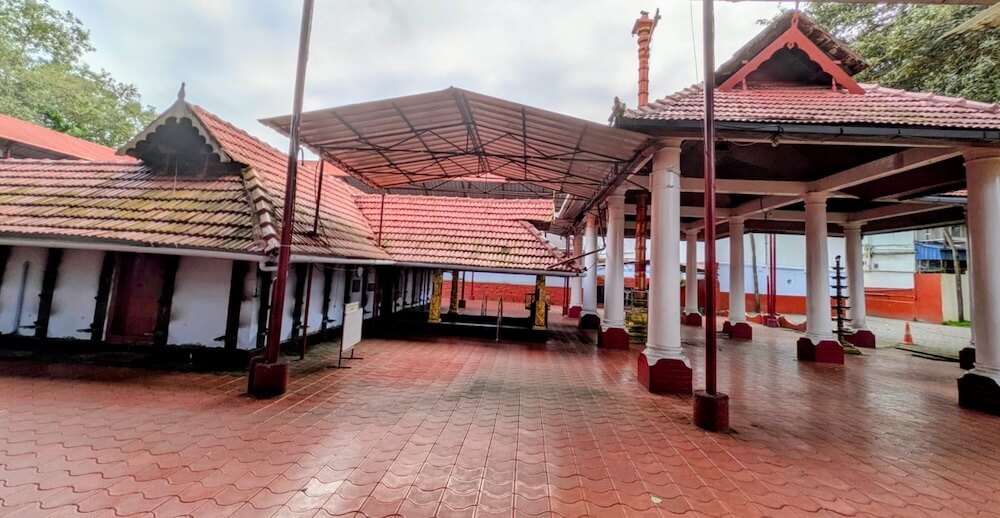
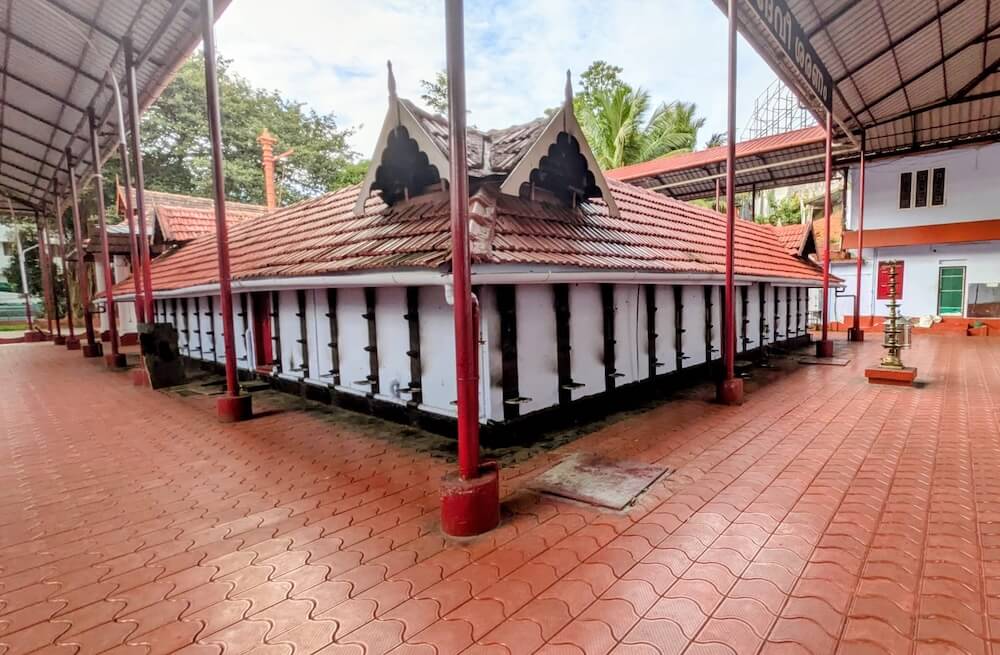
On the busy Paramara Road, the temple’s main elephant entrance can be seen between the surrounding buildings when approached from the Kacheripady side. Above the entrance is a small tiered tower structure in the traditional Kerala style, with the ‘Om’ symbol at the top. Although the entrance looks narrow from the road, it opens into a spacious and peaceful temple setting. Just inside the entrance is a beautiful tiled-roofed walkway supported by large white pillars. During festivals, it provides space for elephants to be kept and for devotees to queue. The flagstaff stands in the centre of the walkway, while a large lamp tower fitted with rows of traditional metal lamps surrounds the main shrine. 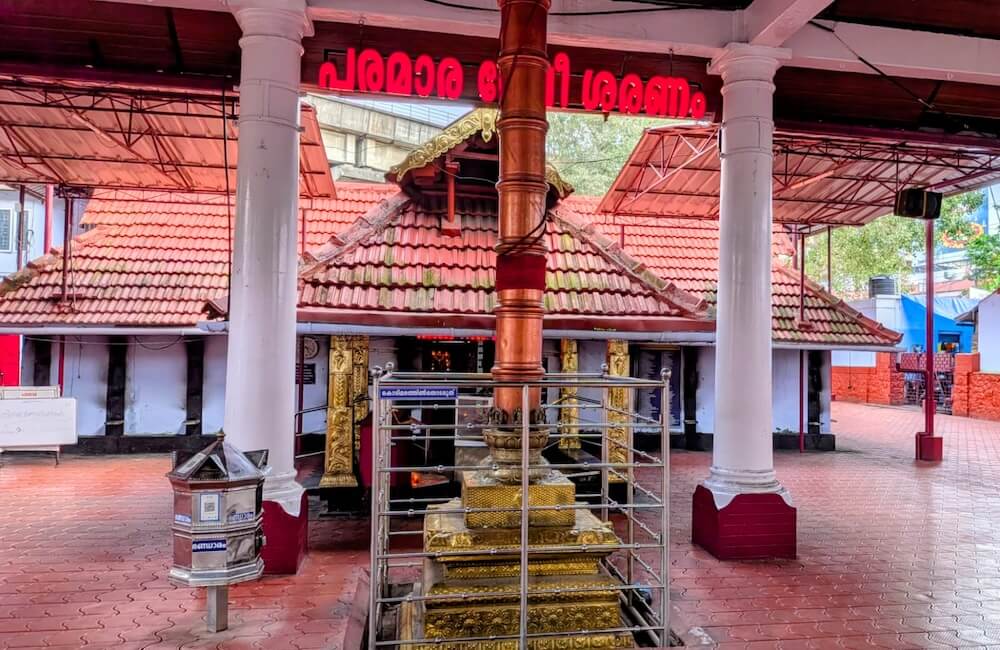 The Nalambalam is built using laterite stone, wood and tiles, following traditional Kerala craftsmanship.
The temple has a square Sreekovil built of laterite stone, with its outer walls finished with cement and lime. The Sreekovil has a sloping tiled roof supported by a wooden structure, with a shining copper Thazhikakudam above it. A small granite Sopana with steps leads to the entrance and curved Vyalimukha carvings can be seen on both sides. Several traditional metal lamps are fixed in wooden frames along the walls of the Nalambalam surrounding the Sreekovil. Sree Bhadrakali, known for her powerful form, is the main deity. One of the main features of the temple is that the deity faces north.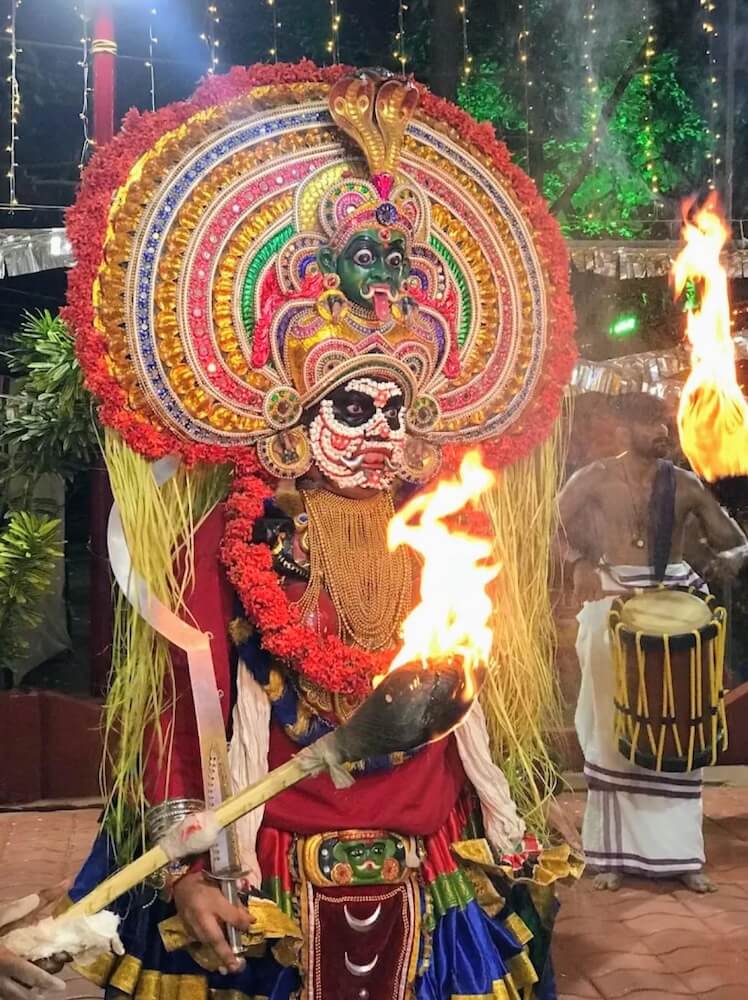 According to Tantric belief, Bhadrakali, who appeared in her fierce form from Lord Shiva’s third eye to defeat Raktabijasura, becomes even more powerful when facing north. The idol is made of black stone and is depicted with four arms. Although the goddess is worshipped in the same form as Kodungalluramma, devotees also worship her in the gentle form of ‘Paramara Muthi’ or ‘Ammumma’. The idol is placed on a black stone pedestal inside the sanctum.
Near the main Sreekovil, inside the Nalambalam, there are shrines for Lord Parashiva and Lord Ganesha. Lord Mahavishnu is worshipped in a separate small Sreekovil within the temple compound. Outside the Nalambalam, there is a separate shrine for Lord Ayyappa, worshipped as Karimala Vasana. The shrine of Alankal Bhagavathi, worshipped in another form, is also located outside the main shrine. The Naga Thara, with shrines for Naga Raja and Naga Yakshi, is situated under the large banyan tree in the temple courtyard. A shrine for Brahmarakshas can also be seen at the north-western corner of the temple.
The temple’s biggest annual festival is the Thalappoli Mahotsavam. Held for six days during Kumbham (February–March), the festival begins with the Kodiyettam and ends with the Kodiyirakkam. Special poojas, Sreebali, Pakalpooram and elephant processions are held during the festival. 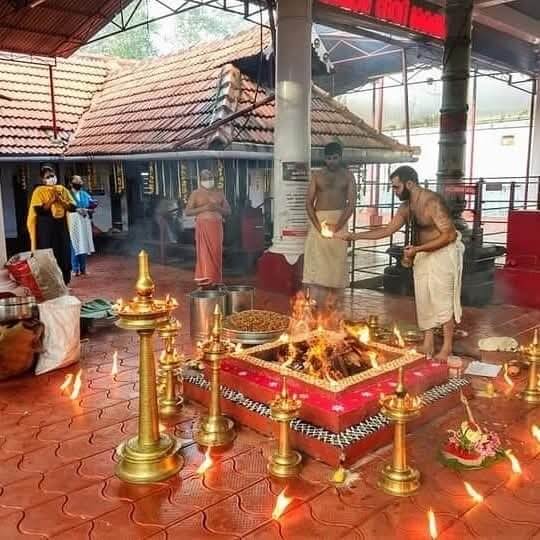 The Thekkumbhagam Thalappoli and Vadakkumbhagam Thalappoli held during the final days are especially well known. The festival also includes Theyyam (Bhadrakali Thira), devotional music programmes, Panchavadyam, Chendamelam, Kalamezhuthu and Paattu and fireworks. Thrikkarthika in Vrischikam (November–December) is another important special day, when Laksha Deepams are lit throughout the temple. After the annual festival, usually in the first week of March, a Valiya Guruthi Pooja is performed to calm the fierce form of the goddess. During the 41-day Mandalam period from Vrischikam 1 to Dhanu 11, the temple has a devotional atmosphere, with special poojas and lamp offerings for Lord Ayyappa, one of the other deities. On the first day of Karkidakam (July–August), Ashtadravya Maha Ganapathi Homam is performed, followed by Ramayana recitation throughout the month. All Tuesdays and Fridays, as well as Bharani nakshatra days each month, are considered important special days.
The main offerings to the goddess include Bhagavathi Seva, Shatrusamhara Pushpanjali, Guruthi Pooja, Raktha Pushpanjali, Kadumpayasam Nivedyam, Chuttuvilakku and Niramala. Bhagavathi Seva is performed in the evenings to seek relief from difficulties and prosperity. Shatrusamhara Pushpanjali is offered to remove obstacles and seek protection from negative influences, while Guruthi Pooja is performed to please the fierce form of the goddess. Raktha Pushpanjali is performed with red flowers for the removal of obstacles and good health. Offering Kadumpayasam, also known as Kaduthupayasam, to the goddess is another important offering. Chuttuvilakku, in which lamps are lit around the temple and Niramala, in which the Sreekovil is decorated with flower garlands, are also important offerings. Among the other deities, Ganapathi Homam, Karukamala and Modakam are offered to Maha Ganapathi; Dhara and Koovalamala to Lord Shiva; Palpayasam and Thulasi Mala to Lord Mahavishnu; and Neerajanam to Lord Ayyappa for relief from Shani-related difficulties. Noorum Paalum and Sarpa Bali are offered to Naga Raja and Naga Yakshi on Ayilyam days. Palpayasam Nivedyam and evening lamp offerings are made to Brahmarakshas.
The temple is open daily from 05:00 AM to 10:30 AM and from 05:00 PM to 08:00 PM. On Thursdays and Fridays, the temple usually remains open until 11:00 AM in the morning. On some days, it opens at 05:30 PM in the evening. Nirmalya Darshan and Abhishekam are performed immediately after the temple opens at 05:00 AM. After sunrise, Usha Pooja is performed, followed by Ucha Pooja and Nivedyam before the morning closing. After the temple reopens in the evening, Deepaaradhana is usually performed around 06:30 PM. Athazha Pooja is performed before the temple closes for the night. The timings of poojas and darshan may change on special days, during festivals and in the Mandalam season.
Key highlight :-
- Located 1.5 km from Kaloor, 6 km from Vyttila and 8 km from Aluva.
- 600 mtr from Ernakulam North railway station and 450 mtr from Kaloor metro station.
- 28 km from Cochin International Airport.
- KSRTC and local bus facilities are available to the temple.
- Limited parking facilities are available near the temple.
- Accommodation and food facilities are available near the temple.
- Contact number +91 4842390789
श्री परमार देवी मंदिर
एर्नाकुलम उत्तर, कचेरीपाडी, जिला। एर्नाकुलम.
मंदिरे
Temples
मंदिर
મંદિરો
கோவில்கள்
దేవాలయాలు
ക്ഷേത്രങ്ങൾ
ದೇವಾಲಯಗಳು
মন্দিরসমূহ
ਮੰਦਿਰ
-
चेरनाल्लूर श्री महादेवाचे मंदिर चेरनाल्लूर पूर्व, जि. एर्नाकुलम.
अधिक माहितीCheranalloor Sree Mahadeva Temple Cheranalloor East, Dist. Ernakulam.
View Detailsचेरनल्लूर श्री महादेव मंदिर चेरनल्लूर पूर्व, जिला। एर्नाकुलम.
विवरण देखेंCheranalloor Sree Mahadeva Temple Cheranalloor East, Dist. Ernakulam.
વિગત જુઓCheranalloor Sree Mahadeva Temple Cheranalloor East, Dist. Ernakulam.
விவரங்களைக் காண்கCheranalloor Sree Mahadeva Temple Cheranalloor East, Dist. Ernakulam.
వివరాలను చూడండిCheranalloor Sree Mahadeva Temple Cheranalloor East, Dist. Ernakulam.
വിശദാംശങ്ങൾ കാണുകCheranalloor Sree Mahadeva Temple Cheranalloor East, Dist. Ernakulam.
ವಿವರಗಳನ್ನು ವೀಕ್ಷಿಸಿCheranalloor Sree Mahadeva Temple Cheranalloor East, Dist. Ernakulam.
বিস্তারিত দেখুনCheranalloor Sree Mahadeva Temple Cheranalloor East, Dist. Ernakulam.
ਵੇਰਵੇ ਦੇਖੋ -
वलंजंबलम श्रीदेवी मंदिर वलंजम्बलम, एर्नाकुलम दक्षिण, जि. एर्नाकुलम.
अधिक माहितीValanjambalam Sree Devi Temple Valanjambalam, Ernakulam south, Dist. Ernakulam.
View Detailsवलंजम्बलम श्री देवी मंदिर वलंजम्बलम, एर्नाकुलम दक्षिण, जिला। एर्नाकुलम.
विवरण देखेंValanjambalam Sree Devi Temple Valanjambalam, Ernakulam south, Dist. Ernakulam.
વિગત જુઓValanjambalam Sree Devi Temple Valanjambalam, Ernakulam south, Dist. Ernakulam.
விவரங்களைக் காண்கValanjambalam Sree Devi Temple Valanjambalam, Ernakulam south, Dist. Ernakulam.
వివరాలను చూడండిValanjambalam Sree Devi Temple Valanjambalam, Ernakulam south, Dist. Ernakulam.
വിശദാംശങ്ങൾ കാണുകValanjambalam Sree Devi Temple Valanjambalam, Ernakulam south, Dist. Ernakulam.
ವಿವರಗಳನ್ನು ವೀಕ್ಷಿಸಿValanjambalam Sree Devi Temple Valanjambalam, Ernakulam south, Dist. Ernakulam.
বিস্তারিত দেখুনValanjambalam Sree Devi Temple Valanjambalam, Ernakulam south, Dist. Ernakulam.
ਵੇਰਵੇ ਦੇਖੋ -
श्रीसंथाना गोपाला श्रीकृष्ण स्वामी मंदिर एरूर दक्षिण, त्रिपुनिथुरा, जि. एर्नाकुलम.
अधिक माहितीSree Santhana Gopala Sree Krishna Swamy Temple Eroor South, Tripunithura, Dist. Ernakulam.
View Detailsश्री संथाना गोपाल श्री कृष्ण स्वामी मंदिर एरूर साउथ, त्रिपुनिथुरा, जिला। एर्नाकुलम.
विवरण देखेंSree Santhana Gopala Sree Krishna Swamy Temple Eroor South, Tripunithura, Dist. Ernakulam.
વિગત જુઓSree Santhana Gopala Sree Krishna Swamy Temple Eroor South, Tripunithura, Dist. Ernakulam.
விவரங்களைக் காண்கSree Santhana Gopala Sree Krishna Swamy Temple Eroor South, Tripunithura, Dist. Ernakulam.
వివరాలను చూడండిSree Santhana Gopala Sree Krishna Swamy Temple Eroor South, Tripunithura, Dist. Ernakulam.
വിശദാംശങ്ങൾ കാണുകSree Santhana Gopala Sree Krishna Swamy Temple Eroor South, Tripunithura, Dist. Ernakulam.
ವಿವರಗಳನ್ನು ವೀಕ್ಷಿಸಿSree Santhana Gopala Sree Krishna Swamy Temple Eroor South, Tripunithura, Dist. Ernakulam.
বিস্তারিত দেখুনSree Santhana Gopala Sree Krishna Swamy Temple Eroor South, Tripunithura, Dist. Ernakulam.
ਵੇਰਵੇ ਦੇਖੋ