
सोमनाथ महादेव मंदिर
दाभेळ, ता. दमण, जि. दमण
Somnath Mahadev Temple
Dabhel, Tal. Daman, Dist. Daman
 The ancient Somnath Mahadev Temple, nestled within the village of Dabhel in Daman, stands as a premier epicentre of culture, tradition and religious devotion. The shrine was erected through the intense penance of a revered mahant and the collective benevolence of local devotees. The annual fair organised here on the auspicious occasion of Makar Sankranti is widely renowned. It is the unwavering faith of the devotees that the presiding deity, Lord Mahadev, is ever-awake and rushes to the aid of his supplicants at their very first call. The vast multitudes of thousands of devotees arriving to seek an audience during Makar Sankranti bear eloquent testimony to this profound belief.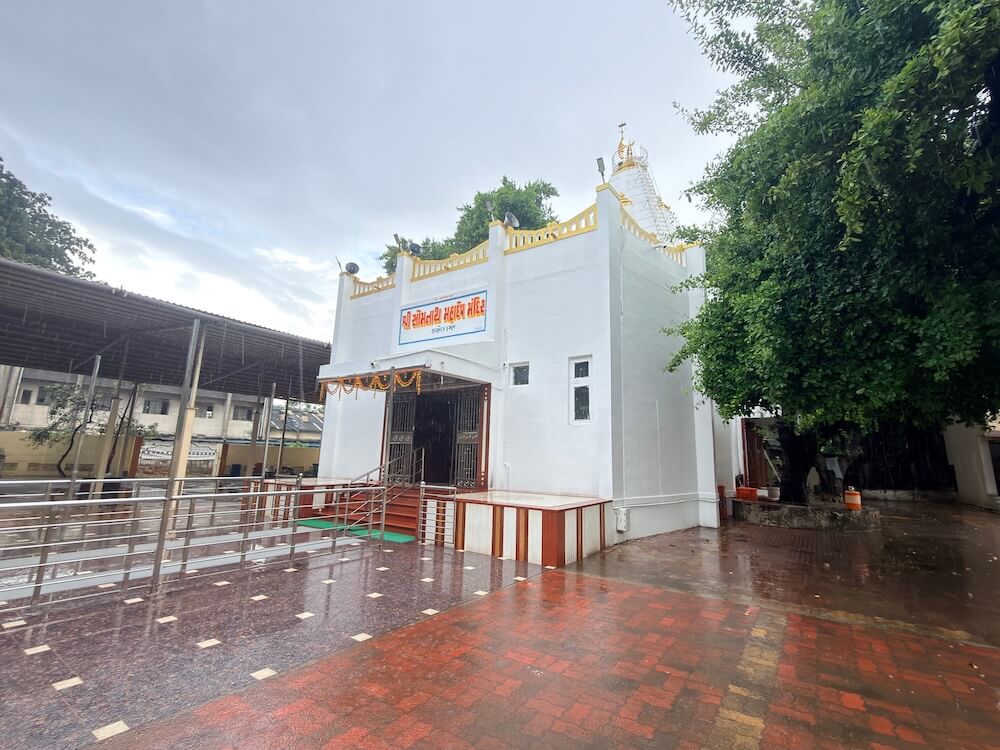
The shrine is reputed to be approximately 200 years old, having attained its contemporary form following an extensive restoration undertaken in the year 1972. Legend dictates that about two centuries ago, a solitary ascetic arrived at this secluded spot near Dabhel village and commenced rigorous penance to seek the divine audience of Somnath Mahadev. Initially observing a strict vow of silence, he remained absorbed in deep meditation. Subsequently, renouncing all sustenance and water, he prolonged his severe austerities for a period of twelve years. Gratified by this fierce devotion, Lord Mahadev manifested before the ascetic, bidding him to ask for any boon he desired. Thereupon, the ascetic supplicated, ‘O Lord, may You reside here permanently and fulfil the deepest aspirations of all the devotees who journey here to seek Your blessings.’ 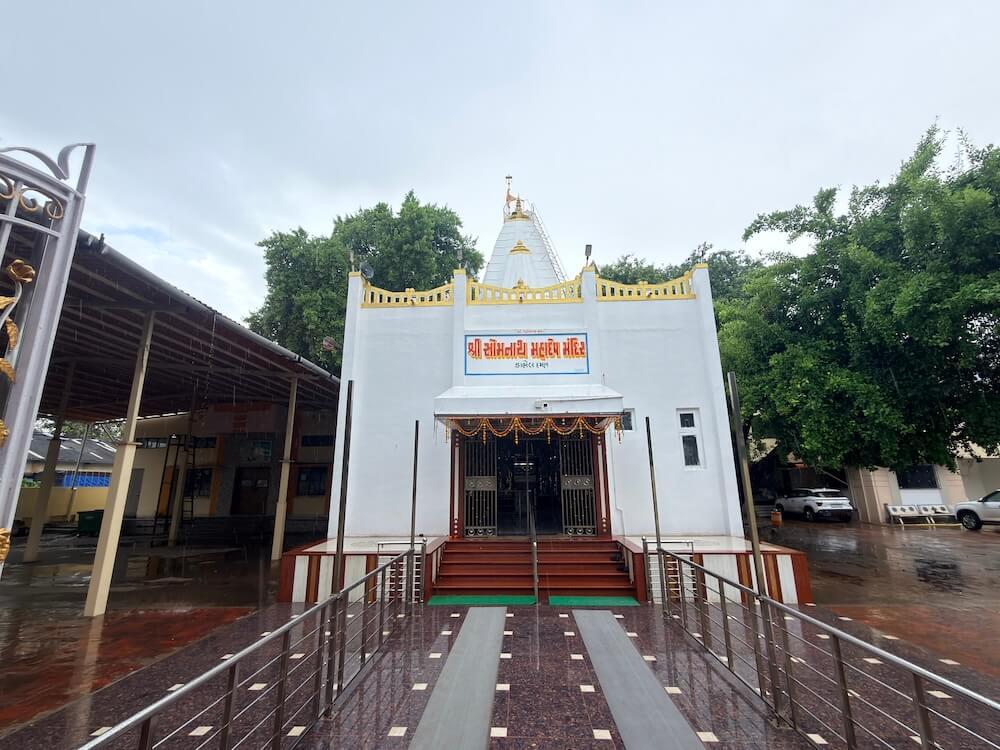 Granting the request with a divine ‘Tathastu’ (so be it), Mahadev consecrated Himself at the spot in the form of a Shiva Lingam. In due course, the holy ascetic erected a modest shrine here according to his means. As the miraculous experiences of the Lord’s divine presence spread, the devotees joined hands with the holy man to construct the grand temple structure that stands today.
The Somnath Mahadev Temple located in Prabhas Patan at Veraval in Gujarat is celebrated as one of the twelve sacred Jyotirlingas. It is traditionally believed that this Somnath Temple in Dabhel functions as an auxiliary seat (‘Upapitha’) of the Veraval shrine. The Puranas narrate a fascinating chronicle of Somnath Mahadev, in which Chandradev (the Moon God) was wedded to the 27 daughters of Prajapati Daksha. However, owing to his profound affection for Rohini, the Moon disproportionately favoured her, neglecting his other consorts. Feeling deeply aggrieved by this perceived injustice, the daughters conveyed their sorrow to their father. Greatly distressed by the anguish of his daughters, Prajapati Daksha pronounced a curse upon his son-in-law, causing the Moon to lose his divine lustre. To seek deliverance from this curse, the Moon entered into rigorous adoration of Lord Mahadev. Pleased with his devotion, Mahadev bestowed a boon upon the Moon, ordaining that his brilliance would wax for fifteen days and wane for the subsequent fifteen days. The word ‘Som’ signifies the Moon. Having regarded Mahadev as his Lord (‘Nath’), the Moon God institutionalised the name ‘Somnath’ for Mahadev from that epoch onwards.
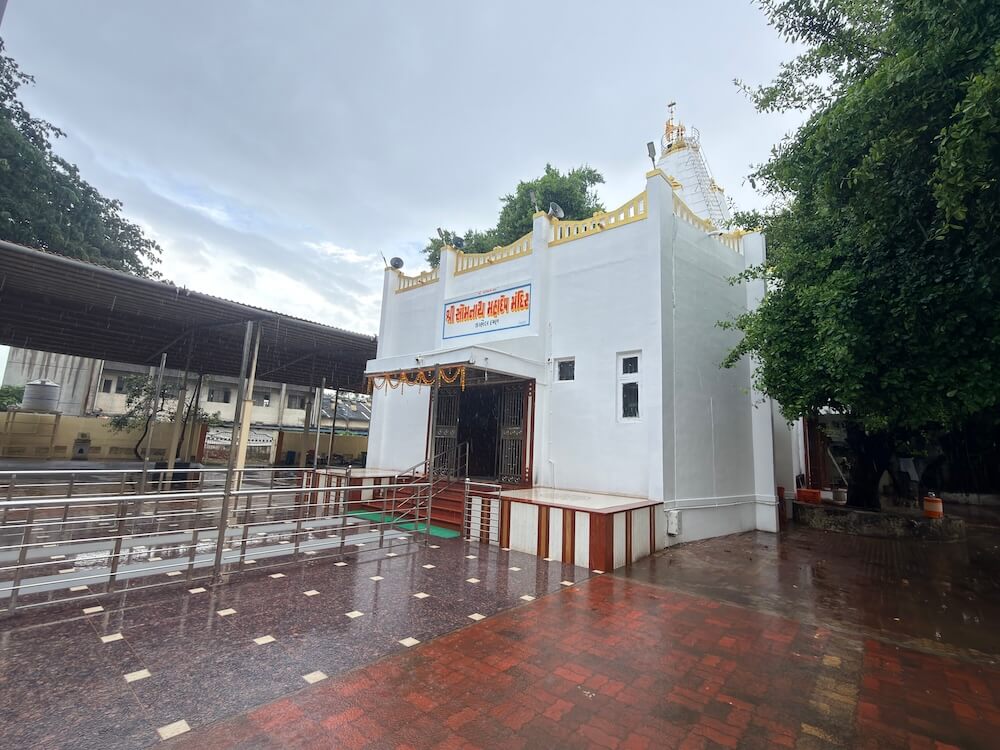
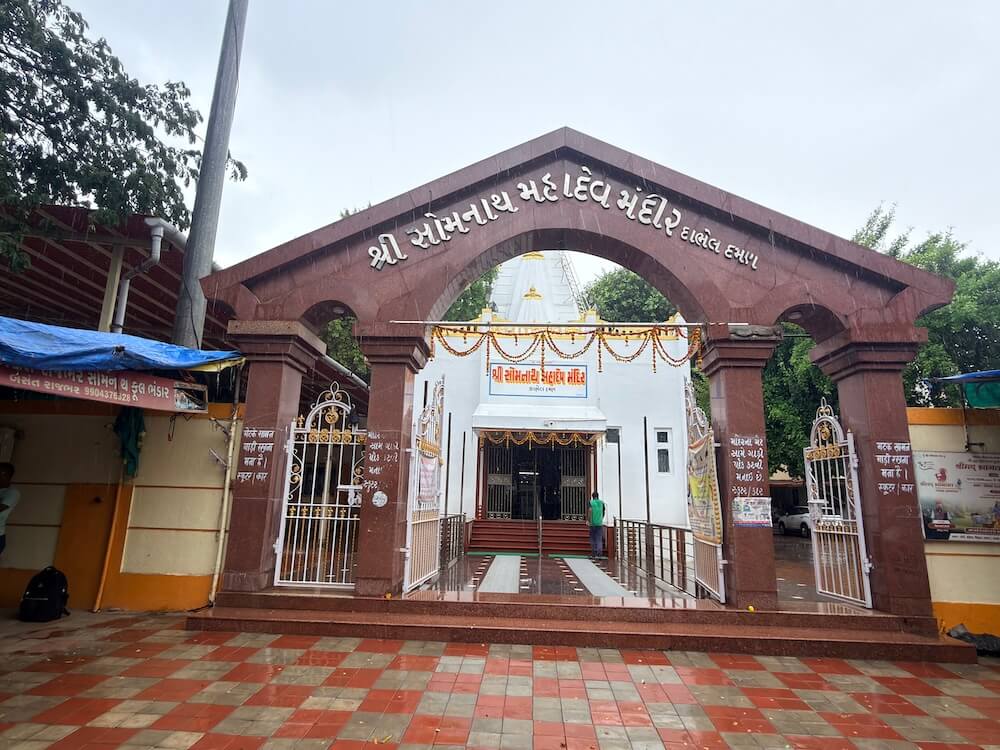 The temple at Dabhel is located next to the main road. Directly facing the shrine are numerous shops offering sacred articles for worship. The grand entrance way and a welcoming archway are set within the fortified ramparts enclosing the precinct, ushering visitors into the temple courtyard. This courtyard, meticulously laid with paver blocks, features comfortable seating for devotees’ leisure. Within the precinct lie the residential quarters of the priests and attendants, storage chambers, the administrative temple office and a pilgrims’ rest house (‘Bhaktanivas’).
The temple edifice is elevated upon a high plinth (‘Jagati’) rising approximately three feet above the ground level. The architectural composition of the shrine comprises a congregational hall (‘Sabhamandapa’) and three distinct sanctum sanctorums (‘Garbhagrihas’).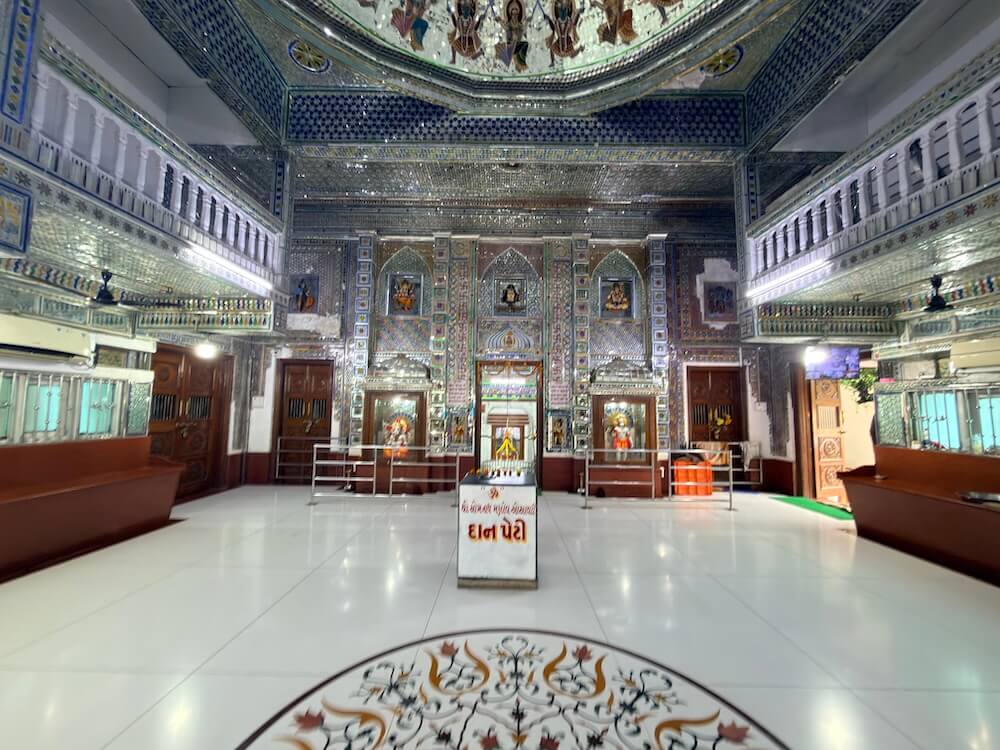 Owing to the elevated position of the entrance to the congregational hall relative to the courtyard, a flight of five steps is provided for access, flanked by protective balustrades on the left and right sides. The interior of this enclosed congregational hall features an exquisite glass ‘meenakari’ pattern adorning the walls and ceiling. Directly facing the entrance to the principal sanctum sanctorum in the hall, a majestic sculpture of Nandi rests upon a high pedestal (‘Vajrapitha’). Positioned ahead of the congregational hall in a horizontal alignment are the three sanctum sanctorums. As the thresholds of all three sanctums are elevated above the hall floor, a shared flight of steps extends across their entrances. The doorways of all three sanctums feature ornately carved door frames, with fine sculptures of Lord Ganesha on their lintels (‘lalatabimba’).
 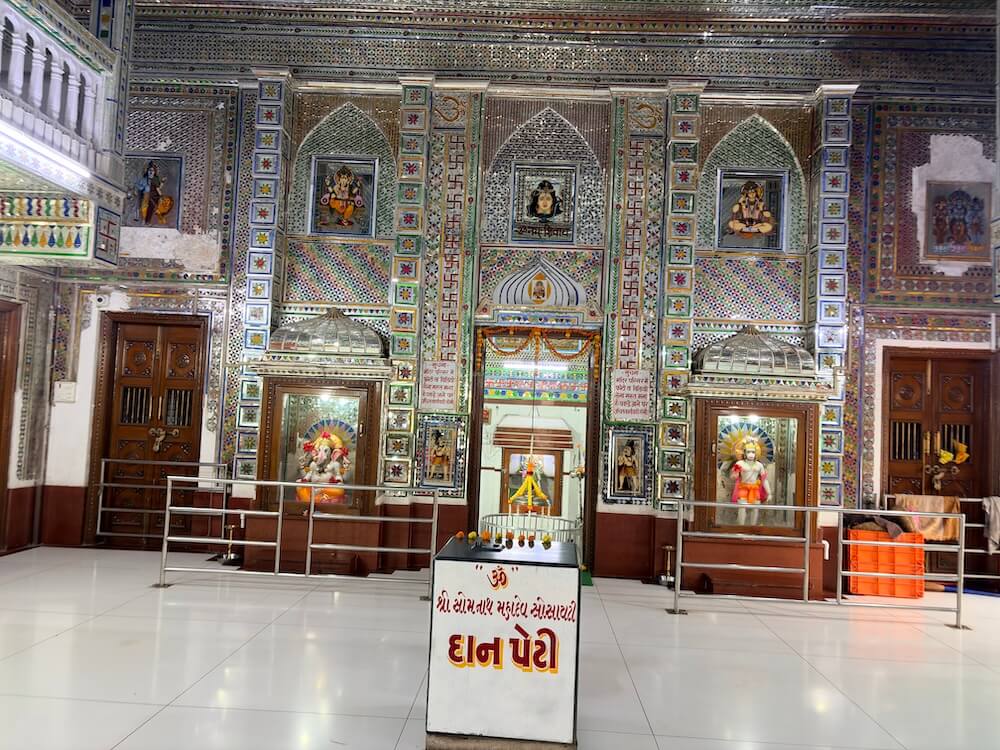 The facade walls, door frames, interior recesses and the ceilings of the sanctums are similarly embellished with elaborate glass mosaic decorations.
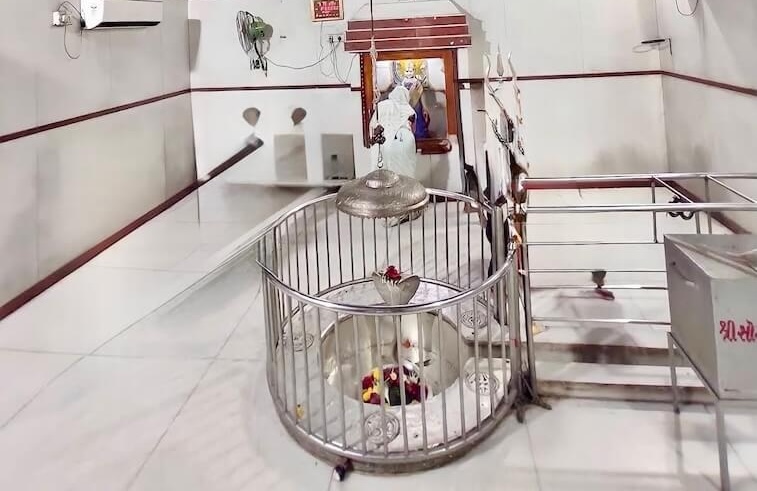
Enshrined upon the floor within the central main sanctum sanctorum is the sacred Shiva Lingam, surmounted by a brass canopy in the form of a multi-headed serpent. Suspended from the ceiling directly above is a brass anointing vessel (‘Abhishek Patra’). In the sanctum sanctorum situated to the left of the principal shrine, an idol of Lord Ganesha rests upon a dais, while the sanctum to the right houses an idol of Lord Hanuman upon a matching dais. A protective parapet wall runs along the perimeter of the temple roof. Rising above the principal sanctum sanctorum is the main spire, which stands approximately fifteen feet in height, designed in a square shape that tapers elegantly towards the apex. 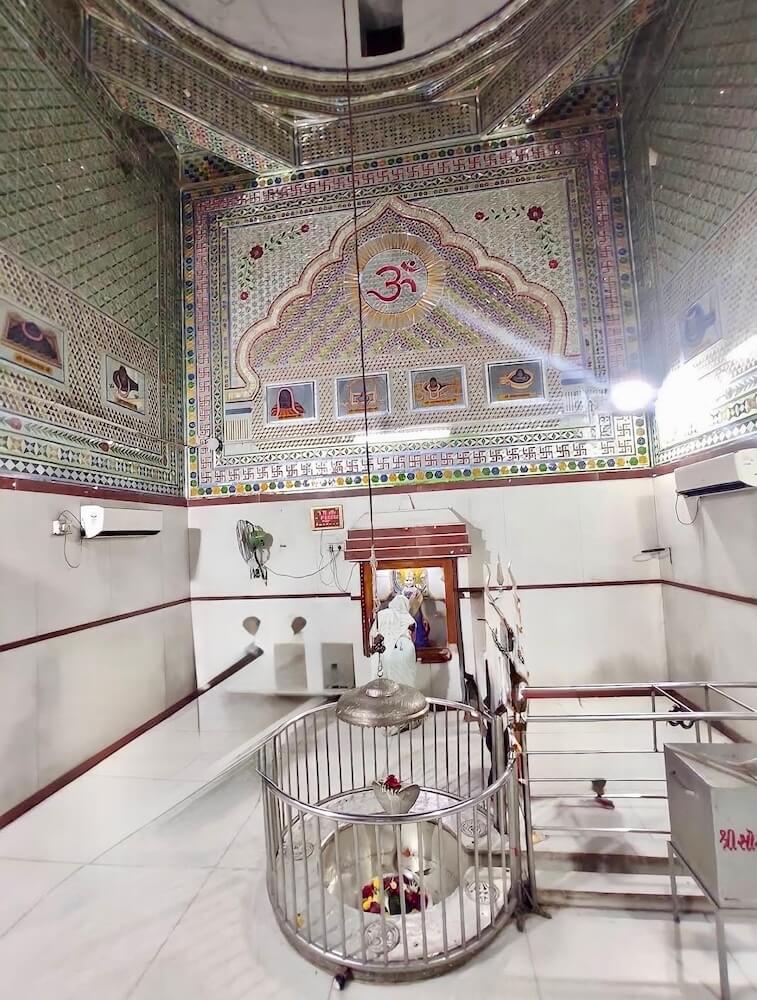 This primary spire is surrounded on all four sides by smaller clustered spires. The absolute summit of the spire is crowned with a finial structure (‘stupika’) and a sacred pot-finial (‘kalash’).
Makar Sankranti is the primary annual festival celebrated at the shrine, an occasion when thousands of devotees from the surrounding regions arrive to pay their respects. During this auspicious time, the faithful offer holy Ganges water and milk directly onto the Shiva Lingam. The temple similarly witnesses vast congregations of the faithful during Mahashivratri and on the Mondays of the holy month of Shravan. On special festive occasions, the devotees are granted the privilege of entering the inner sanctum to perform ritual anointings (‘abhishek’) directly upon the Shiva Lingam. During these festivals, the surrounding area transforms into a vibrant temporary bazaar, adorned with stalls selling diverse wares, generating commercial turnover in the hundreds of thousands of rupees. Furthermore, festivals such as Nag Panchami, Krishna Janmashtami, Dussehra and Diwali are celebrated here in strict accordance with traditional rites. During these grand celebrations, the temple organises a range of religious events, including Shivrudrabhishek, Laghurudra, Maharudra, chanting of the Mahamrityunjay mantra, devotional choruses (‘bhajans’ and ‘kirtans’), scripture readings and the distribution of sanctified food (‘Mahaprasad’). The shrine remains heavily thronged by devotees on Mondays and on the auspicious lunar dates of Ekadashi, Pradosh, Purnima and Amavasya. Devotees can seek the deity’s audience daily from 5 am to 1 pm and from 3:30 pm to 8 pm. Every Monday, the sacred arati is performed at 5 am and 7 pm. From Tuesday to Sunday, the morning arati is solemnised at 6 am, while the evening arati takes place at 7 pm.
Useful Information :
- Situated at a distance of 6 km from Daman
- State Transport (ST) bus facilities are available to Daman from several major cities across Gujarat.
- The temple can be conveniently accessed from Daman via ST buses and private vehicles.
- Accommodation and breakfast facilities are available in the surrounding vicinity.
सोमनाथ महादेव मंदिर
दाभेल, ताल. दमन, जिला. दमन
मंदिरे
Temples
मंदिर
-
सत्यनारायण मंदिर कथिरिया, तीन बत्ती, दमण
अधिक माहितीSatyanarayan Temple Kathiria, Teen Batti, Daman
View Detailsसत्यनारायण मंदिर कथिरिया, तीन बत्ती, दमन
विवरण देखें -
बाबा वासुकीनाथ महादेव मंदिर एअरपोर्ट रोड, भीमपूर, दमण
अधिक माहितीBaba Vasukinath Mahadev Temple Airport Road, Bhimpore, Daman
View Detailsविवरण देखें -
कंठेश्वर महादेव मंदिर काचीगाव, ता. दमण, जि. दमण
अधिक माहितीKantheswar Mahadev Temple Kachigam, Tal. Daman, Dist. Daman
View Detailsकंठेश्वर महादेव मंदिर कचीगाम, ताल. दमन, जिला. दमन
विवरण देखें