
गायत्री मंदिर
मेहसाणा, ता./जि. मेहसाणा
Gayatri Temple
Mehsana, Tal./Dist. Mehsana
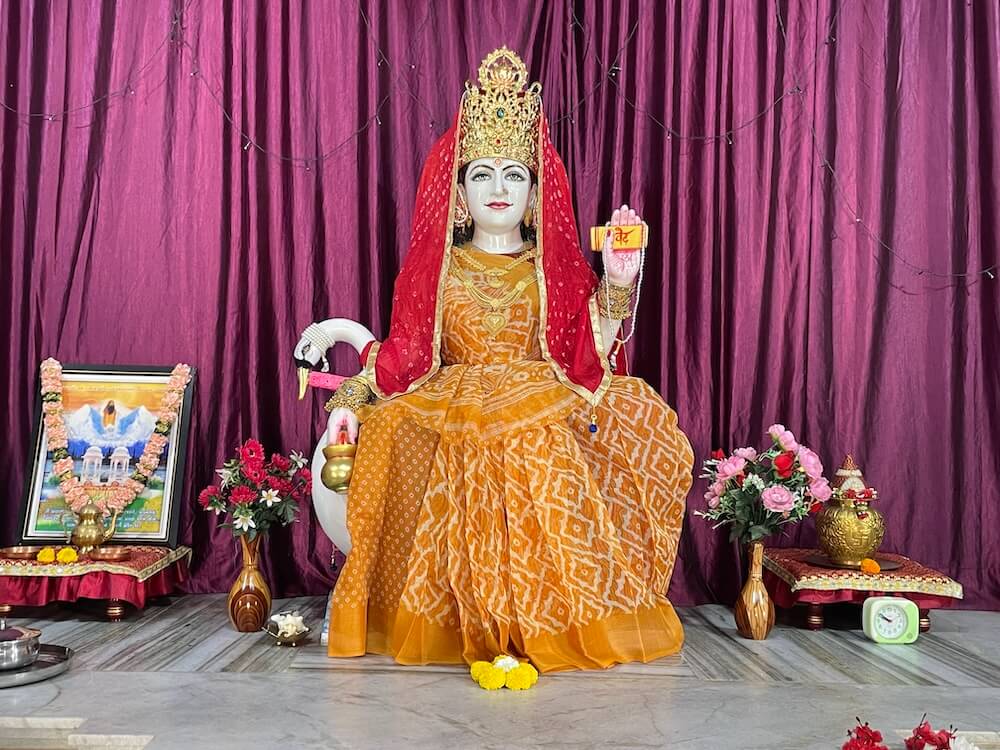 In the city of Mehsana, within the state of Gujarat, lies a celebrated temple dedicated to Goddess Gayatri. Serving as a pivotal regional hub for the ‘Akhil Vishva Gayatri Pariwar’, this sanctuary has attained immense religious significance across North Gujarat. The temple was established under the enlightened guidance of Pandit Shriram Sharma Acharya. As the city of Mehsana expanded during the latter half of the twentieth century, this edifice was raised through the collective contributions of local residents. Initially, the idol of Mother Gayatri was enshrined within a modest space. However, as the congregation of devotees burgeoned, the temple was expanded during the 1980s and 1990s, resulting in the current spacious structure.
 With the noble aim of ushering in a conceptual transformation and uplifting society, the great devotee of Gayatri, Vedmurti Taponishtha Pandit Shriram Sharma Acharya, founded the ‘Akhil Vishva Gayatri Pariwar’. He is also recognised as the pioneer of scientific spiritualism. Born on 20th September 1911 in a village near Agra into the household of a royal priest and landowner, he was initiated into the Gayatri Mantra at the tender age of fifteen by ‘Bharat Ratna’ Pandit Madan Mohan Malaviya, a freedom fighter and a founder of the Banaras Hindu University. Pandit Shriram Sharma Acharya, who actively participated in several movements launched by the Congress for independence, was also a prolific author. He established the ‘Gayatri Tapobhumi’ in Mathura, the ‘Akhand Jyoti Sansthan’ in Ghiyamandi and the ‘Brahmavarchas Research Institute’. The spiritual headquarters of the Gayatri Pariwar is situated at the ‘Shantikunj Ashram’ in Haridwar.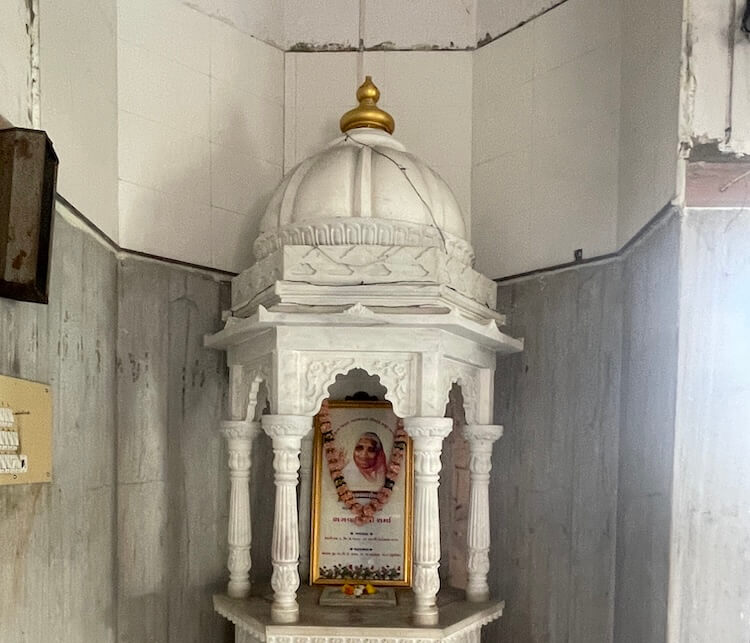
Goddess Gayatri is revered as one of the five forms of the primordial energy, Adi Shakti. Often worshipped as Vedmata, the Mother of the Vedas, her idols are found in either single-faced or three-faced forms in various locales. At the Gayatri Tirtha in Mehsana, a single-faced idol of Goddess Gayatri is consecrated. She is traditionally believed to be the bestower of strength and intellect. Consequently, many devotees make it a point to visit the temple with their young children. The ‘Shatapatha Brahmana’ scripture posits that Gayatri protected the ‘Gayas’ (the vital breaths or ‘Pranas’) and because she protected them, she came to be known as Gayatri. The ‘Brihad Yogi Yajnavalkya Smriti’ (4.16) further asserts that just as honey is the essence of flowers, 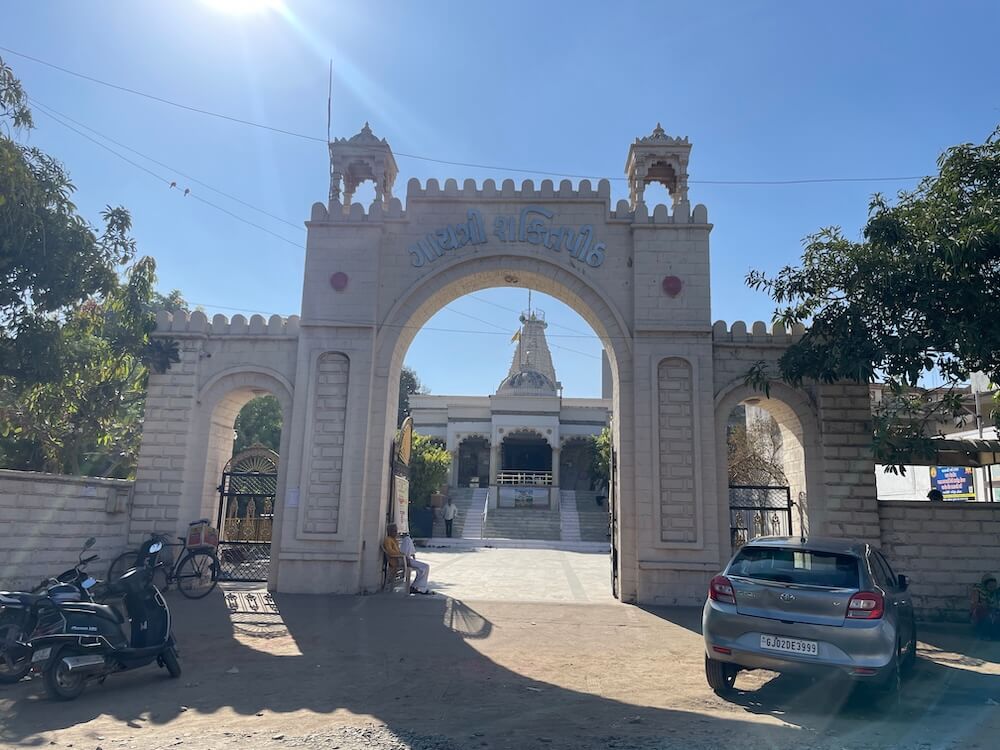 ghee the essence of milk and milk the essence of juices, so is Gayatri the essence of the Vedas. The Skanda Purana also declares Gayatri to be the mother of the Vedas and the Brahmanas. Brahma, Vishnu and Mahesh are considered the three padas (pillars) of Gayatri and she is worshipped by followers of both the Shaiva and Vaishnava sects.
According to religious scholars, Gayatri manifests in a triad of forms corresponding to the divisions of the day : Gayatri in the morning, Savitri in the afternoon and Saraswati at night. In the work ‘Gayatri Rahasyam’ by Pandit Veniram Sharma Gaud Vedacharya, it is mentioned that ‘Gayatri is a Vedic deity, intended for the worship of the Dvijas (the twice-born) alone and not for women or Shudras. Therefore, temples dedicated to Gayatri are not commonly found.’ 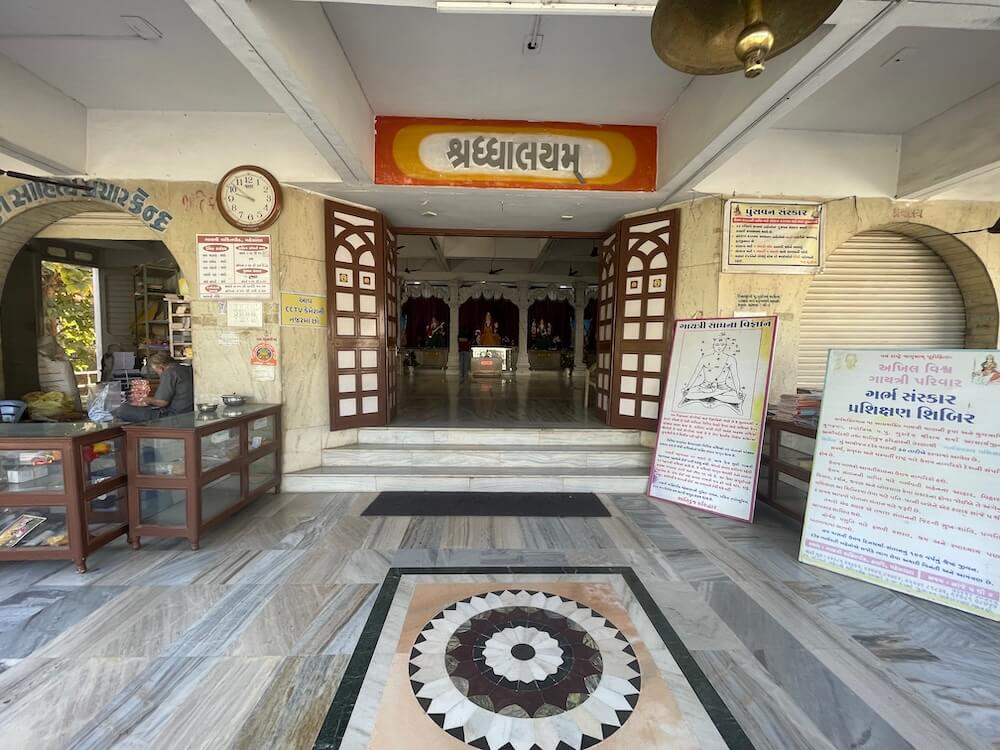 However, the Gayatri Pariwar has made the worship of Gayatri accessible to all. In all their temples, they primarily install the ‘single-faced’ Gayatri. The temple at Mehsana is no exception.
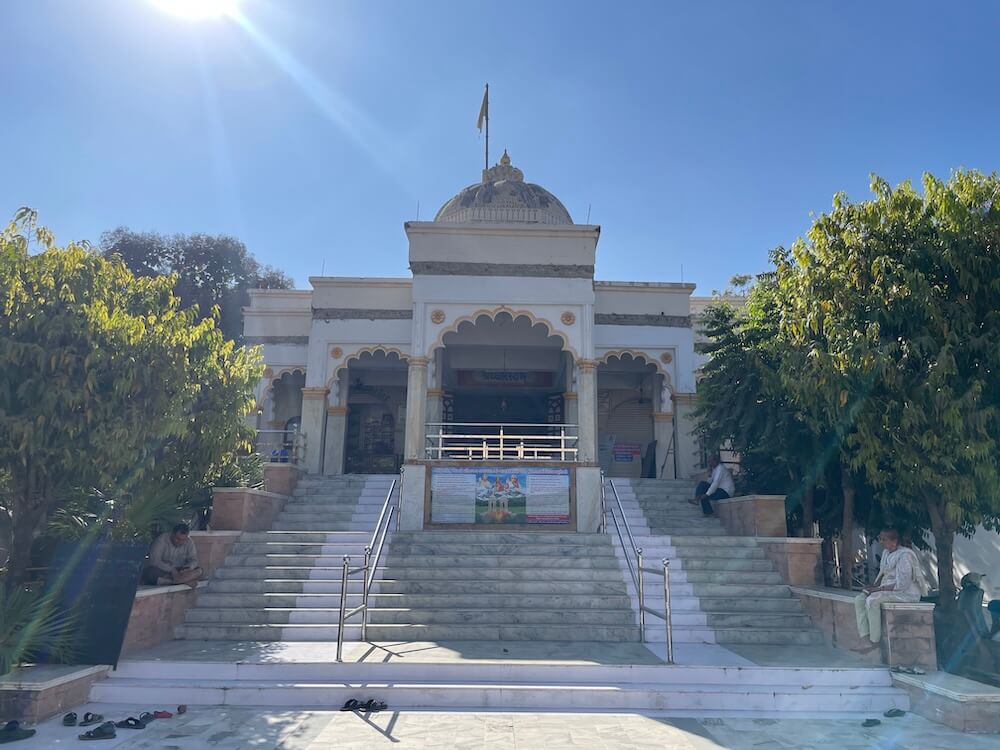
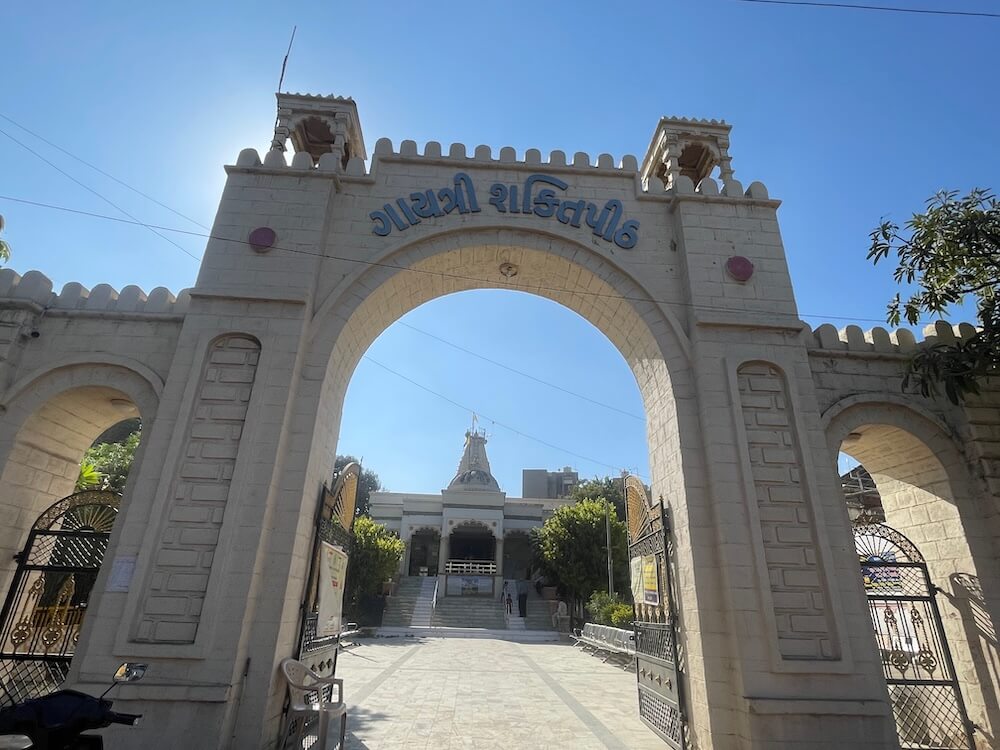
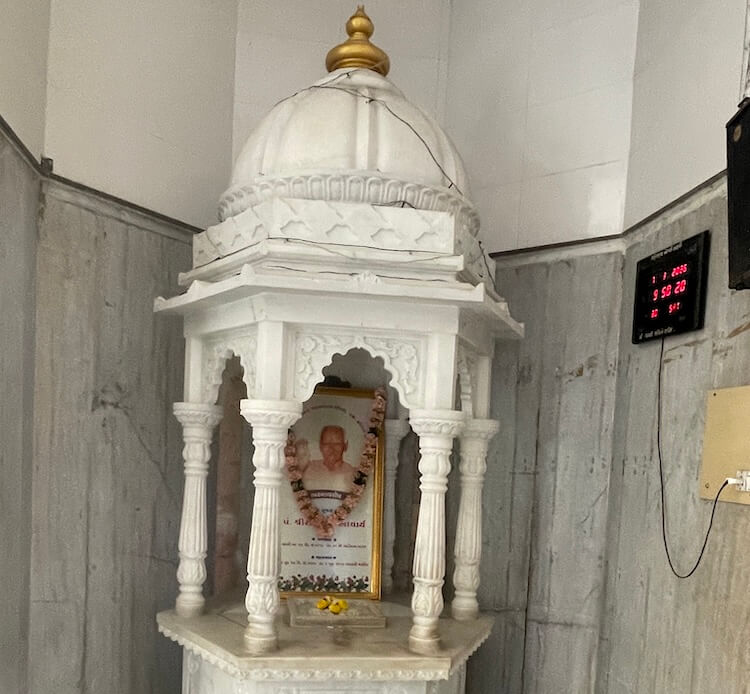
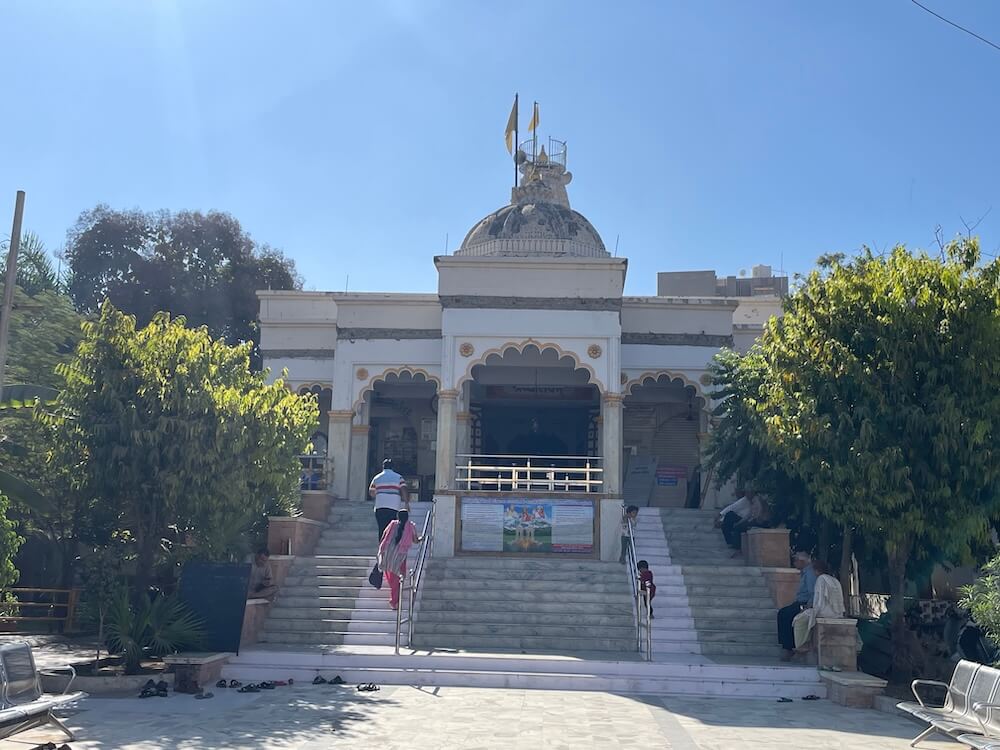
Constructed in the modern ‘Nagar’ style using cement and white marble, the precincts are entered through a grand gateway set within a surrounding wall. The courtyard is adorned with numerous trees and features seating arrangements for the convenience of the faithful. Located on the second floor, the temple comprises an entrance porch, an assembly hall, a vestibule and a sanctum sanctorum. One ascends approximately seventeen steps from the courtyard to enter the assembly hall.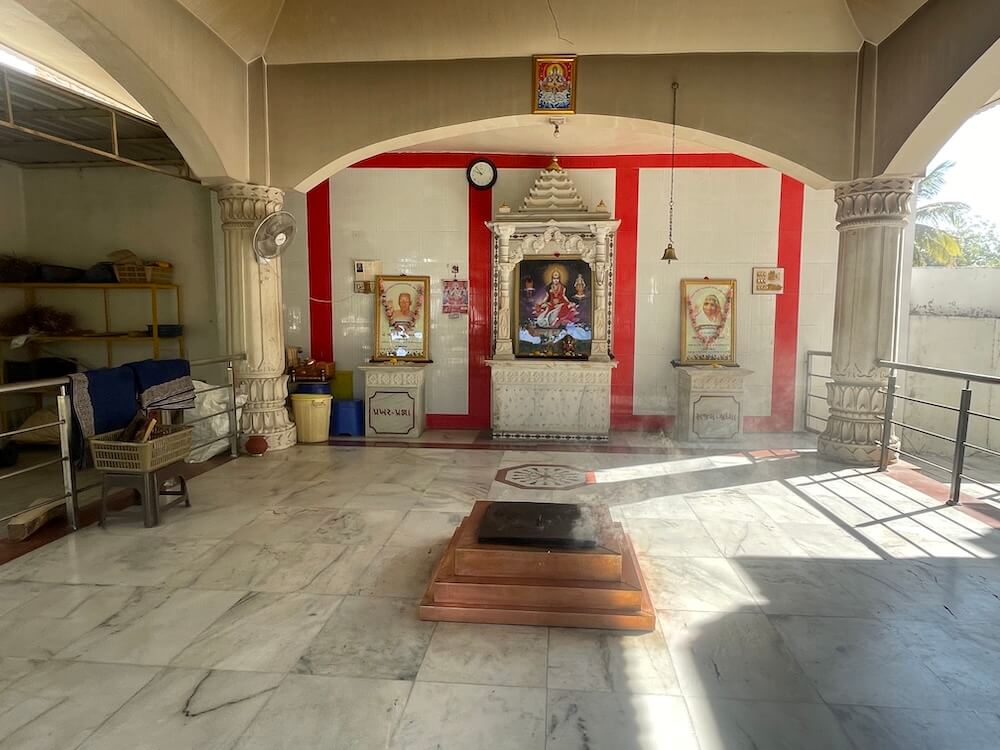 Uniquely, the architectural layout places the assembly hall before the viewing hall. This viewing hall, situated at the head of the stairway, houses a ‘Homakunda’ (sacrificial fire pit), while the assembly hall contains a ‘Prasad’ centre. From here, three steps lead to a slightly elevated and spacious vestibule. Within this vestibule, two marble pavilions house the ‘Padukas’ (sacred footprints) and portraits of the founder of the Gayatri Pariwar, Vedmurti Taponishtha Pandit Shriram Sharma Acharya and his wife, Mata Bhagwati Devi Sharma. Within the Gayatri Pariwar, Mata Bhagwati is affectionately and respectfully addressed as ‘Mataji’. Her contribution is regarded as being as great and inspiring as that of Pandit Shriram Sharma Acharya himself. She was not merely Panditji’s consort but the ‘Shakti’ and pillar of this entire spiritual revolution. Following Panditji’s passing, she led the global Gayatri Pariwar from 1990 to 1994, expanding the movement with renewed vigour.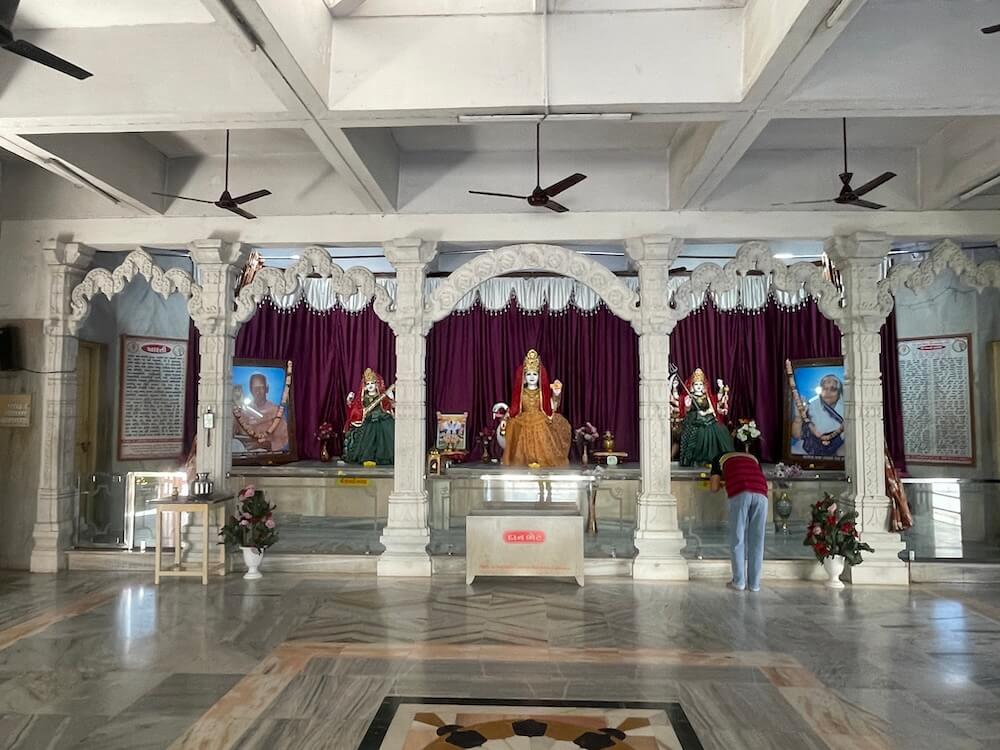
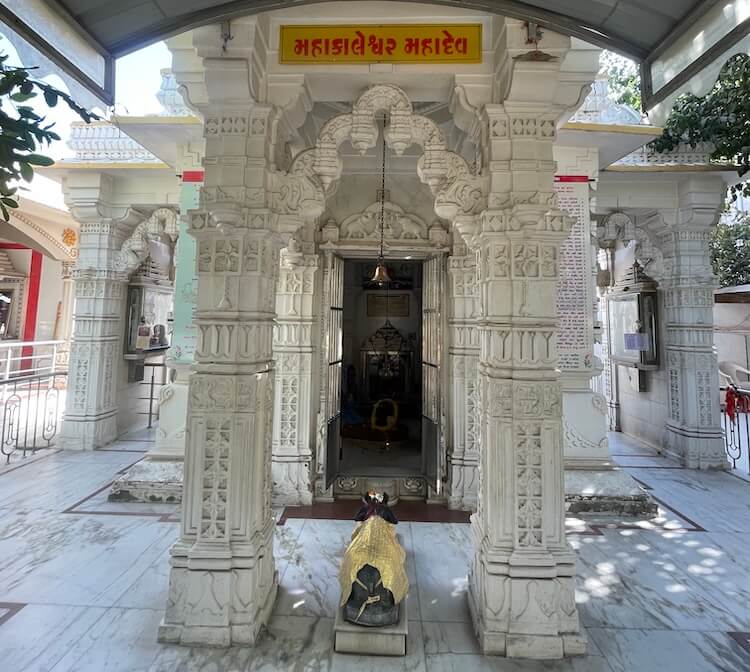
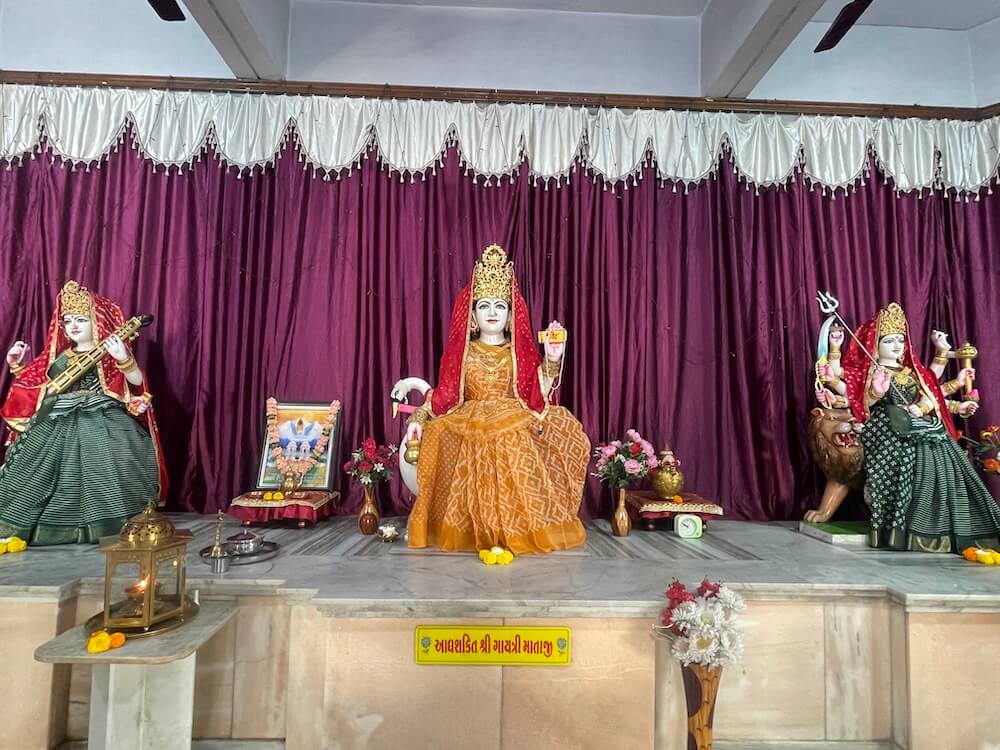
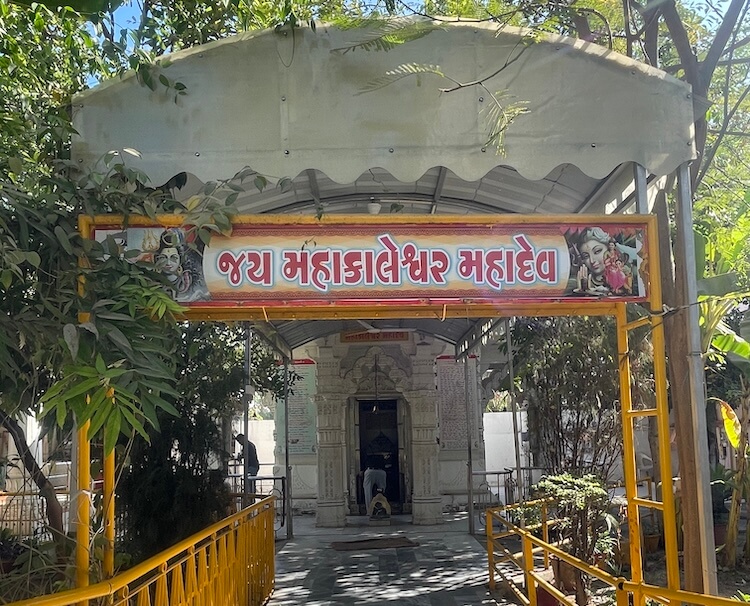
Within the sanctum sanctorum, a pristine white marble idol of Mother Gayatri is enshrined upon a large ‘Vajrapitha’ (pedestal). To the right of Goddess Gayatri sits Mother Saraswati and to her left, Mother Jagdamba. Portraits of Pandit Shriram Sharma Acharya and ‘Mataji’ Bhagwati Devi Sharma are placed beside the idols on this pedestal. Also located within the temple complex is a shrine dedicated to Mahakaleshwar Mahadev. Built of white marble, it consists of an open assembly hall, a vestibule and a sanctum sanctorum. An idol of Nandi sits on a platform in the assembly hall, while the Shivalinga of Mahakaleshwar resides in the sanctum.
 At the Gayatri Shaktipeeth in Mehesana, devotees may seek blessings between 5:15 am and 11:30 am and from 4:00 pm to 9:00 pm. Daily rituals include morning prayers, ‘Aarti’, collective Gayatri chanting and ‘Yagna’, while the evenings are dedicated to ‘Nad-yoga’ meditation. The sixteen ‘Sanskaras’ (sacraments), such as naming ceremonies, weddings and the commencement of education, are performed here according to Vedic traditions. Notably, the ‘Punsavan’ sacrament is conducted every Sunday and a ‘Garbha-sanskar’ training camp for expectant mothers is organised on the 30th of every month.
Amongst the religious festivals, Gayatri Jayanti in the month of Jyeshtha, the Navratra observances, Shiva worship in Shravan and educational sacraments on Vasant Panchami are of significant importance. Alongside worship, the centre places a heavy emphasis on social welfare. On festive occasions, the centre organises blood donation camps, free health check-ups and tree-planting drives and disseminates messages on de-addiction. Constructive initiatives include celebrating Diwali with only oil lamps rather than fireworks and donating food and clothing to the needy during Makar Sankranti. Furthermore, through the Pragya Library, book distribution, free homoeopathic treatment and lectures on moral values, this Shaktipeeth consistently strives to advance society.
Useful Information
- Located at 2 km from Mehesana Bus Station.
- GSRTC bus services connect Mehesana to numerous cities across the state.
- Private vehicles can access the temple premises directly.
- Several accommodation and breakfast options are available in the vicinity.
- Contact – Temple Office, Mob.- 94276 81832
गायत्री मंदिर
मेहसाणा, ताल./जिला. मेहसाणा
मंदिरे
Temples
मंदिर
-
वैजनाथ महादेव मंदिर महादेवपुरा (गावडा), ता. विजापूर, जि. मेहसाणा
अधिक माहितीVaijnath Mahadev Temple Mahadevpura (Gavada), Tal. Vijapur, Dist. Mehsana
View Detailsवैजनाथ महादेव मंदिर महादेवपुरा (गावड़ा), ताल. विजापुर, जिला. मेहसाणा
विवरण देखें -
वैजनाथ महादेव मंदिर सोखडा, तालुका विजापूर, जिल्हा मेहसाणा
अधिक माहितीVaijanath Mahadev Temple Sokhada, Taluka Vijapur, District Mehsana
View Detailsवैजनाथ महादेव मंदिर सोखाडा, तालुका विजापुर, जिला मेहसाणा
विवरण देखें -
काशी विश्वनाथ महादेव मंदिर मेहसाणा, जि. मेहसाणा
अधिक माहितीKashi Vishwanath Mahadev Temple Mehsana, Dist. Mehsana
View Detailsकाशी विश्वनाथ महादेव मंदिर मेहसाणा, जिला. मेहसाणा
विवरण देखें