
Meldi Mata Temple
Nandasan, Tal. Kadi, Dist. Mehsana
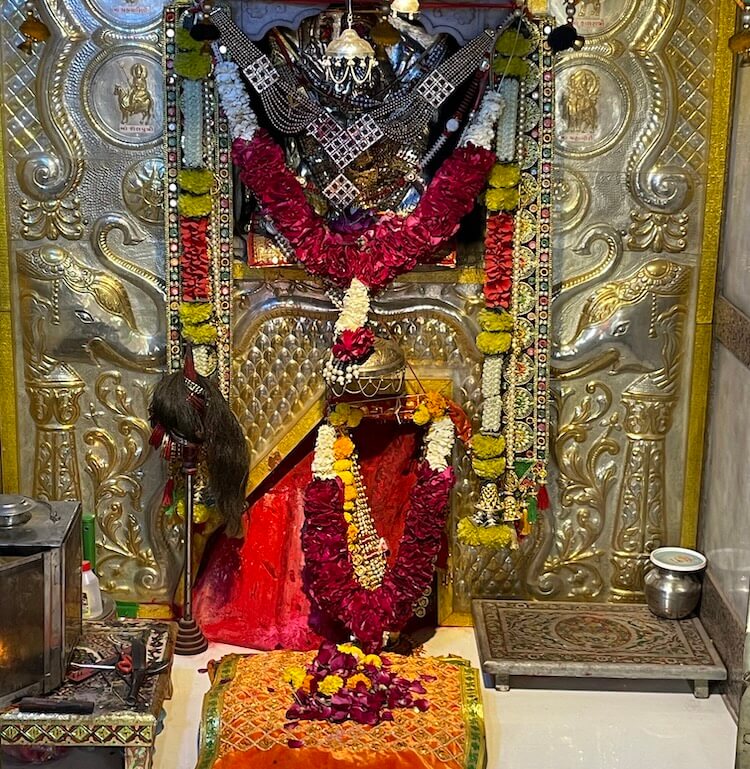 The shrine of Meldi Mata in Nandasan village stands as a profound testament to Hindu-Muslim unity. Legend has it that four centuries ago, a member of the Muslim community brought a sacred stone to the village. At that moment, a divine ‘Akashwani’ (heavenly voice) resonated, proclaiming that the Goddess resided within that very stone. Since that celestial occurrence, the Muslim brethren of the region have reposed as much unwavering faith in the Goddess as their Hindu counterparts. Known affectionately as ‘Sayyid nu Meldi’, the Muslim community participates with immense fervour in the daily ‘aarti’ (ritual of light) and the various festivals celebrated here.
Meldi Mata is revered as a manifestation of Goddess Durga. Tales of her divinity have been carried through generations via local Gujarati manuscripts, ‘Dakla’ (devotional folk music) and the rich oral traditions of the Charan-Bhat community. According to these ancient chronicles, Goddess Parvati once waged a celestial war to annihilate a demon named Amruva. 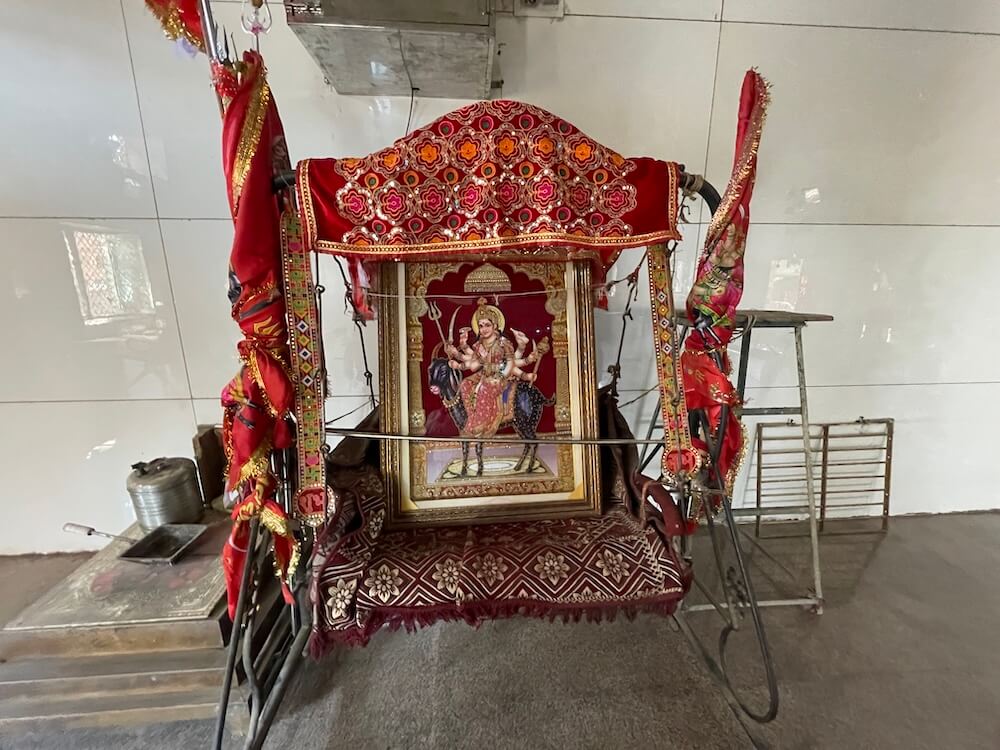 Sensing his imminent defeat, the demon sought refuge beneath the hide of a dead cow. Standing at a distance from such an impure site, the Goddess, in a state of divine wrath, rubbed her palms together. From the ‘mal’ (slough or dirt) of her hands, Meldi Mata emerged in the form of a five-year-old maiden and slayed the demon Amruva. Pleased by this feat, Umadevi sent Meldi Mata to Chamunda Mata, who subsequently dispatched her to Kamakhya to destroy malevolent forces. Before vanquishing the wicked powers of the tantrics there, the Goddess transformed the ghosts and spirits in their possession into a goat, which she then chose as her ‘vaahan’ (mount). Witnessing her valour, Jagdamba Mata manifested in her ‘Navdurga’ (nine forms of Durga) persona and granted a boon, that ‘In the Kali Yuga, thou shalt be renowned as the Goddess who destroys impurities—the internal enemies of lust, anger, ego, greed, attachment and envy.’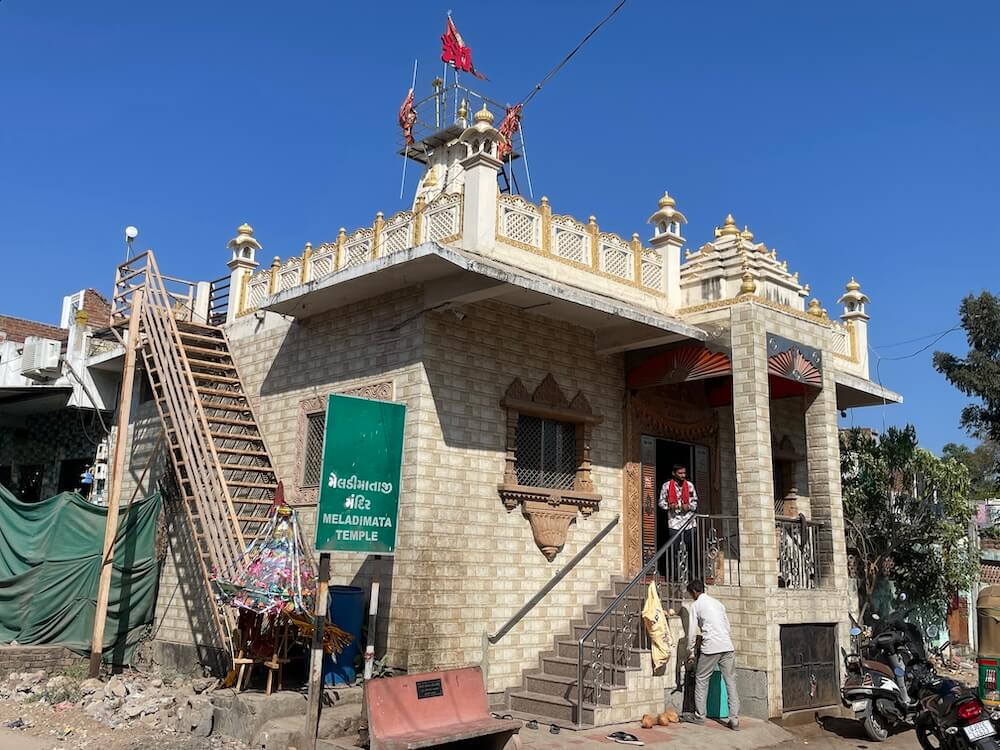
While many temples dedicated to Meldi Mata are spread throughout the state, the legend of her arrival in Nandasan is particularly captivating. For centuries, the Hindu and Muslim communities have resided in Nandasan in perfect harmony. In those bygone days, the village had a significant population of the Sayyid community. A gentleman from this community had travelled to a neighbouring town on business. Whilst returning home by bullock cart, he chanced upon a stone that felt singularly unique. He placed the stone in his cart, but as soon as he entered the village, the vehicle came to a sudden halt. Despite every effort, the bullocks could not move the cart an inch further. It was then that a divine voice spoke, declaring, ‘I reside within this stone. 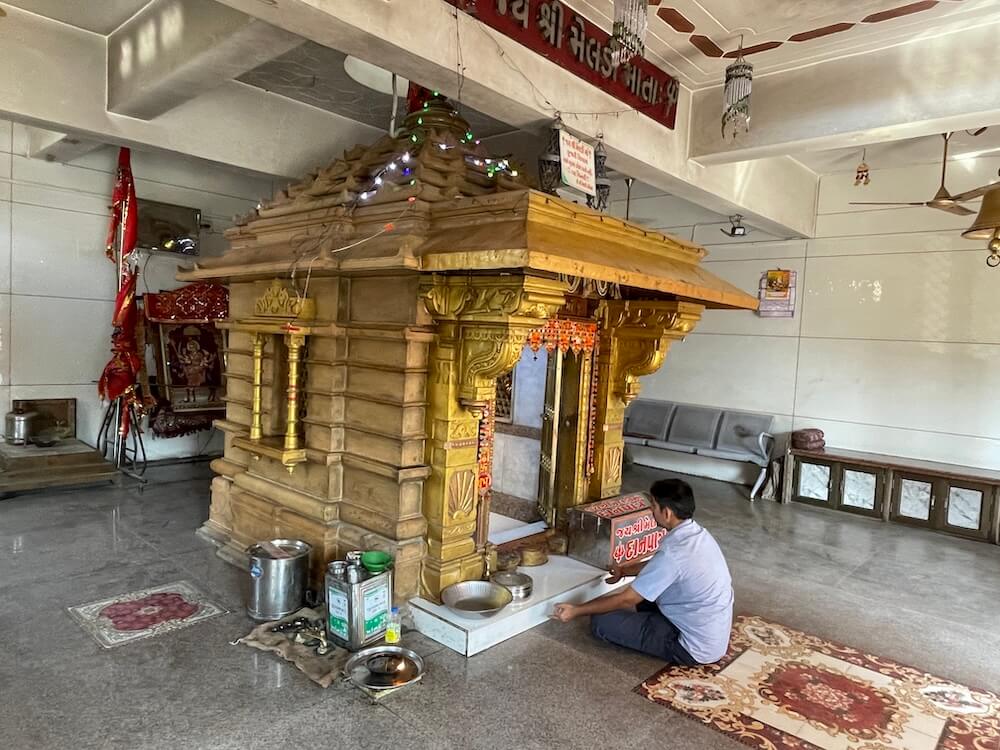 Consecrate me here.’ Following this divine command, the Hindu villagers constructed a modest shrine and performed the ‘vidhivat pratishthapana’ (formal consecration) of the stone. The fame of the Goddess as a ‘jagrut devta’ (awakened or living deity) soon spread throughout the surrounding regions, drawing throngs of devotees to her threshold.
Originally, the sanctum of the Goddess was situated approximately two feet below ground level. During a recent restoration of the temple, the sacred stone was elevated several feet from its original position. Directly opposite the temple stands the ‘Badi Masjid’ (the Great Mosque). Despite its elevated stature, the temple maintains a charmingly modest architectural form, comprising a ‘sabhamandap’ (assembly hall) and a ‘garbhagriha’ (sanctum sanctorum). 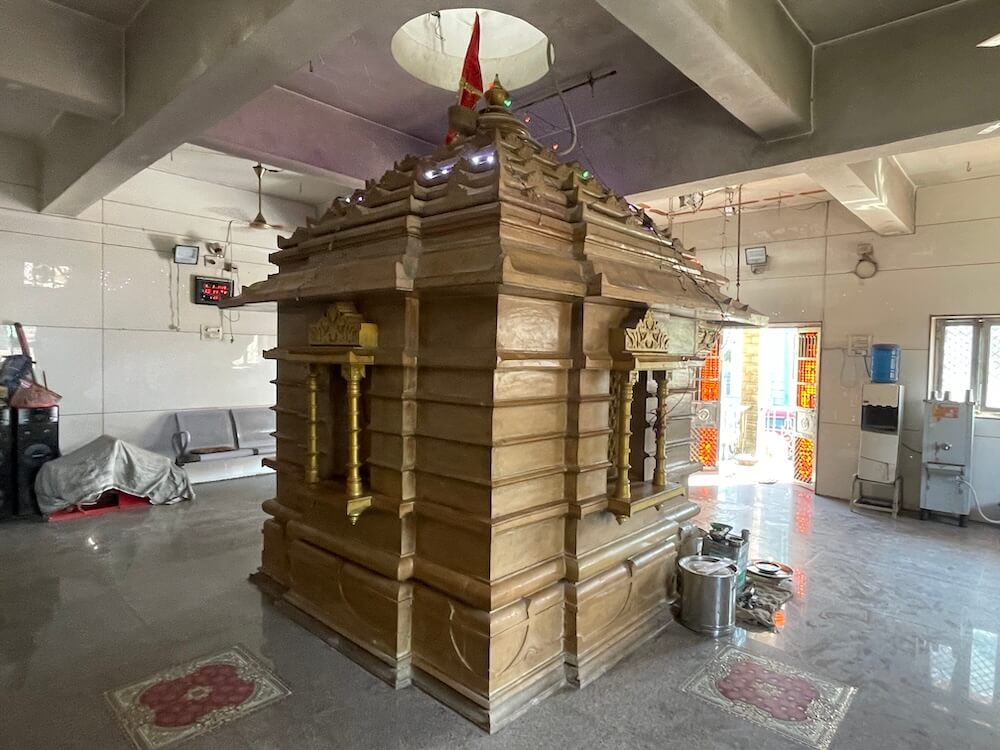 Within the sanctum, the original sacred stone sits at the base, while above it is enshrined an image of the Goddess exquisitely embossed on a metallic sheet. In a ‘devkoshtak’ (niche) in the left corner of the assembly hall, three small wooden horses are kept. Behind the sanctum, an image of the Goddess rests within a cradle and a small ‘yagnyakunda’ (sacirficial fire pit) is located nearby. Devotees flock here in great numbers, particularly on Sundays, Tuesdays and ‘Purnima’ (full moon days), to seek the blessings of this potent deity. Pilgrims are offered ‘sukhadi’ (a traditional sweet) as ‘prasad’ (consecrated offering). The temple remains a hive of religious activity throughout the year, with the Sharadiya Navratra festival being the most significant event, featuring various elaborate rituals over the nine sacred days.
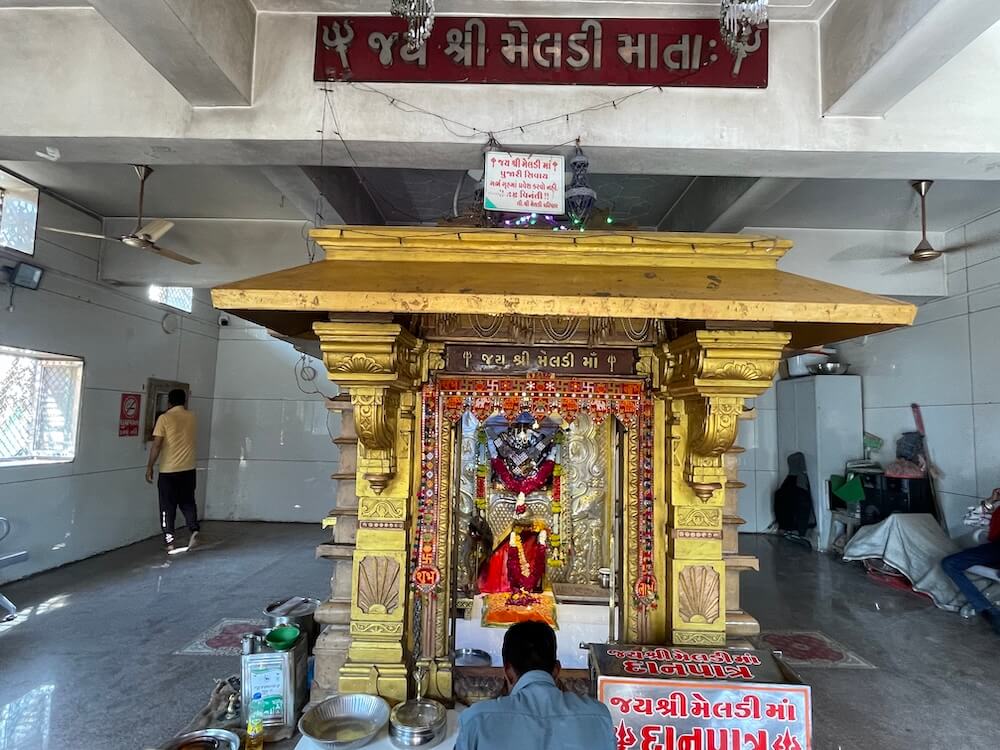
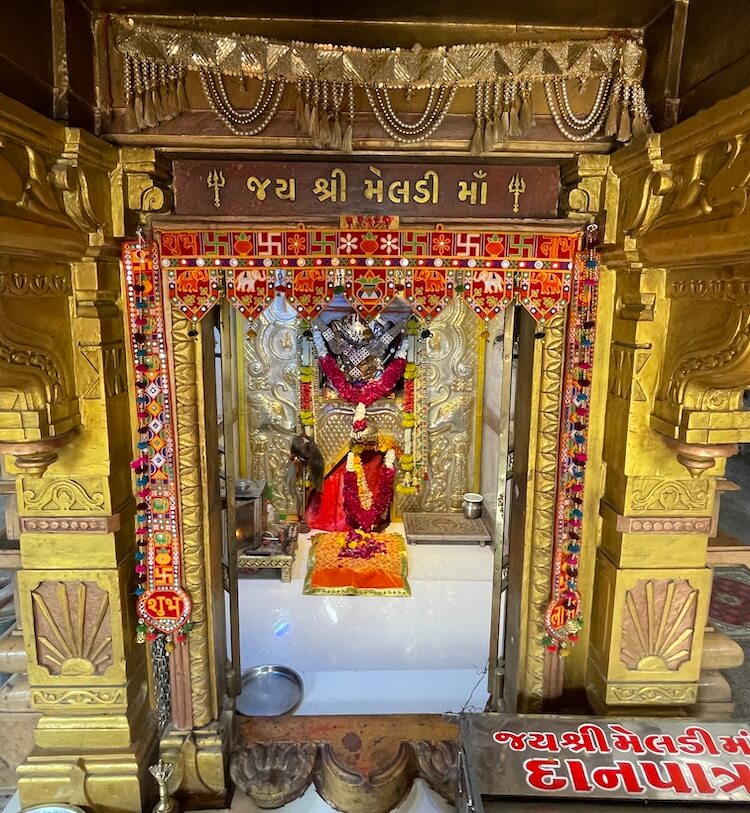 Furthermore, a second temple of Meldi Mata is situated in the Uma Nagar locality of Nandasan. As this area is somewhat distant from the original settlement, making daily visits difficult for local residents, the devotees of Uma Nagar erected a new temple near the Nandasan bridge on the Mehsana-Ahmedabad highway. An ‘akhand jyot’ (eternal flame) was brought from the original shrine to light the way for the new temple, where the idol was formally consecrated on 13 December 1998. This new edifice is grander in scale than the original, featuring a sophisticated architectural layout consisting of a ‘Mukhamandap’ (entrance porch), ‘Ardhamandap’ (half-hall), an open ‘Sabhamandap’, an ‘Antarala’ (vestibule) and the ‘Garbhagriha’.
Within the sanctum, a captivating idol of the Goddess, mounted upon a goat, resides within an ornate ‘makhar’ (canopy). The eight-armed deity holds various ‘ayudhas’ (divine weapons), including a trident, a discus, a sword and a mace. One hand holds a ‘kumbh’ (sacred pot), while another is held in the ‘abhaya mudra’ (the gesture of fearlessness). The smiling Goddess is adorned with a magnificent golden crown. Much like the original shrine, this temple hosts numerous spiritual programmes. During Sharadiya Navratra, the ‘Ghatsthapana’ (ritual installation of the sacred jar) is performed, followed by nine days of religious ceremonies and ‘Garba’ dances. The temple’s ‘Patotsav’ (anniversary festival) is celebrated with great solemnity every December. The temple is open for pilgrims and devotees every day from 6 am to 8 pm.
Useful Information
- Located at 14 km from Kadi town and 30 km from Mehsana.
- State transport (GSRTC) buses and private vehicle services are available from Kadi.
- Private vehicles can access the temple directly.
- Accommodation and breakfast facilities are available in the vicinity.
मेलडी माता मंदिर
नंदासन, ताल. कड़ी, जिला. मेहसाणा
मंदिरे
Temples
मंदिर
-
वैजनाथ महादेव मंदिर महादेवपुरा (गावडा), ता. विजापूर, जि. मेहसाणा
अधिक माहितीVaijnath Mahadev Temple Mahadevpura (Gavada), Tal. Vijapur, Dist. Mehsana
View Detailsवैजनाथ महादेव मंदिर महादेवपुरा (गावड़ा), ताल. विजापुर, जिला. मेहसाणा
विवरण देखें -
वैजनाथ महादेव मंदिर सोखडा, तालुका विजापूर, जिल्हा मेहसाणा
अधिक माहितीVaijanath Mahadev Temple Sokhada, Taluka Vijapur, District Mehsana
View Detailsवैजनाथ महादेव मंदिर सोखाडा, तालुका विजापुर, जिला मेहसाणा
विवरण देखें -
काशी विश्वनाथ महादेव मंदिर मेहसाणा, जि. मेहसाणा
अधिक माहितीKashi Vishwanath Mahadev Temple Mehsana, Dist. Mehsana
View Detailsकाशी विश्वनाथ महादेव मंदिर मेहसाणा, जिला. मेहसाणा
विवरण देखें