
Dholeshwar Mahadev Temple
Randesan, Tal. / Dist. Gandhinagar
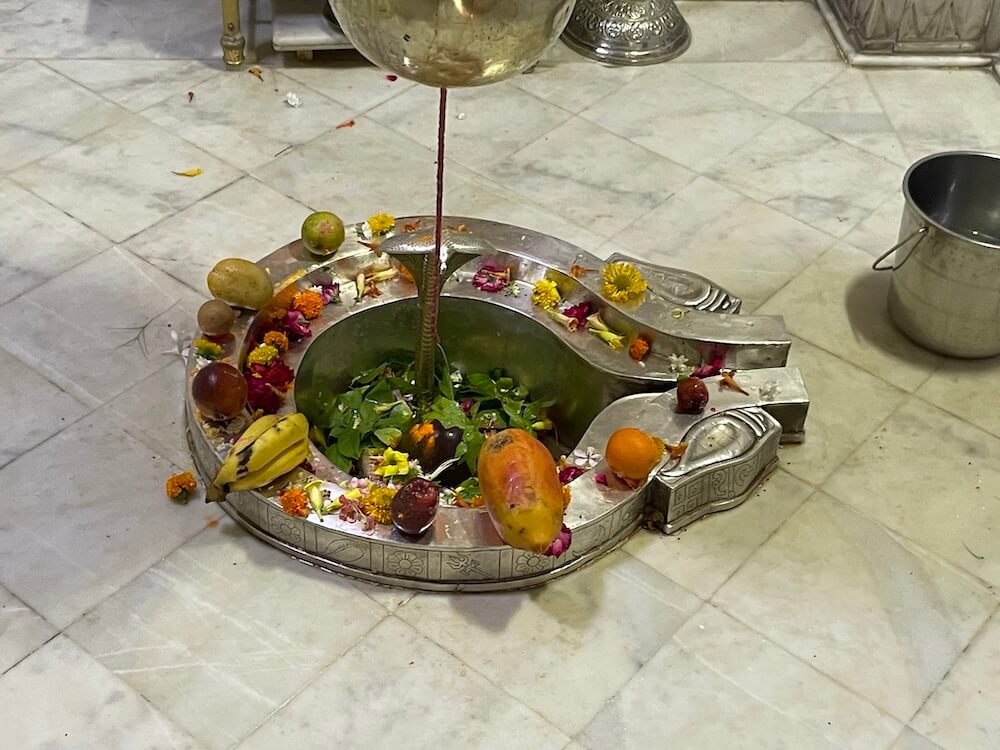 According to ancient legend, the temple of Dholeshwar Mahadev, located on the banks of the Sabarmati River in Randesan, marks the spot where Lord Indra established a Shiva lingam after bathing in the sacred river to absolve the sin of Brahmahatya (the killing of a Brahmin). It is believed that after the ritual bath, Indra’s complexion turned radiant white (dhaval) and thus this temple came to be known as Dholeshwar Mahadev. The lingam established by Indra is also referred to as Indreshwar Mahadev or Dhvaleshwar Mahadev. Devotees believe that bathing in the Sabarmati (considered as the daughter of sage Kashyapa) followed by darshan of Dholeshwar is equivalent to the merit gained by bathing in the Ganga and visiting Kashi Vishwanath.
This sacred site, often referred to as the ‘Kashi of Gujarat’, 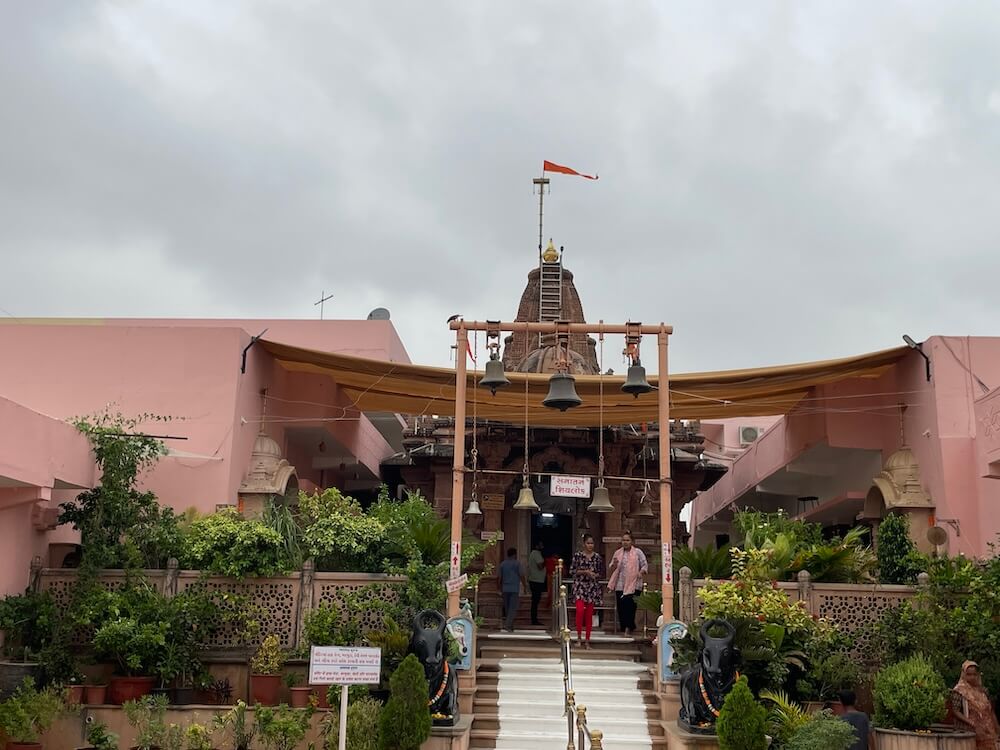 finds mention in the Padma Purana’s Uttarakriya Khand (Chapter 151) and in the Skanda Purana’s Dharmaranya Khand, in the sections about the establishment and glory of Indreshwar. The Padma Purana narrates that the king of gods, Indra and the demon king Namuchi once vowed to defeat each other without using weapons. Acting on a divine voice, Indra used the foam of the sea to slay Namuchi, which led to him incurring the grave sin of Brahmahatya. On seeking advice from his guru Brihaspati, Indra was told to bathe in the waters of Sabarmati at the sacred site of Indragaon. After doing so, the sin left him and his body radiated with a moon-like glow. In gratitude and penance, Indra established a Shiva lingam at that very spot.
Another legend tells of a cow that would mysteriously release milk at a particular spot each day.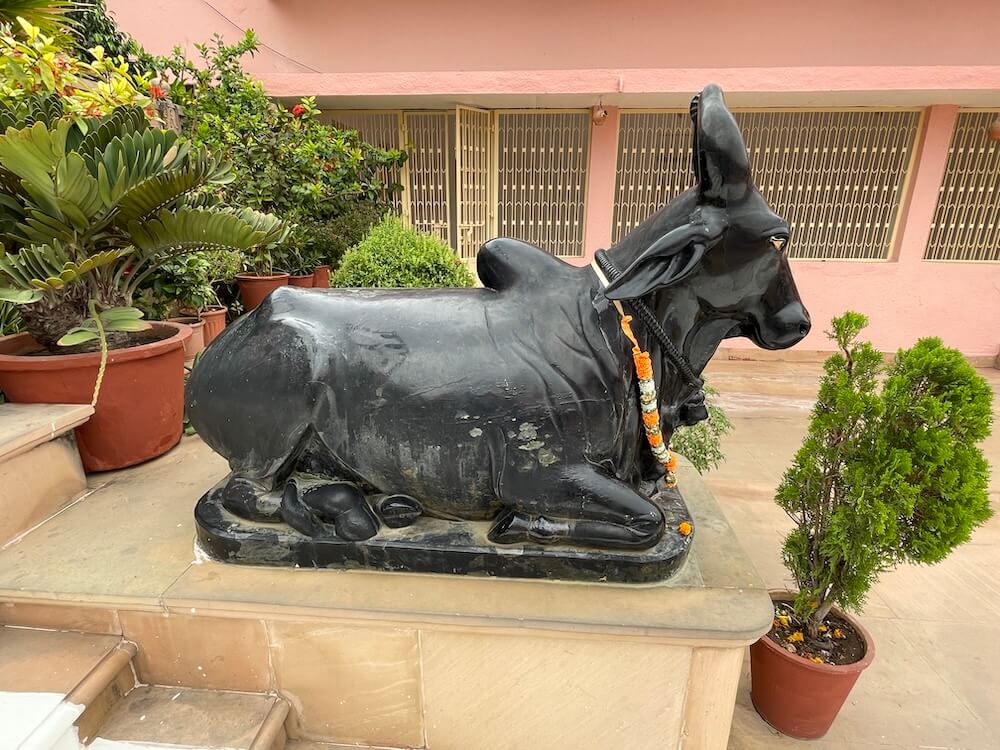 Eventually, a white-colored Shiva lingam was discovered there and owing to its hue, the name Dholeshwar became attached to it. One more story adds to the sanctity of this site. During the reign of Malharrao Gaekwad (1870–1875) in Baroda, soldiers caught sight of thieves stealing horses from the royal stables. The thieves fled toward the banks of the Sabarmati and stumbled upon a sadhu meditating by a fire. They tied their horses nearby and surrendered to the sadhu, vowing never to commit crimes again. The sadhu granted them refuge. When the pursuing soldiers arrived, they found the horses, but those horses had turned white. Confused and fearful of punishment, they approached the sadhu, who explained the situation and allowed them to take the horses if they accepted his terms. As soon as they agreed, the horses returned to their original color.
  The thieves were spiritually reformed and when this account reached Malharrao Gaekwad, he personally visited the temple and assigned an annual grant of 16 rupees and 10 annas for its upkeep. It is believed that the temple’s deity received the name Dhvaleshwar due to this miraculous transformation of the horses’ color.
A short distance from the temple stands Nandidwar, a beautifully carved entrance flanked by sculpted figures of Nandi, Lord Shiva’s sacred mount. Peacocks can occasionally be seen wandering through the premises. To the left of the temple gate is a Goshaala with over 25 cows, where devotees can also perform Godaan. The premises are landscaped with gardens and feature concrete benches for resting. A nearby hall provides space for religious gatherings and accommodation for saints. Facilities for feeding birds are also present. Just a little further is the Yagyapurush Mandir, a pavilion used for fire rituals and havan. The temple complex houses several smaller shrines and many saints’ samadhis lie behind the main temple.
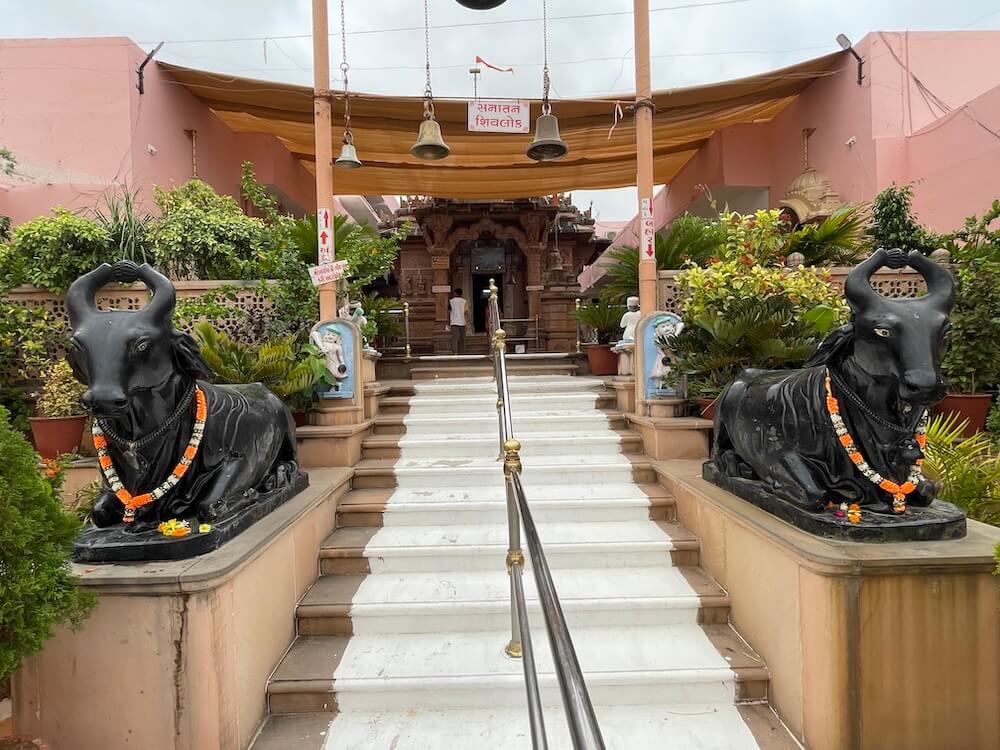
 The entrance to the temple grounds opens into a spacious courtyard, at the end of which stands the temple of Dholeshwar Mahadev, elevated on a raised platform. Constructed in the Nagara architectural style from pink sandstone, the temple includes a prominent central spire (urushringa), a prayer hall, vestibule and sanctum. After ascending nine steps – each side adorned with black stone Nandi statues – visitors reach the temple base, where guardian deities are also sculpted.
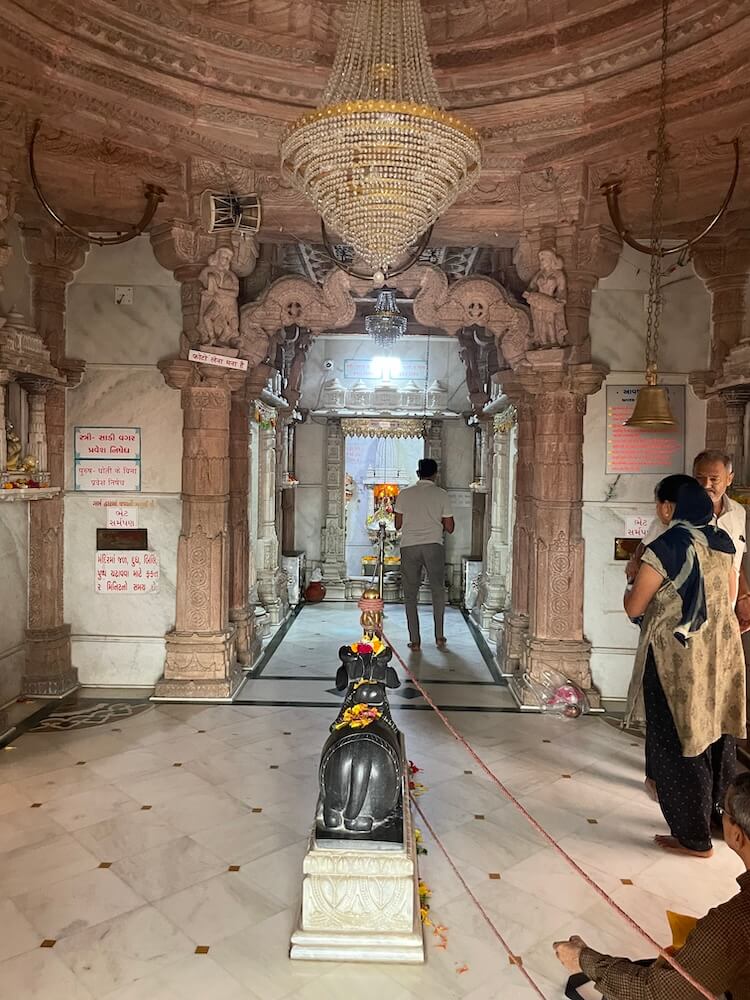
In the courtyard, just in front of the temple, are large sculptures of the Dashavatara and Mahishasuramardini, replicas of 7th-century art. Two steps lead into the prayer hall, where intricately carved pillars and outer walls display celestial maidens and divine beings in detailed relief. Inside the side shrines, a statue of Ganesha stands to the left and a six-faced, twelve-armed Kartikeya to the right. Between them are Nandi and a stone turtle. Just near the vestibule are two more Shiva lingams in dedicated sanctums. The inner shrines also house Kalabhairava and Hanuman. The entrance to the sanctum is richly carved, with deities sculpted into its columns and upper lintel. Within lies the silver-sheathed Shiva lingam of Dholeshwar Mahadev, shaded by a serpent’s hood, topped by a silver umbrella. Behind the lingam, in another sanctum, stands Goddess Parvati.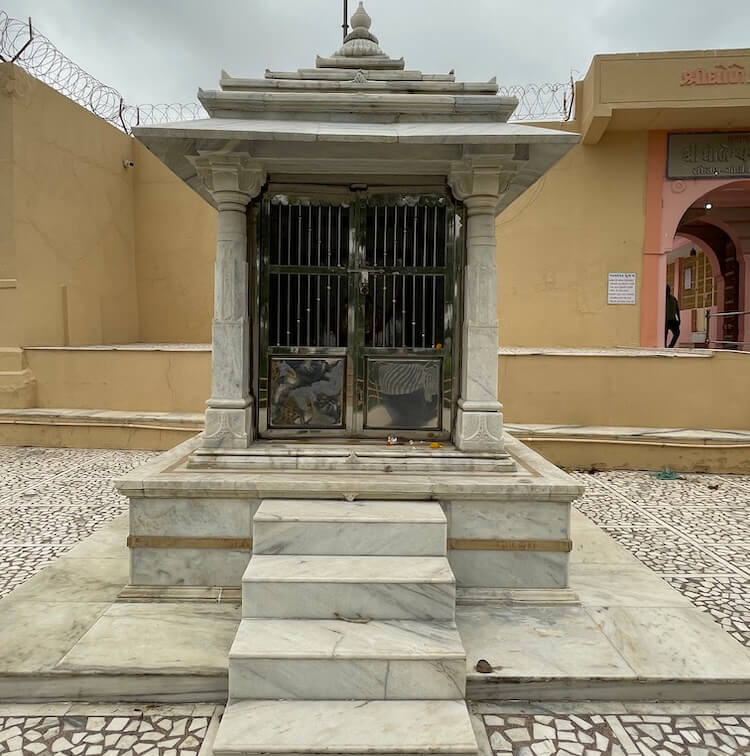
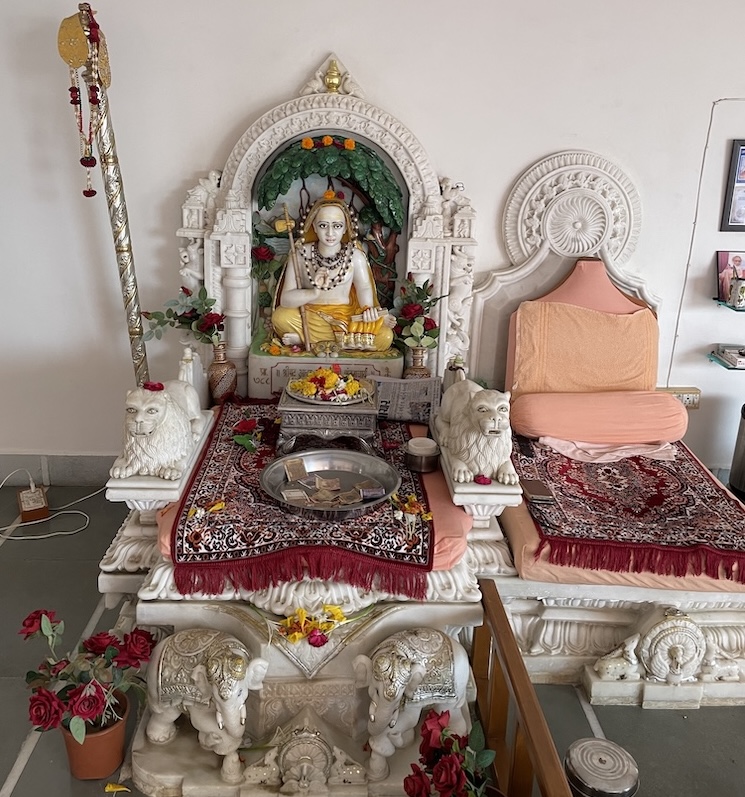
To the right of the main temple is a shrine to Sankatmochan Hanuman, while to the left stands a statue of Shankaracharya. Devotees can visit between 7 AM–11 AM and again from 5 PM–9 PM. Men must wear traditional attire such as dhotis or kurtas to enter the sanctum, while women must wear sarees. The temple opens with Brahmamuhurta Aarti at around 4:30 AM and again conducts an evening Aarti at sunset. Various religious events are held here throughout the year, with crowds especially large on Mondays and during the holy month of Shravan. Massive fairs are held on Mahashivratri and on the last Monday of Shravan, with daily bhandaras (community meals) hosted during the entire month.
Devotees from across Gujarat make pilgrimages here. It is believed that offering a white flower to Dholeshwar Mahadev on a Sunday fulfills all wishes. Bathing in the Sabarmati and performing heartfelt worship on Mondays is said to bring relief from illnesses. Many devotees also perform ancestral rites and feed Brahmins at this sacred site.
Key Features
- Located 7 km from Gandhinagar city
- Accessible by ST buses and private vehicles from Gandhinagar
- Private vehicles can reach up to the temple premises
- Facilities for lodging and breakfast available nearby
मंदिरे
Temples
मंदिर
-
भुवनेश्वर महादेव मंदिर सेक्टर 6, गांधीनगर, ता./जि. गांधीनगर
अधिक माहितीBhuvaneshwar Mahadev Temple Sector 6, Gandhinagar, Tal./Dist. Gandhinagar
View DetailsBhuvaneshwar Mahadev Temple Sector 6, Gandhinagar, Tal./Dist. Gandhinagar
विवरण देखें -
लिंबज माता मंदिर रायसेन, ता. / जिल्हा गांधीनगर
अधिक माहितीLimbaj Mata Temple Raysan, Tal. / Dist. Gandhinagar
View Detailsलिम्बज माता मंदिर रायसेन, ता. / जिला गांधीनगर
विवरण देखें -
गायत्री शक्तीपीठ सेक्टर 1, गांधीनगर, ता./जि. गांधीनगर
अधिक माहितीGayatri Shaktipeeth Sector 1, Gandhinagar, Tal./Dist. Gandhinagar
View Detailsगायत्री शक्तिपीठ सेक्टर 1, गांधीनगर, ताल./जिला. गांधीनगर
विवरण देखें