
ताडकेश्वर महादेव मंदिर
बिंद्राबिन, सिल्वासा, दादरा आणि नगर हवेली
Tadkeshwar Mahadev Temple
Bindrabin, Silvassa, Dadra and Nagar Haveli
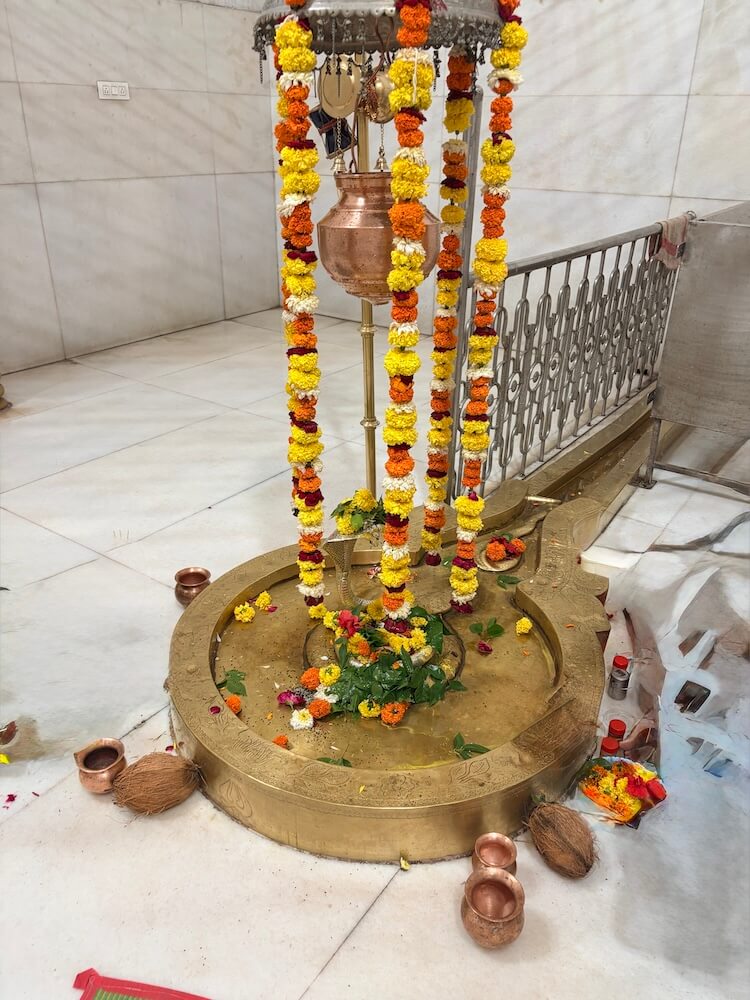 Lord Shiva is honoured as Mahadev, the God of Gods and it is rare to find a village in India without a temple dedicated to him. He is worshipped in both idol and shivalinga forms under various names, including Sadashiva, Samb, Mahesh, Mangesh, Girijapati, Bhootnath, Neelkanth, Chandramouli and Ashutosh. Tadkeshwar Mahadev is one such name. The renowned Tadkeshwar Mahadev Temple at Bindrabin in Silvassa stands on the bank of the Sakartod River. Beside the shrine lies the Tapovan Tourist Complex, which includes a national-symbol theme park and facilities for children. The temple and its riverside setting attract devotees and visitors alike.
In Hinduism, Brahma, Vishnu and Mahesh (Shiva) are the three deities representing the three gunas of sattva, rajas and tamas, with Shiva presiding over the dissolution of the universe. According to Tarkatirtha Lakshmanshastri Joshi’s work ‘Vaidik Sanskruticha Vikas’, the worship of Shiva existed in India from the pre-Aryan period. The name Shiva is said to have originated from the Tamil word Sivan, meaning red. In the Vedas, Shankara is described by the epithet Neelalohit, which means blue and red. Shiva also appears as the name of a people in the ‘Rig Veda’, whose seventh mandala records their participation in the Battle of the Ten Kings.
 The deity Rudra of the ‘Rig Veda’ is identified with Shiva, with the ‘Shvetashvatara Upanishad’ being among the earliest texts to state this connection explicitly and accord him the status of the supreme deity. According to the ‘Shiva Purana’, Mahadev manifested as a column of light with neither a beginning nor an end, from which Brahma and Vishnu were also created. This formless manifestation of Mahadev is called Shiva, while the embodied form represented by the shivalinga or an idol is known as Shankara. In the devotional tradition, Mahadev is honoured for his ability to grant liberation through divine grace, so the Rudra form of the deity is widely regarded as benevolent. Villages and cities across India worship him under many names, predominantly in the form of the shivalinga. At the temple in Bindrabin, he is venerated as Tadkeshwar.
For centuries, the region of Dadra and Nagar Haveli has been associated with the rich folk traditions and nature-centred way of life of several tribal communities, including the Warli, Dhodia and Kokna. During Portuguese rule, this wooded tract came to be known as Silvassa, a name generally linked to the Portuguese word silva, meaning forest. The Sakartod River flows through these woods and Bindrabin on its bank holds both geographical and religious significance. Although devotees believe the shrine of Tadkeshwar Mahadev here is ancient, the exact history of its foundation remains unavailable.
Local legend accounts for the temple’s origin in ancient times, when the area was covered by forest and herders brought their cattle here for grazing. One cow from these herds regularly released her milk over a stone at this spot, prompting the herders to clear the grass and vegetation around it. There they discovered a naturally manifested black-stone shivalinga, which the villagers ritually consecrated and began worshipping. According to tradition, the shivalinga originally had no roof above it, so the sun’s intense rays, known locally as tadak, fell directly upon the stone and made it glow, earning the deity the name Tadkeshwar Mahadev. The official district administration website likewise explains Tadkeshwar as referring to Lord Shiva beneath the sun. 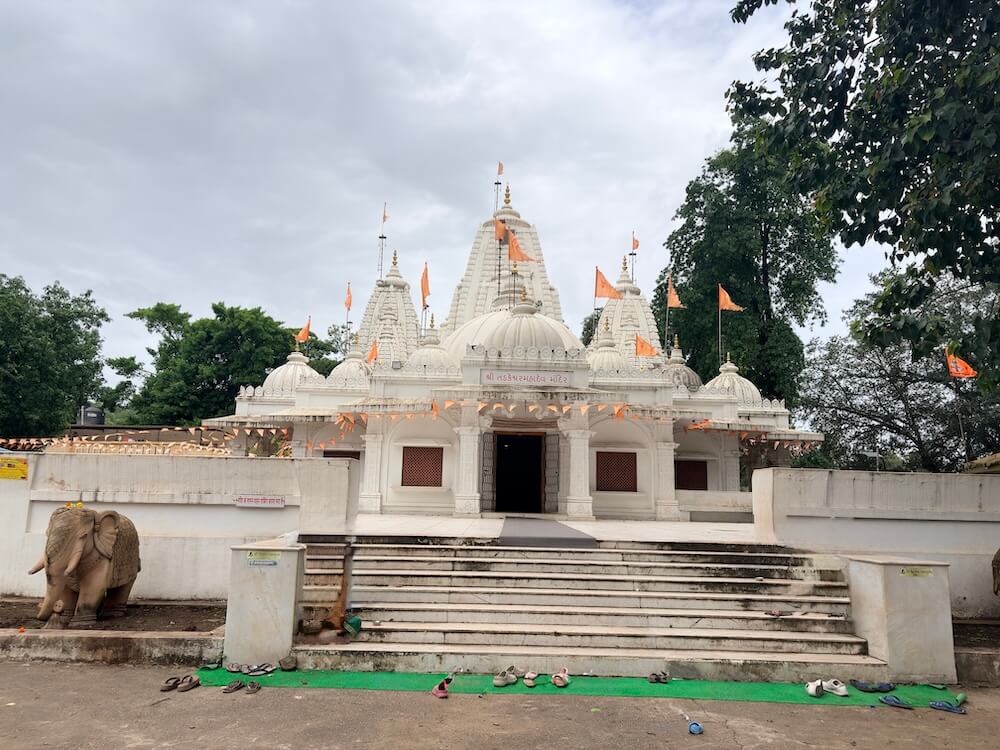 A punah pranapratishtha (re-consecration ceremony) of the murti was held at the temple on 13 December 2021.
The main temple complex is approached from the Silvassa-Khanvel road near the bridge across the Sakartod River. Inside the entrance, an expansive courtyard laid with paver blocks and stone flooring provides parking facilities for devotees as well as several shops selling puja articles and prasad. Immediately beside the shrine stands the Tapovan Tourist Complex, developed by the local administration. From one side of the courtyard, a stone-stepped ghat leads down towards the river, which devotees traditionally visit before entering the temple for darshan.
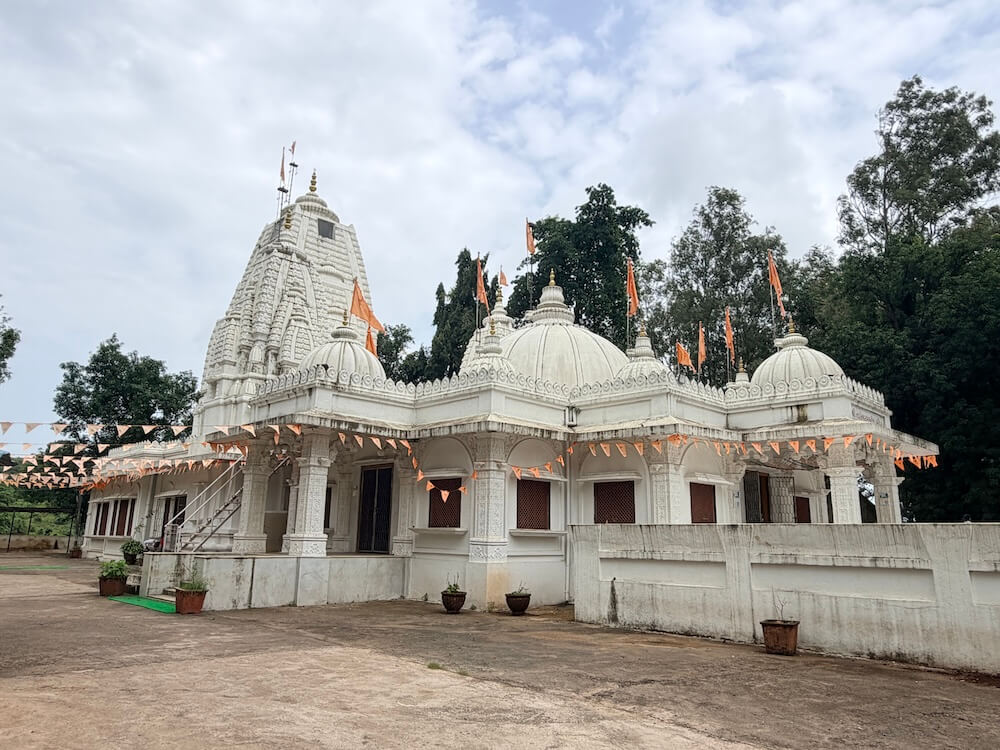
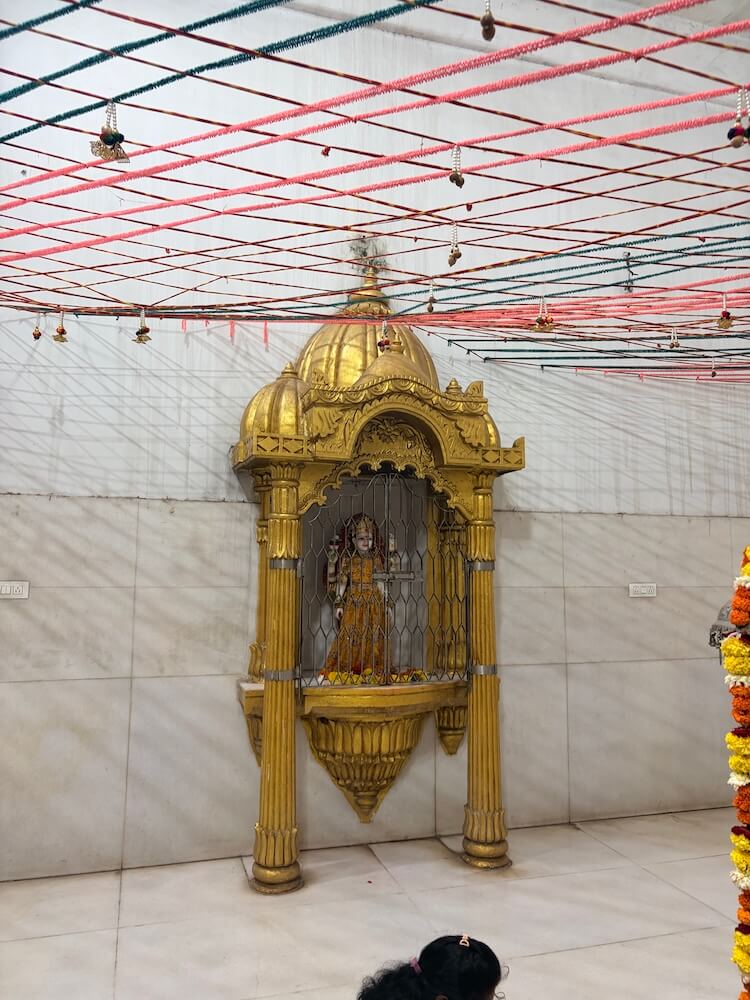
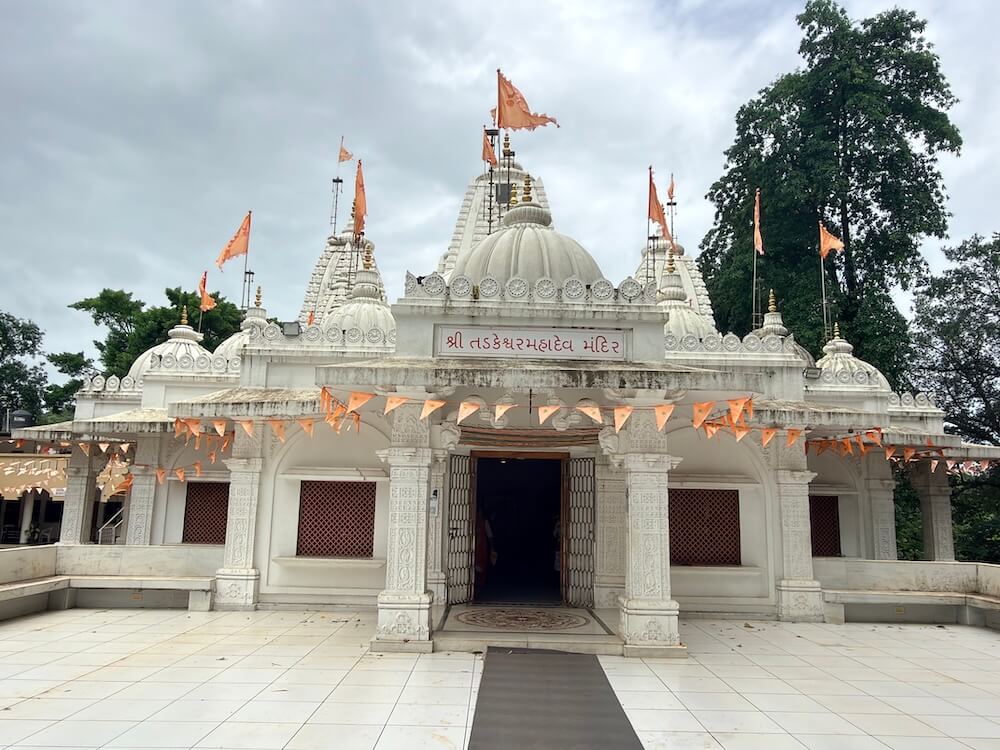
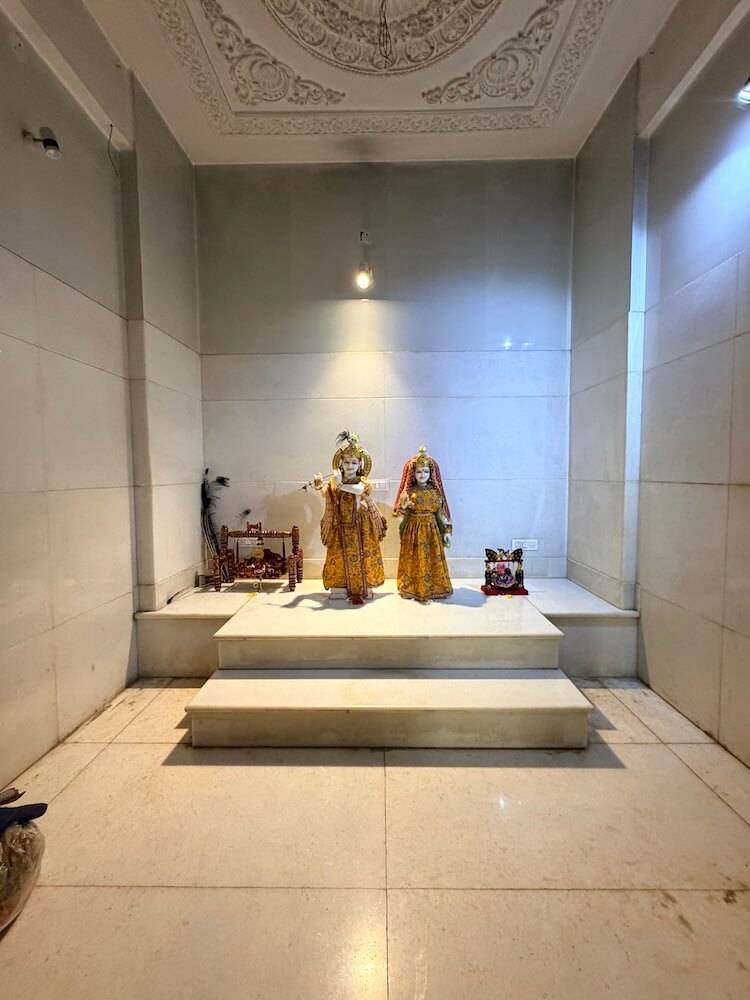
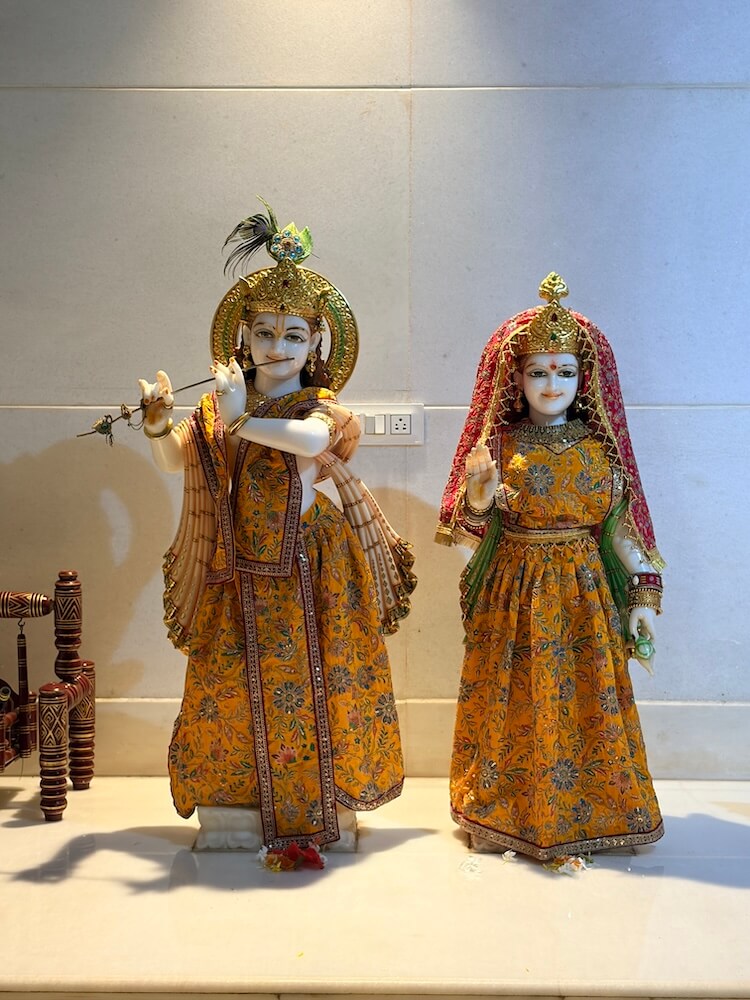
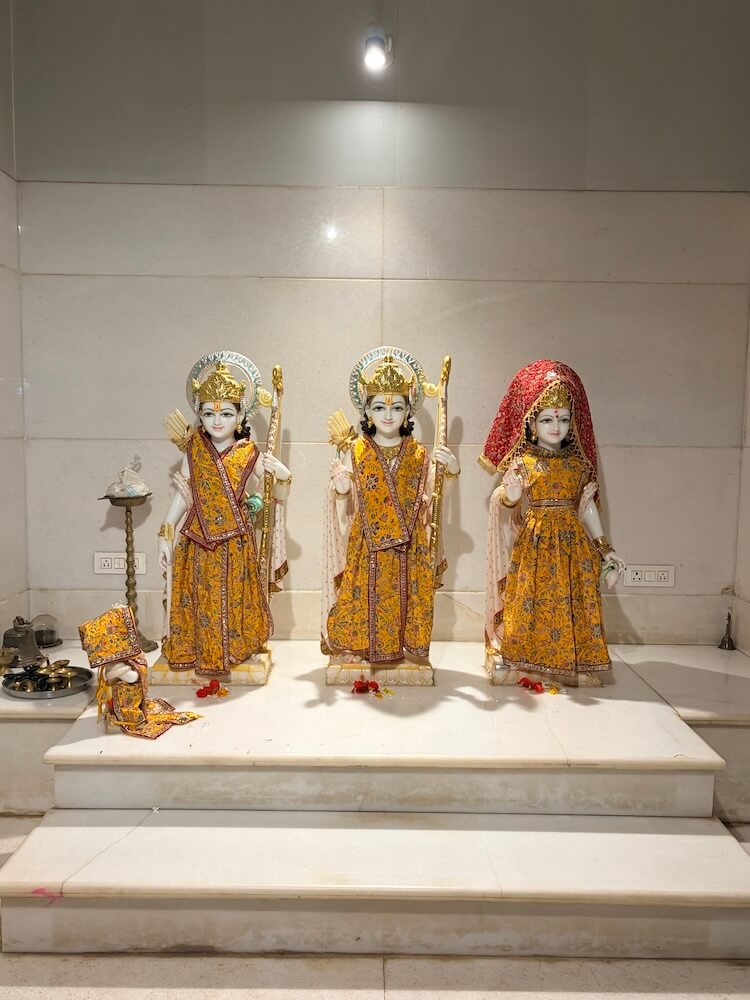
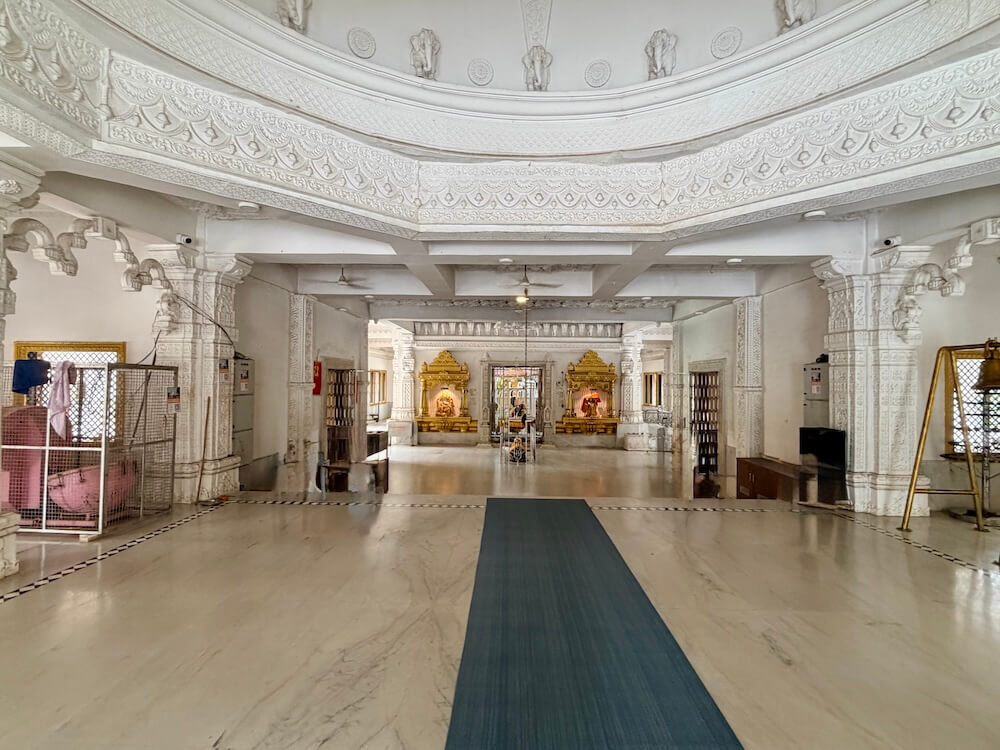
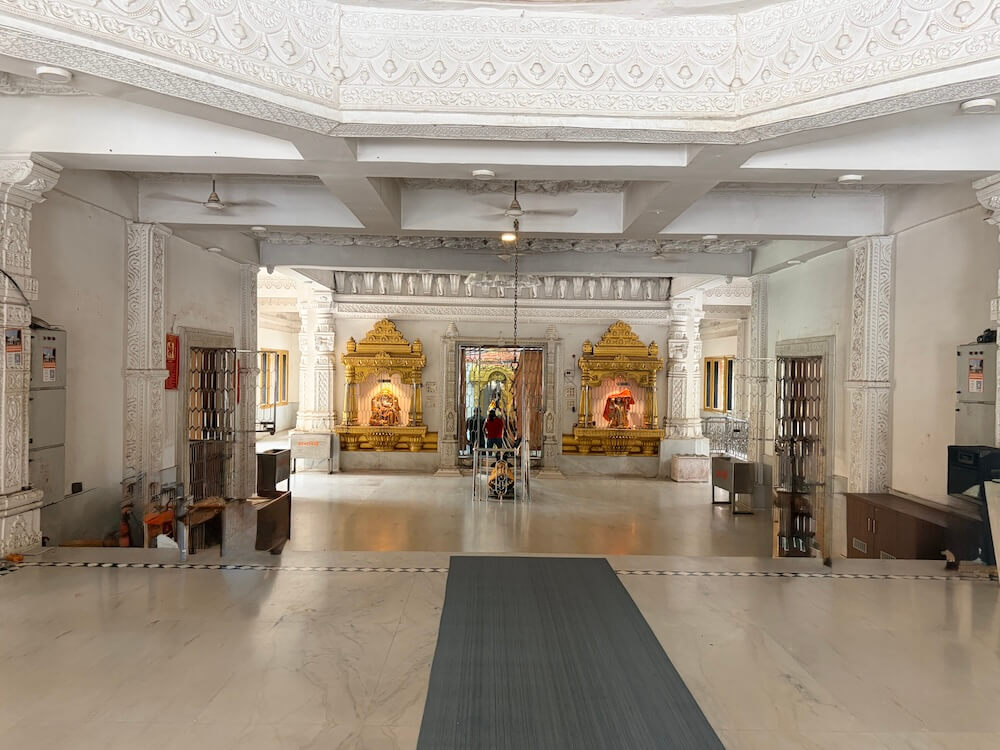 The entire temple structure stands on a substantial jagati (raised platform), where marble steps flanked by stone elephant sculptures lead from the courtyard to the front mandap. Its layout comprises a mukhamandap (entrance porch), a sabhamandap, an antaral (vestibule), a principal sanctum and two subsidiary sanctums. The semi-open mukhamandap rests on four marble pillars bearing distinctive decorative carvings and connected by cusped arches. Beyond it lies the two-part sabhamandap, whose front section is set slightly lower. Directly opposite the sanctum entrance rests a black-stone sculpture of Nandi on a marble pedestal, carved with bells and decorative drapery around the neck and back, while a tortoise sculpture is set on the floor before it. The subsidiary sanctums on the right and left of the sabhamandap house idols of Radha and Krishna and of Shri Ram, Lakshman and Sita respectively.
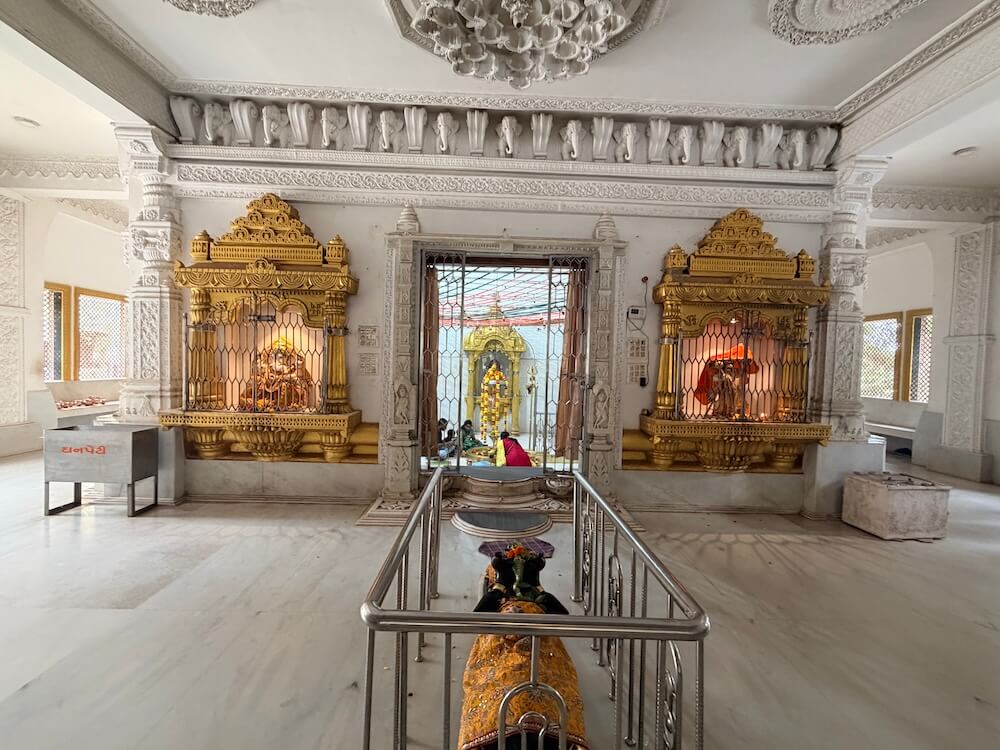
Finely carved devkoshtaks (wall niches) on either side of the front wall of the principal garbhagriha house idols of Hanuman and Ganesha. The marble doorway of the sanctum features door jambs carved with foliage and traditional auspicious motifs, with a sculpture of Ganesha on the lalatbimb (central lintel carving). Four steps descend from the entrance into the sunken sanctum, at the centre of which stands an ancient, naturally manifested black-stone shivalinga set within a brass-covered shalunka (shivalinga pedestal base) beneath a metal serpent canopy. Suspended from the ceiling by a chain, a galantika (overhead dripping pot) continuously releases a stream of water over the deity, while a trishul and a damaru are placed to one side and an idol of Goddess Parvati occupies a niche in the rear wall.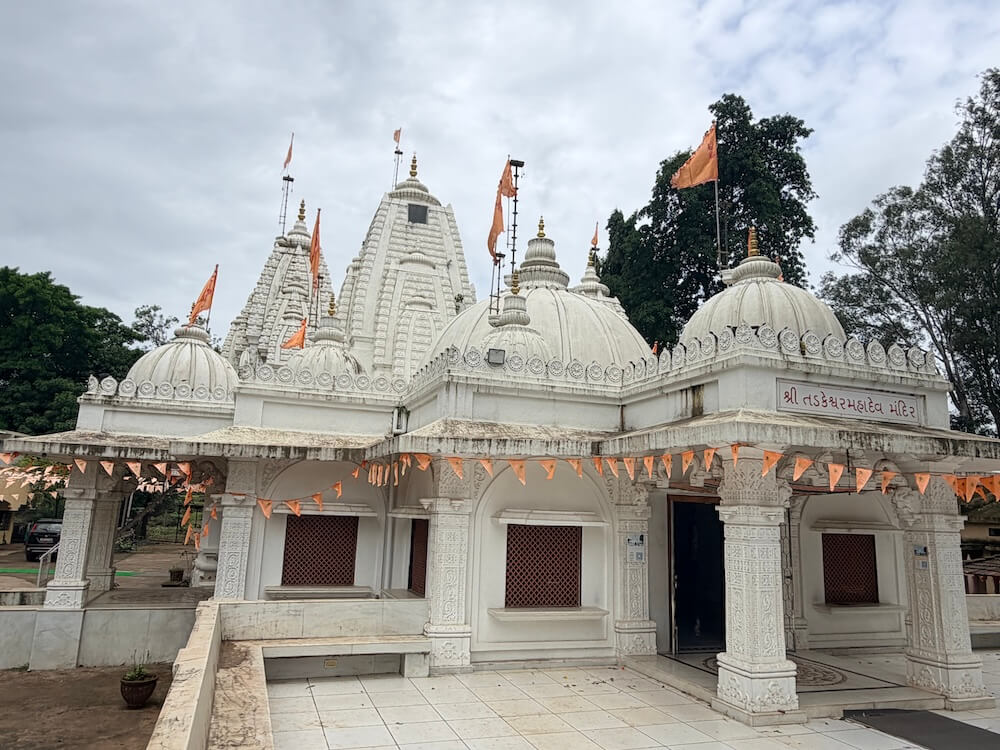 Above the sanctum rises a tall Nagara-style shikhar that tapers upwards from its base with urushrings (miniature spires) and subsidiary spires, crowned by an amalak (ribbed stone disc) and a gilded kalash surmounted by a trishul of Mahadev.
The temple remains open daily from 6 am to 9 pm for the darshan of Tadkeshwar Mahadev. Directly beside the shrine, the Tapovan Tourist Complex houses a theme park with replicas of various national symbols and a garden with play equipment for children. Together, the temple, the bank of the Sakartod River and the tourist complex make the area a popular destination for both devotees and visitors to Silvassa. Mahashivratri is the principal festival celebrated here, when the precinct is specially decorated and illuminated. Large numbers of devotees also visit every Monday during the month of Shravan. In keeping with the temple’s Kanwar Yatra tradition, many pilgrims bring holy water in kanwars (decorated shoulder-poles for water offerings) and offer it to Tadkeshwar Mahadev.
Useful Information :
- Located 18 km from central Silvassa and 6 km from Khanvel
- ST bus services are available from Silvassa and Khanvel
- Private vehicles can reach the temple parking area
ताड़केश्वर महादेव मंदिर
बिंद्राबिन, सिलवासा, दादरा और नगर हवेली
मंदिरे
Temples
मंदिर
મંદિરો
கோவில்கள்
దేవాలయాలు
ക്ഷേത്രങ്ങൾ
ದೇವಾಲಯಗಳು
মন্দিরসমূহ
ਮੰਦਿਰ
-
आमली हनुमान मंदिर आमली औद्योगिक वसाहत, सिल्वासा, दादरा आणि नगर हवेली
अधिक माहितीAmli Hanuman Temple Amli Industrial Estate, Silvassa, Dadra and Nagar Haveli
View Detailsआंवली हनुमान मंदिर अमली इंडस्ट्रियल एस्टेट, सिलवासा, दादरा और नगर हवेली
विवरण देखेंAmli Hanuman Temple Amli Industrial Estate, Silvassa, Dadra and Nagar Haveli
વિગત જુઓAmli Hanuman Temple Amli Industrial Estate, Silvassa, Dadra and Nagar Haveli
விவரங்களைக் காண்கAmli Hanuman Temple Amli Industrial Estate, Silvassa, Dadra and Nagar Haveli
వివరాలను చూడండిAmli Hanuman Temple Amli Industrial Estate, Silvassa, Dadra and Nagar Haveli
വിശദാംശങ്ങൾ കാണുകAmli Hanuman Temple Amli Industrial Estate, Silvassa, Dadra and Nagar Haveli
ವಿವರಗಳನ್ನು ವೀಕ್ಷಿಸಿAmli Hanuman Temple Amli Industrial Estate, Silvassa, Dadra and Nagar Haveli
বিস্তারিত দেখুনAmli Hanuman Temple Amli Industrial Estate, Silvassa, Dadra and Nagar Haveli
ਵੇਰਵੇ ਦੇਖੋ -
BAPS स्वामीनारायण मंदिर नरोली रोड, अथल, सिल्वासा, दादरा आणि नगर हवेली
अधिक माहितीBAPS Swaminarayan Mandir Naroli Road, Athal, Silvassa, Dadra and Nagar Haveli
View Detailsबीएपीएस स्वामीनारायण मंदिर नरोली रोड, अथल, सिलवासा, दादरा और नगर हवेली
विवरण देखेंBAPS Swaminarayan Mandir Naroli Road, Athal, Silvassa, Dadra and Nagar Haveli
વિગત જુઓBAPS Swaminarayan Mandir Naroli Road, Athal, Silvassa, Dadra and Nagar Haveli
விவரங்களைக் காண்கBAPS Swaminarayan Mandir Naroli Road, Athal, Silvassa, Dadra and Nagar Haveli
వివరాలను చూడండిBAPS Swaminarayan Mandir Naroli Road, Athal, Silvassa, Dadra and Nagar Haveli
വിശദാംശങ്ങൾ കാണുകBAPS Swaminarayan Mandir Naroli Road, Athal, Silvassa, Dadra and Nagar Haveli
ವಿವರಗಳನ್ನು ವೀಕ್ಷಿಸಿBAPS Swaminarayan Mandir Naroli Road, Athal, Silvassa, Dadra and Nagar Haveli
বিস্তারিত দেখুনBAPS Swaminarayan Mandir Naroli Road, Athal, Silvassa, Dadra and Nagar Haveli
ਵੇਰਵੇ ਦੇਖੋ -
ओम निखिलेश्वर महादेव मंदिर कुडाचा, सिल्वासा, दादरा आणि नगर हवेली
अधिक माहितीOm Nikhileshwar Mahadev Temple Kudacha, Silvassa, Dadra and Nagar Haveli
View Detailsॐ निखिलेश्वर महादेव मंदिर कुदाचा, सिलवासा, दादरा और नगर हवेली
विवरण देखेंOm Nikhileshwar Mahadev Temple Kudacha, Silvassa, Dadra and Nagar Haveli
વિગત જુઓOm Nikhileshwar Mahadev Temple Kudacha, Silvassa, Dadra and Nagar Haveli
விவரங்களைக் காண்கOm Nikhileshwar Mahadev Temple Kudacha, Silvassa, Dadra and Nagar Haveli
వివరాలను చూడండిOm Nikhileshwar Mahadev Temple Kudacha, Silvassa, Dadra and Nagar Haveli
വിശദാംശങ്ങൾ കാണുകOm Nikhileshwar Mahadev Temple Kudacha, Silvassa, Dadra and Nagar Haveli
ವಿವರಗಳನ್ನು ವೀಕ್ಷಿಸಿOm Nikhileshwar Mahadev Temple Kudacha, Silvassa, Dadra and Nagar Haveli
বিস্তারিত দেখুনOm Nikhileshwar Mahadev Temple Kudacha, Silvassa, Dadra and Nagar Haveli
ਵੇਰਵੇ ਦੇਖੋ