
BAPS स्वामीनारायण मंदिर
नरोली रोड, अथल, सिल्वासा, दादरा आणि नगर हवेली
BAPS Swaminarayan Mandir
Naroli Road, Athal, Silvassa, Dadra and Nagar Haveli
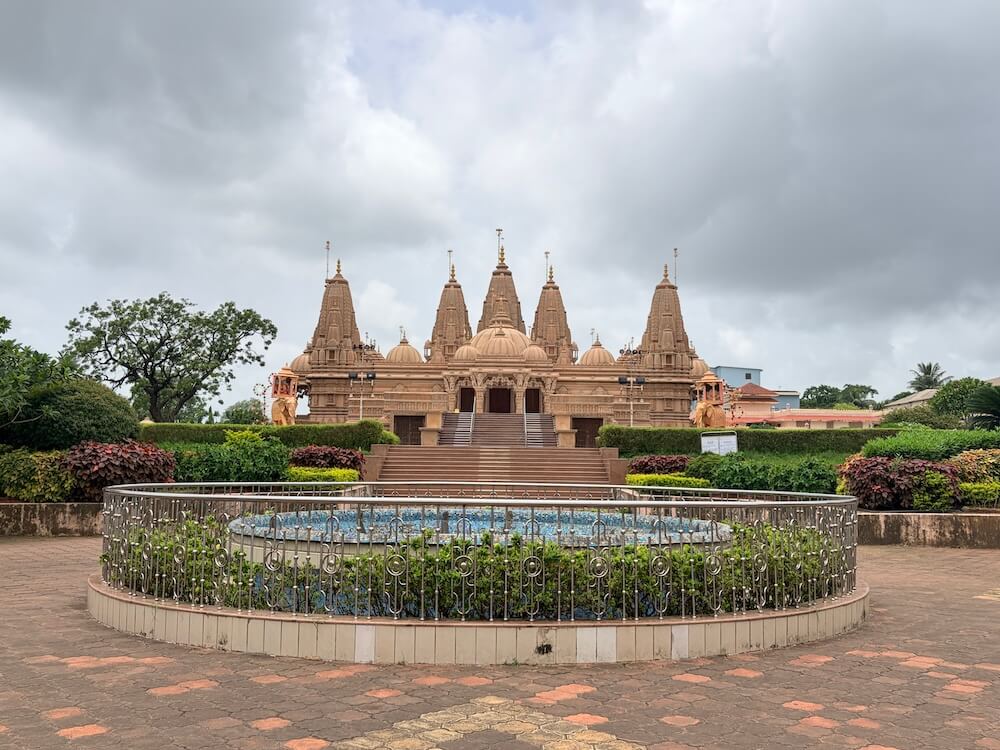
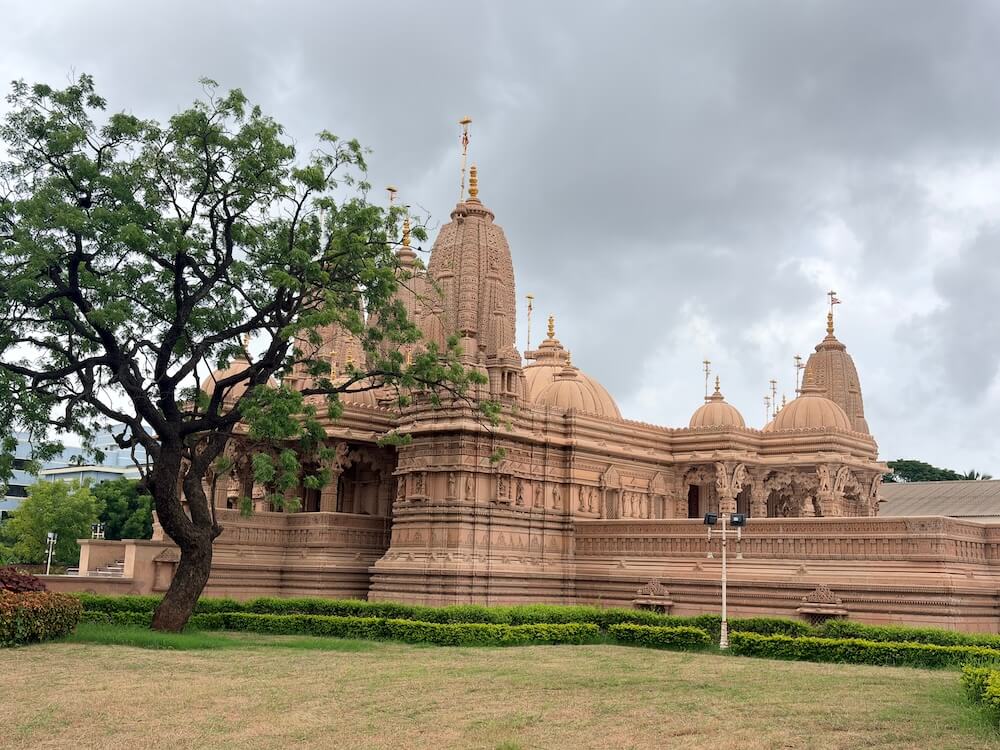
 At Athal in Silvassa, the capital of the Union Territory of Dadra and Nagar Haveli and Daman and Diu, stands the Swaminarayan Mandir of the Bochasanwasi Akshar Purushottam Swaminarayan Sanstha, better known as BAPS. Beyond its religious significance, the temple serves as an important centre of social and cultural activity in Silvassa. Constructed in keeping with the distinctive architectural traditions of BAPS Swaminarayan temples, it also forms part of the organisation’s ongoing efforts to bring the region’s tribal communities into the wider spiritual mainstream. As part of this work, BAPS runs the Swaminarayan Vidyamandir at the Swaminarayan Cultural Complex here.
The Swaminarayan tradition emerged as a prominent religious movement in 19th-century Gujarat under its founder, Swami Sahajanand. Followers revere him as an avatar of Uddhava, which gave the sect the names Sahajanand Sampradaya and Uddhava Sampradaya. Devotees also worship him as Swaminarayan, an incarnation of God. Born on 3 April 1781 as Ghanshyam Pandey, he renounced his home at the age of 12 and travelled across India for seven years, performing penance in the Himalayas. During this ascetic journey, he was known as Neelkanth Varni. In 1800, he received initiation from Muktanand Swami at Mangrol in Saurashtra and subsequently from his guru,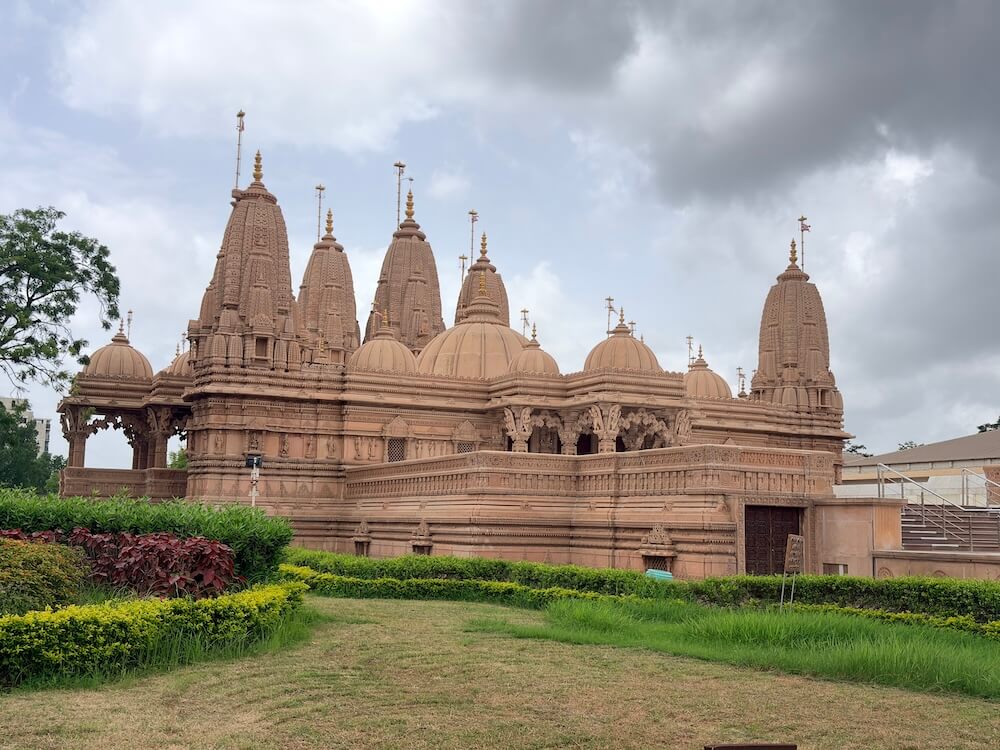 Ramanand Swami, at Piplana.
Gujarat became the principal field for his religious and social reform work. Drawing upon Ramanujacharya’s Vishishtadvaita and Vallabhacharya’s Shuddhadvaita philosophies, he fostered a harmonious and inclusive spiritual tradition. Ramanand Swami conferred the name Sahajanand upon Neelkanth Varni, who succeeded his mentor as head of the organisation in 1801. Travelling from village to village, he taught countless devotees the Swaminarayan mahamantra. He preached against social evils such as sati and female infanticide, alongside intoxicants, meat-eating, violence, animal sacrifice, theft, gambling, adultery and superstition. He also opposed the vulgarity and obscenity associated, in his view, with certain aspects of festivals such as Holi.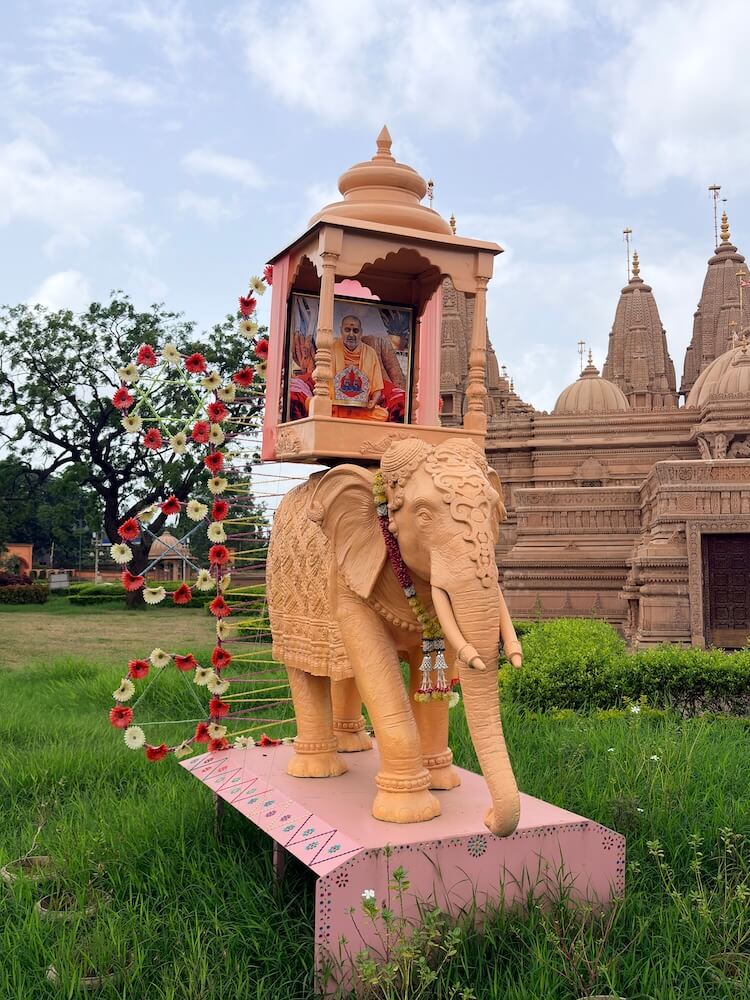
Like the Jains, he strongly emphasised vegetarianism and non-violence, teaching that harmlessness held supreme spiritual importance and opposing bloodshed in sacrificial rituals. Disapproving of what he viewed as sexual immorality within certain Hindu traditions of the era, he introduced strict codes of moral conduct for his followers. He taught that Swaminarayan was none other than Lord Krishna and urged devotees to worship and surrender to him. Followers, in turn, revere Sahajanand himself as a manifestation of Swaminarayan. Tradition holds that in November 1820, he explained to Gopalanand Swami six reasons for his incarnation on Earth. Sahajanand, also known as Swaminarayan, passed away on 1 June 1830.
In 1825, before his death, he established two hereditary seats of authority within the fellowship: the Nar-Narayan Dev Gadi in Ahmedabad and the Laxmi-Narayan Dev Gadi at Vadtal. As acharyas, he appointed his elder brother Rampratap Pandey’s son Ayodhyaprasad to the Ahmedabad seat and his younger brother Ichharam’s son Raghuvir to Vadtal. In 1905, an acharya leadership dispute led Shastri Yagnapurushdas, popularly known as Shastriji Maharaj, to establish a separate organisation at Bochasan, the Bochasanwasi Akshar Purushottam Swaminarayan Sanstha (BAPS). 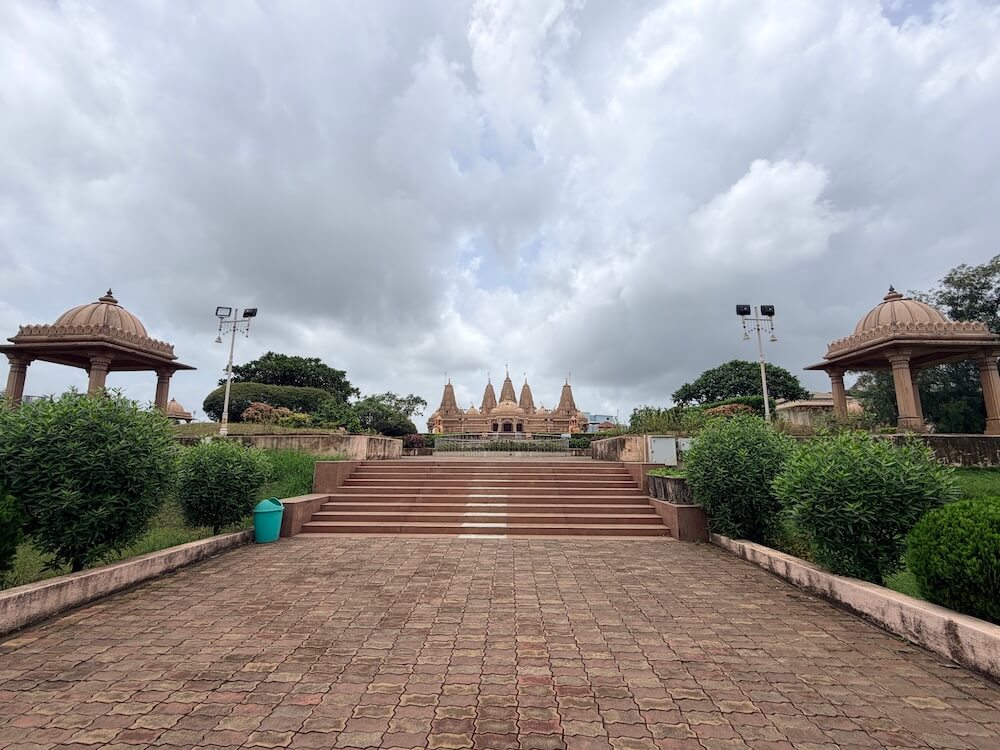 BAPS holds that Swaminarayan remains manifest on Earth through the Gunatit gurus of the tradition. After the founder, Gunatitanand Swami assumed spiritual leadership. Mahant Swami Maharaj, born in 1933, is today the sixth spiritual successor of Bhagwan Swaminarayan and the present guru of BAPS.
For more than four decades, Mahant Swami Maharaj and his predecessor Pramukh Swami Maharaj, the fifth spiritual successor of BAPS, have carried out religious, moral and social work among the tribal communities of Dadra and Nagar Haveli. As part of these efforts, the foundation stone of a Swaminarayan Mandir was laid here on 12 March 1973. The murtis in that shrine were consecrated on 3 January 1982. 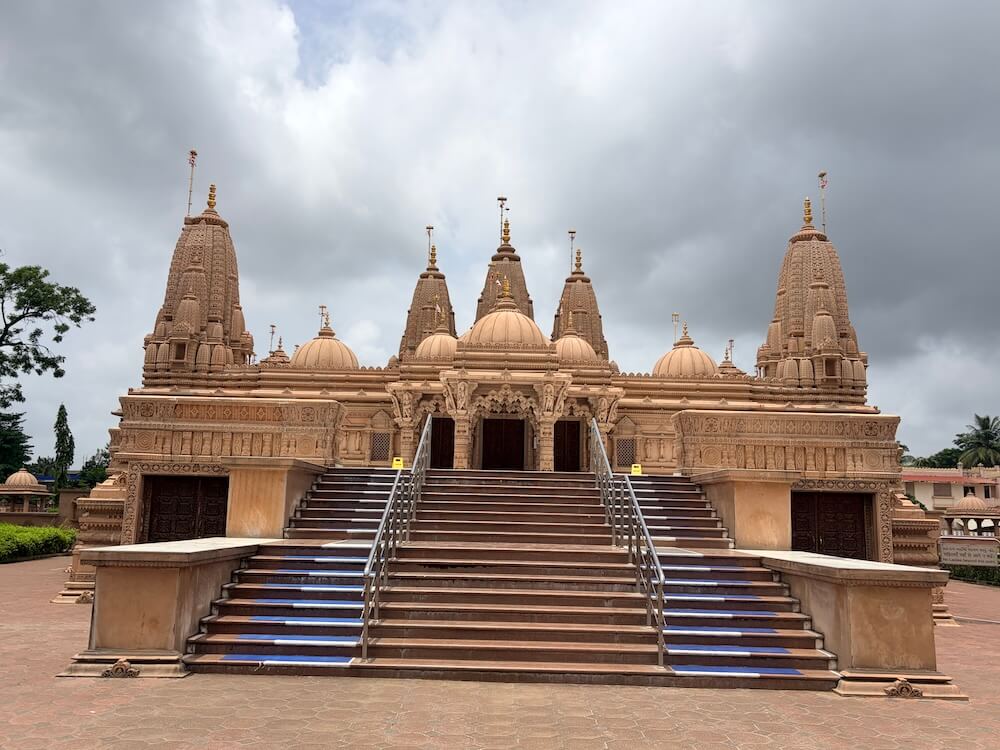 Thereafter, the organisation’s devotional and welfare initiatives continued to expand across Silvassa and its surrounding areas.
As satsang grew in Silvassa, the need arose for a larger and more impressive place of worship. This led to the decision to build a new temple across approximately 15 acres at Athal, near the Daman Ganga River. Inspired by Pramukh Swami Maharaj, the new shikharbaddha (spired) temple held its murti-pratishtha (consecration ceremony) celebrations from 10 to 13 May 2013, marked by diverse religious and cultural programmes. The Vishvashanti Mahayajna was a particular attraction during the festivities. As many as 389 yajna kunds were constructed for the ceremony, with around 3,000 yajmans (ritual hosts) participating. 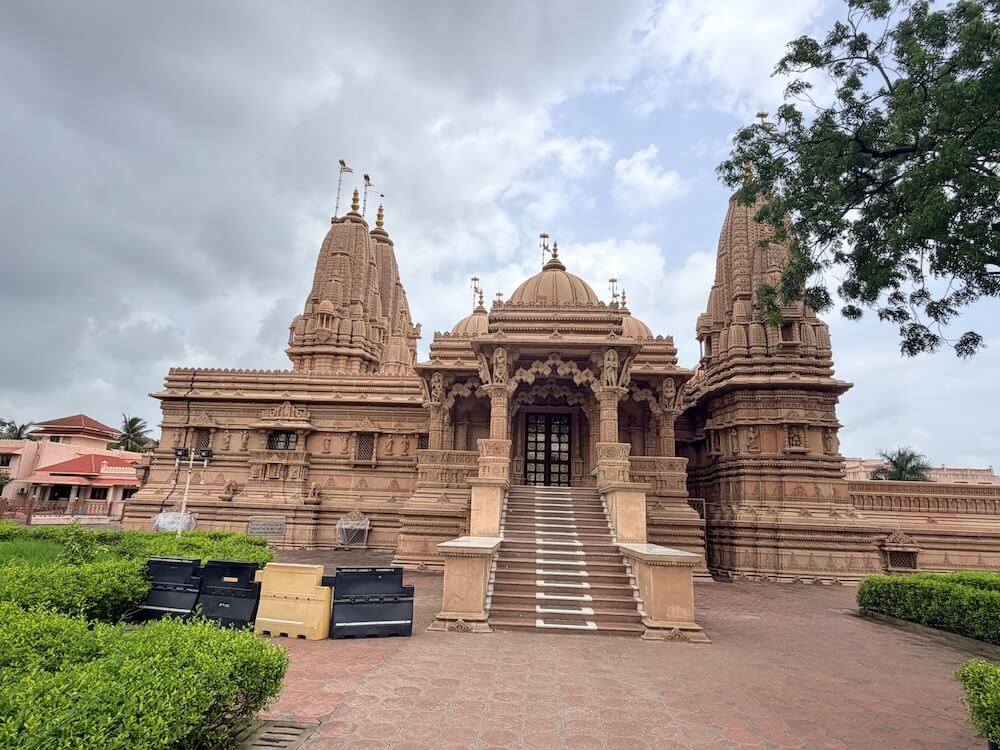 A grand Nagar Yatra procession covering approximately eight kilometres also marked the occasion.
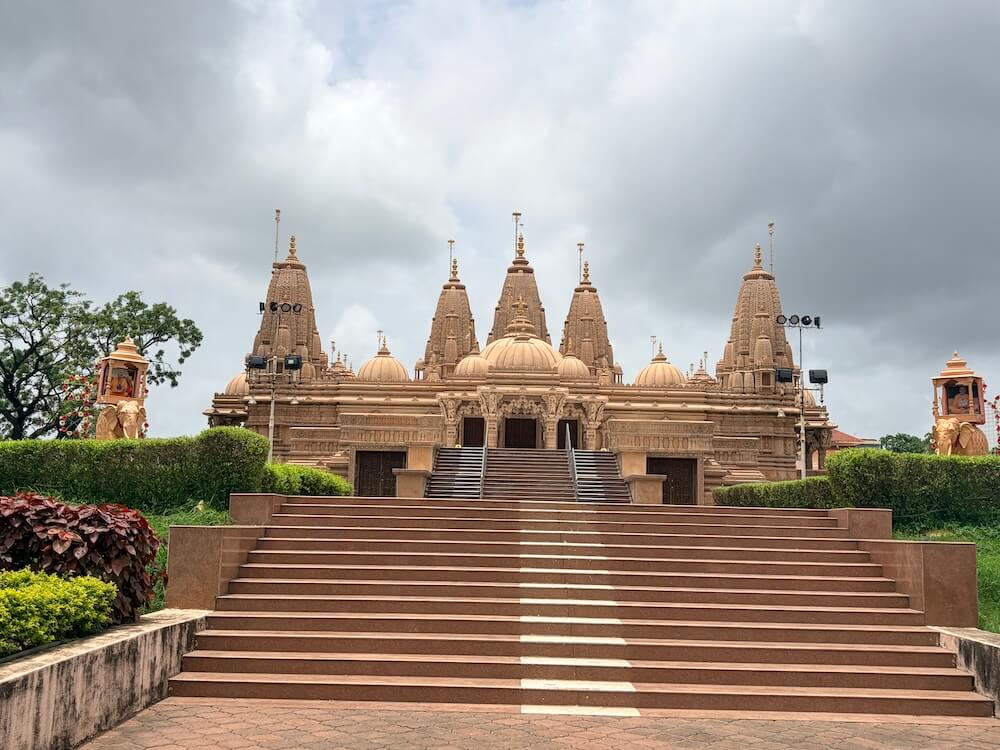
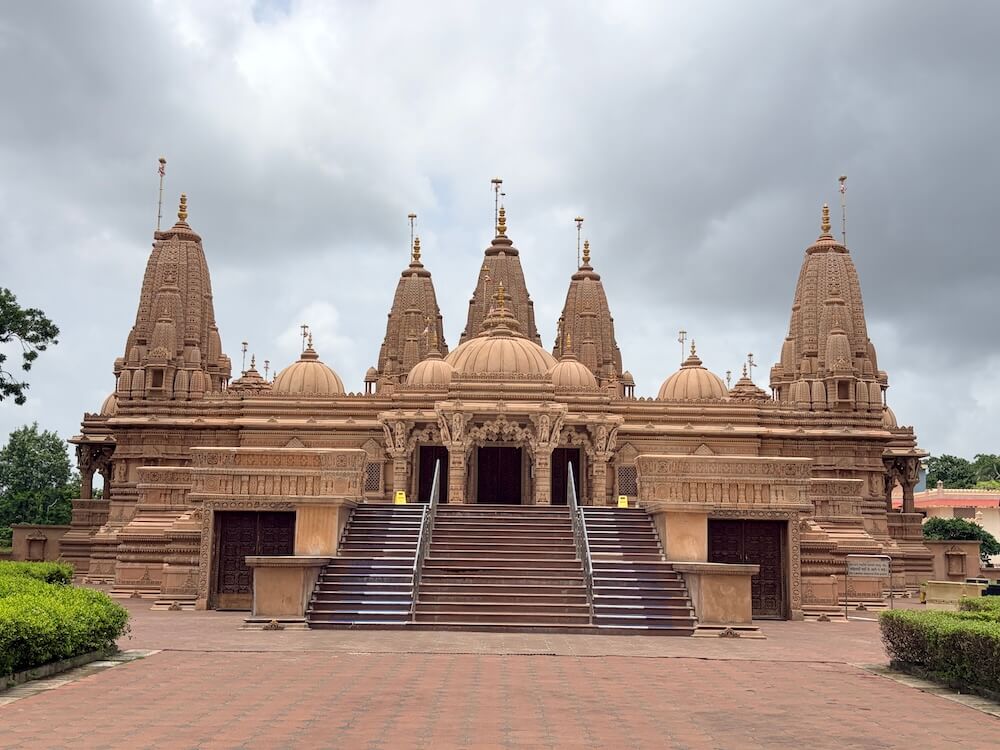
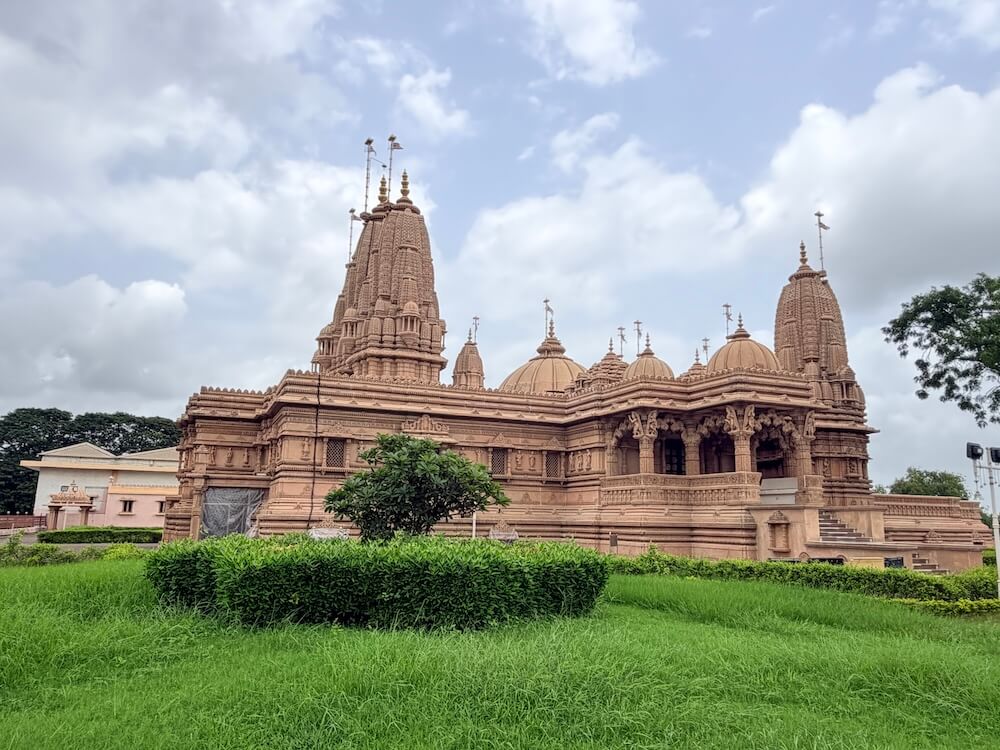
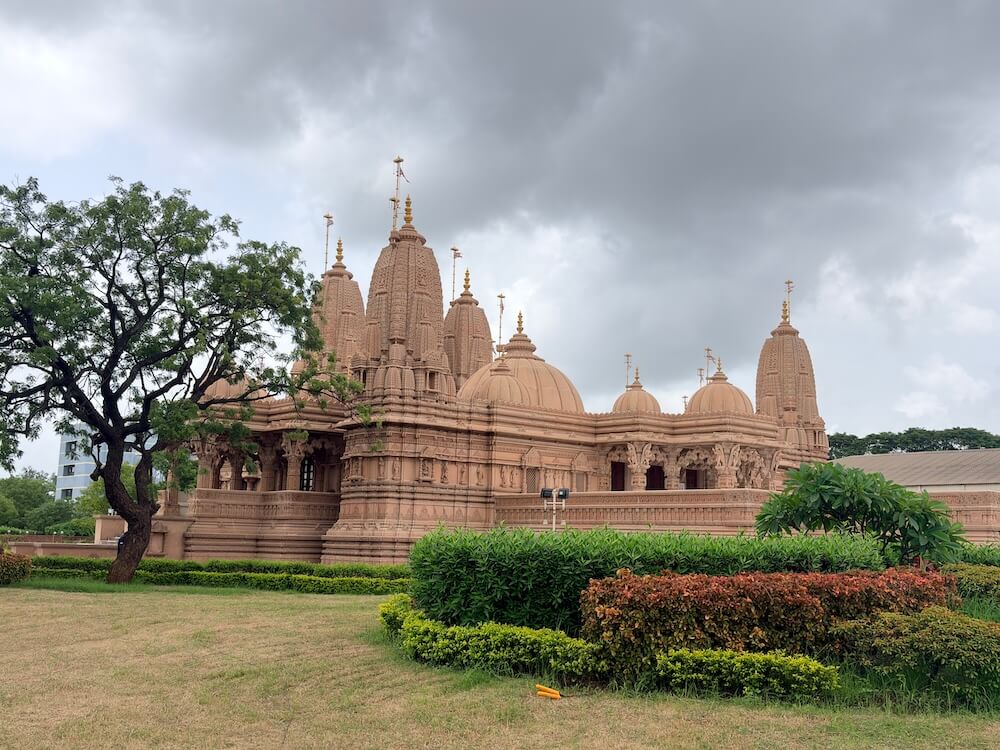
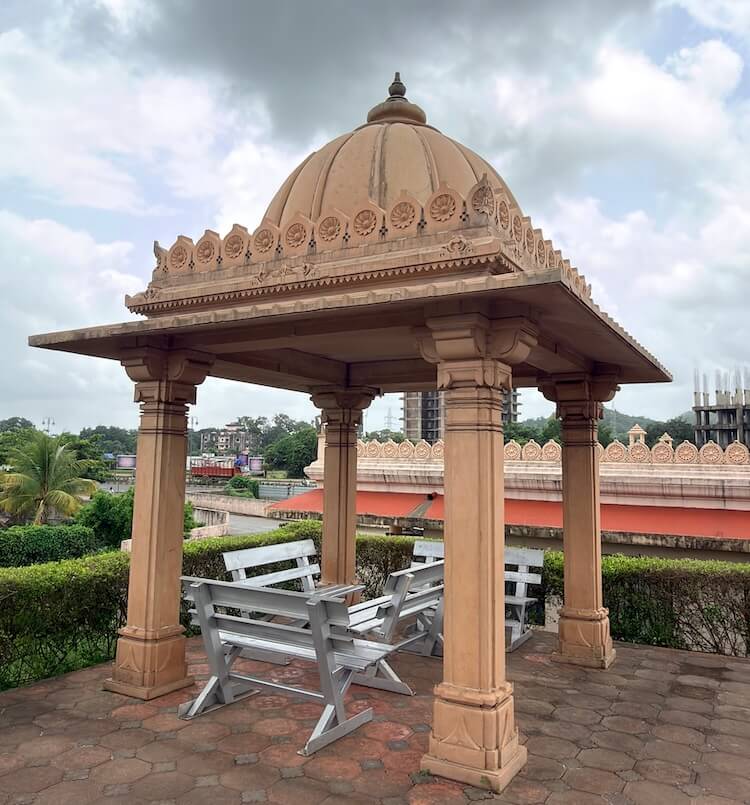
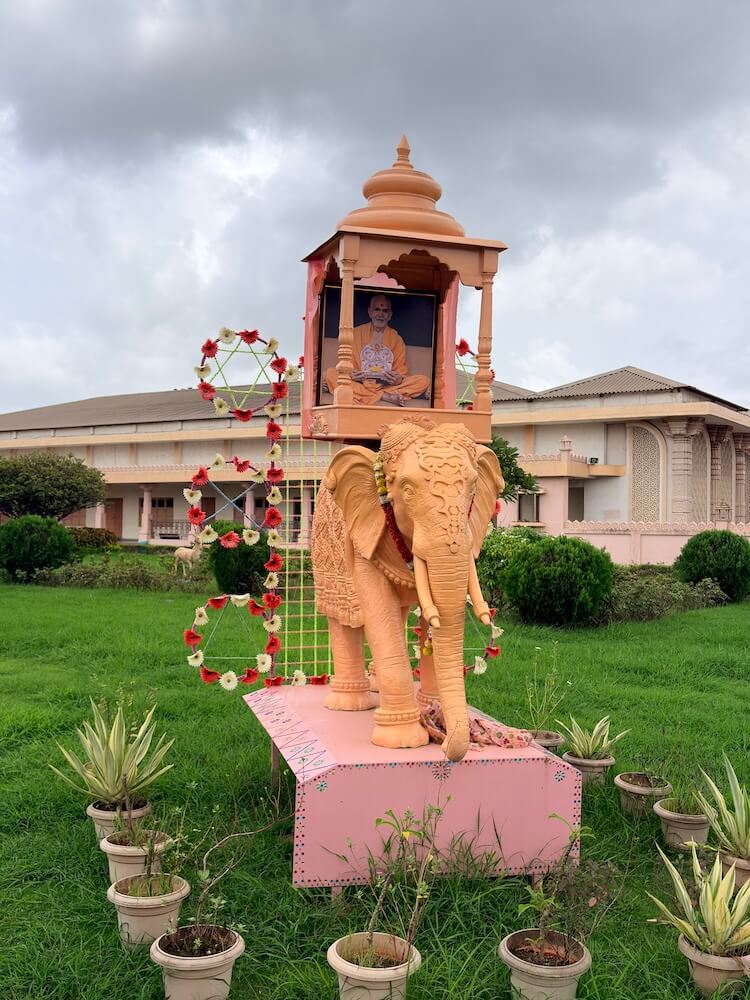
A landscaped garden with broad stretches of green lawn surrounds the temple within its spacious complex. Following the distinctive layout of Swaminarayan shrines, the two-storey building houses a cultural activity hall on the ground floor. The main structure comprises three mukhamandaps (entrance porches), an assembly hall and three sanctums, with finely chiselled pillars across the porches and hall. Rising from stone bases and linked by arched openings, the pillar shafts bear composite motifs and end in moulded capitals and brackets. Distinctive sculptures of deities and saints adorn these brackets, while the beams and ceilings they support display rich decorative carvings.
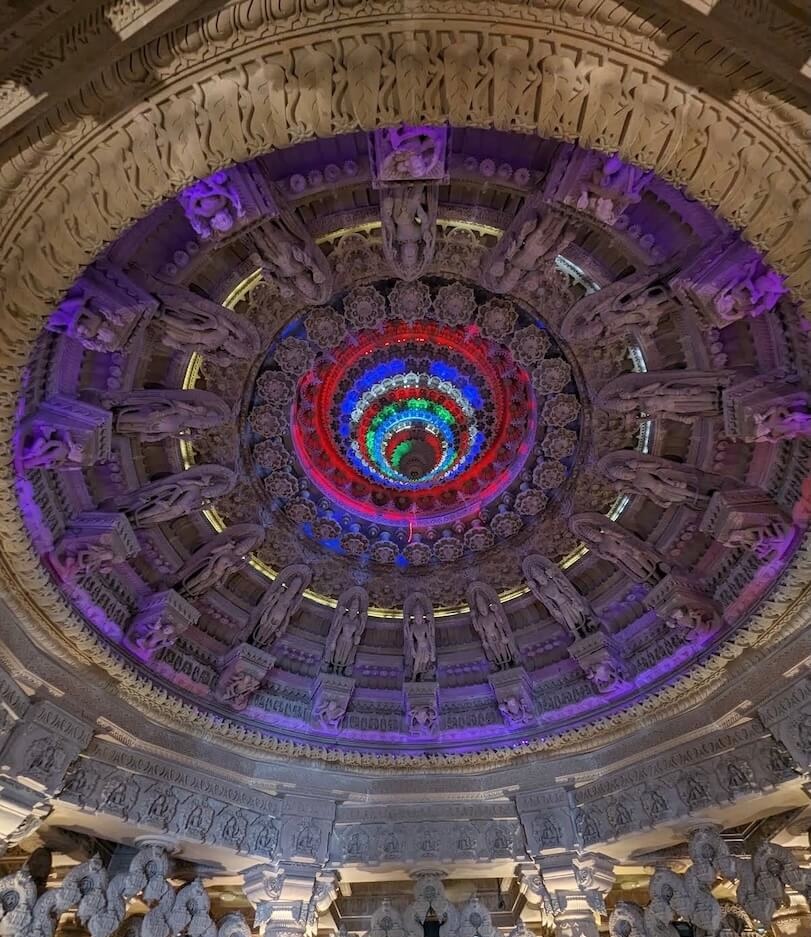 The entire temple is constructed from pink stone sourced from Bansi Paharpur in Rajasthan. Two subsidiary shrines flank the main structure on either side, one housing the Shiva Darbar and the other the Shri Ram Darbar. Their finely sculpted walls and entrances are crowned with distinctive roof spires. Inside, three sanctums stand in front of the semi-open assembly hall, framed by richly decorated doorways. The lalatbimb (central lintel carving) above each entrance depicts Ganesha, while the mandarak (carved threshold base) features a chandrashila (moonstone threshold) and kirtimukhs (protective mask motifs).
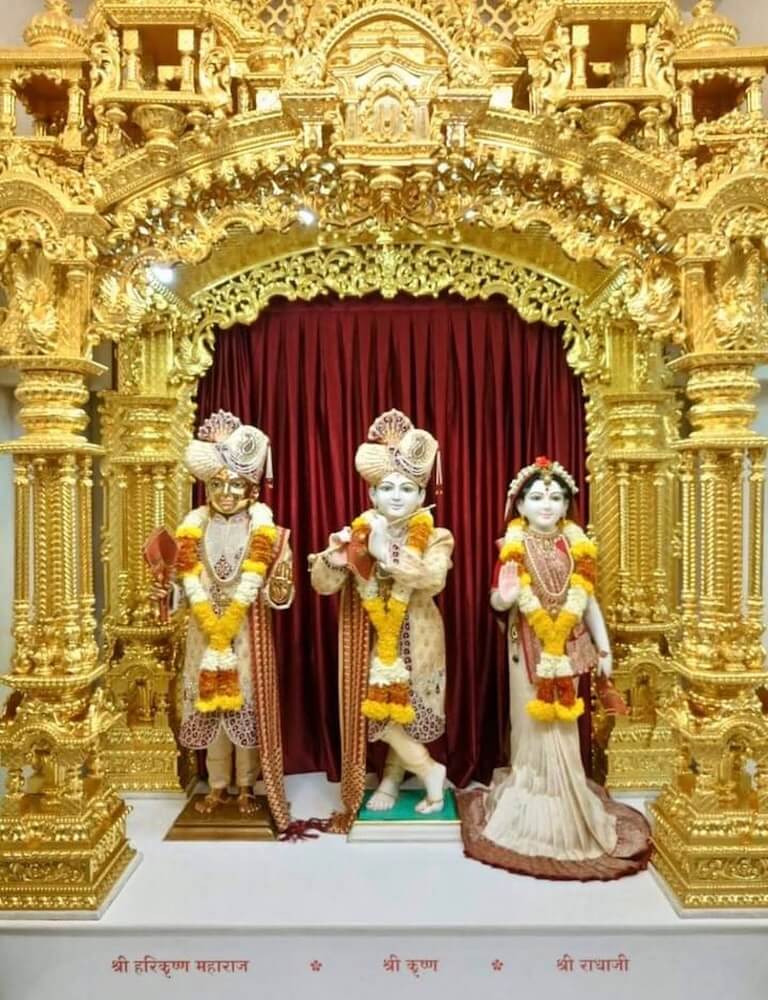
Within the richly decorated shrine in the central sanctum, the murtis of Parabrahman Bhagwan Swaminarayan and Gunatitanand Swami rest upon a vajrapith (raised stone pedestal). The flanking shrines on the right and left house idols of Radha-Krishna, Harikrishna Maharaj and Ghanshyam Maharaj on their respective vajrapiths. On the exterior walls, devkoshtaks (wall niches) hold carvings of numerous gods and goddesses, including Vayu, Kuber, Ishan, Indra, Agni, Yama and Nairritya. Domed shikhars rise above the roofs of the mukhamandaps and the assembly hall. Their summits bear amalaks (ribbed stone discs) and kalashs. Meanwhile, the three sanctums are topped by upward-tapering square shikhars, each crowned with an amalak, a kalash and a flag.
The temple remains open for darshan daily from 7.30 am to 10.15 am, after which the sanctums close until 11.15 am for the Rajbhog thal (midday meal offering). Both the main sanctum and the subsidiary shrines reopen from 11.15 am to 12 pm before closing for the afternoon break until 4 pm. Evening darshan takes place from 4 pm to 6 pm and again from 7 pm to 8.15 pm, with a one-hour closure between 6 pm and 7 pm for the thal offering. Five aartis are performed every day: Mangala Aarti at 6 am, Shringar Aarti at 7.30 am, Rajbhog Aarti at 11.15 am, Sandhya Aarti at 7 pm and Shayan Aarti at 8.15 pm. A special satsang assembly is also held every Sunday from 5 pm to 7 pm.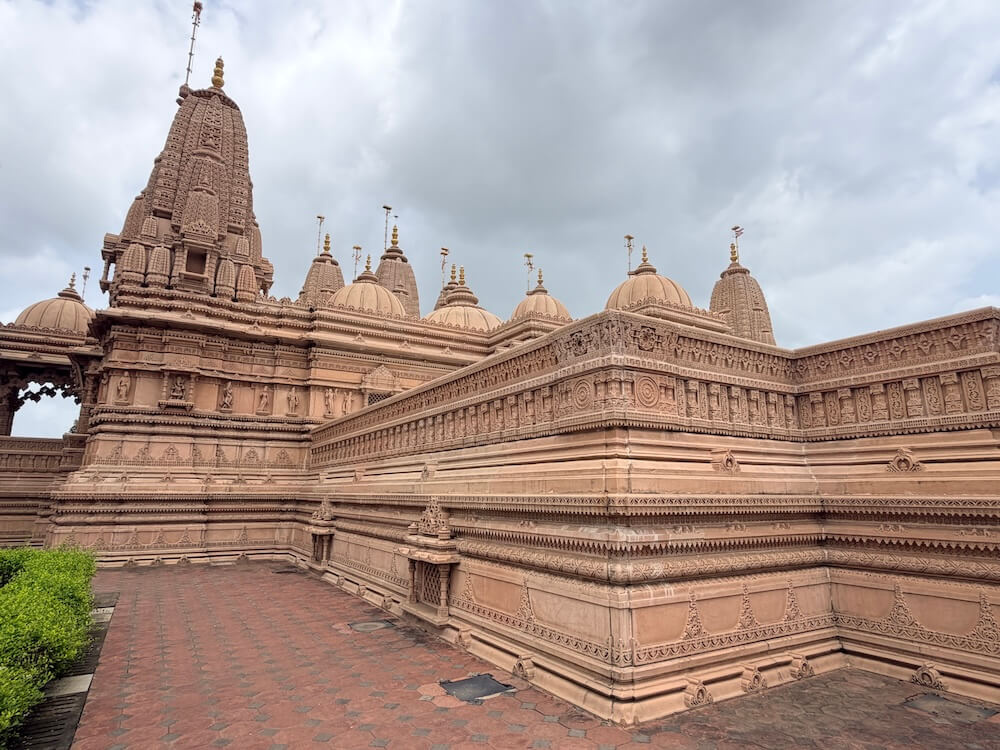
Various festivals and religious observances take place at the temple throughout the year with strict discipline and devotion. Shri Ram Navami and Swaminarayan Jayanti on Chaitra Shuddha Navami rank among the foremost annual celebrations, when devotees mark the birth of Shri Ram and Bhagwan Swaminarayan with great enthusiasm. The Annakut Mahotsav during Diwali is another major attraction, with hundreds of pure vegetarian dishes arranged before the deities. During the month of Shravan, the hindola (sacred swing festival) sees the deity seated each day in a differently adorned swing and gently rocked. Special decorations also grace the shrine on Janmashtami, Mahashivratri and Vasant Panchami. All major festive occasions feature devotional programmes including bhajans, kirtans, scripture readings and mantra recitations.
Useful Information :
- Located 4 km from Silvassa Central Bus Station and 24 km from Vapi
- State Transport bus services to Silvassa are available from several cities in Gujarat and Maharashtra
- Private vehicles can travel up to the temple’s parking area
- Several accommodation and breakfast options are available nearby
- Contact : Temple Office, Mob. 99989 92900
बीएपीएस स्वामीनारायण मंदिर
नरोली रोड, अथल, सिलवासा, दादरा और नगर हवेली
मंदिरे
Temples
मंदिर
મંદિરો
கோவில்கள்
దేవాలయాలు
ക്ഷേത്രങ്ങൾ
ದೇವಾಲಯಗಳು
মন্দিরসমূহ
ਮੰਦਿਰ
-
आमली हनुमान मंदिर आमली औद्योगिक वसाहत, सिल्वासा, दादरा आणि नगर हवेली
अधिक माहितीAmli Hanuman Temple Amli Industrial Estate, Silvassa, Dadra and Nagar Haveli
View Detailsआंवली हनुमान मंदिर अमली इंडस्ट्रियल एस्टेट, सिलवासा, दादरा और नगर हवेली
विवरण देखेंAmli Hanuman Temple Amli Industrial Estate, Silvassa, Dadra and Nagar Haveli
વિગત જુઓAmli Hanuman Temple Amli Industrial Estate, Silvassa, Dadra and Nagar Haveli
விவரங்களைக் காண்கAmli Hanuman Temple Amli Industrial Estate, Silvassa, Dadra and Nagar Haveli
వివరాలను చూడండిAmli Hanuman Temple Amli Industrial Estate, Silvassa, Dadra and Nagar Haveli
വിശദാംശങ്ങൾ കാണുകAmli Hanuman Temple Amli Industrial Estate, Silvassa, Dadra and Nagar Haveli
ವಿವರಗಳನ್ನು ವೀಕ್ಷಿಸಿAmli Hanuman Temple Amli Industrial Estate, Silvassa, Dadra and Nagar Haveli
বিস্তারিত দেখুনAmli Hanuman Temple Amli Industrial Estate, Silvassa, Dadra and Nagar Haveli
ਵੇਰਵੇ ਦੇਖੋ -
ओम निखिलेश्वर महादेव मंदिर कुडाचा, सिल्वासा, दादरा आणि नगर हवेली
अधिक माहितीOm Nikhileshwar Mahadev Temple Kudacha, Silvassa, Dadra and Nagar Haveli
View Detailsॐ निखिलेश्वर महादेव मंदिर कुदाचा, सिलवासा, दादरा और नगर हवेली
विवरण देखेंOm Nikhileshwar Mahadev Temple Kudacha, Silvassa, Dadra and Nagar Haveli
વિગત જુઓOm Nikhileshwar Mahadev Temple Kudacha, Silvassa, Dadra and Nagar Haveli
விவரங்களைக் காண்கOm Nikhileshwar Mahadev Temple Kudacha, Silvassa, Dadra and Nagar Haveli
వివరాలను చూడండిOm Nikhileshwar Mahadev Temple Kudacha, Silvassa, Dadra and Nagar Haveli
വിശദാംശങ്ങൾ കാണുകOm Nikhileshwar Mahadev Temple Kudacha, Silvassa, Dadra and Nagar Haveli
ವಿವರಗಳನ್ನು ವೀಕ್ಷಿಸಿOm Nikhileshwar Mahadev Temple Kudacha, Silvassa, Dadra and Nagar Haveli
বিস্তারিত দেখুনOm Nikhileshwar Mahadev Temple Kudacha, Silvassa, Dadra and Nagar Haveli
ਵੇਰਵੇ ਦੇਖੋ -
ताडकेश्वर महादेव मंदिर बिंद्राबिन, सिल्वासा, दादरा आणि नगर हवेली
अधिक माहितीTadkeshwar Mahadev Temple Bindrabin, Silvassa, Dadra and Nagar Haveli
View Detailsताड़केश्वर महादेव मंदिर बिंद्राबिन, सिलवासा, दादरा और नगर हवेली
विवरण देखेंTadkeshwar Mahadev Temple Bindrabin, Silvassa, Dadra and Nagar Haveli
વિગત જુઓTadkeshwar Mahadev Temple Bindrabin, Silvassa, Dadra and Nagar Haveli
விவரங்களைக் காண்கTadkeshwar Mahadev Temple Bindrabin, Silvassa, Dadra and Nagar Haveli
వివరాలను చూడండిTadkeshwar Mahadev Temple Bindrabin, Silvassa, Dadra and Nagar Haveli
വിശദാംശങ്ങൾ കാണുകTadkeshwar Mahadev Temple Bindrabin, Silvassa, Dadra and Nagar Haveli
ವಿವರಗಳನ್ನು ವೀಕ್ಷಿಸಿTadkeshwar Mahadev Temple Bindrabin, Silvassa, Dadra and Nagar Haveli
বিস্তারিত দেখুনTadkeshwar Mahadev Temple Bindrabin, Silvassa, Dadra and Nagar Haveli
ਵੇਰਵੇ ਦੇਖੋ