
राधा-कृष्ण मंदिर
धरमपूर, ता. आणि जि. वलसाड
Radha-Krishna Temple
Dharampur, Tal. & Dist. Valsad
 Nestled at the foothills of the Sahyadri mountain range and on the banks of the ‘Swargavahini’ (Waki River), Dharampur was a prosperous Rajput princely state in British India. The Radha-Krishna Temple located here stands even today as a testament to the grandeur of that princely era. Established by the then ruler of Dharampur, this temple is approximately one hundred and fifty years old. Under the jurisdiction of the Department of Archaeology, the shrine was recently restored at an expenditure of about 3.78 crore rupees. Serving as the focal point of faith for the devotees of Lord Krishna in Dharampur, this temple has now become a defining identity of the town.
Radha is regarded as the companion of Lord Krishna, though there is no specific mention of Radha in texts like the ‘Mahabharata’, the ‘Harivamsa’ or the ‘Bhagavata Purana’. The Bhagavata Purana notes that one Gopi was dearer to Krishna than the others and the remaining Gopis would remark that she had ‘Radhit’, meaning pleased, Krishna. 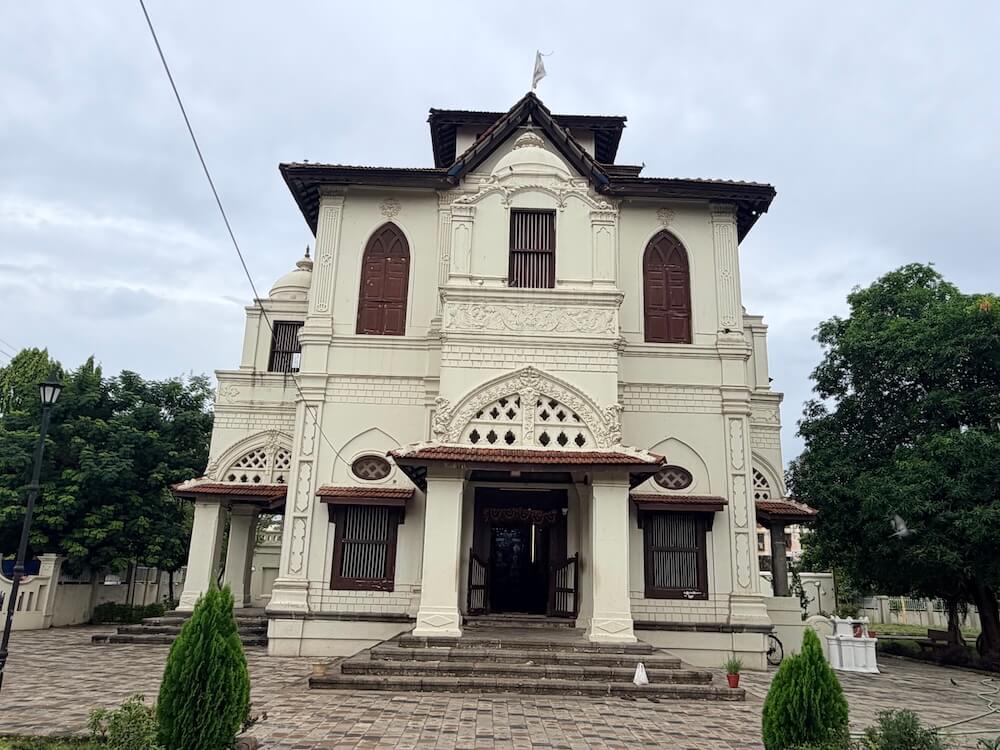 Scholars opine that this very Gopi, who was beloved to Krishna, emerged later in the form of Radha. The earliest mention of Radha is found in the ‘Gaha Sattasai’ (Gatha Saptashati), a text composed by King Hala of the Satavahana dynasty in the first century AD. The Gaha Sattasai, along with texts like the ‘Brahmavaivarta Purana’, refers to her as the beloved or wife of Krishna. Chaitanya Mahaprabhu (1496 to 1534), who lived in Bengal, is considered an incarnation of Lord Krishna. According to the renowned mythologist Devdutt Pattanaik, Chaitanya Mahaprabhu popularised the worship of Krishna along with Radha, as well as the Raslila dance form, across India.
The worship of Radha and Krishna is deeply rooted in Gujarat. It became widespread through the influence of several devotional traditions over the centuries.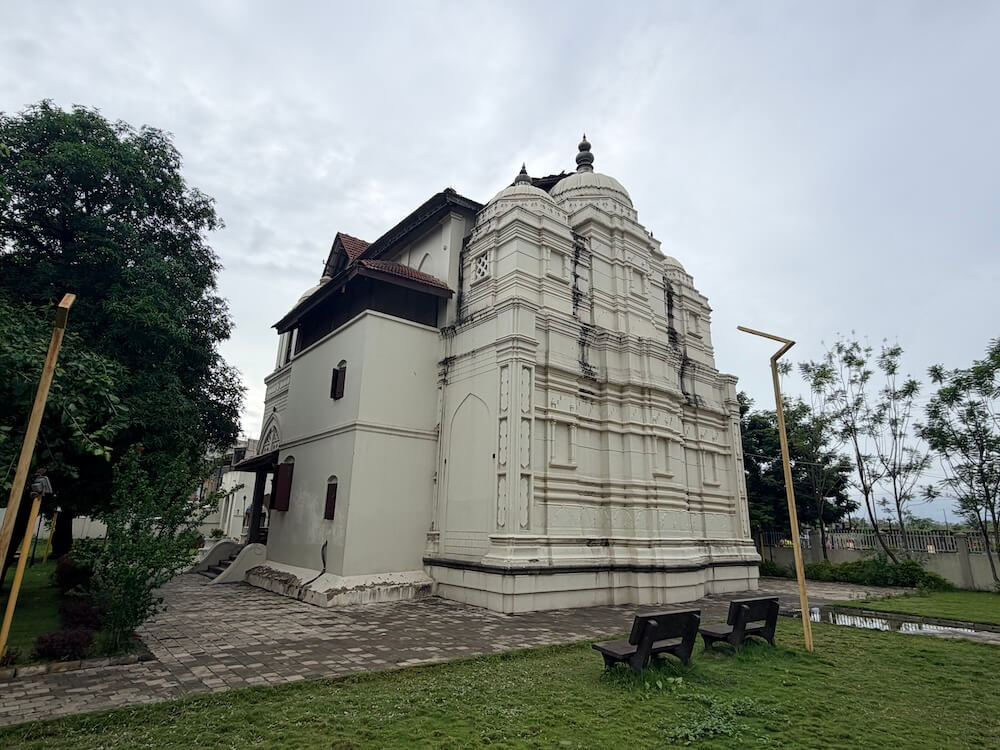 These include Nimbarkacharya’s Sanakadik Sampradaya in the 12th century, Narsi Mehta’s Bhakti movement in the 15th century, Chaitanya Mahaprabhu’s Gaudiya Vaishnava tradition and the Radhavallabh (Pushtimarg) Sampradaya in the 16th century, the Krishna Pranami Sampradaya in the 17th century, as well as the Swaminarayan Sampradaya in the 18th century. The tradition of worshipping Radha-Krishna was deeply rooted in many Rajput and Gurjar royal families. The heritage of that very tradition is beautifully reflected in the Radha-Krishna Temple at Dharampur.
The history of the princely state of Dharampur reveals that it was founded in the year 1262 by Rana Ramshah (reign 1262–1295), who belonged to the Sisodia Rajput clan of Udaipur in Rajasthan.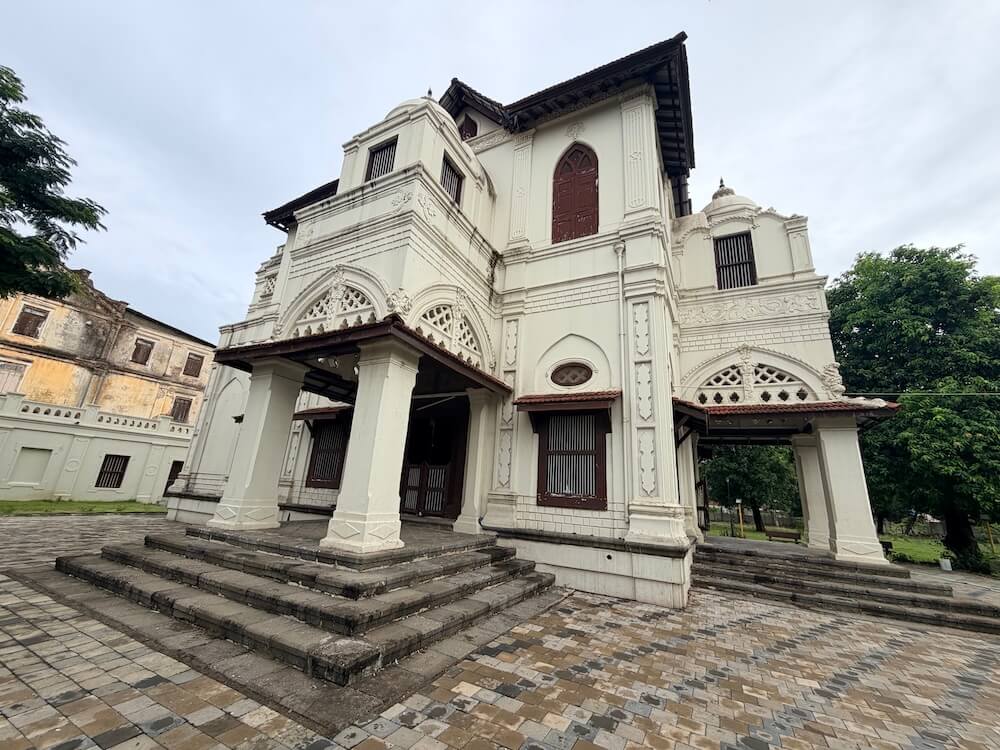 According to the book ‘Dharampur – A Brief Sketch of its History and Administration’ by Naoroji M. Dumasia (The Times Press, Bombay, 1928), the capital of this state was initially located at Mandavgan. In the year 1766, Maharana Dharamdevji Ramdev established a new city for his capital and named it after himself. That city is this very Dharampur. The princely state of Dharampur shared highly cordial relations with Chhatrapati Shivaji Maharaj, the founder of the Maratha Empire. Shivaji Maharaj raided Surat, a major commercial port of the Mughal Empire, on two occasions (1664 and 1670). At that time, Maharana Somdev permitted the Maratha army to pass through his territory. In return, Shivaji Maharaj exempted this state from the ‘Chauthai’ tax. However, these relations strained during the later Peshwa era.
  In the year 1802, the Peshwas’ rights over this state and the authority to collect Chauthai were permanently transferred to the British. During the British colonial era, the ruler of this princely state was honoured with a nine-gun salute.
During the reign of Maharana Narayandev Ramdev (III), who ascended the throne in 1860, numerous administrative and fiscal reforms were introduced in the state of Dharampur. He connected Dharampur to Valsad by a railway line. The Radha-Krishna Temple in Dharampur was constructed during his tenure. According to research by the Department of Archaeology, the period of the temple’s establishment dates between 1875 and 1885. In recent times, the structure had fallen into a severely dilapidated condition. 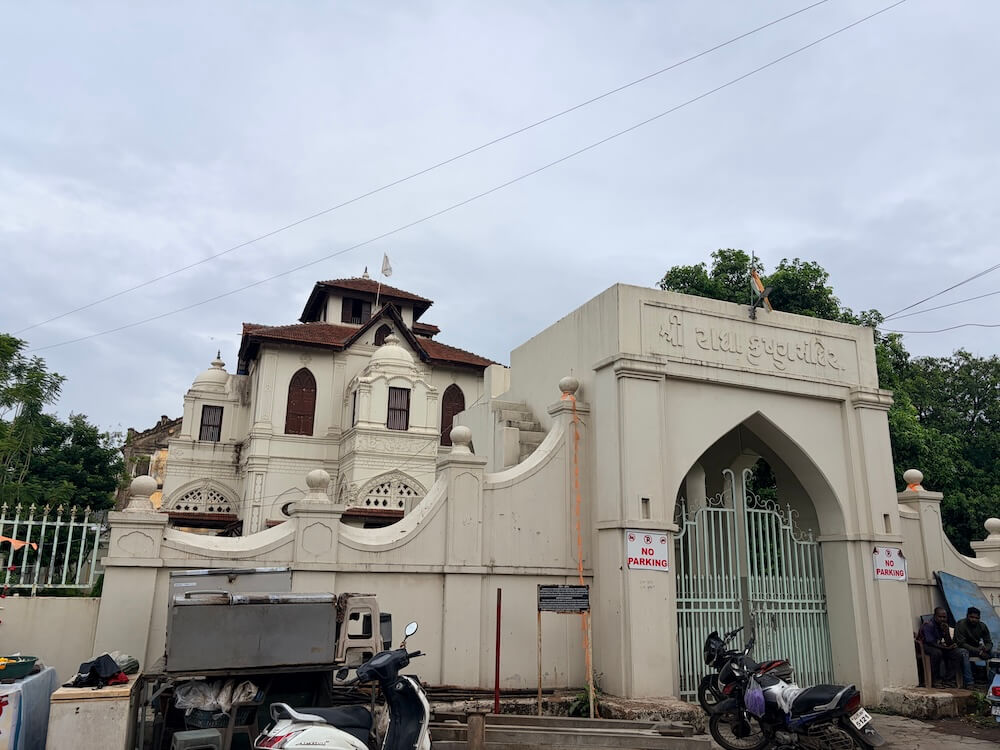 During the monsoon, rainwater leaked directly onto the idols of the deities. Consequently, several prominent citizens of Dharampur came together and petitioned the government to restore the shrine. After a persistent effort lasting nearly ten years, the Department of Archaeology of the state government allocated a fund of 3.78 crore rupees for the project. Following extensive restoration completed in 2022 using these funds, the temple has now been restored to its pristine glory.
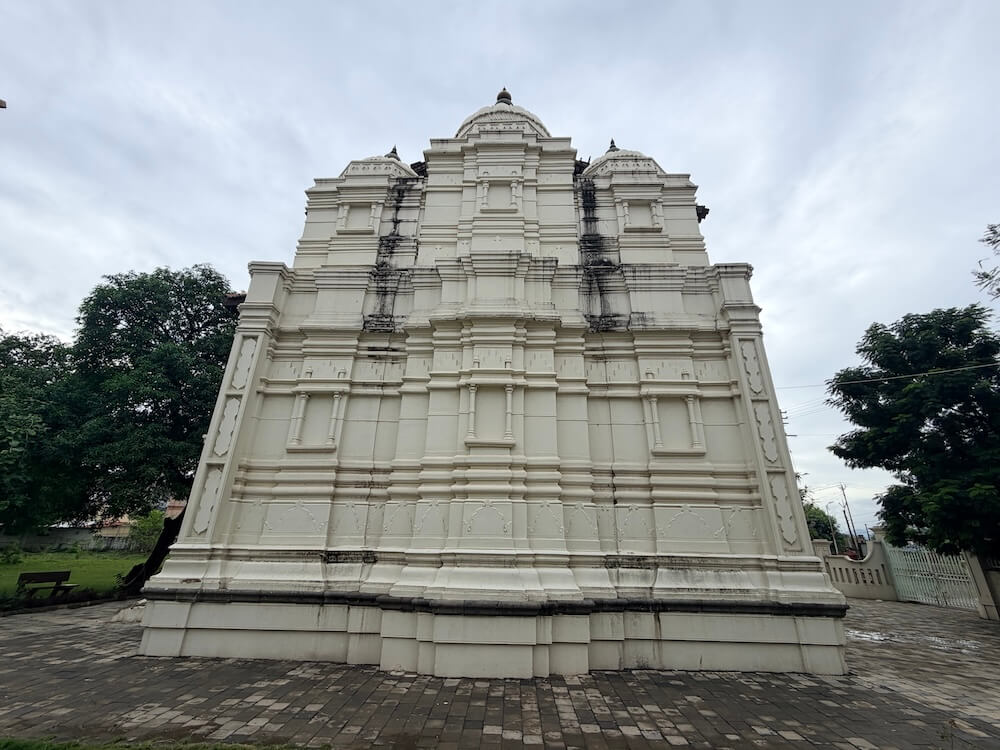
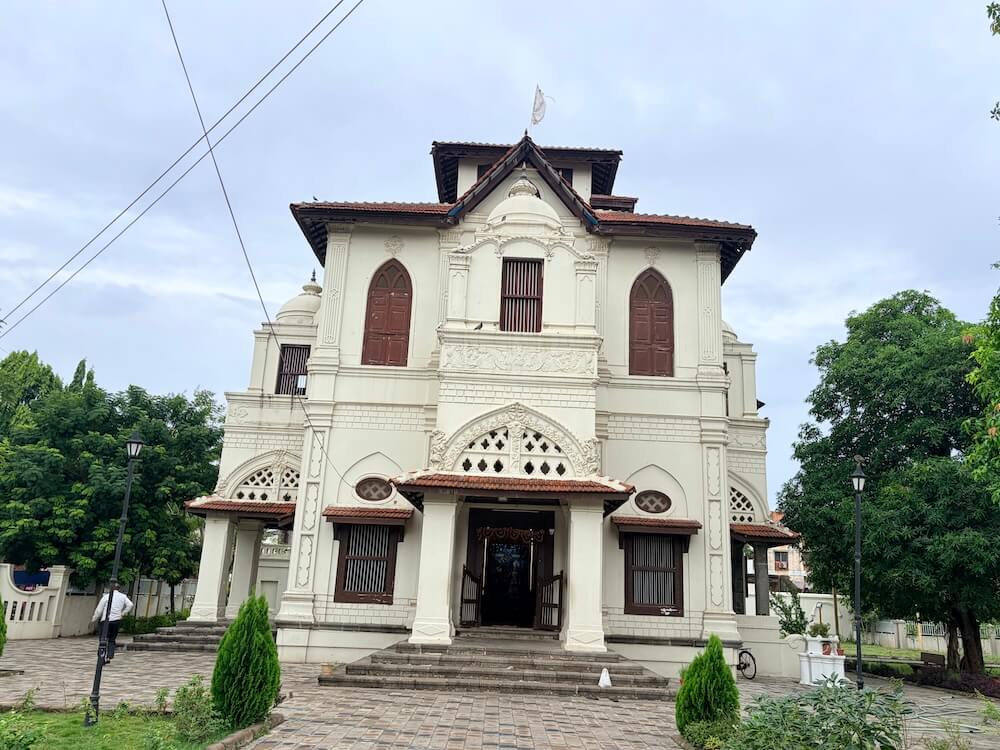
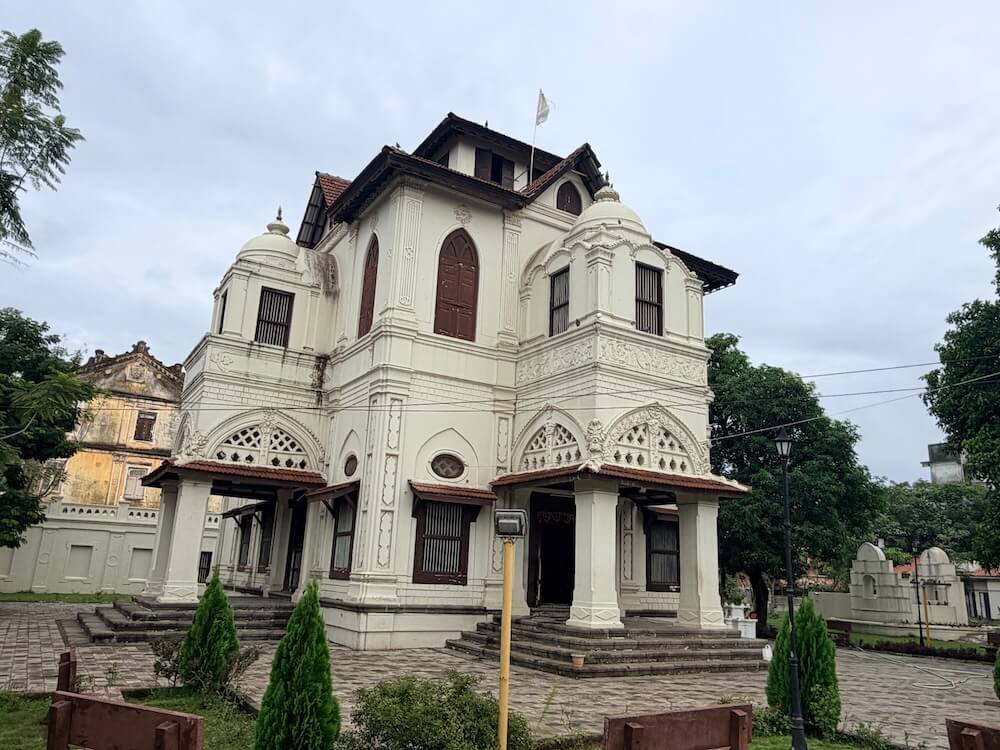
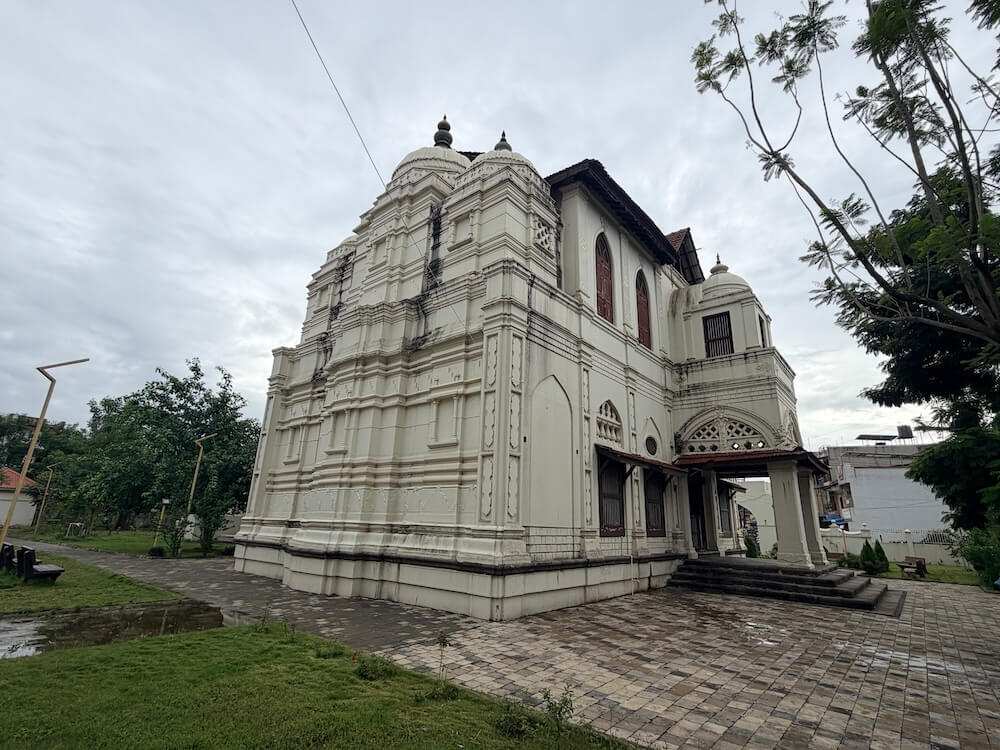
The temple is situated in the heart of Dharampur town. Entry into the temple courtyard is through a gateway built into the fortification wall that surrounds the shrine. The pathway leading from the entrance to the main temple building is paved with interlocking blocks. The architectural layout of this temple bears witness to the eclectic styles of the late eighteenth to nineteenth centuries. The structure appears as a beautiful synthesis of the Maratha-era ‘Wada’ vernacular style and European architecture. The entire temple structure stands on a raised stone plinth. The architectural plan comprises three entrance porches (‘Mukhamandapas’), a central assembly hall (‘Sabhamandapa’), an ante-chamber (‘Antarala’) and the sanctum sanctorum (‘Garbhagriha’). The entrance porch features a semi-circular European layout, supported by semi-engaged columns built into the walls. The bases and capitals of these columns bear a distinct resemblance to the ‘Ionic’ or ‘Tuscan’ classical orders. Though these architectural styles originated in Europe, 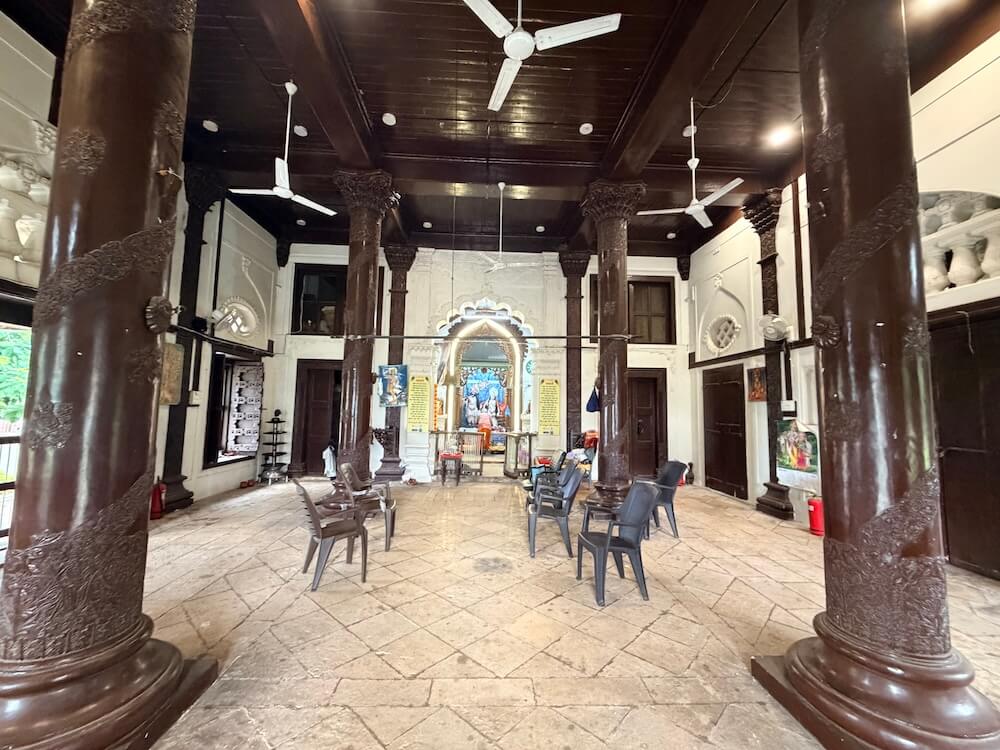 British and European builders brought them to India during the colonial era and incorporated them into several structures across the country. Above these classical columns rests a tiled roof in the traditional Maratha style, supported by sturdy wooden beams.
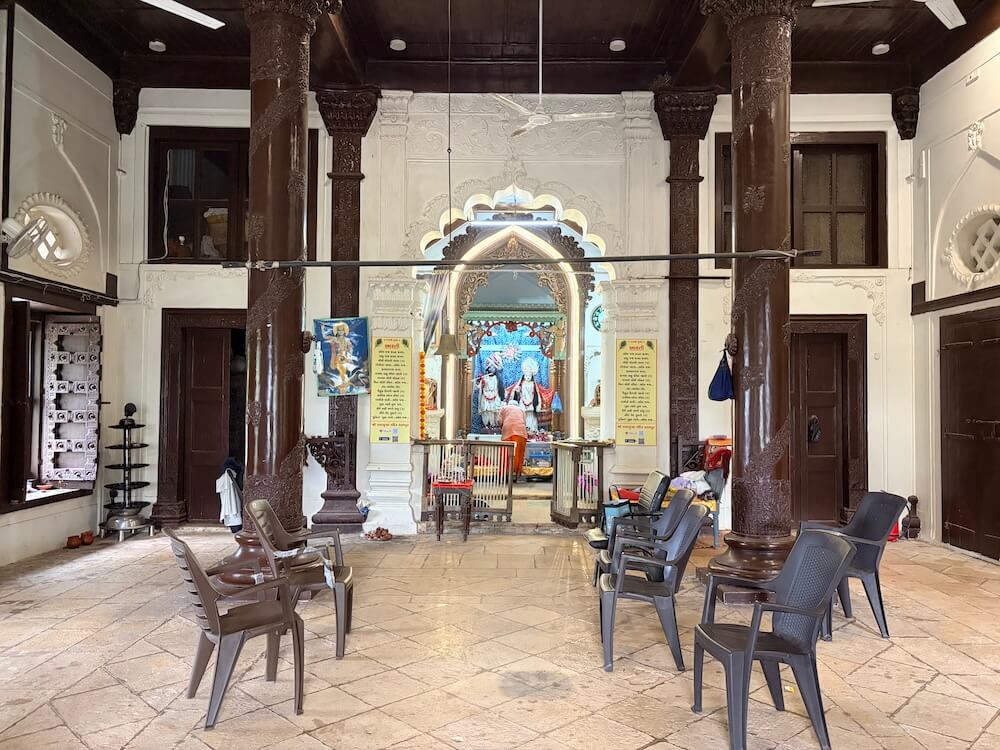
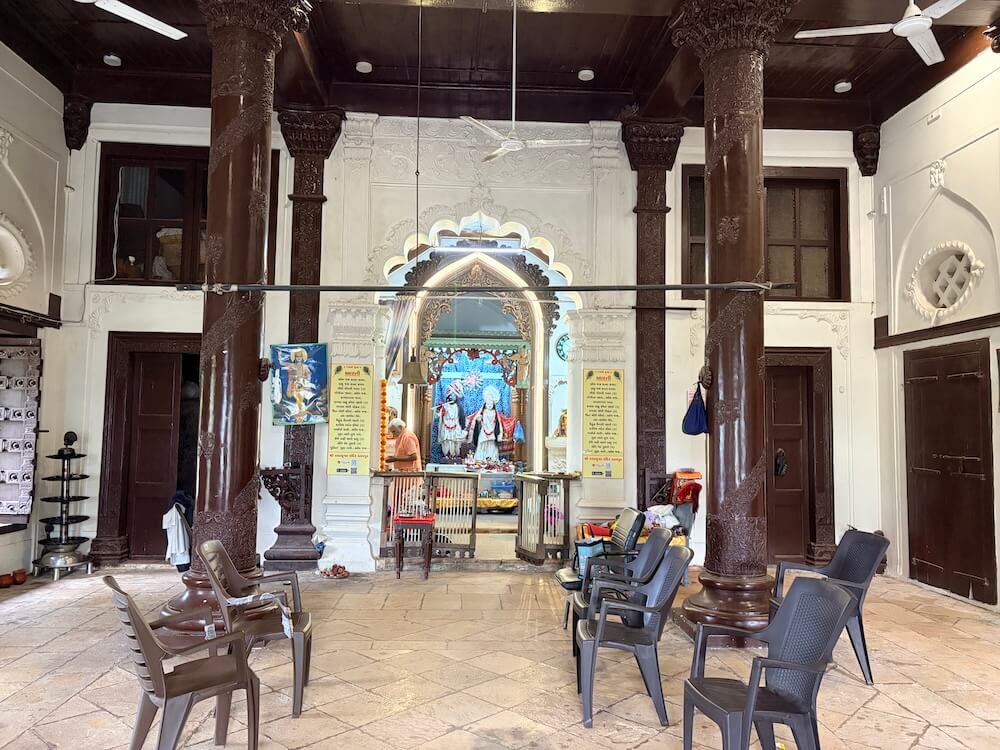
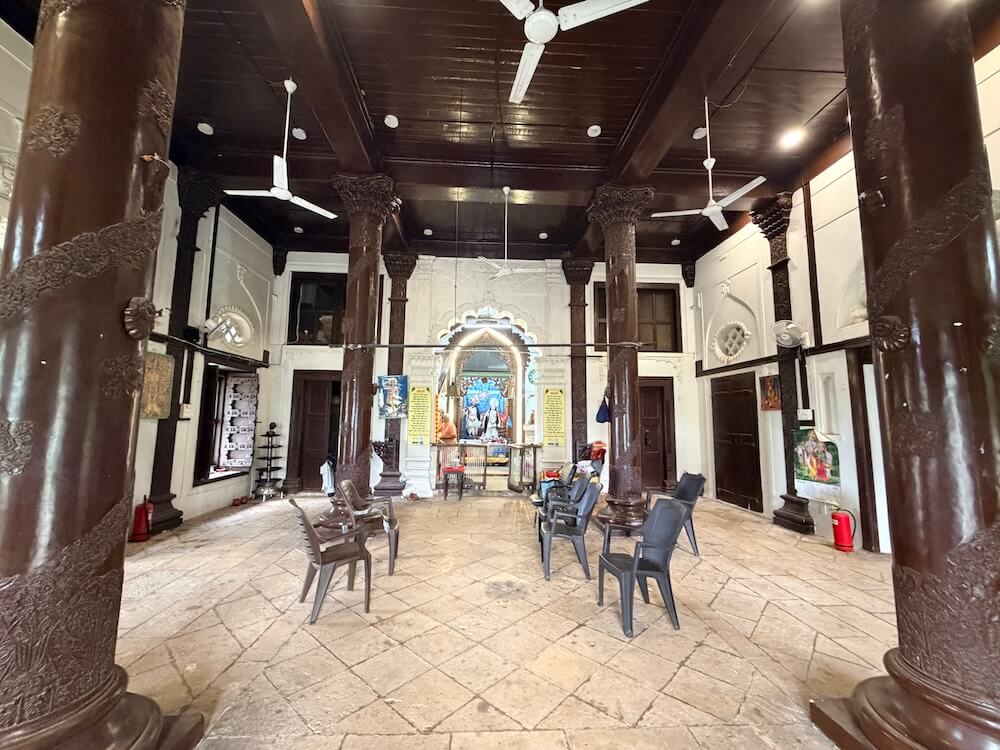
Devotees ascend five steps from the courtyard to enter the raised entrance porch of the temple. The doorway to the assembly hall is fitted with intricately carved wooden shutters. The double-storeyed assembly hall features wooden pillars adorned with distinctive, fine craftsmanship on the shafts and upper sections. From the assembly hall, one proceeds into a compact ante-chamber. The column branches and the arched frame (‘Mahirapi Torana’) over the open doorway of the ante-chamber exhibit delicate carvings. 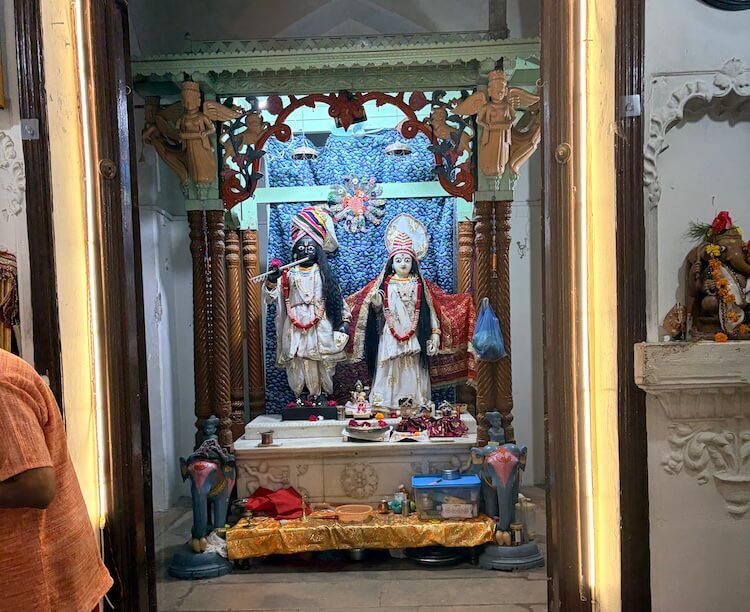 Within the niches on the front walls of the ante-chamber stand the idols of Lord Ganesha and Lord Hanuman.
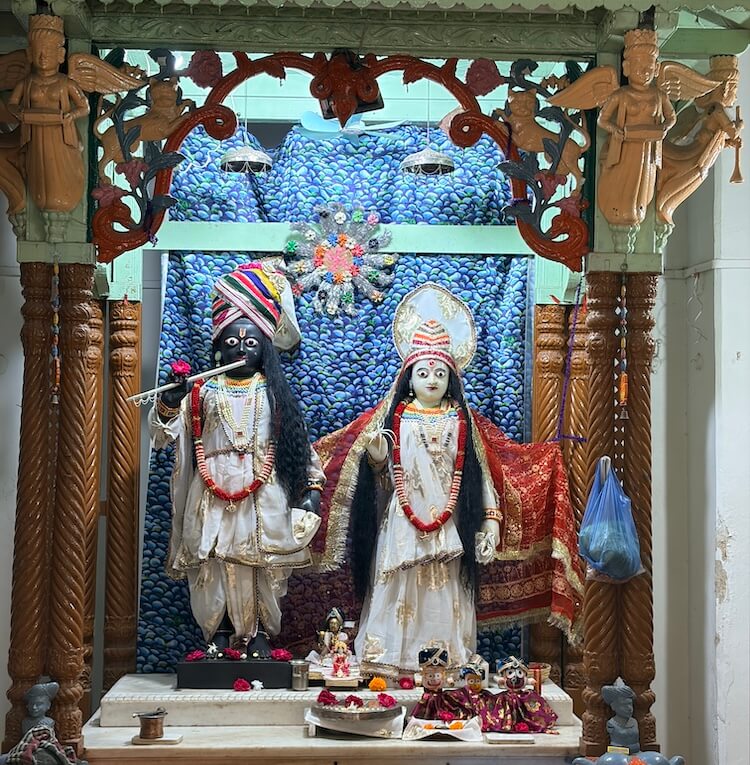
Inside the sanctum sanctorum, an idol of Lord Krishna carved from black stone and a pristine white marble idol of Radha are enshrined within a wooden pavilion resting on a marble altar (‘Vajrapeetha’). Adorned in elegant vestments and fine ornaments, these idols look remarkably unique. A striking feature of these deities is the exceptional length of their sculpted hair. Lord Krishna’s tresses extend down to his waist, while Radha’s hair reaches down to her knees. The entrance porches of the temple are crowned with small, minaret-like domes, while the sanctum sanctorum features three small spires.
Numerous traditional and religious festivals are celebrated with grand fervour at this historic temple throughout the year. Krishna Janmashtami stands as the grandest annual religious festival here. For this occasion, the temple is beautifully decorated with special floral arrangements and attractive lighting displays. The celebration of the birth of Lord Krishna takes place at midnight, at 12:00 am. Following the performance of the ‘Maha Aarti’, sacred offerings (‘Prasad’) of ‘Panchamrit’ and ‘Panjiri’ are distributed among the gathered devotees. On the day following Janmashtami, the ‘Gopalakala’ ritual and the traditional ‘Dahi Handi’ celebrations are organised. The temple also hosts a vibrant celebration during Holi and Rang Panchami, known locally as the Phag festival. On this auspicious day, the idols of Radha-Krishna are dressed in beautiful, colourful attire. Festivals like the Rasotsav on the auspicious full moon day of the Hindu month of Ashwin and the Hindola festival during the holy month of Shravan, are also celebrated here with deep devotion. The temple remains open for devotees daily from 6:00 am to 12:00 pm and from 4:00 pm to 8:00 pm.
Useful Information :
- Located 1 km away from the Dharampur Bus Station and 28 km away from Valsad.
- State transport (ST) bus services are available regularly from Valsad.
- Private vehicles can drive right up to the temple premises.
- Lodging and breakfast facilities are available in the surrounding vicinity.
राधा-कृष्ण मंदिर
धरमपुर, ताल. एवं जिला. वलसाड
मंदिरे
Temples
मंदिर
-
साईबाबा मंदिर तिथळ, ता./जि. वलसाड
अधिक माहितीSai Baba Temple Tithal, Tal./Dist. Valsad
View Detailsसाईं बाबा मंदिर तीथल, ताल./जिला. वलसाड
विवरण देखें -
भाव-भावेश्वर महादेव मंदिर बारुमाळ, ता. धरमपूर, जि. वलसाड
अधिक माहितीBhav-Bhaveshwar Mahadev Temple Barumal, Tal. Dharampur, Dist. Valsad
View Detailsभाव-भावेश्वर महादेव मंदिर बारुमल, ताल. धरमपुर, जिला. वलसाड
विवरण देखें -
दत्त मंदिर पाथरी, ता./जि. वलसाड
अधिक माहितीDatt Temple Pathri, Tal./Dist. Valsad
View Detailsदत्त मंदिर पाथरी, ताल./जिला. वलसाड
विवरण देखें