
पुथुकुलम श्री नागराज मंदिर
वेंगल्लूर, थोडुपुझा, जि. इडुक्की.
Puthukkulam Sree Nagaraja Temple
Vengalloor, Thodupuzha, Dist. Idukki.
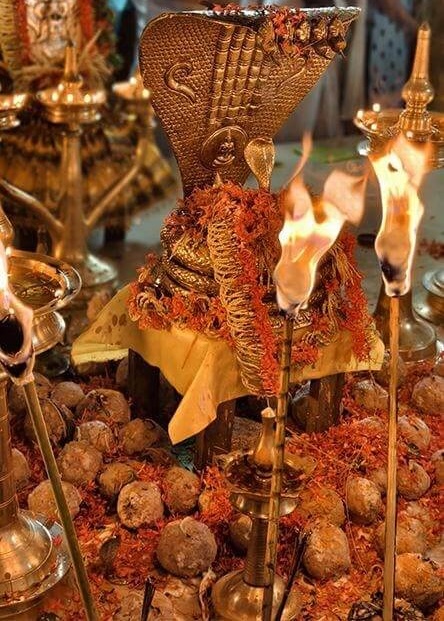 Sree Nagaraja Temple is located at Manakkad, near Thodupuzha, on the banks of the Thodupuzha River in Idukki district. The west-facing temple has Bhagavathi and Nagaraja Anantha Padmanabhan as its principal deities. It is one of the rare temples in Kerala where Nagaraja holds an important place. Many devotees visit the temple to seek relief from Sarpa Dosha and for blessings for children.
The origin of the temple is historically linked to the old Puthukkulath Mana family. In earlier times, the head of Puthukkulath Mana had a close friendship with the head of Pampummekkatt Mana in Thrissur, one of the well-known centres of Naga worship in Kerala. Pleased with the family’s goodness and devotion, the head of Pampummekkatt Mana gifted five Naga deities to the family for worship and also gave them the mantras for their worship, written on palm leaves. This is considered the historical beginning of Naga worship in this area. Centuries ago, Manakkad and Vengalloor were mainly agricultural villages. As part of the traditional agricultural culture of Kerala, prominent ancestral homes maintained sacred groves known as Sarpa Kavu to preserve the fertility of the land and protect nature and water sources. The sacred grove maintained by Puthukkulath Mana later developed into a large temple complex. This Kavu, which grew as part of Kerala’s traditional agricultural culture and family-based Naga worship, is believed to have a history dating back several centuries.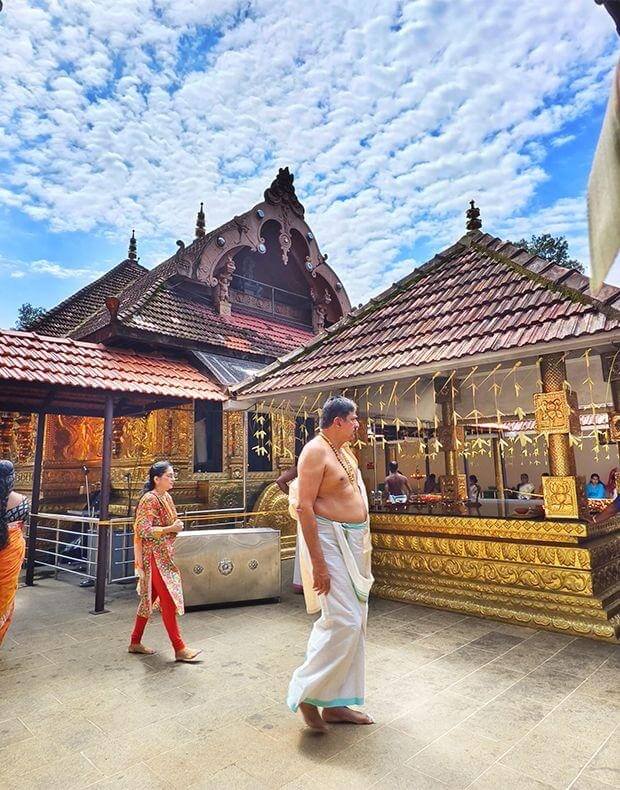
Over time, with the decline of the large ancestral families, this place of worship and the sacred grove were neglected and fell into a poor condition due to the lack of regular worship. As the old Kavu deteriorated, a committee formed by local residents and devotees, now known as the Puthukkulam Sree Nagaraja Swami Trust, began efforts to restore it. Under the leadership of a prominent person from Puthukkulam and based on the findings of traditional Deva Prasnam, the temple was restored. A new and larger temple complex, including the Sreekovil and Chuttambalam, was built and the deities were reinstalled. The present temple complex is believed to have been established around 20–25 years ago.
There is a beautiful legend connecting Pampummekkatt Mana and Puthukkulath Mana with the origin of the temple. In the past, the head of Puthukkulath Mana went to Pampummekkatt Mana to observe Bhajanam. Pleased with his devotion, the Nagaraja of Pampummekkatt is believed to have decided to give him a Naga deity for worship. As the head of the family was returning home by boat, he noticed a Paralmheen (a small freshwater fish) swimming mysteriously in the water inside the boat. No matter how many times he tried to throw the fish out, it kept returning to the boat. When he finally reached his home and looked in the boat, the fish was nowhere to be seen.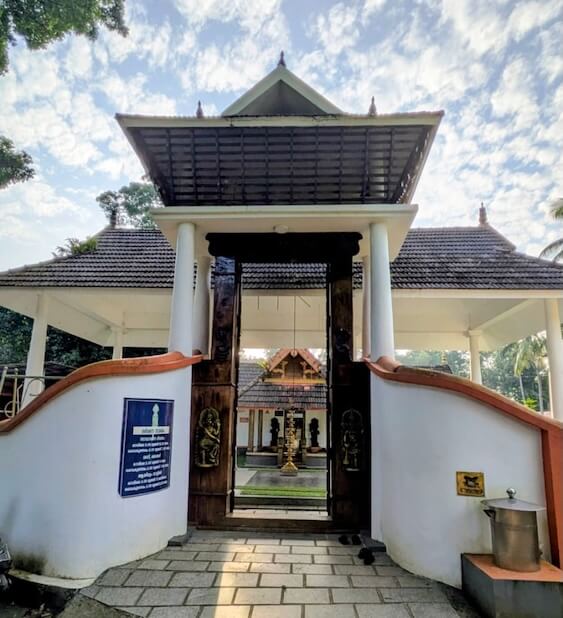 However, he found the same fish swimming in the pond at his ancestral home, known as Puthukkulam. It is believed that, realising that Nagaraja had appeared in the form of the fish, he installed a Naga deity on the banks of the pond. The temple is believed to have received the name ‘Puthukkulam’ from this miraculous pond.
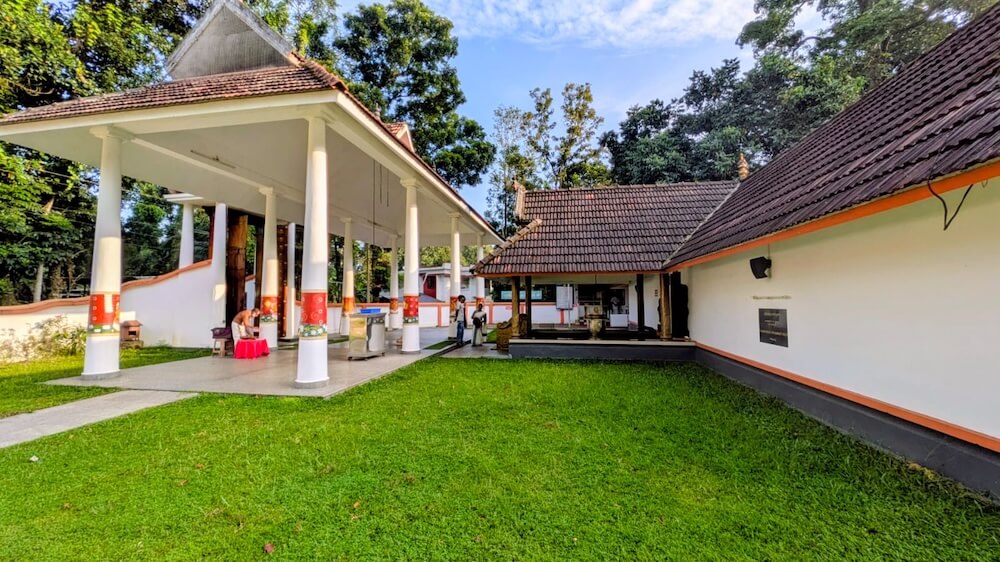
When viewed from the road, the first thing that catches the eye is the beautiful Padippura, a traditional Kerala-style entrance gate. It provides access to the temple courtyard. The large trees around the temple, the sacred grove and the nearby Thodupuzha River create a green and pleasant setting. The main temple has a traditional Kerala-style Chuttambalam, with white walls and a roof covered with red clay tiles. After passing through the Padippura, devotees can see the spacious temple courtyard, an Aanapandal for devotees to stand under and a large traditional lamp that adds to the beauty of the premises.
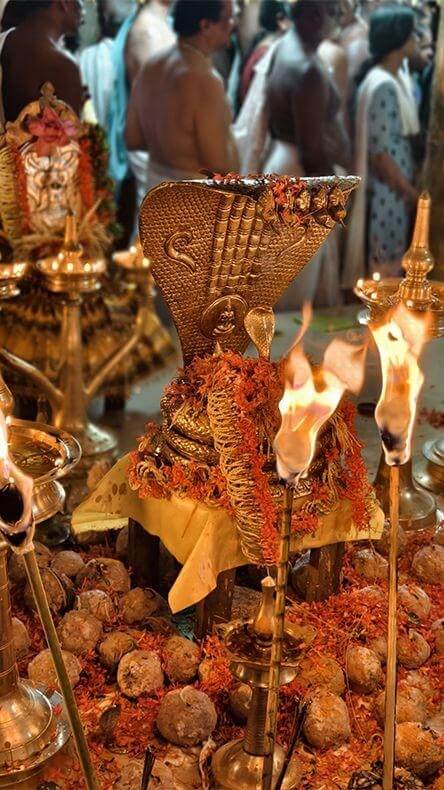
The main Sreekovil is square in shape and built in the traditional Kerala architectural style. Granite, earth, wood and clay tiles have been mainly used in its construction.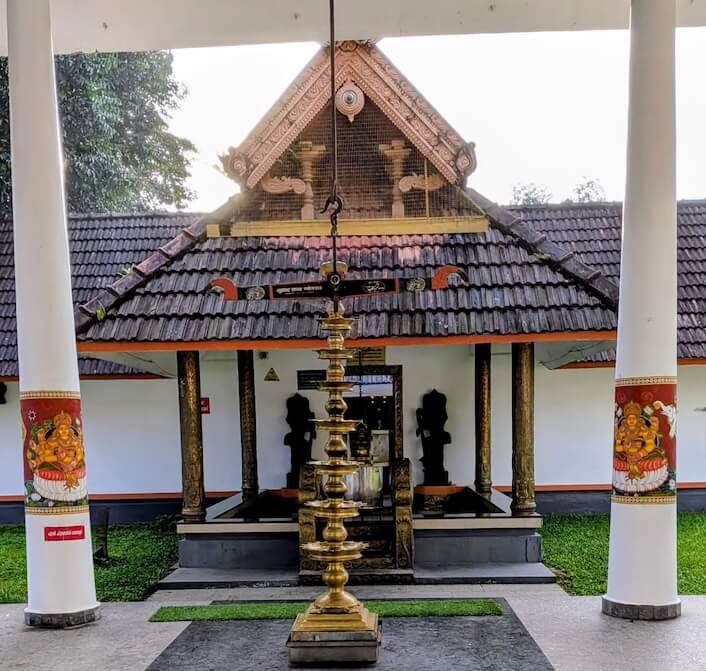 A key architectural feature of the temple is that the same Sreekovil has entrances on two different sides, unlike most temples. The western entrance leads to the shrine of Bhagavathi, while the southern entrance leads to the shrine of Nagaraja Anantha Padmanabhan. A traditional Nalambalam surrounds the Sreekovil, along with a Namaskara Mandapam for prayers. The use of concrete has been kept to a minimum to retain the traditional style and natural setting. The idol of Nagaraja Anantha Padmanabhan, shown with its hood raised, is the main focus of worship at the southern entrance. Devotees offer various offerings here seeking blessings for children and relief from Sarpa Dosha. At the western entrance, Bhagavathi is worshipped as the peaceful form of Bhuvaneshwari and as Bhadrakali, who is believed to remove harmful influences. The Bhagavathi shrine is given the first importance in Tantric rituals.
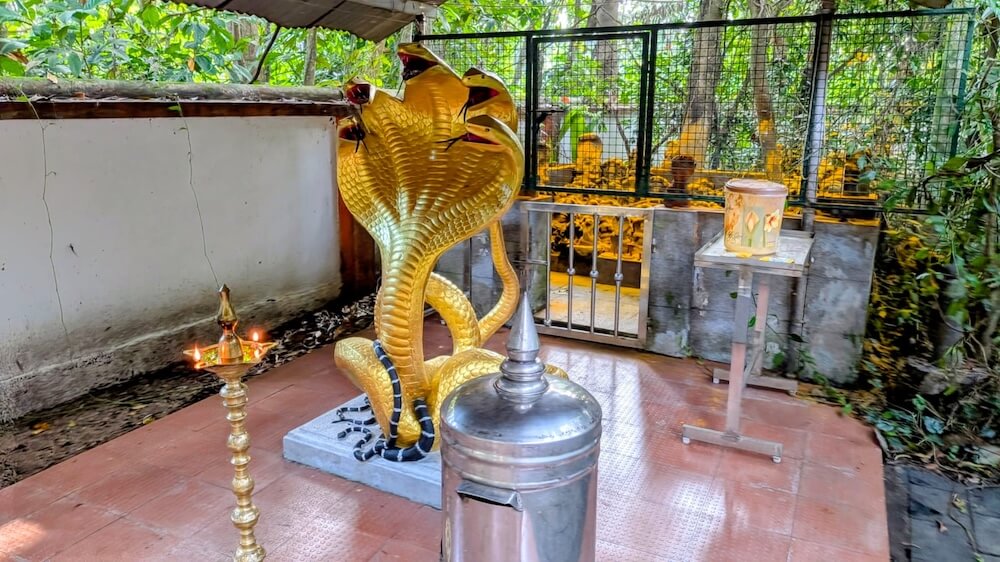
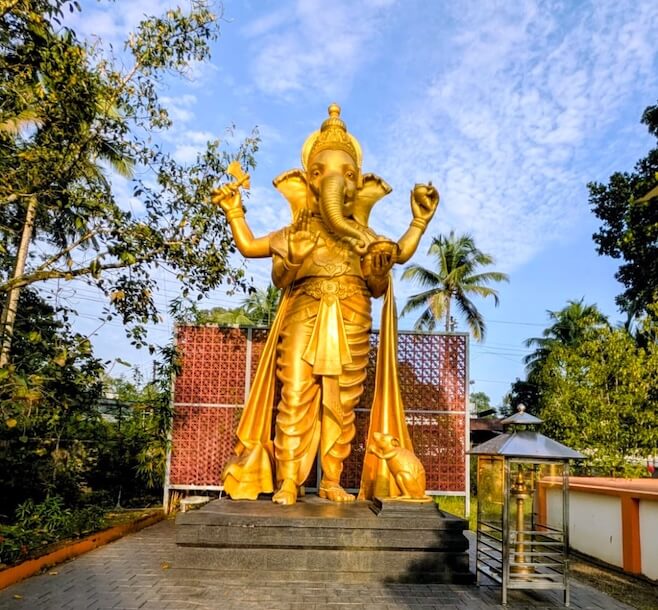 The shrine of Nagayakshiyamma is located just outside the main Sreekovil, in the north-west corner. Nagayakshiyamma is worshipped as an important deity for family prosperity and the well-being of married women. Outside the main Nalambalam, on the northern side of the temple, the deity of Karinaga is worshipped in a protected sacred grove. This Naga shrine is set among large trees and surrounded by nature. Near the Karinaga shrine is the shrine of Kuzhinaga, which is worshipped to honour the Naga deities believed to reside beneath the earth. Inside the main Nalambalam, Lord Ganesha, the remover of obstacles, is installed in the Kannimoola (south-west corner), facing east. Devotees traditionally worship Ganesha first for the smooth completion of their activities.
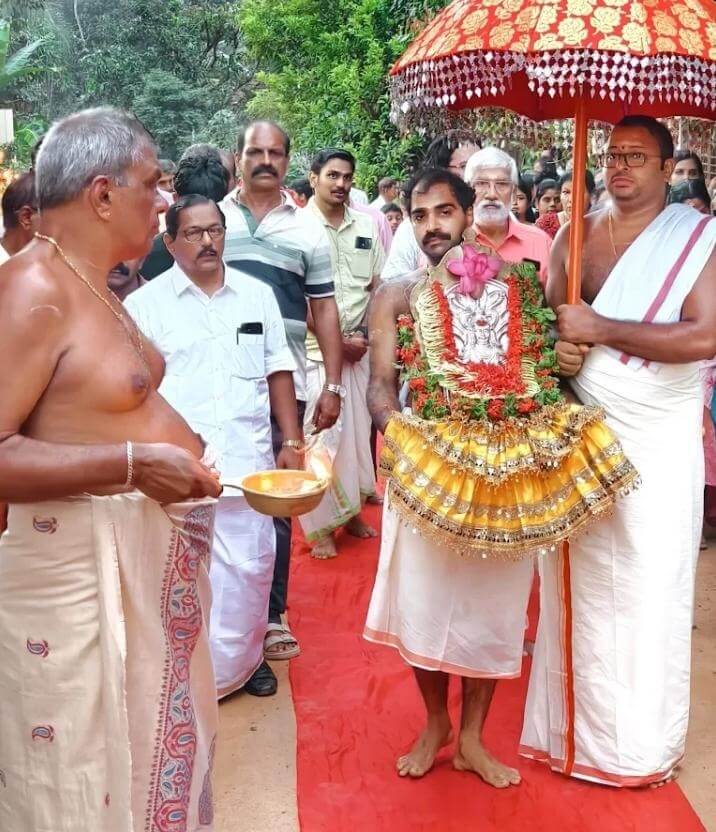
The most important annual festival of the temple is the Ayilyam Makam Mahotsavam, celebrated during the Malayalam month of Kanni (September–October) on the Ayilyam and Makam star days.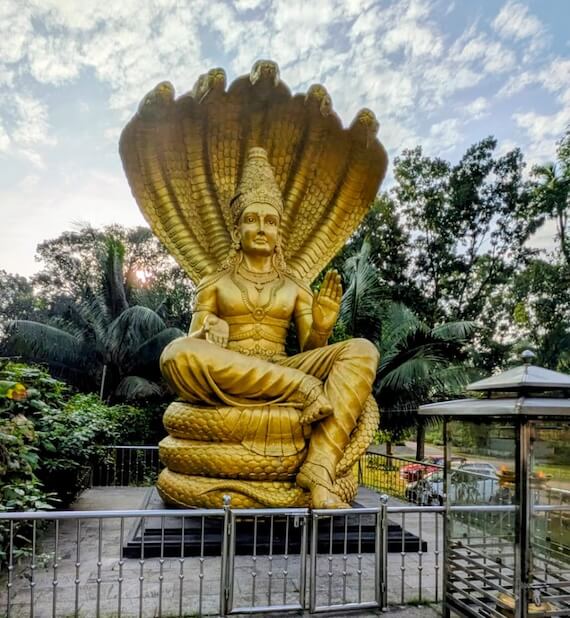 Kanni Ayilyam is believed to be the birthday of Nagaraja and special poojas, Noorum Palum offering and Nagappattu are conducted from the morning. In the evening, a large procession to the southern sacred grove is held, followed by Sarpabali. On the following day, under the Makam star, a special offering known as ‘Makam Idi’ is prepared using a mixture of medicinal ingredients and distributed to devotees. Ayilyam in every Malayalam month is also an important special day at the temple. On these days, many devotees, including those from distant places, visit the temple to perform special poojas such as Noorum Palum and Sarpabali for relief from Sarpa Dosha. Mahashivaratri is also given special importance due to the Shaiva association of the Nagaraja Prathishta and special lamps and day-and-night poojas are conducted on the occasion. As Bhagavathi is one of the principal deities, Navaratri is observed on a grand scale for nine days, followed by Vidyarambham on Vijayadashami. Thrikarthika and Thiruvonam are also observed with special rituals in honour of the Goddess.
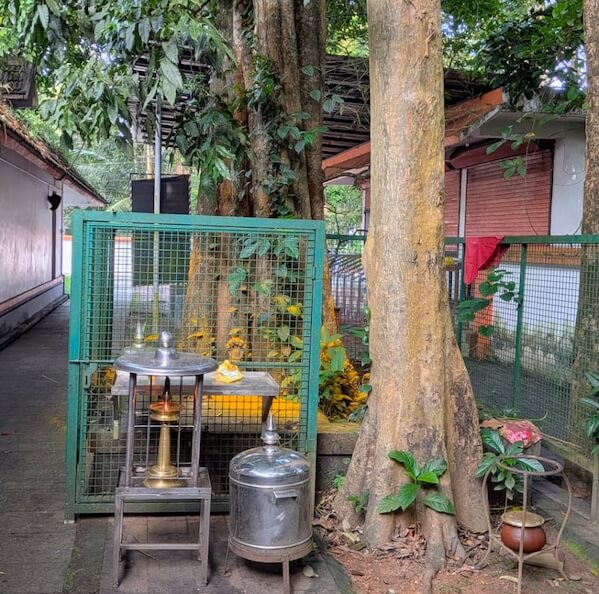 The main offerings to Nagaraja include Noorum Palum, Sarpabali, Ashta Naga Pooja, Ashta Naga Archana, turmeric powder Abhishekam, milk Abhishekam, offering of Naga-shaped figures and Makam Idi. Noorum Palum is an offering made with rice flour, turmeric powder and milk to please the Naga deities. Sarpabali (Payasa Homam) is performed to seek relief from Sarpa Kopam and Sarpa Dosha. Ashta Naga Pooja is a special archana performed to please the eight Naga deities, including Anantha and Vasuki. Milk Abhishekam and turmeric powder Abhishekam involve offering milk and applying turmeric powder to the Naga idols. Offering Naga-shaped figures made of gold, silver or copper is also an important ritual performed for relief from Naga-related afflictions. Makam Idi is a special medicinal offering distributed to devotees only on the Makam star day in the Malayalam month of Kanni. The main offerings to Bhagavathi and the other deities include Bhagavathi Seva, performed for family prosperity and relief from difficulties; Pattucharthal, mainly performed by married women for Nagayakshiyamma and Bhagavathi; and Ganapathi Homam, performed for Lord Ganesha to remove obstacles.
The daily poojas begin at 05:00 AM with the opening of the sanctum and Abhishekam. Ganapathi Homam is performed at 06:15 AM, followed by Mrityunjaya Homam at 06:30 AM. Usha Pooja is conducted at 07:00 AM and Ucha Pooja at 08:45 AM. The temple closes at 10:30 AM, while on Saturdays and Sundays, it closes at 11:00 AM. In the evening, it reopens at 05:30 PM, followed by Deepaaradhana at 06:30 PM and Athazha Pooja at 07:00 PM. The temple closes at 07:30 PM, marking the end of the day’s poojas. On the Ayilyam star day of every Malayalam month, the temple opens as early as 04:00 AM for special poojas such as Noorum Palum and Sarpabali.
Key highlight :-
- Located 2 km from Thodupuzha, 18 km from Muvattupuzha and 28 km from Pala.
- 35 km from Piravom road railway station.
- 53 km from Cochin International Airport.
- KSRTC and local bus facilities are available to the temple.
- Private vehicles can be parked in the temple’s parking area.
- Accommodation and food facilities are available near the temple.
- Contact number +91 9446012500
पुथुक्कुलम श्री नागराज मंदिर
वेंगल्लूर, थोडुपुझा, जिला। इडुक्की
मंदिरे
Temples
मंदिर
મંદિરો
கோவில்கள்
దేవాలయాలు
ക്ഷേത്രങ്ങൾ
ದೇವಾಲಯಗಳು
মন্দিরসমূহ
ਮੰਦਿਰ
-
श्रीकृष्ण स्वामी मंदिर थोडुपुझा, जि. इडुक्की.
अधिक माहितीSree Krishna Swamy Temple Thodupuzha, Dist. Idukki.
View Detailsश्री कृष्ण स्वामी मंदिर थोडुपुझा, जिला. इडुक्की.
विवरण देखेंSree Krishna Swamy Temple Thodupuzha, Dist. Idukki.
વિગત જુઓSree Krishna Swamy Temple Thodupuzha, Dist. Idukki.
விவரங்களைக் காண்கSree Krishna Swamy Temple Thodupuzha, Dist. Idukki.
వివరాలను చూడండిSree Krishna Swamy Temple Thodupuzha, Dist. Idukki.
വിശദാംശങ്ങൾ കാണുകSree Krishna Swamy Temple Thodupuzha, Dist. Idukki.
ವಿವರಗಳನ್ನು ವೀಕ್ಷಿಸಿSree Krishna Swamy Temple Thodupuzha, Dist. Idukki.
বিস্তারিত দেখুনSree Krishna Swamy Temple Thodupuzha, Dist. Idukki.
ਵੇਰਵੇ ਦੇਖੋ -
श्री नेल्लिकावू दुर्गा भद्रकाली मंदिर पुथेनपेरियाराम, थोडुपुझा, जि. इडुक्की.
अधिक माहितीSree Nellikkavu Durga Bhadrakali Temple Puthenperiyaram, Thodupuzha, Dist. Idukki.
View Detailsश्री नेल्लिक्कावु दुर्गा भद्रकाली मंदिर पुथेनपेरियाराम, थोडुपुझा, जिला। इडुक्की.
विवरण देखेंSree Nellikkavu Durga Bhadrakali Temple Puthenperiyaram, Thodupuzha, Dist. Idukki.
વિગત જુઓSree Nellikkavu Durga Bhadrakali Temple Puthenperiyaram, Thodupuzha, Dist. Idukki.
விவரங்களைக் காண்கSree Nellikkavu Durga Bhadrakali Temple Puthenperiyaram, Thodupuzha, Dist. Idukki.
వివరాలను చూడండిSree Nellikkavu Durga Bhadrakali Temple Puthenperiyaram, Thodupuzha, Dist. Idukki.
വിശദാംശങ്ങൾ കാണുകSree Nellikkavu Durga Bhadrakali Temple Puthenperiyaram, Thodupuzha, Dist. Idukki.
ವಿವರಗಳನ್ನು ವೀಕ್ಷಿಸಿSree Nellikkavu Durga Bhadrakali Temple Puthenperiyaram, Thodupuzha, Dist. Idukki.
বিস্তারিত দেখুনSree Nellikkavu Durga Bhadrakali Temple Puthenperiyaram, Thodupuzha, Dist. Idukki.
ਵੇਰਵੇ ਦੇਖੋ -
कोलाणी श्रीकृष्ण मंदिर थोडुपुझा, जि. इडुक्की.
अधिक माहितीKolani Sree Krishna Temple Thodupuzha, Dist. Idukki.
View Detailsकोलानी श्री कृष्ण मंदिर थोडुपुझा, जिला. इडुक्की.
विवरण देखेंKolani Sree Krishna Temple Thodupuzha, Dist. Idukki.
વિગત જુઓKolani Sree Krishna Temple Thodupuzha, Dist. Idukki.
விவரங்களைக் காண்கKolani Sree Krishna Temple Thodupuzha, Dist. Idukki.
వివరాలను చూడండిKolani Sree Krishna Temple Thodupuzha, Dist. Idukki.
വിശദാംശങ്ങൾ കാണുകKolani Sree Krishna Temple Thodupuzha, Dist. Idukki.
ವಿವರಗಳನ್ನು ವೀಕ್ಷಿಸಿKolani Sree Krishna Temple Thodupuzha, Dist. Idukki.
বিস্তারিত দেখুনKolani Sree Krishna Temple Thodupuzha, Dist. Idukki.
ਵੇਰਵੇ ਦੇਖੋ