
जलाराम बाप्पा मंदिर
सोमनाथ रोड, बिलीमोरा, ता. गाणदेवी, जि. नवसारी
Jalaram Bapa Temple
Somnath Rd, Bilimora, Tal. Gandevi, Dist. Navsari
 The temple is situated on Somnath Road in the city of Bilimora. Located on the banks of the Ambika River, this sacred shrine faithfully carries forward the legacy of saintly philanthropy pioneered by Sant Jalaram Bapa, serving as a pre-eminent center of devotion for pilgrims. During an era fraught with social inequities, Sant Jalaram Bapa devoted his entire existence to the service of the marginalized and the distressed. His name is uttered with profound reverence among the galaxy of saints who transcended the rigid strictures of the Chaturvarnya system and caste discrimination to uphold the true spirit of humanity. Established upon the tenet that ‘service to humanity is service to God’, this temple has blossomed into a vibrant sanctuary of spiritual devotion and humanitarian welfare.
Nestled along the banks of the Ambika River, the city of Bilimora flourished as a vital commercial hub and naval outpost in South Gujarat during the eighteenth and nineteenth centuries.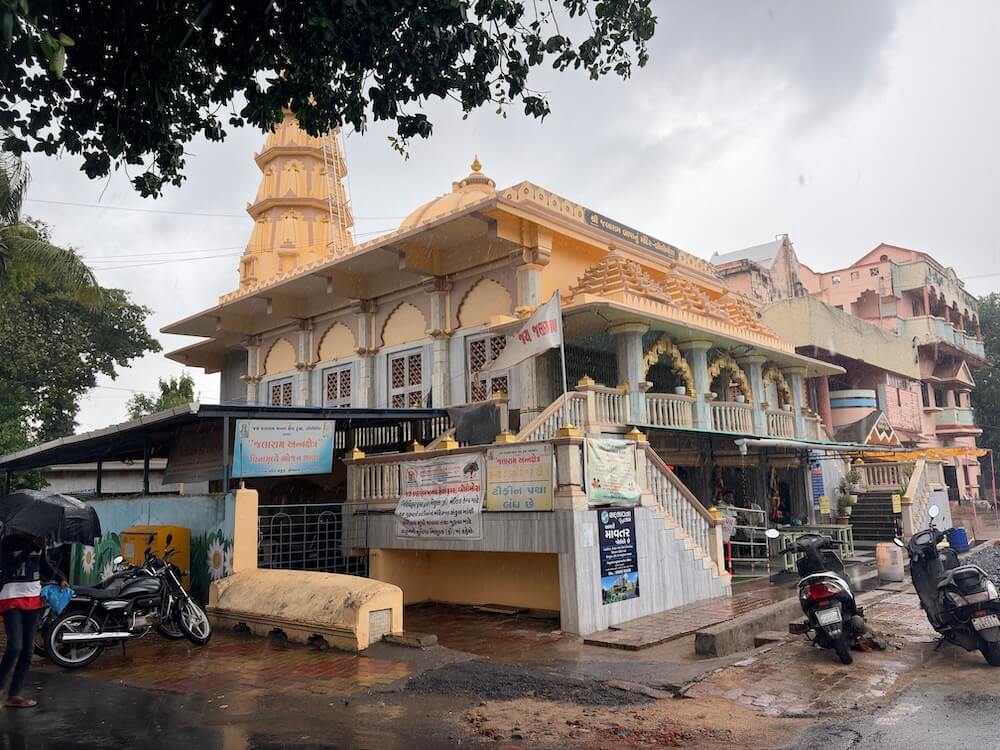 Historically, the strategic prominence of this city was intimately intertwined with the naval forces of the Maratha Empire and the Gaekwad state of Baroda. In the latter half of the eighteenth century, the Gaekwad rulers established a formidable naval base here, designated as the ‘Bandar Bilimora Suba Armar’. This port held immense strategic value for the maritime security of the Baroda princely state. Owing to its highly advantageous geographical positioning along the Ambika River, Bilimora evolved into a premier center for shipbuilding and the timber trade. Subsequently, at the dawn of the twentieth century, specifically in 1913, Maharaja Sayajirao Gaekwad III of Baroda inaugurated the historic ‘Bilimora-Waghai’ narrow-gauge railway line. The confluence of an illustrious naval heritage, the timber trade, shipbuilding enterprises and the Gaekwad-era railway has endowed the city of Bilimora with remarkable historical distinction.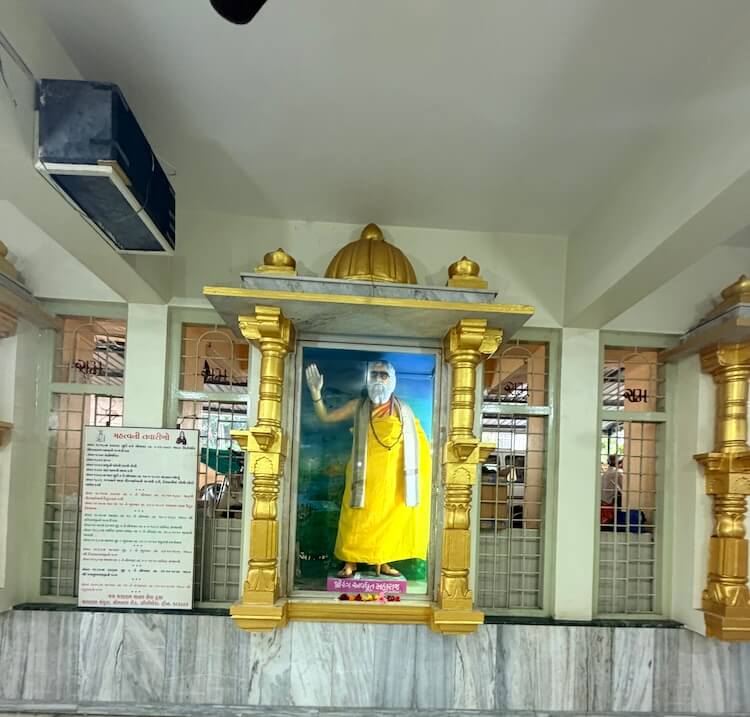
Sant Jalaram Bapa was born in 1799 on the auspicious day of Kartik Shuddha Saptami in the village of Virpur, located within the Rajkot district of Gujarat, to a pious couple, Pradhan Thakkar and Rajbai. The noble virtues of selfless service were deeply ingrained in his character from early childhood through the spiritual upbringing provided by his mother. Recognizing his innate spiritual inclination, Sant Raghuvirdasji accepted Jalaram as his disciple. Even after his marriage to Virabai at the tender age of sixteen, his mind remained detached from worldly domesticity. He chose instead to dedicate his hours to comforting people in need. At the age of eighteen, he placed himself under the spiritual tutelage of Sant Bhojalram of Fatehpur, steadfastly fulfilling his preceptor’s vows of lifelong humanitarian service. By the time he attained his twentieth year, his renown had spread far and wide. He eventually departed from his mortal frame on 23 February 1881. An ardent devotee of Lord Shri Ram, Bapa regarded the feeding of the hungry as the ultimate,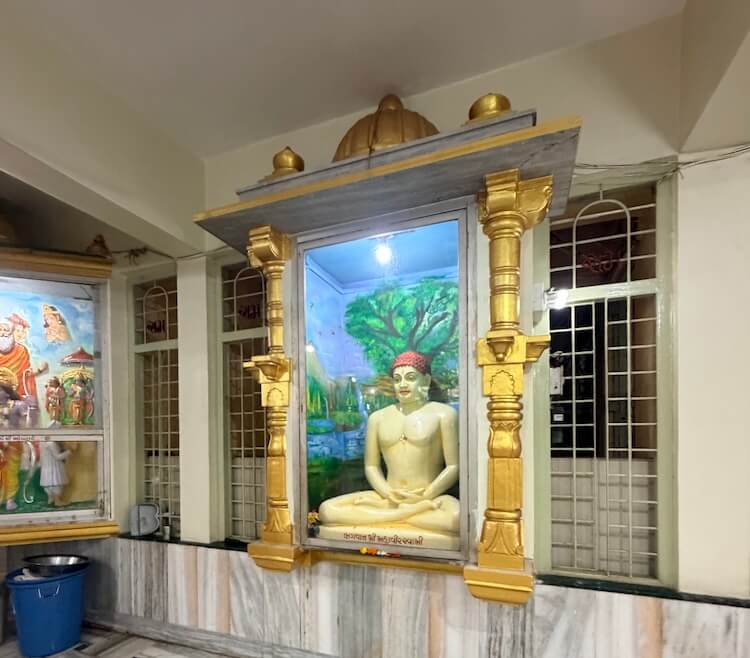 unending vow (sadavrat) of his life. This sacred tradition continues to be meticulously observed across various temples dedicated to him to this day.
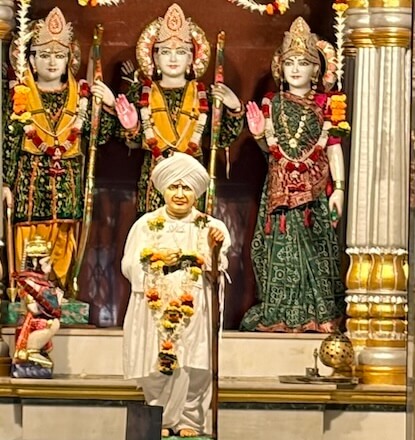
Although Sant Jalaram Bapa or his contemporary disciples had no direct geographical association with the city of Bilimora during their lifetimes, an enduring spiritual bond has nonetheless been forged between the citizens of this metropolis and Bapa’s philosophical tenets. The foundations of this specific temple, managed by the ‘Jai Jalaram Manav Seva Trust’ in Bilimora, were laid under extraordinary circumstances. In the year 1981, a grand recital of the Bhagwat Katha by Sri Dongreji Maharaj was organized within the precinct of the nearby Somnath Mahadev Temple complex in Bilimora. During this discourse, Dongreji Maharaj profoundly counseled the gathering to establish a permanent soup kitchen (annachhatra) to provide sustenance to the impoverished and destitute of the locality.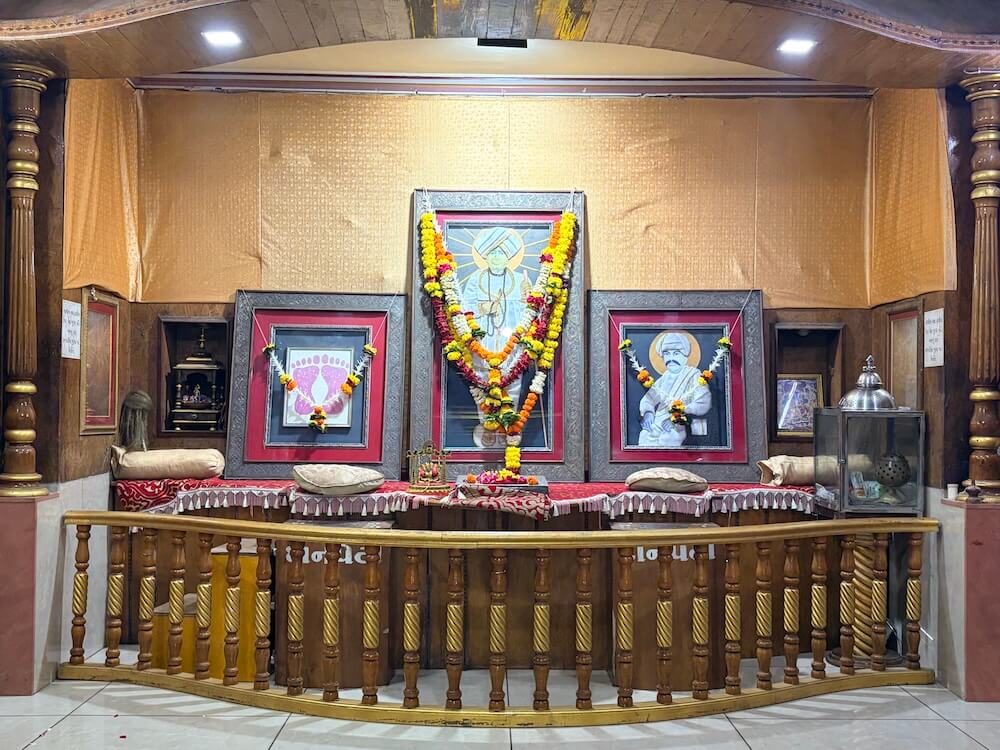 As the entire life of Jalaram Bapa was anchored upon the maxim that ‘feeding the hungry is the truest worship of God’, local devotees, inspired by the preceptor’s words, united to formally register the ‘Jai Jalaram Manav Seva Trust’ in 1981. The auspicious foundation-stone-laying ceremony (bhoomi pujan) of this sacred ground was performed by the holy hands of Dongreji Maharaj himself on 12 August 1981. Initially, the shrine of Jalaram Bapa was established on the ground floor. Many years later, on 23 May 1998, the marble idols of Lord Shri Ram, Sita, Laxman and Jalaram Bapa were formally consecrated on the first floor with full ritualistic splendor. Today, this temple stands not merely as a house of prayer, but as a dynamic nucleus for social welfare.
 Mirroring the pristine traditions of the mother shrine at Virpur, the Bilimora temple dispenses wholesome meals to the needy without the slightest distinction of caste, creed, or status.
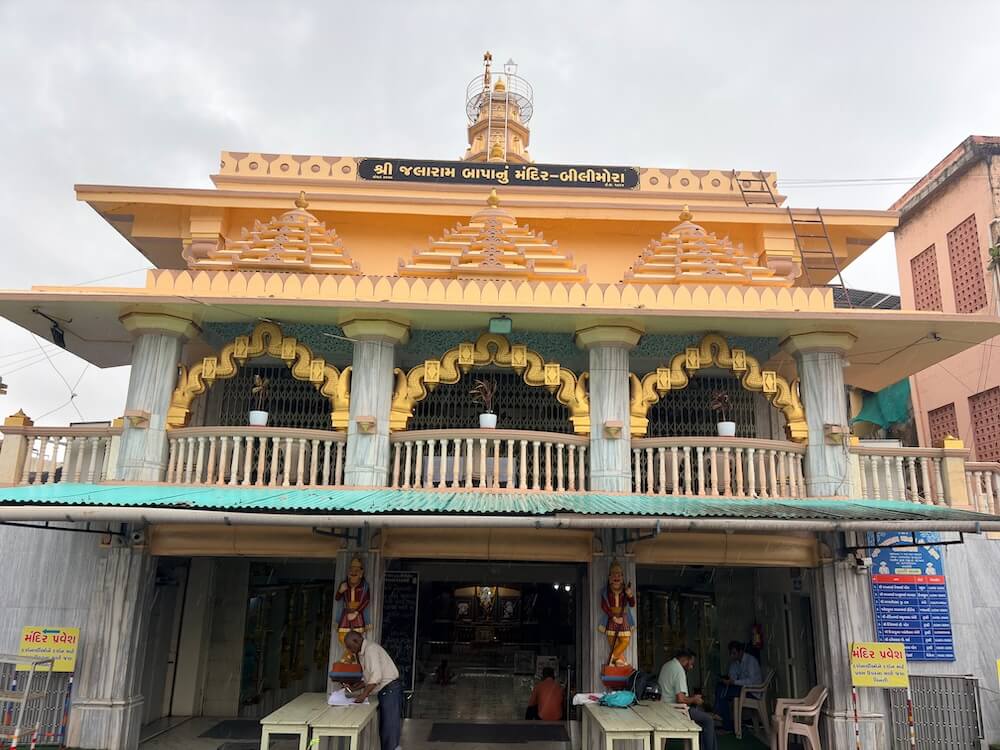
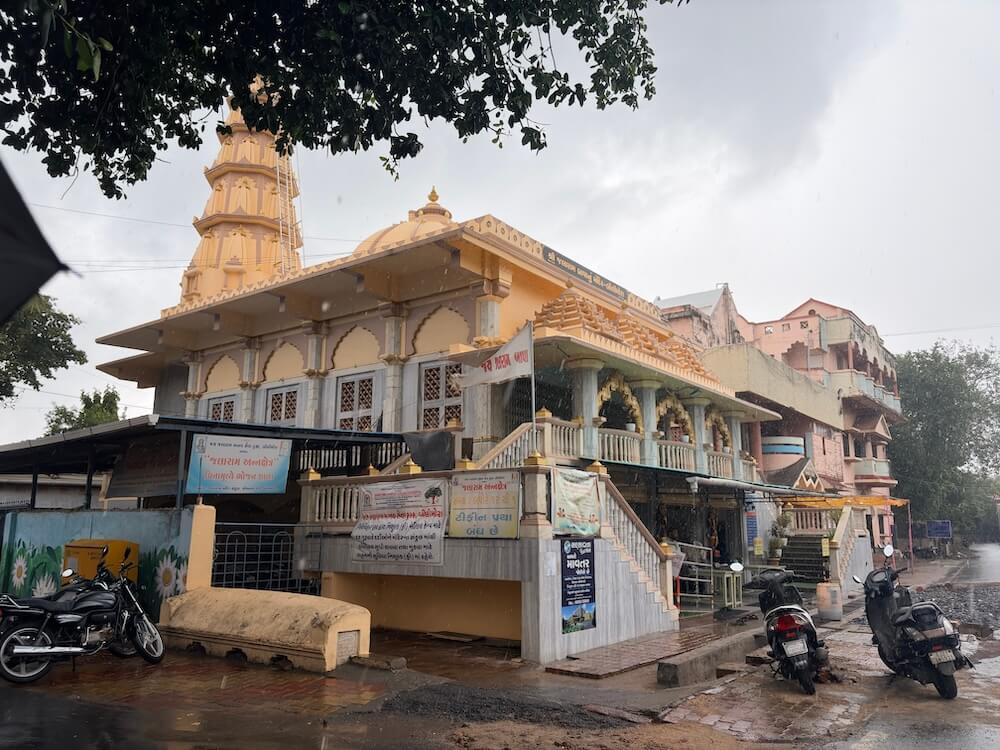
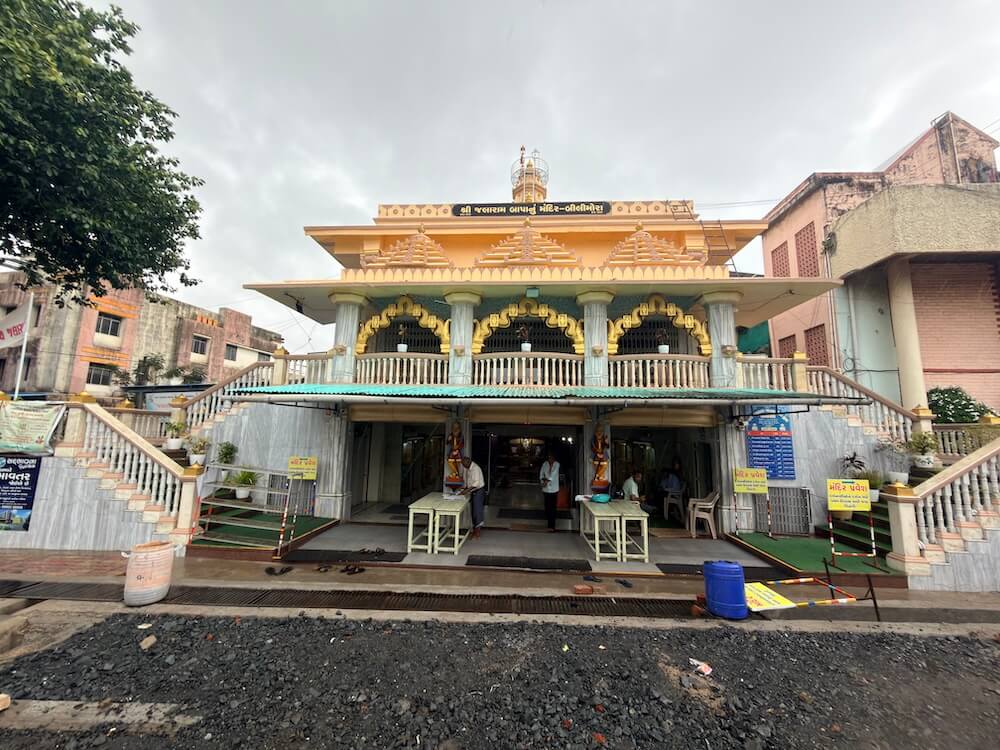
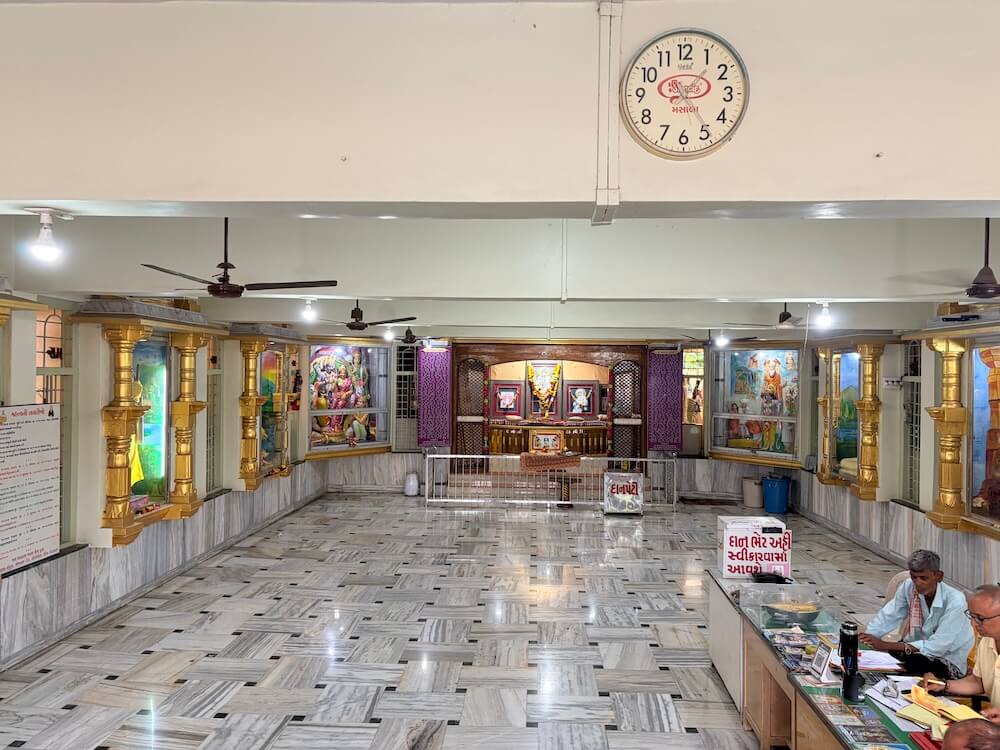
The two-storeyed edifice of the Jalaram Bapa Temple stands majestically on Somnath Road in Bilimora. The entrance to the primary shrine on the ground floor is adorned with two elegantly sculpted gatekeepers (dwarpala). From here, a short flight of steps descends into the main assembly hall (sabhamandap). The walls of this marble-floored assembly hall feature finely crafted niches housing sculptures of various deities, alongside consecrated idols of Lord Mahavira and Rang Avadhut Swami. To the left of the sanctum sanctorum, a large architectural niche enshrines three-dimensional sculptures of Lord Shri Ram, Sita,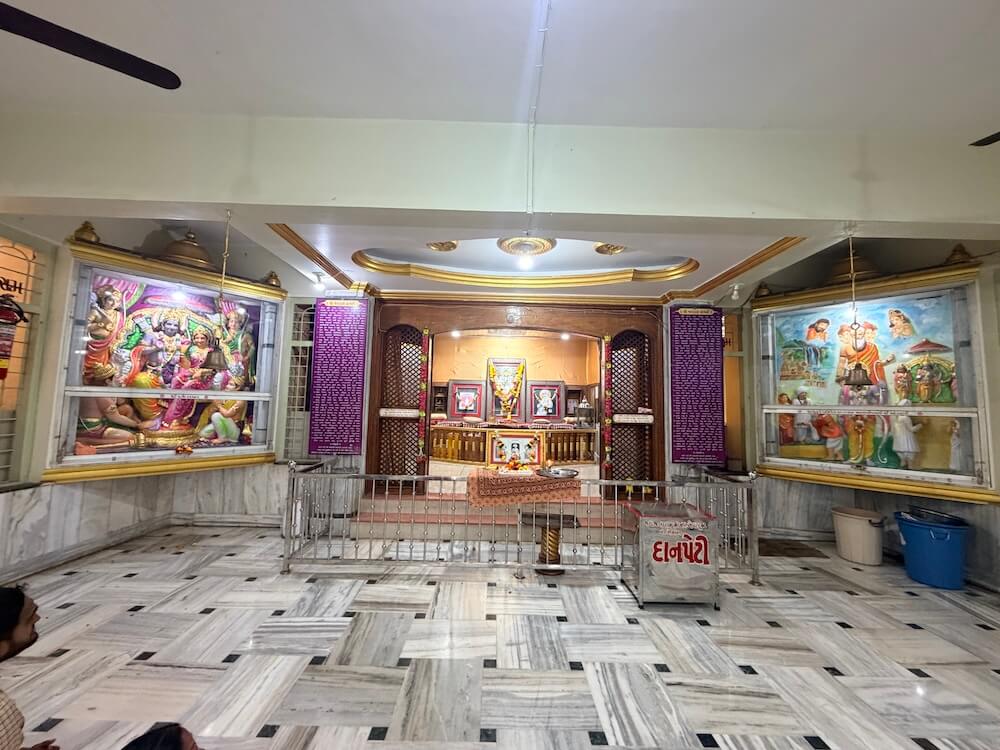 Laxman and Hanuman. The right niche displays a detailed relief sculpture depicting scenes from Sant Jalaram Bapa’s soup kitchen and his devoted service to visiting ascetics. Inside the principal sanctum sanctorum on the ground floor, a large oil portrait of Sant Jalaram Bapa is enshrined upon a sacred stone pedestal (vajrapitha). This central portrait is flanked by a depiction of Bapa’s holy footprints (charan paduka) to the left and a portrait illustrating the lineage of his spiritual gurus to the right. The architectural framework of the sanctum features ornately carved wooden pillars and wooden doorframes. Flanking the interior of the sanctum are smaller niches housing miniature shrines. From the main entrance, matching staircases on either side ascend to the assembly hall on the second floor.
 The layout of this upper hall mirrors that of the ground floor, with its walls embellished with numerous niches containing divine idols. Beyond this hall lies the upper sanctum, where a life-sized standing idol of Jalaram Bapa clad in white vestments is enshrined directly before the idols of Lord Ram, Sita, Laxman and Hanuman. Structurally, individual spires (shikharas) crown the entrance
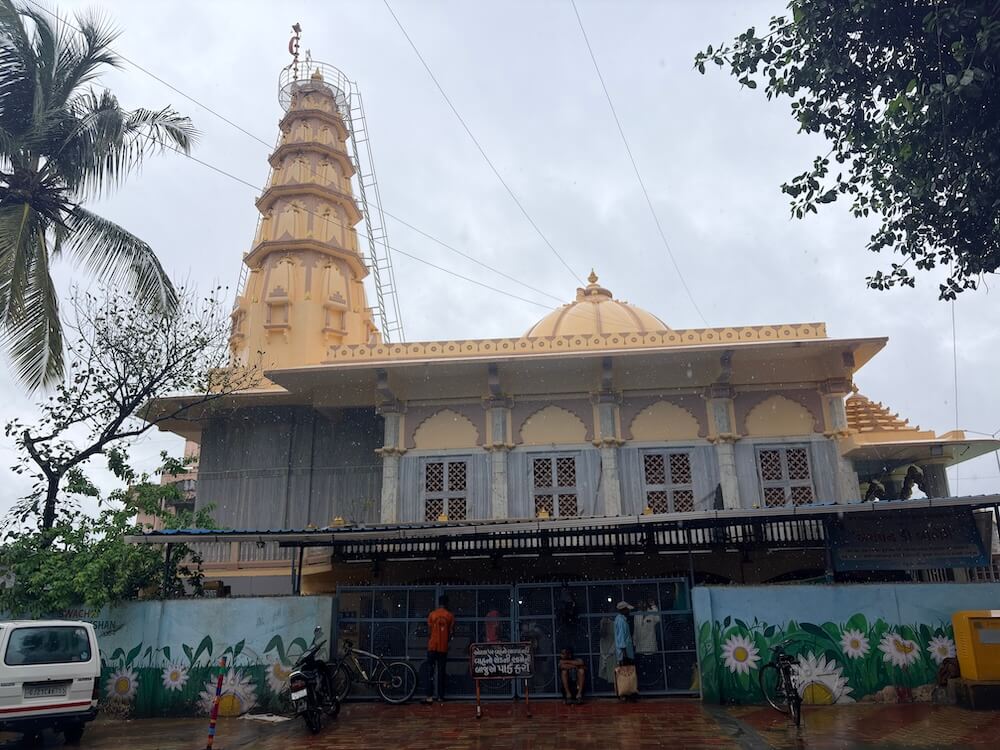
portico, the assembly hall and the sanctum sanctorum. The entrance portico is topped by three miniature spires. The spire over the assembly hall is dome-shaped, whilst the primary spire surmounting the sanctum sanctorum is a soaring, five-tiered structure that tapers elegantly towards the sky. The first tier of this principal spire is decorated with small niches, while the subsequent levels are adorned with auxiliary miniature spires (angashikharas).
A multitude of festivals and religious events are celebrated at the Jalaram Bapa Temple throughout the year, the most significant being ‘Jalaram Jayanti’, which is celebrated on Kartik Sud Panchami. This festive occasion is marked by illuminations, elaborate floral decorations, grand worship services (mahapuja), sacrificial fire rituals (hom-havan), the presentation of an annakut (an offering of diverse foodstuffs) and devotional singing. Thousands of devotees from Bilimora and its surrounding regions converge upon the temple on this day. During this celebration, a sumptuous mahaprasad consisting of bundi, gathiya and traditional lentil-rice is served to over fifty thousand pilgrims. Furthermore, festivals such as Guru Purnima, Ram Navami (Shyam Navami), Hanuman Jayanti and Gokulashtami are celebrated with immense fervor. On Ram Navami, a special birth-celebration ceremony is held at noon, followed by an evening of devotional music.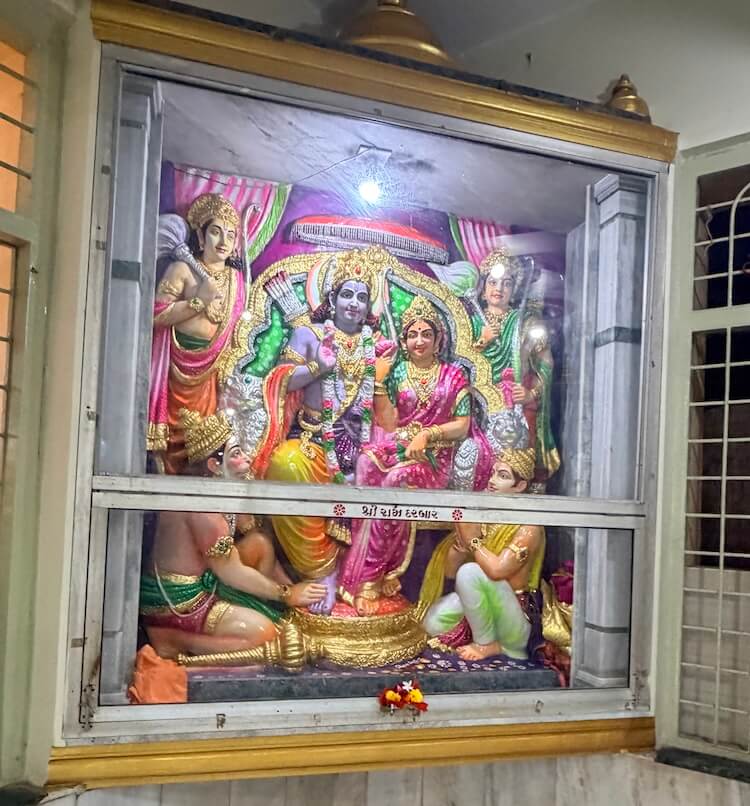 On the day following Diwali, marking the New Year according to the Vikram Samvat calendar, a spectacular annakut composed of varied delicacies is artfully arranged before the deities. Every Thursday, the Jalaram Mahila Mandal hosts religious singing and chanting sessions. During the holy month of Shravan, a sacred Laghurudra Yajna involving fire offerings is performed. On the twin occasions of this Laghurudra Yajna and the temple’s anniversary (Patotsav), upwards of 3,000 devotees partake of the sanctified feast.
In absolute alignment with Bapa’s sacred motto, “Aapo tukdo to Hari aape dheeglo” (If you offer a morsel of food, the Lord will bless you with a bounty), the Jai Jalaram Manav Seva Trust operates its charitable food kitchen here uninterruptedly. During the month of Shravan, free meals are provided in the dining hall to approximately 80,000 pilgrims, who visit the town to seek the blessings of Somnath Mahadev, Gayatri Mata and Jalaram Bapa. For travelers coming from distant towns, free lodging and boarding facilities are generously provided.
Daily, the trust provides free food to 400 impoverished, needy and disabled individuals from the locality. Additionally, the trust supplies monthly food rations to 200 economically disadvantaged families. On every new moon day (Amavasya), free distributions of sorghum (jowar) are made to impoverished individuals, people with disabilities and elderly citizens from lower-income backgrounds. The temple doors remain open to welcome devotees for the darshan of Jalaram Bapa daily from 6:00 am until 10:00 pm.
Useful Information :
- Located at a distance of 7 km from Gandevi
- Situated 28 km away from Navsari city
- State transport buses and private vehicle services operate regularly from Gandevi.
- Private vehicles can drive directly up to the temple premises.
- Comfortable lodging and breakfast facilities are available in the immediate vicinity.
- Contact: Temple Office, Tel: 02634-283880
जलाराम बापा मंदिर
सोमनाथ रोड, बिलिमोरा, ताल। गणदेवी, जिला. नवसारी
मंदिरे
Temples
मंदिर
મંદિરો
கோவில்கள்
దేవాలయాలు
ക്ഷേത്രങ്ങൾ
ದೇವಾಲಯಗಳು
মন্দিরসমূহ
ਮੰਦਿਰ
-
आशापुरी माता मंदिर विजलपूर मेन रोड, नवसारी, ता./जि. नवसारी
अधिक माहितीAshapuri Mata Temple Vijalpore Main Road, Navsari, Tal./Dist. Navsari
View Detailsआशापुरी माता मंदिर विजलपोर मेन रोड, नवसारी, ताल./जिला. नवसारी
विवरण देखेंAshapuri Mata Temple Vijalpore Main Road, Navsari, Tal./Dist. Navsari
વિગત જુઓAshapuri Mata Temple Vijalpore Main Road, Navsari, Tal./Dist. Navsari
விவரங்களைக் காண்கAshapuri Mata Temple Vijalpore Main Road, Navsari, Tal./Dist. Navsari
వివరాలను చూడండిAshapuri Mata Temple Vijalpore Main Road, Navsari, Tal./Dist. Navsari
വിശദാംശങ്ങൾ കാണുകAshapuri Mata Temple Vijalpore Main Road, Navsari, Tal./Dist. Navsari
ವಿವರಗಳನ್ನು ವೀಕ್ಷಿಸಿAshapuri Mata Temple Vijalpore Main Road, Navsari, Tal./Dist. Navsari
বিস্তারিত দেখুনAshapuri Mata Temple Vijalpore Main Road, Navsari, Tal./Dist. Navsari
ਵੇਰਵੇ ਦੇਖੋ -
चौसठ जोगणी माता मंदिर माळवाडा, ता. चिखली, जि. नवसारी
अधिक माहितीChausath Jogani Mata Temple Malwada, Tal. Chikhli, Dist. Navsari
View Detailsचौसठ जोगणी माता मंदिर मालवाड़ा, ताल. चिखली, जिला. नवसारी
विवरण देखेंChausath Jogani Mata Temple Malwada, Tal. Chikhli, Dist. Navsari
વિગત જુઓChausath Jogani Mata Temple Malwada, Tal. Chikhli, Dist. Navsari
விவரங்களைக் காண்கChausath Jogani Mata Temple Malwada, Tal. Chikhli, Dist. Navsari
వివరాలను చూడండిChausath Jogani Mata Temple Malwada, Tal. Chikhli, Dist. Navsari
വിശദാംശങ്ങൾ കാണുകChausath Jogani Mata Temple Malwada, Tal. Chikhli, Dist. Navsari
ವಿವರಗಳನ್ನು ವೀಕ್ಷಿಸಿChausath Jogani Mata Temple Malwada, Tal. Chikhli, Dist. Navsari
বিস্তারিত দেখুনChausath Jogani Mata Temple Malwada, Tal. Chikhli, Dist. Navsari
ਵੇਰਵੇ ਦੇਖੋ -
गुप्तेश्वर महादेव मंदिर नंदाई-भैरवी, ता. खेरगाम, जि. नवसारी
अधिक माहितीGupteshwar Mahadev Temple Nandhai–Bhairavi, Tal. Khergam, Dist. Navsari
View Detailsगुप्तेश्वर महादेव मंदिर नन्दई-भैरवी, ताल. खेरगाम, जिला. नवसारी
विवरण देखेंGupteshwar Mahadev Temple Nandhai–Bhairavi, Tal. Khergam, Dist. Navsari
વિગત જુઓGupteshwar Mahadev Temple Nandhai–Bhairavi, Tal. Khergam, Dist. Navsari
விவரங்களைக் காண்கGupteshwar Mahadev Temple Nandhai–Bhairavi, Tal. Khergam, Dist. Navsari
వివరాలను చూడండిGupteshwar Mahadev Temple Nandhai–Bhairavi, Tal. Khergam, Dist. Navsari
വിശദാംശങ്ങൾ കാണുകGupteshwar Mahadev Temple Nandhai–Bhairavi, Tal. Khergam, Dist. Navsari
ವಿವರಗಳನ್ನು ವೀಕ್ಷಿಸಿGupteshwar Mahadev Temple Nandhai–Bhairavi, Tal. Khergam, Dist. Navsari
বিস্তারিত দেখুনGupteshwar Mahadev Temple Nandhai–Bhairavi, Tal. Khergam, Dist. Navsari
ਵੇਰਵੇ ਦੇਖੋ