
राणी सती मंदिर
साहिबाग, अहमदाबाद, जिल्हा अहमदाबाद
Rani Sati Temple
Shahibaug, Ahmedabad, Dist. Ahmedabad
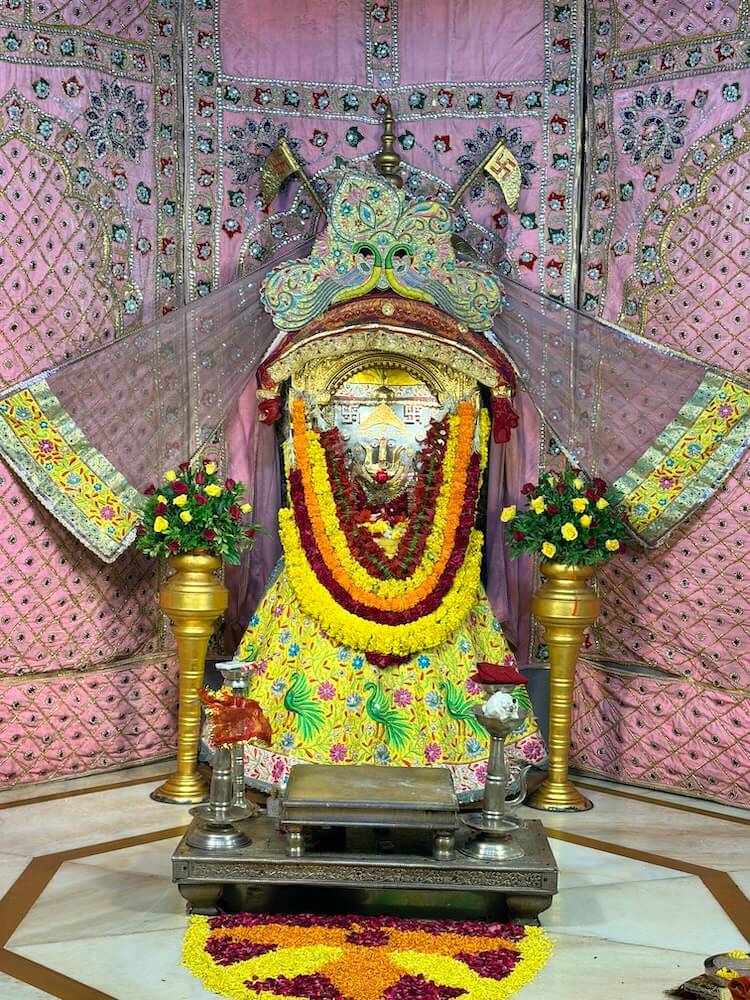 The famous Rani Sati Temple stands near the Sabarmati River in the Shahibaug area of Ahmedabad. Honoured by Marwaris as a manifestation of Goddess Durga, the deity embodies feminine strength, courage and valour. The shrine serves as an important centre of worship for members of the community living in the city. Here, the principal Goddess is not worshipped in human form, but is represented by a trishul signifying divine power. The annual celebration held on Bhadrapada Amavasya is the temple’s main festival, drawing thousands of devotees on this occasion.
Ahmedabad’s heritage stretches back more than six and a half centuries. According to records in M. S. Commissariat’s ‘History of Gujarat’, Sultan Ahmad Shah I laid the foundations of the city on the eastern bank of the Sabarmati River in 1411. Later, during the Mughal era, Prince Khurram, who went on to become Emperor Shah Jahan, served as the governor of Gujarat from 1616 to 1623. In those years, he built the Moti Shahi Mahal along the riverfront and laid out a royal garden around it. The fourth volume of the government’s ‘Gazetteer of the Bombay Presidency’, published in 1879, notes that this garden eventually gave the wider locality its name, Shahibaug. With the growth of textile mills in the late 19th and early 20th centuries, a large number of Marwari traders and workers settled in the neighbourhood.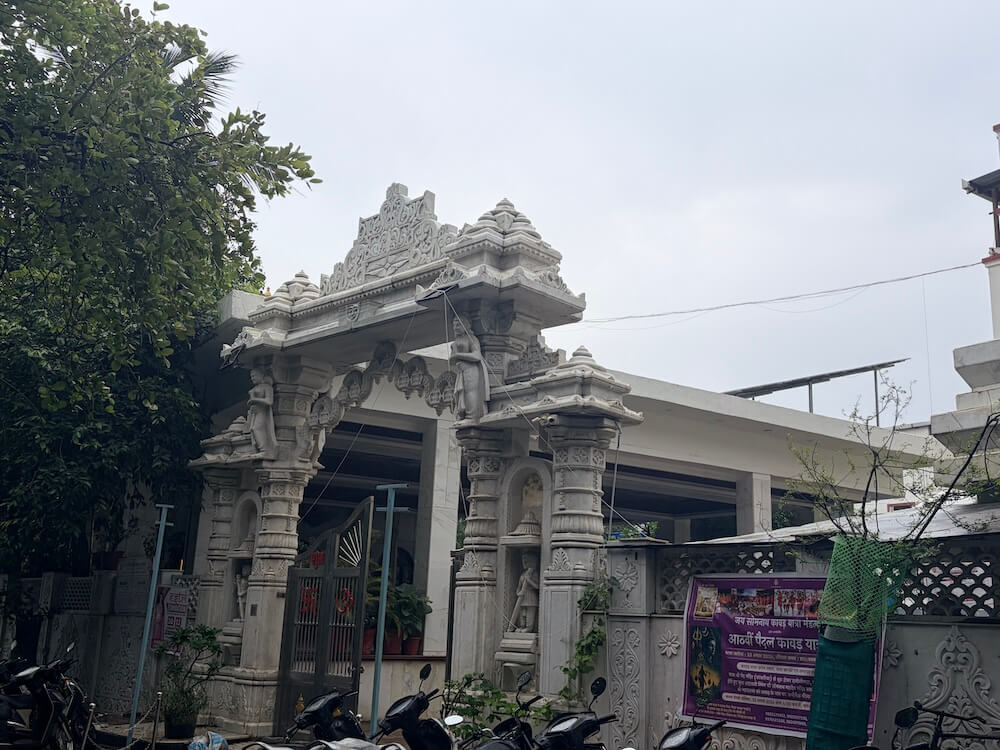
The devotion of these settlers is rooted in a popular legend that traces Rani Sati’s origins to the Mahabharata era, when she was Uttara, the wife of Arjuna’s son Abhimanyu. After Abhimanyu fell in the Chakravyuha formation laid by the Kauravas during the war, a grief-stricken Uttara resolved to commit sati. Because she was expecting a child, Lord Krishna dissuaded her and granted a boon that her wish would be fulfilled in a future life. Tradition holds that Uttara was reborn in the 13th century as Narayani in the household of Gursamal Birmewal at Dokwa village in Rajasthan, while Abhimanyu was born as Tandan to Jaliram Jalan in Hisar, Haryana.
After Narayani and Tandan were married, the prince of Hisar attempted to seize Tandan’s horse. A duel followed in which the prince lost his life, prompting the king to have Tandan treacherously murdered in revenge. Enraged by the betrayal, 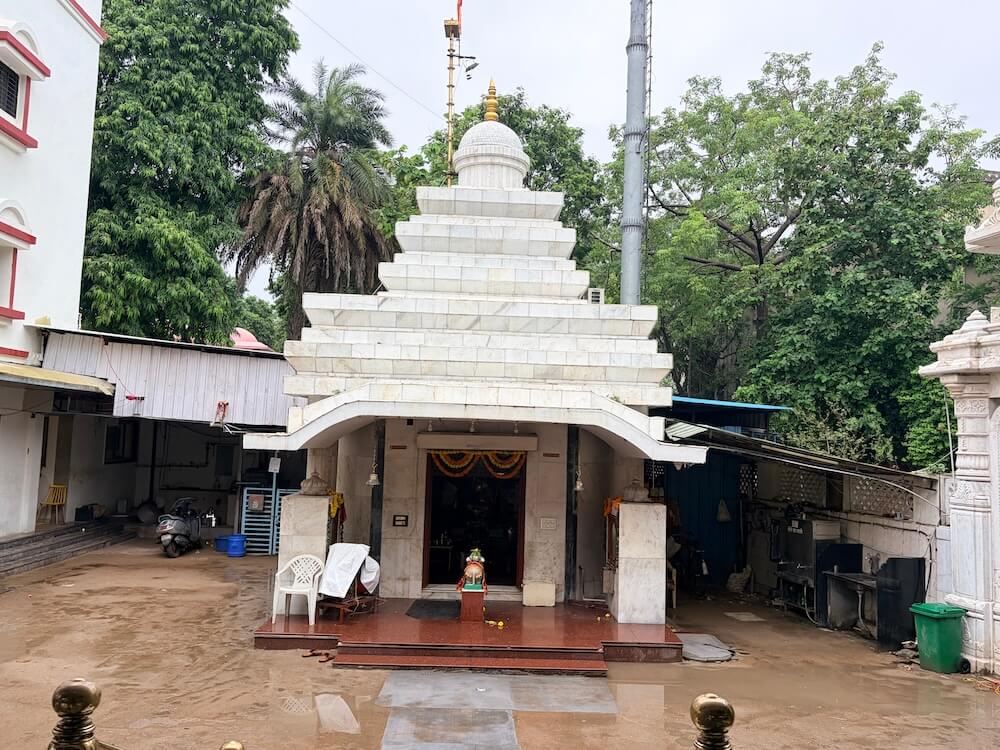 Narayani slew the ruler and resolved to become sati with her husband’s body. She instructed Ranaji, the attendant who had cared for the horse, to make the necessary preparations. Pleased with his loyalty, she blessed him and declared that he too would be worshipped alongside her.
Another version of the legend, set about 600 years ago, recounts that a 14-year-old bride named Narayani Devi was travelling home for the first time just after her marriage to a Jhunjhunu trader from the Jalan family. Along the way, Muslim invaders ambushed the party, brutally killing her husband and his companions. Only the young bride and a faithful servant named Rana survived the assault. According to the story, 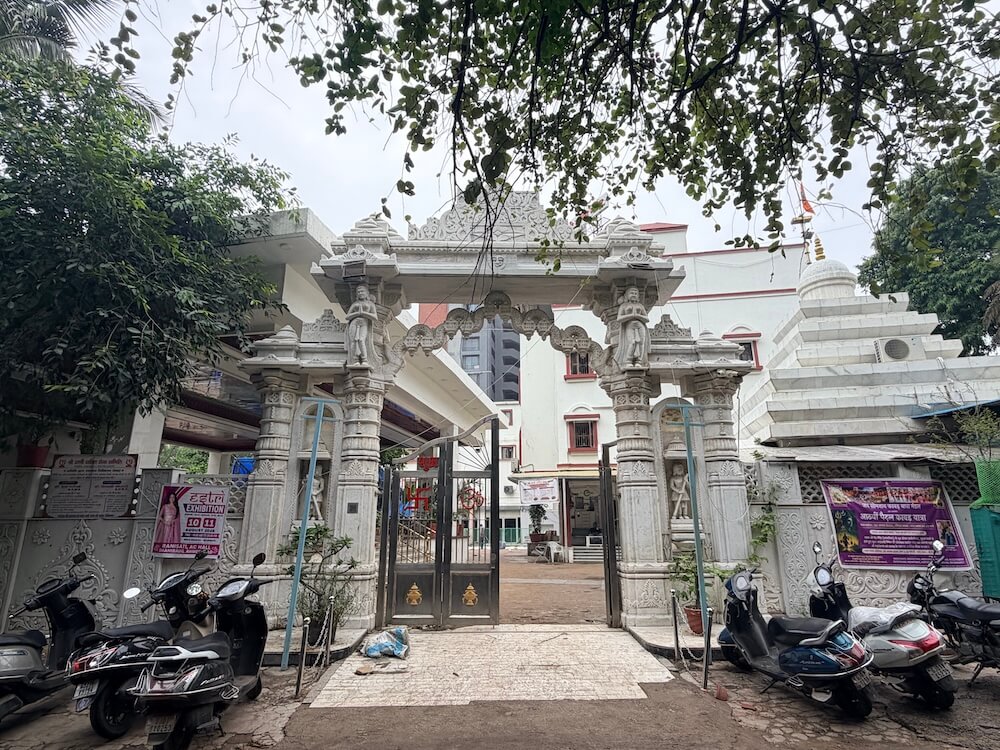 Narayani Devi then bravely immolated herself by bursting into flames to avoid being captured and taken away by the attackers.
The principal shrine dedicated to the Goddess was founded at Jhunjhunu in Rajasthan in Vikram Samvat 1352, corresponding to 1295. Nearly seven centuries later, in 1978, the Marwari community of Shahibaug in Ahmedabad built the present temple through public contributions, bringing the eternal flame from the original Jhunjhunu shrine to establish it here.
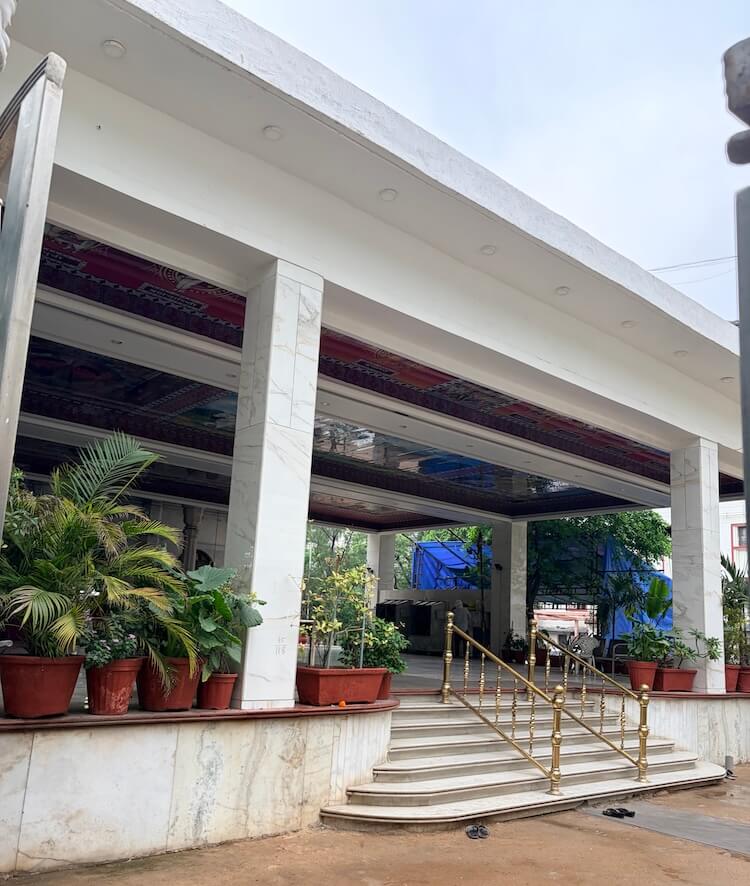
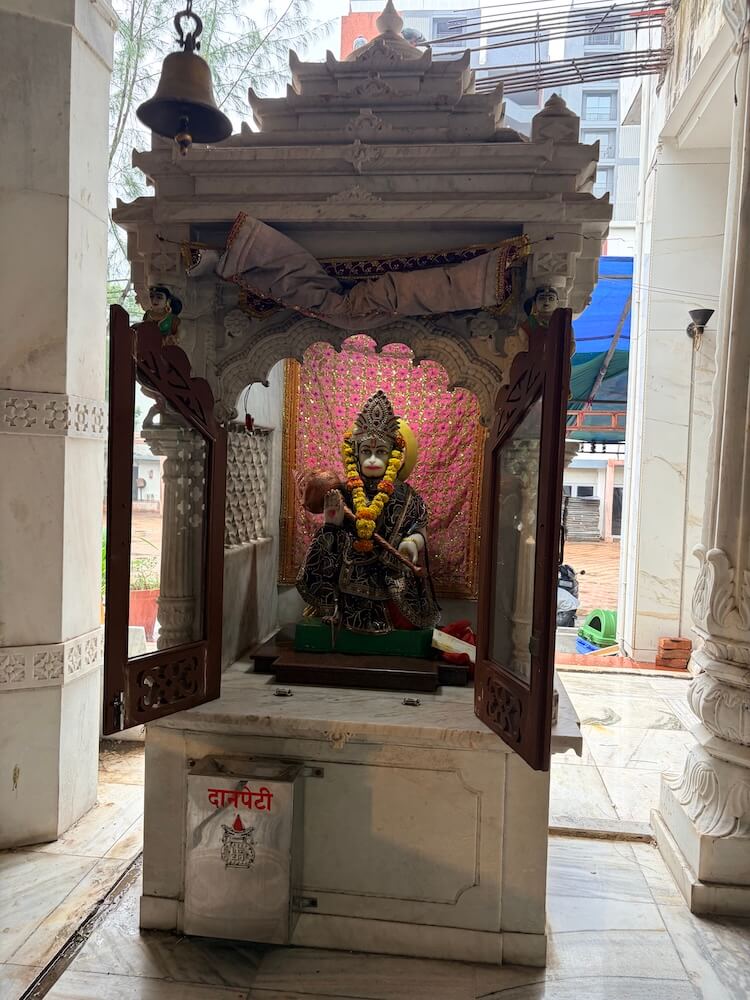
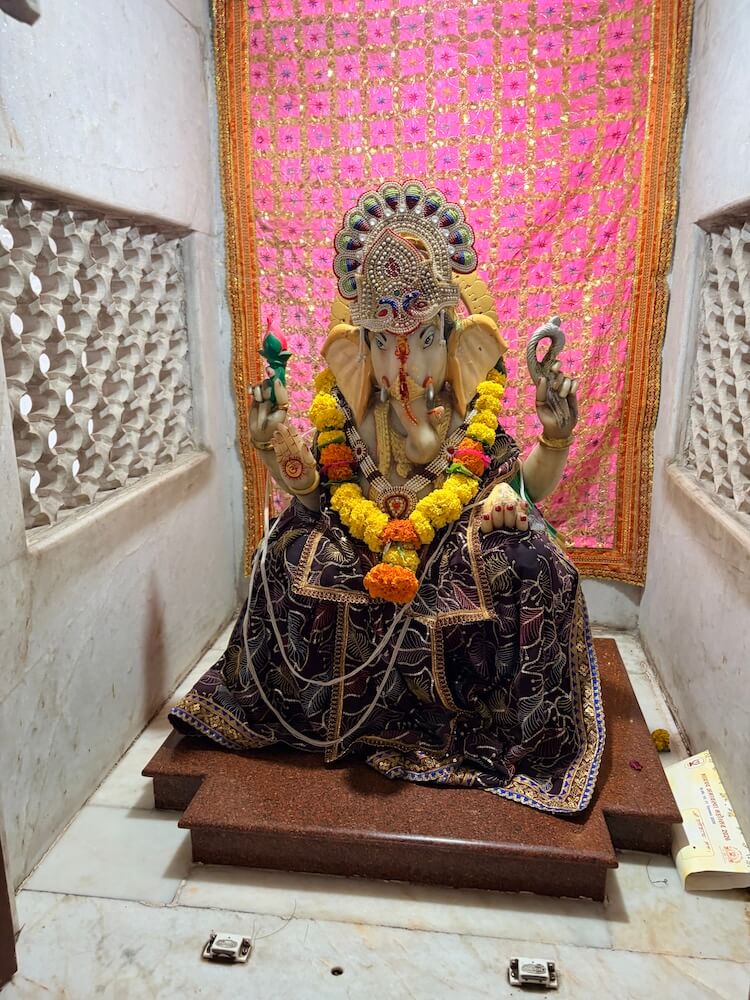
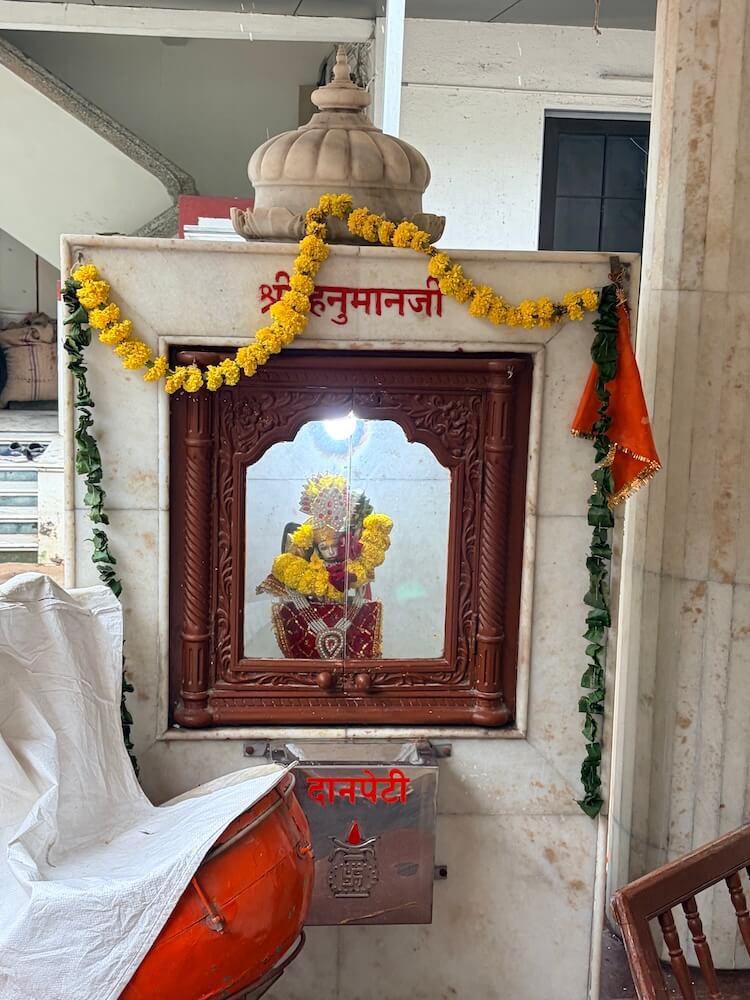
The marble temple stands on the left side of the main courtyard. Its principal entrance has carved pillars, while sculptures of dwarpals (door guardians) and stone reliefs decorate the adjoining sections and arches. A flight of steps leads up to the semi-open mandap on a raised platform, flanked by small shrines dedicated to Ganesha and Hanuman.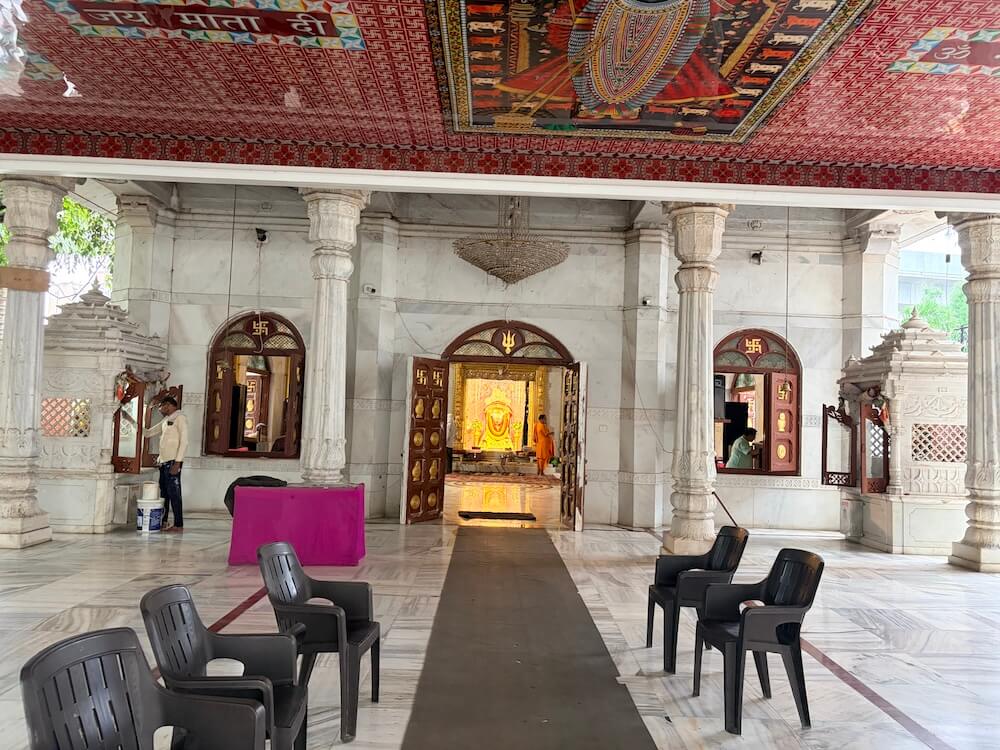 Above the entrance to the sabhamandap, the lintel bears a motif of the trishul, with large windows set on both sides of the doorway. The ceiling of the sabhamandap features paintings of the Navadurga (nine forms of Durga), other deities and episodes from the life of Rani Sati.
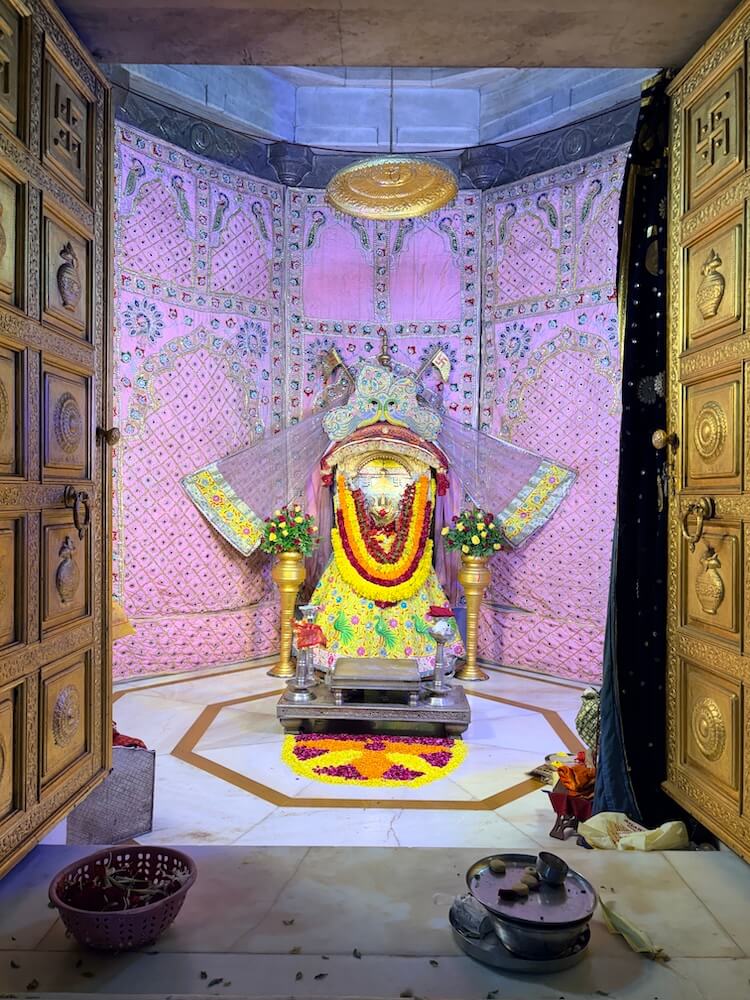
The wooden doorway of the garbhagriha has a golden finish and features kirtimukhs (protective mask motifs) carved at its base. Inside the sanctum, the principal trishul is enshrined at the centre within a makhar (decorative frame). Behind the sacred emblem sits a silver panel depicting the eyes and nose of the Goddess, with a swastika engraved above them. On the front of the trident, two raised hands wearing bangles are visible.
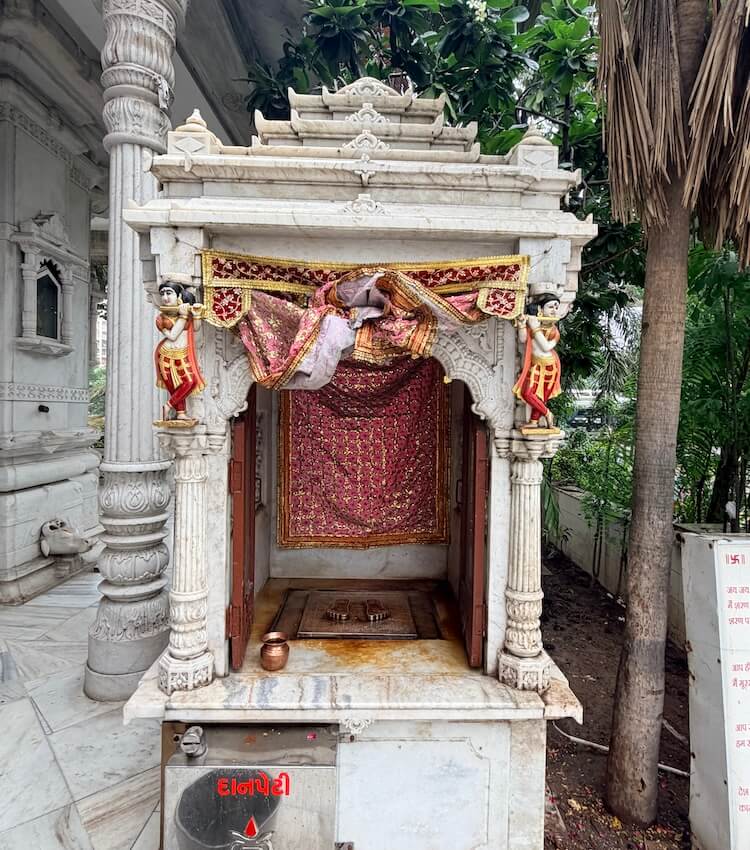
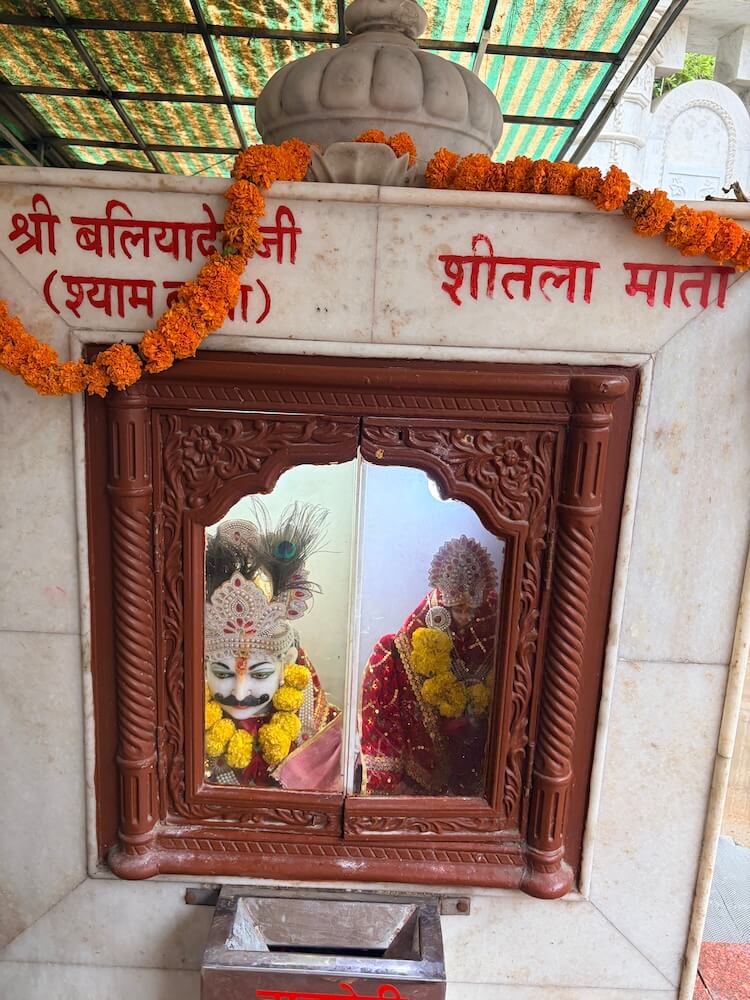
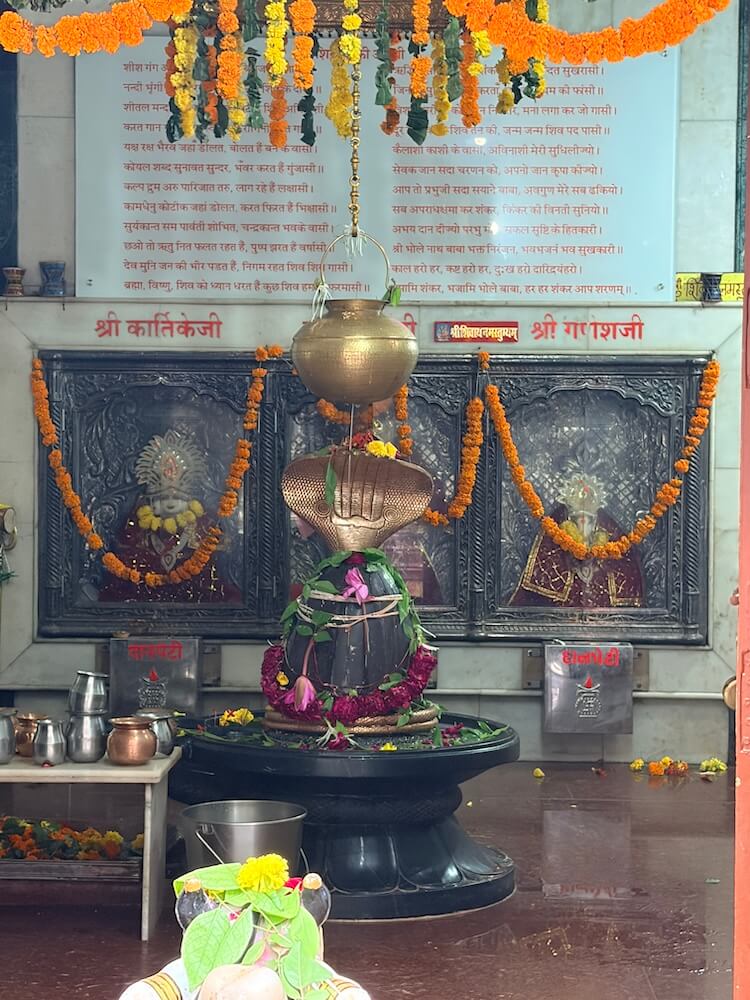
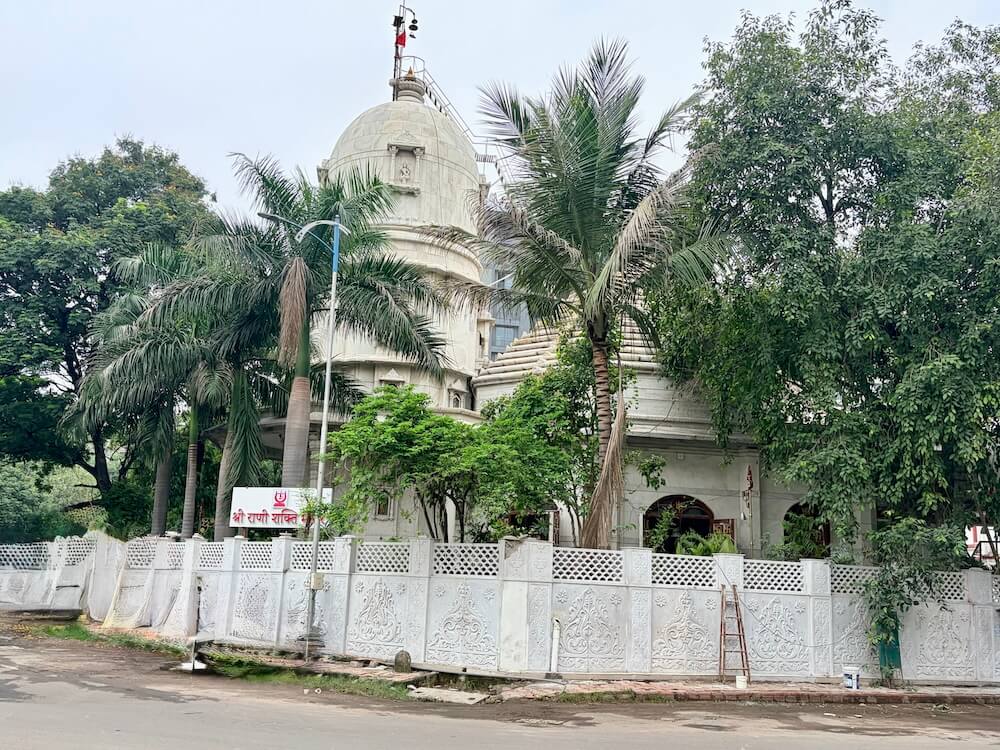 Above the garbhagriha rises a tall domed shikhar that combines elements of Rajasthani and Mughal architectural styles. Stone sculptures of various deities occupy the devkoshtaks (wall niches) along its exterior walls. Directly opposite the main temple stands a separate Shiva shrine housing a large shivalinga, with idols of Parvati, Kartikeya and Ganesha positioned behind it. Elsewhere in the complex are murtis of Baliyadev and Sheetala Mata, a pedestal bearing padukas (sacred footprints), a guest house and a dining hall.
Shri Rani Shakti Seva Samiti administers the temple, where daily aartis take place in the morning and evening. During the main annual festival on Bhadrapada Amavasya, the morning Mangala Aarti is followed by an offering of chhappan bhog (56-dish offering) and darshan of the Goddess in her ceremonial adornment. On the festival evening, aarti is performed at 7 pm and the Shayan Aarti at 10.30 pm. A Durga Saptashati mahayajna is organised across the nine days of Sharadiya Navratri, while the Goddess’s birth anniversary on Margashirsha Krishna Navami is celebrated with religious rituals and devotional singing. The temple remains open for darshan daily from 7 am to 12 pm and from 4 pm to 8 pm.
Useful Information :
- Located 3.5 km from Ahmedabad Railway Station and 2.5 km from Sabarmati Junction
- BRTS and AMTS bus services are available from various parts of Ahmedabad
- Private vehicles can travel directly to the temple
- Guest accommodation and a vegetarian dining hall are available within the temple complex
- Contact : Temple Office, Telephone : 079-22867595
रानी सती मंदिर
शाहीबाग, अहमदाबाद, जिला अहमदाबाद
मंदिरे
Temples
मंदिर
મંદિરો
கோவில்கள்
దేవాలయాలు
ക്ഷേത്രങ്ങൾ
ದೇವಾಲಯಗಳು
মন্দিরসমূহ
ਮੰਦਿਰ
-
वाराही माता मंदिर कालुपूर, अहमदाबाद, जि. अहमदाबाद
अधिक माहितीVarahi Mata Temple Kalupur, Ahmedabad, Dist. Ahmedabad
View Detailsवाराही माता मंदिर कालूपुर, अहमदाबाद, जिला. अहमदाबाद
विवरण देखेंVarahi Mata Temple Kalupur, Ahmedabad, Dist. Ahmedabad
વિગત જુઓVarahi Mata Temple Kalupur, Ahmedabad, Dist. Ahmedabad
விவரங்களைக் காண்கVarahi Mata Temple Kalupur, Ahmedabad, Dist. Ahmedabad
వివరాలను చూడండిVarahi Mata Temple Kalupur, Ahmedabad, Dist. Ahmedabad
വിശദാംശങ്ങൾ കാണുകVarahi Mata Temple Kalupur, Ahmedabad, Dist. Ahmedabad
ವಿವರಗಳನ್ನು ವೀಕ್ಷಿಸಿVarahi Mata Temple Kalupur, Ahmedabad, Dist. Ahmedabad
বিস্তারিত দেখুনVarahi Mata Temple Kalupur, Ahmedabad, Dist. Ahmedabad
ਵੇਰਵੇ ਦੇਖੋ -
कर्णमुक्तेश्वर महादेव मंदिर सारंगपूर गेट, अहमदाबाद, जि. अहमदाबाद
अधिक माहितीKarnamukteshwar Mahadev Temple Sarangpur Gate, Ahmedabad, Dist. Ahmedabad
View Detailsकर्णमुक्तेश्वर महादेव मंदिर सारंगपुर गेट, अहमदाबाद, जिला। अहमदाबाद
विवरण देखेंKarnamukteshwar Mahadev Temple Sarangpur Gate, Ahmedabad, Dist. Ahmedabad
વિગત જુઓKarnamukteshwar Mahadev Temple Sarangpur Gate, Ahmedabad, Dist. Ahmedabad
விவரங்களைக் காண்கKarnamukteshwar Mahadev Temple Sarangpur Gate, Ahmedabad, Dist. Ahmedabad
వివరాలను చూడండిKarnamukteshwar Mahadev Temple Sarangpur Gate, Ahmedabad, Dist. Ahmedabad
വിശദാംശങ്ങൾ കാണുകKarnamukteshwar Mahadev Temple Sarangpur Gate, Ahmedabad, Dist. Ahmedabad
ವಿವರಗಳನ್ನು ವೀಕ್ಷಿಸಿKarnamukteshwar Mahadev Temple Sarangpur Gate, Ahmedabad, Dist. Ahmedabad
বিস্তারিত দেখুনKarnamukteshwar Mahadev Temple Sarangpur Gate, Ahmedabad, Dist. Ahmedabad
ਵੇਰਵੇ ਦੇਖੋ -
सोमनाथ महादेव मंदिर ग्यासपूर, अहमदाबाद, जिल्हा अहमदाबाद
अधिक माहितीSomnath Mahadev Temple Gyaspur, Ahmedabad, Dist. Ahmedabad
View Detailsसोमनाथ महादेव मंदिर ग्यासपुर, अहमदाबाद, जिला अहमदाबाद
विवरण देखेंSomnath Mahadev Temple Gyaspur, Ahmedabad, Dist. Ahmedabad
વિગત જુઓSomnath Mahadev Temple Gyaspur, Ahmedabad, Dist. Ahmedabad
விவரங்களைக் காண்கSomnath Mahadev Temple Gyaspur, Ahmedabad, Dist. Ahmedabad
వివరాలను చూడండిSomnath Mahadev Temple Gyaspur, Ahmedabad, Dist. Ahmedabad
വിശദാംശങ്ങൾ കാണുകSomnath Mahadev Temple Gyaspur, Ahmedabad, Dist. Ahmedabad
ವಿವರಗಳನ್ನು ವೀಕ್ಷಿಸಿSomnath Mahadev Temple Gyaspur, Ahmedabad, Dist. Ahmedabad
বিস্তারিত দেখুনSomnath Mahadev Temple Gyaspur, Ahmedabad, Dist. Ahmedabad
ਵੇਰਵੇ ਦੇਖੋ