
कर्णमुक्तेश्वर महादेव मंदिर
सारंगपूर गेट, अहमदाबाद, जि. अहमदाबाद
Karnamukteshwar Mahadev Temple
Sarangpur Gate, Ahmedabad, Dist. Ahmedabad
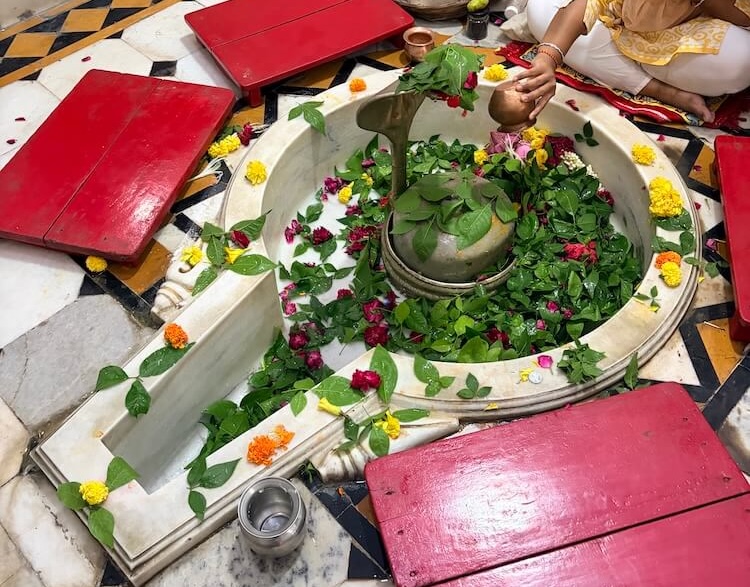 In eastern Ahmedabad, a city traditionally associated with Karnavati, the stone temple of Karnamukteshwar Mahadev stands just outside the walled quarter’s Sarangpur Gate. Located near the boundary between the heritage neighbourhoods of Khadia and Jamalpur, it is regarded as one of Gujarat’s most ancient and historically significant Shiva shrines. Set beside a main road amid the bustle of the textile market, the temple occupies a prominent place in the daily life of the old quarter. Devotees revere the swayambhu shivalinga enshrined here as the city deity of Ahmedabad.
The origins of this region and the founding of the shrine date back to antiquity. According to the 14th-century work ‘Prabandha-Chintamani’ by Jain scholar Merutunga and other historical chronicles, a Bhil ruler named Asha governed this area in the 11th century, 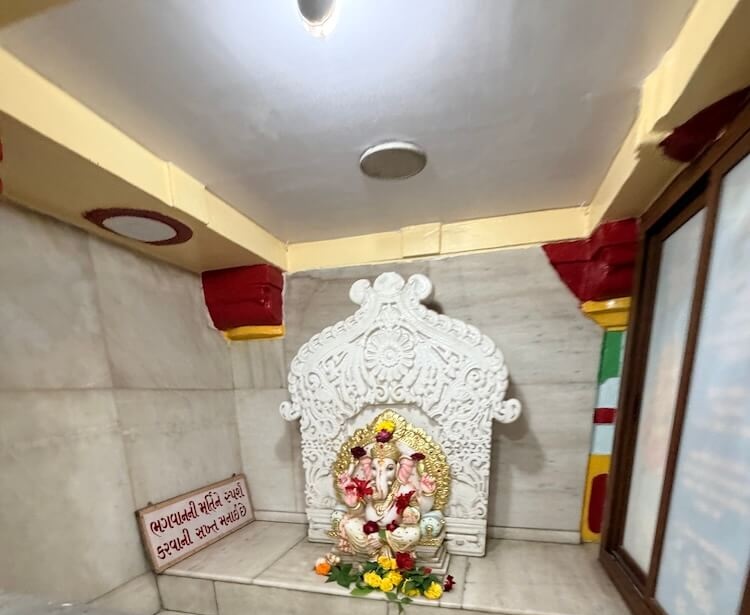 when the settlement was known as Ashapalli. Around 1074, King Karndev I (reigned c. 1064 to 1092) of the Solanki (Chalukya) dynasty invaded Ashapalli and defeated King Asha. Scholars believe the monarch built this temple as a monument to his victory in that battle. Following the conquest, he founded a new city named Karnavati along the eastern bank of the Sabarmati River. Karnavati stood at the confluence of three rivers and King Karndev laid the foundation of the Shiva shrine to the south of this Triveni Sangam.
Historical gazetteers, British-era records and the ‘Gujarat State Gazetteer’ (Part 2) contain direct references to the founding of Karnavati and the shrine built by King Karndev Solanki. According to these accounts, construction of the temple began during King Karndev’s reign after 1074 and reached completion under his son, 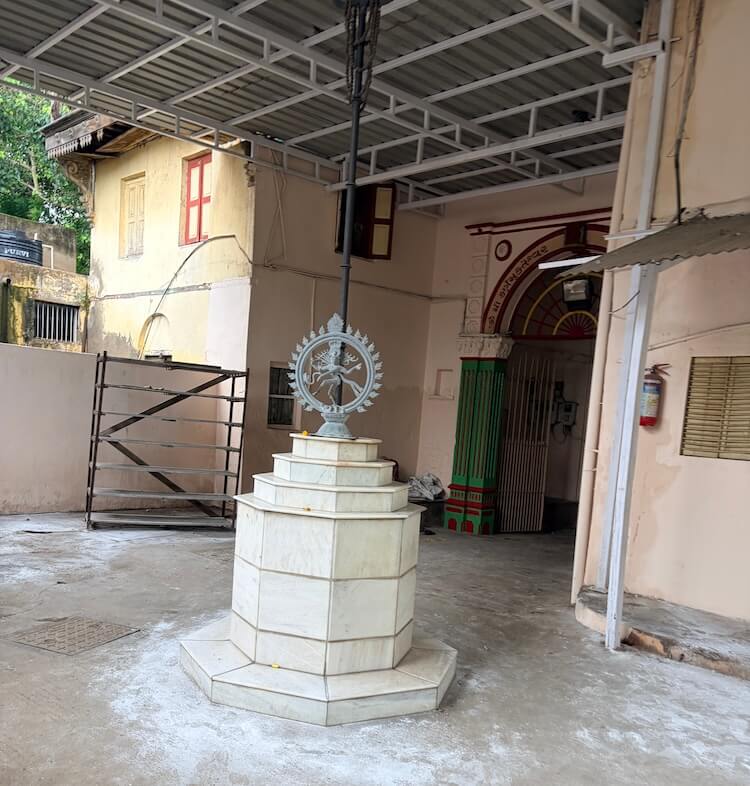 Siddharaj Solanki, after 1092. Local historical tradition also holds that King Siddharaj’s coronation took place at this sacred site. To the south of the shrine, King Karndev excavated a reservoir named Karnasagar, commonly identified today with Kankaria Lake. Documented history, however, records that the present lake was completed in 1451 as Hauz-e-Qutb, leaving the link between ancient Karnasagar and modern Kankaria Lake a subject of ongoing historical debate. Established by King Karndev, the shrine came to be known as the Karnamukteshwar Mahadev Temple.
A legend passed down through generations recounts the manifestation of the swayambhu shivalinga during an era when a river named the Manek flowed through this region. When local cowherds brought their cattle to graze along its banks, one cow reportedly stood at a particular spot every day and spontaneously released her milk. After a cowherd informed King Karndev of this unusual occurrence, royal workers excavated the site and unearthed a self-manifested shivalinga beneath the ground. 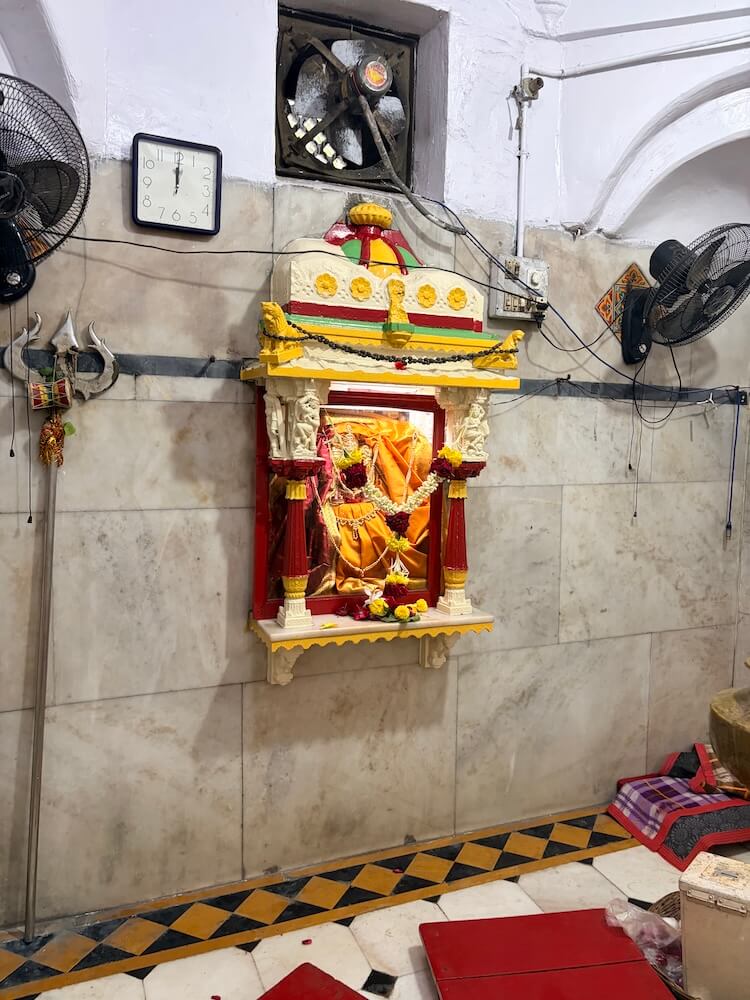 In Shaiva tradition and ancient scriptures such as the ‘Skanda Purana’, naturally manifested lingas hold special sanctity because they are believed not to have been fashioned by human hands and their darshan is thought to lead towards spiritual liberation. King Karndev therefore resolved to build a shrine over the shivalinga. In earlier times, devotees are believed to have bathed in the Manek before proceeding to the temple for Mahadev’s darshan, though the river eventually disappeared and only a well is said to remain along its former course today.
In ancient times, an extensive garden, a water tank, a stepwell and a dharmashala for ascetics and saints surrounded the temple. Many sadhus and holy men are said to have performed spiritual practices within these precincts. According to tradition, the Solanki kings made special arrangements for their stay and worship. Several smaller shrines also once stood around the main temple.
According to local belief, a priceless jewel once adorned the shivalinga. During the medieval period, the shrine is said to have suffered damage in a Mughal attack, when invaders carried away the precious stone and struck the linga. Marks of that destruction and the partially fractured form of the shivalinga can still be seen inside the garbhagriha. After the Marathas established rule in Ahmedabad in 1753, 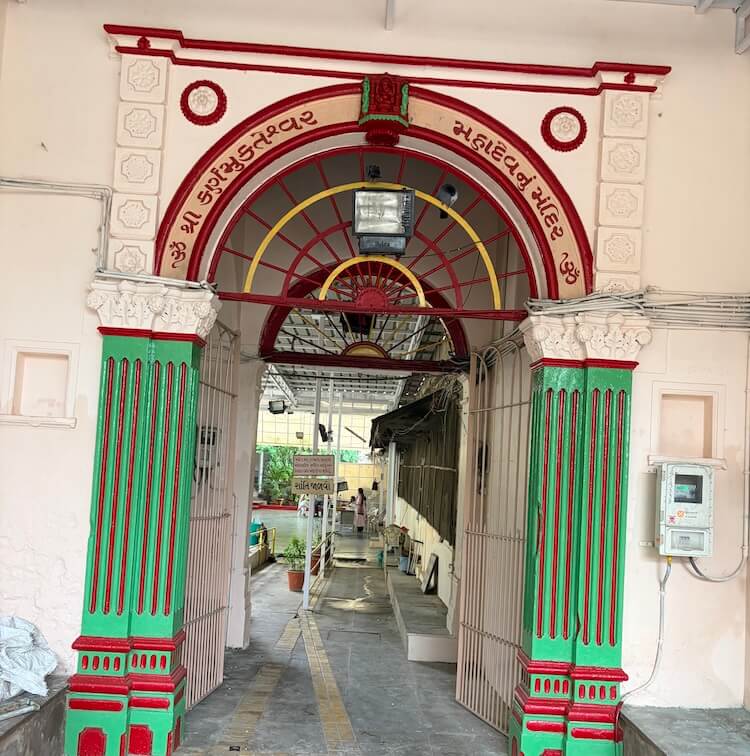 several ancient Hindu temples across the city underwent restoration and local tradition records that Karnamukteshwar Temple was rebuilt during this era. Responsibility for worship at the shrine was entrusted to the family of a priest named Bapashastri. Subsequent renovation and restoration work in recent times gave the temple its present form.
The temple’s architecture reflects a synthesis of Maratha and later medieval styles. From the main road, an outer gate flanked by dense greenery leads towards the shrine’s principal arched entrance a short distance ahead. A sculpture of Nataraja stands on a platform before this gateway, while the lalatbimb (central lintel carving) bears a carving of Ganesha. Beyond the doorway lies a spacious paved courtyard with the main structure of Karnamukteshwar Temple standing directly ahead.
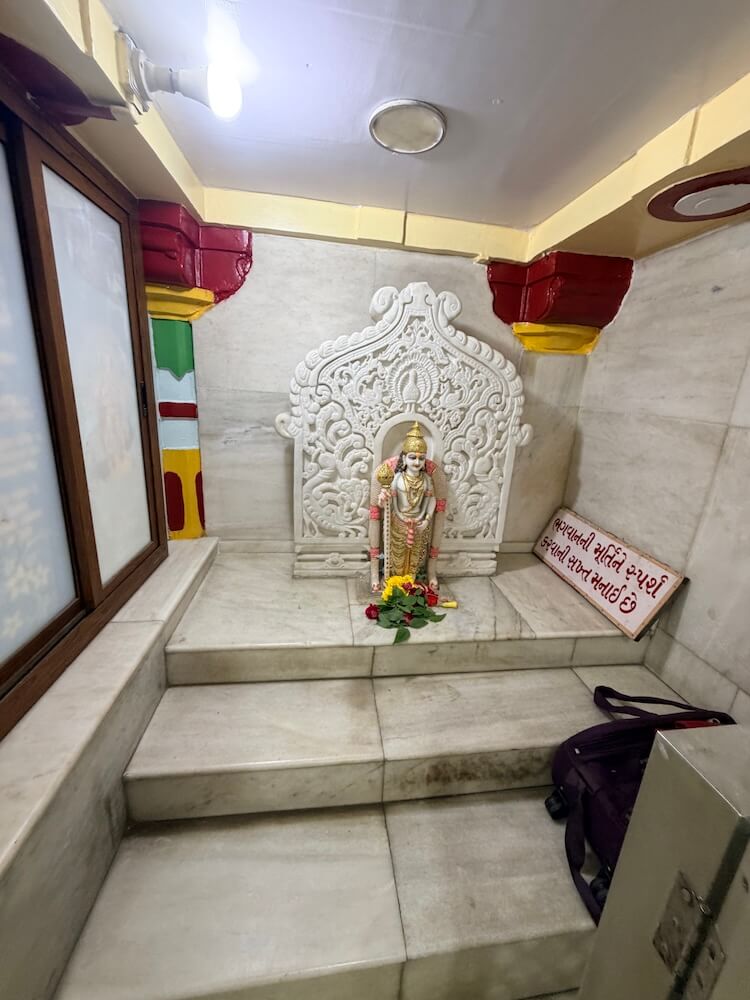
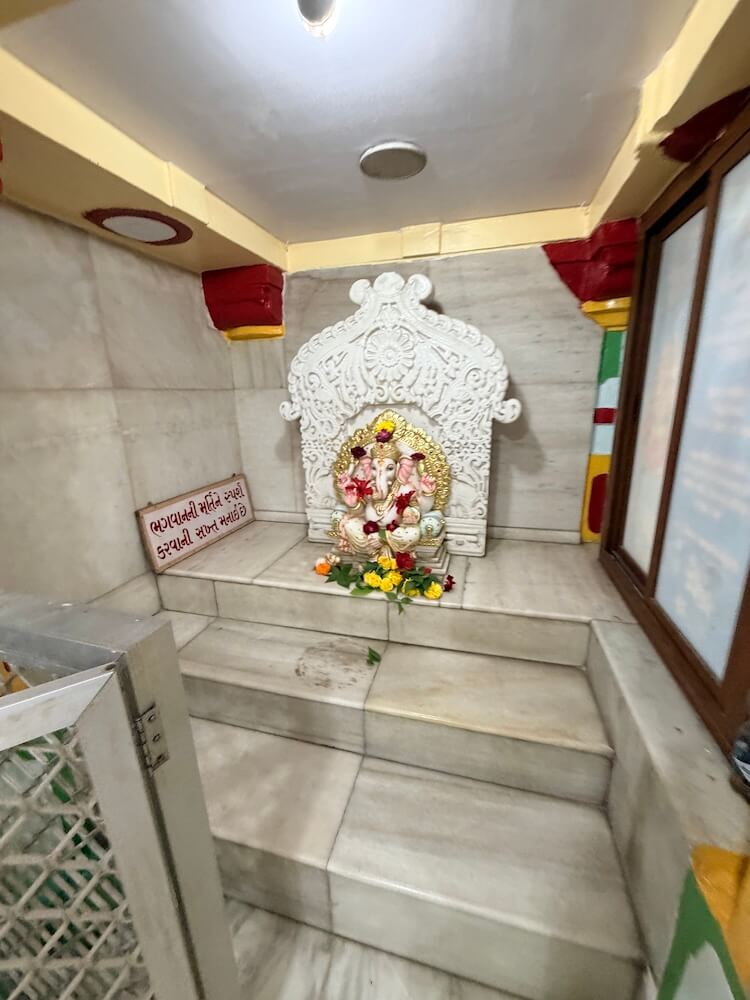
The substantial stone structure comprises a semi-open sabhamandap, an antaral (vestibule) and the garbhagriha, resting upon 16 sturdy pillars. 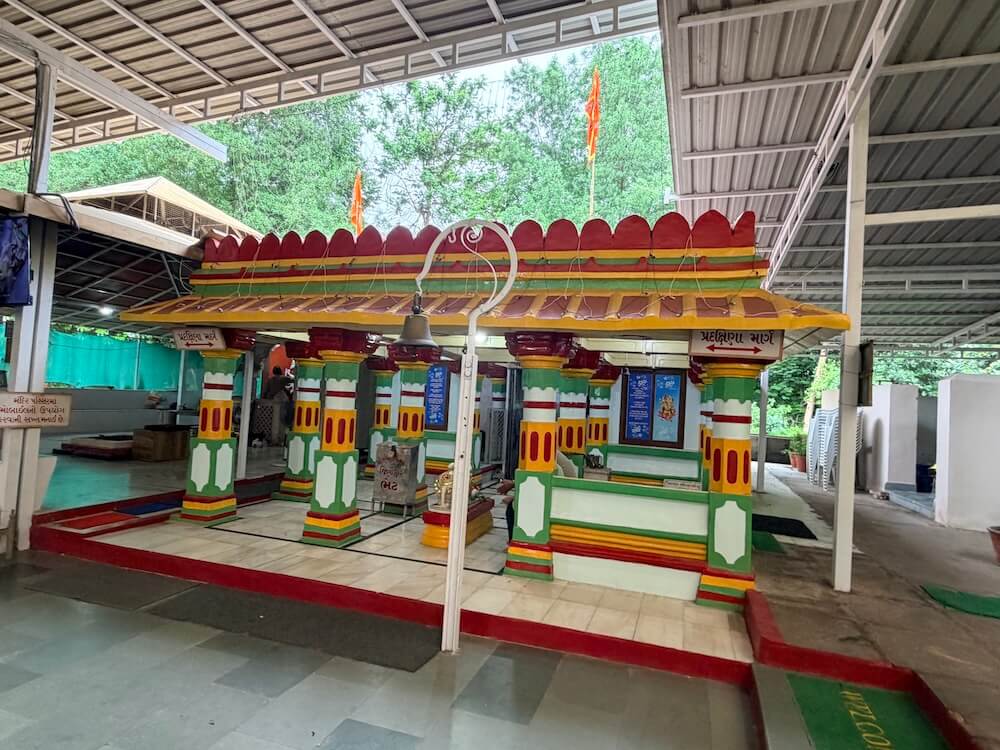 Within the sabhamandap sits a carved stone sculpture of Nandi facing the inner shrine. Ordinarily, the antaral of a Shiva temple contains murtis of Ganesha or Kartikeya, but this vestibule houses idols of both Ganesha and a chaturbhuja (four-armed) Vishnu. This iconographic pairing expresses the Harihara tradition, reflecting the harmony of Vaishnava and Shaiva worship. To the left of the Shiva temple stands a separate shrine dedicated to Panchmukhi (five-faced) Hanuman.
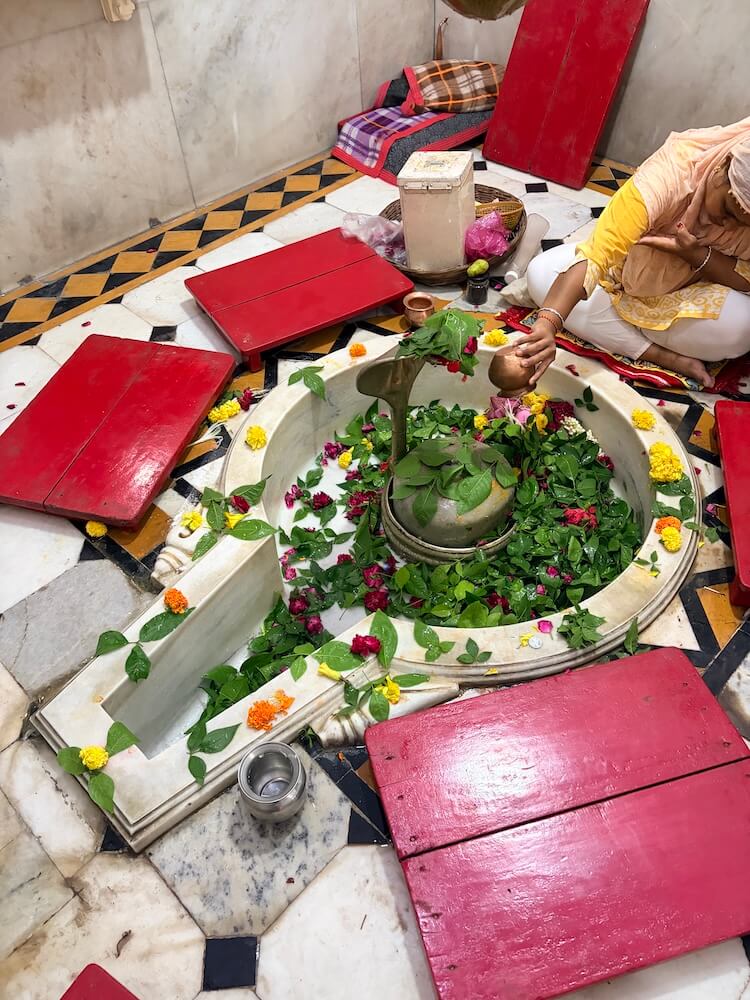
The garbhagriha lies at a lower level than the sabhamandap and is reached by descending five steps. At its centre stands the swayambhu shivalinga of Karnamukteshwar Mahadev, set within a large stone shalunka (shivalinga pedestal base). A copper serpent forms a protective canopy over the linga, while an overhead vessel of the same metal pours a continuous stream of water upon the deity. 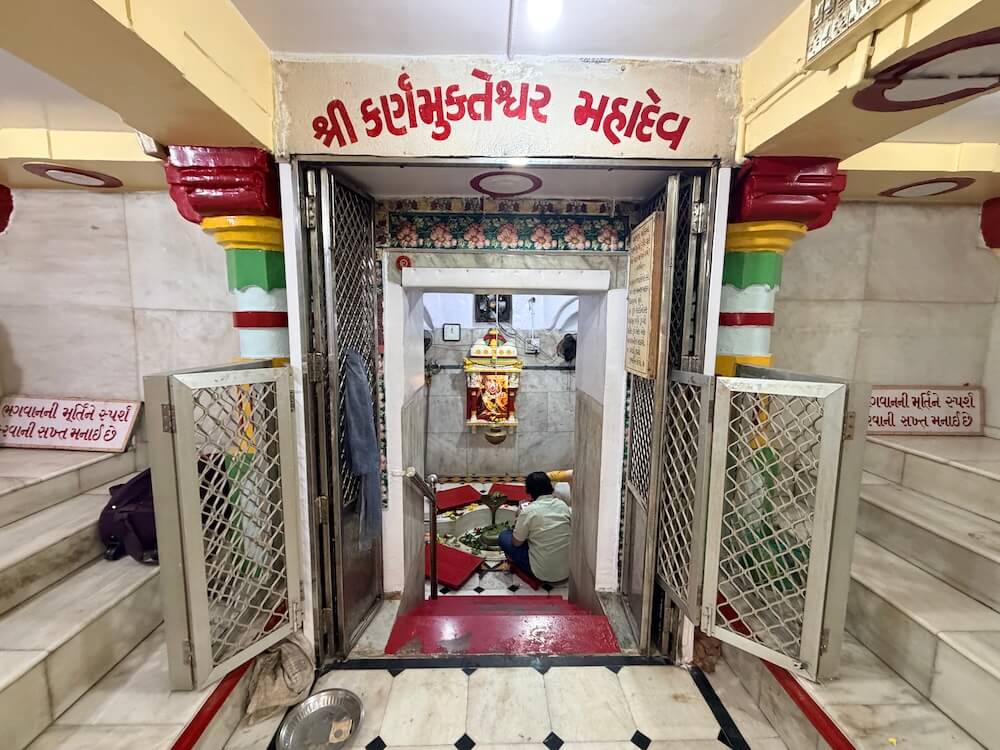 An idol of Parvati Mata is enshrined in a niche within the chamber. Earlier excavations in the temple grounds also unearthed several ancient stone sculptures, including carvings of Mahishasuramardini and Lakshmi seated in padmasan (lotus posture), which are now displayed within the complex.
The deity receives regular worship and aarti every morning and evening at the prescribed hours, drawing many devotees from across Ahmedabad for darshan. Worshippers also engage Brahmin priests here to conduct rituals for planetary peace and other religious ceremonies. Every Monday from 4 pm to 7 pm, a free Mahamrityunjaya homa is performed for devotees in the yajnashala.
 During the sacred month of Shravan, daily rituals include the Mahamrityunjaya Yajna, Rudra recitation with abhishek, panchopachar puja (five-step ritual worship), shodashopachar puja (16-step ritual worship), laghurudra abhishek, the offering of bilva leaves and lotus worship. A major observance during this month is the offering of 1.25 lakh bilva (bel) leaves to the shivalinga. Shravan also features one of the temple’s most distinctive customs. Following a practice associated with the Kashi Vishwanath Temple, musicians play the shehnai during the aarti at Karnamukteshwar. Performing the aarti to the accompaniment of this traditional wind instrument is regarded as rare and distinctive in Gujarat.
On Mahashivratri, the temple organises homa-havans and various religious programmes as devotees gather in long queues for darshan. Another old tradition is observed every year on Parashuram Jayanti, when a grand procession of Mahadev sets out from the shrine. Carried in a palkhi, the deity travels through the city before returning to the complex, where the route concludes with countless devotees participating in traditional attire. A local board of trustees and the hereditary priestly families jointly manage the organisation of these festivals as well as the temple’s daily administration. The shrine remains open for darshan every day from 6 am to 1 pm and from 3 pm to 9.30 pm.
Useful Information :
- Located 2.5 km from Ahmedabad Railway Station (Kalupur)
- Located 1.5 km from the city’s main bus station at Gita Mandir
- ST buses, autorickshaws and BRTS services are available from several parts of the city
- Private vehicles can reach the temple
- Several accommodation and breakfast options are available in the surrounding area
- Contact : Temple Office, Telephone : 079-22174524
कर्णमुक्तेश्वर महादेव मंदिर
सारंगपुर गेट, अहमदाबाद, जिला। अहमदाबाद
मंदिरे
Temples
मंदिर
મંદિરો
கோவில்கள்
దేవాలయాలు
ക്ഷേത്രങ്ങൾ
ದೇವಾಲಯಗಳು
মন্দিরসমূহ
ਮੰਦਿਰ
-
वाराही माता मंदिर कालुपूर, अहमदाबाद, जि. अहमदाबाद
अधिक माहितीVarahi Mata Temple Kalupur, Ahmedabad, Dist. Ahmedabad
View Detailsवाराही माता मंदिर कालूपुर, अहमदाबाद, जिला. अहमदाबाद
विवरण देखेंVarahi Mata Temple Kalupur, Ahmedabad, Dist. Ahmedabad
વિગત જુઓVarahi Mata Temple Kalupur, Ahmedabad, Dist. Ahmedabad
விவரங்களைக் காண்கVarahi Mata Temple Kalupur, Ahmedabad, Dist. Ahmedabad
వివరాలను చూడండిVarahi Mata Temple Kalupur, Ahmedabad, Dist. Ahmedabad
വിശദാംശങ്ങൾ കാണുകVarahi Mata Temple Kalupur, Ahmedabad, Dist. Ahmedabad
ವಿವರಗಳನ್ನು ವೀಕ್ಷಿಸಿVarahi Mata Temple Kalupur, Ahmedabad, Dist. Ahmedabad
বিস্তারিত দেখুনVarahi Mata Temple Kalupur, Ahmedabad, Dist. Ahmedabad
ਵੇਰਵੇ ਦੇਖੋ -
सोमनाथ महादेव मंदिर ग्यासपूर, अहमदाबाद, जिल्हा अहमदाबाद
अधिक माहितीSomnath Mahadev Temple Gyaspur, Ahmedabad, Dist. Ahmedabad
View Detailsसोमनाथ महादेव मंदिर ग्यासपुर, अहमदाबाद, जिला अहमदाबाद
विवरण देखेंSomnath Mahadev Temple Gyaspur, Ahmedabad, Dist. Ahmedabad
વિગત જુઓSomnath Mahadev Temple Gyaspur, Ahmedabad, Dist. Ahmedabad
விவரங்களைக் காண்கSomnath Mahadev Temple Gyaspur, Ahmedabad, Dist. Ahmedabad
వివరాలను చూడండిSomnath Mahadev Temple Gyaspur, Ahmedabad, Dist. Ahmedabad
വിശദാംശങ്ങൾ കാണുകSomnath Mahadev Temple Gyaspur, Ahmedabad, Dist. Ahmedabad
ವಿವರಗಳನ್ನು ವೀಕ್ಷಿಸಿSomnath Mahadev Temple Gyaspur, Ahmedabad, Dist. Ahmedabad
বিস্তারিত দেখুনSomnath Mahadev Temple Gyaspur, Ahmedabad, Dist. Ahmedabad
ਵੇਰਵੇ ਦੇਖੋ -
चकलेश्वर महादेव मंदिर रायपूर चकला, खाडिया, अहमदाबाद, जि. अहमदाबाद
अधिक माहितीChakleshwar Mahadev Temple Raipur Chakla, Khadia, Ahmedabad, Dist. Ahmedabad
View Detailsचकलेश्वर महादेव मंदिर रायपुर चकला, खड़िया, अहमदाबाद, जिला। अहमदाबाद
विवरण देखेंChakleshwar Mahadev Temple Raipur Chakla, Khadia, Ahmedabad, Dist. Ahmedabad
વિગત જુઓChakleshwar Mahadev Temple Raipur Chakla, Khadia, Ahmedabad, Dist. Ahmedabad
விவரங்களைக் காண்கChakleshwar Mahadev Temple Raipur Chakla, Khadia, Ahmedabad, Dist. Ahmedabad
వివరాలను చూడండిChakleshwar Mahadev Temple Raipur Chakla, Khadia, Ahmedabad, Dist. Ahmedabad
വിശദാംശങ്ങൾ കാണുകChakleshwar Mahadev Temple Raipur Chakla, Khadia, Ahmedabad, Dist. Ahmedabad
ವಿವರಗಳನ್ನು ವೀಕ್ಷಿಸಿChakleshwar Mahadev Temple Raipur Chakla, Khadia, Ahmedabad, Dist. Ahmedabad
বিস্তারিত দেখুনChakleshwar Mahadev Temple Raipur Chakla, Khadia, Ahmedabad, Dist. Ahmedabad
ਵੇਰਵੇ ਦੇਖੋ