
अंबामाता मंदिर
मधुपुरा, ता./जि. अहमदाबाद
Ambamata Temple
Madhupura, Tal./Dist. Ahmedabad
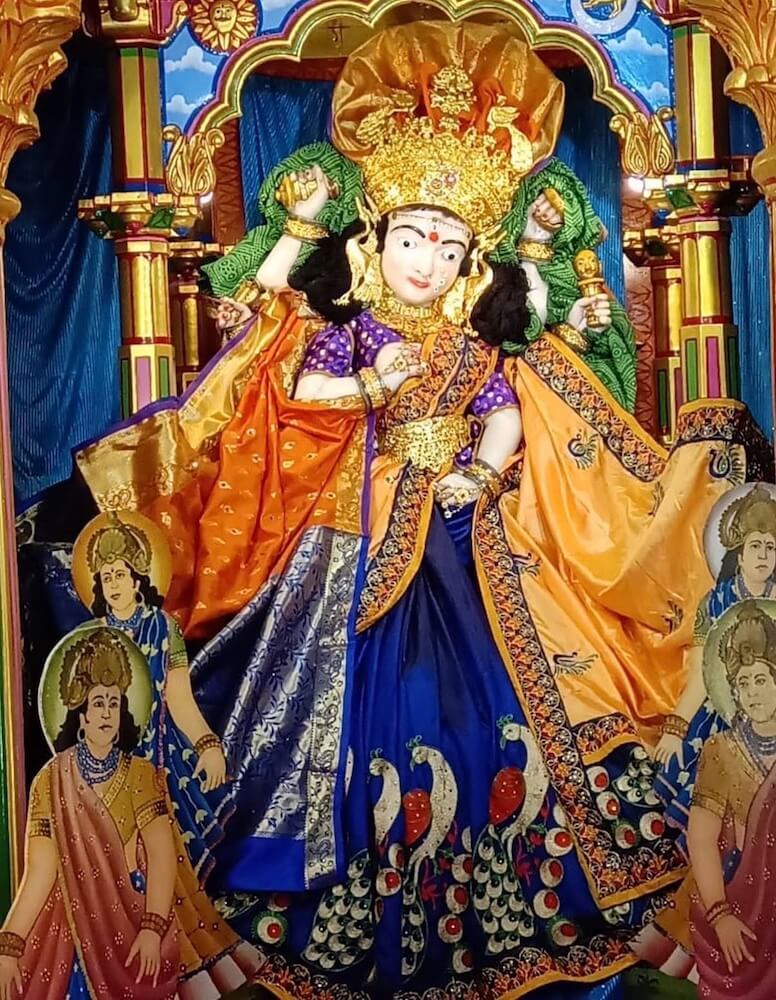 In the tradition of goddess worship across the Indian subcontinent, Ambaji in Gujarat’s Banaskantha district is regarded as one of the principal Shaktipeeths (sacred seats of the Goddess). An important historic shrine associated with this Shaktipeeth is the Ambamata Temple at Madhupura in Ahmedabad. Here, the goddess is worshipped in the form of Mahishasuramardini, the slayer of the demon Mahishasura. More than two centuries old, the temple remains a major centre of faith for local traders and residents. It has witnessed the commercial transformations of Ahmedabad during the eighteenth and nineteenth centuries. During Navratri, the shrine draws a large number of devotees.
Ahmedabad’s ancient history is linked to the eleventh-century Bhil settlement of Ashaval and the town of Karnavati, founded by the Solanki ruler Karna I. The region came under the control of the Delhi Sultanate in the fourteenth century and Sultan Ahmad Shah founded Ahmedabad on the banks of the Sabarmati River in 1411. After periods of Mughal and Maratha rule, the city passed to the British East India Company following the Third Anglo-Maratha War in 1818 . Under British administration, Ahmedabad developed into a major centre of the textile industry.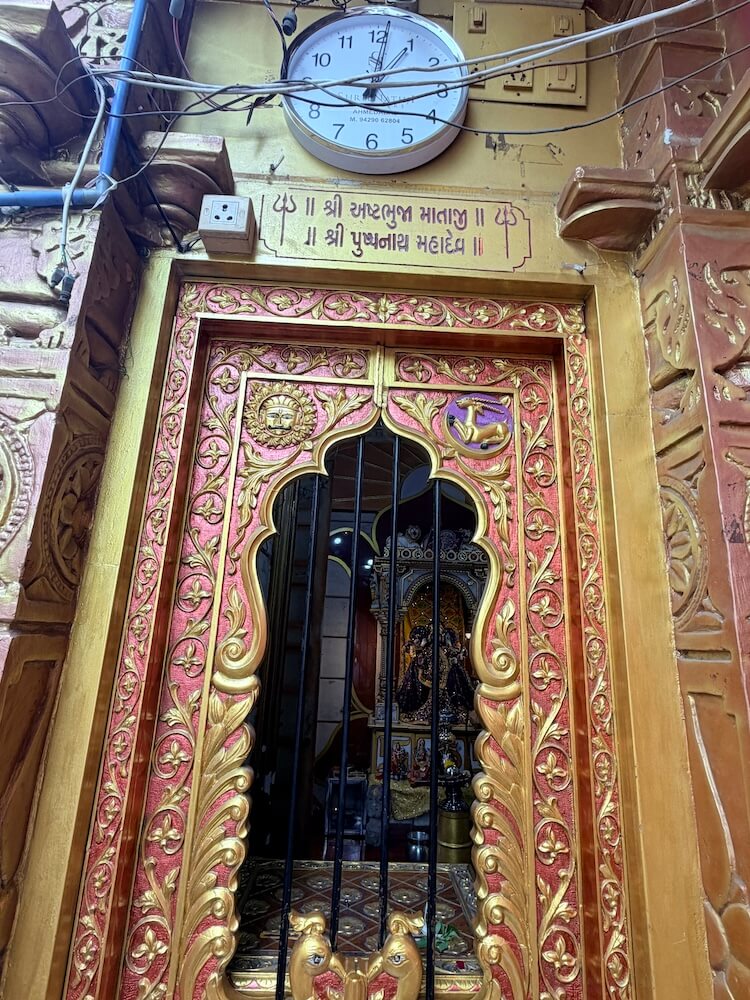
Detailed accounts of the city’s population and commerce appear in Volume IV of the ‘Gazetteer of the Bombay Presidency’ dealing with Ahmedabad, published in 1879 under the general editorship of James Macnabb Campbell. After the death of Ahmedabad’s then Nagarseth (chief city merchant) Khushalchand Lakhimchand in 1748, the position passed to his son, Nathusha Seth (Nathmal Shah). Between 1768 and 1770, he established a new commercial settlement through an agreement with Peshwa and Gaekwad representatives Trimbak Narayan and Fattesinghrao Gaekwad. Known as Madhupura, the settlement grew into an important market for cotton, ghee and grain. Today, Madhupura Market is renowned across Gujarat for its wholesale trade in dry fruits and spices and the historic Ambamata Temple stands within this commercial quarter.
The idol worshipped at the Madhupura temple is associated with the account of Mahishasuramardini narrated in the ‘Durga Saptashati’ of the ‘Markandeya Purana’. According to temple tradition, a learned man named Narbheram Prabhuram Bhatt lived around two centuries ago in Kapadvanj in present-day Kheda district of Gujarat, a town known for historic architecture such as the Solanki-era Kundvav stepwell. Because he was highly educated, villagers respectfully called him Darbar, while his main occupation was the ghee trade. One day, a sculptor arrived in Kapadvanj carrying two stone idols of Ambamata. When he failed to find buyers, some villagers sent him to Narbheram in jest;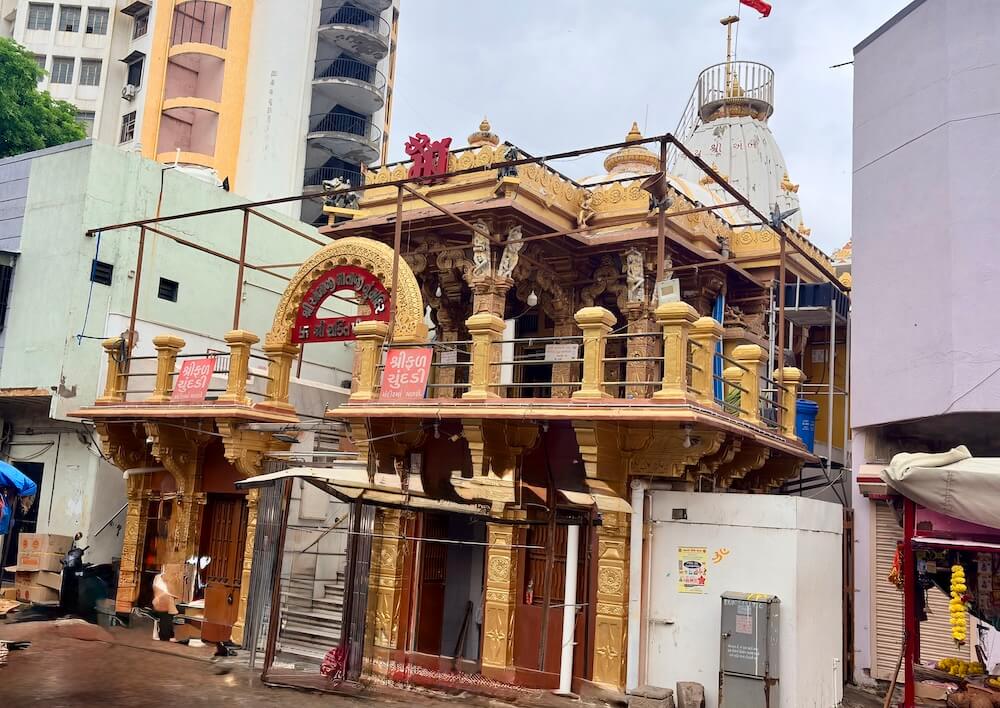 although not financially prosperous at the time, Narbheram offered seventeen jars of ghee in exchange for the two murtis, which the sculptor accepted.
After receiving the idols, Narbheram sold his possessions and set out towards Ahmedabad along the historic route through the Utkantheshwar-Dehgam region. During the journey, he halted near the ancient Utkantheshwar Mahadev Temple on the banks of the Vatrak River, known locally as the Kashyapganga. Narbheram presented one of the two idols to the priest of this Shiva temple, which is believed to be nearly two thousand years old and is associated with the penance of Maharishi Jabali.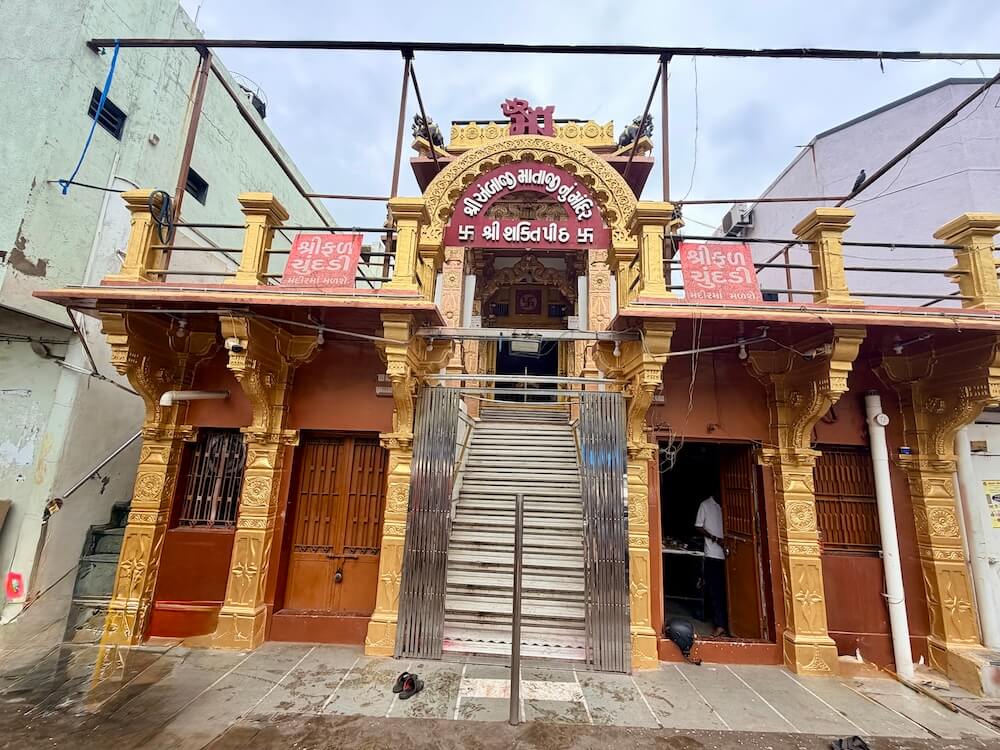 This murti continues to receive regular worship within the precincts of Utkantheshwar, also known as Untadia Mahadev.
Carrying the second idol, Narbheram reached the Delhi Darwaza area of Ahmedabad around 1848. At that time, construction of the Hutheesing Jain Temple was underway, inspired by the vision of the wealthy merchant Sheth Hathising Kesarisinh and completed under the supervision of his wife, Shethani Harkunvar. Narbheram approached the trustees of the Jain temple to request land for a shrine dedicated to the goddess. When the trustees stipulated that they would retain complete control over the proposed temple in the future, he declined the offer.
He then approached landowners and traders in nearby Madhupura, where the local merchants immediately provided land and a small shrine was initially built. 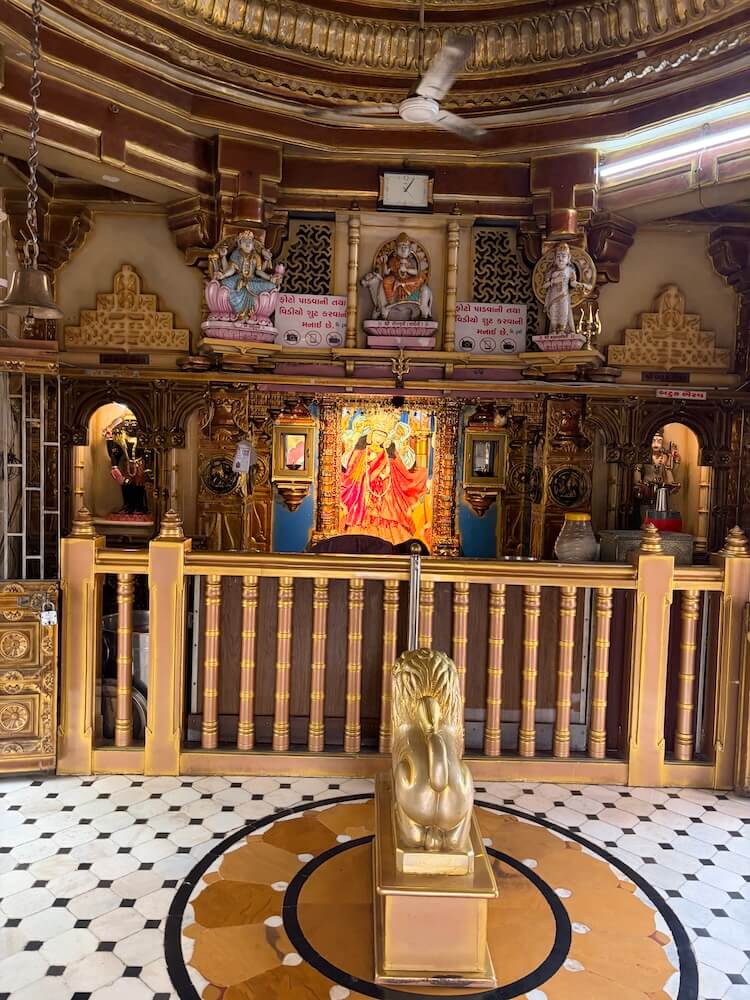 A few generations later, Narbheram’s descendant Ambalal Bapuji Bhatt undertook the development of the site and after his passing, Pushparai Ambalal Bhatt supervised the completion of the work. More recently, traders of Madhupura Market restored the structure. For the past two centuries, two ghee lamps have been kept burning continuously in the temple.
Architecturally, the Ambamata Temple at Madhupura blends North Indian Nagara and regional Maru-Gurjara traditions. Raised above street level and reached by a flight of stone steps, the temple has an arched main entrance finished with gold plating. The original structure comprises three principal sections: the mukhamandap (entrance porch), a spacious sabhamandap and the garbhagriha. Stone pillars in the mukhamandap are linked by cusped arches, with their upper sections featuring carvings of surasundaris (celestial maidens) playing musical instruments and dancing. Gold plating also adorns the pillars and ceilings of both the mukhamandap and sabhamandap, as well as the entrance to the garbhagriha.
At the centre of the sabhamandap stands a gold-plated sculpture of a lion, the goddess’s vahan. The upper sections of the hall walls bear carvings of the Navadurga (nine forms of Durga), while stone idols of Kalimata, Gayatri Mata, Ganesh, Hanuman, 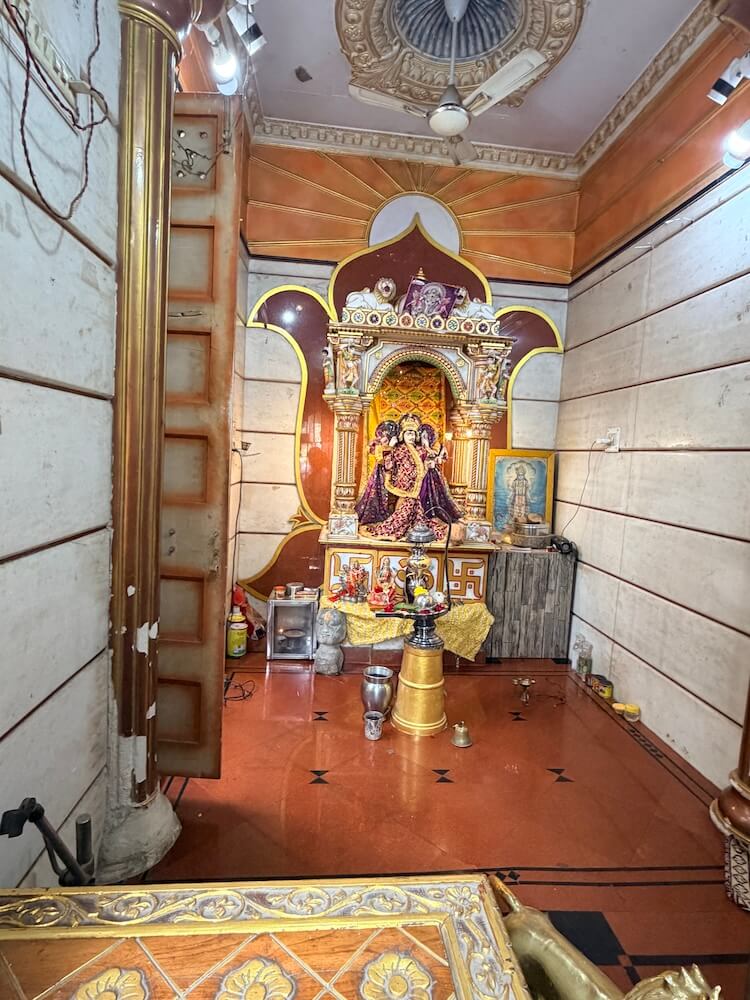 Kalbhairav and Batuk Bhairav are enshrined elsewhere in the complex. A single-band carved doorway frames the entrance to the garbhagriha. Sculptures of dwarpals (door guardians) appear on its lower sections and kirtimukhs (protective mask motifs) are carved along the base.
Within the garbhagriha, Ambamata is enshrined in a makhar (decorative frame) as an eight-armed white marble idol depicted according to iconographic conventions as Mahishasuramardini. Her eight hands hold weapons and sacred objects including a trishul, sword, shield, noose and damaru, while she is attired in traditional garments and a golden crown. In front of the main deity stands a metal utsav murti (festival idol) of the goddess seated on a lion, placed alongside a gold-plated Shri Yantra and the two ghee lamps that, according to temple tradition, have burned continuously for two centuries. Rising above the garbhagriha is a tall Nagara-style shikhar adorned with urushrings (miniature spires) and crowned by a golden kalash and a dharmadhvaj (sacred flag).
Wholesale traders of Madhupura Market traditionally begin their working day only after visiting the temple for the darshan of the goddess. The shrine opens for darshan at 6.30 am, followed by the Mangala Aarti at 6.45 am and remains closed in the afternoon from 1.30 pm to 3.30 pm. Evening darshan resumes at 3.30 pm, with the evening aarti performed at 7.45 pm. At 10 pm, the Shayan Aarti is conducted, after which the temple closes to devotees. Particularly large crowds visit the shrine on Sundays and on every full-moon day.
While many festivals are celebrated at the temple throughout the year, Navratri holds the greatest importance, with Chaitra Navratri and Sharadiya Navratri serving as the principal annual celebrations. Across these nine days, the main idol in the garbhagriha is adorned each day in a different form of Navadurga: Shailaputri, Brahmacharini, Chandraghanta, Kushmanda, Skandamata, Katyayani, Kalaratri, Mahagauri and Siddhidatri. Special adornments using saris form an important part of the festivities. On Ashtami during Chaitra Navratri, religious ceremonies such as the Navachandi Yajna (Vedic Chandi fire ritual), special worship of the Shri Yantra and kanya pujan (worship of young girls) are performed.
Special worship of the Shri Yantra is also conducted on Bhadrapada Purnima, when hundreds of devotees gather at the temple. During Sharadiya Navratri, devotees perform the traditional garba dance in the temple courtyard. On Sharad Purnima, a grand annakut (festive food offering) is organised and a variety of dry fruits is offered to Ambamata as naivedya. The original Bhatt family trustees and an association of local traders jointly oversee these celebrations as well as the temple’s daily administration.
Useful Information :
- Located 4 km from Ahmedabad Junction (Kalupur) Railway Station
- Bus and autorickshaw services are available from various parts of the city, including along the
- Delhi Darwaza and Shahibaug routes
- Private vehicles can travel up to the entrance of Madhupura Market
- Several options for accommodation and breakfast are available in the surrounding area
- Contact : Temple Office, Mobile : 09327486689
अम्बामाता मंदिर
मधुपुरा, ताल./,. अहमदाबाद
मंदिरे
Temples
मंदिर
મંદિરો
கோவில்கள்
దేవాలయాలు
ക്ഷേത്രങ്ങൾ
ದೇವಾಲಯಗಳು
মন্দিরসমূহ
ਮੰਦਿਰ
-
राणी सती मंदिर साहिबाग, अहमदाबाद, जिल्हा अहमदाबाद
अधिक माहितीRani Sati Temple Shahibaug, Ahmedabad, Dist. Ahmedabad
View Detailsरानी सती मंदिर शाहीबाग, अहमदाबाद, जिला अहमदाबाद
विवरण देखेंRani Sati Temple Shahibaug, Ahmedabad, Dist. Ahmedabad
વિગત જુઓRani Sati Temple Shahibaug, Ahmedabad, Dist. Ahmedabad
விவரங்களைக் காண்கRani Sati Temple Shahibaug, Ahmedabad, Dist. Ahmedabad
వివరాలను చూడండిRani Sati Temple Shahibaug, Ahmedabad, Dist. Ahmedabad
വിശദാംശങ്ങൾ കാണുകRani Sati Temple Shahibaug, Ahmedabad, Dist. Ahmedabad
ವಿವರಗಳನ್ನು ವೀಕ್ಷಿಸಿRani Sati Temple Shahibaug, Ahmedabad, Dist. Ahmedabad
বিস্তারিত দেখুনRani Sati Temple Shahibaug, Ahmedabad, Dist. Ahmedabad
ਵੇਰਵੇ ਦੇਖੋ -
वाराही माता मंदिर कालुपूर, अहमदाबाद, जि. अहमदाबाद
अधिक माहितीVarahi Mata Temple Kalupur, Ahmedabad, Dist. Ahmedabad
View Detailsवाराही माता मंदिर कालूपुर, अहमदाबाद, जिला. अहमदाबाद
विवरण देखेंVarahi Mata Temple Kalupur, Ahmedabad, Dist. Ahmedabad
વિગત જુઓVarahi Mata Temple Kalupur, Ahmedabad, Dist. Ahmedabad
விவரங்களைக் காண்கVarahi Mata Temple Kalupur, Ahmedabad, Dist. Ahmedabad
వివరాలను చూడండిVarahi Mata Temple Kalupur, Ahmedabad, Dist. Ahmedabad
വിശദാംശങ്ങൾ കാണുകVarahi Mata Temple Kalupur, Ahmedabad, Dist. Ahmedabad
ವಿವರಗಳನ್ನು ವೀಕ್ಷಿಸಿVarahi Mata Temple Kalupur, Ahmedabad, Dist. Ahmedabad
বিস্তারিত দেখুনVarahi Mata Temple Kalupur, Ahmedabad, Dist. Ahmedabad
ਵੇਰਵੇ ਦੇਖੋ -
कर्णमुक्तेश्वर महादेव मंदिर सारंगपूर गेट, अहमदाबाद, जि. अहमदाबाद
अधिक माहितीKarnamukteshwar Mahadev Temple Sarangpur Gate, Ahmedabad, Dist. Ahmedabad
View Detailsकर्णमुक्तेश्वर महादेव मंदिर सारंगपुर गेट, अहमदाबाद, जिला। अहमदाबाद
विवरण देखेंKarnamukteshwar Mahadev Temple Sarangpur Gate, Ahmedabad, Dist. Ahmedabad
વિગત જુઓKarnamukteshwar Mahadev Temple Sarangpur Gate, Ahmedabad, Dist. Ahmedabad
விவரங்களைக் காண்கKarnamukteshwar Mahadev Temple Sarangpur Gate, Ahmedabad, Dist. Ahmedabad
వివరాలను చూడండిKarnamukteshwar Mahadev Temple Sarangpur Gate, Ahmedabad, Dist. Ahmedabad
വിശദാംശങ്ങൾ കാണുകKarnamukteshwar Mahadev Temple Sarangpur Gate, Ahmedabad, Dist. Ahmedabad
ವಿವರಗಳನ್ನು ವೀಕ್ಷಿಸಿKarnamukteshwar Mahadev Temple Sarangpur Gate, Ahmedabad, Dist. Ahmedabad
বিস্তারিত দেখুনKarnamukteshwar Mahadev Temple Sarangpur Gate, Ahmedabad, Dist. Ahmedabad
ਵੇਰਵੇ ਦੇਖੋ