
माता विश्वंभरी तीर्थ यात्रा धाम
रबाडा, ता. वलसाड, जि. वलसाड
Mata Vishwambhari Tirth Yatra Dham
Rabada, Tal. Valsad, Dist. Valsad
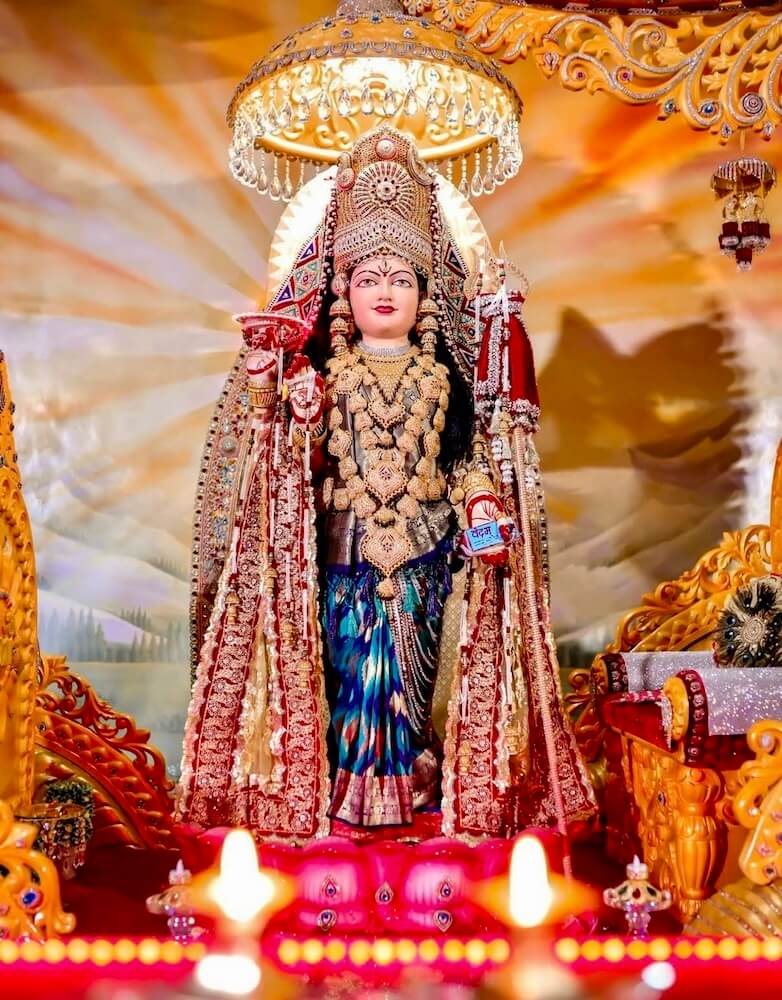 Vishwambhari is one of the names of Goddess Bhagwati. According to religious belief, she sustains and nurtures all living beings in the universe and the name Vishwambhari also features among the 1,008 names of the Goddess recited by Lord Shri Ram in the ‘Adbhuta Ramayana’. A grand temple of the goddess stands on the banks of the Par River at Rabada village near Valsad. Known as Maa Vishwambhari Tirth Yatra Dham, this shrine is a major pilgrimage centre whose spacious complex houses idols of various deities and tableaux depicting episodes from Hindu mythology. Many devotees and religious tourists visit the site.
Some scholars believe that Valsad was known in ancient times as Nyagrodhapura. In Sanskrit, the word nyagrodha means a banyan tree and the name Nyagrodhapura is thought to have derived in reference to the term Val-Vad associated with Valsad. Historical sources also refer to the town as Balsar and Baxay. Over the centuries, it witnessed the rule of several dynasties, including the Mauryas, Traikutakas, Saindrakas, Chalukyas and Rashtrakutas. Situated about 15 kilometres from Valsad town is Maa Vishwambhari Tirth Yatra Dham. Vishwambhari is a widely worshipped goddess in Gujarat, addressed by names such as Bhavani, Vidyadhari and Bhadravati in the traditional Gujarati composition ‘Vishwambhari Stuti’, 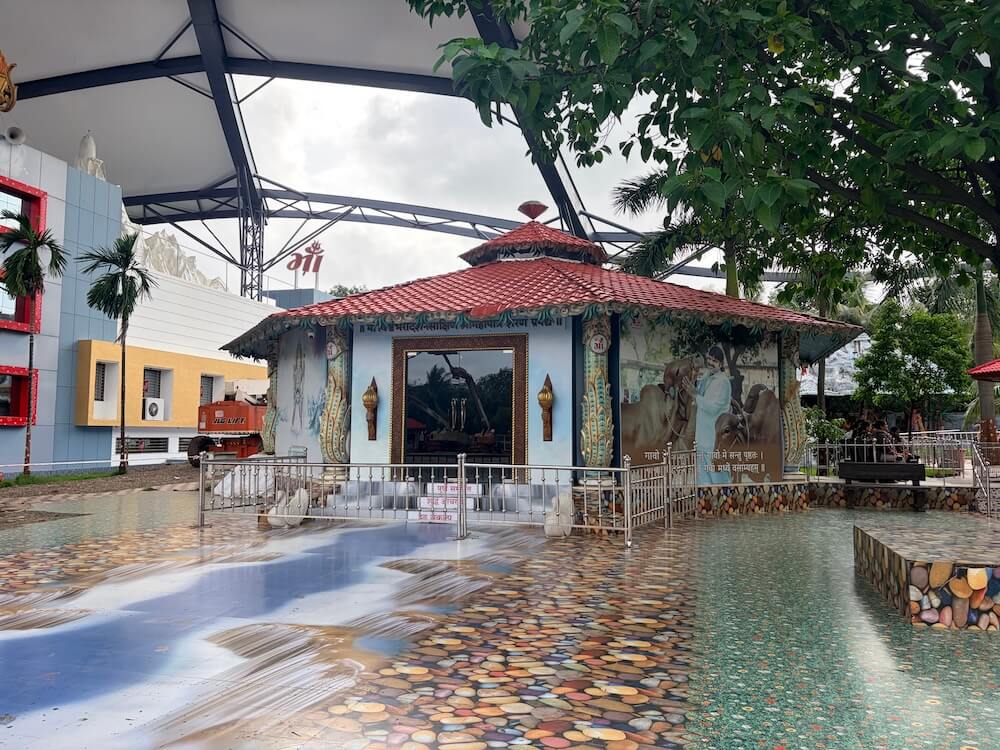 while her name also occurs in the Sanskrit work ‘Adbhuta Ramayana’.
Traditional belief attributes the composition of this Sanskrit text to Maharishi Valmiki, although modern scholarship does not regard its authorship as securely established. In her article ‘Historical Evolution of the Ram Legend’, published in ‘Social Scientist’ (Vol. 21, 1993), Suvira Jaiswal discusses the ‘Adbhuta Ramayana’ as a later and distinctive strand of the Ramayana tradition. Associated with Shakta worship, the work presents Sita as the daughter of Ravana’s wife, Mandodari and identifies her with Goddess Kali. According to this version, after slaying Ravana, Shri Ram fought the demon king’s thousand-headed brother, Sahasramukha Ravana. When Shri Ram fell unconscious during the battle, an enraged Sita assumed the form of Kali and slew Sahasramukha Ravana. 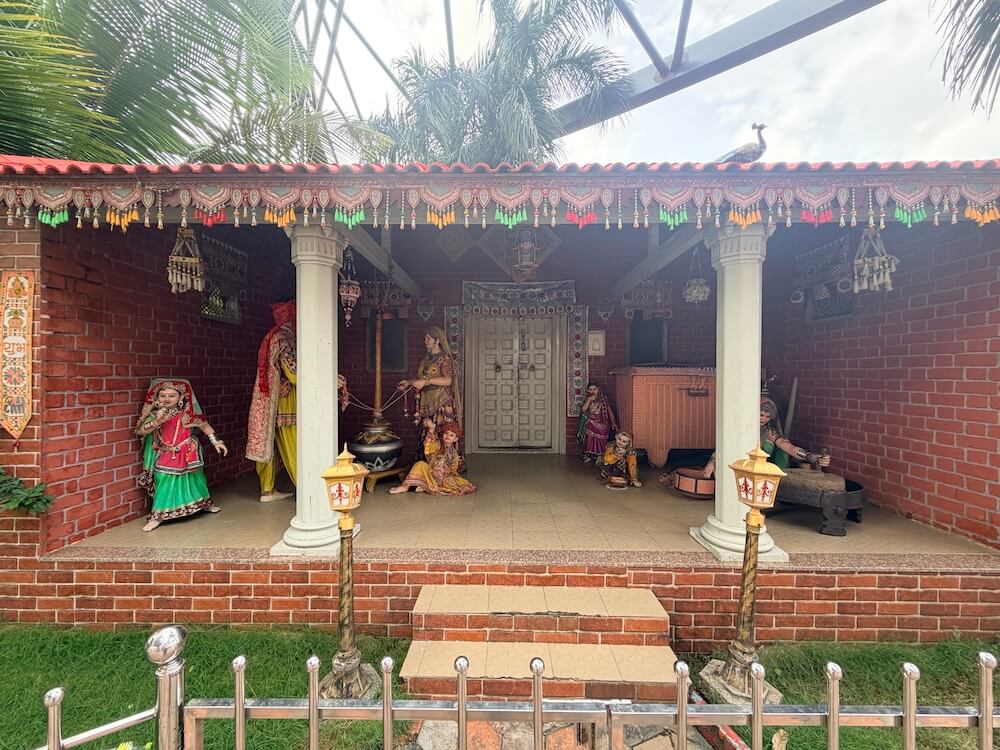 Even after the demon’s death, her fury did not subside, prompting Shri Ram to chant a hymn of 1,008 names to pacify the Goddess, among which the name Vishwambhari appears.
Local legend recounts the experience of a devout resident of Rabada named Vitthalbhai. On 6 September 1999, while travelling on his two-wheeler to another place for work, he passed through a forest where he saw a young woman on the road. When she asked for his help to reach a nearby village, Vitthalbhai invited her to sit behind him on his vehicle. Along the way, the young woman tried to become overly familiar with him to test his character, yet Vitthalbhai did not behave improperly in any manner. After some time, she disappeared. 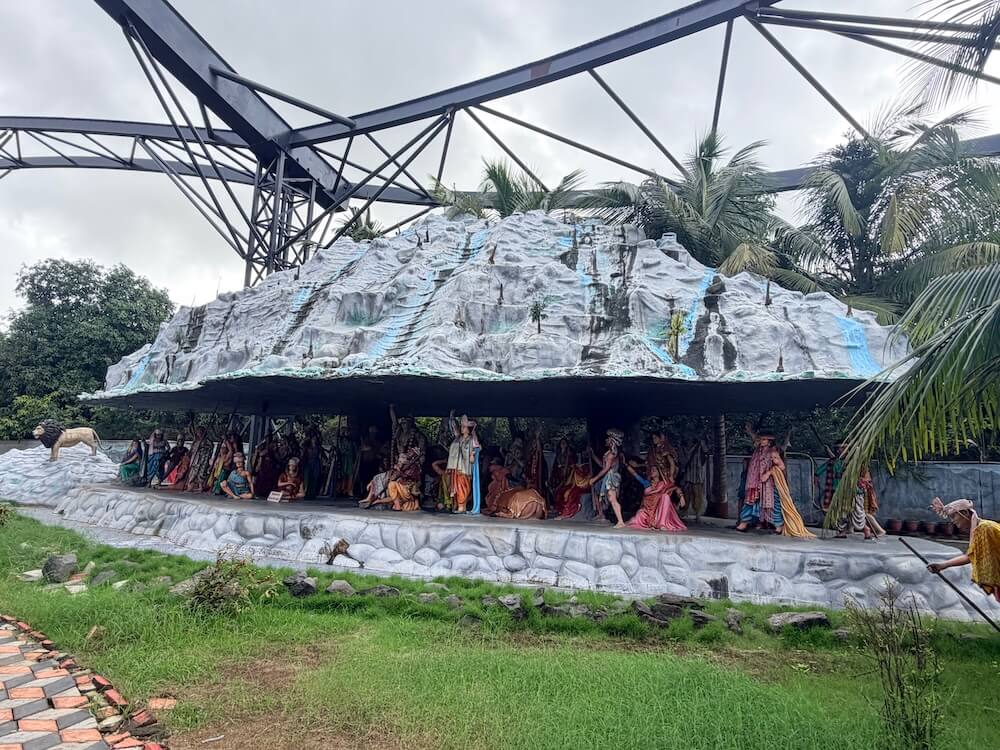 Local belief holds that the passenger was none other than Goddess Vishwambhari.
Later, the goddess appeared before Vitthalbhai in her Vishwambhari form, expressing her wish that a grand temple be built in the area and bestowing upon him the name Mahapatra. Upon returning to the village, he narrated the incident to the villagers and resolved to build the shrine. Constructed in just 90 days between 4 February and 4 May 2016, the temple took shape under the guidance of Vitthalbhai Mahapatra without the assistance of an architect or engineer. According to the temple’s published account, the idol of the goddess was consecrated here on 9 May 2016 on the auspicious occasion of Akshaya Tritiya.
A large gateway marks the entrance to the Mata Vishwambhari complex, where palm trees and various other plant species have been planted in an orderly manner throughout the grounds. Notably, the principal shrine is referred to here not as a temple, but as a Pathshala (school). In the vision of its founder, Vitthalbhai, Mata Vishwambhari is the giver of knowledge who bestows compassion, love, peace, strength, wisdom and spiritual joy upon the world and on this understanding the sacred place is called a Pathshala.
On the outer facade of the main entrance to the Pathshala, a representation of the Earth sits at the centre with a map of the country engraved upon it. A kalash symbolising purity is depicted on the left, while a flaming torch mounted on a trishul appears on the right. 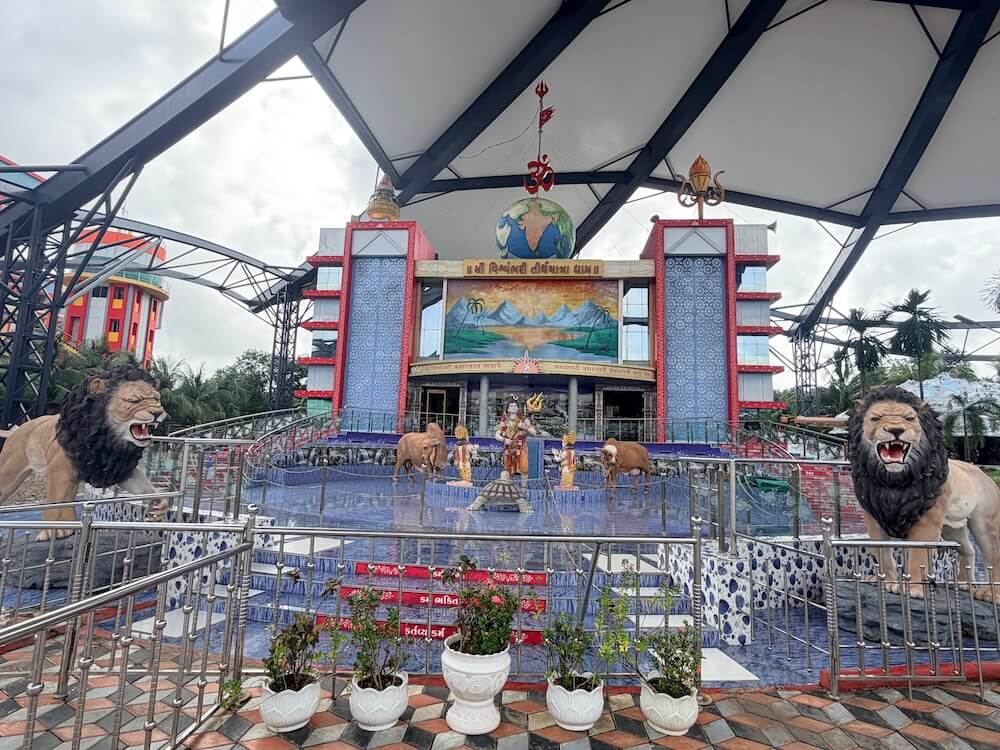 In the forecourt before the entrance stand two large sculptures of lions, the vahan of the goddess. Further inside, a distinctive tableau features Nandi, Lord Mahadev holding a trident, a tortoise, two sacred cows and the deities Brahma and Vishnu.
Stairways on both sides lead into the Pathshala, with the virtues of the Vedic religion inscribed along their lower sections. These include duty and action, devotion through action, the ideal of the Karma Yogi, faith, curiosity, trust, purity, spirituality, valour, readiness, courage, restraint, loyalty to the collective, regularity, fearlessness, endurance and greatness. The underlying belief is that by practising all these virtues, a person can attain Mata Vishwambhari within this very lifetime.
Inside the inner hall of the Pathshala, laid with bluish floor tiles, stands an artistic representation of the three worlds. 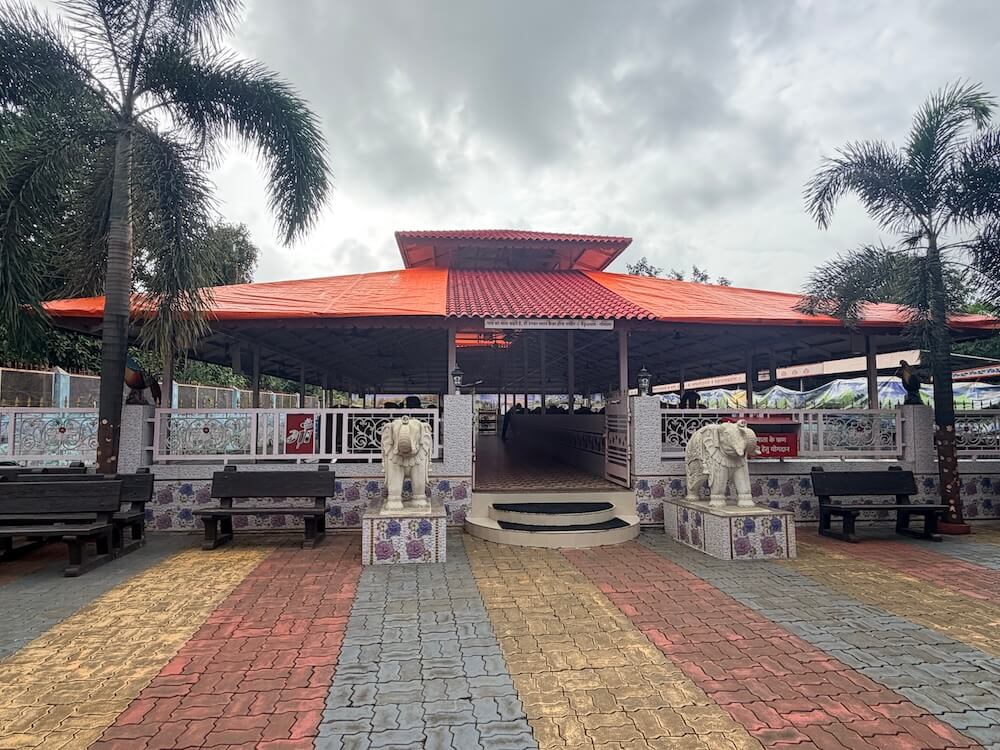 Through creative design, modern technology and contemporary materials, the three realms of Patala, the earthly world and outer space have been delineated and recreated in detail. The celestial section portrays all the planets of the Solar System along with stars, enhanced by special lighting. Along the inner walls of the Pathshala are scenic depictions of mountains, rivers and forests on Earth.
Against the backdrop of these three worlds stands a ten-armed idol of Mata Vishwambhari mounted on a decorative four-wheeled chariot. The standing goddess holds a trishul, chakra and other weapons in her hands. She wears a large crown, earrings and several pieces of jewellery, while a crescent-shaped vermilion tilak marks her forehead and a richly decorated sari drapes her form. An elegant canopy with hanging ornaments rises above the deity. Installed nearby is a statue of the temple’s founder, Vitthalbhai, seated on a chopala (traditional swing), whose two supporting pillars rest upon carved lion faces accompanied by ornamental elephant sculptures.
Above the Pathshala rises a lifelike representation of the Himalayas. A flight of stairs leads up to a white cave said to be about 200 feet high, complete with rock-like formations along its sides that give it a natural appearance. Inside the cavern, soft blue lighting creates an evocative atmosphere.
Beyond the Pathshala stands a recreation of the home of Nandalal and Yashoda, built with red-brick walls and a tiled roof. Traditional household objects are neatly arranged inside alongside sculptures of women churning butter and grinding flour on a traditional millstone. In the Gokuldham section, a striking tableau depicts Lord Krishna lifting Govardhan Hill on his little finger, surrounded by statues of numerous gopas (cowherds) and gopis (milkmaids) along with the inhabitants of Vrindavan. Every evening, an artificial display of rain and thunder over Govardhan Hill brings the scene to life. The complex also includes a section called Ramkutir, where statues of Lord Shri Ram, Sita and Lakshman are installed.
Maa Vishwambhari Tirth Yatra Dham remains open for darshan from 7.30 am to 1 pm and from 2.30 pm to 8.30 pm, while aarti is performed every morning at 8.15 am and every evening at 7.15 pm. Navratri is one of the principal festivals celebrated here, marked by special worship, rituals and devotional programmes that draw large numbers of devotees and religious tourists. Mahashivratri is also celebrated on a grand scale, alongside Krishna Janmashtami, Ram Navami and Diwali, which are observed with deep devotion. A short distance from the temple stands a clean, well-planned gaushala divided into three sections, where Gir cows are kept and given special attention regarding their food and care.
Useful Information :
- Located 15 km from Valsad
- State Transport bus services are available from Valsad
- Private vehicles can travel up to the temple’s parking area
- Accommodation and breakfast facilities are available within the complex
- Contact : Temple Office, 9898574674, 8866884949, 7203025755
माता विश्वम्भरी तीर्थ यात्रा धाम
रबाडा, ताल. वलसाड, जिला. वलसाड
मंदिरे
Temples
मंदिर
મંદિરો
கோவில்கள்
దేవాలయాలు
ക്ഷേത്രങ്ങൾ
ದೇವಾಲಯಗಳು
মন্দিরসমূহ
ਮੰਦਿਰ
-
कलगाम हनुमान मंदिर कलगाम, बारियावाड, ता. उमरगाम, जि. वलसाड
अधिक माहितीKalgam Hanuman Temple Kalgam, Bariyawad, Tal. Umargam, Dist. Valsad
View Detailsकलगाम हनुमान मंदिर कलगाम, बरियावाड, ताल. उमरगाम, जिला. वलसाड
विवरण देखेंKalgam Hanuman Temple Kalgam, Bariyawad, Tal. Umargam, Dist. Valsad
વિગત જુઓKalgam Hanuman Temple Kalgam, Bariyawad, Tal. Umargam, Dist. Valsad
விவரங்களைக் காண்கKalgam Hanuman Temple Kalgam, Bariyawad, Tal. Umargam, Dist. Valsad
వివరాలను చూడండిKalgam Hanuman Temple Kalgam, Bariyawad, Tal. Umargam, Dist. Valsad
വിശദാംശങ്ങൾ കാണുകKalgam Hanuman Temple Kalgam, Bariyawad, Tal. Umargam, Dist. Valsad
ವಿವರಗಳನ್ನು ವೀಕ್ಷಿಸಿKalgam Hanuman Temple Kalgam, Bariyawad, Tal. Umargam, Dist. Valsad
বিস্তারিত দেখুনKalgam Hanuman Temple Kalgam, Bariyawad, Tal. Umargam, Dist. Valsad
ਵੇਰਵੇ ਦੇਖੋ -
इराणशाह आतश बेहराम उदवाडा, ता. पारडी, जि. वलसाड
अधिक माहितीIranshah Atash Behram Udvada, Tal. Pardi, Dist. Valsad
View Detailsईरानशाह अताश बेहराम उदवाड़ा, ताल. पारडी, जिला. वलसाड
विवरण देखेंIranshah Atash Behram Udvada, Tal. Pardi, Dist. Valsad
વિગત જુઓIranshah Atash Behram Udvada, Tal. Pardi, Dist. Valsad
விவரங்களைக் காண்கIranshah Atash Behram Udvada, Tal. Pardi, Dist. Valsad
వివరాలను చూడండిIranshah Atash Behram Udvada, Tal. Pardi, Dist. Valsad
വിശദാംശങ്ങൾ കാണുകIranshah Atash Behram Udvada, Tal. Pardi, Dist. Valsad
ವಿವರಗಳನ್ನು ವೀಕ್ಷಿಸಿIranshah Atash Behram Udvada, Tal. Pardi, Dist. Valsad
বিস্তারিত দেখুনIranshah Atash Behram Udvada, Tal. Pardi, Dist. Valsad
ਵੇਰਵੇ ਦੇਖੋ -
साईबाबा मंदिर तिथळ, ता./जि. वलसाड
अधिक माहितीSai Baba Temple Tithal, Tal./Dist. Valsad
View Detailsसाईं बाबा मंदिर तीथल, ताल./जिला. वलसाड
विवरण देखेंSai Baba Temple Tithal, Tal./Dist. Valsad
વિગત જુઓSai Baba Temple Tithal, Tal./Dist. Valsad
விவரங்களைக் காண்கSai Baba Temple Tithal, Tal./Dist. Valsad
వివరాలను చూడండిSai Baba Temple Tithal, Tal./Dist. Valsad
വിശദാംശങ്ങൾ കാണുകSai Baba Temple Tithal, Tal./Dist. Valsad
ವಿವರಗಳನ್ನು ವೀಕ್ಷಿಸಿSai Baba Temple Tithal, Tal./Dist. Valsad
বিস্তারিত দেখুনSai Baba Temple Tithal, Tal./Dist. Valsad
ਵੇਰਵੇ ਦੇਖੋ