 Approximately eight kilometres from the Vimleshwar Mahadev temple – the final sacred destination on the southern bank of the Narmada Parikrama (the ritual circumambulation of the Narmada River) – lies the serene abode of Hanuman Tekdi in Dantrai. This sanctuary is dedicated to Bhagwan Hanuman and his mother, Mata Anjani. In accordance with the tradition where a shrine to Shani (Saturn) often accompanies a Hanuman temple, the spacious courtyard of this renowned complex also houses a temple for Shani and the Navagrahas(the nine celestial deities). Known as Hanuman Tekdi, this site is regarded as an important resting halt for devotees undertaking the Parikrama. It is said that nearly fifty thousand such pilgrims seek repose here in the ashram (hermitage) every year.
 The Hanuman Tekdi ashram was founded twenty-four years ago by Mahant Ramanand Tyagi. Originally a resident of Jabalpur in Madhya Pradesh, he accepted the life of renunciation (Sannyasashram) in 1994. His Guru had entrusted him with the sacred directive of serving the devotees undertaking the Narmada Parikrama. At that time, he observed that while numerous temples, ashrams and dharmashalas (charitable rest houses) along the pilgrimage trail provided food and shelter, there was virtually no habitation for nearly twenty kilometres between Hansot and the Vimleshwar Mahadev temple, save for one small village. Many pilgrims required three and a half to four hours on foot to cover this stretch; during this arduous walk, countless devotees faced considerable hardship. Mahant Ramanand Tyagi himself experienced this while performing his own Parikrama.
 He therefore resolved to find a suitable place between these two points where pilgrims could be served. He finally selected this land at Dantrai, around twelve kilometres from Hansot. After he expressed his intention to the villagers, they generously bestowed the land upon him. At that time, the entire area was a dense forest. He personally cleared it with his own hands, a task which took nearly two years. As there was no drinking water, he dug twelve wells and two bore-wells across the vicinity; however, saline water was found in all of them, rendering this entire labour futile. For the last four years, sweet potable water has been brought here through a pipeline laid from the village.
Some Parikrama devotees urged him to raise a temple within the ashram precinct. Thus, on an auspicious day, 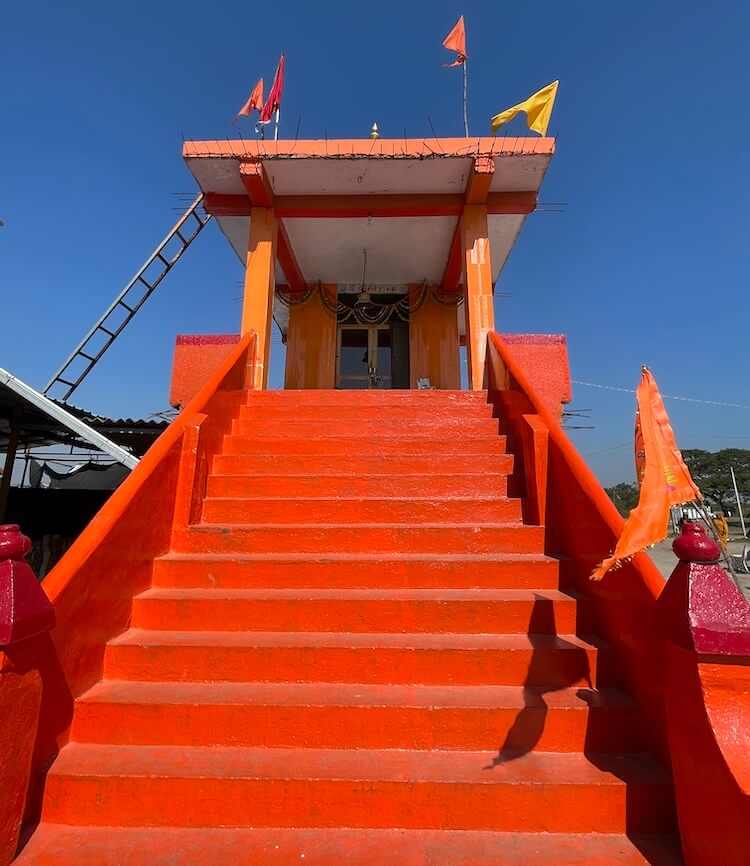 Margashirsha Shukla Panchami in 2008, he consecrated the temple of Hanuman here. There is a religious tradition that wherever there is a Hanuman temple, a Shani temple must also be established. The theological explanation suggests that Shani and Maruti share several spiritual parallels. Both embody the Rudransha (aspect of Shiva), their birth days are said to coincide and both share the same day of worship. Shani is the son of Surya (the Sun God), while Maruti is the beloved disciple of Surya; there is also a deep friendship between these two deities. A legend narrates that, once, the baleful gaze of Shani fell upon Hanuman and Shani mounted upon Hanuman’s head. To humble Shani’s pride, Hanuman began performing playful yet powerful simian feats, lifting great mountains and striking them upon Shani’s head. Troubled and overwhelmed, Shani begged Hanuman’s forgiveness. Hanuman agreed to release him on the condition that Shani would not cause suffering to his devotees. In gratitude, Shani offered Hanuman the things most dear to him : Saturday, oil, black gram and the leaves of the Rui (Calotropis) plant.
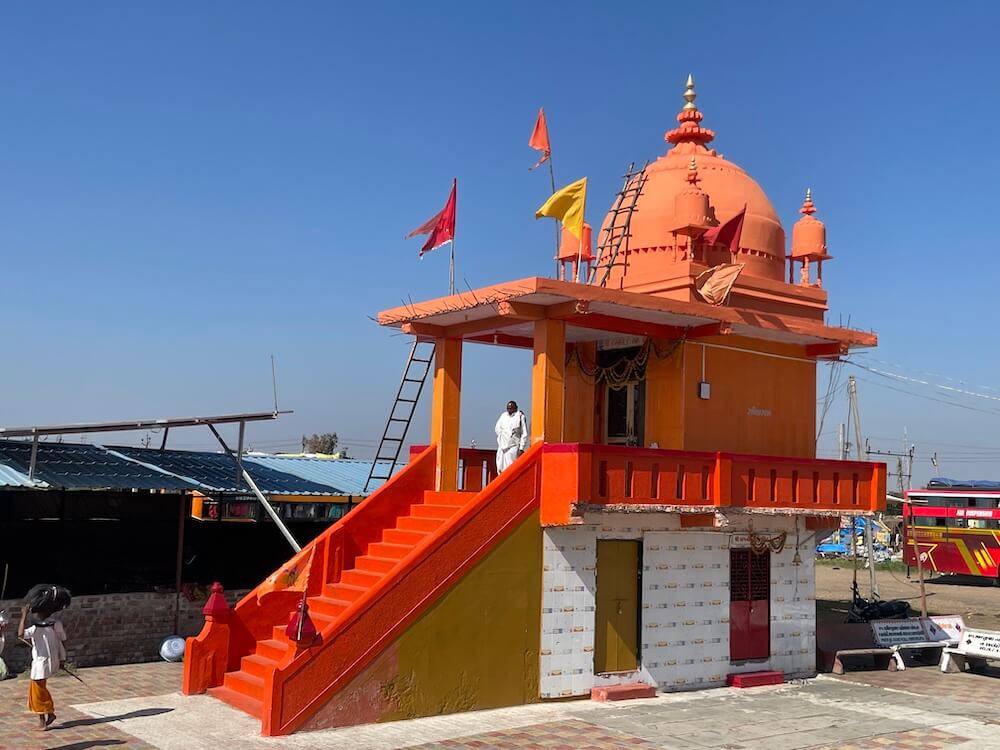
After establishing the Shani temple here, Mahant Ramanand Tyagi, with the support of villagers and devotees, also erected a Navagraha temple in 2018. 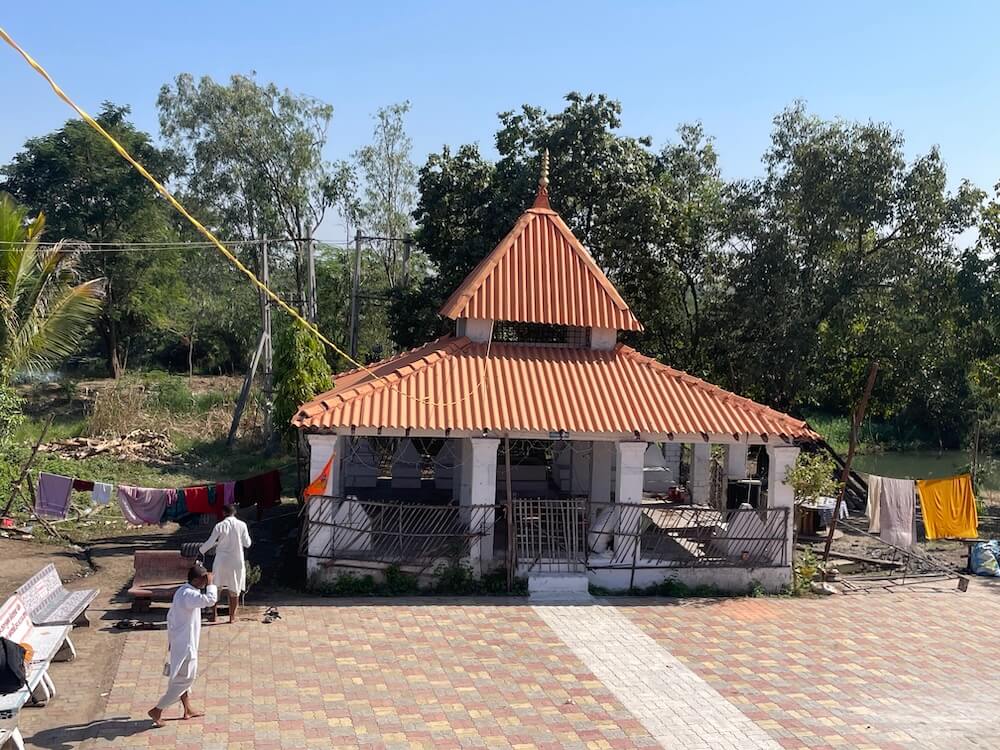 The Hanuman Tekdi precinct, situated along the road from Hansot to the Vimleshwar Mahadev temple, today boasts charming gardens and tranquil ponds. Within the grand, paved courtyard stands the elegant two-storeyed Hanuman temple. Fifteen steps lead the way into the sabhamandap (assembly hall), an open-style structure that leads to the garbhagriha (sanctum sanctorum). A pradakshina marg (circumambulatory path) surrounds the sanctum from within the hall. The sabhamandap features a flat roof, while the garbhagriha is crowned by a domed shikhara (spire), topped with a circular amalak (stone disk) and a kalash (sacred pinnacle). Four smaller bell-shaped spires grace the corners of the main spire. Inside the sanctum, a stone idol of Hanuman, anointed with shendur (vermillion), rests upon a marble pedestal.
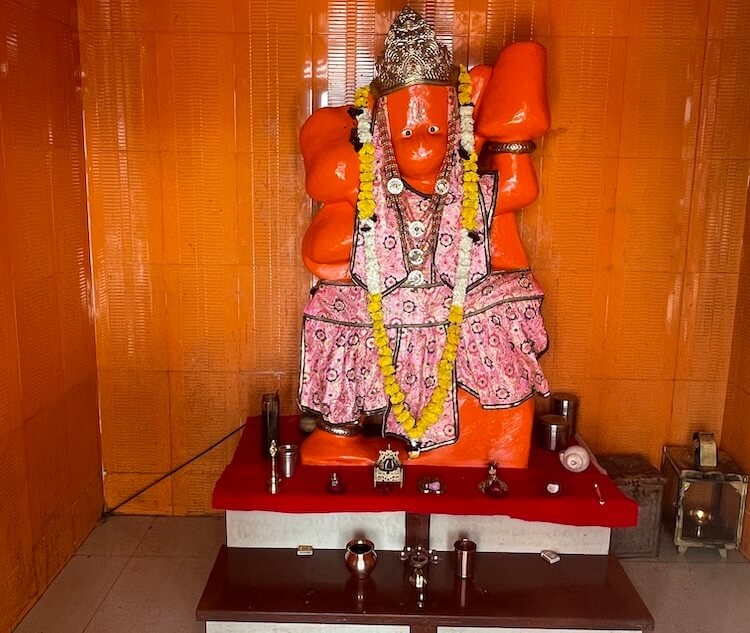
 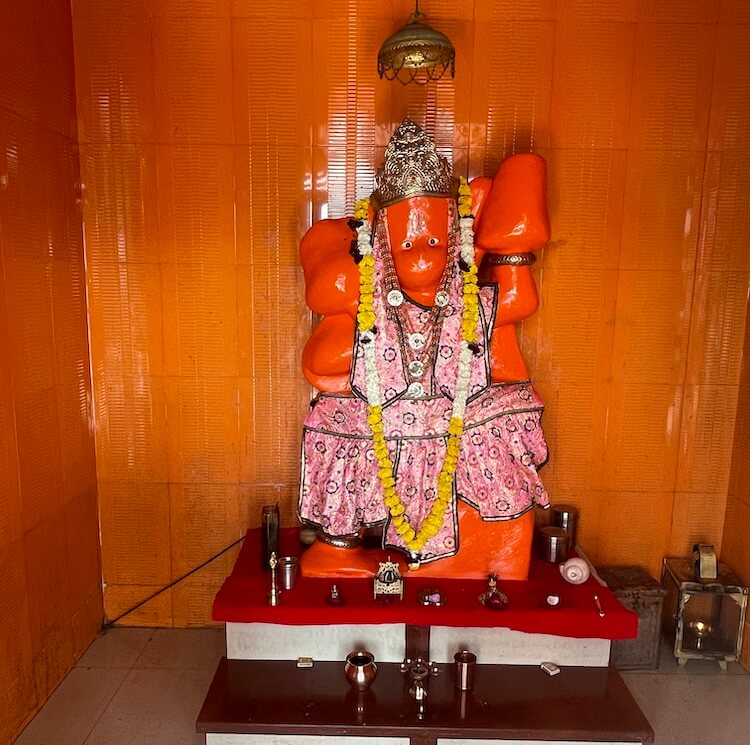 Adorned with fine garments and ornaments, the deity wears a magnificent crown, holding the Dronagiri mountain in one hand and a gada(mace) in the other. A samai (traditional oil lamp) burns perpetually beside the idol. On the ground floor of this structure lies the temple of Mata Anjani, where the goddess is depicted in a seated posture with the infant Hanuman cradled by her right side. With a benevolent smile, Mata Anjani’s right hand is raised in the ashirwad mudra (gesture of blessing). A beautiful idol of Bal Krishna (the infant Krishna) stands before her.
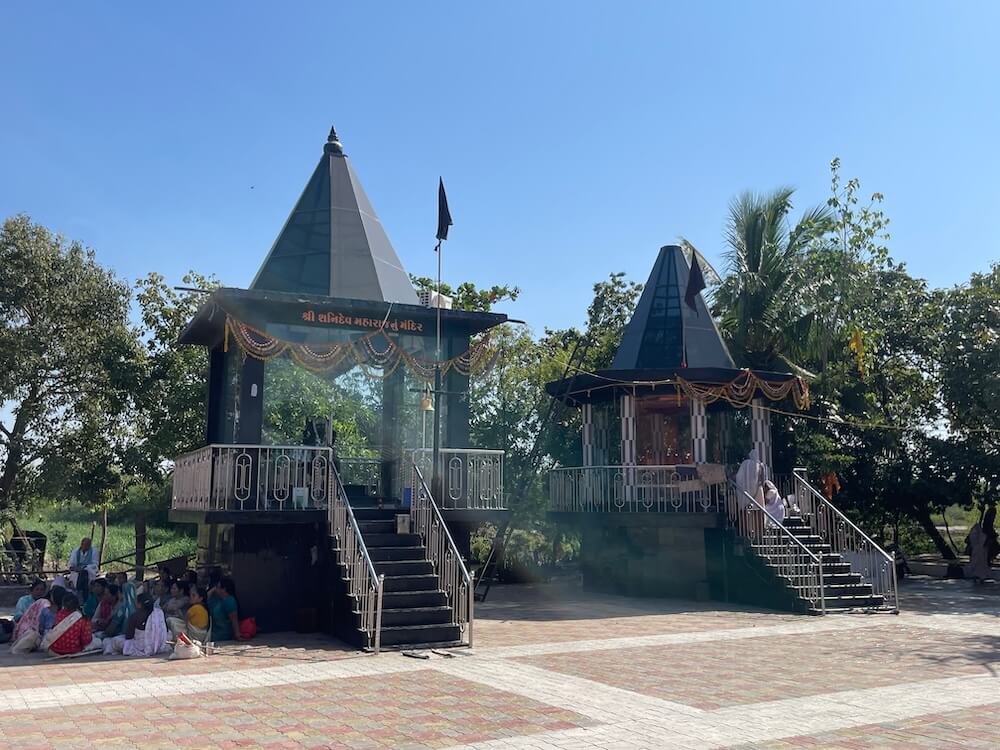
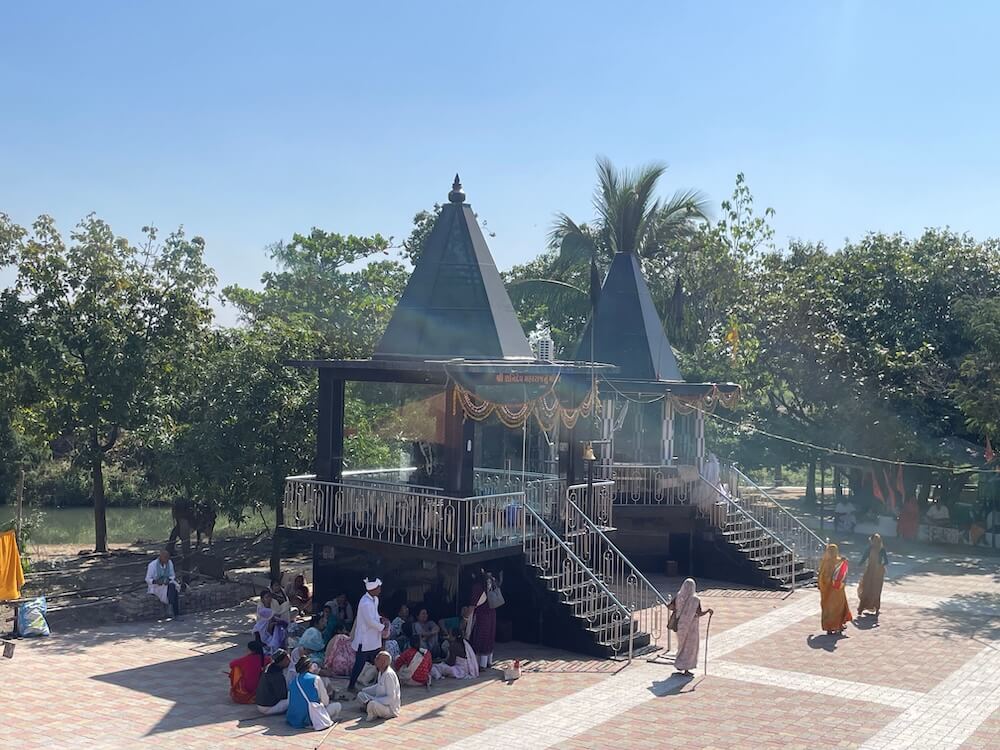
On the left side of the courtyard stand the two twin, two-storeyed shrines of Shani and the Navagraha. These compact temples resemble one another in appearance. One ascends eight steps to enter each, where an open pavilion enclosed on all four sides with glass panels welcomes visitors. Above them rise pyramid-shaped spires crowned with kalashas. In the Shani temple, the idol of Shani is enthroned upon a pedestal. In the Navagraha temple, nine separate pedestals hold the nine beautifully adorned idols of the celestial deities. 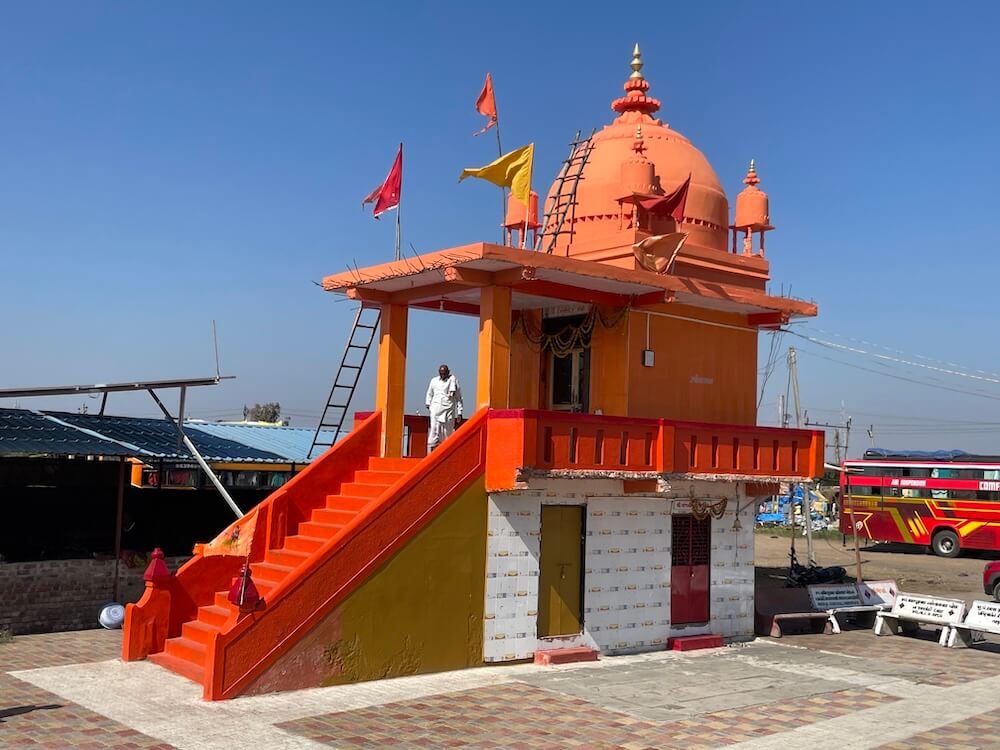 Near the Navagraha temple stands a tree whose trunk bears a natural formation resembling the trunk of Ganesha. This form has been anointed with vermillion, crowned above and beside it rests a Shivalinga.
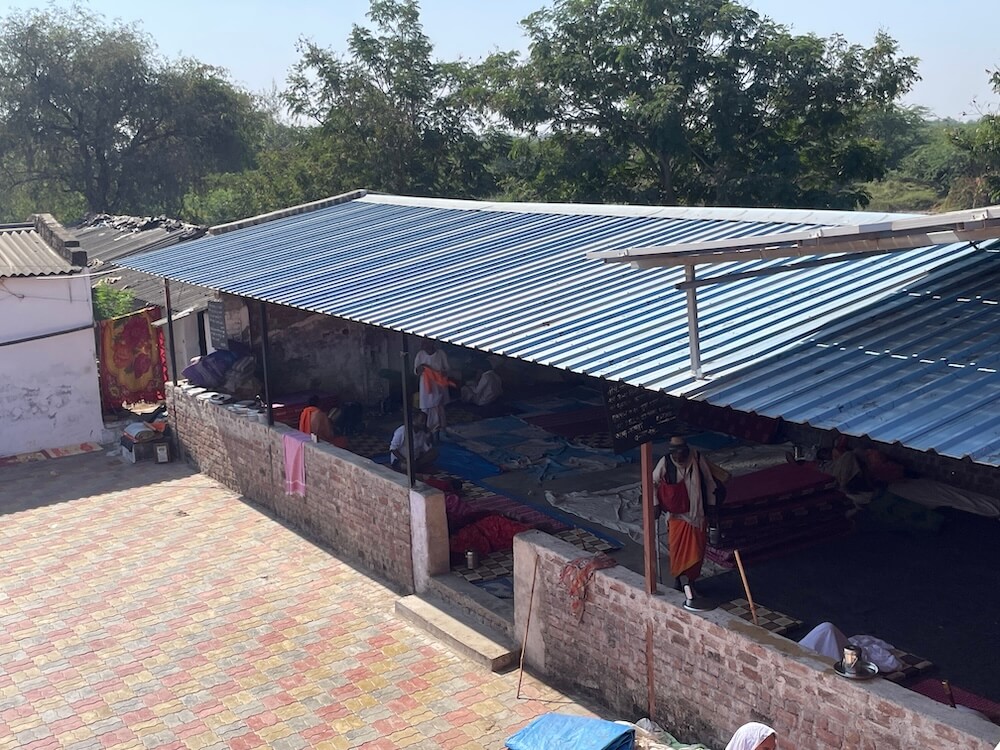
Within the temple precinct are situated Mahant Ramanand Tyagi’s kuti (hut) and the ashram building. Beneath one particular tree, he is often engaged in devoted austerities. To the left of the Hanuman temple stands a large hall constructed for Parikrama pilgrims to rest. Being the only ashram along the stretch between Hansot and Vimleshwar, every passing pilgrim inevitably halts here. Arrangements for their stay and meals are thoughtfully made. Pilgrims are traditionally served khichdi, kadhi and gur (jaggery). Even if an exhausted traveller arrives at midnight, none is allowed to sleep hungry. It is due to this heartfelt service that across the entire Narmada region, Mahant Ramanand Tyagi is affectionately known as ‘Khichdiwale Baba’.
On every Amavasya (new moon day), a Shani havan (sacred fire ritual) is performed here, accompanied by a bhandara (community feast) for devotees. On Mahashivaratri, Hanuman Jayanti and Ganga Dashahara, numerous religious rites and feasts are likewise organised. During Chaturmas, the pilgrims staying here engage in devotional bhajan sessions for three hours in the morning and evening. The month of Shravan witnesses many holy programmes within the ashram.