
वल्लियूरक्कावू श्रीभागवती मंदिर
वल्लीयोरक्कावू, मानंथवाडी, जि. वायनाड.
Valliyoorkkavu Sree Bhagavathy Temple
Valliyoorkkavu, Mananthavady, Dist. Wayanad.
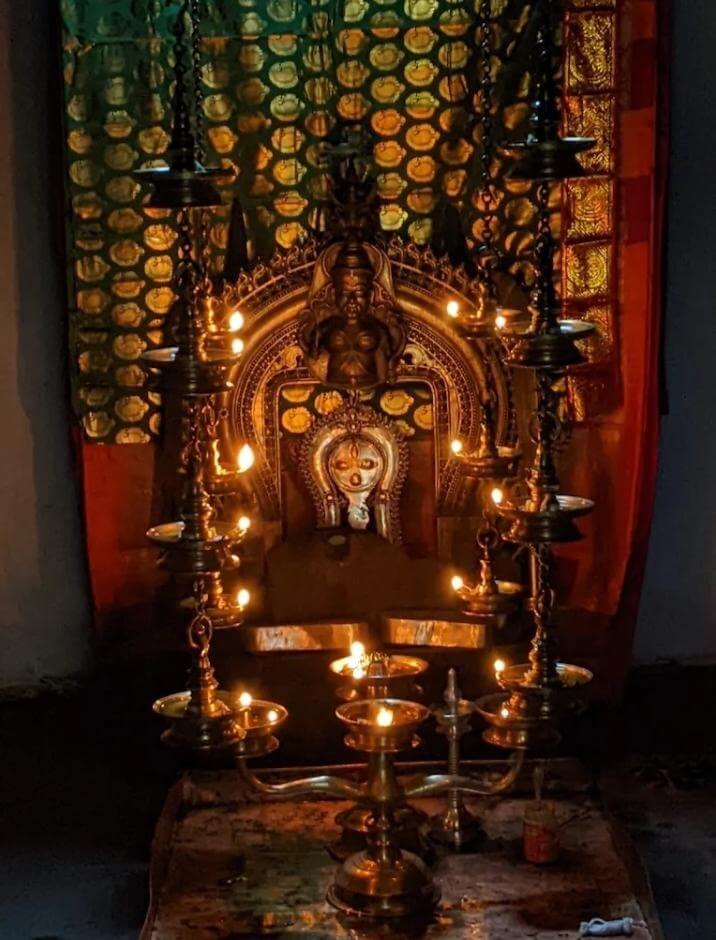 Valliyoorkkavu Sree Bhagavathy Temple, also known as Valliyoor Sree Bhagavathy Temple, is a famous and ancient temple located on the banks of the Kabini River near Mananthavady in Wayanad district, Kerala. According to Hindu and Shakta traditions, Sree Bhadrakali, regarded as Jagadeeswari and Adi Parashakti, is the main deity of the temple. Also known as Valliyoorkkavamma, the Goddess is worshipped in three forms: Vanadurga, Bhadrakali and Jaladurga. The temple is one of the major places of worship for the tribal communities of Wayanad and is also an important pilgrimage centre in the district.
Historical records such as the Malabar Gazetteer trace the temple’s ancient origins to the Dravidian tradition. Before Aryanisation, the site was a major place of worship for the tribal communities who were the early inhabitants of Wayanad. Historical records state that in the 14th century, during the rule of the Kottayam kings of the Pazhassi Raja lineage, the existing kavu was rebuilt as a temple in its present form. The Kottayam king also developed Valliyoorkkavu as one of four major guardian shrines placed in the four directions to protect the ancient Thirunelli Mahavishnu Temple.
Historical records indicate that the Valliyoorkkavu festival also had an economic aspect linked to the trade in bonded labour. 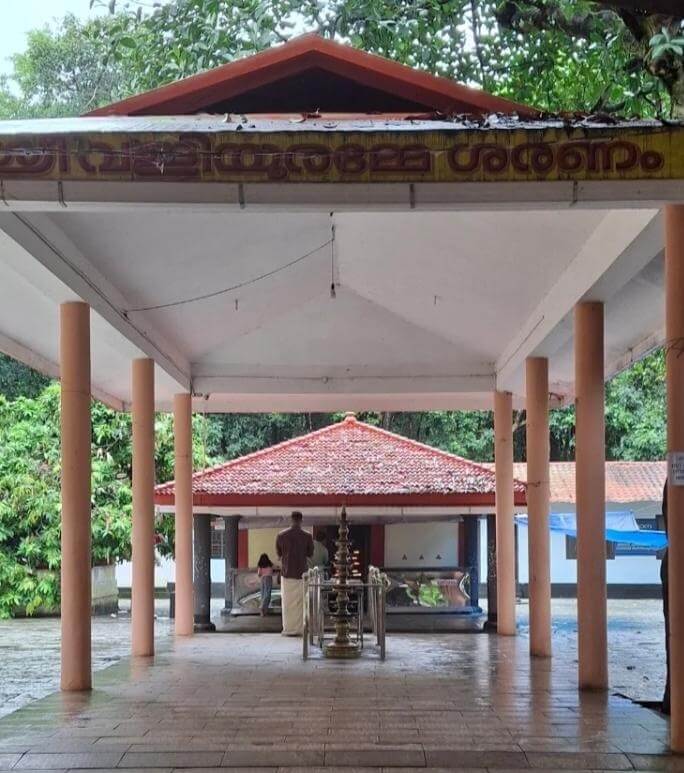 In earlier times, agreements between the local landlords and tribal communities such as the Paniya and Adiya were renewed at the Valliyoorkkavu festival ground. Under these agreements, the landlords gave the tribal families a small amount of money and paddy in return for their labour for the following year. The practice of making the payment in the presence of the Goddess was used to ensure that the workers would honour the agreement. Works by researchers such as K. Panur, including Keralathile Africa and Aziz Tharuvana also record Valliyoorkkavu as a major centre associated with the trade in bonded labour. The Bonded Labour System (Abolition) Act, 1976, which came into force on 25 February 1976, legally abolished the bonded labour system in India, bringing such contractual practices to an end. Today, the Valliyoorkkavu festival serves as a gathering for the tribal communities of Wayanad to celebrate their cultural traditions and express their heritage and rights. The participation of tribal elders in the flag-hoisting ceremony on the seventh day of the festival is also part of this tradition.
The Kottayam kings handed over the temple’s urayma and administrative rights to prominent Brahmin maths in the region. 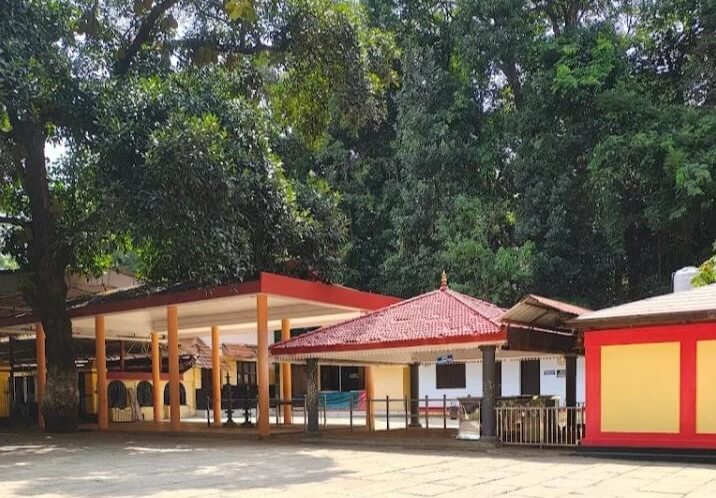 Later, the main administration of the temple was under Padutholmana, a prominent Namboothiri illam. Major decisions and the conduct of festivals were managed by them. The temple administration at that time was linked to the janmi system. Today, the temple is fully administered by a devotees’ trust. A Temple Administration Committee, elected annually by the general meeting, oversees the temple’s daily affairs and major festivals.
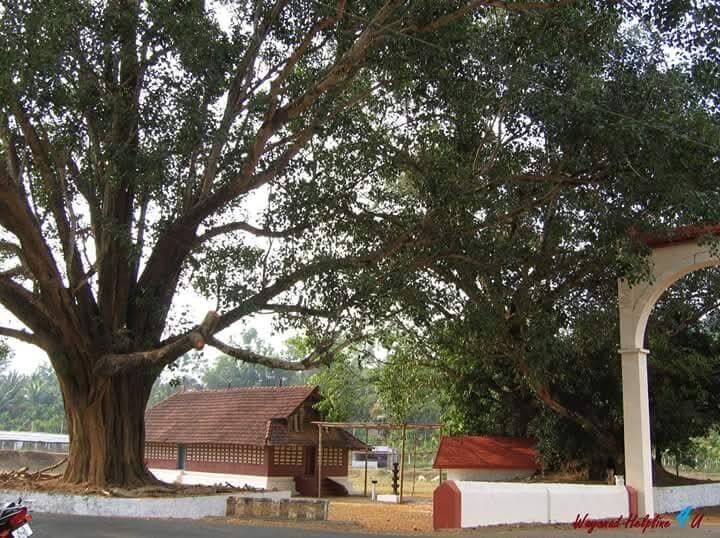
According to the Aithihyam, Vadakkola Nambiar, the chief Velichappadu of Kodungallur Bhagavathy Temple in earlier times, was travelling through Wayanad carrying the Goddess’s sacred sword and anklet.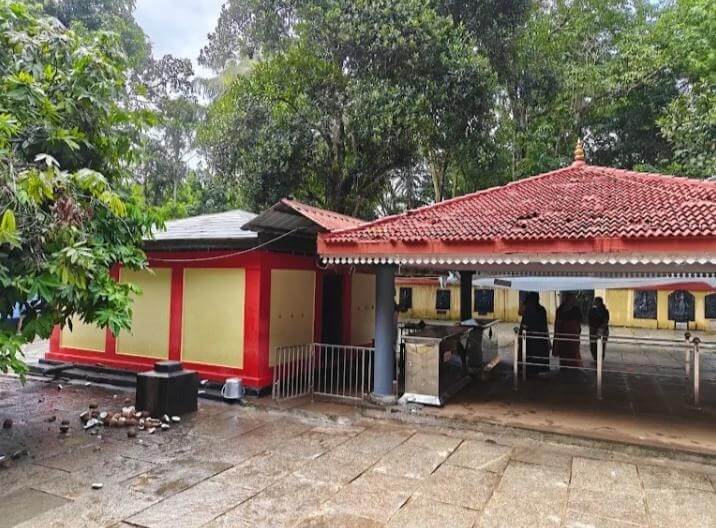 While resting on the banks of the Kabini River near the present Valliyoorkkavu, he fell asleep due to exhaustion. When he woke up, he found that the sword and anklet were missing. Although he searched the area, he could not find them. A member of the Paniya community then saw the sword and anklet hanging from the vines of a large banyan tree on a nearby hill and informed Nambiar. However, they could not be removed from the vines. Nambiar and the local people then prayed, after which the Goddess is said to have appeared and expressed her wish to reside there in three forms: Vanadurga, Bhadrakali and Jaladurga. The place is said to have been named Valliyoorkkavu because the presence of the Goddess was found in the vines (valli) of the banyan tree and the site was a kavu. The Aithihyam further states that the Kottayam king of that time ordered the construction of a temple at the site.
 Devotees also believe that the main idol is a natural, self-manifested stone and that a large pit beneath it marks the place where the Goddess emerged from the earth.
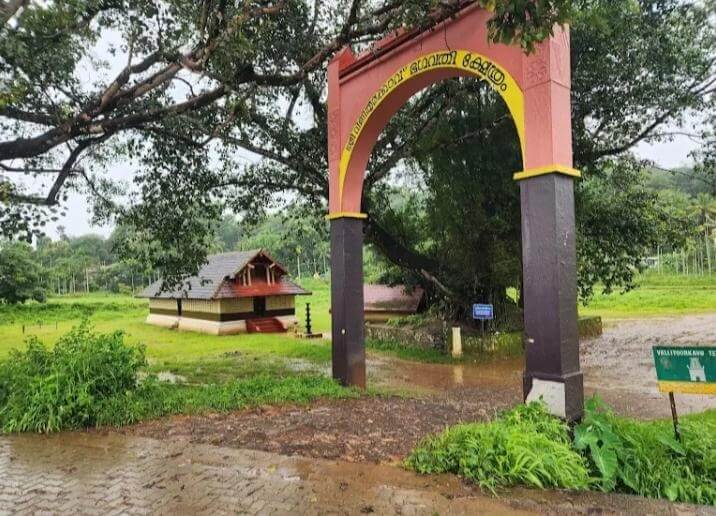
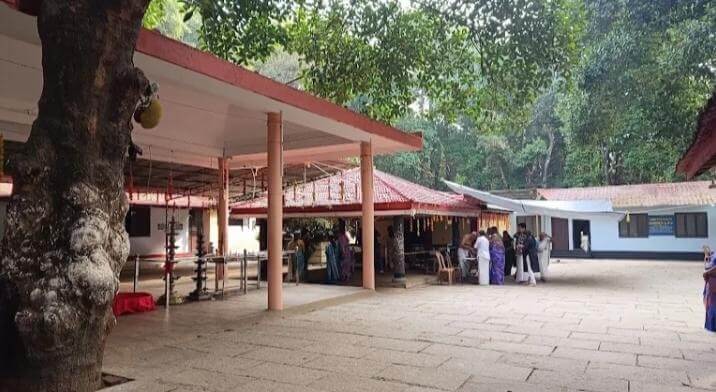
On arriving at the temple, the first feature noticed is the large open festival ground, with the Kabini River flowing nearby. The temple complex stands on slightly raised ground from the road and has a simple Kerala-style tiled entrance gate or padippura. Buildings such as the pathayappura, used for storing paddy and other goods and the oottupura are located outside the temple complex. Their design resembles that of traditional Kerala nalukettu houses. The temple complex is divided into two parts, Mele Kavu and Keezhe Kavu, which are about 100 metres apart.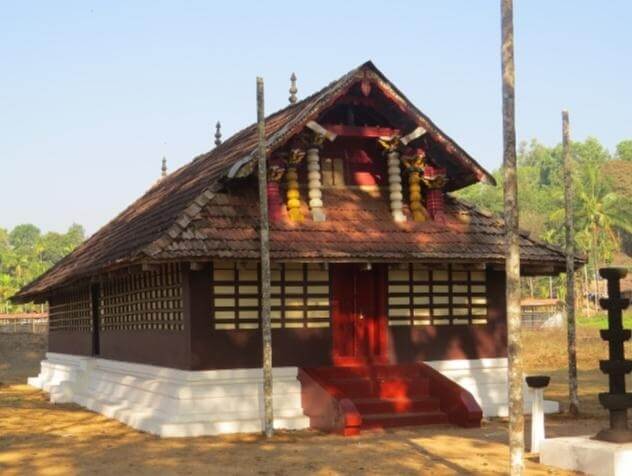 The main temple at Mele Kavu has a large pillared nadappanthal and a large bali stone in front of the Sreekovil. Traditional lamp towers are also placed along the walls of the nalambalam. Keezhe Kavu, close to the Kabini River, has a termite mound regarded in the Aithihyam as the original Moolasthanam of the Goddess. This part retains the natural character of the kavu.
The Sreekovil at Valliyoorkkavu is square in shape and built in the traditional Kerala architectural style. It has walls set on a granite base and a simple tiled roof. The structure retains the natural character of the kavu. A large nadappanthal stands in front of the Sreekovil, with a mandapam known as Thottampatt Kottil attached to it for the traditional singing of Thottampattu. The main deity is a natural, self-manifested stone in the form of a Shivalinga. 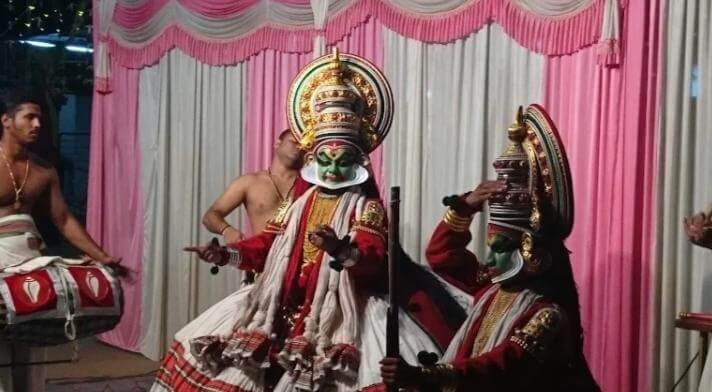 Although the idol is self-manifested, devotees believe that the concept of the deity is that of Kodungallur Bhagavathy invoked at Valliyoorkkavu.
The sub-deities at Valliyoorkkavu include Lord Shiva, Ganesha, Sastha and Naga deities. The shrine of Lord Shiva is located near the main Sreekovil, where he is worshipped in the belief that his presence calms the fierce form of the Goddess. Inside the nalambalam, Ganesha is enshrined on the southern side of the main Sreekovil at the Kannimoola, along with the concept of Dakshinamurthy. A separate shrine for Sastha, also known as Ayyappa, is located outside the nalambalam on the north-western side. 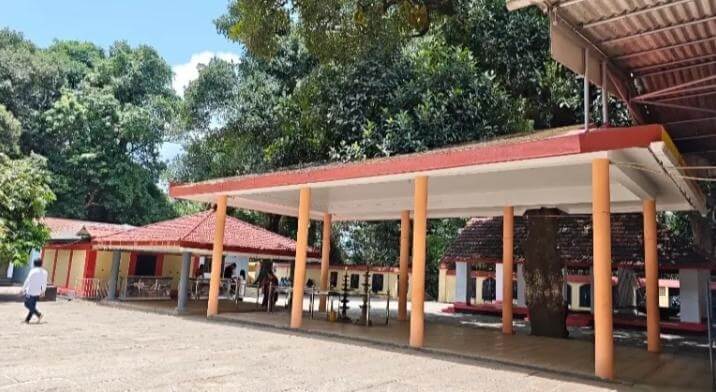 Tharas dedicated to Naga-raja and Naga-yakshi are found among the kavu areas of the temple, particularly along the paths leading to Keezhe Kavu.
The main festival at Valliyoorkkavu is the annual 14-day festival held in the Malayalam month of Meenam (March–April). It usually begins on 14 or 15 March and ends around 28 March. On the first day, the chief priest brings the sacred sword of the Goddess from Palliyara Bhagavathy Temple at Pandikkadavu near Mananthavady to Valliyoorkkavu, marking the beginning of the festival. On the seventh day, the tribal elders of Wayanad conduct the flag-hoisting ceremony. Every night, Kalamezhuthum Pattum is performed, in which an image of the Goddess is drawn using natural colours, along with traditional tribal dances accompanied by the thudi. During the final days, Rudhirakolam, representing the battle between Bhadrakali and Darikasura, is performed and the festival concludes with an aarattu in the Kabini River. Special poojas are also held during Navaratri in the Malayalam month of Kanni (September–October), including Vidyarambham for children. During the 41-day Mandalam period in Vrischikam (November–December), special lamps and poojas are conducted, along with special worship for Ayyappa. On the Pooram day in Meenam, an elephant procession and traditional melams are also held.
The main offerings at the temple include Thottampattu, payasam, the offering of rice and money, Chuttuvilakku, Niramala and Meenootu. Thottampattu, in which the praises and deeds of the Goddess are sung, is one of the distinctive offerings at Valliyoorkkavu and is traditionally performed for relief from mental difficulties and family prosperity. Kadumadhura Payasam and Kootupayasam are also offered.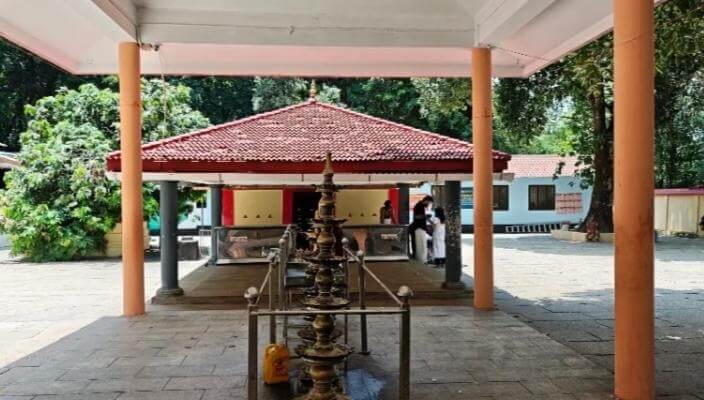 Rice and coins are traditionally offered to the Goddess as Vallippanam, recalling an old practice associated with the tribal communities. Chuttuvilakku, in which lamps are lit around the temple and Niramala, in which the Sreekovil is decorated with flowers, are performed on special days. Meenootu, the feeding of fish in the Kabini River, is another distinctive offering, as devotees regard the fish in the river as subjects of the Goddess. During the annual festival, devotees can also book Kalamezhuthum Pattum as a special offering.
The general darshan timings at the temple are usually from 06:00 AM to 12:00 PM in the morning and from 05:30 PM to 08:00 PM in the evening. Ushapooja is performed after the temple opens in the morning, followed by Uchapooja with offerings shortly before the morning session ends. After the temple reopens in the evening, Athazhapooja is performed before the temple closes at 08:00 PM. Deeparadhana is held around sunset, usually between 06:15 PM and 06:45 PM. During the 14-day annual Aarattu festival, the pooja timings and other rituals may change and poojas and Thottampattu may continue until midnight on festival days.
Key highlight :-
- Located 5 km from Mananthavady, 24 km from Kalpetta and 31 km from Sulthan Bathery.
- 77 km from Thalassery railway station.
- KSRTC and local bus facilities are available to the temple.
- Private vehicles can be parked in the temple’s parking area.
- Accommodation and food facilities are available in the nearby towns.
- Contact number +91 4935240084.
वल्लियूरक्कवु श्री भगवती मंदिर
वल्लियूरक्कावु, मनन्थावडी, जिला। वायनाड.
मंदिरे
Temples
मंदिर
મંદિરો
கோவில்கள்
దేవాలయాలు
ക്ഷേത്രങ്ങൾ
ದೇವಾಲಯಗಳು
মন্দিরসমূহ
ਮੰਦਿਰ
-
थ्रिशलेरी श्री महादेवाचे मंदिर थ्रिशलेरी, मानंतवाडी, जि. वायनाड.
अधिक माहितीThrishilery Sree Mahadeva Temple Thrishilery, Mananthavady, Dist. Wayanad.
View Detailsत्रिशिलरी श्री महादेव मंदिर थ्रिशिलेरी, मनन्थावडी, जिला। वायनाड.
विवरण देखेंThrishilery Sree Mahadeva Temple Thrishilery, Mananthavady, Dist. Wayanad.
વિગત જુઓThrishilery Sree Mahadeva Temple Thrishilery, Mananthavady, Dist. Wayanad.
விவரங்களைக் காண்கThrishilery Sree Mahadeva Temple Thrishilery, Mananthavady, Dist. Wayanad.
వివరాలను చూడండిThrishilery Sree Mahadeva Temple Thrishilery, Mananthavady, Dist. Wayanad.
വിശദാംശങ്ങൾ കാണുകThrishilery Sree Mahadeva Temple Thrishilery, Mananthavady, Dist. Wayanad.
ವಿವರಗಳನ್ನು ವೀಕ್ಷಿಸಿThrishilery Sree Mahadeva Temple Thrishilery, Mananthavady, Dist. Wayanad.
বিস্তারিত দেখুনThrishilery Sree Mahadeva Temple Thrishilery, Mananthavady, Dist. Wayanad.
ਵੇਰਵੇ ਦੇਖੋ -
पोंकुळी श्री राम मंदिर पोंकुळी, मुथांगा, जि. वायनाड.
अधिक माहितीPonkuzhi Sree Rama Temple Ponkuzhi, Muthanga, Dist. Wayanad.
View Detailsपोंकुझी श्री राम मंदिर पोंकुझी, मुथांगा, जिला। वायनाड.
विवरण देखेंPonkuzhi Sree Rama Temple Ponkuzhi, Muthanga, Dist. Wayanad.
વિગત જુઓPonkuzhi Sree Rama Temple Ponkuzhi, Muthanga, Dist. Wayanad.
விவரங்களைக் காண்கPonkuzhi Sree Rama Temple Ponkuzhi, Muthanga, Dist. Wayanad.
వివరాలను చూడండిPonkuzhi Sree Rama Temple Ponkuzhi, Muthanga, Dist. Wayanad.
വിശദാംശങ്ങൾ കാണുകPonkuzhi Sree Rama Temple Ponkuzhi, Muthanga, Dist. Wayanad.
ವಿವರಗಳನ್ನು ವೀಕ್ಷಿಸಿPonkuzhi Sree Rama Temple Ponkuzhi, Muthanga, Dist. Wayanad.
বিস্তারিত দেখুনPonkuzhi Sree Rama Temple Ponkuzhi, Muthanga, Dist. Wayanad.
ਵੇਰਵੇ ਦੇਖੋ