
मधुर श्री मदननाथेश्वर सिद्धिविनायक मंदिर
मधुर, जि. कासारगोड.
Madhur Shree Madanantheshwara Siddivinayaka Temple
Madhur, Dist. Kasaragod.
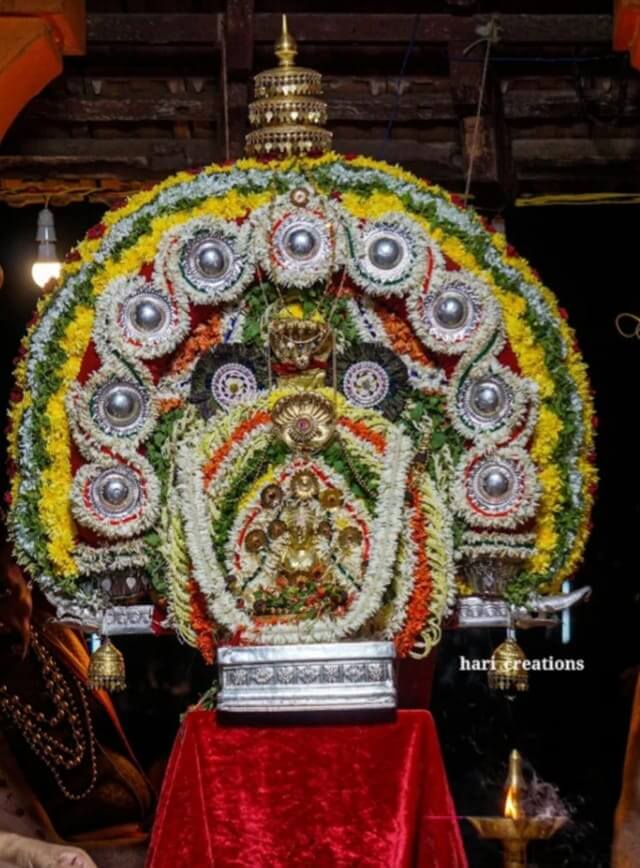 Madhur Sree Madanantheswara Siddhivinayaka Temple, situated on the banks of the Madhuvahini River in Madhur village of Kasaragod district, is one of the most famous pilgrimage centres in North Kerala. The main deity of the temple is Lord Madanantheswara, a fierce form of Lord Shiva associated with the burning of Kamadeva. However, it is the glory of the other deity, Lord Siddhivinayaka (Lord Ganesha), that has made this temple well known far beyond the region. One of the four principal temples of Mayipadi Desam, traditionally known as Kumbla Seema, this ancient temple is noted for its rich heritage, sacred legends and distinctive architecture. Throughout the year, thousands of devotees visit the temple to seek the blessings of Lord Madanantheswara and Lord Siddhivinayaka.
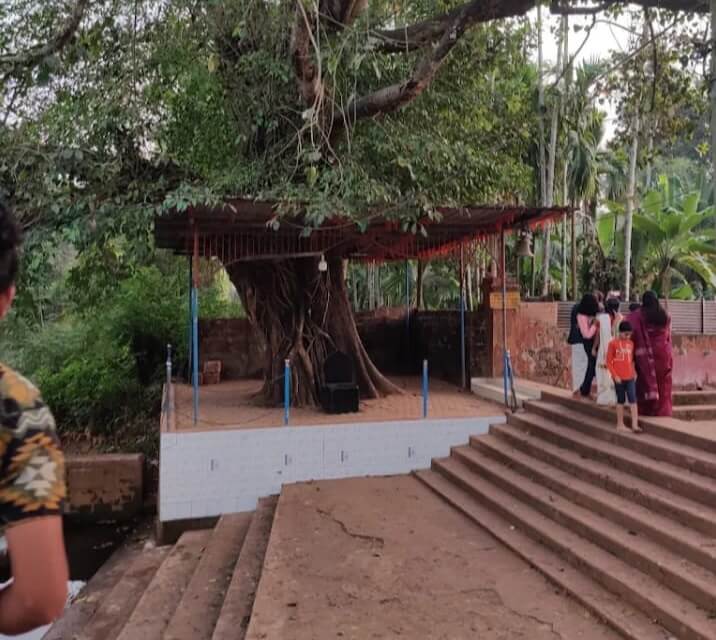
According to historical records, Madhur Sree Madanantheswara Siddhivinayaka Temple has a history of more than 1,000 years and is believed to have been built during the 9th or 10th century under the rule of the Mayipadi rulers of Kumbla. It was originally a Shiva temple and served as one of the principal family deity temples of the rulers of the Kumbla kingdom, which was part of ancient Tulu Nadu. Over time, the fame of the other deity, Lord Siddhivinayaka, spread widely and Lord Ganesha also came to hold a special place in the temple. During the Malabar campaign in the 18th century, Tipu Sultan came to destroy the temple. 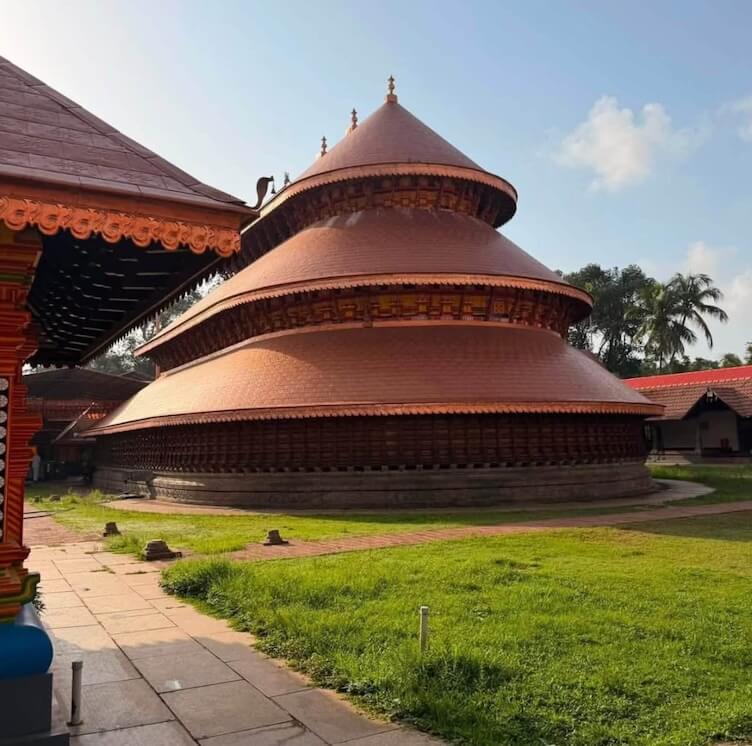 However, after drinking the sacred water from the temple well, he changed his mind and left without damaging it. Before leaving, he struck the wall of the temple well with his sword to satisfy his soldiers. The historic sword mark can still be seen on the wall of the well today.
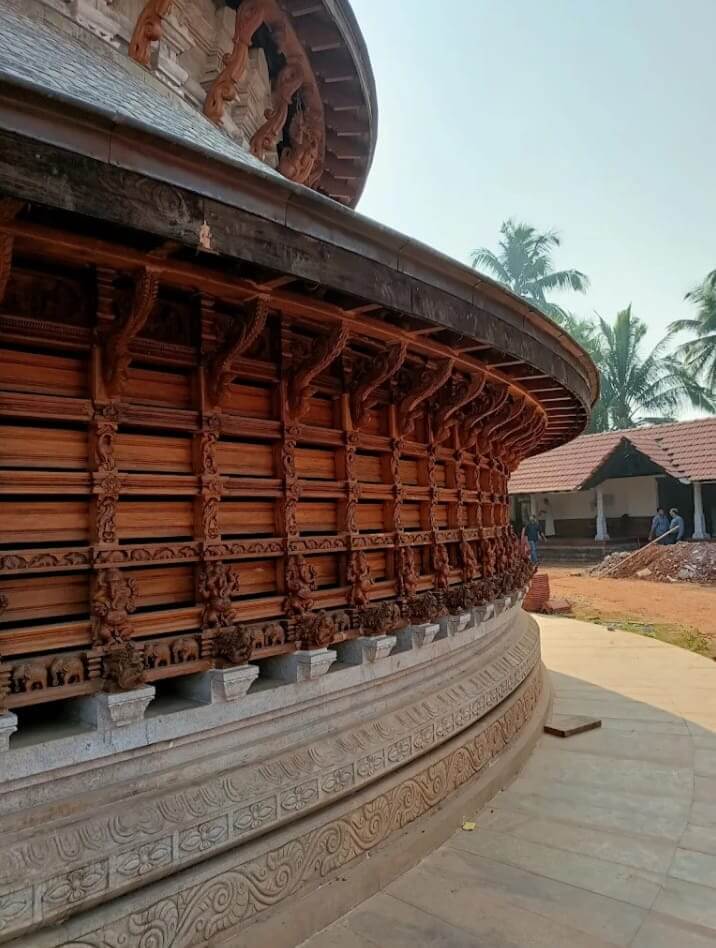
Originally built in the 10th century, the temple was extensively renovated during the 15th century and took the form of the present three-tiered sanctum in the shape of a Gajaprishta (the back of an elephant). This structure, which reflects a blend of Hindu and Jain architectural styles, is one of the temple’s most distinctive features. As no major renovations were carried out for several centuries, the wooden pillars and roof gradually fell into a state of disrepair. The temple was later comprehensively restored at a cost of around ₹25 to ₹30 crore under a committee led by the late Sri Sri Keshavananda Bharati Swamiji, the former head of Edneer Mutt, with the support of the Government of Kerala. Once under the control of the Kumbla rulers, the temple is now directly administered by the Malabar Devaswom Board under the Government of Kerala. 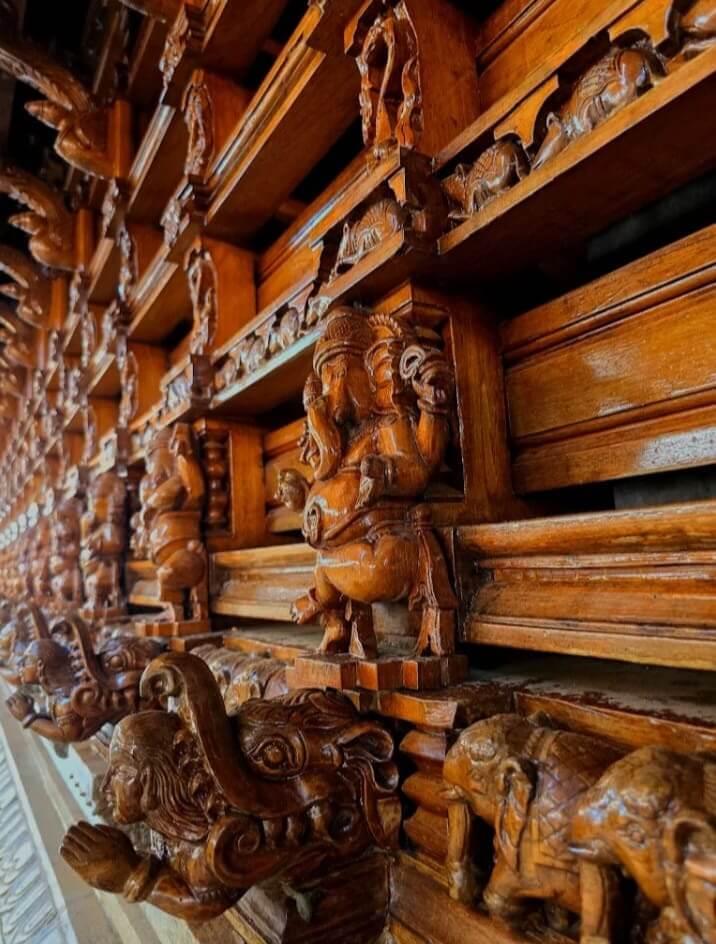 Its day-to-day administration is managed by an Executive Officer and a Board of Trustees appointed by the Devaswom Board.
According to the main legend associated with the origin of the temple, this area was once covered by a dense forest. A devotee named Madaru, who belonged to the Tulu Moger community, was collecting firewood when he noticed an unusual light emerging from a rocky crevice. On reaching the spot, he discovered a self-manifested (Swayambhu) Shiva Linga. He began offering worship there with great devotion and after learning about the discovery, the local rulers built a temple at the site. The legend also says that the place came to be known as “Madhura” after Madaru and over time the name gradually evolved into “Madhur”.
Another well-known legend associated with the temple explains the origin of the Siddhivinayaka idol. It is said that the young son of the temple’s chief priest once drew an image of Lord Ganesha with a piece of charcoal on the southern wall of the sanctum. When the temple was opened the next day, the drawing had transformed into an idol projecting out from the wall, astonishing the devotees. Over time, the idol is said to have continued growing in size. When it was believed to have almost reached the roof of the sanctum, the devotees prayed to Lord Ganesha, 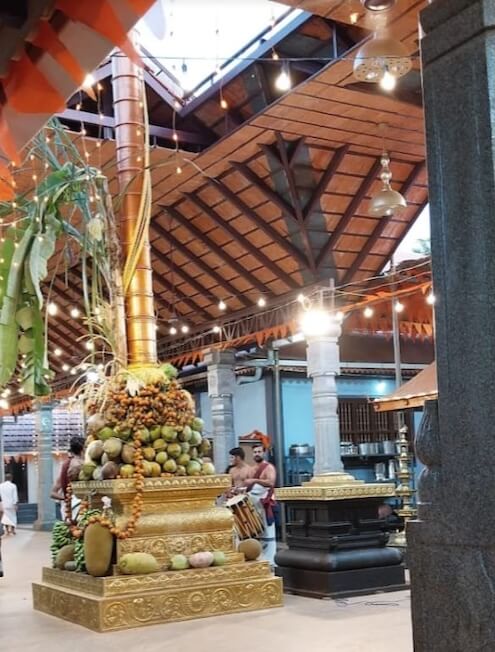 after which its upward growth stopped and it began to grow in width instead. According to the legend, the idol continues to grow very slowly in width even today.
There is also a legend about the origin of the name of the Madhuvahini River, which flows beside the temple. According to the legend, Kamadeva, who had been reduced to ashes by the curse of Goddess Parvati, was restored to life through the blessings of Lord Madanantheswara of this temple. It is said that the gods showered amrita (divine nectar) from the heavens to mark the occasion and because the river is believed to have carried this sacred nectar, it came to be known as “Madhuvahini”, meaning “the river that carries honey or nectar”.
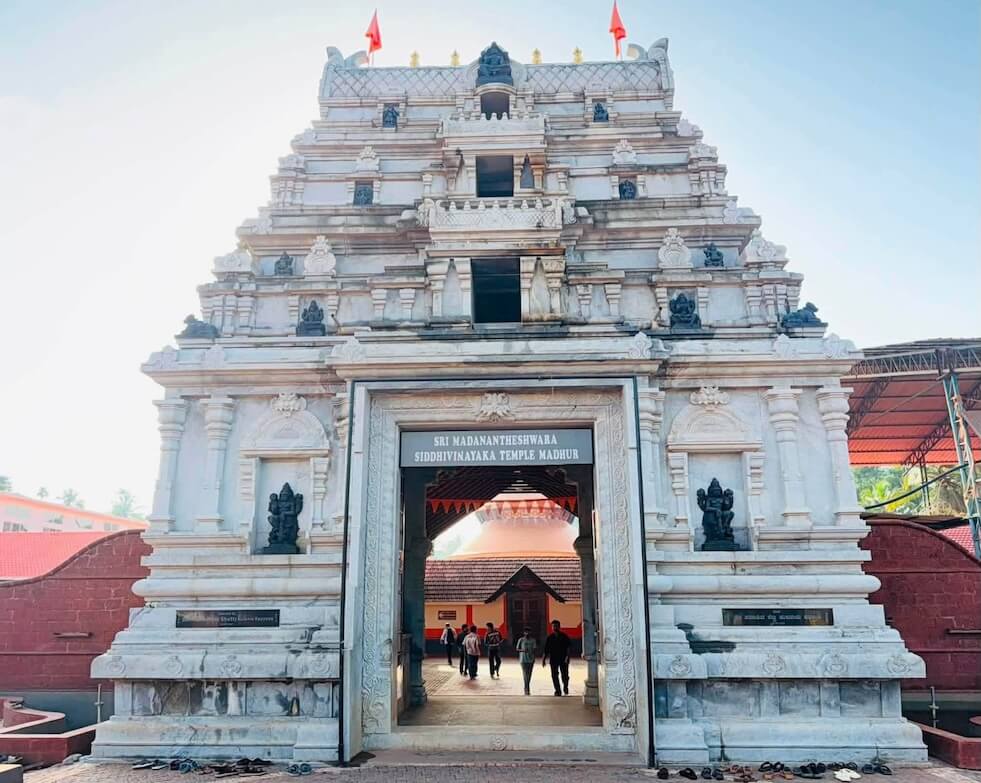
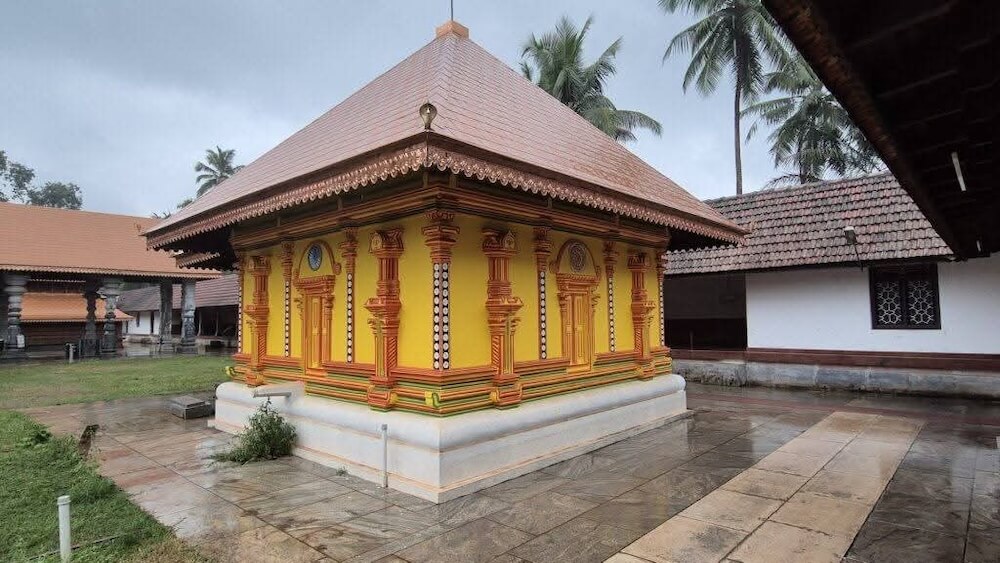
Madhur Sree Madanantheswara Siddhivinayaka Temple is built in a blend of traditional Kerala architecture and the Hindu-Jain architectural styles of Tulu Nadu. The first things that catch the eye are the Madhuvahini River flowing in front of the temple and the temple complex set amidst lush green paddy fields and coconut groves. The large eastern entrance tower, the tall copper-clad flagstaff and the impressive outer walls and roof of the Chuttambalam are clearly visible from outside. Inside the Chuttambalam, there is a spacious granite-paved courtyard lined with rows of traditional oil lamps. 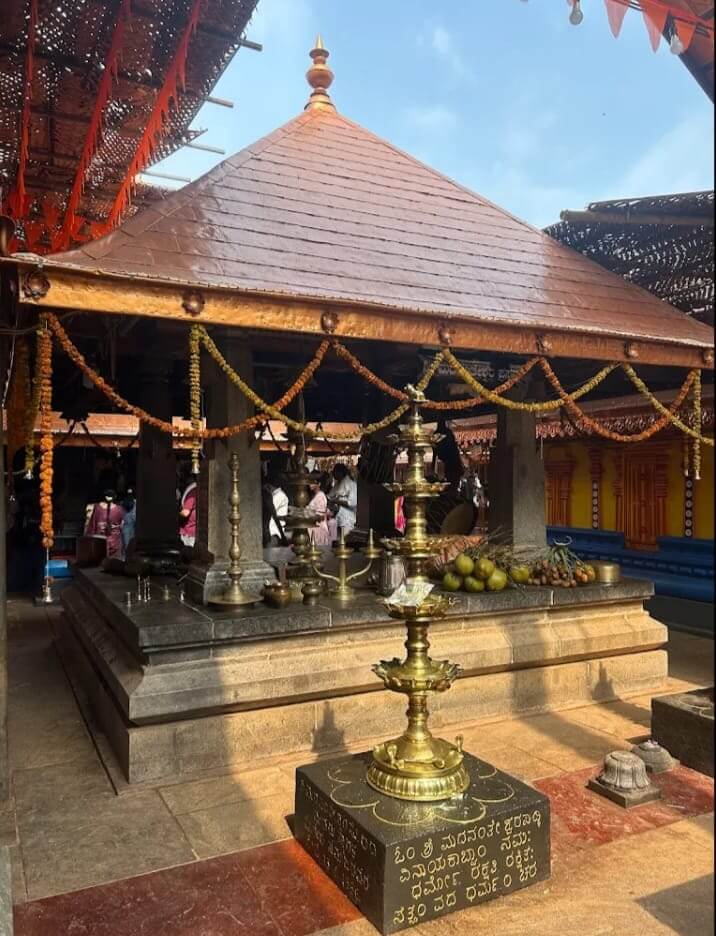 The Namaskara Mandapam in front of the sanctum is one of the temple’s main architectural highlights. Its wooden roof and pillars are beautifully carved with scenes from the Ramayana and the Mahabharata. At the centre of the hall are finely carved images of the Ashta Dikpalakas (Guardians of the Eight Directions) and Lord Brahma.
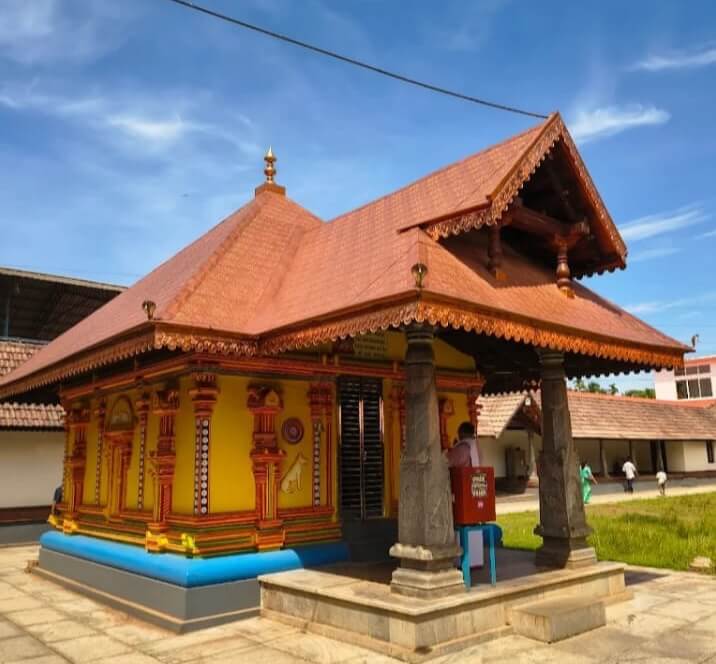
On entering the Chuttambalam, the first shrine to come into view is the main sanctum of Lord Madanantheswara, a Hamsa-form of Lord Shiva, facing west. On the southern wall of the sanctum is the world-famous idol of Lord Siddhivinayaka, believed to have manifested on its own (Swayambhu), facing south. As you continue the clockwise circumambulation (Pradakshina) around the sanctum, you will come across the shrines of Kashi Viswanatha, Lord Ayyappa (Shasta), Goddess Durga and Lord Subrahmanya. Along the Pradakshina path, you can also see the historic temple well, where the sword mark of Tipu Sultan has been preserved on its wall. The walls of the sanctum and the Chuttambalam are adorned with murals depicting stories from the Puranas, along with beautiful stucco sculptures made of lime and clay.
The annual festival, popularly known as Madhur Bedi, is the biggest festival celebrated at Madhur Sree Madanantheswara Siddhivinayaka Temple. 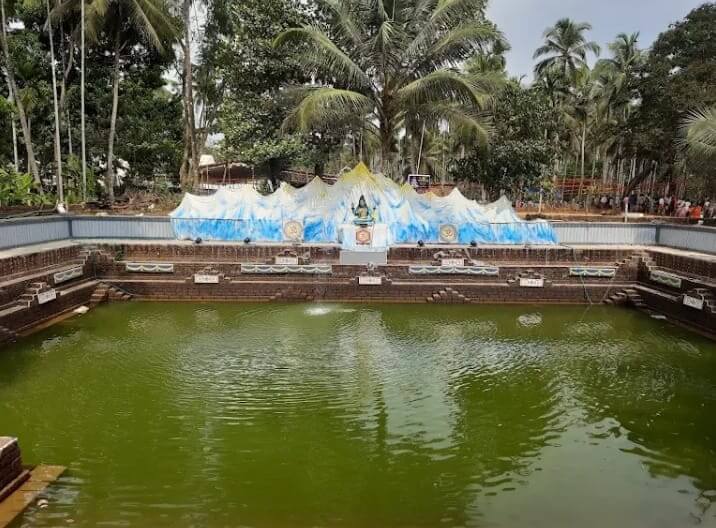 Held every year during the Malayalam month of Meenam, usually in March or April, the festival lasts for five to seven days and begins with the ceremonial flag hoisting (Dwajarohanam). The main rituals include Sahasra Kumbhabhishekam, Maha Pooja, Deepotsavam and Utsava Bali. One of the major highlights is the Thidambu Ezhunnallathu procession to the original shrine of Uliyathadukka Devan on the fourth day of the festival. Traditional performances such as Karnataka’s famous Yakshagana, various folk art forms, Panchavadyam and Thayambaka are also presented during the celebrations. The festival concludes with the ceremonial Avabhritha Snanam (holy bath) in the temple pond, followed by the Battalu Kanikka ritual.
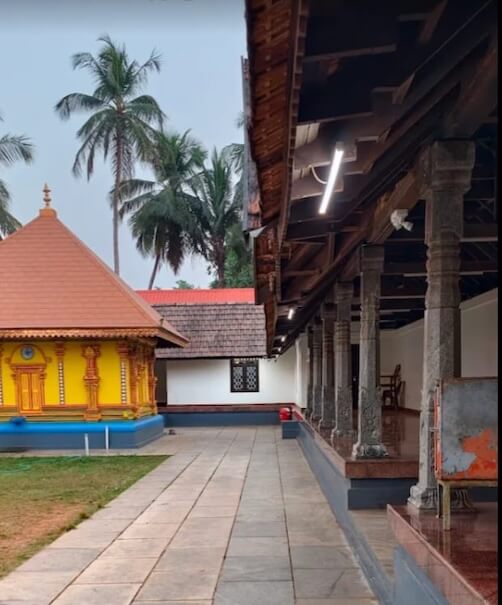 Vinayaka Chaturthi, observed during the Malayalam month of Chingam (August/September), is the most important festival for Lord Ganesha devotees at the temple. On this day, special Ganapathi Homam and other rituals are performed and thousands of devotees visit the temple to seek the blessings of Lord Siddhivinayaka. Vishu, celebrated in the month of Medam (April), is another important occasion. Devotees gather in large numbers to witness the early morning Vishukkani, followed by special poojas and Deepotsavam. As the main deity is Lord Shiva, Maha Shivaratri, observed during the month of Kumbham (February/March), is also celebrated with great devotion. Special Abhishekams and Yama Poojas are conducted throughout the night. In addition, special poojas and Appam offerings are made to Lord Siddhivinayaka on every monthly Sankashti Chaturthi.
One of the most famous and rare rituals of the temple is Moodappa Seva. During this unique ceremony, the idol of Lord Ganesha is completely covered with Appam prepared using large quantities of rice, jaggery, ghee and other ingredients. As the ritual involves considerable expense and requires strict religious observances, it is not performed every year. Instead, it is usually conducted only once in several years, or sometimes even after a few decades. 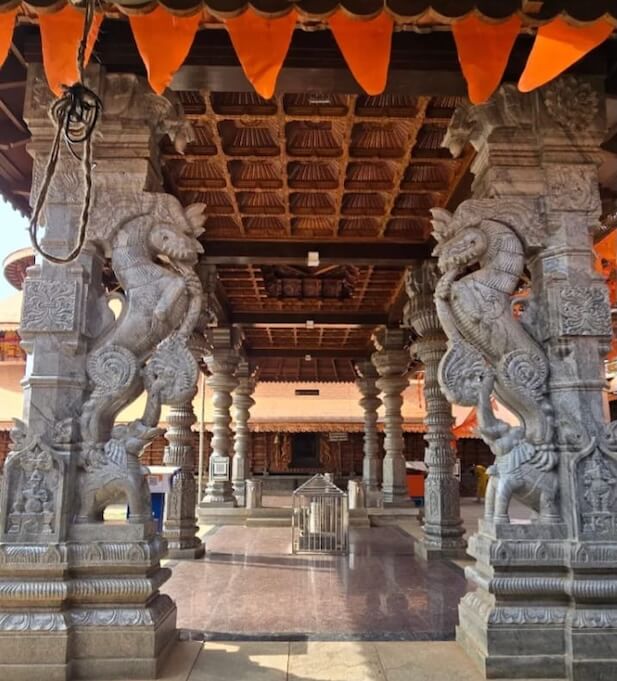 The ceremony attracts hundreds of thousands of devotees from different parts of India. After a gap of 33 years, Moodappa Seva was held again at the temple in April 2025. Before that, the ritual was last conducted in 1992.
The most important offering at the temple is Appa Prasadam (Madhur Appam). This special Unniyappam, prepared using raw rice, jaggery, ripe bananas and ghee, is the temple’s most famous offering. Devotees offer it for the intellectual growth of children, the removal of obstacles and the success of new ventures. Thousands of Appams are prepared as prasadam every day. Another important offering is Sahasrappa Seva, during which 1,001 Appams are offered to Lord Ganesha. Devotees perform this offering to overcome major obstacles and to seek prosperity for their families. Ganapathi Homam, conducted every morning before the main poojas, is also one of the temple’s most popular offerings. Devotees book this ritual in advance to pray for success and the removal of obstacles. Udayasthamana Pooja, in which all the poojas performed from the opening of the temple until its closing are conducted in the name of a devotee, is another important offering, usually performed for the fulfilment of long-standing prayers. Devotees may also take part in the Maha Poojas held at noon and at night and offer Koottu Payasam and Ney Payasam as special offerings to the deity.
The temple is open to devotees every day from 5:00 am to 1:30 pm and from 5:30 pm to 8:00 pm. Timings may vary on festival days and other special occasions. Three main Maha Poojas are performed daily. The morning Maha Pooja takes place at 8:00 am, following the Nirmalya Darshan and Usha Pooja. It is preceded by the Ganapathi Homam. The noon Maha Pooja, held at 12:30 pm, is the temple’s most important and busiest daily pooja. Prasada Oottu (Annadanam) begins after this pooja. The final Maha Pooja and Deeparadhana of the day are held at 8:00 pm, after which the temple closes for the day.
Key highlight :-
- Located 8 km from Kasaragod.
- The nearest railway station is Kasaragod Railway Station, about 9 km away.
- KSRTC bus services are available to Kasaragod from all major cities in Kerala. From Kasaragod, frequent local bus services are available to Madhur Temple.
- Private vehicles can be parked in the temple’s parking area.
- Men should wear a mundu and enter the temple without a shirt or vest. Women should wear a saree or a churidar for temple darshan.
- Accommodation and food facilities are available near the temple.
- Contact number + 91 8078240666
मधुर श्री मदनंतेश्वर सिद्धिविनायक मंदिर
मधुर, जिला. कासरगोड.
मंदिरे
Temples
मंदिर
મંદિરો
கோவில்கள்
దేవాలయాలు
ക്ഷേത്രങ്ങൾ
ದೇವಾಲಯಗಳು
মন্দিরসমূহ
ਮੰਦਿਰ
-
श्री मल्लिकार्जुन मंदिर कासारगोड टाउन, जि. कासारगोड.
अधिक माहितीShree Mallikarjuna Temple Kasaragod Town, Dist. Kasaragod.
View Detailsश्री मल्लिकार्जुन मंदिर कासरगोड टाउन, जिला। कासरगोड.
विवरण देखेंShree Mallikarjuna Temple Kasaragod Town, Dist. Kasaragod.
વિગત જુઓShree Mallikarjuna Temple Kasaragod Town, Dist. Kasaragod.
விவரங்களைக் காண்கShree Mallikarjuna Temple Kasaragod Town, Dist. Kasaragod.
వివరాలను చూడండిShree Mallikarjuna Temple Kasaragod Town, Dist. Kasaragod.
വിശദാംശങ്ങൾ കാണുകShree Mallikarjuna Temple Kasaragod Town, Dist. Kasaragod.
ವಿವರಗಳನ್ನು ವೀಕ್ಷಿಸಿShree Mallikarjuna Temple Kasaragod Town, Dist. Kasaragod.
বিস্তারিত দেখুনShree Mallikarjuna Temple Kasaragod Town, Dist. Kasaragod.
ਵੇਰਵੇ ਦੇਖੋ -
अनंतपुरा तलाव मंदिर कुंबाळा, जि. कासारगोड.
अधिक माहितीAnanthapura Lake Temple Kumbala, Dist. Kasaragod.
View DetailsAnanthapura Lake Temple Kumbala, Dist. Kasaragod.
विवरण देखेंAnanthapura Lake Temple Kumbala, Dist. Kasaragod.
વિગત જુઓAnanthapura Lake Temple Kumbala, Dist. Kasaragod.
விவரங்களைக் காண்கAnanthapura Lake Temple Kumbala, Dist. Kasaragod.
వివరాలను చూడండిAnanthapura Lake Temple Kumbala, Dist. Kasaragod.
വിശദാംശങ്ങൾ കാണുകAnanthapura Lake Temple Kumbala, Dist. Kasaragod.
ವಿವರಗಳನ್ನು ವೀಕ್ಷಿಸಿAnanthapura Lake Temple Kumbala, Dist. Kasaragod.
বিস্তারিত দেখুনAnanthapura Lake Temple Kumbala, Dist. Kasaragod.
ਵੇਰਵੇ ਦੇਖੋ