
मुथलियारमदम श्री महादेवाचे मंदिर
मुथलियारमडम, थोडुपुझा, जि. इडुक्की.
Muthaliyarmadam Sree Mahadeva Temple
Muthaliyarmadam, Thodupuzha, Dist. Idukki.
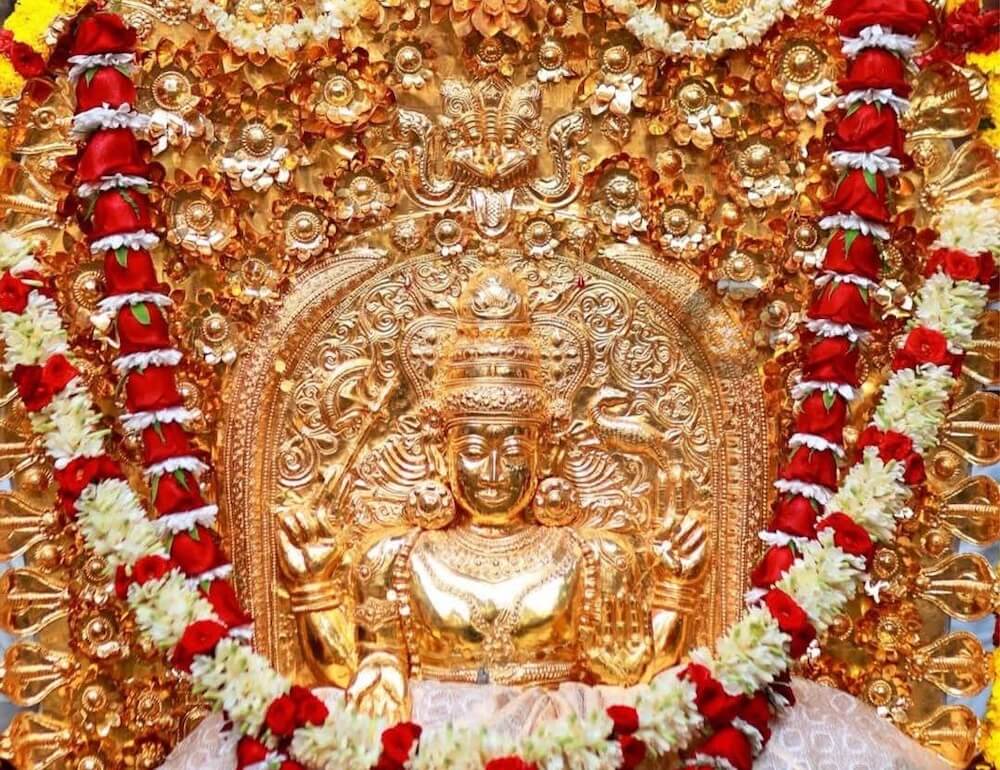 Muthaliyarmadam Sree Mahadeva Temple is a historic and ancient place of worship in Thodupuzha, Idukki district. Associated with the Vellalar community, the temple is dedicated to Lord Shiva, worshipped here as Sree Mahadeva. It is located on a small hill about 2 km east of Thodupuzha town. A small stream flowing beside the temple is also a notable feature of the area.
Between around AD 1300 and 1400, members of the Vellalar community migrated from parts of Tamil Nadu, including Tenkasi and Kumbakonam, to central Kerala. They came for administrative work, agriculture and trade and prominent landowners and officials among them came to be known by the title ‘Muthaliyar’. Between AD 1400 and 1500, when Thodupuzha was under the Keezhmalanad dynasty, 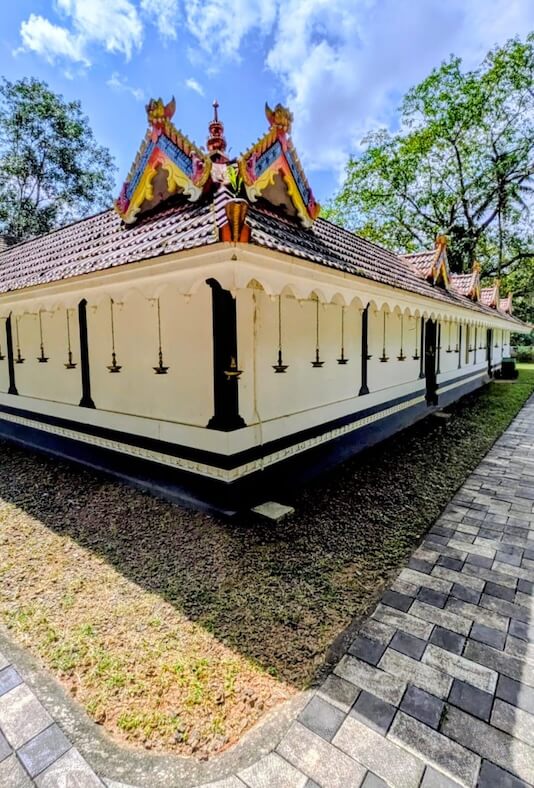 Muthaliyars served as palace officials and tax officers known as Kanakkappillais. The residential and official buildings given to them by the king were known as ‘Madams’. A small shrine was also built within the compound of this Madam for worship. Later, a panchaloha idol of Venkitanatha, which had been installed beside a pond at a place in Thodupuzha called Pallikkoodam Parambu, was moved to this temple for safekeeping after a fire broke out there.
In the 16th century, the Vadakkumkoor king attacked and conquered the Keezhmalanad region, bringing the Keezhmalanad dynasty to an end. After this, many Vellalar traders left Thodupuzha and settled in places such as Pala, Poovarani and Koothattukulam. However, the Muthaliyar families who served in the administration remained in Thodupuzha and continued to protect their family temple, Muthaliyarmadam. Over time, the old Madam disappeared, but the temple associated with it survived as Muthaliyarmadam Sree Mahadeva Temple. Today, the temple is managed by a trust led by members of the Vellalar community.
According to local legend, a Muthaliyar who once lived in this Madam was a devoted worshipper of Parameshiva and Venkitanatha (Vishnu). He worshipped both deities every day and it is believed that, pleased with his devotion, Bhagavan manifested as Shiva to the north of the Madam and as Vishnu to the south. Later, a Salagrama lingam, representing Rudra, was installed between these two shrines.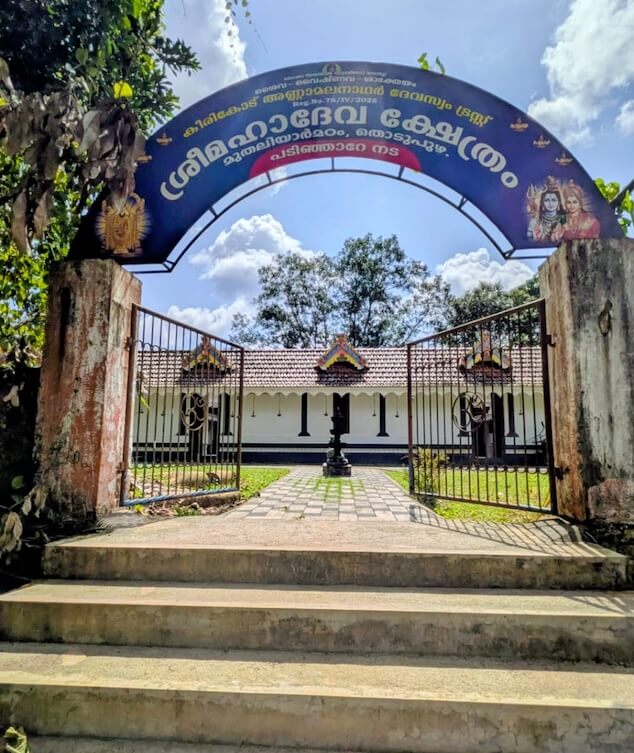 The three sanctums were thus arranged in a single line, with Shiva in the north, Vishnu in the south and Rudra in the centre. Local tradition connects this unusual arrangement of three shrines with the story of the devotee. Unlike many temples where such deities have separate shrines in different parts of the temple, all three are placed in a single line here.
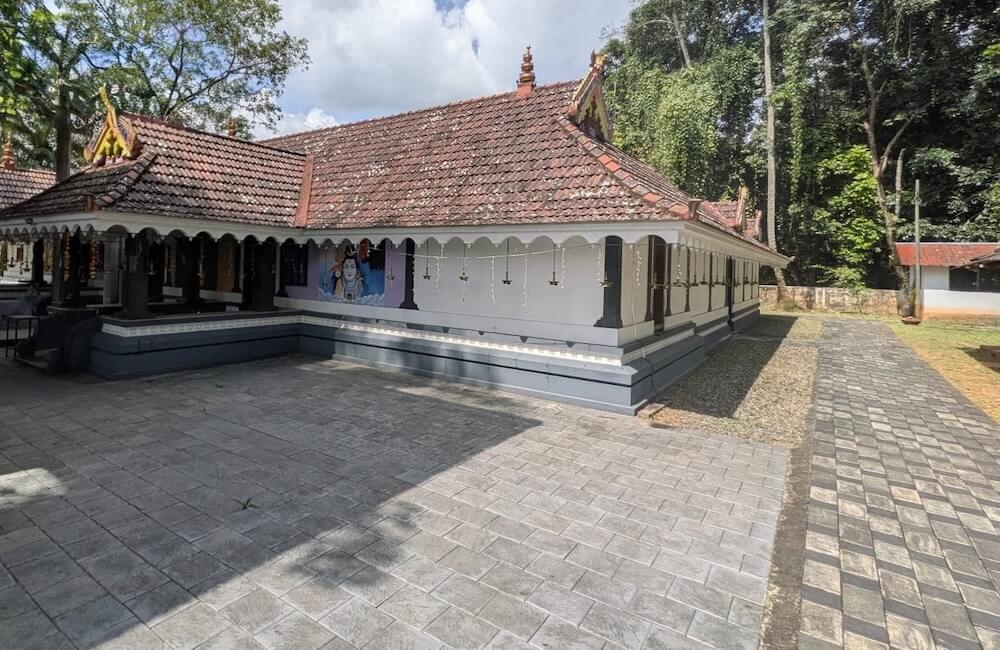
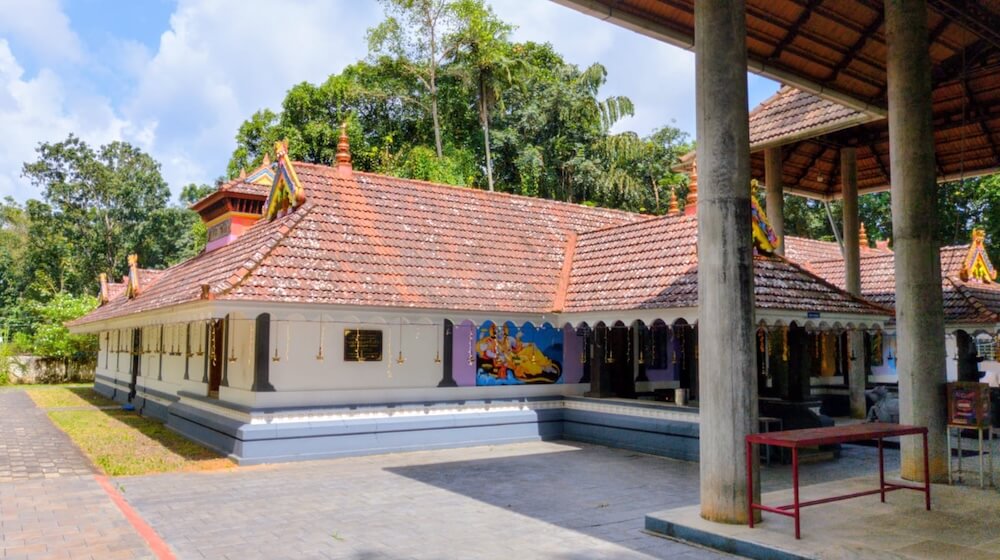
The temple is situated on a small hill beside a small stream. From outside, the first things visible are a small Kerala-style entrance gateway and a simple tiled-roof chuttambalam. The square chuttambalam has a tiled roof, without large gopurams or elaborate decoration. Rows of wooden lamp shelves are fixed to the outer walls of the chuttambalam. Just inside the main entrance is the balikkalpura, with a large balikkallu in the centre. A small four-pillared namaskara mandapam stands in front of the main sanctum, with simple wood carvings on its roof. The thidappalli is located in the south-eastern corner of the nalambalam, while the temple well is in the north-eastern corner. Water from this well is used for pooja and for preparing offerings. Outside the nalambalam is a granite-paved pradakshina path and an oottupura where prasada meals are served to devotees.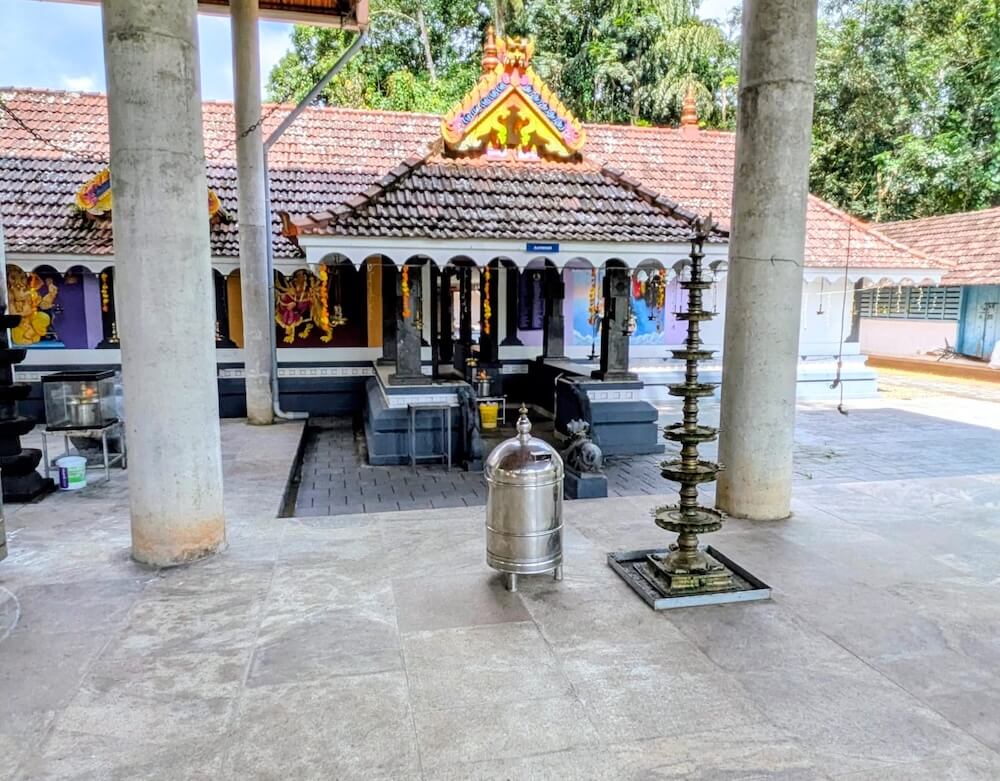
In Kerala temple architecture, a nalambalam usually has one main sanctum. Here, however, three square sanctums are built in a single row on the same pedestal (peedha), which is an unusual feature in Kerala temples. The foundations and walls of the sanctums are made of laterite and granite, with traditional Kerala-style tiled roofs. Each sanctum has small granite steps in front, with simple carved images of dvarapalas on either side of the doorway. Granite pranalas are provided on the northern side to drain the water used for abhishekam. The northern sanctum houses a granite Shiva lingam, worshipped in the calm Sadashiva form. The central sanctum has no anthropomorphic idol, but a lingam made from a sacred Salagrama stone obtained from the Gandaki River in Nepal. Although Salagrama stones are usually associated with the worship of Vishnu, the one here is worshipped as Rudra.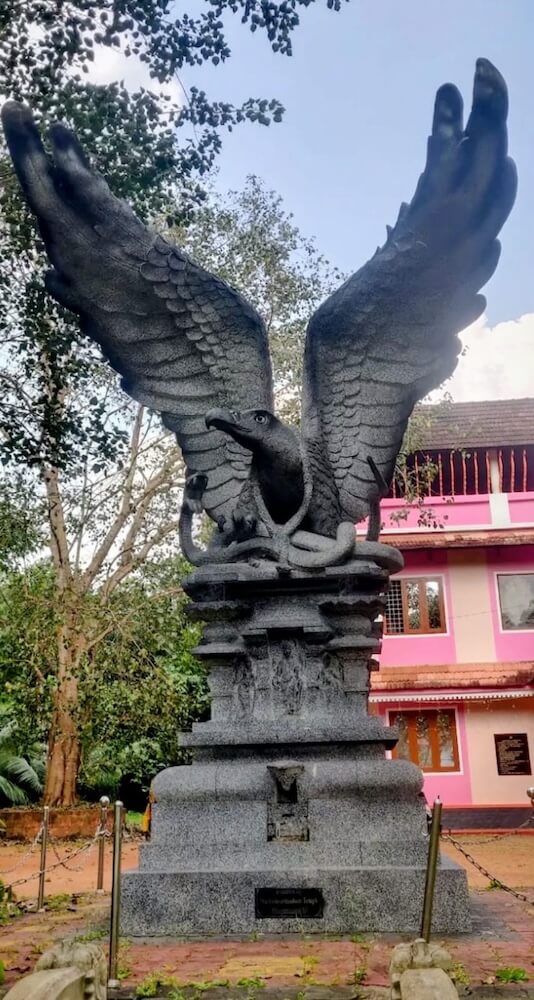 The southern sanctum houses Venkitanatha, a four-armed panchaloha image of Mahavishnu. The image holds the shankha, chakra, gada and padma and is made in a traditional Tamil-Kerala style, with ornaments.
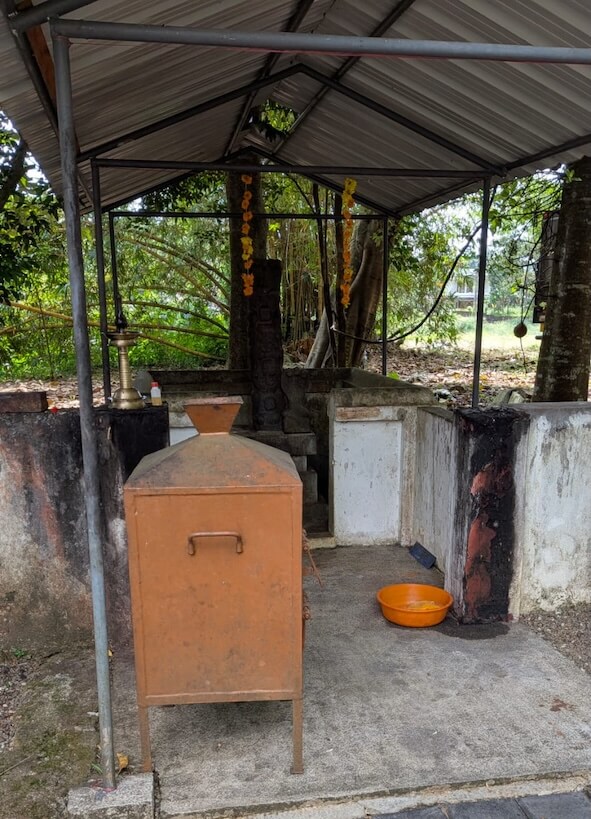
The sub-shrines are located in different parts of the temple. At the south-western corner of the main sanctums, known as the Kannimoola, is the east-facing shrine of Lord Ganapati. Nearby, in the south-western part of the temple, is the shrine of Dharmasastha. The shrine of Mahakali (Bhadrakali) is located in the north-western part. The temple also has a shrine for Kamakshi Amma, associated with the Vellalar community’s traditional kuladevata worship. In the shaded grove at the south-western corner are the shrines of Nagaraja and Nagayakshi. In the south-eastern corner, known as the Agnikona, are the shrine of Rakshas and another sub-shrine dedicated to Yakshiyamma.
The temple observes various rituals and ceremonies during festivals and special occasions. Maha Shivaratri in the Malayalam month of Kumbham is the main annual festival, with special abhishekams for Shiva and Rudra, Laksharchana and Akhanda Namajapam continuing throughout the night, along with various cultural programmes. On Karkidaka Vavubali, many devotees gather on the banks of the stream beside the temple to perform offerings for their ancestors. Throughout the month of Karkidakam, special Ramayana recitations, Ganapathi Homam and Bhagavathi Seva are conducted. A Srimad Bhagavatha Sapthaham is also held once a year. During Navaratri in the Malayalam month of Kanni, Saraswati Pooja and Vidyarambham are conducted on a large scale for success in education, along with special poojas for Kamakshi Amma, the kuladevata of the Vellalar community. During the Mandala-Makaravilakku period, from Vrischikam to Dhanu,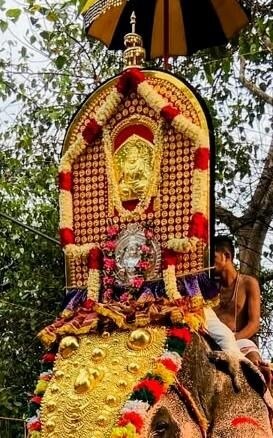 special Neyyabhishekam, Neerajanam and poojas for relief from the effects of Shani Dosha are conducted for 41 days for Dharmasastha, the sub-deity. During the month of Karkidakam, devotees also conduct special Akhanda Namajapam and Sarvaishwarya Pooja as part of the Udayasthamana Pooja for family prosperity. On the Ayilyam star day every month, special Sarpa Bali and offerings of Noorum Palum are made to the naga deities.
The temple’s main offerings include Sarvaishwarya Pooja, Vidyagopala Mantrarchana and Udayasthamana Pooja. Sarvaishwarya Pooja is performed for family prosperity and relief from difficulties and many devotees take part. Vidyagopala Mantrarchana is conducted for children’s educational progress and intellectual development. Udayasthamana Pooja is a major offering conducted through advance booking. For Shiva and Rudra, the main offerings include Dhara (Jaladhara / Ilaneer Dhara), Koovalamala and Pinvilakku; Dhara is performed on the Shiva lingam and Salagrama for mental peace and relief from difficulties, while Pinvilakku is offered for good children and family well-being. For Venkitanatha, the main offerings include Palpayasam, Thulasi Mala and Purushasookta Archana; Thulasi Mala is offered for fulfilment of wishes and good health and Purushasookta Archana for fulfilment of desires. Among the sub-deities, Ganapathi is offered Ganapathi Homam, Karukamala and Ottayappa Nivedyam to remove obstacles, while Neerajanam and Ellupayasam are offered to Dharmasastha on Saturdays to reduce the effects of Shani Dosha. For the naga deities, Noorum Palum, Sarpa Bali and Ayilyam Pooja are performed for relief from Sarpa Dosha. 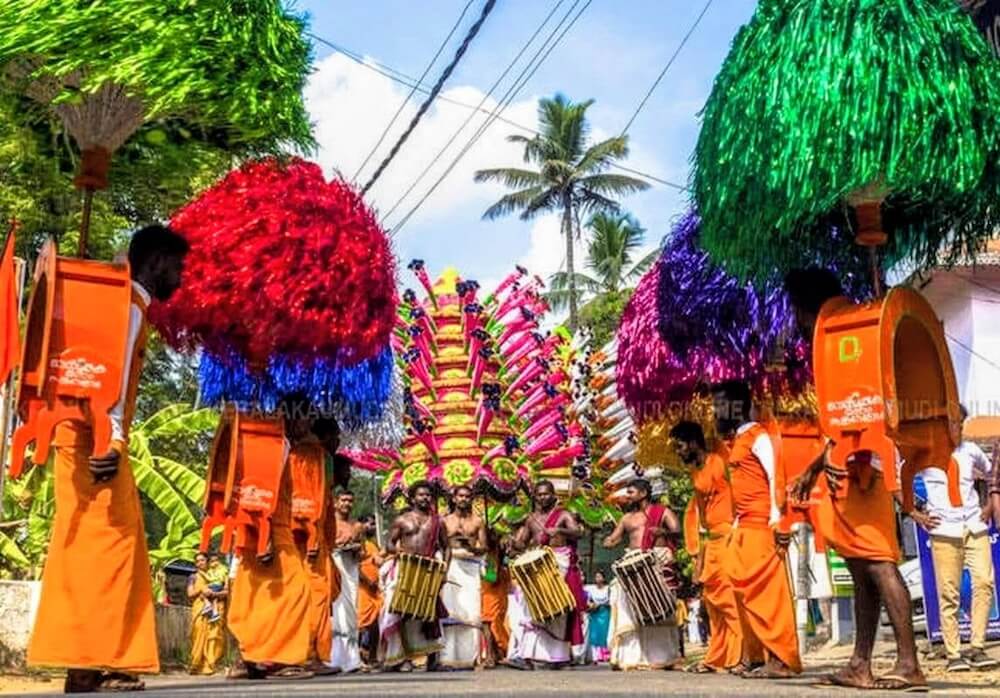 The main offerings for Kamakshi Amma and Mahakali include Rakthapushpanjali, Lalitha Sahasranama Archana and Pattucharthal.
The temple’s general darshan hours are usually from 05:00 AM to 10:00 AM and from 05:30 PM to 07:00 PM. In the morning, the temple opens with Nirmalya Darshan and abhishekam, followed by Ushapooja, during which simple offerings are made to the deity. The Uchappooja and offering are performed just before the temple closes, usually between about 09:30 AM and 10:00 AM. In the evening, Deepaaradhana is held after the temple reopens, around sunset and the lamps on the Vilakkumadam and surrounding lamps are lit. Athazhapooja is the final main pooja before the temple closes at night. Poojas and Deepaaradhana for the three main deities—Shiva, Rudra and Vishnu—are generally conducted at the same time. On special days such as Shivaratri, Karkidaka Vavubali and during the Mandala season, the closing time may change depending on the number of devotees.
Key highlight :-
- Located 22 km from Muvattupuzha and 24 km from Kothamangalam.
- 64 km from Aluva railway station.
- 54 km from Cochin International Airport.
- KSRTC and local bus facilities are available to Thodupuzha.
- Private vehicles can be parked in the temple’s parking area.
- Accommodation and food facilities are available near the temple.
- Contact number +91 4862223755.
मुथलियारदमम श्री महादेव मंदिर
मुथलियारदम, थोडुपुझा, जिला। इडुक्की.
मंदिरे
Temples
मंदिर
મંદિરો
கோவில்கள்
దేవాలయాలు
ക്ഷേത്രങ്ങൾ
ದೇವಾಲಯಗಳು
মন্দিরসমূহ
ਮੰਦਿਰ
-
श्री अन्नपूर्णेश्वरी नवग्रह भद्रकाली मंदिर थोडुपुझा, जि. इडुक्की.
अधिक माहितीSree Annapoorneswari Navagraha Bhadrakali Temple Thodupuzha, Dist. Idukki.
View Detailsश्री अन्नपूर्णेश्वरी नवग्रह भद्रकाली मंदिर थोडुपुझा, जिला. इडुक्की.
विवरण देखेंSree Annapoorneswari Navagraha Bhadrakali Temple Thodupuzha, Dist. Idukki.
વિગત જુઓSree Annapoorneswari Navagraha Bhadrakali Temple Thodupuzha, Dist. Idukki.
விவரங்களைக் காண்கSree Annapoorneswari Navagraha Bhadrakali Temple Thodupuzha, Dist. Idukki.
వివరాలను చూడండిSree Annapoorneswari Navagraha Bhadrakali Temple Thodupuzha, Dist. Idukki.
വിശദാംശങ്ങൾ കാണുകSree Annapoorneswari Navagraha Bhadrakali Temple Thodupuzha, Dist. Idukki.
ವಿವರಗಳನ್ನು ವೀಕ್ಷಿಸಿSree Annapoorneswari Navagraha Bhadrakali Temple Thodupuzha, Dist. Idukki.
বিস্তারিত দেখুনSree Annapoorneswari Navagraha Bhadrakali Temple Thodupuzha, Dist. Idukki.
ਵੇਰਵੇ ਦੇਖੋ -
श्रीकृष्ण स्वामी मंदिर थोडुपुझा, जि. इडुक्की.
अधिक माहितीSree Krishna Swamy Temple Thodupuzha, Dist. Idukki.
View Detailsश्री कृष्ण स्वामी मंदिर थोडुपुझा, जिला. इडुक्की.
विवरण देखेंSree Krishna Swamy Temple Thodupuzha, Dist. Idukki.
વિગત જુઓSree Krishna Swamy Temple Thodupuzha, Dist. Idukki.
விவரங்களைக் காண்கSree Krishna Swamy Temple Thodupuzha, Dist. Idukki.
వివరాలను చూడండిSree Krishna Swamy Temple Thodupuzha, Dist. Idukki.
വിശദാംശങ്ങൾ കാണുകSree Krishna Swamy Temple Thodupuzha, Dist. Idukki.
ವಿವರಗಳನ್ನು ವೀಕ್ಷಿಸಿSree Krishna Swamy Temple Thodupuzha, Dist. Idukki.
বিস্তারিত দেখুনSree Krishna Swamy Temple Thodupuzha, Dist. Idukki.
ਵੇਰਵੇ ਦੇਖੋ -
श्री नेल्लिकावू दुर्गा भद्रकाली मंदिर पुथेनपेरियाराम, थोडुपुझा, जि. इडुक्की.
अधिक माहितीSree Nellikkavu Durga Bhadrakali Temple Puthenperiyaram, Thodupuzha, Dist. Idukki.
View Detailsश्री नेल्लिक्कावु दुर्गा भद्रकाली मंदिर पुथेनपेरियाराम, थोडुपुझा, जिला। इडुक्की.
विवरण देखेंSree Nellikkavu Durga Bhadrakali Temple Puthenperiyaram, Thodupuzha, Dist. Idukki.
વિગત જુઓSree Nellikkavu Durga Bhadrakali Temple Puthenperiyaram, Thodupuzha, Dist. Idukki.
விவரங்களைக் காண்கSree Nellikkavu Durga Bhadrakali Temple Puthenperiyaram, Thodupuzha, Dist. Idukki.
వివరాలను చూడండిSree Nellikkavu Durga Bhadrakali Temple Puthenperiyaram, Thodupuzha, Dist. Idukki.
വിശദാംശങ്ങൾ കാണുകSree Nellikkavu Durga Bhadrakali Temple Puthenperiyaram, Thodupuzha, Dist. Idukki.
ವಿವರಗಳನ್ನು ವೀಕ್ಷಿಸಿSree Nellikkavu Durga Bhadrakali Temple Puthenperiyaram, Thodupuzha, Dist. Idukki.
বিস্তারিত দেখুনSree Nellikkavu Durga Bhadrakali Temple Puthenperiyaram, Thodupuzha, Dist. Idukki.
ਵੇਰਵੇ ਦੇਖੋ